
How to Choose Solar Security Lights for Your Home
Match brightness, motion sensors, battery life, and weather resistance to choose durable, energy-saving solar security lights for reliable home protection.

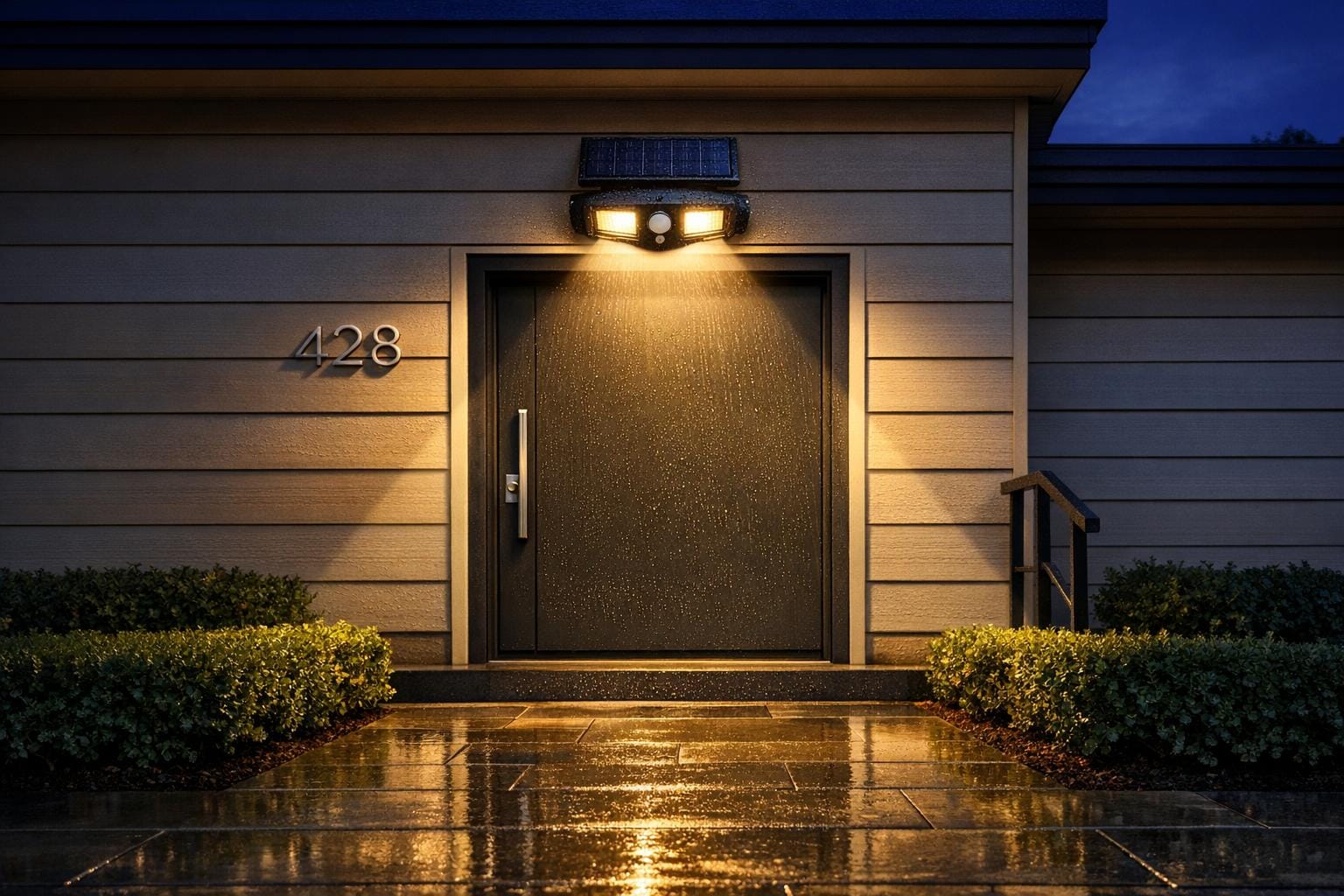
Solar security lights are a cost-effective way to boost home safety while reducing energy bills. They use sunlight to power motion-activated LEDs, making them ideal for driveways, backyards, and entryways. Here’s a quick guide to help you pick the right ones:
- Brightness: Measured in lumens. Choose 300–500 lumens for porches, 700–1,200 for driveways, and 1,200–2,400 for larger spaces.
- Motion Sensors: Look for Passive Infrared (PIR) sensors with adjustable sensitivity and detection ranges of 26–72 feet.
- Battery Life: Opt for lithium-ion batteries with 8–12 hours of runtime. Use "motion-only" mode in winter to save power.
- Weather Resistance: Go for IP65 or higher ratings to ensure durability in rain and dust.
- Installation: Place lights 8–10 feet high in sunny spots or use models with remote solar panels for shaded areas.
Premium models may cost $60–$100 but last longer and retain brightness better than cheaper options. Cleaning solar panels every 3–6 months keeps them efficient. If installed before the end of 2025, you may qualify for a 30% federal tax credit.
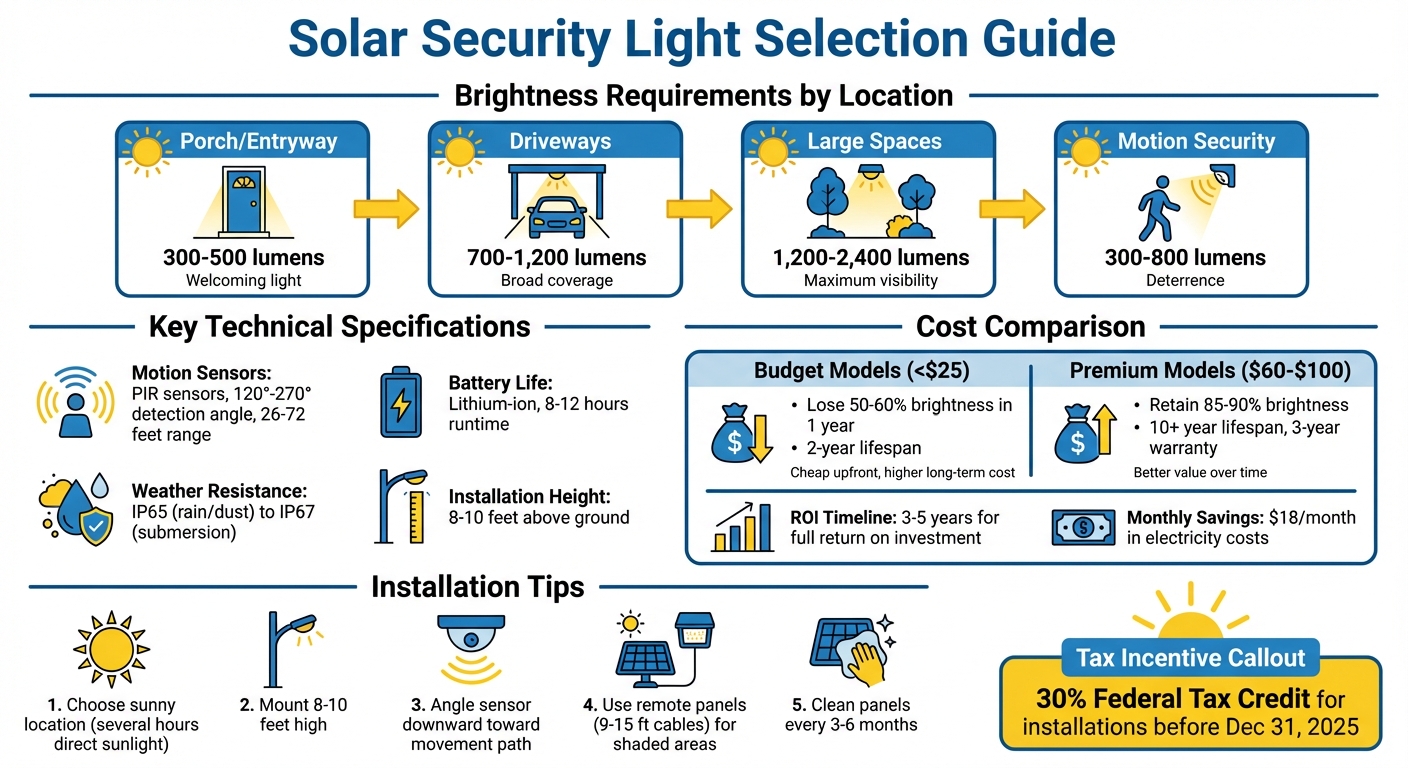
Solar Security Light Brightness Guide: Lumens by Application
Don't Buy Solar Security Lights Until You See This Test!
Key Factors to Consider When Choosing Solar Security Lights
Finding the right solar security lights means balancing technical features with the specific needs of your space. Important aspects to weigh include brightness, motion detection, battery life, weather resistance, and installation requirements. Let’s dive into how these factors influence performance, starting with brightness and lumens.
Brightness and Lumens
Lumens measure how much visible light a fixture produces - the higher the lumens, the brighter the light. Unlike traditional wattage ratings, modern LED solar lights rely on lumens to indicate brightness.
The ideal brightness depends on where you’ll install the lights. For porches or entryways, 300–500 lumens provide enough light to welcome guests without being too harsh. Driveways and parking areas may need 700–1,200 lumens for broader coverage, while large backyards benefit from multiple lights delivering 1,200–2,000 lumens. Motion-activated lights typically range from 300 to 800 lumens, though high-powered floodlights can exceed 1,500 lumens. Keep in mind, higher lumen levels drain batteries faster - especially during shorter winter days. A "motion-only" mode can help conserve energy during colder months. To maximize light spread and minimize tampering risks, mount lights 8 to 10 feet above the ground.
| Application | Recommended Lumens | Purpose |
|---|---|---|
| Porch/Entryway | 100–500 | Soft, welcoming light |
| Motion Security | 300–800 | Deterrence and visibility |
| Driveway/Flood Lighting | 700–1,500+ | Broad coverage for larger areas |
Motion Sensors
Most solar security lights use Passive Infrared (PIR) sensors, which detect motion by identifying heat changes from moving objects. These sensors work best when motion crosses their field of view. Residential models typically offer detection angles of 120° to 270°, with ranges from 26 to 40 feet for standard units. High-performance models can detect movement up to 72 feet away. Research suggests that well-lit properties are about 20% less likely to be targeted by burglars.
Many lights let you adjust sensitivity, range, and how long the light stays on after activation. Common modes include "motion-only" (ideal for winter), "dim-to-bright", and "always-on." For best results, angle the sensor downward toward the anticipated path of movement. Avoid pointing sensors at roads, trees, or busy sidewalks to reduce false activations. If your installation area is shaded, consider lights with remote solar panels connected by cables, allowing the panel to sit in direct sunlight while the light is positioned for security.
Battery Life and Solar Charging Efficiency
Battery performance depends on both the battery's capacity and the solar panel's ability to charge efficiently. Higher lumen outputs use more power, which can shorten runtime during periods of limited sunlight. Switching to "motion-only" mode in winter can extend battery life when daylight hours are shorter. Many high-quality models provide 8 to 12 hours of runtime on a full charge, with modern lithium-ion batteries delivering more reliable performance compared to older types.
To maintain charging efficiency, clean your solar panels every three to six months with a damp cloth. Dust, dirt, and algae can block sunlight and reduce power generation. In areas with inconsistent sunlight, choose models with remote solar panels connected by 9–15 foot cables. This setup lets you position the panel in a sunnier spot while placing the light fixture where it’s most needed.
Weather Resistance and Durability
Since solar security lights are exposed to the elements, weather resistance is crucial. Without proper protection, moisture can disrupt sensors, and extreme temperatures can damage batteries or internal components. The Ingress Protection (IP) rating indicates how well a light withstands weather conditions. An IP44 rating works for sheltered areas, like under eaves, while an IP65 rating is better for lights exposed to the elements. Premium options with IP67 ratings offer complete dust protection and can even handle temporary immersion in water.
Durable materials like high-grade plastics or metals resist UV damage, heat, and corrosion better than cheaper alternatives. For coastal homes, stainless steel components help prevent salt-air corrosion. Features like tapered designs to deflect water and gaps for heat dissipation also improve durability. Budget-friendly lights may last about two years in tough climates, while premium models often include warranties of up to three years. After severe weather, inspect your lights for damage or water intrusion to ensure continued performance.
Installation and Placement
One of the biggest perks of solar security lights is their simple installation - no wiring or professional help needed. To ensure optimal solar charging, pick a spot that gets several hours of direct sunlight daily. Mount the lights 8 to 10 feet high for effective coverage and added protection against tampering.
Angle the light and sensor slightly downward along the expected path of movement for better detection. If the chosen spot lacks direct sunlight, opt for a model with a remote solar panel connected by a 9–15 foot cable. This allows you to place the panel in full sun while positioning the light exactly where it’s needed. Avoid mounting lights where sensors face busy roads, trees, or pathways to prevent constant false triggers. These practical steps help you balance technical performance with long-term energy savings.
Comparing Cost and Return on Investment
When evaluating solar security lights, it’s not just about how well they perform - it’s also about understanding the cost and potential return on investment (ROI). These lights eliminate recurring electricity bills and professional installation costs, but the initial expense can vary significantly. For instance, budget-friendly models priced under $25 tend to lose 50–60% of their brightness within a year. On the other hand, premium options, typically costing between $60 and $100, retain 85–90% of their light output over time. To put it in perspective, a $70 light that lasts 10 years ends up being more cost-effective than replacing three $25 lights every two years.
Initial Costs vs. Long-Term Savings
The upfront price of solar lights depends on factors like materials, battery quality, and added features. Budget models often use plastic housings and standard batteries, while premium ones feature durable materials such as UV-stable polycarbonate or aluminum and high-capacity lithium-ion batteries. Products with higher IP ratings (IP65 to IP67) may cost more, but they offer better protection against weather, increasing their lifespan.
Switching to LED solar lights can reduce your monthly electricity bill by about $18. Over a decade, this adds up to savings of $1,500 to $1,800 per unit compared to traditional grid-tied lighting. Installation costs are also significantly lower - about 50% less than hardwired alternatives - since there’s no need for trenching, cabling, or hiring an electrician, which can cost $150 to $300 per fixture. Most users see a full return on their investment within 3 to 5 years.
"Solar will save about 20% of the original cost of a traditional grid-tie lighting system... for the entire life of each solar lighting system, you won't receive a monthly bill to pay." - Stephen Shickadance, Greenshine New Energy
ENERGY STAR-certified lights are designed to last up to 25,000 hours, translating to more than 20 years of regular use. Solar panels themselves often last up to 25 years with minimal upkeep, even in tough weather. Opting for models with LiFePO4 batteries, which are rated for 3,000 to 6,000 cycles, can further reduce replacement costs compared to cheaper units that use recycled cells. These savings align with the durability and reliability discussed earlier.
Government Incentives and Rebates
Government programs and rebates make solar security lights even more appealing. For example, the federal Residential Clean Energy Credit offered a 30% tax credit for eligible solar systems installed through December 31, 2025. However, systems installed after this deadline won’t qualify for the credit as of March 2026. On top of that, many states provide additional financial incentives, with tax credits ranging from $500 to $5,000 depending on the system’s cost.
Local utility companies may also offer rebates for energy-efficient lighting. To find out what’s available in your area, check the Database of State Incentives for Renewables & Efficiency (DSIRE). Additionally, contacting your electricity provider directly can help you uncover rebates specifically for "energy-efficient lighting" that might apply to your solar setup. If you install solar security lights before the end of 2025 and file taxes in 2026, you may still be able to claim the 30% federal credit using IRS Form 5695.
Additional Features to Look For
After evaluating performance and cost, it's worth considering extra features that can make your solar security lighting even more effective.
Adjustable Settings and Modes
Customizable settings allow you to tailor your lighting for different conditions. Many high-quality models offer three primary modes: motion-activated (stays off until movement is detected), dim-to-bright (maintains a low glow and brightens when triggered), and dusk-to-dawn (remains on from sunset to sunrise) [6,8].
Fine-tuning options like motion sensitivity, detection range, and illumination duration can make a big difference. For example, the LEPOWER model has a motion detection range of up to 72 feet, which you can adjust to avoid unnecessary activations from passing cars or pets. Setting the light to stay on for 30 seconds instead of several minutes can help conserve battery life without compromising security. Additionally, the ability to physically adjust the light's direction is crucial. Lights with dual or triple rotating heads are particularly useful for eliminating blind spots around corners or driveways [3,6,7]. Some models even feature separate solar panels connected by long cables (up to 15 feet), so you can place the panels in direct sunlight while mounting the light in shaded areas like porches [3,6]. These adjustable features strike a balance between performance and energy efficiency.
"Use motion-only mode in winter. 'Dim all night' looks nice in summer but drains batteries fast in December." - BeeHomie
Smart Technology Integration
Smart technology takes solar lights to the next level, offering flexibility and convenience. Smartphone apps allow you to adjust brightness, motion sensitivity, and operating schedules directly from your phone [2,32]. For example, the Ring Bridge can connect multiple Ring Solar Pathlights, enabling you to group them or link them with other security devices like video doorbells. This setup can trigger a coordinated response - when one light detects motion, others activate automatically.
Voice assistant compatibility with Amazon Alexa or Google Assistant adds hands-free control. You can adjust settings with simple commands or even receive spoken alerts when motion is detected [32,34]. Some advanced models combine lighting with HD cameras, two-way audio, and sirens, all manageable via a mobile app. These features provide real-time notifications and allow you to monitor your property remotely.
Smart battery management systems are another key feature. They monitor charge levels and optimize energy usage, ensuring the lights stay operational even during extended cloudy periods [33,34]. You can also create a layered security system by linking outdoor solar lights with indoor smart bulbs. For instance, when someone approaches your front door, lights throughout your home can turn on simultaneously, giving the impression that someone is inside. These smart integrations enhance both security and energy efficiency, making them a valuable addition to your solar lighting setup.
Conclusion
When choosing solar security lights, consider your property's layout, security priorities, and budget. Pay attention to brightness levels: 300–500 lumens work well for porches, 700–1,200 lumens suit driveways, and 1,200–2,400 lumens are ideal for larger outdoor spaces. Weather resistance is another key factor - opt for IP65-rated lights for general use, or IP67-rated lights if you live in coastal or flood-prone areas. These specifications ensure reliable performance and long-term savings.
Although quality solar lights may cost $40 to $100 upfront for mid-range models, they offer excellent value by eliminating electricity costs and requiring minimal maintenance. Premium models maintain 85%–90% of their brightness over time, while cheaper options can lose up to 60% within a year. With LED bulbs lasting up to 25,000 hours - equivalent to more than 20 years of typical use - you’ll enjoy dependable security lighting without adding to your energy bills.
"Outdoor security lighting isn't about making your yard look nice - it's about making it impossible for someone to sneak around unnoticed." - Total Security
For the best results, mount lights 7–9 feet high to balance coverage and tamper resistance. If you're dealing with shaded areas, look for models with remote solar panels and cables up to 15 feet long to maximize sun exposure. Maintenance is straightforward: clean the solar panels every three to six months to prevent dust from reducing charging efficiency. A well-installed system enhances both security and energy savings.
High-quality solar security lights help eliminate blind spots, deter potential intruders, and keep functioning even during power outages. By carefully matching brightness, sensor accuracy, and durability to your specific needs, you’ll achieve a dependable, cost-effective solution to protect your home for the long haul.
FAQs
How many solar security lights do I need for my yard?
When deciding how many solar security lights you need, start by considering the size of your yard and the coverage each light provides. Most solar lights can brighten an area of about 50 to 100 square feet. For larger spaces or targeted areas like driveways, you might need several lights or even floodlights for better illumination.
To figure it out, measure your yard’s total area, divide that by the coverage of a single light, and map out where to place them for the best security and visibility.
Why do solar security lights stop working well in winter?
Solar security lights can struggle during winter because of reduced sunlight, shorter days, and snow blocking the panels. Cold temperatures also affect battery efficiency, which impacts their performance. To keep them working effectively, make sure the panels are clear of snow and positioned to get as much sunlight as possible during the limited daylight hours.
Do solar security lights qualify for the 30% federal tax credit?
Yes, solar security lights could be eligible for the 30% federal tax credit under the Residential Clean Energy Credit. This credit applies to renewable energy systems, including solar-powered installations. To determine if your solar lights qualify, make sure they meet the specific requirements outlined for renewable energy investments.
Related Blog Posts
Stop Overpaying for Electricity in 2026
Irish homeowners are saving thousands with the €2,400 SEAI grant and 0% VAT. Get 3 free quotes from vetted, SEAI-approved installers.
Your data is secure. We only share with top-rated SEAI-approved installers.