Impact of Solar Farms on Irish Landscapes
Ireland’s solar boom reshapes rural identity — delivering jobs and farm income while changing landscapes and wildlife, demanding landscape-sensitive planning.

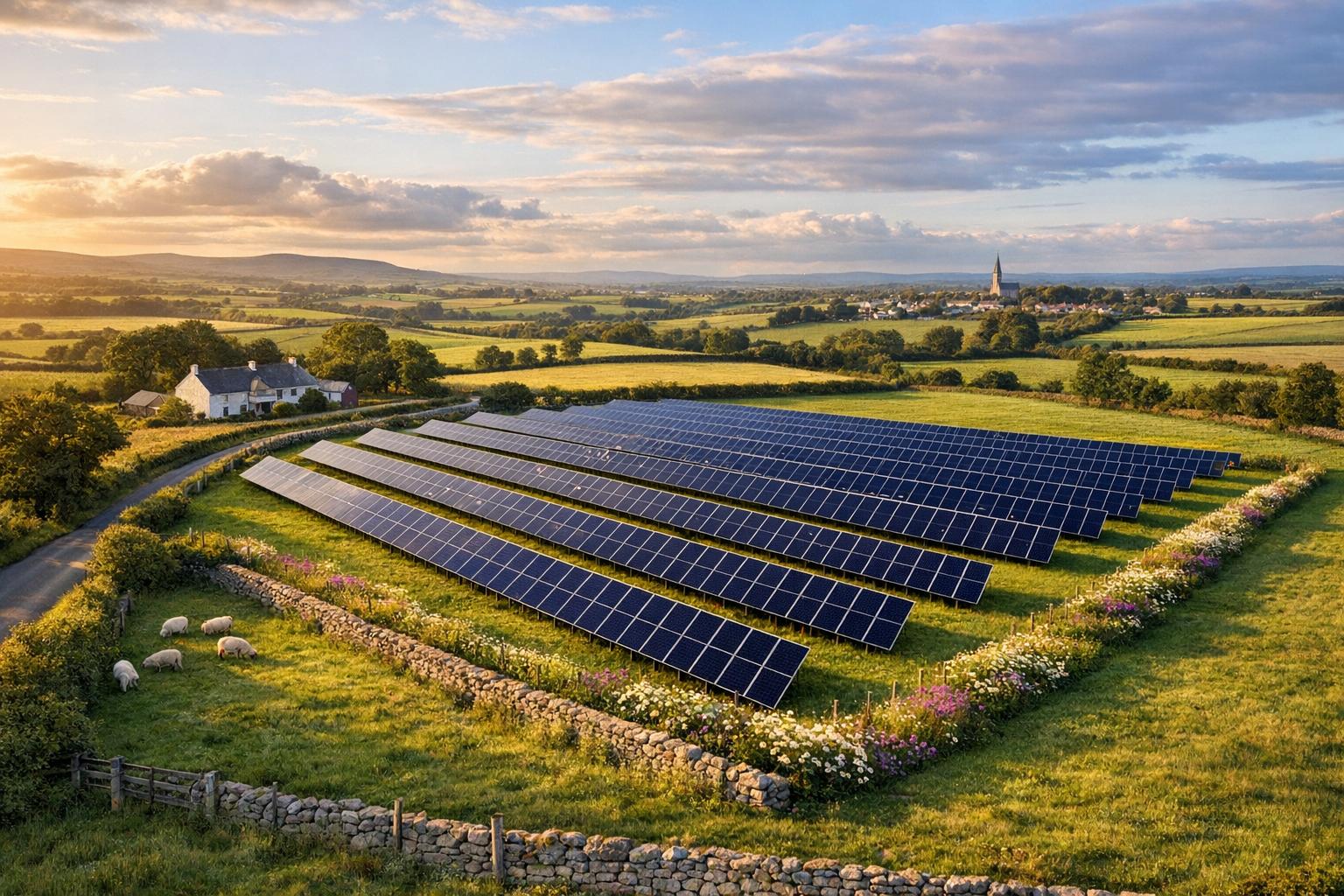
Solar farms are reshaping Ireland's countryside. By 2024, Ireland had 1.4GW of solar capacity, with plans to reach 8GW by 2030. While this expansion supports renewable energy goals and provides economic benefits, it also raises concerns about the visual and ecological effects on rural areas.
- Land Use: Solar farms occupy large areas, such as the 14,000 acres proposed in 2024 alone. By 2030, they may cover 25,000 acres - less than 1% of Ireland's agricultural land.
- Visual Impact: Residents in counties like Meath and Cork report changes to rural scenery, with some describing solar farms as intrusive.
- Wildlife: Managed properly, solar farms can support biodiversity, but construction can disrupt habitats.
- Economic Growth: Solar farms could bring €2.3 billion in value and 7,130 jobs by 2030, with farmers earning €1,000–€1,200 per acre annually through leases.
The challenge lies in balancing energy production with preserving Ireland's rural charm. Developers are working on solutions like native planting, wildlife-friendly designs, and community engagement to address these concerns.
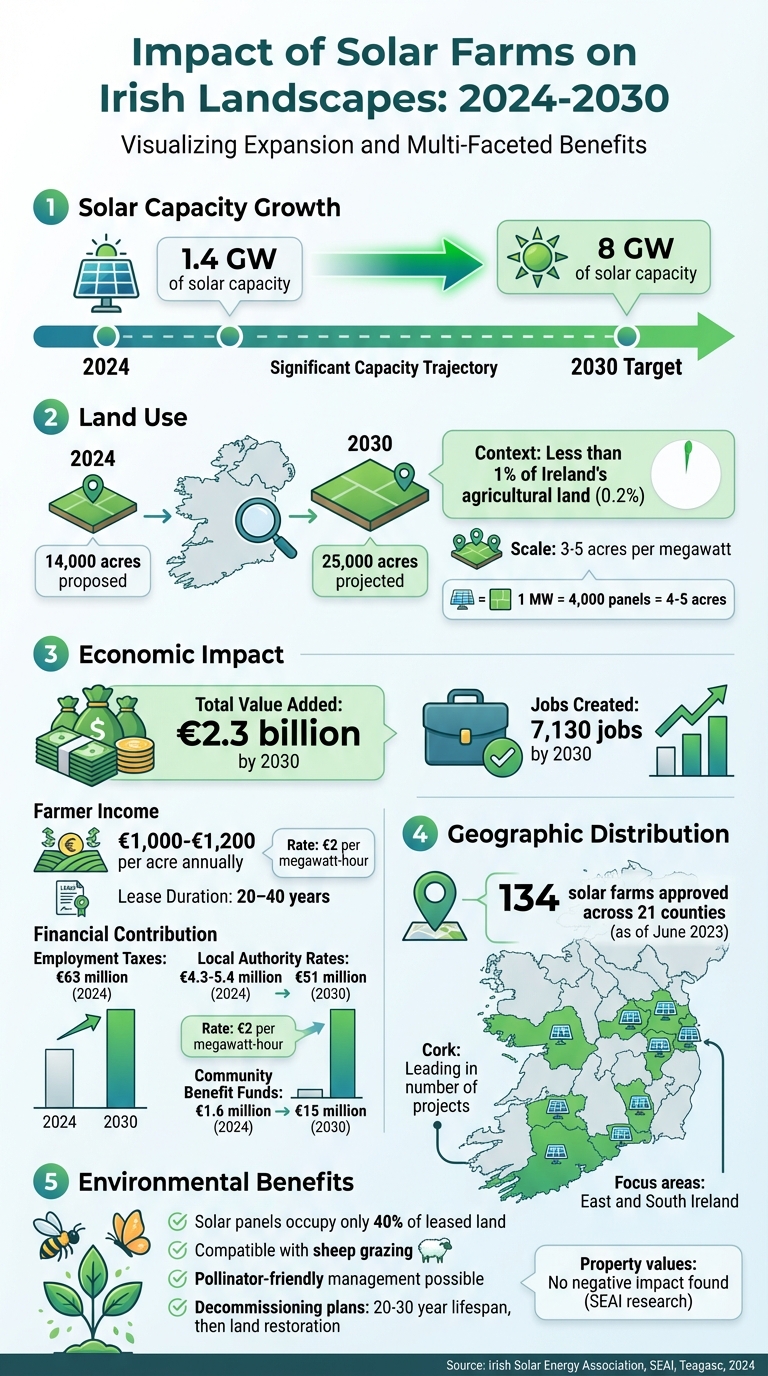
Ireland's Solar Farm Growth: Key Statistics and Impact by 2030
How Solar Farms Change the Look of Rural Ireland
Size and Appearance of Solar Farms
In Ireland, solar farms can span anywhere from 10 to over 400 acres, with each project capable of generating between 0.5 MW and 120 MW of power. To give you an idea, producing one megawatt of energy requires about 4,000 panels, which occupy roughly 4 to 5 acres. By 2030, these installations are expected to cover around 25,000 acres of Irish farmland.
This shift is a stark departure from the traditional rural landscapes Ireland is known for. Instead of the soft green fields and pastoral charm, rows of solar panels now dominate the scenery. For example, in March 2024, Paul McCue, a resident of Fidorfe near Ashbourne, Co. Meath, described how his once-tranquil laborer's cottage, surrounded by hayfields and small woodlands, is now encircled by an industrial solar farm.
The East and South of Ireland have become focal points for these developments due to their favorable solar conditions and proximity to the grid. This includes optimizing panel orientation to capture maximum sunlight. County Meath alone has nearly 1,800 acres allocated for funded solar projects. As of June 2023, the Renewable Electricity Support Scheme had approved 134 solar farms across 21 counties, with Cork leading in the number of successful projects. These changes have left local communities divided in their opinions.
What Local Communities Think About Visual Changes
The visual impact of solar farms has sparked contrasting reactions among residents. Many see these installations as intrusive, describing them as "eyesores" that consume valuable farmland and disrupt the character of rural villages. Some have likened the rapid growth of these projects to a chaotic "Wild West" scenario, citing a lack of clear regulations and guidance.
"Eyesores that take up prime farmland, sound the 'death knell' for villages and mostly benefit faceless corporations." – Niall Hurson, Journalist
Concerns extend beyond aesthetics. Residents worry about falling property values due to their proximity to solar farms and the potential for glint and glare, even though modern solar panel types are designed with anti-reflective coatings to address these issues. For some, the overwhelming presence of these large-scale developments feels like a threat to the identity of their communities. One Meath resident shared how their once-idyllic view of pheasants and rabbits in the summer has been replaced by a landscape dominated by solar panels.
Land Use and Farming Alongside Solar Farms
Combining Solar Farms with Agriculture
Solar farms and agriculture can work together in harmony, allowing land to serve dual purposes. For example, sheep grazing is a practical way to maintain agricultural activity on land with solar installations. Barry Caslin, Energy and Rural Development Specialist at Teagasc, highlights this compatibility:
"While it is not practical to graze large animals such as cattle on land hosting solar PV installations, it is possible to graze smaller ruminants such as sheep on this land".
This approach lets landowners produce both food and renewable energy from the same space, maximizing land use efficiency.
Ireland is targeting 8GW of solar PV capacity by 2030, which will require an estimated 24,000 to 26,000 acres - about 0.2% of the country's agricultural land. Utility-scale solar projects typically need 3 to 5 acres per megawatt, and landowners can earn between €1,000 and €1,200 per acre annually through lease agreements lasting 20 to 40 years.
For dairy farmers, the synergy is even greater. Solar energy production peaks in summer, perfectly aligning with the high energy demands of milking, cooling, and water heating. Some dairy processors and agribusinesses are already building small-scale solar farms to reduce their energy costs.
In addition to keeping agricultural activities alive, thoughtful site management can also enrich local biodiversity.
Converting Land and Protecting Natural Areas
Beyond food production, solar farms can be managed to benefit the environment. The All-Ireland Pollinator Plan emphasizes this potential:
"Managing vegetation on solar farms less intensively does not hinder the efficiency of energy production and can even increase local biodiversity".
By reducing the intensity of vegetation management, solar farms can maintain energy output while creating habitats for wildlife. For example, maintaining hedgerows and managing grasslands with a lighter touch can turn these areas into thriving ecosystems for pollinators and other species. Native plantings and buffer zones can transform land that might otherwise be heavily farmed into valuable biodiversity hotspots.
Farmers interested in adopting solar should start by conducting a thorough on-farm survey. This includes reviewing the past year’s electricity bills and understanding the commercial solar installation process and specifications. Before signing any lease agreements, it’s crucial for landowners to consult legal and taxation professionals. These agreements, often spanning decades, may include clauses about transferring ownership of the project to third parties.
'They've taken the home away from me': Life in the middle of a solar farm
Effects on Wildlife and Ecosystems
Solar farms, while a step toward renewable energy, play a complex role in shaping local wildlife and ecosystems.
How Solar Farms Support Wildlife
When managed thoughtfully, solar farms can become havens for wildlife. For instance, the All-Ireland Pollinator Plan outlines 10 science-backed actions to boost pollinators and biodiversity on solar farm sites in Ireland. These actions aim to create spaces where bees, butterflies, and other beneficial insects can coexist with renewable energy initiatives. Research suggests that scaling back intensive vegetation management can encourage diverse habitats on land previously used for agriculture.
As the All-Ireland Pollinator Plan highlights:
"Studies suggest that if solar farms are managed strategically, particularly on land that was previously managed intensively for agriculture, they can have positive impacts on local biodiversity."
In rural areas like County Meath, residents have reported spotting pheasants and rabbits near solar installations. Additionally, native plants growing beneath solar panels attract pollinators at levels similar to those seen in conservation areas. To encourage this trend, the Irish Solar Energy Association promotes the "Pollinator-friendly management of Solar Farms" guide, which helps developers turn their sites into thriving wildlife corridors. However, these ecological benefits can be offset by the disruption caused during the construction phase.
Risks to Natural Habitats
Despite their potential to support biodiversity, solar farms also pose risks to natural habitats. The All-Ireland Pollinator Plan cautions:
"Solar farms require huge areas of land which, during development, can undergo significant habitat destruction, degradation, fragmentation, and biodiversity loss."
Construction activities, such as the use of heavy machinery and site preparation, can harm soil structure and displace local wildlife. To address these challenges, planning authorities like Kilkenny County Council suggest focusing utility-scale solar projects on "Rural Brownfields", such as cutaway bogs, rather than clearing forests or wetlands. Additionally, conducting detailed environmental assessments during the planning stage helps identify and mitigate potential impacts on local species and historical sites before breaking ground.
Economic Benefits and Community Impact
Beyond environmental advantages, solar farms play a major role in driving economic growth and supporting local communities. Between 2025 and 2030, solar farms are projected to contribute over €2.3 billion ($2.5 billion) in Gross Value Added, while creating approximately 7,130 jobs, up from 6,440 jobs in 2024. Most of these opportunities will be concentrated in rural areas, offering a boost to local economies.
Jobs and Revenue from Solar Farms
Solar farms do more than generate clean energy - they provide jobs and bring in tax revenue that directly benefits local and national governments. Employment opportunities span construction, project management, and professional services, with the sector generating up to €63 million ($68 million) in employment-related taxes for the Irish government in 2024 alone. Local authorities also see significant financial gains through commercial rates paid by solar farms, currently ranging between €4.3 million and €5.4 million ($4.7 million to $5.9 million) annually, with projections climbing to €51 million ($55 million) per year by 2030.
Farmers who lease their land for solar installations benefit from steady, long-term income. Lease payments typically range from €1,000 to €1,200 ($1,090 to $1,310) per acre annually for contracts lasting 20 to 30 years. These agreements often include inflation protections through index-linking, while solar panels occupy only about 40% of the leased land. This setup allows farmers to continue activities like sheep grazing or maintaining pollinator-friendly gardens.
Additionally, Community Benefit Funds ensure local reinvestment. Solar developers are required to contribute €2 per megawatt-hour ($2.18 per MWh) of energy generated, with contributions expected to grow from €1.6 million ($1.7 million) in 2024 to €15 million ($16.3 million) annually by 2030.
Addressing Community Concerns
Despite the clear economic advantages, some community concerns around property values and visual impacts persist. However, research from SEAI (Sustainable Energy Authority of Ireland) found no evidence that proximity to solar farms negatively affects property prices. According to their findings:
"Having undertaken a comprehensive desk review, this research has identified no studies from the case study countries which indicate that proximity to USSPV negatively impacts on property prices."
To address visual and noise concerns, developers conduct independent assessments during the planning phase. Solar panels themselves produce no operational noise, while equipment like inverters and transformers emit only low-level sounds that must meet strict planning regulations. Furthermore, achieving Ireland's 8GW solar energy target by 2030 would require less than 1% of the country’s total agricultural land, minimizing disruption to farming activities.
Ways to Reduce Landscape Impact
Balancing the need for renewable energy with the preservation of Ireland's scenic rural landscapes is no small task. By focusing on native planting and thoughtful planning, developers are finding ways to integrate solar farms into the countryside without disrupting its charm. Irish solar developers employ several effective strategies, including careful site selection, natural screening, and temporary installations that allow for eventual land restoration.
Native Plants and Temporary Installations
Using native vegetation and adopting pollinator-friendly practices are key methods for helping solar farms blend into Ireland's natural surroundings. The All-Ireland Pollinator Plan outlines ten evidence-based actions that support this approach. Studies reveal that reducing intensive vegetation management on solar farms - especially on land previously used for agriculture - can significantly boost local pollinator populations and enhance wildlife habitats.
To ensure minimal long-term impact, developers include decommissioning plans outlining how agricultural land will be restored after the solar farm's 20- to 30-year operational lifespan. These commitments, paired with rigorous planning, aim to reduce both visual and environmental disruptions.
Planning Through Environmental Assessments
Comprehensive environmental assessments play a critical role in minimizing the visual impact of solar farms. Developers use tools like "zones of visual influence" mapping to strategically place panels away from prominent roads and walking trails. By positioning panels in areas naturally concealed by hills or hedgerows, they leverage the landscape's features to obscure the infrastructure.
These assessments also address practical concerns, such as glint and glare near homes and roads, ensuring that solar farms do not interfere with daily life. Additional measures, like archaeological surveys and cumulative impact studies, help prevent visual overcrowding from multiple installations. Kilkenny County Council's planning guidelines emphasize the importance of this careful approach:
"The Planning Authority will support and facilitate the generation of renewable energy from Utility Scale Solar Photo-Voltaic (USSPV) where solar arrays can be so positioned that... they will not have an excessively adverse impact on the landscape." – Kilkenny County Council
Get Solar Panels: A Resource for Solar Solutions in Ireland
As large-scale solar farms reshape Ireland's countryside, individual homeowners, farmers, and businesses are increasingly turning to their own solar solutions. Rooftop and on-site installations are becoming popular, offering a localized way to embrace renewable energy. Get Solar Panels (https://getsolarpanels.ie) is a go-to resource that helps navigate Ireland's solar options, providing insights into government grants, cutting-edge technologies, and installation choices tailored to the Irish climate.
One key focus is Ireland's Solar Capital Investment Scheme (TAMS III), which offers farmers a 60% grant for solar PV systems, including panels, inverters, and controllers. The grant applies under a standalone investment cap of €98,100 ($107,000). For instance, a 10kWp system costing €17,720 ($19,300) would qualify for roughly €10,800 ($11,800) in funding. Barry Caslin from Teagasc notes that simplified grid connections, the removal of planning requirements, and the 60% grant have shortened the payback period for roof-mounted solar panels to just 2–4 years.
The platform also highlights advanced technologies like the Tesla Powerwall 3, which became available in Ireland in July 2025. This system offers 13.5kWh of storage and an integrated inverter. When paired with a 6kW solar system, homeowners can reduce their dependence on the grid by up to 70%, saving an average of €2,190 ($2,390) annually. Additionally, Get Solar Panels covers innovations like perovskite solar cells, which have achieved impressive efficiencies of up to 29.15% in tandem setups.
For those exploring solar options, the platform provides detailed information on financial incentives. These include zero-VAT installations, the Clean Export Guarantee, and exemptions from planning permission for most rooftop systems. Farmers and businesses can find practical advice on conducting solar surveys, choosing reliable battery storage, and aligning with Ireland’s Climate Action Plan, which aims for 8GW of solar PV electricity by 2030.
Whether you're considering a rooftop system or curious about how solar farms influence land use, Get Solar Panels offers the technical insights and financial guidance needed to make informed decisions about solar energy in Ireland. It empowers individuals and businesses to take part in shaping a greener energy future.
Conclusion
Solar farms represent a careful balancing act in Ireland's quest to modernize its countryside. The country's ambitious goal of reaching 8GW of solar capacity by 2030 will use less than 1% of its agricultural land. While the physical footprint may be small, the visual and ecological changes they bring are significant. Counties like Meath and Cork are already seeing how these projects are altering rural landscapes, sparking concerns among residents about the potential loss of their area's pastoral charm.
Thoughtful site planning is key to addressing these concerns. By choosing locations based on terrain and access to the power grid, developers can reduce disruptions. Solar panels, which are relatively low-profile, can be hidden using native hedgerows and vegetation. This approach helps maintain the visual integrity of the countryside while advancing renewable energy initiatives.
"Design strategies taking account of site characteristics and locally sensitive viewpoints can enable suitable and coherent compositions... communication about the need for renewable energy are essential for a balanced approach to development." - ScienceDirect
Beyond planning, community involvement plays a critical role in ensuring the success of these projects. Open discussions about project goals, visual impacts, and biodiversity concerns build trust between developers and locals. Initiatives like dual-use farming - where sheep graze beneath solar panels - and maintaining wildlife corridors show that energy production and environmental health can go hand in hand. Independent environmental reviews also help ensure that these measures deliver on their promises.
Ireland's solar energy expansion doesn't have to come at the cost of its rural heritage. With clear legislation, landscape-sensitive designs, and genuine collaboration with communities, the country can achieve its climate goals while safeguarding the natural beauty and ecosystems that define its countryside. This approach strikes a balance between economic growth and environmental care.
FAQs
How do planners decide where a solar farm should go?
Planners evaluate site suitability by looking at a mix of environmental, technical, and social factors. Some of the key considerations include how close the site is to the electrical grid, the amount of sunlight the location receives, and efforts to reduce environmental and visual disruptions. Additionally, regulatory guidelines play a critical role, ensuring projects meet renewable energy goals while respecting landscapes and land use priorities. Community involvement and adherence to planning frameworks also help determine the best locations for solar farms.
What can be done to hide solar farms from nearby homes and roads?
Solar farms can be hidden from view by employing a mix of thoughtful strategies. For instance, planting dense vegetation or trees around the edges creates a natural screen, softening the visual impact. Selecting locations that already have natural barriers or are less visible to the public can also make a difference. Incorporating landscape buffers and orienting panels to minimize glare are additional ways to make solar farms less intrusive. Plus, integrating them into existing land uses, like agricultural areas, helps them blend more seamlessly into the surroundings.
How can solar farms protect wildlife during construction and operation?
Solar farms can play a role in protecting wildlife by adopting practices that prioritize biodiversity. For instance, maintaining native vegetation and minimizing habitat disruption can create a more wildlife-friendly environment. Incorporating pollinator-friendly strategies, such as supporting diverse plant habitats, helps sustain local ecosystems and benefits species like bees and butterflies. Additionally, conducting thorough environmental impact assessments and using thoughtful land-use planning can reduce risks to birds and other animals. These measures aim to strike a balance between advancing renewable energy and preserving the natural world.
Related Blog Posts
Stop Overpaying for Electricity in 2026
Irish homeowners are saving thousands with the €2,400 SEAI grant and 0% VAT. Get 3 free quotes from vetted, SEAI-approved installers.
Your data is secure. We only share with top-rated SEAI-approved installers.