
CdTe vs. Silicon Panels: Irish Climate
Compare CdTe and silicon solar panels for Ireland's cloudy, mild climate — differences in low-light output, cost, space needs, durability and recycling.

In Ireland’s cloudy, mild climate, choosing the right solar panels can impact energy output and savings. The two main types - CdTe (Cadmium Telluride) and silicon panels - perform differently under these conditions:
- CdTe Panels: Better in low light and diffuse sunlight, slightly more stable in varying temperatures, and cost-effective for larger installations. Ideal for Ireland’s overcast skies and coastal areas.
- Silicon Panels: Higher efficiency overall, space-efficient, and well-suited for rooftops with limited space. Performs well in sunnier regions of Ireland.
Quick Comparison
| Feature | CdTe Panels | Silicon Panels |
|---|---|---|
| Efficiency | ~19% | 20–25% |
| Low-Light Performance | Strong | Moderate (improved with PERC) |
| Temperature Stability | Slightly better | Good |
| Space Requirements | Higher | Lower |
| Cost per Watt | $0.20–$0.35 | Higher upfront costs |
| Lifespan | 25–35 years | 25–30 years |
| Best Use Case | Large/commercial setups | Small rooftops |
Both options reduce energy bills and last decades, but your choice depends on space, budget, and energy goals. CdTe panels are great for low-light conditions, while silicon panels are better for compact spaces.
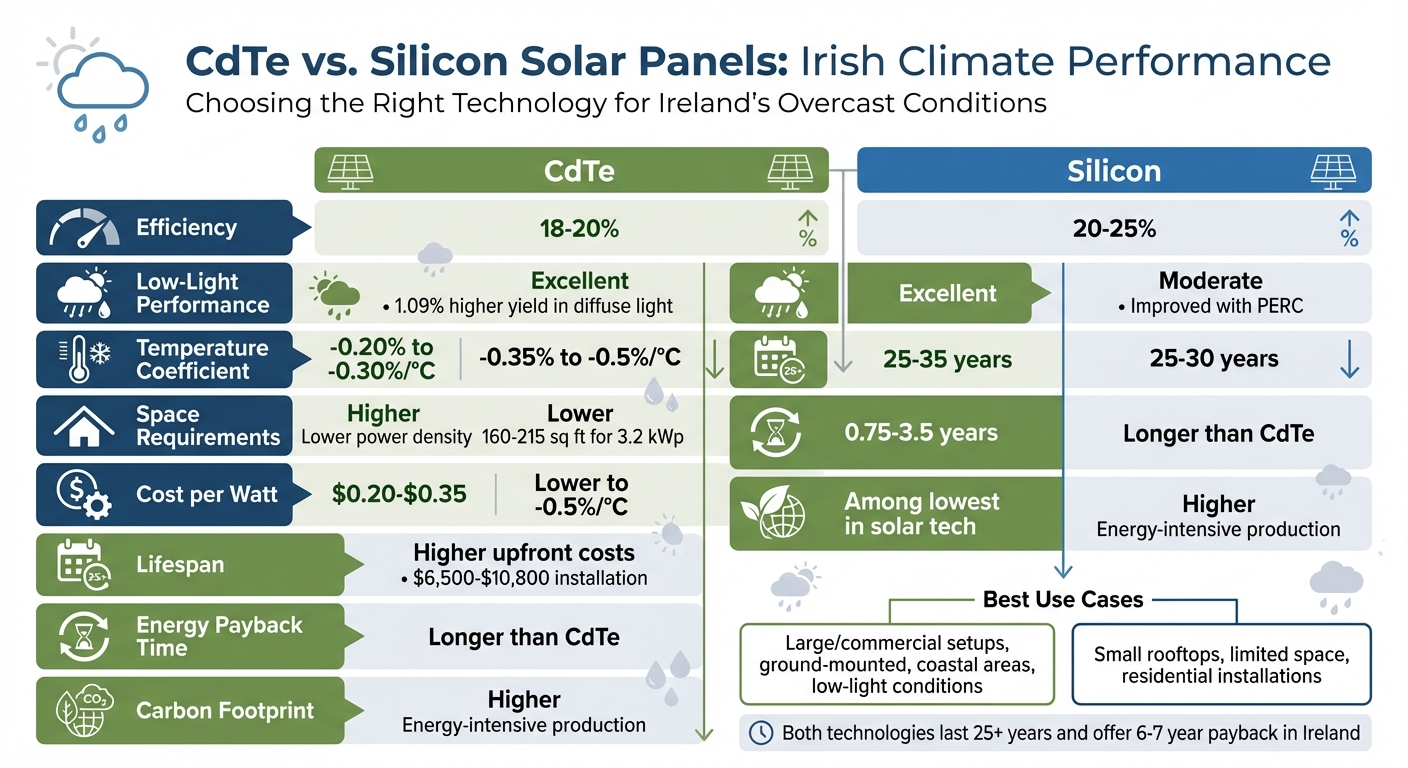
CdTe vs Silicon Solar Panels Comparison for Irish Climate
How does the efficiency of thin film solar cells compare to traditional silicon based solar cells?
How Irish Climate Affects Solar Panel Performance
Ireland's weather creates a unique backdrop for solar energy. By understanding these specific conditions, you can make better decisions about the type of solar panels to use and what kind of energy output to expect. Let’s explore how Ireland's climate influences solar panel performance.
Diffuse Light and Cloud Cover
With overcast skies dominating more than half the year in Ireland, most solar energy arrives as diffuse irradiance - light scattered by clouds and atmospheric particles - rather than direct sunlight. On cloudy days, nearly all solar radiation is diffuse, while on sunnier days, this percentage drops to less than 30%.
Modern monocrystalline silicon panels incorporate PERC (Passivated Emitter and Rear Cell) and half-cut cell technology, which are specifically designed to capture this scattered light. Additionally, CdTe panels are naturally suited for diffuse light due to their impressive absorption properties. A layer as thin as 1–2 μm can absorb over 90% of the incident light. Ireland receives between 1,100 and 1,600 hours of sunshine annually, with Southeast Ireland receiving around 1,050 kWh per square meter per year, compared to 950 kWh/m² in the Northwest. This ability to perform well under diffuse light conditions gives CdTe panels a notable advantage in Ireland's climate.
Temperature and Humidity
Temperature also plays a key role in solar panel efficiency. Silicon panels typically lose 0.35% to 0.5% efficiency for every degree Celsius above 77°F (25°C). However, Ireland's temperate climate works in their favor. For instance, a study in Dublin recorded a maximum panel temperature of 116.4°F (46.9°C), significantly lower than the 140°F–158°F (60°C–70°C) temperatures seen in hotter regions. The same study reported no temperature-related efficiency losses on average.
"Ireland's typically moderate, cool, and temperate climate is a massive advantage... The cooler air helps keep the panel temperature down, meaning the panels can convert solar energy to electricity much more effectively than those sweating on a scorching roof in Southern Spain." – Joseph Reilly, Owner, Solar PV Panels Ireland
Frequent rainfall in Ireland also serves as a natural cleaning system, washing away dust and debris that could otherwise reduce efficiency by 10% or more.
Coastal Exposure and Weather Resistance
Ireland’s coastal environment introduces additional challenges, such as salty air and strong winds. CdTe panels are particularly durable and perform well in these conditions, while silicon panels require rigorous weather-resistant certifications to handle the salty atmosphere. Both panel types, when installed at the optimal 30–35° angle for Ireland’s latitude, are built to endure wind loads and resist salt-induced corrosion on electrical components.
The durability of these panels is impressive, with both types designed to last 25–35 years in Ireland’s conditions. Thanks to the country's moderate temperatures, the structural integrity of the panels is preserved better than in more extreme climates.
CdTe Panel Performance in Ireland
Low-Light Performance
CdTe panels are well-suited for Ireland's often overcast skies, thanks to their ability to absorb visible light efficiently. Their spectral response is specifically tuned to the visible spectrum, which is prevalent in diffuse light conditions.
A study published in June 2019 in IET Renewable Power Generation by researchers Syed M. Ahsan and Hassan A. Khan from the SBA School of Science and Engineering compared CdTe and silicon panels over eight days of high-resolution data. The results showed that CdTe panels delivered a 1.09% higher specific energy yield overall. Notably, on a winter day with significant irradiance variation (referred to as "Day 2"), CdTe panels outperformed silicon by 5.66%. During these low-light conditions, silicon panels experienced a steep efficiency drop, whereas CdTe panels maintained more stable performance.
"Under overcast conditions or cloud cover, the efficiency of c-Si PV panels drop significantly compared to its rated values... On the other hand, the decline in the efficiency of CdTe is less significant." – IET Renewable Power Generation
This capability to absorb light effectively also supports consistent performance across varying temperatures.
Temperature Response and Energy Output
Beyond their low-light advantages, CdTe panels stand out for their temperature resilience. They exhibit a temperature coefficient between –0.20%/°C and –0.30%/°C, compared to silicon's –0.3% to –0.5%/°C range. While Ireland's mild weather means neither type suffers extreme heat losses, CdTe's better temperature response ensures steady energy output during warmer months - when approximately 75% of annual energy is generated.
"CdTe solar panels can offer a more suitable alternative to traditional c-Si panels... They provide stable energy output and are geared toward long-term performance." – Solar Buy
Additionally, CdTe technology is priced between $0.20 and $0.35 per watt, making it a budget-friendly choice for installations with sufficient roof space.
Durability and Cadmium Safety
Designed to endure Ireland's Atlantic climate, CdTe panels hold up against high levels of moisture, frost, and wind. Frequent rainfall provides a natural cleaning effect, but coastal setups may require occasional maintenance to remove salt deposits.
Regarding cadmium safety, the cadmium in CdTe panels is locked in a stable compound. Companies like First Solar have implemented robust recycling programs, processing about 25,000 tons of modules annually to prevent environmental risks. For eco-conscious installations, consulting experienced installers about recycling options is recommended to ensure compliance with environmental standards. These features make CdTe panels a practical choice for Ireland's wet and coastal conditions.
Furthermore, CdTe thin-film solar cells boast an energy payback time of 0.75 to 3.5 years - shorter than that of silicon panels - reinforcing their environmental suitability for Ireland's renewable energy goals.
Silicon Panel Performance in Ireland
Efficiency and Roof Space Requirements
Silicon panels are a popular choice in Ireland's solar market, thanks to their high efficiency and compact design - perfect for homes with limited roof space. For example, a standard 3.2 kWp system with 8 silicon panels needs about 160–215 square feet of roof area. This makes them a practical option for urban and suburban homes where space is often at a premium.
Their efficiency directly influences energy production. A system covering 215 square feet (around 3 kW) can generate roughly 2,600 kWh per year, which meets more than 40% of the electricity needs for an average Irish household. On a bright day, as little as 10.8 square feet of these panels can produce about 150W of power. This compact energy output ensures reliable performance, even under Ireland's famously changeable skies.
Cloudy Weather Performance
One of the standout features of silicon panels is their ability to perform well in diffuse light conditions, which are common in Ireland. Even in mild weather, their efficiency remains stable, with only a 0.35% to 0.5% drop for every 1.8°F above 77°F. Ireland's cooler climate helps keep these panels operating close to their peak efficiency throughout the year.
Seasonal variations in energy output are expected, but silicon panels continue to deliver. A 4 kW system can produce 16–20 kWh daily during the summer months and still generate 4–6 kWh on a winter day. To address challenges like passing clouds and partial shading - common in Ireland - installers often recommend micro-inverters or power optimizers. These tools help maintain steady energy production, even when light conditions fluctuate.
Durability and Local Availability
Beyond efficiency, silicon panels are built to last and are well-suited for Ireland's climate. They are certified to endure high winds, frost, and moisture, while frequent rainfall naturally keeps the panels clean.
Accessing silicon panels in Ireland is straightforward, thanks to a strong network of SEAI-registered installers. Installation costs typically range from $6,500 to $10,800, offering reliable options for homeowners. This well-established supply chain ensures easy access to replacement parts, warranty services, and experienced installation teams familiar with Ireland's unique weather conditions.
CdTe vs. Silicon: Side-by-Side Comparison
Performance Comparison Table
Deciding between CdTe and silicon panels involves evaluating factors that influence energy output and long-term costs. Here's a breakdown of how they compare in key areas relevant to installations in Ireland:
| Feature | CdTe (Thin-film) | Crystalline Silicon (c-Si) |
|---|---|---|
| Commercial Efficiency | 18–20% | 20–23% |
| Temperature Coefficient | Excellent (~‑0.14%/°F) | Moderate (‑0.19% to ‑0.28%/°F) |
| Low-Light Performance | Performs well in diffuse light | Moderate, though improved with PERC technology |
| Space Required | Higher due to lower power density | Lower thanks to higher power density |
| Carbon Footprint | Among the lowest in solar technologies | Higher due to energy-intensive production |
| Recycling | High recovery rate (90–95%) with specialized processes | Standard recycling, less specialized |
| Environmental Impact | Contains cadmium (safely encapsulated) | Made with non-toxic materials |
Silicon panels are known for their higher power density, making them ideal for compact spaces. On the other hand, CdTe panels excel in consistent energy output under fluctuating conditions, which aligns well with Ireland's mild and variable climate.
Best Applications for Each Panel Type
The choice of panel type often depends on the installation setting. Silicon panels work best for residential rooftops with limited space, while CdTe panels are more suitable for commercial setups or ground-mounted projects where space is less of a constraint.
Environmental Impact and Recycling
When it comes to environmental factors, the differences between these technologies become even clearer. CdTe panels boast a smaller carbon footprint and an energy payback period of about one year. Their specialized recycling processes recover 90–95% of materials, a step ahead of the standard recycling methods used for silicon panels. Additionally, CdTe modules require less material, with layers under 10 micrometers thick compared to the 150–200 micrometer silicon wafers.
"Environmental lifecycle assessments consistently show that CdTe modules have one of the lowest carbon footprints and environmental impacts among all solar technologies." – GKToday
Conclusion
Ireland's overcast skies, mild temperatures, and coastal conditions make choosing the right solar panel technology an important decision. Silicon panels are a favorite among Irish homeowners due to their high efficiency (over 20%), compact size, and impressive lifespan of 25–30 years. On the other hand, CdTe panels shine in Ireland’s typical low-light conditions, delivering a 1.09% higher energy yield under limited sunlight.
For homes with limited roof space, silicon panels strike the perfect balance between performance and durability. However, for commercial setups or ground-mounted systems where space isn’t an issue, CdTe panels can take full advantage of their superior performance in low-light environments.
Get Solar Panels provides personalized advice based on your roof type, available space, and energy goals. With solar installations in Ireland offering a payback period of 6–7 years and lasting 25–30 years, choosing the right panel technology ensures maximum returns. Both options reduce energy bills and take advantage of Ireland's attractive solar incentives. By matching the technology to your specific needs, you can boost energy output and enjoy long-term savings.
FAQs
How do CdTe solar panels perform in Ireland’s cloudy weather compared to silicon panels?
CdTe (cadmium telluride) solar panels are known for their strong performance in low-light or cloudy conditions, which are quite common in Ireland. Thanks to their higher light absorption rate and reduced efficiency loss during temperature changes, these panels can generate more electricity from diffuse sunlight compared to traditional silicon panels.
For homeowners or businesses in Ireland, this means CdTe panels provide a more consistent energy output on overcast days. This makes them an excellent option for those looking to get the most out of their solar installations in Ireland’s unpredictable weather. For guidance on optimizing solar systems for the local climate, consider exploring resources that cover sizing strategies, available grants, and maintenance tips specific to Ireland.
How do the costs of CdTe and silicon solar panels compare in Ireland?
CdTe (thin-film) solar panels are generally easier on the wallet compared to high-efficiency monocrystalline silicon panels, but their pricing aligns closely with the more budget-friendly polycrystalline silicon options. For a standard 4 kW residential setup in Ireland, the cost of CdTe panels typically falls between $4,800 and $6,400 after accounting for SEAI grant support. In comparison, monocrystalline silicon panels are priced higher, ranging from $6,400 to $8,000, while polycrystalline silicon panels come in at $3,800 to $6,900 for the same system size.
In practical terms, CdTe panels are about $1,600 to $2,000 less expensive than monocrystalline options, while overlapping the lower end of polycrystalline pricing. Their affordability, coupled with reliable performance in low-light conditions, makes them a smart option for Ireland's often overcast weather.
Are CdTe solar panels safe for the environment, and how is cadmium handled?
Cadmium-telluride (CdTe) solar panels are built with a focus on environmental safety. Although cadmium in its raw state is toxic, within CdTe panels, it is securely bound in a stable compound and protected by durable layers of glass and encapsulant. This design ensures cadmium remains contained and does not leach during regular use.
To address the environmental impact even further, manufacturers have developed recycling programs that safely recover and reuse cadmium when the panels reach the end of their lifespan. Additionally, CdTe panels require fewer raw materials and consume less energy during production compared to traditional silicon panels, resulting in a smaller overall environmental footprint. Continuous advancements in recycling methods and encapsulation technology are improving their eco-friendliness even more.
For those considering CdTe panels in Ireland's climate, Get Solar Panels offers expert guidance on safe installation, maximizing performance, and managing end-of-life recycling solutions.