
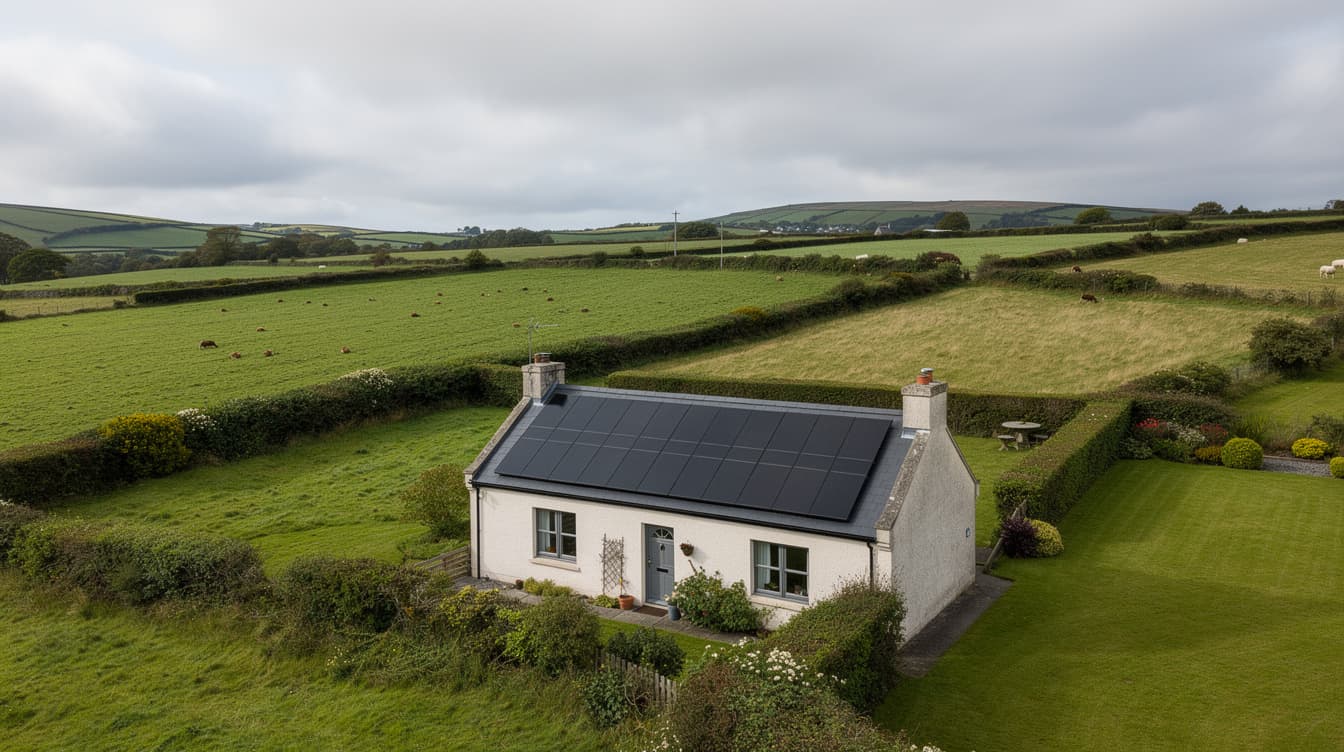
Best Solar Panels for Ireland 2026: A Practical Buyer’s Guide
Updated 30 July 2026 — what installers are actually fitting this month
Three panels dominate SEAI-registered installer quotes in July 2026: the Jinko Tiger Neo 480W N-type TOPCon (safe default, best price-per-watt), the AIKO Comet 3S 475W back-contact ABC (highest efficiency now on the SEAI Triple-E list at 24.1%, small roofs), and the LONGi Hi-MO X10 470W (hybrid back-contact, strong in low light). Panel wholesale is down 12–15% year-on-year and supply has fully stabilised on all three. Quick-pick table below, then the deep dive.
TL;DR — Best Solar Panels for Ireland (July 2026)
| Panel | Wattage & tech | Efficiency | Typical installed €/panel (Ireland) | Best for |
|---|---|---|---|---|
| Jinko Tiger Neo | 480 W N-type TOPCon | 22.3% | €780–€880 | Safe default, unbeatable price-per-watt, 30 yr product warranty |
| AIKO Comet 3S | 475 W back-contact ABC | 24.1% (highest on SEAI Triple-E) | €950–€1,080 | Small or awkward roofs, all-black aesthetic, best partial-shade tolerance |
| LONGi Hi-MO X10 | 470 W hybrid back-contact | 23.4% | €880–€990 | Best low-light Irish winter yield, mid-range budget with premium output |
| REC Alpha Pure-RX | 470 W heterojunction (HJT) | 22.8% | €1,050–€1,200 | Premium spec, EU-assembly preference, 25 yr labour warranty |
| Canadian Solar TOPHiKu6 | 465 W N-type TOPCon | 21.8% | €740–€830 | Cheapest N-type panel still on SEAI Triple-E, budget builds |
Reading the table: the “installed €/panel” figure is what SEAI-registered installers are quoting on a like-for-like basis (panel + mounting + labour + inverter apportionment) in a 10–12 panel install. Cheaper standalone panel prices exist online, but they don’t include the labour and BOS costs that make up 55–60% of a fitted quote. For the full install price with a battery, see our 2026 installation cost guide.
Which one should you actually buy? For 85% of Irish semi-Ds the answer is the Jinko Tiger Neo 480W. If your roof is small (under 22 m² of usable slope) or partially shaded by a chimney, dormer or neighbouring tree, pay the €170–€200/panel premium for the AIKO Comet 3S — you’ll fit 20–25% more kWp into the same area and shade tolerance is measurably better. If you’re on a dark western-facing roof in Donegal, Galway or Kerry, the LONGi Hi-MO X10 gives a 4–6% winter yield boost that pays back the extra spend over 8–10 years.
Ready to Go Solar?
Get your free personalised quote from SEAI-registered installers.
The “best solar panel for Ireland” question has changed completely in the last three years. In 2022 the answer was straightforward: a 350–400 W monocrystalline panel from a Tier 1 manufacturer. In 2026 the Irish market is full of 430–480 W N-type TOPCon panels from a dozen credible brands, a fresh wave of back-contact technology arriving at residential price points, and an installer base that’s splintered on which to recommend. This guide cuts through it with 2026 Irish-specific data: what actually performs on a 1,460-sunshine-hour, 78%-humidity, frequently cloudy roof.
We’ll cover the three main panel technologies on the Irish market today (PERC mono, N-type TOPCon, back-contact), the brands you’ll see on installer quotes, panel wattage realities, why low-light performance matters more than peak efficiency in Ireland, panel-only vs solar thermal vs hybrid systems, the €1,800 SEAI grant and 0% VAT context, and which panel choice fits which household type.
Find the Right Panel for Your Roof
Three free quotes from SEAI-registered installers — we’ll match you with installers that carry the panel brands suited to your home.
Quick answer: what panel is best for Ireland in 2026?
For most Irish homes a 430–460 W N-type TOPCon monocrystalline panel from a Tier 1 manufacturer (JA Solar, Longi, Trina, Jinko, Canadian Solar, Q Cells, REC, Aiko or LG-spec equivalent) is the best balance of efficiency, low-light performance, warranty depth and installer availability. Expect 21–22.5% module efficiency, 30-year linear power warranty, and 12–15 years of product warranty — the cell technology degrades roughly 0.4% per year compared with 0.55% per year for older PERC mono.
For premium roofs where every watt matters — small roofs, north-facing supplements, partial shading, period houses with limited array space — back-contact panels from Aiko, SunPower (now Maxeon) or LG-spec equivalents deliver 22.5–24% efficiency at a 30–50% price premium over standard TOPCon. The maths usually only justifies the premium if you genuinely can’t fit more standard panels.
For budget installs and replacement panels in an existing string, PERC mono is still common and still credible but its market share is declining fast. Don’t accept a PERC panel quote in 2026 unless the installer can justify it on price or string-matching grounds.
Solar thermal panels (for hot water only) are now a niche product in Ireland. They’re cheaper than PV + diverter for a like-for-like hot-water-only outcome, but the SEAI grant ended in 2022 and you can’t generate electricity or sell to the grid. Most installers no longer offer them and most homeowners are better off with PV + an immersion diverter (eddi or similar) which qualifies for the €1,800 grant.
Panel technologies on the Irish market in 2026
| Technology | Typical efficiency | Wattage range | Price €/Wp installed | Best for |
|---|---|---|---|---|
| PERC mono (legacy) | 19–20.5% | 380–420 W | €1.95–€2.25 | Budget installs, string-matching replacements |
| N-type TOPCon (mainstream) | 21–22.5% | 430–480 W | €2.05–€2.35 | Most Irish homes — the default 2026 choice |
| Back-contact (premium) | 22.5–24% | 440–500 W | €2.70–€3.30 | Small roofs, partial shading, aesthetic-led installs |
| Heterojunction (HJT) | 22–23.5% | 440–470 W | €2.40–€2.90 | Hot roofs (low temp coefficient), high-yield installs |
The headline shift in 2026: N-type TOPCon has effectively replaced PERC mono as the default panel on Irish quotes. If you’re being quoted PERC at 380 W in 2026, ask why. The cost difference between PERC and TOPCon at the panel level is now €6–€15 per panel — trivial in the context of a €8,500 install — and the warranty, degradation and low-light performance are all materially better on TOPCon.
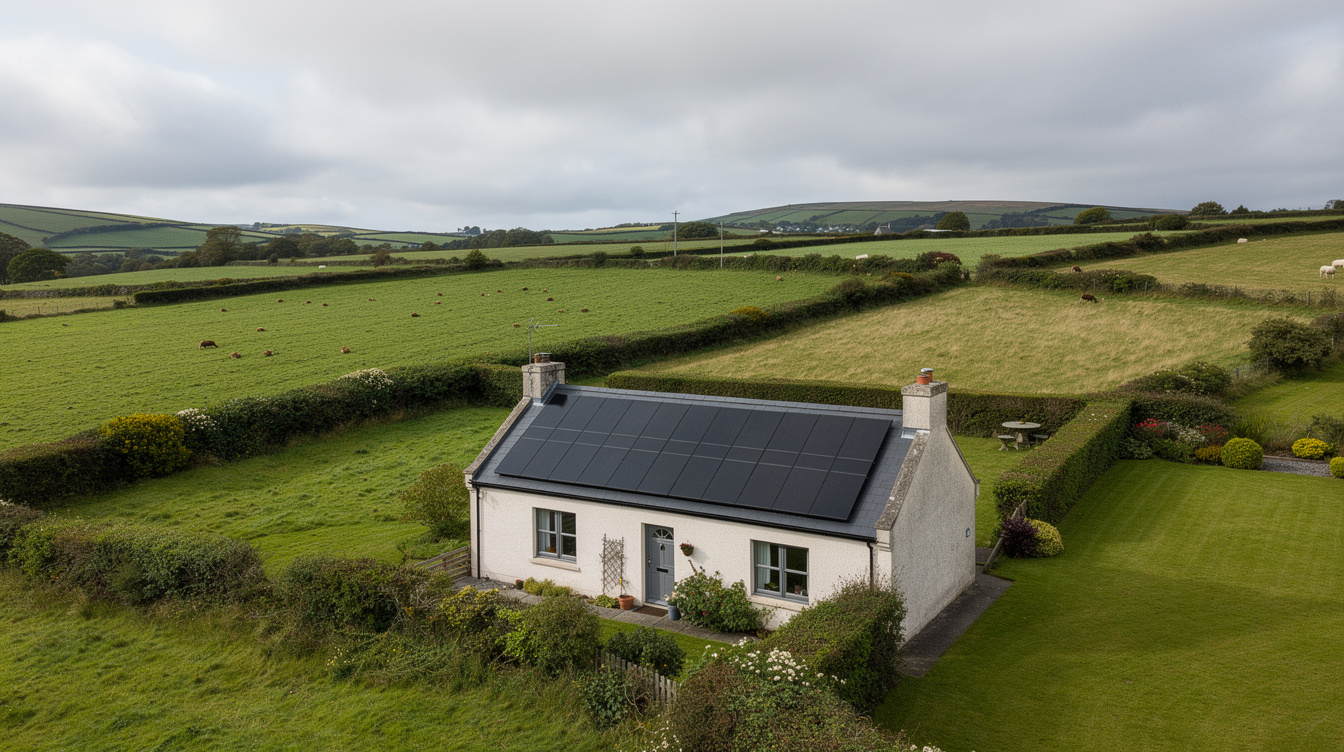
Why low-light performance matters more than peak efficiency in Ireland
Almost every panel datasheet leads with STC (Standard Test Conditions) efficiency: the percentage of light energy converted to electricity at 1000 W/m² irradiance, 25°C cell temperature and AM1.5 spectrum. That number is what manufacturers compete on and what installer quotes lead with. In Ireland, it’s the wrong number to fixate on.
Why? Because Irish irradiance is rarely above 600 W/m². Met Éireann data shows that the typical Irish solar day delivers 350–550 W/m² for most generating hours. Cloud-cover diffuse light, low sun angles and high humidity mean that what you actually want is a panel that performs well at low irradiance and high diffuse light fraction, not at 1000 W/m² full sun.
This is where N-type TOPCon and HJT pull ahead of PERC. The cell architecture has better low-light response — a TOPCon panel rated at 21.5% STC efficiency typically delivers 96–98% of its rated relative output at 200 W/m² irradiance. A comparable PERC panel delivers 93–95%. Across a typical Irish year of mostly-diffuse generation, that’s an extra 3–5% of annual yield. On a 4 kWp install in central Ireland generating 3,900 kWh/year, that’s 117–195 kWh extra — €25–€55 a year of additional benefit.
The temperature coefficient also matters more in Ireland than people expect. Irish panel temperatures rarely exceed 45°C even in summer, but cool-temperature performance bonus is real on a typical 5–15°C Irish operating day. HJT and TOPCon both have temperature coefficients around -0.27°C to -0.30°C per watt — meaningfully better than PERC’s -0.35°C.
The brands you’ll see on 2026 Irish installer quotes
The Tier 1 manufacturer list is fluid, but for residential Irish installs in 2026 you’ll see roughly the following brands on quotes from SEAI-registered installers:
- JA Solar — high availability, JAM72S30-MR/MB and JAM54S31 series, broad installer adoption. Default-pick on many mid-market quotes.
- Longi (Hi-MO 5 and Hi-MO 7) — strongest brand recognition globally, deeply stocked by Irish wholesalers, 25-year product warranty on Hi-MO 7.
- Trina Vertex S+ — aesthetically clean all-black option, popular for ACA and visible-roof installs.
- Jinko Tiger Neo — competitive pricing, strong on TOPCon, good installer support.
- Canadian Solar TOPHiKu7 — reliable mid-market choice, broad warranty terms.
- Q Cells Q.TRON — German engineering, strong installer support in Ireland, premium pricing.
- REC Alpha Pure-R — Norwegian brand, premium HJT, 25-year product warranty, popular for heat-pump-heavy installs.
- Aiko — back-contact specialist, the fastest-growing premium brand in Ireland in 2025–2026.
- Maxeon (formerly SunPower) — premium back-contact, 40-year warranty (NB: warranty fulfilment requires Maxeon-certified installers).
- LG-spec / NeoSun / others — LG exited residential solar in 2022 but rebrand and channel-spec equivalents still appear on quotes.
Critical: brand alone is not enough. A “Tier 1” designation from BloombergNEF refers to the company’s financial standing and project-bankability, not panel quality. Two panels from the same Tier 1 manufacturer can have very different specs depending on which generation/factory they came from. Always look at the specific datasheet: cell technology (PERC vs TOPCon vs HJT vs IBC), wattage, efficiency, temperature coefficient, and warranty terms (product warranty vs power warranty).
Panel wattage on Irish roofs in 2026
Average panel wattage on Irish residential quotes has climbed steadily: 320–360 W in 2020, 380–420 W in 2023, 420–480 W in 2026. The driver is cell technology improvement (more watts per square metre) and slightly larger physical panel sizes (most modern panels are 1.95–2.10 m by 1.10–1.13 m).
A typical 4 kWp install in 2020 was 11–12 panels. In 2026 the same 4 kWp install is 9–10 panels. Practical implications:
- You can fit more capacity on a small roof. A south-facing roof area that held 2.8 kWp of 350 W panels in 2020 now holds 3.6–4.0 kWp of 450 W panels. That’s a 30–40% capacity uplift on the same roof area.
- Fewer panels means fewer roof penetrations, lower install time, less risk. A 9-panel install is roughly 0.5 days faster than a 12-panel install of the same kWp rating.
- Inverter sizing matters more. A 4 kWp array of high-watt panels can clip a 3.6 kW inverter. Most modern installers spec the inverter at 80–90% of array DC rating, which works in Ireland because peak summer clipping is rare, but it’s worth understanding the trade.
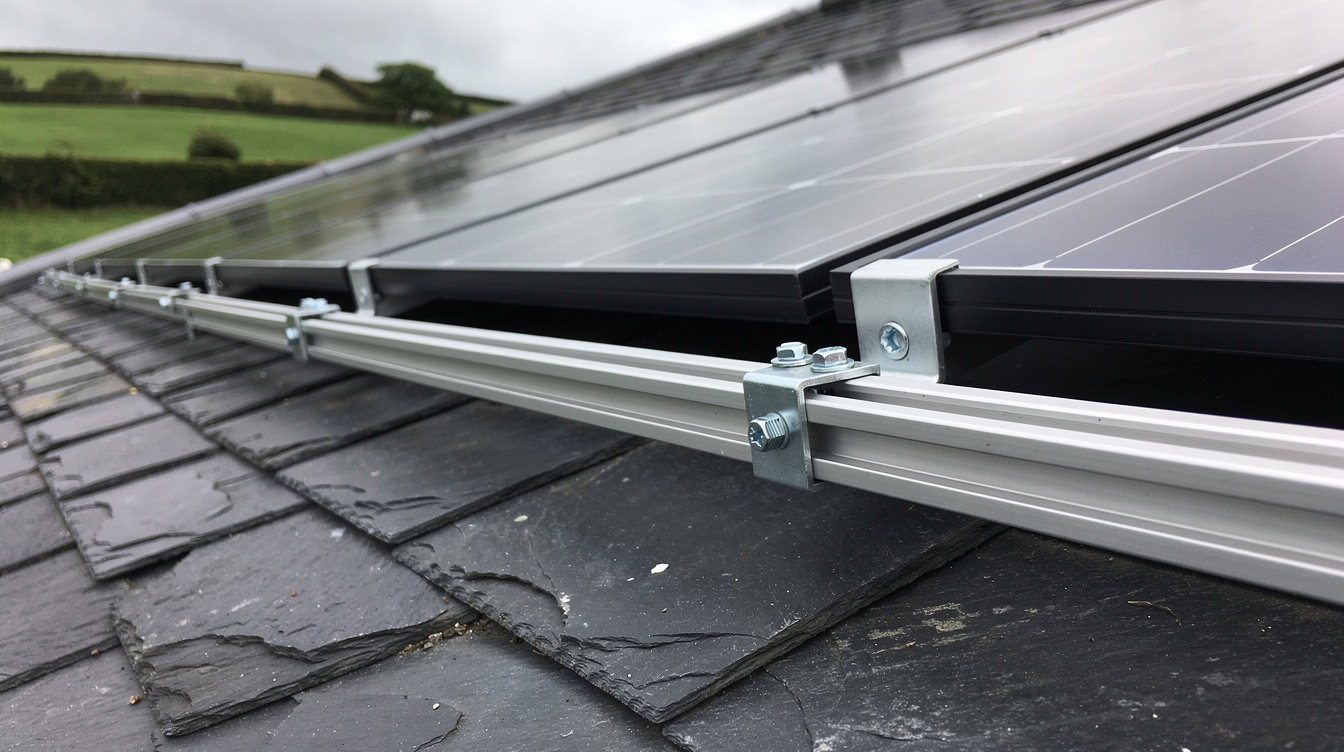
- Mounting hardware needs to handle larger format panels. The 1.95×1.13 m format adds wind-loading. On Atlantic-exposed installs (Clare, Mayo, Donegal coasts) this matters — insist on Eurocode-compliant rail spec.
Solar PV vs solar thermal vs hybrid: which makes sense for your home?
The Irish market has three distinct solar-on-roof products, and they don’t do the same thing.
| System type | What it produces | Typical cost (Ireland 2026) | SEAI grant? | Best fit |
|---|---|---|---|---|
| Solar PV (photovoltaic) | Electricity (DC then inverter-converted to AC) | €8,400–€11,000 for 4–5 kWp | Yes, €1,800 + 0% VAT | Almost all Irish homes — the default 2026 choice |
| Solar PV + immersion diverter (eddi) | Electricity + hot water from surplus PV | €9,200–€12,000 for 4–5 kWp + diverter | Yes, €1,800 + 0% VAT | Households with electric immersion tanks (oil and gas-heated homes) |
| Solar thermal (flat-plate or evacuated tube) | Hot water only (no electricity) | €3,800–€6,200 for 2–3 panel kit | No (grant ended 2022) | Niche — rarely the best maths in 2026 |
| Hybrid (PV + thermal in one panel) | Electricity + hot water from same panel area | €12,000–€18,000 for 4 kWp | Partial (PV portion only) | Very small roofs where both electricity and hot water are required |
The 2026 default for almost all Irish homes is solar PV + immersion diverter. The combination gives you electricity self-consumption (reducing bills at 35c/kWh import rate), CEG export income (18–22c/kWh on surplus), and free hot water from solar surplus that would otherwise have exported at lower rates. Solar thermal made sense in the 2010s when PV was €3.50/Wp and grants existed for thermal. Neither is true in 2026.
What about “thermodynamic solar panels”?
You’ll occasionally see thermodynamic panels marketed in Ireland — sometimes as “solar assist” or “ambient heat” panels. These are heat-pump systems using a refrigerant loop to extract ambient heat from a thin black panel mounted on the roof or wall. They are not solar panels in any conventional sense and they don’t qualify for the SEAI Solar PV grant.
Most Irish heating consultants don’t recommend them in 2026. The reasons are simple: an air-to-water heat pump (which does qualify for the €6,500 SEAI heat pump grant) does the same job better and integrates with under-floor heating, radiators and hot water cylinder. Thermodynamic panels were a 2010s product. They’re still marketed but rarely deliver the claimed COP in Irish conditions.
Mono vs poly: the 2026 reality
Polycrystalline (multicrystalline) panels were once the budget option in Irish residential installs. In 2026 they’re effectively extinct in the residential channel. Module efficiency on the best polycrystalline panels capped at around 17%, while modern monocrystalline TOPCon delivers 21–22.5%. The cost per watt of polycrystalline is now actually higher than mono because manufacturing scale has shifted entirely to mono. If an installer offers polycrystalline panels in 2026, treat it as a red flag — either they’re clearing old stock or they don’t understand the current market.
Within monocrystalline, the meaningful distinction in 2026 is P-type vs N-type silicon. P-type (older, doped with boron) was the basis for PERC panels — it’s reliable but suffers light-induced degradation in the first year (~2%) and has higher long-term degradation (~0.55%/year). N-type (newer, doped with phosphorus) supports the TOPCon, HJT and back-contact architectures — lower initial degradation (~0.4%/year), better low-light response, better temperature coefficient.
The practical answer in 2026: insist on N-type for any new install. The price difference is €6–€15 per panel; the cumulative power output difference over a 25-year warranty is 3–5% across the lifetime.
Warranties: what to look for in 2026
Every panel has two distinct warranties and they get conflated all the time:
- Product warranty — covers physical defects in the panel itself (delamination, corrosion of busbars, frame failure, junction box failure). Typical 2026 levels: 12 years entry, 15–20 years mid-range, 25 years premium, 30–40 years for Maxeon and REC Alpha Pure-R.
- Power output warranty (linear) — guarantees the panel will produce at least X% of nameplate output at year Y. Industry standard 2026: 30 years to 87.4% (TOPCon) or 30 years to 92% (premium HJT and back-contact).
The product warranty matters more in practice. Panel power degradation is usually slow and predictable; physical failure (junction box overheating, frame fatigue, sealant ageing) is the more common claim. A 25-year product warranty from a credible manufacturer is meaningfully better than a 12-year one.
Equally important: the installer’s workmanship warranty. SEAI-registered installers are required to provide a minimum 2-year workmanship warranty under the grant scheme; the best installers offer 5–10 years on workmanship plus separate cover on inverter, optimisers and mounting hardware. Always ask: workmanship warranty length, inverter warranty length (separately), optimiser warranty length (separately), and what the claim process is if something fails.
Matching panel choice to household
The right panel depends on roof, household type and budget more than on absolute “best”. Practical 2026 guidance:
- 3-bed semi in Dublin commuter belt, gas heating, no EV yet: 4 kWp of standard N-type TOPCon at 440–450 W. JA Solar, Longi or Trina. €8,400–€9,200 net — the workhorse install.
- 4-bed detached, family of four, heat pump, one EV: 5–6 kWp of TOPCon. Q Cells Q.TRON or REC Alpha Pure-R for low-light performance. Plus a 5–7 kWh battery. €13,500–€16,000 net.
- 3-bed bungalow with small south-facing roof (under 25 sq m): Back-contact panels (Aiko or Maxeon) at 460–500 W to squeeze maximum kWp into the available area. €12,500–€16,000 net.
- Period property, ACA designation, slate roof: Premium matt-black TOPCon (Trina Vertex S+, Q Cells Q.TRON Black, or full-black Aiko). Conservation-officer approval easier with full-black panels and inverter located out of sight. €10,500–€13,500 net.
- Atlantic-exposed coastal install (Clare, Mayo, Donegal, west Galway): Standard TOPCon but with marine-grade mounting hardware and Eurocode wind-loading-compliant rails. Panel choice less critical than mounting spec — insist the installer specifies wind loading for your location.
- Rural off-grid or grid-edge property: Standard TOPCon plus oversized battery (10–20 kWh) and possibly two-string inverter for redundancy. Panel brand secondary to system architecture.
- TAMS 3 farm install (15–30 kWp): Volume-spec N-type TOPCon — JA Solar JAM72 series is the most-installed agricultural panel in Ireland. Cost per watt is what matters at scale.
The €1,800 SEAI grant context in 2026
The SEAI Solar PV Grant pays €1,800 toward any qualifying domestic solar PV install. Eligibility (as of mid-2026):
- Property built and occupied before 1 January 2021
- Homeowner applying (not rental landlord; LL grants are processed under a separate scheme)
- No previous SEAI Solar PV grant claimed at the same MPRN
- Install completed by an SEAI-registered installer
- Minimum 2 kWp install (you can install smaller, just no grant)
- BER assessment required post-install (the BER assessment cost €120–€180 is your responsibility but it’s also required for the €0 VAT eligibility on the install)
The grant applies to any panel technology that’s SEAI-eligible — which is essentially any mainstream TOPCon, PERC, HJT or back-contact panel from a credible manufacturer with valid CE/IEC certification. The grant is paper-thin on which brand you choose; it’s a flat €1,800 regardless of whether you pick JA Solar at €2.05/Wp or Maxeon at €3.20/Wp.
Combined with 0% VAT (effective since May 2023 for qualifying domestic solar installs), the headline maths in 2026 looks like this for a 4 kWp install:
- Gross install price: €8,400–€9,700 (zero-VAT inclusive)
- Less SEAI grant: €1,800
- Net cost to homeowner: €6,600–€7,900
For a quick estimate of payback for your specific home, our solar panel calculator takes account of yield by county, system size, battery, EV and heat pump.
Common questions on choosing solar panels for Ireland
What efficiency should I look for in 2026? 21% module efficiency or higher. Anything under 20% in 2026 is dated technology and you’ll see better lifetime output from a current-generation TOPCon panel.
Are all-black panels less efficient than silver-frame? The all-black backsheet does run 1–2°C warmer in summer than a white backsheet, which translates to a marginal annual yield reduction of around 0.5–1%. For most Irish installs this is invisible on an annual energy bill. The aesthetic benefit usually outweighs the small efficiency cost.
Do bifacial panels make sense on Irish roofs? Bifacial panels (which can generate from both sides) are excellent on ground-mount and east-west solar farms but add little value on roof-mount installs because the underside reflection isn’t available. Don’t pay a bifacial premium for a roof install — you’re paying for capability you won’t use.
What’s the difference between 400 W and 450 W panels on the same install? Higher wattage panels mean fewer panels needed for the same kWp, which means lower install labour and fewer roof penetrations. The cost per watt is broadly similar, but the cost per kWp installed is usually 4–7% lower with higher-watt modules.
Will solar work on a north-facing roof in Ireland? Yes, with an output penalty. A north-facing 4 kWp array yields about 70–75% of a south-facing array (roughly 2,800–3,000 kWh/year vs 3,800–3,950 kWh/year). The maths can still work, especially if a south or east-facing supplement is impossible. Best panel choice for north roofs: high-low-light-performance TOPCon or HJT, not premium back-contact (the premium-cost-to-output ratio is worst on lowest-yield orientations).
How does degradation actually show up over 25 years? A TOPCon panel rated at 460 W today should produce 442 W at year 5, 432 W at year 10, 414 W at year 25. On a 4 kWp install of 9 panels, year-25 output is about 92% of year-1. The financial impact is small — payback is achieved long before any meaningful output reduction.
What about panels from China — are they safe? Most Tier 1 panels (including JA Solar, Longi, Trina, Jinko, Canadian Solar) are manufactured in China or south-east Asia. This is the standard global supply chain and these are reputable brands with extensive Irish installer adoption and warranty fulfilment infrastructure. Avoid no-name “OEM” panels not sold under a Tier 1 brand — warranty fulfilment risk is real.
How long do solar panels actually last? The mainstream answer is 25–30 years to manufacturer power warranty, with most real-world Irish installs still producing 85–90% of original output at year 25. The first commercial Irish residential installs from around 2008–2010 are still operating at 88–92% of original output.
The bottom line
In 2026, the best solar panel for almost all Irish homes is a 430–460 W N-type TOPCon monocrystalline from a Tier 1 manufacturer (JA Solar, Longi, Trina, Jinko, Canadian Solar, Q Cells, REC). The premium back-contact panels (Aiko, Maxeon) are worth the premium only if your roof area is constrained or you genuinely want the highest possible efficiency per square metre. Solar thermal is no longer a competitive choice in most cases — PV + diverter does the same hot-water job, qualifies for the €1,800 grant, and delivers electricity savings on top. Avoid PERC panels unless there’s a specific price or string-matching reason. Avoid polycrystalline entirely.
The factor that matters more than panel brand is installer competence: workmanship, mounting spec, inverter sizing, system architecture and aftercare. A great installer fitting a mid-market panel will deliver better real-world output than a mediocre installer fitting a premium panel.
Ready for Real Irish Solar Quotes?
Three free quotes from SEAI-registered installers — we’ll match you with installers carrying the right panel spec for your roof, county and household.
Related Articles
Best Solar Setup Ireland 2026: Complete System Design Guide
The best solar setup for Ireland 2026 — panels, inverter, battery, diverter and installer — with 4 real-world configurations, prices and paybacks.
20 Solar Panels Ireland 2026: Cost, Output, Battery & Payback
What 20 solar panels cost in Ireland 2026 (€12.7-18.6k net after grant), 7,600-8,100 kWh output, roof space, battery choice and payback vs 10 or 14 panels.
Solar Panel Temperature Coefficient Ireland 2026: How Heat Affects Output
What temperature coefficient really means for Irish solar output, real cell temps by season, 2026 brand rankings, and why low-light beats heat spec in Ireland.