
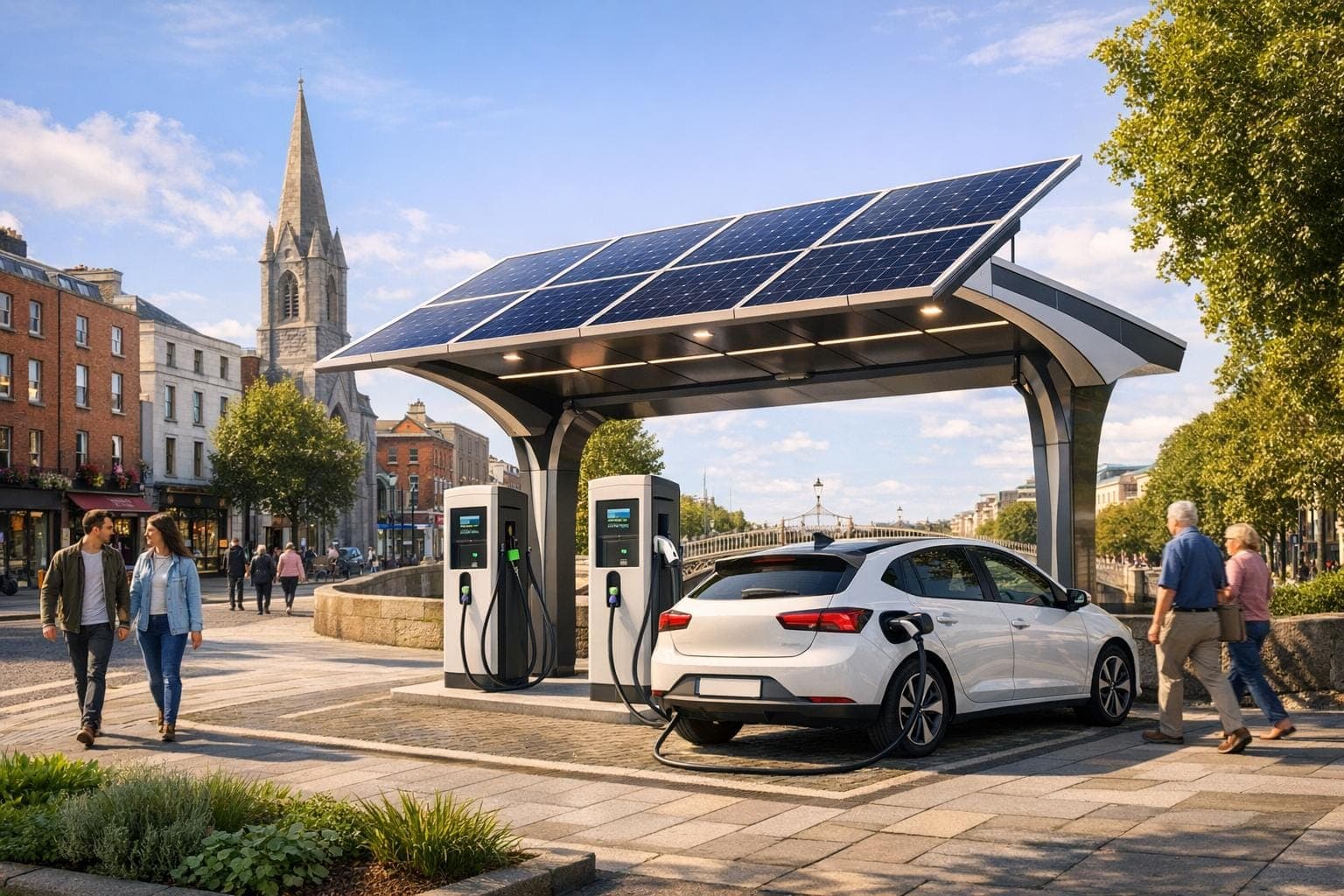
Solar EV Chargers: Cleaner Air for Irish Cities
Solar-powered EV chargers are helping Irish cities tackle air pollution and reduce emissions. With transport accounting for 20% of Ireland's total emissions - 95.8% from on-road vehicles - this solution offers a cleaner way to charge electric vehicles. By using renewable energy, solar chargers eliminate tailpipe emissions and cut indirect pollution from fossil-fuel electricity.
Key takeaways:
- Transport-related emissions contribute to 1,700 premature deaths annually in Ireland.
- Solar-powered EV systems can achieve up to 67% self-consumption, as seen in Dublin installations.
- Ireland aims to have 945,000 EVs on the road by 2030, supported by grants for solar PV and EV chargers.
- Challenges include limited rooftop space in cities and frequent cloud cover, but government programs and planning reforms are addressing these issues.
Switching to solar EV charging is a practical step toward cleaner air, healthier communities, and meeting Ireland’s renewable energy goals.
Ireland's First Solar EV Hub Launches in Galway
Air Pollution in Irish Cities: Current State and Trends
Ireland may meet EU legal standards for air quality, but it falls short of the stricter guidelines set by the World Health Organization (WHO). This shortfall has dire consequences, with approximately 1,700 premature deaths each year attributed to poor air quality.
The country has made strides in monitoring air pollution, expanding its network from 29 stations in 2017 to 115 in 2024. Despite this progress, the data is sobering: in 2023, 24 out of 36 nitrogen dioxide (NO₂) levels and 79 out of 101 fine particulate matter (PM₂.₅) levels exceeded WHO limits. Dr. Micheál Lehane, Director of the EPA's Office of Radiation Protection & Environmental Monitoring, highlighted the widespread nature of the issue:
"Ireland now has a world class air quality monitoring network so the evidence base is strong in showing us that air pollution is not just a city phenomenon, there are negative impacts in towns and villages right across the country".
Looking ahead, Ireland faces an uphill battle in meeting the new EU Ambient Air Quality Directive targets for 2030. Projections suggest only 78% compliance for NO₂ and 93% for PM₂.₅. Pollution levels often spike during colder months, particularly from late autumn to early spring, when stagnant air traps pollutants near the ground.
Transport Emissions and Health Effects
Road traffic is the leading contributor to urban air pollution in Ireland, with vehicles being the primary source of nitrogen dioxide in cities. The EPA explains:
"The major sources of NO₂ are combustion - car and ship engines, electricity generation and industry. It is a toxic gas that effects throat and lungs by inflaming the lining causing respiratory problems".
The health effects of air pollution go far beyond respiratory issues. Fine particulate matter (PM₂.₅) can penetrate deep into the lungs, enter the bloodstream, and contribute to conditions like cardiovascular disease, dementia, and type 2 diabetes. Research from the AEROSOURCE network revealed that during winter pollution spikes, WHO limits for particulate matter were exceeded as often as one day out of every five in Dublin. In urban areas like Dublin, traffic-related carbonaceous particles make up between 60% and 90% of PM₁ mass.
Another major challenge is the discrepancy between real-world vehicle emissions and official test results. Fossil-fuel vehicles consistently emit more pollutants on the road than laboratory tests suggest. The 2024 REDMAP study, led by researchers Srinath Mahesh and Bidisha Ghosh, used remote sensing to measure emissions from over 130,000 vehicles in Dublin. Their findings confirmed that roadside pollution levels were consistently higher than expected, further complicating Ireland's air quality efforts.
How EVs Reduce Emissions
Electric vehicles (EVs) offer a promising solution to Ireland's air quality challenges. By eliminating tailpipe emissions, EVs remove a key source of nitrogen dioxide and particulate matter. Even when powered by Ireland’s current electricity grid - which still includes some fossil fuel generation - EVs deliver substantial environmental benefits. Projections show that transitioning to electric vehicles, alongside other transport measures, could reduce well-to-wheel emissions by 56% by 2050.
EVs also bring significant energy efficiency gains. They are expected to cut final energy consumption in the transport sector by 48% compared to fossil fuel vehicles. With private cars accounting for over 25% of Ireland’s energy-related non-ETS greenhouse gas emissions, electrifying this sector is a critical step toward cleaner air in cities. Pairing EVs with solar charging amplifies these benefits, allowing renewable energy to power vehicles directly. This highlights the importance of investing in dedicated solar EV charging infrastructure, which will be explored in the next section.
How Solar EV Charging Improves Air Quality
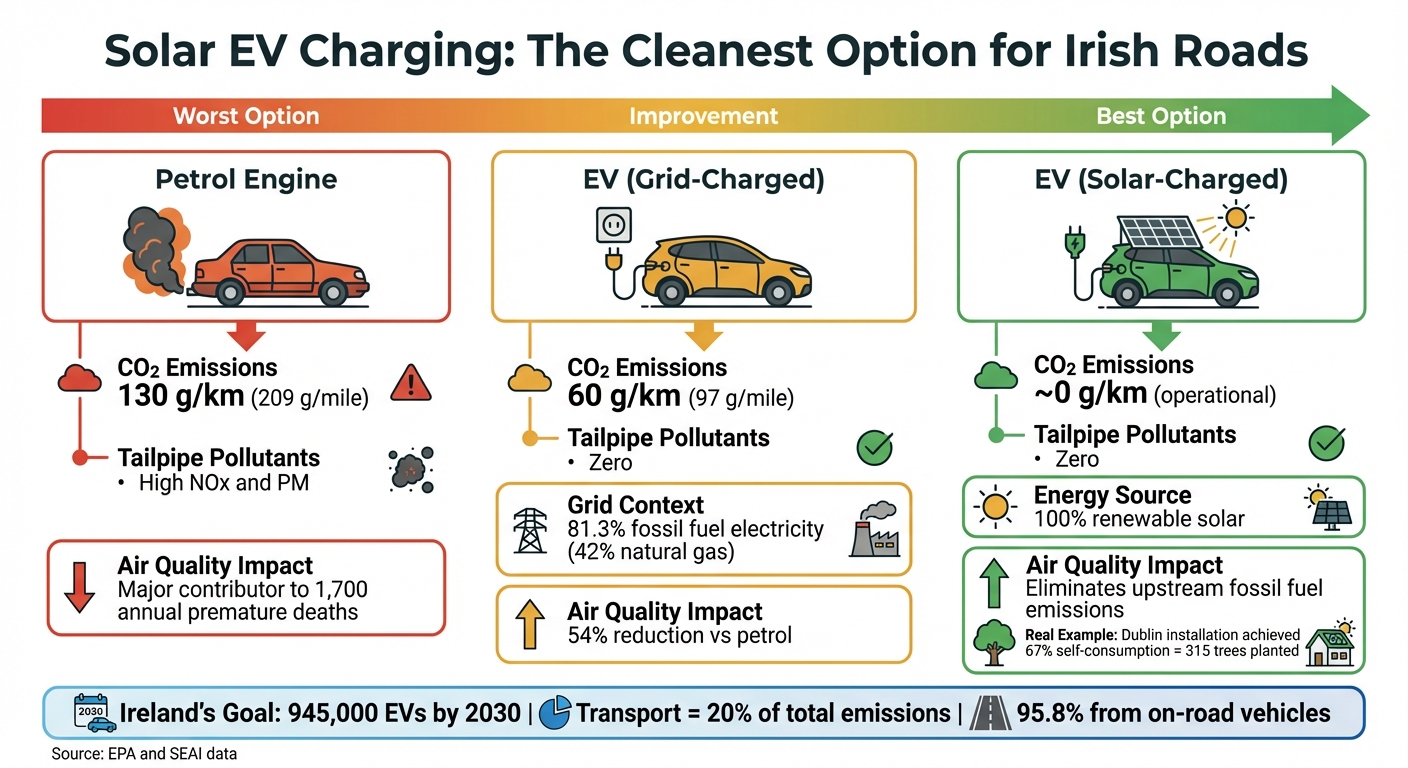
CO2 Emissions Comparison: Petrol vs Grid-Charged vs Solar-Charged EVs in Ireland
Cleaner Energy for EV Charging
The environmental benefit of electric vehicles (EVs) largely depends on the energy source used for charging. In Ireland, where 81.3% of the electricity grid relies on fossil fuels - 42% of that from natural gas - charging EVs still generates indirect emissions. However, switching to solar power eliminates these emissions, significantly reducing harmful pollutants like NOx, SOx, and particulates, which are linked to approximately 1,700 premature deaths annually. By replacing fossil fuel–based electricity with solar energy, upstream emissions from burning fossil fuels are completely avoided.
The Sustainable Energy Authority of Ireland (SEAI) highlights this cleaner energy advantage:
"Even when emissions from Irish electricity generation are considered, the CO₂ emissions from EVs are less than those from the cleanest petrol engines".
This transition to solar energy not only reduces emissions but also leads to measurable improvements in air quality.
Measured Pollution Reductions
To put it into perspective, petrol engines emit around 130 g of CO₂ per kilometer (about 209 g per mile), while an EV charged from Ireland's grid averages 60 g CO₂/km (approximately 97 g per mile). Charging the same EV with solar power brings operational emissions close to zero.
A real-world example from Dublin showcases the impact of solar EV systems. Between 2024 and 2025, SolarSmart Energy Ltd installed a residential system featuring 16 high-efficiency solar panels (435 W each), a 4 kW hybrid inverter, and a Zappi smart EV charger. This setup achieved a 67% solar self-consumption rate, enabling the homeowner to rely entirely on solar power during summer months. Researchers Mohammed Albaba and Morgan Pierce equated the environmental benefits of this installation to planting 315 trees.
With Ireland aiming for 945,000 EVs on the road by 2030 and transport currently responsible for roughly 20% of the nation’s total emissions, solar-powered EVs represent a transformative step toward cleaner cities and healthier air. The benefits demonstrated in Dublin provide a scalable model for solar EV charging across the country.
Solar EV Charging Performance in Ireland
In 2024, Ireland saw a 69% increase in photovoltaic (PV) energy generation, making solar charging an increasingly viable option for daytime EV use at workplaces and public spaces. This aligns perfectly with Ireland’s EV infrastructure strategy, which emphasizes "destination charging" and "workplace charging" to complement home charging.
The timing of solar energy generation naturally fits with typical work schedules, allowing businesses to install smart chargers that prioritize solar energy over grid power. Even in Ireland’s cloudy, temperate climate, these systems can maximize clean energy use.
The Department of Transport underscores the broader benefits of this approach:
"Electrification of the vehicle fleet offers a pathway to zero tailpipe emissions, with several co-benefits such as improved air quality, reduced noise pollution, and less fossil fuel dependence".
By integrating solar energy into EV infrastructure, Irish cities can address not only direct vehicle emissions but also the indirect emissions tied to electricity generation.
| Vehicle Type | CO₂ Emissions | Tailpipe Pollutants |
|---|---|---|
| Petrol Engine | 130 g/km (≈209 g/mile) | High NOx and PM |
| EV (Grid-Charged) | 60 g/km (≈97 g/mile) | Zero |
| EV (Solar-Charged) | ~0 g/km (Operational) | Zero |
Installing Solar EV Chargers in Irish Cities
Air Quality Improvements in Cities
Dublin's air quality data highlights an urgent need for cleaner transportation solutions. In 2024, the EPA's REDMAP project used remote sensing to analyze emissions from over 130,000 vehicles across the city. The findings were stark: 95.8% of all transport emissions came from on-road vehicles. Replacing fossil fuel-powered vehicles with solar EV chargers in urban areas can eliminate both tailpipe emissions and the upstream pollution caused by fossil fuel-based power plants. This shift provides immediate and measurable improvements in air quality. Beyond the immediate impact, solar EV charging also helps reduce strain on the grid and encourages the use of distributed renewable energy.
Grid Decarbonization and Distributed Solar
Solar EV charging doesn’t just clean the air - it also supports Ireland’s ambitious target of achieving 80% renewable electricity by 2030. By generating power locally at the point of use, it reduces the demand on the centralized grid, especially during peak hours when fossil fuel plants typically ramp up production.
Demonstration projects in Dublin have shown that residential solar systems can achieve complete grid independence for EV charging during summer months. Integrated Battery Energy Storage Systems (BESS) play a key role here, stabilizing the grid by preventing voltage drops during periods of high demand. This decentralized approach minimizes transmission losses and reduces strain on older urban electrical infrastructure.
Researchers Mohammed Albaba and Morgan Pierce emphasized the broader potential of this approach:
"The integration of solar energy into EV charging infrastructure is particularly appealing, as it links clean energy production directly with end‑use consumption".
Deployment Challenges in Urban Areas
While the benefits are clear, deploying solar EV chargers in cities comes with challenges. In dense urban neighborhoods, limited unshaded rooftop space can restrict installations, as taller buildings often cast shadows on potential sites. Ireland’s temperate climate, with its frequent cloud cover and rain, further reduces the consistency of solar energy output compared to sunnier regions.
Infrastructure integration adds another layer of complexity. Although the 2022 updates to Planning and Development Regulations removed rooftop area limits for domestic PV systems, coordinating installations with existing utilities and ensuring proper grid connections requires detailed planning. Urban residents without private driveways face additional hurdles, as they rely on shared charging facilities, which complicates deployment strategies.
To address these issues, the Department of Transport has implemented regional and local EV Charging Network Plans, led by local authorities, to standardize infrastructure rollout across cities and towns. Researchers also recommend oversizing PV arrays by about 30% relative to converter capacity in areas with low sunlight, like Ireland, to ensure sufficient energy availability.
Government Support for Solar EV Charging in Ireland
Government efforts in Ireland are playing a crucial role in advancing solar-powered EV charging by providing both financial backing and regulatory support to encourage widespread adoption.
Grants and Financial Programs
The Irish government, through the Sustainable Energy Authority of Ireland (SEAI), offers several financial incentives to promote solar EV charging. For homeowners, the Residential Solar PV Grant is available for properties built and occupied before 2021. This grant provides €700 per kWp for the first 2kWp installed and €200 for each additional kWp, with a cap of €1,800. Additionally, the EV Home Charger Grant offers €300 toward installing a smart charger, provided applicants use equipment listed on SEAI’s Smart Charger Register and hire a Safe Electric Ireland registered electrician.
Businesses also benefit from targeted programs. The Non-Domestic Microgen Grant supports commercial solar installations up to 1,000kWp, offering up to €162,600. Moreover, companies can take advantage of the Accelerated Capital Allowance, which allows them to deduct the full cost of energy-efficient equipment from their profits in the year of purchase. These initiatives are key to achieving Ireland’s ambitious goal of having 945,000 EVs on the road by 2030.
It’s important to note that installation should only begin after receiving a formal Letter of Offer from SEAI, as any expenses incurred before approval will not qualify for grant support. Once all required documentation is submitted, grants are typically processed within four to six weeks. Beyond financial incentives, planning reforms are also being introduced to simplify the deployment of solar EV chargers.
Urban Planning and Solar-Ready Buildings
Ireland’s planning regulations are evolving to encourage the integration of solar EV infrastructure. Under Class 29A of the Planning and Development Regulations, certain EV charging point installations are classified as "exempted development." This means that full planning permission is not required unless the project involves new permanent structures or extends beyond property boundaries.
Local authorities are spearheading efforts to ensure equitable access to charging facilities through the Regional and Local EV Charging Network Plan. A standout example is Dublin City Council’s Finglas Mobility Hub, launched in January 2023. This hub provides residents with facilities to charge personal EVs, e-bikes, or shared electric vehicles. Minister for Transport Eamon Ryan highlighted its potential for replication across Ireland, stating:
"One of the initiatives I really want Local Authorities to embrace are the mobility hubs where people can charge their own cars, charge their e-bikes or e-scooters, or use a shared EV... I think it should be a standard feature in our towns and cities nationwide".
To further expand public charging infrastructure, the government has committed €100 million between 2023 and 2025. This includes a €15 million Shared Island Sports Club Scheme to fund community-based destination chargers. These investments align closely with Ireland’s climate goals. As Minister of State Jack Chambers remarked, "As we move to EVs and more sustainable modes of travel, this will enable us to meet our national carbon reduction targets".
By combining financial incentives, streamlined planning, and strategic investments, Ireland is laying the groundwork for a robust solar EV charging network.
Resources from Get Solar Panels
For those looking to take advantage of these government programs, Get Solar Panels offers valuable guidance. Their website (https://getsolarpanels.ie) is a one-stop resource for Irish residents exploring solar EV charging solutions. It provides practical advice on system design, grant applications, and selecting the right solar EV chargers for various property types.
Whether you’re a homeowner considering residential installations or a business evaluating larger commercial systems, the platform offers tailored recommendations specific to Ireland’s climate and regulatory framework. This includes tips on maximizing solar output during Ireland’s winter months, navigating zero-VAT installations, and integrating energy storage solutions like the Tesla Powerwall to achieve greater energy independence.
Conclusion
Research highlights that solar-powered EV charging offers cleaner air and healthier communities in Ireland. With the transport sector accounting for about 20% of Ireland's total emissions - and 95.8% of that coming from on-road vehicles - shifting to electric vehicles powered by renewable energy is a key step in Ireland's renewable energy transition. By cutting both tailpipe emissions and upstream pollution, this approach delivers wide-ranging environmental benefits, backed by real-world evidence.
For example, a 2025 study in Dublin found that a solar-EV installation achieved 67% self-consumption and grid independence during the summer months, with environmental benefits comparable to planting 315 trees. If scaled nationwide to meet the target of 945,000 EVs by 2030, similar initiatives could significantly improve urban air quality.
Moving forward, progress will rely on government grants, simplified planning processes, and supportive urban policies to encourage broader adoption of solar EV charging. This aligns with Ireland's ambitious goal of sourcing 80% of its electricity from renewable energy by 2030, making solar EV charging a vital component of sustainable urban development.
For residents and businesses seeking expert advice on system design, grants, and installation tailored to Ireland's conditions, visit Get Solar Panels. One installation at a time, solar-powered transportation is driving change.
FAQs
How do solar EV chargers help improve air quality in cities across Ireland?
Solar EV chargers play a key role in improving air quality in Irish cities. By harnessing sunlight to produce electricity, they eliminate the emissions associated with fossil-fuel-powered vehicles and traditional energy sources. This means fewer pollutants like carbon dioxide (CO₂), nitrogen oxides (NOx), sulfur oxides (SOx), and particulate matter polluting the air.
Using renewable energy to power electric vehicles doesn’t just lower greenhouse gas emissions - it also promotes cleaner, healthier urban spaces. This shift is an important move toward reducing pollution and enhancing public health in city environments.
What are the main challenges in building solar EV charging infrastructure in Ireland?
Ireland is grappling with several hurdles in its efforts to expand solar-powered EV charging. One major challenge lies in the high costs and technical difficulties of connecting solar systems to the national grid, particularly in urban areas where space is tight. Adding to this, Ireland’s electricity prices - some of the highest in Europe - make solar-powered public chargers less attractive to investors looking for profitable ventures.
Government funding has been relatively limited, leaving many projects without the financial backing needed to cover the steep installation expenses. On top of that, the country’s grid capacity is under strain, struggling to accommodate the rising demand from EVs. This issue is further complicated by the intermittent nature of solar energy, which makes consistent power supply a challenge. Another significant roadblock is the lack of clear, long-term policies and incentives, which discourages private companies from committing to solar EV charging infrastructure.
To tackle these challenges, Ireland will need stronger policy measures, simplified grid connection procedures, and targeted subsidies to make solar EV charging a practical option. Resources like Get Solar Panels can provide valuable guidance on grants, optimizing solar setups for Ireland’s unique climate, and incorporating storage solutions to address these issues effectively.
What financial incentives are available for installing solar EV chargers in Ireland?
Ireland has introduced several government programs to make installing solar-powered EV chargers more affordable. For homeowners, the Electric Vehicle Home Charger Grant provides up to €300 toward the purchase and installation of a smart home charger, as long as it's installed by a certified contractor. If you live in an apartment or don’t have a private driveway, the EV Apartment Grant offers support for shared or communal charging setups.
Businesses can take advantage of the Accelerated Capital Allowance (ACA), which allows a tax deduction on qualifying solar-powered EV charging equipment. Meanwhile, the Shared Island Sports Club Scheme helps sports clubs and community venues secure funding for EV chargers, which can also be paired with solar panels.
To expand charging options, the government has set aside €100 million under the National EV Charging Infrastructure Strategy (2022-2025). This funding supports the development of public and residential charging networks, including those integrated with solar power. Homeowners can also combine Solar PV Grants (offering up to €1,800 for a 4 kW system) with EV chargers to create a fully solar-powered charging setup. These initiatives are designed to help individuals, businesses, and communities embrace cleaner, solar-driven charging solutions.
Related Blog Posts
Related Articles

Lidl Plug-In Solar Panels: Are They Coming to Ireland? What You Need to Know (2026)
Lidl will sell plug-in solar panels for €200-€500 that save €100-€200/year. But a full installation saves €700-€950/year after the €1,800 SEAI grant. Full comparison inside.

Can You Sell Electricity Back to the Grid in Ireland? (Clean Export Guarantee Guide 2026)
Irish homeowners can sell surplus solar electricity back to the grid at €0.155-€0.185/kWh through the Clean Export Guarantee (CEG). Earn €300-€450/year tax-free. Full guide: rates by supplier, how to set up, and how to maximise earnings.

How to Choose Solar Security Lights for Your Home
Match brightness, motion sensors, battery life, and weather resistance to choose durable, energy-saving solar security lights for reliable home protection.