
String vs. Micro Inverters: Cost Comparison
Compare string inverters and microinverters — upfront cost, lifespan, shading impact, installation labor, and 20-year energy value.

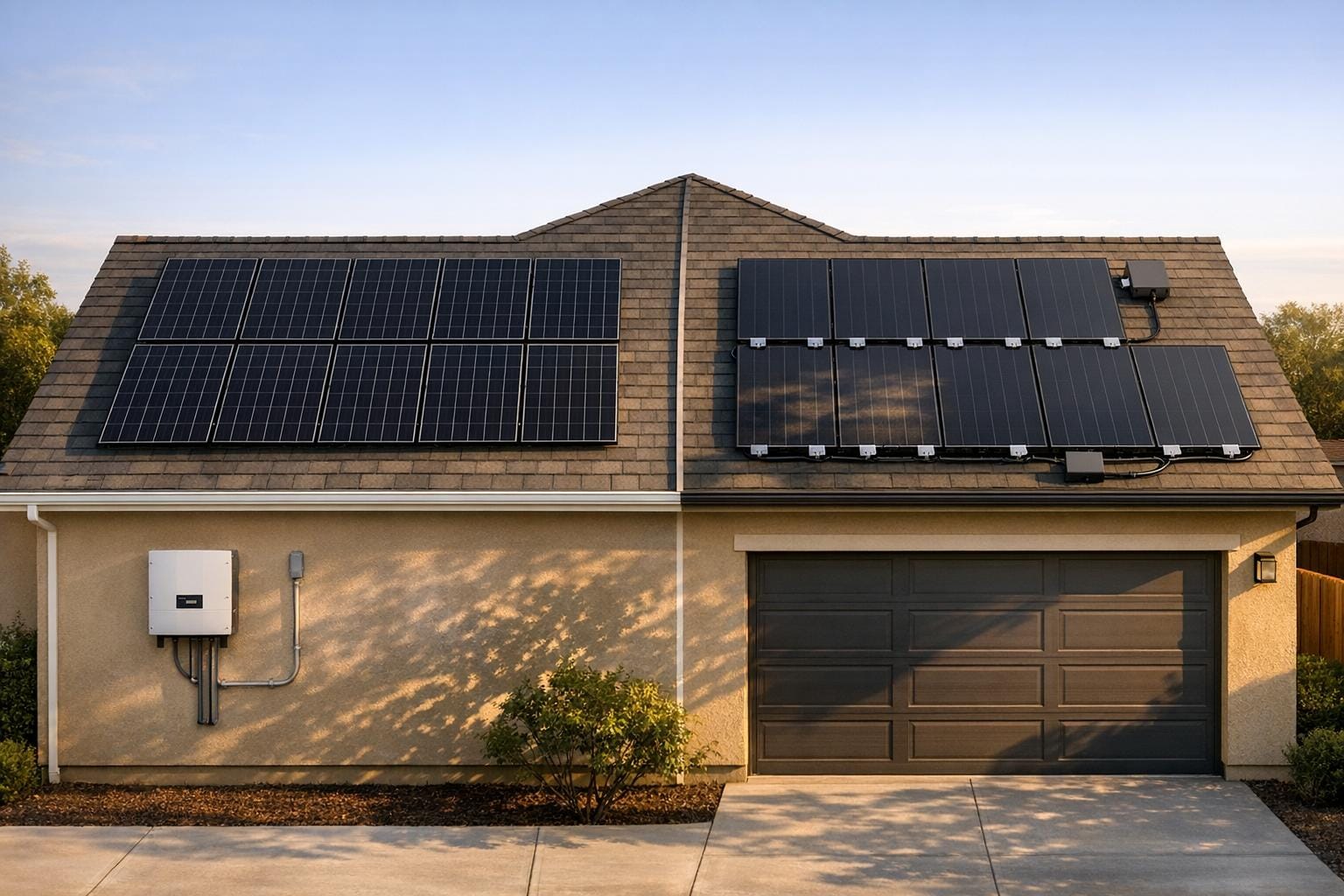
When choosing between string inverters and microinverters for your solar system, the decision often comes down to solar installation costs, lifespan, and performance in specific conditions. Here's a quick breakdown:
- String Inverters: Lower upfront cost ($750–$1,500 per unit), but shorter lifespan (10–15 years). Best for simple, unshaded roofs. Vulnerable to shading, where one panel can reduce the output of the entire system. Replacement costs and downtime are potential drawbacks.
- Microinverters: Higher upfront cost ($1,000–$3,000 more for a system), but they last 20–25 years. Ideal for shaded or complex roofs, as each panel operates independently, increasing energy output by 5–25% in challenging conditions. They also offer panel-level monitoring and better safety features but involve higher labor costs for installation.
Quick Comparison:
| Feature | String Inverter | Microinverter |
|---|---|---|
| Upfront Cost | $750–$1,500/unit | $150–$250/panel |
| Lifespan | 10–15 years | 20–25 years |
| Energy Output | Lower in shaded areas | Higher in shaded areas |
| Replacement Costs | $750–$2,150 (likely) | None (rarely needed) |
| Monitoring | System-level only | Panel-level monitoring |
| Best For | Simple, unshaded roofs | Shaded, complex roofs |
String inverters are a budget-friendly choice for straightforward installations, while microinverters are worth the investment for long-term performance, especially in shaded or complex setups. Choose based on your roof’s layout, shading, and future expansion plans.
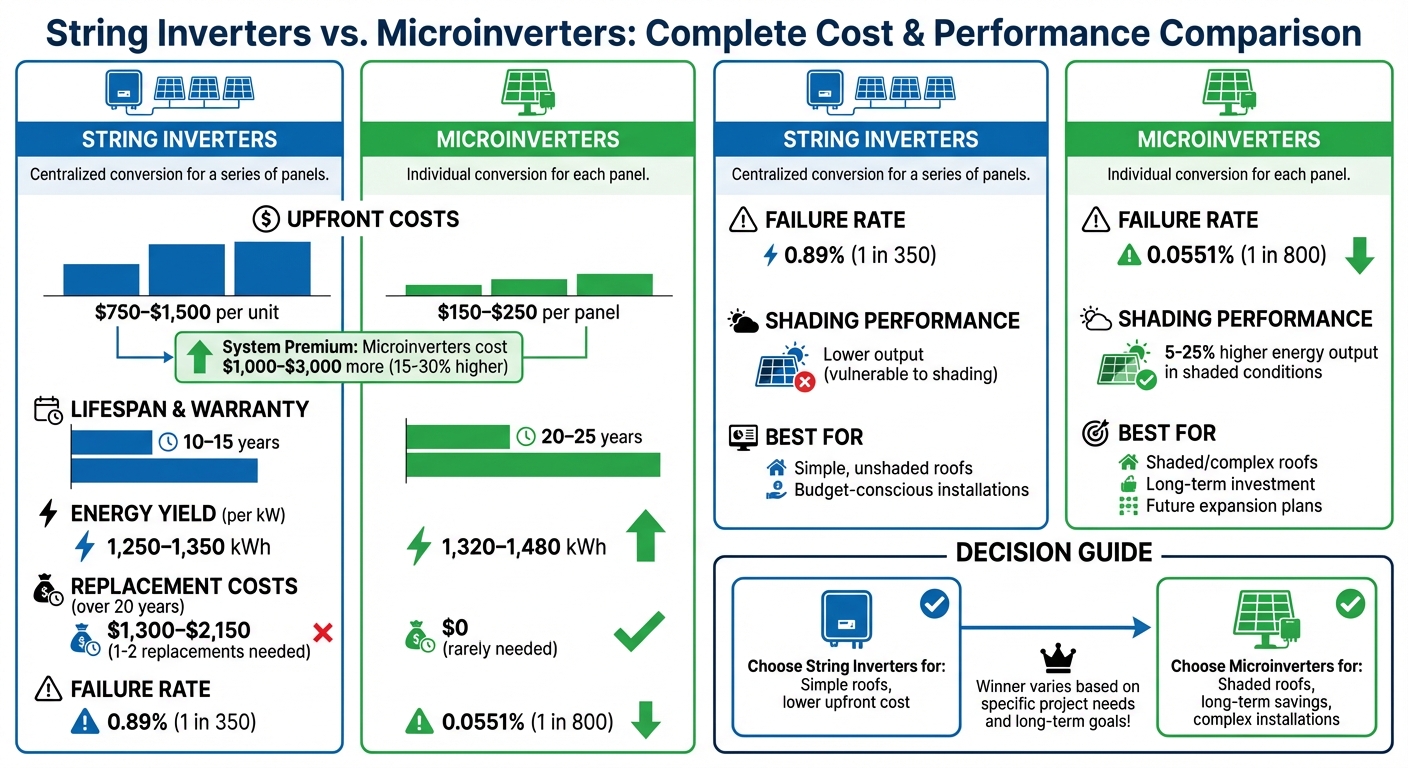
String Inverters vs Microinverters Cost and Performance Comparison
Microinverter vs String Inverter: What's The Better Inverter?
String Inverters Explained
A string inverter serves as the central hub for converting the electricity generated by your solar panels into usable power for your home. Here’s how it works: solar panels are connected in series to form a "string", which channels high-voltage DC electricity (typically between 150V and 1,000V) to a single inverter. This device, often installed near your electrical panel or in your garage, transforms the DC electricity into AC electricity that your home can use.
The setup is pretty straightforward. Panels are wired in series, and the inverter is installed at ground level. String inverters typically operate with efficiencies of about 97% to 98% and account for roughly 10% to 15% of the total cost of a solar system. They also feature Maximum Power Point Tracking (MPPT) technology, which can manage up to four separate strings, allowing some flexibility if panels face different directions.
However, there’s a catch: because the panels are connected in series, the performance of the entire string depends on the weakest panel. If one panel is shaded or dirty, it can drag down the output of the entire system. As Johanna Poole from Solar.com explains:
With string inverters, the lowest performing panel dictates the production of the entire system. So if one panel has a branch shading it by 30%, you will only receive 70% of your total system's possible production.
This design makes string inverters best suited for simple, unshaded roofs where all panels face the same direction and receive consistent sunlight. They’re a go-to option for straightforward installations, especially when keeping initial costs low is a priority.
Benefits of String Inverters
String inverters are the most budget-friendly inverter option. Equipment costs typically range from $0.15 to $0.24 per watt, with installation labor adding another $200 to $500 per unit.
The installation process is quicker and easier compared to other inverter types. Since only one central unit needs to be mounted and wired, technicians don’t have to install electronics under every panel. Maintenance is also simpler because the inverter is located at ground level, making troubleshooting and repairs more accessible.
These inverters are a popular choice for residential systems, especially when the roof has a uniform layout and all panels face the same direction. For homes with unobstructed sunlight and consistent panel orientation, the energy production difference between string inverters and more expensive microinverters is minimal - typically within a range of 0% to 5%.
Drawbacks of String Inverters
The biggest downside of string inverters is their vulnerability to shading. When panels are connected in series, shading on just one panel can reduce the output of the entire string. This is often referred to as the "Christmas light effect." Even a small shadow from a tree branch or chimney can significantly impact the system's overall performance.
Another concern is that string inverters represent a single point of failure. If the inverter breaks down, the entire solar system stops producing power until it’s repaired or replaced. A study of 100,000 solar systems found that string inverters had a failure rate of 0.89%.
Lastly, string inverters generally have a lifespan of 10 to 15 years, which is much shorter than the 25+ years expected from solar panels. This means you’ll likely need to replace the inverter at least once during the system’s lifetime. Additionally, to meet rapid shutdown safety requirements, you might need to invest an extra $300 to $800 in equipment - something microinverters handle automatically.
Next, we’ll dive into microinverters, which tackle some of these issues by managing power conversion at the panel level.
Micro Inverters Explained
Microinverters are small devices installed behind each solar panel, converting the direct current (DC) generated by the panel into alternating current (AC) right at the source. This setup eliminates the need for a central inverter and ensures each panel operates independently.
One of the standout benefits of microinverters is their ability to bypass the "Christmas light effect." This term refers to how a single underperforming panel - due to shade, dirt, or damage - can drag down the output of an entire system. With microinverters, each panel functions as its own unit, maximizing energy production across your array. As Joe Brennan, Founder of Going Solar, explains:
"Using Microinverters on a system is like turning your 10-panel array into 10 individual PV arrays."
Beyond energy optimization, microinverters enhance safety during installation and operation. They handle low-voltage DC current on the roof (around 40VDC per panel), unlike string inverters, which transmit high-voltage DC - up to 400V or more - through your home to a central unit. This makes microinverters a safer choice for residential systems and ensures compliance with rapid shutdown safety standards.
Another advantage is panel-level monitoring. Microinverters allow you to track the performance of each panel through mobile apps, providing real-time data on energy output. This feature not only helps identify maintenance needs quickly but can also improve overall system efficiency by up to 15%.
Durability is another strong point. Microinverters typically come with 25-year warranties, matching the lifespan of most solar panels, whereas string inverters often have warranties lasting 8 to 12 years. Their failure rate is also lower - about 1 in 800 in the first two years, compared to 1 in 350 for string inverters. Currently, Enphase Energy leads the U.S. residential market, holding around 60% of the share, though brands like APsystems and Hoymiles provide alternative options.
Now, let’s dive into the advantages and challenges of this technology.
Benefits of Micro Inverters
Microinverters excel in situations where roofs have shading, multiple orientations, or varied panel angles. Thanks to their individual Maximum Power Point Tracking (MPPT) capability, each panel operates at its optimal performance, regardless of conditions affecting neighboring panels. This can result in 5% to 25% higher energy output compared to string inverters in such scenarios.
Reliability is another major perk. With no single point of failure, the system remains functional even if one microinverter stops working. As EnergySage puts it:
"If one microinverter stops working, the entire system's performance isn't ruined."
Expanding your solar system is also easier with microinverters. Adding more panels is as simple as installing new ones with their own microinverters - there’s no need to replace or upgrade a central inverter. This modular approach makes scaling your system straightforward as your energy needs grow.
While these benefits are impressive, it’s important to weigh them against the potential downsides.
Drawbacks of Micro Inverters
The most notable downside is the higher upfront cost. Microinverters typically add $1,000 to $3,000 to the cost of a solar installation - roughly 15% to 30% more than a system with string inverters. Individual units range from $100 to $242 depending on the brand, and most setups require one microinverter per panel, though newer models can sometimes serve multiple panels.
Installation can be more complex and time-consuming. Each microinverter must be mounted and wired under its respective panel, unlike string inverters, which are installed as a single unit at ground level. This added complexity can increase labor costs.
Maintenance can also pose challenges. Since microinverters are mounted on the roof, servicing them often requires removing panels and working at heights. While failures are relatively rare, repairs can be more labor-intensive and expensive than those for a ground-level string inverter.
Another consideration is clipping, where some energy is lost during peak sunlight hours. While this typically results in only minor losses - around 1% to 3% - it’s still worth noting. Additionally, the higher number of components (20 to 40 microinverters for a standard array) means there are more potential points of failure, despite each unit’s high reliability.
These trade-offs highlight the balance between the benefits of microinverters and their higher costs, which we’ll explore in greater detail next.
Initial Installation Costs Compared
When it comes to upfront costs, there’s a noticeable difference between string inverters and micro inverters. String inverters typically range from $0.15 to $0.24 per watt, while micro inverters are priced higher, at $0.20 to $0.35 per watt. This translates to micro inverters carrying a 15% to 30% higher price tag than string inverters.
For a standard 5kW system, the hardware costs for string inverters fall between $750 and $1,200, whereas micro inverters cost between $1,000 and $1,750 for the system. Since a 5kW system generally uses 12–14 panels, the per-panel cost of micro inverters ($150–$300 each) can push the total equipment expense to anywhere from $1,950 to $3,900.
Labor costs also play a significant role. String inverters are installed as a single unit, which is usually mounted on a wall or at ground level. This straightforward process keeps labor costs between $200 and $500. On the other hand, micro inverters require installation on each individual panel, adding both time and labor expenses.
Another factor to consider is compliance with U.S. building codes. The NEC 2017+ regulations require rooftop systems to have rapid shutdown capabilities. Micro inverters typically include this feature by default, but string inverters may need additional equipment to meet these standards, costing an extra $300 to $800.
Cost Breakdown Table
| Component | String Inverter | Micro Inverter |
|---|---|---|
| Cost per Watt (Equipment) | $0.15–$0.24 | $0.20–$0.35 |
| 5kW System Equipment Cost | $750–$1,200 | $1,000–$1,750* |
| Installation Labor | $200–$500 (single unit) | Higher (12–14 rooftop units) |
| Rapid Shutdown Compliance | $300–$800 (if needed) | Included |
| Total Upfront Premium | Baseline | +$1,000–$3,000 |
*Note: Per-panel costs ($150–$300 each) for 12–14 panels can increase total equipment costs to between $1,950 and $3,900.
Next, we’ll dive into long-term costs and performance to complete the financial picture.
Long-Term Costs and Performance
When evaluating solar systems, the Levelized Cost of Energy (LCOE) is a key metric. It measures the cost per kilowatt-hour over the system's entire lifespan, providing a clearer picture of long-term expenses. Let’s break down how different inverter types compare in terms of lifespan, maintenance, and overall costs.
Lifespan and Maintenance Compared
String inverters generally have a lifespan of 10 to 15 years. Over a typical 20-year system lifespan, you’ll likely need to replace them once or even twice - an expense that can add up quickly. On the other hand, micro inverters are built to last 20 to 25 years, aligning with the lifespan of the best solar panel types and often eliminating the need for replacements.
Warranty coverage reflects this difference. Micro inverters often come with warranties that match their 20–25 year lifespan, while string inverters typically include shorter warranties. As Solar Optimum puts it:
Microinverters sacrifice short-term costs to give you a barrage of long-term benefits. They are better for the future as you spend less money to install new panels into the PV system and get up to 25-year warranties.
Maintenance is another factor to consider. String inverters are usually installed at ground level - like in a garage or on an exterior wall - which makes repairs easier and less expensive. Micro inverters, however, are mounted on the roof alongside the panels. Accessing them for maintenance often requires removing panels, which can drive up labor costs.
Reliability also sets these systems apart. String inverters are prone to higher early failure rates, and when one fails, the entire system shuts down immediately. In contrast, if a micro inverter fails, only the affected panel loses output - typically reducing system performance by just 3% to 8%. HBOWA New Energy highlights this advantage:
In most scenarios, string inverters tend to require replacement after 10-15 years, but most of the modern microinverter models come with a 20-25-year warranty, matching the effective module life.
Long-Term Cost Comparison Table
Here’s how the two inverter types stack up over time:
| Factor | String Inverter | Micro Inverter |
|---|---|---|
| Average Lifespan | 10–15 years | 20–25 years |
| Warranty Coverage | 10–15 years | 20–25 years |
| Replacements (20 years) | 1–2 times | Rarely needed |
| Replacement Cost | $750–$1,200 per unit | N/A |
| Maintenance Access | Ground-level (easy) | Roof-level (more complex) |
| System Outage Risk | 100% (total shutdown) | 3–8% (per unit failure) |
| Energy Yield (per kW) | 1,250–1,350 kWh | 1,320–1,480 kWh |
| 20-Year LCOE | Higher (due to replacements) | Competitive/Lower |
While micro inverters come with higher upfront costs, they often result in lower LCOE over 20 years. This is due to their higher energy output - especially in shaded conditions, where energy yields can improve by 5% to 25% - and the absence of mid-life replacement costs.
Performance in Different Installation Conditions
Shading and Roof Complexity Effects
The layout of your roof and the amount of shading it experiences have a big impact on how well your solar inverter performs and how much the system costs overall. String inverters, which connect solar panels in series, are particularly sensitive to shading. If one panel in the string is shaded or underperforming, it reduces the output of the entire string. Joe Brennan, Founder of Going Solar, puts it simply:
The disadvantage of [string inverters] is if the production of one of the panels in the string is low then it drags down the production of all the panels.
Micro inverters avoid this issue entirely. Each panel operates independently with its own Maximum Power Point Tracking (MPPT), meaning shading on one panel won't impact the others. Studies have shown that in shaded conditions, micro inverters can deliver 10% to 25% more energy compared to string inverters. In urban areas with lots of trees or roofs with multiple planes, this advantage grows to 15% to 25%.
Roof orientation is another factor that plays a role. For example, if your panels are installed facing different directions - like some facing east and others west - micro inverters can optimize each panel's performance individually. String inverters, even the newer models with multiple MPPT inputs, improve output by 3% to 8% compared to older versions, but they still fall short of the panel-specific optimization offered by micro inverters.
These benefits make micro inverters especially appealing for complex roof designs or shaded environments. But their advantages don't end there; their performance in low-light conditions is another key differentiator.
Performance in Low-Light Conditions
Low-light conditions, such as overcast skies or early mornings, further highlight the differences between micro inverters and string inverters. Micro inverters can generate power at lower light levels, while string inverters require a minimum start-up voltage from the entire string to begin operating. This means that during cloudy days or when parts of the roof are shaded in the morning, micro inverters keep producing power, whereas string inverters may lag behind. This difference can result in a 4% to 8% lower energy output for string inverters.
For homeowners in areas with frequent cloud cover or roofs that experience partial shading from trees, neighboring buildings, or architectural features, this capability can significantly boost energy production over time. While micro inverters may come with a higher upfront cost, their ability to perform better in low-light conditions and their 25-year lifespan make them a smart investment. These performance differences should be carefully weighed when evaluating the long-term energy yield and cost-effectiveness of your solar system.
Cost Comparison Summary
Complete Cost Summary Table
The table below outlines the key cost and performance figures for string inverters and micro inverters, making it easier to compare the two options side by side.
| Feature | String Inverter | Micro Inverter |
|---|---|---|
| Upfront Cost | $750–$1,500 per unit | $150–$250 per panel |
| System Premium | Baseline | $1,000–$3,000 higher |
| Warranty | 10–15 years | 20–25 years |
| Energy Yield | 1,250–1,350 kWh/kW | 1,320–1,480 kWh/kW |
| Replacement Cost | $1,300–$2,150 (once) | Usually none |
| Failure Rate | 0.89% (1 in 350) | 0.0551% (1 in 800) |
| Monitoring | System-level only | Panel-level detail |
This comparison highlights the trade-offs between the two types of inverters. While micro inverters come with a 15–30% higher upfront cost, they offer a 25-year lifespan, which eliminates the need for mid-life replacement costs. On the other hand, string inverters typically last 12–14 years, meaning you may need to budget $1,300–$2,150 for a replacement during your system's lifetime.
In terms of energy output, micro inverters shine in installations with shading or complex roof designs, delivering 5% to 25% more energy. However, for simple, unshaded roofs, string inverters remain the more economical choice.
Decision Guide for Homeowners and Businesses
When choosing between string inverters and micro inverters, your roof conditions and long-term plans play a big role in determining the best fit.
- Go with string inverters if your roof is unshaded, south-facing, and you want to keep upfront costs as low as possible. They’re also ideal for large commercial setups where uniform conditions reduce the need for panel-level optimization.
- Opt for micro inverters if your roof has multiple angles, shading from trees or chimneys, or if you plan to expand your solar system over time. Their detailed panel-level monitoring and lack of mid-life replacement needs make them a strong choice despite the higher initial investment of $1,000 to $3,000.
For those looking for a middle ground, power optimizers paired with a string inverter offer a great balance. They provide panel-level optimization and monitoring while keeping the inverter accessible at ground level for easier maintenance. This setup typically costs $800 to $1,200 more than a basic string inverter system.
Conclusion
When deciding between string and micro inverters, your roof's design and budget play a major role. String inverters, priced at $750–$1,500 per unit, are ideal for straightforward, unshaded roofs. However, they typically need replacement after 12–14 years, which adds $1,300–$2,150 to long-term costs.
Micro inverters, while costing $1,000–$3,000 more upfront, come with a 25-year warranty, eliminating replacement expenses. They excel in shaded or complex setups, ensuring higher energy output and offering panel-level monitoring to catch issues early. Their reliability is notable, with a failure rate of about 1 in 800 compared to 1 in 350 for string inverters.
"Micro-inverters remove that risk - they come with a 25-year warranty and are designed to last as long as your panels. Over the life of your system, that can mean substantial savings." – MySolar Ireland
For basic installations and tighter budgets, string inverters remain a practical choice. On the other hand, if your roof has multiple angles, partial shading, or if you’re planning future expansions, micro inverters justify their higher cost with improved energy production and reduced maintenance needs.
Ultimately, your inverter choice affects both your system's lifespan and its energy efficiency. Balancing upfront costs with long-term benefits is key. Ready to make the best decision for your home? Visit Get Solar Panels for expert advice on selecting the right inverter to maximize your solar investment.
FAQs
Which inverter type is cheaper over 20 years?
Over a span of 20 years, string inverters tend to be more budget-friendly because of their lower upfront price. However, they often require replacement within 10–15 years. On the other hand, microinverters come with a higher initial cost but typically have a longer lifespan and can provide improved energy output, especially in situations where the roof has shading or a more complicated layout. When deciding on the most economical choice for the long term, it's important to factor in your roof's design and any shading it may have.
Do microinverters really help with partial shade?
Microinverters work well in situations with partial shade because they let each solar panel operate independently. This setup ensures that if one panel is shaded, it won't negatively impact the performance of the others. As a result, energy production remains steady, even when conditions aren't perfect.
Should I choose microinverters if I plan to add panels later?
Microinverters are an excellent option if you’re considering expanding your solar system in the future. They make it simple to add panels without needing to upgrade or replace the inverter. Plus, they offer panel-level monitoring, which boosts both flexibility and overall performance.
Related Blog Posts
Stop Overpaying for Electricity in 2026
Irish homeowners are saving thousands with the €2,400 SEAI grant and 0% VAT. Get 3 free quotes from vetted, SEAI-approved installers.
Your data is secure. We only share with top-rated SEAI-approved installers.