
Solar Panel Types for Irish Homes: Which One Should You Choose? (2026 Guide)
Explore the best solar panel options for Irish homes, comparing costs, efficiency, and climate suitability to make an informed choice.

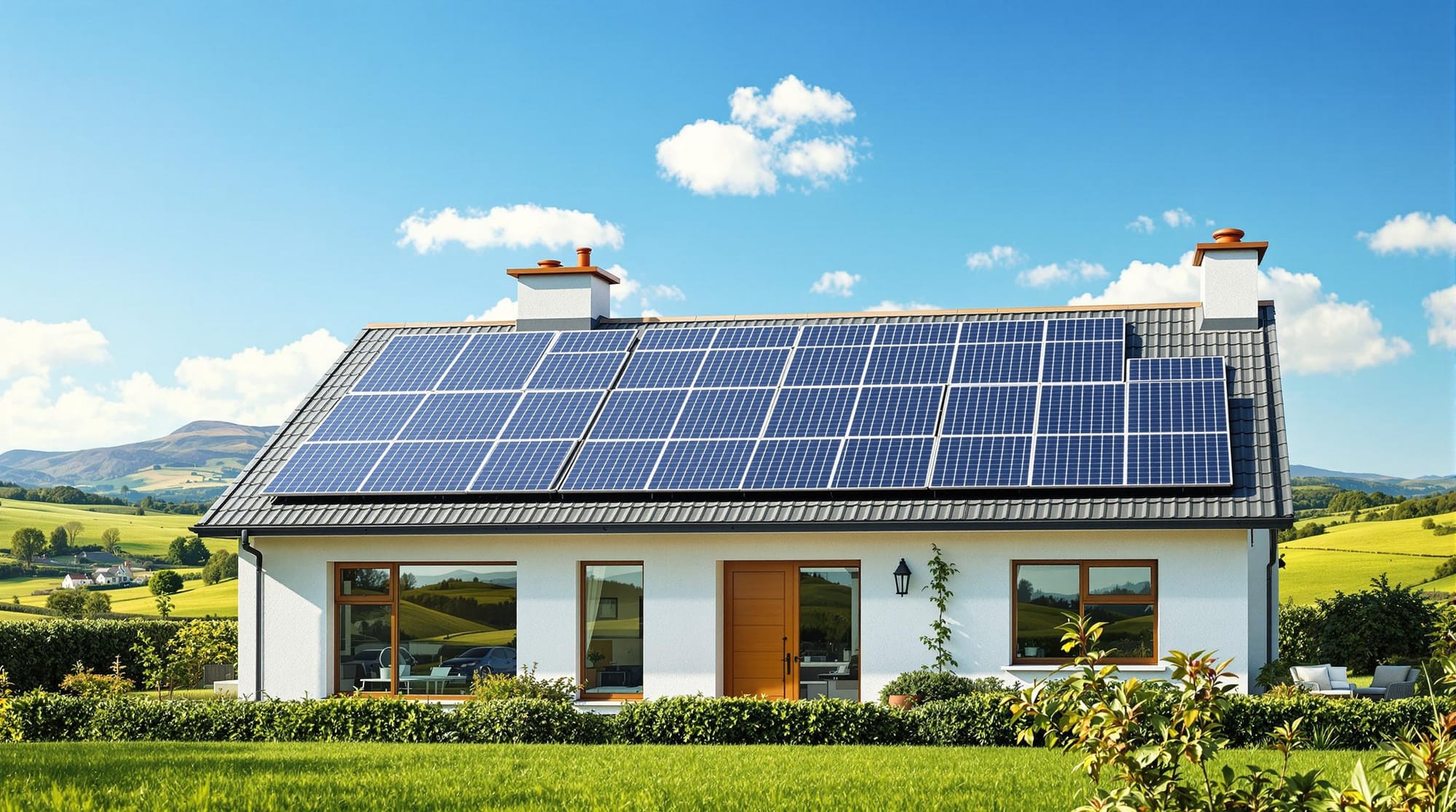
If you're researching solar panels for your home in Ireland, you've probably seen terms like monocrystalline, polycrystalline, thin-film, and bifacial thrown around. It can feel overwhelming, but here's the good news: the choice is much simpler than it looks in 2026.
Monocrystalline panels now account for 98% of all solar panels produced globally. Polycrystalline (the old blue panels) has effectively been discontinued. For most Irish homeowners, the real decision isn't which panel type to choose — it's which brand and installer to go with. But understanding the differences helps you make a smarter purchase.
⚡ Quick Answer: Which Panel Type for Ireland?
Monocrystalline panels are the right choice for almost every Irish home in 2026. They offer the best efficiency (20–24%), work well in Ireland's cloudy climate, fit more power into limited roof space, and last 25–30+ years. Every reputable SEAI-registered installer in Ireland now uses monocrystalline panels as standard.
Solar Panel Types at a Glance
| Panel Type | Efficiency | Cost (4 kWp System) | Lifespan | Best For |
|---|---|---|---|---|
| Monocrystalline | 20–24% | €6,500–€8,500 | 25–30+ years | Almost every Irish home |
| Polycrystalline | 15–17% | N/A (discontinued) | 20–25 years | No longer manufactured |
| Thin-Film | 7–13% | €4,500–€6,000 | 10–20 years | Flexible surfaces, weight-limited roofs |
| Bifacial | 20–24% (+ up to 25% rear gain) | €7,500–€10,000 | 25–30 years | Ground mounts, flat roofs with reflective surface |
| Solar Roof Tiles | 10–20% | €15,000–€30,000+ | 25–30 years | New builds, heritage properties |
| Perovskite (emerging) | Up to 33% (lab) | Not yet commercially available | Unknown | Future technology — watch this space |
Costs are approximate for a 4 kWp system before the SEAI grant (€1,800). All costs at 0% VAT.
1. Monocrystalline Solar Panels — The Standard Choice
Monocrystalline panels are made from a single crystal of silicon, giving them a distinctive black appearance and uniform look. They're the most efficient panels available and dominate the global market — 98% of all solar panels produced in 2023 were monocrystalline.
Why Monocrystalline is Right for Ireland
- Best performance in low light: Ireland's cloudy climate means panels need to work well with diffuse (scattered) light, not just direct sunshine. Monocrystalline panels excel here thanks to their single-crystal structure.
- Most power per square metre: At 20–24% efficiency, you get more electricity from less roof space. Critical for Dublin semis and terraced houses with limited roof area.
- Longest lifespan: 25–30+ years with warranties guaranteeing 80–85% output after 25 years. Some systems from the 1970s are still functioning.
- Sleek appearance: All-black panels look better on most roofs than the older blue polycrystalline style.
- Standard modern wattage: Current monocrystalline panels are typically 400–445W each. You need fewer panels to reach your target system size.
Typical Cost
A 4 kWp monocrystalline system (10 x 440W panels) costs €6,500–€8,500 before the SEAI grant in Ireland. After the €1,800 grant: €4,700–€6,700. This is the standard for residential installations.
Popular Monocrystalline Brands in Ireland
Leading brands used by SEAI-registered installers include Trina Solar, JA Solar, Canadian Solar, Longi, and SunPower. Premium brands like SunPower offer up to 22.8% efficiency and 40-year warranties, but cost more. Mid-range brands like Trina and JA Solar offer excellent value at 20–21% efficiency with 25-year warranties.
💡 Bottom Line
If you're getting solar panels installed on your home in Ireland in 2026, you're getting monocrystalline. It's not even a close call. The only real decision is which brand and what wattage — and your SEAI-registered installer will recommend the best option for your roof and budget.
2. Polycrystalline Solar Panels — The Blue Ones (Discontinued)
Polycrystalline panels — the blue ones you still see on some older roofs — were the most popular type a decade ago. They're made from multiple silicon crystals melted together, which made them cheaper to produce but less efficient.
As of 2024, polycrystalline panels account for 0% of global solar panel production, according to the National Renewable Energy Laboratory. They've been completely replaced by monocrystalline panels, which are now similarly priced but significantly more efficient.
Should You Replace Old Polycrystalline Panels?
If you had polycrystalline panels installed 5–10 years ago, they're still working fine — there's no need to rip them off. But when they eventually need replacing (or if you're adding panels to an existing system), go with monocrystalline. No reputable installer in Ireland offers polycrystalline for new installations in 2026.
3. Thin-Film Solar Panels
Thin-film panels are made by depositing a very thin layer of photovoltaic material (like amorphous silicon, cadmium telluride, or CIGS) onto a surface like glass or metal. They're much thinner, lighter, and more flexible than crystalline panels.
Pros
- Lightweight and flexible: Can be applied to curved surfaces, portable setups, or roofs that can't support heavy panels
- Good in high temperatures: Less efficiency loss in extreme heat (less relevant in Ireland)
- Low-light performance: Performs reasonably well in diffuse light conditions
- Lower cost per panel: Cheaper to manufacture than crystalline panels
Cons
- Much lower efficiency: 7–13% vs 20–24% for monocrystalline. You need roughly twice the roof space for the same power output.
- Shorter lifespan: 10–20 years vs 25–30+ for monocrystalline
- More degradation over time: Performance drops faster than crystalline panels
- Not commonly installed in Ireland: Very few SEAI-registered installers offer thin-film for homes
When Thin-Film Makes Sense
Thin-film is rarely the right choice for a standard Irish home. It can make sense for portable solar (camping, caravans), temporary structures, or very specific situations where weight is a concern and roof space is abundant. For a typical residential installation, monocrystalline is always the better investment.
4. Bifacial Solar Panels
Bifacial panels can generate electricity from both sides — the front captures direct sunlight while the back picks up light reflected off the ground or roof surface below. They're essentially monocrystalline panels with a transparent backsheet instead of an opaque one.
How Much Extra Power?
In ideal conditions (light-coloured ground, raised mounting), bifacial panels can produce 10–25% more energy than standard one-sided panels. The gain depends heavily on the surface below the panels — white or light-coloured surfaces reflect more light to the rear.
Best For
- Ground-mounted systems: Where panels are raised above grass or gravel — the reflected light from below boosts output
- Flat roofs: When panels are tilted on frames with a reflective surface below
- Commercial installations: Where the extra cost is justified by higher output over larger arrays
Worth It for Irish Homes?
For a standard rooftop installation on a pitched roof, bifacial panels offer minimal advantage — the roof surface below doesn't reflect enough light. The extra cost (€1,000–€2,000 for a typical system) is rarely justified for residential rooftop use in Ireland. They're more relevant for ground-mounted garden installations or commercial projects.
5. Solar Roof Tiles (Solar Slates)
Solar tiles replace your actual roof tiles with tiles that generate electricity. They look like regular roofing tiles but contain photovoltaic cells. The most well-known brand is Tesla's Solar Roof, but other companies like Nulok and Planum also offer solutions in Ireland.
Pros
- Aesthetics: Near-invisible solar generation — looks like a normal roof
- Dual purpose: Serves as both your roof covering and solar generation
- Good for heritage properties: Where visible solar panels might not be appropriate
Cons
- Very expensive: €15,000–€30,000+ for a typical home — 2–4x the cost of standard panels
- Lower efficiency: 10–20% vs 20–24% for standard monocrystalline panels
- Limited availability in Ireland: Very few installers offer solar tiles
- Only makes sense with a new roof: If you need to re-roof anyway, the economics improve. Retrofitting solar tiles onto an existing good roof makes no financial sense.
Our Take
Solar tiles are a niche product. They make sense if you're building a new home, re-roofing an existing property, or have aesthetic restrictions (e.g., conservation area). For everyone else, standard monocrystalline panels offer far better value and faster payback.
6. Perovskite Solar Cells — The Future?
Perovskite solar cells are an exciting emerging technology that has achieved over 33% efficiency in laboratory settings when combined with silicon (tandem cells). That's significantly higher than any commercial panel available today.
However, perovskite panels are not yet commercially available for home use. Researchers are still working on durability (current perovskite cells degrade much faster than silicon) and scaling up manufacturing. Irish institutions including Trinity College Dublin and UCD are involved in perovskite research.
When perovskite-silicon tandem cells eventually reach the market (potentially within 5–10 years), they could deliver 30%+ efficiency in a commercial panel — a significant leap. But for anyone buying solar in 2026, monocrystalline silicon is the proven, available, and cost-effective choice.
Which Panel Type for Your Irish Home?
| Your Situation | Best Panel Type | Why |
|---|---|---|
| Standard home (any size) | Monocrystalline | Best efficiency, longest life, best value in Ireland |
| Limited roof space (Dublin semi) | Monocrystalline (high wattage, 440W+) | Maximum power per panel = fewer panels needed |
| Large roof, budget-conscious | Monocrystalline (mid-range brand) | Brands like Trina and JA Solar offer great value |
| Ground-mounted garden system | Bifacial monocrystalline | Captures reflected light from below for 10–25% extra |
| New build / re-roofing | Solar roof tiles (consider) | Integrated aesthetics if budget allows |
| Heritage / conservation area | Solar tiles or in-roof panels | Minimal visual impact on protected buildings |
| Campervan / caravan / portable | Thin-film or portable mono | Lightweight and flexible for mobile use |
What to Look for When Comparing Panels
Once you've settled on monocrystalline (as most Irish homeowners will), here's what actually matters when comparing specific panels and quotes:
Wattage (Power Rating)
Modern residential panels range from 400W to 445W. Higher wattage means fewer panels for the same system size. A 440W panel generates roughly 10% more power than a 400W panel in the same space.
Efficiency Rating
Look for 20%+ efficiency. Premium panels hit 22–24%. Higher efficiency matters most when roof space is limited — you'll get more power from fewer panels.
Product Warranty
The product warranty covers manufacturing defects. Standard is 12–15 years; premium brands offer 25–40 years. This is separate from the performance warranty.
Performance Warranty
Guarantees minimum power output over time. Standard: 80–85% output after 25 years. This means a 440W panel should still produce at least 352–374W after 25 years.
Temperature Coefficient
How much efficiency drops as temperature rises. Lower is better (e.g., -0.29%/°C is better than -0.37%/°C). Less critical in Ireland's mild climate than in hotter countries, but still worth checking.
The SEAI Grant: Same for All Panel Types
The SEAI Solar PV Grant (up to €1,800 in 2026) applies equally to all panel types — monocrystalline, thin-film, bifacial, or solar tiles. The grant is based on system size (kWp), not panel type. The same eligibility rules apply: home built before 2021, homeowner, SEAI-registered installer.
Frequently Asked Questions
What type of solar panel is best for Ireland?
Monocrystalline panels are the best choice for Irish homes in 2026. They offer the highest efficiency (20–24%), work well in Ireland's cloudy climate with diffuse light, and last 25–30+ years. 98% of all panels installed in Ireland today are monocrystalline.
Are polycrystalline panels still available?
No. Polycrystalline panels account for 0% of global production as of 2024. They've been completely replaced by monocrystalline, which now costs about the same but performs significantly better. If you see blue panels on a roof, they were installed years ago.
Do solar panels work in Ireland's cloudy weather?
Yes. Solar PV panels generate electricity from daylight, not direct sunshine. Monocrystalline panels perform particularly well in low-light and cloudy conditions. Ireland's long summer days (up to 17 hours of daylight) and mild temperatures actually help panel performance.
What's the difference between monocrystalline and polycrystalline?
Monocrystalline panels (black) are made from a single silicon crystal — higher efficiency, longer life, better in low light. Polycrystalline (blue) used multiple crystals — lower efficiency, shorter life. The price gap has disappeared, making polycrystalline obsolete.
Are solar roof tiles worth it in Ireland?
Only in specific situations: new builds where you'd be paying for roofing anyway, re-roofing projects, or properties where visible panels aren't acceptable. At 2–4x the cost of standard panels with lower efficiency, solar tiles don't make financial sense for most existing Irish homes.
What wattage solar panel should I get?
Modern residential panels are typically 400–445W. Higher wattage panels (430–445W) are recommended when roof space is limited, as you'll need fewer panels. For most Irish homes, 440W panels from brands like Trina Solar or JA Solar offer the best balance of performance and value.
How many solar panels do I need for my house?
Most Irish homes need 8–12 monocrystalline panels (3.5–5 kWp). A 3-bed semi typically needs 10 panels. Your installer will size the system based on your electricity usage, roof space, and orientation.
What is a bifacial solar panel?
A bifacial panel generates electricity from both sides — the front captures direct sunlight while the back captures reflected light. They produce 10–25% more energy in ideal conditions (ground mount with reflective surface). For standard rooftop installations, the extra cost is rarely justified.
Should I wait for perovskite solar panels?
No. Perovskite technology is still years away from commercial availability. Current monocrystalline panels are excellent and pay for themselves in 4–7 years. Waiting means missing out on years of savings and the current €1,800 SEAI grant (which may be reduced in future years).
📞 Get 3 Free Solar Quotes for Your Home
Compare prices from SEAI-approved installers who use the best monocrystalline panels. 100% free, no obligation. Our trusted partners handle the full SEAI grant application for you.
Related Guides
Stop Overpaying for Electricity in 2026
Irish homeowners are saving thousands with the €2,400 SEAI grant and 0% VAT. Get 3 free quotes from vetted, SEAI-approved installers.
Your data is secure. We only share with top-rated SEAI-approved installers.