Is It Worth Getting a Battery With Solar Panels in Ireland? (2026 Analysis)
For most Irish homeowners in 2026, a solar battery is a worthwhile investment IF you use a lot of electricity in the evenings, charge an EV at home, or want backup power during outages. The typical 5-10 kWh battery costs €4,000-€7,000 installed, saves an additional €300-€500 per year on top of your solar panels, and pays for itself in 8-14 years. However, if you mainly use electricity during the day or have a modest electricity bill, a €400 power diverter may be better value. See our solar panel costs for more details. See our solar immersion diverter guide for more details.
That opening paragraph is the honest truth, and it sets the tone for this entire guide. We are not here to sell you a battery. We are here to help you figure out if one makes sense for your home, your usage, and your budget. We will show you the real numbers, the real brands available in Ireland, and the scenarios where a battery is a smart investment versus the scenarios where your money is better spent elsewhere. See our Clean Export Guarantee rates for more details.

Is a Solar Battery Worth It in Ireland? The Honest Answer
The short answer: yes for some households, no for most. That might surprise you from a solar energy website, but honesty is more useful than hype. Whether a battery is worth it depends almost entirely on your electricity usage patterns and what you are trying to achieve.
| Condition | Battery Worth It? | Why |
|---|---|---|
| House empty during the day, high evening usage | Yes | Without a battery, most solar is exported at low rates. A battery stores it for evening use. |
| EV owner charging at home | Yes | Stored solar can charge your EV overnight instead of drawing from the grid at peak rates. |
| Smart tariff with cheap night rates | Yes | Grid arbitrage works 365 days a year, not just sunny days. Saves €150-€300 extra annually. |
| Backup power during outages is important | Yes | A battery with backup capability keeps essential circuits running during power cuts. |
| Home during the day, already using solar directly | No | Your self-consumption is already 50-70%. A battery adds marginal benefit. |
| Low electricity bill (under €100/month) | No | Not enough electricity spend for a battery to offset its cost within its lifespan. |
| Tight budget, no panels yet | No | Spend the money on more panels instead. Solar panels pay back in 4-7 years; batteries take 8-14. |
The key insight is this: solar panels are almost always worth it; batteries are only worth it in specific circumstances. Panels alone pay for themselves in 4-7 years with SEAI grants. Batteries add 8-14 years of payback on top of that. The battery does not replace panels — it supplements them. Think of panels as the main course and the battery as a side dish that makes the meal better but is not essential.
Quick Summary: Solar Batteries in Ireland 2026
- Cost: €4,000-€7,000 fully installed (5-10 kWh capacity)
- SEAI battery grant: €600 (when installed with solar panels)
- VAT: 0% on solar panels and batteries when installed together
- Annual additional savings: €300-€500 per year beyond panels alone
- Payback period: 8-14 years depending on usage
- Battery lifespan: 10-15 years (warranty typically 10 years)
- Self-consumption increase: From 30-40% to 60-80%
- Top brands: Huawei LUNA 2000, Tesla Powerwall 3, GivEnergy, BYD HVS
How Solar Batteries Work
Understanding how a solar battery works takes about 60 seconds. Here is the simple version.
Your solar panels generate electricity during daylight hours. In a typical Irish home, you use about 30-40% of that electricity as it is produced — powering your fridge, router, washing machine, and anything else running during the day. The remaining 60-70% gets exported to the grid because you are not home or simply not using enough electricity at that moment.
Your electricity supplier pays you for that export — typically 18-24c per kWh under the Clean Export Guarantee (CEG). But when you need electricity in the evening, you buy it back from the grid at 35-45c per kWh. You are selling cheap and buying expensive.
A battery changes this equation. Instead of exporting surplus solar at 20c, the battery stores it. When the sun goes down and you start cooking dinner, turning on lights, and watching TV, the battery releases that stored electricity. You are using your own solar power instead of buying from the grid at 40c per kWh. The saving is the difference between what you would have imported (40c) minus what you would have earned exporting (20c) — roughly 20c per kWh stored and used.
Here is the daily flow for a home with solar panels and a battery:
- Morning (7am-9am): Panels start generating. Battery begins charging from surplus solar.
- Midday (10am-3pm): Peak solar generation. Home uses some, battery fills up, any remaining surplus exports to the grid.
- Evening (4pm-10pm): Solar generation drops. Battery discharges to power the home. Grid only kicks in when the battery is empty.
- Night (10pm-7am): No solar. If you are on a smart tariff, the battery can charge from cheap night-rate grid electricity (10-15c/kWh) to use during tomorrow's peak hours.
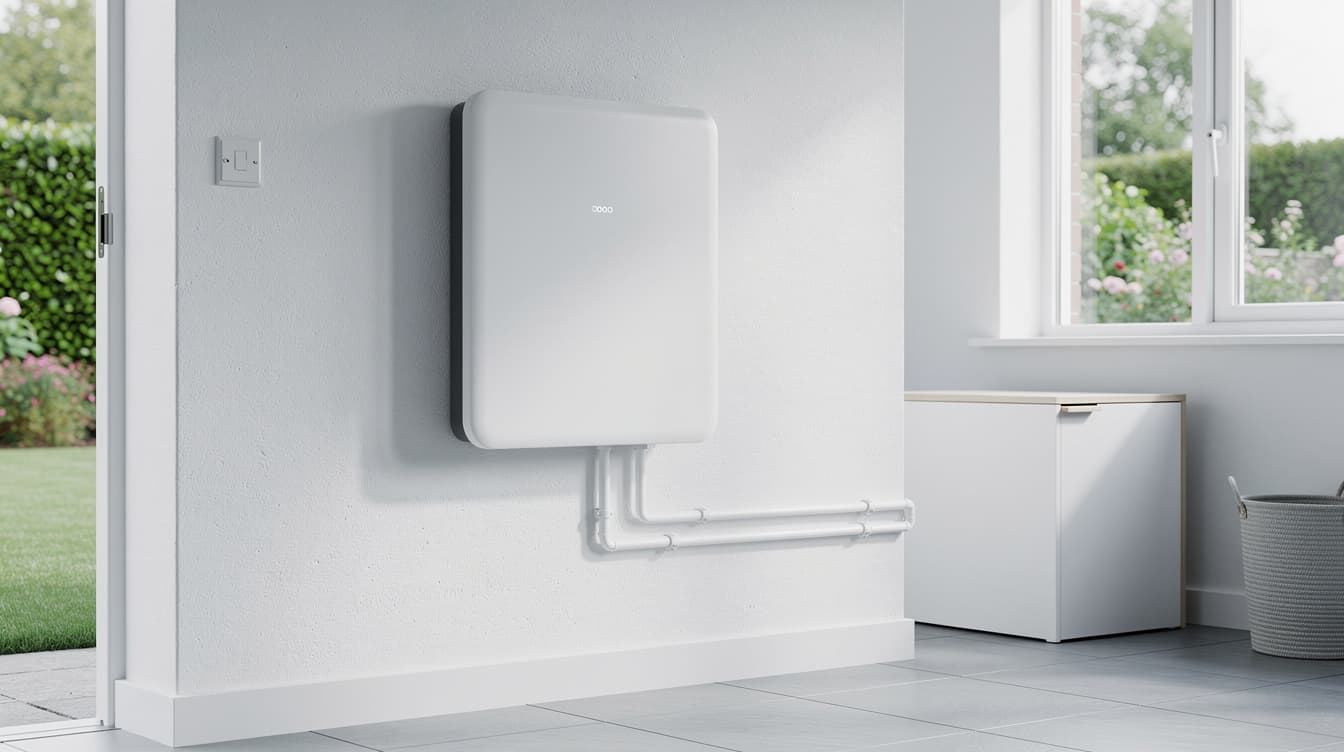
The technology is straightforward: modern solar batteries use lithium iron phosphate (LFP) chemistry, which is the same technology used in electric vehicles. They are safe, quiet, wall-mounted, and about the size of a small fridge. Installation takes half a day.
Solar Battery Costs in Ireland 2026
Battery prices have come down significantly over the past three years, but they are still a meaningful investment. Here are the realistic installed costs for the most popular battery sizes and brands in Ireland in 2026:

| Battery | Capacity | Installed Cost | Notes |
|---|---|---|---|
| Huawei LUNA 2000 (1 module) | 5 kWh | €4,000-€5,000 | Most popular in Ireland. Requires Huawei hybrid inverter. |
| Huawei LUNA 2000 (2 modules) | 10 kWh | €5,500-€6,500 | Sweet spot for larger homes. Modular — add modules later. |
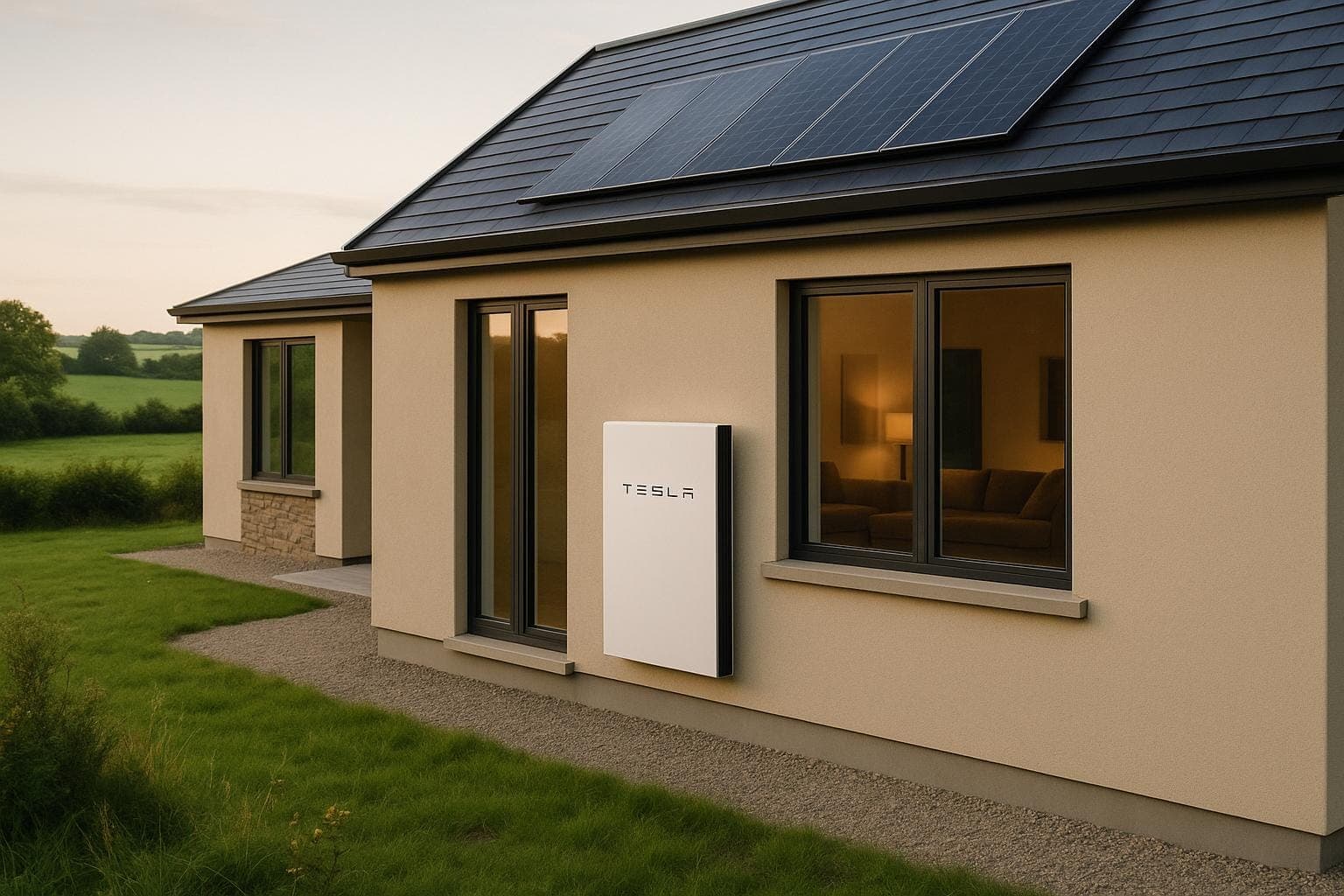
| Tesla Powerwall 3 | 13.5 kWh | €8,000-€11,000 | Premium. Built-in inverter. Integrated backup as standard. |
| GivEnergy All-in-One | 5 kWh | €4,000-€5,500 | Integrated inverter and battery. Good for retrofits. |
| GivEnergy All-in-One | 10 kWh | €5,500-€7,000 | Expandable with add-on battery modules. |
| BYD HVS | 5.1 kWh | €4,500-€5,500 | Reliable. Compatible with multiple inverter brands. |
| BYD HVS | 10.2 kWh | €6,000-€7,500 | Modular tower design. Strong warranty. |
All prices include installation and VAT at 0% (when installed with solar panels on the same contract). If your system already has a compatible hybrid inverter, the battery-only cost will be at the lower end. If you need a new hybrid inverter, add €800-€1,500. See our Tesla Powerwall costs for more details.
The most common setup in Ireland is a Huawei LUNA 2000 5 kWh battery paired with a Huawei SUN2000 hybrid inverter, coming in at roughly €4,000-€5,000 installed. This is the configuration most Irish solar installers recommend and carry in stock.
The Real Savings: Battery vs No Battery
Let us look at the real numbers. Below is a side-by-side comparison for a typical Irish 3-bed semi-detached home with a 4.1 kWp solar panel system, annual electricity consumption of 4,200 kWh, and an electricity rate of 40c/kWh import and 21c/kWh export.
| Metric | Solar Only (No Battery) | Solar + 5 kWh Battery | Solar + 10 kWh Battery |
|---|---|---|---|
| Self-consumption rate | 30-40% | 60-70% | 70-80% |
| Solar used directly in home (kWh/yr) | ~1,300 | ~2,500 | ~2,900 |
| Exported to grid (kWh/yr) | ~2,500 | ~1,300 | ~900 |
| Grid import savings | €520 | €1,000 | €1,160 |
| Export income (CEG) | €525 | €273 | €189 |
| Total annual benefit | €1,045 | €1,273 | €1,349 |
| Extra annual benefit from battery | — | +€228 | +€304 |
| Smart tariff arbitrage (additional) | — | +€100-€200 | +€150-€300 |
| Total extra benefit from battery (with arbitrage) | — | €328-€428 | €454-€604 |
| Battery cost (installed) | — | €4,000-€5,000 | €5,500-€6,500 |
| Battery payback period | — | 9-15 years | 9-14 years |
The key takeaway: a battery does save you money, but the payback is roughly double that of the panels themselves. Solar panels alone in Ireland pay for themselves in 4-7 years. Adding a battery extends the payback on the battery portion to 8-14 years. This is still within the battery's lifespan, so you will come out ahead — but it is a longer wait than many homeowners expect.
The savings improve significantly if you are on a smart tariff that allows grid arbitrage (charging at night rates, discharging at peak rates). This can add €100-€300 per year to the battery's value and works every day of the year, not just sunny days.

When a Solar Battery IS Worth It
There are five clear scenarios where a battery makes strong financial and practical sense in Ireland. If two or more of these apply to you, a battery is almost certainly worth the investment.
1. High Evening Electricity Usage
If your household is out during the day and uses most electricity between 5pm and 11pm, a battery is ideal. Without one, your solar panels export 60-70% of their output at 18-24c/kWh. A 5 kWh battery captures roughly 5 kWh of that daily surplus and lets you use it in the evening instead of buying from the grid at 35-45c/kWh. That is a saving of roughly 15-20c for every kWh stored — adding up to €250-€400 per year in a typical home.
2. EV Owners Charging at Home
If you have an electric vehicle, a battery transforms your solar economics. An EV typically needs 8-12 kWh per day for average Irish driving (14,000 km/year). Without a battery, you either charge from the grid (costing €1,200-€1,800/year at peak rates) or use cheap night rates (€500-€700/year). With a battery, you can store daytime solar and charge your EV in the evening — effectively driving on free fuel. A 10 kWh battery used partly for EV charging can save an additional €300-€500 per year compared to grid-only EV charging.
3. Frequent Power Cuts in Your Area
Some parts of rural Ireland experience several power cuts per year. A battery with backup capability (not all have this — see our section below) keeps your lights, fridge, heating controls, and internet running during outages. This is not a pure financial calculation — it is about peace of mind. If you work from home and a power cut costs you a day's productivity, or if you have medical equipment that needs continuous power, the value of backup is significant.
4. Smart Tariff Arbitrage
This is where batteries get really interesting. If you are on a smart electricity tariff with cheap night rates (8-15c/kWh) and expensive peak rates (38-45c/kWh), your battery can charge from the grid at night and discharge during peak hours. The saving is the spread between rates — roughly 20-30c per kWh. A 5 kWh battery cycling daily on arbitrage alone saves €150-€250 per year — and this works 365 days a year regardless of weather. Combined with solar storage, the total battery savings reach €400-€600 annually.
5. Future-Proofing Against Rising Electricity Prices
Electricity prices in Ireland have increased by over 40% in the past five years. Every cent that electricity prices rise makes your battery more valuable, because the gap between export rates and import rates widens. If electricity reaches 50c/kWh (not unrealistic given recent trends), a 5 kWh battery's annual savings jump to €400-€550, bringing the payback period down to 8-10 years. A battery installed today is a hedge against future price rises.
When a Solar Battery is NOT Worth It
This section might cost us a sale, but it will save you money. Here are five honest scenarios where a battery is not the right investment.
1. Your Electricity Bill is Already Low
If your electricity bill is under €100 per month (roughly €1,200/year), you simply do not use enough electricity for a battery to pay back within its lifespan. A battery saves you money by shifting when you use solar electricity — but if your total consumption is modest, the absolute savings are small. A household spending €80/month on electricity might save only €150-€200/year with a battery, giving a payback of 20+ years. That is beyond the battery's lifespan.
2. You Are Home During the Day and Already Using Your Solar
If you are retired, work from home, or have someone in the house during daylight hours running the washing machine, dishwasher, and other appliances, your self-consumption rate is already 50-70% without a battery. A battery would only capture the remaining 30-50% of surplus, and the marginal benefit is much smaller — perhaps €100-€200/year. At that rate, payback stretches to 15-25 years.
3. Tight Budget Better Spent on a Bigger Solar System
If you have €5,000 to spend and you do not yet have solar panels, do not buy a battery. That money will get you a 3-4 kWp solar system with SEAI grants, which will save €800-€1,100 per year and pay for itself in 4-6 years. Compare that to a standalone battery saving €300-€500/year with a 10-14 year payback. Panels first, battery second — always.
Even if you already have panels, if your system is small (2-3 kWp / 5-7 panels), consider adding more panels before adding a battery. Extra panels generate more total electricity, increasing both direct use and export income. The payback on additional panels (4-6 years) is significantly faster than on a battery.
4. Your Solar Panels Are Old and Nearing End of Life
If your solar panels are 15-20 years old and approaching their end of life, investing €4,000-€7,000 in a battery for a declining system does not make sense. Panel output degrades by about 0.5% per year, so 15-year-old panels produce roughly 7-8% less than when new. You would be better off planning a panel replacement or upgrade, which you could bundle with a battery at that point to get 0% VAT on the whole system.
5. You Already Have High Self-Consumption
Some households — particularly those with electric heating, heat pumps running during the day, or a hot water diverter already installed — achieve 60-70% self-consumption without a battery. Adding a battery might push this to 80-85%, but the extra 15-20% captured represents only a small improvement. If you are already using most of your solar electricity, a battery adds limited value. Check your inverter app or monitoring system to see your current self-consumption rate before deciding.
Not Sure if a Battery Is Right for You?
The best way to find out is to have an SEAI-registered installer assess your home, your electricity usage, and your current solar setup. They can calculate your actual self-consumption rate and project the real savings a battery would deliver for your specific situation.
Battery Payback Period: Realistic Calculations
The payback period is the single most important number when deciding on a battery. It varies widely depending on your electricity rate, how much you use the battery, and whether you do smart tariff arbitrage. Here is a sensitivity analysis showing payback under different conditions:
5 kWh Battery (Cost: €4,500 after SEAI grant)
| Scenario | Annual Battery Savings | Payback Period |
|---|---|---|
| Low usage, no arbitrage (35c/kWh import) | €200-€280 | 16-22 years |
| Average usage, no arbitrage (40c/kWh import) | €300-€380 | 12-15 years |
| Average usage + smart tariff arbitrage | €400-€500 | 9-11 years |
| High usage + arbitrage (45c/kWh import) | €480-€580 | 8-9 years |
| High usage + arbitrage + EV charging | €550-€700 | 6-8 years |
10 kWh Battery (Cost: €5,900 after SEAI grant)
| Scenario | Annual Battery Savings | Payback Period |
|---|---|---|
| Low usage, no arbitrage (35c/kWh import) | €280-€380 | 16-21 years |
| Average usage, no arbitrage (40c/kWh import) | €380-€480 | 12-16 years |
| Average usage + smart tariff arbitrage | €500-€650 | 9-12 years |
| High usage + arbitrage (45c/kWh import) | €620-€780 | 8-10 years |
| High usage + arbitrage + EV charging | €750-€950 | 6-8 years |
The pattern is clear: batteries pay back fastest when you combine solar storage with smart tariff arbitrage and EV charging. In the best-case scenario, payback drops to 6-8 years. In the worst case — low usage, no arbitrage — it stretches beyond the battery's warranty period, which makes it a poor investment.
One important note on these calculations: they assume current electricity prices. If electricity prices rise by 3-5% per year (which has been the trend), payback periods shorten by 1-2 years. Conversely, if export rates increase significantly, the gap between using stored solar and exporting narrows, reducing the battery's advantage.
Solar Battery Comparison: Top Brands in Ireland 2026
Four battery brands dominate the Irish residential market. Here is a detailed comparison to help you choose the right one for your home.

| Feature | Huawei LUNA 2000 | Tesla Powerwall 3 | GivEnergy All-in-One | BYD HVS |
|---|---|---|---|---|
| Usable capacity | 5-15 kWh (modular) | 13.5 kWh | 5-15.8 kWh (modular) | 5.1-12.8 kWh (modular) |
| Chemistry | LFP | LFP | LFP | LFP |
| Warranty | 10 years | 10 years | 12 years | 10 years |
| Cycle life | 6,000+ cycles | Unlimited (warranty period) | 6,000+ cycles | 6,000+ cycles |
| Max discharge rate | 2.5-5 kW | 11.5 kW | 3.6 kW | 2.56-5.12 kW |
| Backup capable | Yes (with backup box) | Yes (built-in) | Yes (with EPS) | Yes (inverter dependent) |
| Built-in inverter | No (needs Huawei hybrid) | Yes | Yes (All-in-One model) | No (multi-brand compatible) |
| Monitoring app | FusionSolar | Tesla app | GivEnergy portal | Varies by inverter |
| Installed cost (5 kWh) | €4,000-€5,000 | N/A (13.5 kWh only) | €4,000-€5,500 | €4,500-€5,500 |
| Installed cost (10 kWh) | €5,500-€6,500 | N/A | €5,500-€7,000 | €6,000-€7,500 |
| Installed cost (13.5 kWh) | €7,000-€8,500 | €8,000-€11,000 | €7,500-€9,000 | €7,500-€9,500 |
| Best for | Most Irish homes (if using Huawei inverter) | Large homes, full backup, premium choice | Retrofits, all-in-one simplicity | Flexibility with different inverter brands |
Our take: The Huawei LUNA 2000 is the default choice for most Irish homes because the majority of solar installers already use Huawei inverters. It is reliable, modular (start with 5 kWh, add more later), and competitively priced. The Tesla Powerwall 3 is the premium option — more expensive, but it has a built-in inverter and the best backup power capability. GivEnergy is the best choice for retrofitting a battery to an existing system, particularly if you do not have a Huawei inverter. BYD is a solid workhorse that pairs with multiple inverter brands.
Can You Add a Battery to Existing Solar Panels?
Yes, absolutely. Retrofitting a battery to an existing solar panel system is increasingly common in Ireland, and it is a perfectly valid approach. However, the process and cost depend on one critical factor: what type of inverter you currently have.
If You Have a Hybrid Inverter (Most Likely)
If your solar panels were installed in the last 2-3 years, there is a good chance your installer fitted a hybrid inverter — even if you did not get a battery at the time. Most Irish installers now fit Huawei SUN2000 hybrid inverters as standard because the cost difference versus a standard inverter is small, and it makes the system battery-ready.
Adding a battery to a hybrid inverter is straightforward. The battery module connects directly to the inverter via a DC cable. Installation takes 2-4 hours. Cost: €3,000-€5,000 for the battery unit and installation labour, depending on capacity.
If You Have a Standard String Inverter
If your system uses a standard (non-hybrid) inverter, you have two options:
- Option A: AC-coupled battery. Install a separate battery system with its own inverter (like the GivEnergy All-in-One or Tesla Powerwall 3, which have built-in inverters). This sits alongside your existing system and does not require replacing your current inverter. Cost: €4,500-€7,000.
- Option B: Replace the inverter. Swap your standard inverter for a hybrid model and add a DC-coupled battery. This is more efficient but involves replacing working equipment. Cost: €5,000-€8,000 (new hybrid inverter + battery).
For most retrofit situations, Option A (AC-coupled) is the most practical because it does not disturb your existing system.
The Process
- Assessment: An installer inspects your current system, checks inverter compatibility, and recommends the right battery size.
- Quote: You receive a detailed quote including equipment and installation.
- Installation: Typically completed in half a day.
- Commissioning: The installer configures the battery's charging and discharging schedules.
- Notification: ESB Networks is notified of the system change (your installer handles this).
Important VAT note: If you add a battery as a separate project (not at the same time as your original solar installation), it may attract the standard 23% VAT rate rather than 0%. Check with your installer, as the rules depend on whether the battery is considered part of the original solar installation contract.
Do Solar Batteries Work During Power Cuts?
This is one of the most misunderstood aspects of solar batteries. The short answer: not all batteries provide backup during power cuts, and those that do require additional hardware.
Why Standard Solar Systems Shut Down During Outages
When the grid goes down, your solar panels and battery are required by law to shut down immediately. This is called "anti-islanding" protection, and it exists for a critical safety reason: ESB Networks engineers working on the lines must be certain that no electricity is being fed into the grid from any source. If your solar system kept running and feeding power back, it could electrocute someone repairing the lines.
How Backup-Capable Batteries Work
A backup-capable battery uses a changeover switch (also called an EPS — Emergency Power Supply, or backup box) to physically disconnect your home from the grid during an outage. Once disconnected, your battery can safely power a set of designated circuits in your home without any risk of feeding power back to the grid.
Key points about backup operation:
- Not whole-house backup: Most residential systems power only essential circuits — lights, fridge, internet router, phone charging, heating controls. Running an electric cooker, oven, or immersion heater from a 5 kWh battery would drain it in under an hour.
- Switchover is not instant: There is typically a 5-10 second gap while the system detects the outage and switches over. Sensitive electronics may need a UPS.
- Solar can recharge during outages: If the power cut happens during the day, your panels can continue charging the battery, potentially giving you power indefinitely until the grid returns.
Which Brands Offer Backup?
| Battery | Backup Capability | What You Need | Extra Cost |
|---|---|---|---|
| Tesla Powerwall 3 | Built-in | Included as standard — no extra hardware needed | €0 |
| Huawei LUNA 2000 | Optional | Huawei Backup Box-B1 accessory required | €500-€1,000 |
| GivEnergy All-in-One | Optional | EPS (Emergency Power Supply) module required | €500-€800 |
| BYD HVS | Inverter-dependent | Depends on which inverter brand is paired | €500-€1,000 |
If backup during power cuts is important to you, mention this to your installer at the quoting stage. The backup hardware is much cheaper and easier to install at the same time as the battery rather than retrofitting it later.

Battery vs Power Diverter: Which Is Better Value?
This is the comparison most solar websites do not make — and it is arguably the most important one for Irish homeowners. A power diverter (also called an immersion diverter or solar diverter) is a small device that sends surplus solar electricity to your immersion heater to heat your hot water tank, instead of exporting it to the grid.
On pure return on investment, a €400 power diverter beats a €5,000 battery every time. Here is the honest comparison:
| Feature | Power Diverter | 5 kWh Battery |
|---|---|---|
| Cost (installed) | €300-€500 | €4,000-€5,000 |
| Annual savings | €150-€300 | €300-€500 |
| Payback period | 1-2 years | 8-14 years |
| What it does with surplus | Heats your hot water | Powers any appliance in the evening |
| Works in evening? | No (daytime only) | Yes (that is the whole point) |
| Backup during outages? | No | Yes (with backup hardware) |
| Smart tariff arbitrage? | No | Yes |
| Complexity | Very simple — one device, no app | More complex — inverter integration, monitoring |
| Lifespan | 15-20+ years | 10-15 years |
| ROI (10-year return) | 300-700% | -20% to +25% |
The numbers speak for themselves. A power diverter costing €400 that saves €200/year has a 2-year payback and generates 300-700% ROI over 10 years. A battery costing €4,500 that saves €400/year takes 11 years to break even.
However, a diverter and a battery are not mutually exclusive — they serve different purposes:
- A diverter uses surplus solar to heat water during the day. It is limited to one use (hot water) and only works while the sun is shining.
- A battery stores surplus solar for any use in the evening. It is flexible and also enables grid arbitrage.
Our recommendation: Every solar home in Ireland should have a power diverter — it is a no-brainer at €300-€500 with a 1-2 year payback. Whether you also need a battery depends on your evening usage, EV ownership, and whether you want backup power. Many Irish homes benefit most from both a diverter and a battery working together: the diverter captures surplus for hot water first, and the battery stores the rest for evening use.
SEAI Battery Grant and 0% VAT
There are two financial supports that reduce the cost of a solar battery in Ireland: the SEAI grant and the 0% VAT rate.
SEAI Battery Grant: €600
The SEAI (Sustainable Energy Authority of Ireland) offers a €600 grant for battery storage when it is installed as part of a solar PV system. This grant is part of the overall SEAI solar PV grant scheme and applies when you install a battery at the same time as your solar panels, or add a battery to an existing SEAI-grant-supported system.
Key conditions:
- The battery must be installed by an SEAI-registered contractor.
- The home must be built before 2011 (same as the solar panel grant).
- The battery must have a minimum usable capacity of 2 kWh.
- Only one battery grant per property.
- The grant is applied for by your installer as part of the overall solar PV grant application.
0% VAT on Solar Batteries
Since 2023, the supply and installation of solar panels qualifies for the 0% VAT rate in Ireland. Batteries installed as part of a solar PV system on the same contract also benefit from 0% VAT. This saves roughly €700-€1,300 compared to the standard 23% VAT rate, depending on the battery cost.
When 0% VAT applies:
- Battery installed at the same time as solar panels, on the same contract.
- Battery added to an existing solar system where the battery supply and installation is clearly linked to the solar PV system.
When 0% VAT may NOT apply:
- A standalone battery with no solar panels (rare, but some people want grid-only arbitrage).
- A battery purchased separately and self-installed (the 0% rate applies to supply and installation together).
Total Savings on a 5 kWh Battery
Battery cost before supports: ~€5,100 (incl. 23% VAT)
SEAI grant: -€600
0% VAT saving: -€950
Your cost: ~€3,550-€4,500
These supports reduce the effective cost of a battery by roughly €1,500, bringing the payback period down by 2-4 years.
Frequently Asked Questions
Are solar batteries worth it in Ireland in 2026?
For households that use most electricity in the evenings and are out during the day, yes — a battery saves approximately €300-€500 per year and pays for itself in 8-14 years. For households that are home during the day and already use most solar electricity directly, the financial case is weaker and a power diverter (€300-€500) may be better value.

How much does a solar battery cost in Ireland in 2026?
A 5 kWh battery costs approximately €4,000-€5,000 fully installed with 0% VAT. A 10 kWh battery costs €5,500-€6,500. The Tesla Powerwall 3 (13.5 kWh) costs €8,000-€11,000. The SEAI grant reduces these costs by a further €600.
Is there an SEAI grant for solar batteries?
Yes. The SEAI offers a €600 grant for battery storage when installed as part of a solar PV system by an SEAI-registered contractor. This is in addition to the solar panel grants (€900-€2,100 depending on system size). Batteries also qualify for 0% VAT when installed with solar panels.
What is the best solar battery for Ireland?
The Huawei LUNA 2000 is the most popular solar battery in Ireland because most installers use Huawei inverters. It is modular (start with 5 kWh, expand later), competitively priced, and reliable. The Tesla Powerwall 3 is the premium choice with built-in backup. GivEnergy is best for retrofitting to non-Huawei systems.
How long does a solar battery last?
Most modern solar batteries last 10-15 years with daily cycling. Warranties typically guarantee 10-12 years or 6,000+ charge cycles, whichever comes first. At one cycle per day, 6,000 cycles equates to roughly 16 years. Battery capacity degrades gradually — expect 70-80% of original capacity after 10 years.
Can I add a battery to my existing solar panels?
Yes. If you have a hybrid inverter (most systems installed in the last 2-3 years), adding a battery is straightforward and costs €3,000-€5,000. If you have a standard inverter, you can add an AC-coupled battery (like the GivEnergy All-in-One) without replacing your inverter, at a cost of €4,500-€7,000.
Will a solar battery work during a power cut?
Not by default. You need a battery with backup capability and a changeover switch (EPS/backup box). The Tesla Powerwall 3 has this built in. Huawei and GivEnergy require an additional module costing €500-€1,000. Standard batteries without backup hardware shut down during grid outages for safety.
Should I get a battery or more solar panels?
If your budget is limited, more panels almost always have a faster payback (4-6 years vs 8-14 years for a battery). However, if you already have a good-sized system (4+ kWp) and use most electricity in the evenings, a battery provides more value than additional panels. The ideal approach is to install a hybrid inverter with your panels and add a battery later.
Can I charge a battery from the grid at cheap night rates?
Yes. If you have a smart meter and a compatible hybrid inverter, you can programme your battery to charge from the grid during off-peak hours (typically 11pm-8am at 8-15c/kWh) and discharge during peak hours (35-45c/kWh). This grid arbitrage saves €150-€300 per year and works regardless of weather.
What size battery do I need?
A 5 kWh battery suits most 3-bed homes with a 4 kWp solar system, covering 4-6 hours of typical evening usage. Larger homes, families with high evening consumption, or those with an EV should consider 10 kWh. A good rule of thumb: your battery size (kWh) should roughly match your daily surplus solar generation.
Is a battery or a power diverter better?
On pure ROI, a power diverter wins easily — €300-€500 cost with a 1-2 year payback vs €4,000-€7,000 for a battery with an 8-14 year payback. However, a diverter only heats water during the day, while a battery powers any appliance in the evening and enables grid arbitrage. Ideally, install both: diverter first (captures surplus for hot water), battery second (stores the rest for evening use).
Do solar batteries degrade over time?
Yes, but slowly. Expect roughly 2-3% capacity loss per year. After 10 years, a 5 kWh battery will have approximately 3.5-4.0 kWh of usable capacity. This is accounted for in warranty terms — most brands guarantee at least 60-70% capacity retention after 10 years. LFP (lithium iron phosphate) batteries degrade more slowly than older lithium-ion chemistries.
Can I go fully off-grid with solar panels and a battery in Ireland?
Technically possible but not practical or economical for most Irish homes. Ireland's short winter days mean solar generation drops to 20-30% of summer levels. You would need a very large solar system (10+ kWp) and a massive battery bank (30+ kWh) to get through winter evenings, costing €25,000-€40,000+. Staying grid-connected and using the grid as backup is far more cost-effective. A battery reduces your grid dependence significantly but going fully off-grid is rarely worth it.
Get Expert Advice on Solar Batteries for Your Home
Every home is different. The right battery setup depends on your roof, your usage, your inverter, and your goals. An SEAI-registered installer can assess your home and give you an accurate projection of costs, savings, and payback for your specific situation.
Related Articles

Tesla Powerwall Costs in Ireland 2026: Price, Specs, Alternatives & Is It Worth It?
Is the Tesla Powerwall 3 worth it in Ireland? Full 2026 pricing, specs, cheaper alternatives and honest ROI breakdown from real Irish installations.

How Much Do Solar Panels Save Per Month in Ireland? (Real 2026 Numbers)
Solar panels save €60–€145/month in Ireland in 2026. Real monthly breakdown by system size, season and household type with CEG export rates.

Are Solar Panels Worth It in Ireland in 2026? We Ran the Numbers (With Real Data)
Are solar panels worth it in Ireland? We break down real costs, savings, payback periods, and ROI for Irish homeowners in 2026. Full analysis with data.