
Ultimate Guide to Grid-Tied and Off-Grid Inverters
Grid-tied systems cut costs; off-grid delivers full independence; hybrids balance savings and backup—compare inverters, costs, batteries, efficiency, and sizing.

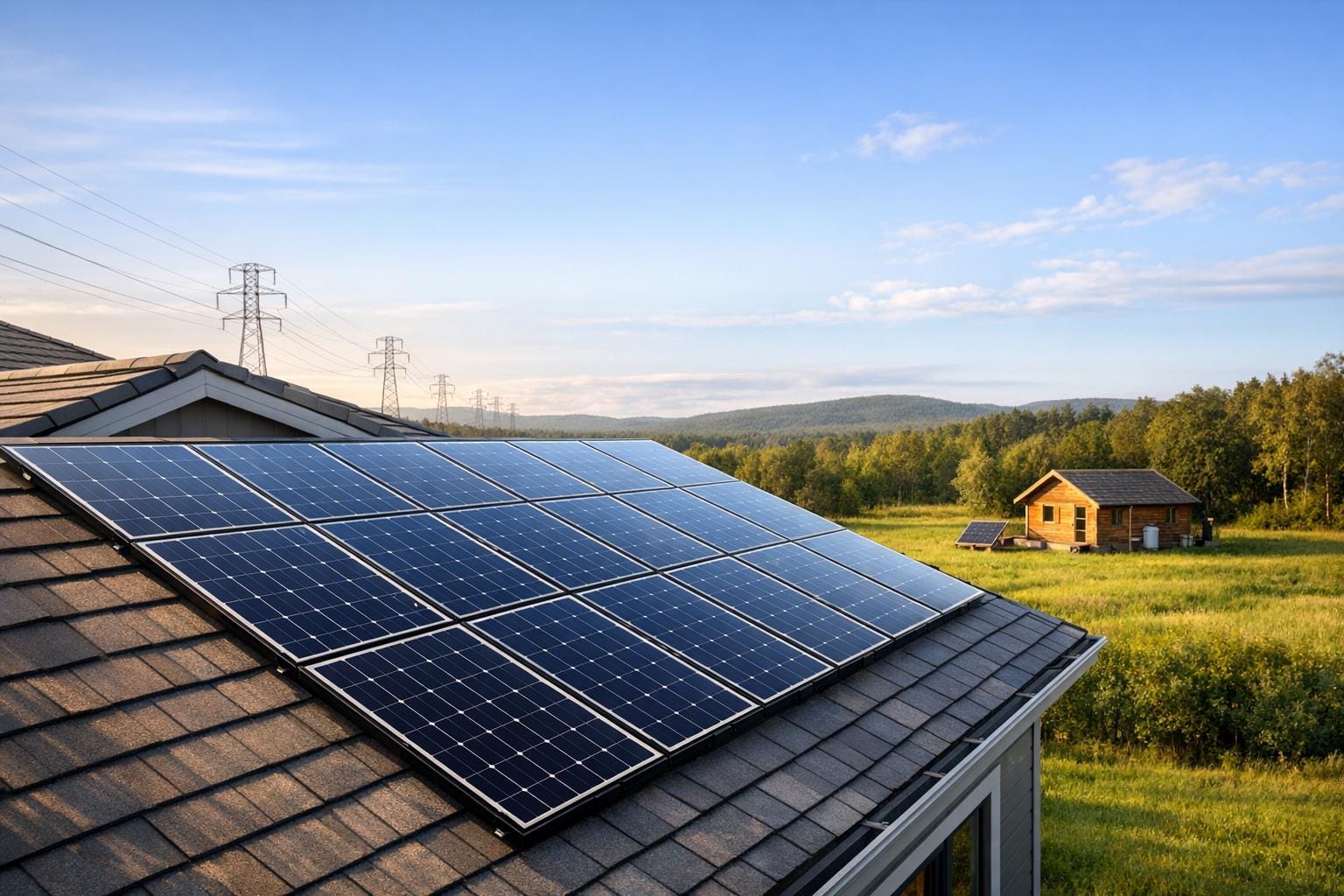
Solar inverters are essential for converting the direct current (DC) electricity generated by solar panels into alternating current (AC) electricity used in homes. The two main types - grid-tied and off-grid inverters - serve different needs:
- Grid-Tied Inverters: Connect to the utility grid, offering lower costs and benefits like net metering. However, they shut down during power outages and rely on grid stability.
- Off-Grid Inverters: Operate independently, requiring batteries for energy storage. Ideal for remote locations but come with higher upfront costs and maintenance needs.
- Hybrid Inverters: Combine features of both, supporting grid connection and battery backup, but at a higher price point.
Key considerations when choosing an inverter include your budget, energy independence goals, grid reliability, and whether you need backup power. Proper sizing, efficiency, and compatibility with your solar setup are critical for optimal performance.
Here’s a quick comparison:
| Feature | Grid-Tied | Off-Grid | Hybrid |
|---|---|---|---|
| Upfront Cost | Lower | Higher | Medium to High |
| Backup Power | No | Yes | Yes |
| Battery Required | No | Yes | Optional |
| Net Metering | Yes | No | Yes |
Choosing the right inverter ensures your solar system meets your energy needs effectively and efficiently.

Grid-Tied vs Off-Grid vs Hybrid Solar Inverter Comparison Chart
How Grid-Tied Inverters Work
How Grid-Tied Inverters Operate
A grid-tied inverter takes the direct current (DC) generated by your solar panels and converts it into alternating current (AC) that matches the grid's requirements. At its core, it uses high-speed electronic components called Insulated-Gate Bipolar Transistors (IGBTs). These transistors chop the DC into pulses, which are then smoothed into a grid-compatible sine wave.
Synchronization with the grid is critical. The inverter constantly samples the grid's voltage and frequency, making adjustments to ensure its output matches the grid's phase, amplitude, and frequency within a ±1% margin. To send power into the grid, the inverter slightly increases its output voltage above the grid voltage.
Another key feature is Maximum Power Point Tracking (MPPT). This technology ensures that the inverter extracts the maximum possible power from your solar panels, even as sunlight and weather conditions fluctuate. Thanks to these advanced features, modern grid-tied inverters achieve impressive peak efficiencies, ranging from 97% to 99%.
Safety is also a priority. Grid-tied inverters include anti-islanding protection, which shuts them down within two seconds during a power outage to prevent electricity from backfeeding into the grid. They also monitor the grid's frequency and will shut off if it deviates by as little as ±0.1 Hz.
"At its heart, an on-grid inverter is the brain of a grid-tied solar system. While its most basic job is converting electricity, its real role is far more sophisticated: it's a manager, a translator, and a safety officer all in one."
– Sunriver Inverter
This precise functionality ensures not only efficient energy conversion but also the safety of the entire system.
Benefits of Grid-Tied Inverters
Grid-tied systems offer an accessible and cost-effective way to harness solar energy. One of the biggest advantages is the reduced upfront cost - there’s no need for a battery bank, which significantly lowers equipment expenses and simplifies installation. Fewer components and streamlined wiring also mean less time and money spent on setup.
Net metering adds another financial perk. Any excess electricity your solar panels generate flows back into the grid, and in many cases, your utility meter runs backward, earning you credits. This can cut down, or even eliminate, your monthly electric bill.
Additionally, by converting DC directly to AC without involving batteries, grid-tied inverters avoid the energy losses typically associated with battery storage. This direct conversion ensures that nearly all the energy your solar panels produce is put to use.
| Benefit | Details |
|---|---|
| Lower Initial Cost | No need for a battery bank; fewer components to buy and install. |
| Higher Efficiency | Direct energy conversion minimizes losses, achieving efficiencies of 97–99%. |
| Net Metering | Excess power sent to the grid earns credits, reducing your electricity bill. |
| Simpler Installation | Fewer components and less wiring make installation quicker and cheaper. |
| Faster ROI | Lower costs combined with utility savings lead to a quicker payback period. |
Drawbacks of Grid-Tied Inverters
Despite their many benefits, grid-tied inverters do have some limitations. One major drawback is their inability to provide backup power during a grid outage. Even if your solar panels are producing energy, the system will shut down to protect utility workers, leaving your home without electricity during blackouts.
Another downside is the system's dependence on the utility grid. Any changes in electricity rates, connection fees, or outages will still impact you. Additionally, there’s a policy risk: changes to net metering rules or utility compensation rates could reduce the financial returns of your solar setup.
Lastly, grid-tied systems must comply with stringent safety codes, such as the Rapid Shutdown requirements set by the National Electrical Code. While these regulations enhance safety, they can also add complexity and cost to the installation process.
How Off-Grid Inverters Work
How Off-Grid Inverters Operate
Off-grid inverters function independently, generating their own voltage and frequency without relying on a utility grid. Unlike grid-tied inverters, which synchronize with the grid's existing voltage and frequency, off-grid inverters are "grid-forming", meaning they create their own power parameters.
The process begins with DC power supplied by a battery bank. The inverter uses components like MOSFETs or silicon carbide transistors to invert the DC power into AC. Through pulse-width modulation (PWM) and filtering, it produces a clean sine wave suitable for powering appliances.
An essential part of this setup is a charge controller, which directs solar energy into the battery bank. The inverter then draws DC power from the batteries to generate AC electricity. This makes the battery bank a critical component of the system.
Many modern off-grid inverters are designed as inverter/chargers. These units can recharge the battery bank using AC input from sources like a backup generator. When necessary, they convert this AC power back into DC to replenish the batteries. This self-contained capability highlights the distinctiveness of off-grid systems compared to grid-tied models.
"An Off-Grid inverter provides maximum independence from the grid or utility company and allows a solar system to be active regardless of the presence or status of the grid."
– Solar-Electric
Benefits of Off-Grid Inverters
Off-grid inverters offer complete energy independence, giving you full control over your power supply. This is particularly advantageous for remote locations like cabins, mountain homes, desert properties, or islands where connecting to the grid is either too expensive or simply not an option. Unlike grid-tied systems, which shut down during outages to protect utility workers, off-grid systems keep running as long as the batteries are charged. This reliability is especially important in areas with frequent power outages or for those who depend on electricity for critical equipment.
Another benefit is the flexibility in designing your system. Off-grid setups can be tailored to your specific energy needs and expanded over time, without being bound by utility company regulations.
| Scenario | Why Off-Grid Works Best |
|---|---|
| Remote Cabin/No Grid Access | Provides complete independence and allows for generator backup during low-sun periods. |
| Unreliable Utility Service | Ensures continuous power regardless of grid outages. |
| Mobile Applications (RV/Marine) | Offers compact inverter/charger units with safety features for connecting to shore power. |
| Areas with High Connection Costs | Avoids the need for costly utility line extensions. |
Drawbacks of Off-Grid Inverters
One of the biggest challenges with off-grid systems is the upfront cost. A robust battery bank is required, which can be a significant investment. Lead-acid batteries are less expensive initially but need regular maintenance and have shorter lifespans. On the other hand, lithium (LiFePO4) batteries, while more expensive, are maintenance-free and can last over a decade.
Proper sizing of the system is critical. You need to account for both average energy use and peak loads to avoid system shutdowns, especially when appliances with motors - like refrigerators, well pumps, or air conditioners - cause power surges during startup. These surges can be three to five times the appliance's rated power.
Battery upkeep and eventual replacement also add complexity. Lead-acid batteries, for example, can only use 50% to 70% of their capacity without risking damage, making load management - such as staggering high-power appliance use - essential.
Seasonal changes pose another challenge. During winter, shorter days and reduced sunlight can limit solar panel output, potentially leaving your batteries undercharged. In these cases, a backup generator often becomes necessary.
Grid-Tied vs. Off-Grid Inverters: Side-by-Side Comparison
Technical Differences
Grid-tied inverters operate by syncing with the utility grid, relying on external signals to match the grid's phase and frequency. In contrast, off-grid inverters act as standalone systems, generating their own AC sine wave with regulated voltage and frequency. This distinction makes grid-tied inverters "grid-following" devices, while off-grid inverters are "grid-forming" systems.
Grid-tied systems depend on the utility grid as a backup, while off-grid setups require a battery bank and an external charge controller to handle fluctuating solar generation and energy demands. This reliance on additional components makes off-grid systems more intricate to design and maintain.
Another key difference lies in safety features. Grid-tied inverters include anti-islanding protection, which shuts them down during power outages to prevent back-feeding electricity into the grid - a critical safety measure for utility workers. Off-grid systems, however, continue operating as long as their battery bank has sufficient charge.
"Standard grid‑following inverters must stop exporting if the grid goes down. This anti‑islanding protection prevents the PV system from energizing dead lines and protects lineworkers."
– Bob Wu, Solar Engineer, Anern
Efficiency also sets these systems apart. Grid-tied inverters avoid the energy losses associated with battery cycling, achieving efficiencies of around 92% for string inverters and up to 96.5% for microinverters. Off-grid systems, on the other hand, experience additional energy losses due to battery storage and conversion processes.
Cost Comparison
The cost gap between grid-tied and off-grid systems is substantial. Grid-tied setups are generally 40% to 50% less expensive than off-grid ones, primarily because they don't require batteries. Instead, they rely on net metering, which allows homeowners to offset electricity costs by feeding excess power back into the grid.
Off-grid systems, by necessity, involve higher upfront expenses. They require robust battery banks, charge controllers, and additional inverter components. Batteries, particularly lithium (LiFePO4) models, represent a significant portion of these costs. Lithium batteries are popular for their 80% to 95% usable depth of discharge but come with a premium price tag.
| Cost Factor | Grid‑Tied | Off‑Grid | Hybrid |
|---|---|---|---|
| Upfront Investment | Lowest | Highest | Medium to High |
| Battery Storage | No | Yes (Mandatory) | Optional |
| Charge Controller | Not required | Yes | Yes (if batteries are used) |
| Maintenance Costs | Minimal | Higher | Medium |
| Net Metering | Yes | No | Yes |
| Long‑Term Savings | High (via net metering) | Variable (depends on grid costs) | Medium to High |
Maintenance costs further widen this financial gap. Off-grid systems demand ongoing battery maintenance and eventual replacement, whereas grid-tied systems typically require only occasional inverter servicing and routine panel cleaning.
Which Inverter Works Best for Different Situations
The choice between grid-tied and off-grid inverters hinges on location and energy needs. Grid-tied systems are ideal for urban or suburban areas with stable utility service. Their lower upfront costs, combined with the benefits of net metering, make them an economical option for homeowners looking to reduce electricity bills.
Off-grid systems, on the other hand, are indispensable in remote areas where connecting to the grid isn't feasible. For properties like mountain cabins, rural farms, or island homes, off-grid setups can be more practical despite higher initial costs. They also suit mobile applications, such as RVs and boats, though these require specialized inverters with neutral-to-ground switching for safety.
| Location Type | Best Inverter Choice | Why |
|---|---|---|
| Urban/Suburban (Stable Grid) | Grid‑Tied | Lowest cost, net metering benefits, reliable utility service |
| Remote/Rural (No Grid Access) | Off‑Grid | Only viable option; avoids expensive line extension costs |
| Areas with Frequent Outages | Hybrid | Combines grid benefits with backup power for outages |
| Mobile (RV/Marine) | Off‑Grid (specialized) | Requires compact inverters with neutral‑to‑ground switching |
Hybrid inverters offer a middle ground for those seeking grid access with the added security of backup power. They are particularly useful in areas prone to outages or natural disasters, providing both cost savings through net metering and reliable power during grid failures.
During blackouts, the differences between these systems become clear. Grid-tied systems shut down entirely due to anti-islanding protection, leaving users without power even if their solar panels are generating electricity. In contrast, off-grid and hybrid systems can draw from battery storage to keep essential devices running, making them invaluable for critical applications.
"Choosing the right inverter ensures reliability, efficiency, and cost-effectiveness."
– EPEVER
How to Choose the Right Inverter for Your Solar System
What to Consider When Choosing an Inverter
Picking the right inverter is crucial for getting the most out of your solar system and aligning it with your energy goals.
Start by assessing the reliability of your local grid. If outages are common, a grid-tied inverter might not be the best choice since it shuts down during power cuts due to anti-islanding protection. In such cases, an off-grid or hybrid system may be a better fit .
Next, think about your level of energy independence. Grid-tied systems are ideal if you're looking to save on costs through net metering, which lets you sell excess power back to the utility . If you're in a remote location or want total independence, off-grid systems are the way to go .
Also, consider your roof's conditions. String inverters work best on roofs with uniform orientation and no shading. For roofs with partial shading or different angles, microinverters or power optimizers are better, as even minor shading (about 9%) can cut energy output by up to 54% .
Sizing your inverter correctly is another key step. You'll need to account for both continuous power (the total wattage of all devices running at the same time) and startup surge power (the extra wattage needed when devices like refrigerators or pumps start up) .
Finally, think about the system's complexity. Grid-tied systems are simpler and less expensive since they don’t require batteries or charge controllers. Off-grid setups, however, need battery banks and precise sizing to ensure year-round reliability. It's a good idea to choose an inverter with a 20% to 30% capacity buffer to allow for future expansion.
Technical Specifications to Review
After identifying your system's needs, focus on these technical details to ensure your inverter is compatible and efficient.
Pay close attention to continuous and surge power ratings. Continuous power is the total wattage the inverter can handle at once, while surge power measures its ability to handle short-term peaks - like when motors or compressors start up. These peaks can be 2 to 3 times the appliance's running wattage .
The type of output waveform is another critical factor. For home use, always go with a pure sine wave inverter. It ensures compatibility with sensitive electronics like laptops and variable-speed tools. While modified sine wave inverters are cheaper, they can cause noise, overheating, or even damage to modern appliances. Though pure sine wave inverters cost more - typically 2 to 3 times as much - they're worth the investment for protecting your devices .
Efficiency is key to minimizing energy loss. Modern grid-tied inverters are highly efficient, with conversion rates between 97% and 99%. String inverters usually hit around 92%, while microinverters can reach about 96.5%, potentially boosting solar power output by up to 16%.
"The inverter is no longer a simple converter; it is the real-time orchestrator of a decentralized, resilient, and profitable energy network." - Sunriver Electric
Warranty length can vary. String inverters often come with 5- to 10-year warranties, whereas microinverters, which experience less heat stress, typically offer 20 to 25 years . Also, check the inverter's operating temperature range. High temperatures can cause "derating", where the inverter reduces power output to avoid overheating . To avoid this, install the inverter in a cool, ventilated spot.
Ensure the inverter meets local electrical codes and standards, like IEEE 1547 and UL 1741. Many areas also require "Rapid Shutdown" features to ensure safety during emergencies . Always consult with local authorities to confirm compliance before purchasing equipment.
| Specification | What to Look For | Why It Matters |
|---|---|---|
| Continuous Power | Must exceed simultaneous loads | Prevents overload during normal operation |
| Surge Rating | 2–3× continuous for motor loads | Handles startup currents for pumps, fridges |
| Waveform | Pure sine wave only | Protects sensitive electronics |
| Efficiency | 97–99% for grid-tied systems | Reduces energy loss during conversion |
| Warranty | At least 10 years | Protects your long-term investment |
| Temperature Range | Suitable for your climate | Avoids derating in high temperatures |
How Inverters Fit Into Complete Solar Systems
Once you've nailed down the specs, the next step is integrating your inverter into the overall solar setup.
For off-grid systems, the inverter must match the voltage of your battery bank - commonly 12V, 24V, or 48V . If you're using lithium batteries, make sure the inverter supports "closed-loop" communication so the battery management system can optimize charge rates.
A common design strategy is using a DC-to-AC ratio of 1.2 to 1.5. This means the solar array's capacity is slightly higher than the inverter's output. It allows you to capture more energy during peak production without oversizing the inverter.
Hybrid inverters are a flexible choice, as they manage both solar panels and battery storage in one unit. They enable "self-consumption" during the day and provide backup power during outages . If you already have a grid-tied system and want to add batteries later, consider "AC Coupling", which involves adding a separate battery inverter/charger alongside your existing system.
"A well-chosen solar inverter or home backup inverter gives you stability, safety, and reliability." - Aforenergy
Residential solar inverters typically cost between $1,000 and $3,000, often bundled into the total system price. Microinverters may increase the cost by 15% to 25% compared to string inverters, but their ability to handle shading and offer module-level monitoring can make the extra expense worthwhile.
Before finalizing your system, conduct a load audit. List all devices you plan to power, including their running and surge wattages, to determine the correct inverter size. This planning step ensures your system runs smoothly and avoids costly upgrades later. Proper preparation aligns your inverter choice with the overall system efficiency and performance goals discussed here.
Off Grid Inverters vs Grid Tie Inverters
Conclusion
If you're deciding on a solar inverter, here’s the breakdown: grid-tied systems are the most affordable and deliver faster returns, typically costing 40–50% less because they skip battery storage. They’re perfect if you have steady access to the utility grid and want to benefit from net metering, which lets you earn credits for excess energy. Just keep in mind, grid-tied systems shut down during power outages, which can be a drawback if reliability is a concern.
Off-grid inverters, on the other hand, offer complete energy independence. They’ll keep your system running even when the grid fails, but they come with a higher upfront cost. You’ll need carefully sized batteries and a well-planned setup to ensure power during low production periods, such as cloudy days or winter months.
For a middle-ground option, hybrid inverters let you enjoy the cost savings of a grid connection while having backup power for outages. They also allow you to add batteries over time, making them a flexible choice.
"Your inverter is the heart of your solar system - choose wisely for long-term, clean energy." - EPEVER
Ultimately, the right inverter depends on your priorities. Are you looking to save money with a grid-tied system, achieve full energy independence with off-grid, or strike a balance with a hybrid setup? Think about factors like grid reliability, your home’s energy demands, roof space, and whether you need pure sine wave output for delicate electronics.
For expert advice and custom solar solutions, check out Get Solar Panels (https://getsolarpanels.ie). Their team can guide you through everything from Tesla Powerwall storage options to navigating regulations and designing the perfect system to meet your energy goals.
FAQs
What’s the difference between grid-tied and off-grid inverters?
Grid-tied inverters are specifically built to work alongside the utility grid. They take the DC electricity generated by solar panels and convert it into AC power, making it ready for immediate use in your home or business. Any surplus electricity can be sent back to the grid, often through a system called net metering. However, for safety reasons, these inverters automatically shut off during power outages.
Off-grid inverters, in contrast, are designed to function without any connection to the utility grid. These systems depend on battery storage to supply power and are a great option for locations where access to the grid isn’t available. Unlike grid-tied inverters, they don’t send electricity back to the grid, but they do offer a reliable power source even during outages.
Deciding between these two options largely depends on your energy goals, where you’re located, and whether you prefer staying connected to the grid or aiming for total energy independence.
What are hybrid inverters, and how do they combine grid-tied and off-grid features?
Hybrid inverters are a clever solution that blends the features of grid-tied and off-grid inverters. They take the direct current (DC) generated by solar panels and turn it into alternating current (AC), which powers your home. Plus, when there’s extra energy, they send it to the grid. At the same time, these inverters handle charging and discharging batteries, so you’ve got stored energy ready to go during outages or when the grid isn’t available.
This dual functionality makes hybrid inverters a solid pick for households looking to boost energy independence while staying efficient. They offer dependable power management, whether it’s for everyday needs or unexpected emergencies.
What should I consider when choosing an inverter for my solar system?
When choosing an inverter, the first step is to ensure it aligns with the size and purpose of your system. Start by calculating your total energy requirements, factoring in both continuous loads (like refrigerators) and intermittent ones (such as microwaves). Opt for an inverter with a continuous power rating that exceeds your current demand by about 20–25% to allow room for future expansion. For grid-connected systems, you’ll need a grid-tied or hybrid inverter. Off-grid setups, on the other hand, require a pure off-grid inverter, often combined with a battery charger for added functionality.
Next, evaluate the electrical compatibility and efficiency of the inverter. The input voltage must match your solar panel array and, if applicable, your battery bank (commonly 12V, 24V, or 48V for off-grid systems). Look for inverters with efficiency ratings of 95% or higher, as these minimize energy losses. Features like multiple MPPT (Maximum Power Point Tracking) channels are particularly helpful in optimizing power output, especially when parts of your system are shaded. Also, ensure the inverter can handle startup surges from appliances like motors or compressors, which often require extra power at the moment of activation.
Lastly, focus on reliability and additional features. Choose a well-established brand that offers a solid warranty - ideally one lasting 10 years - to ensure long-term peace of mind. Features like advanced battery management for hybrid systems, grid-service capabilities such as net metering, and user-friendly monitoring tools (like app-based interfaces) can greatly enhance your system’s performance and usability. A dependable and efficient inverter tailored to your specific needs will maximize the benefits of your solar setup.