
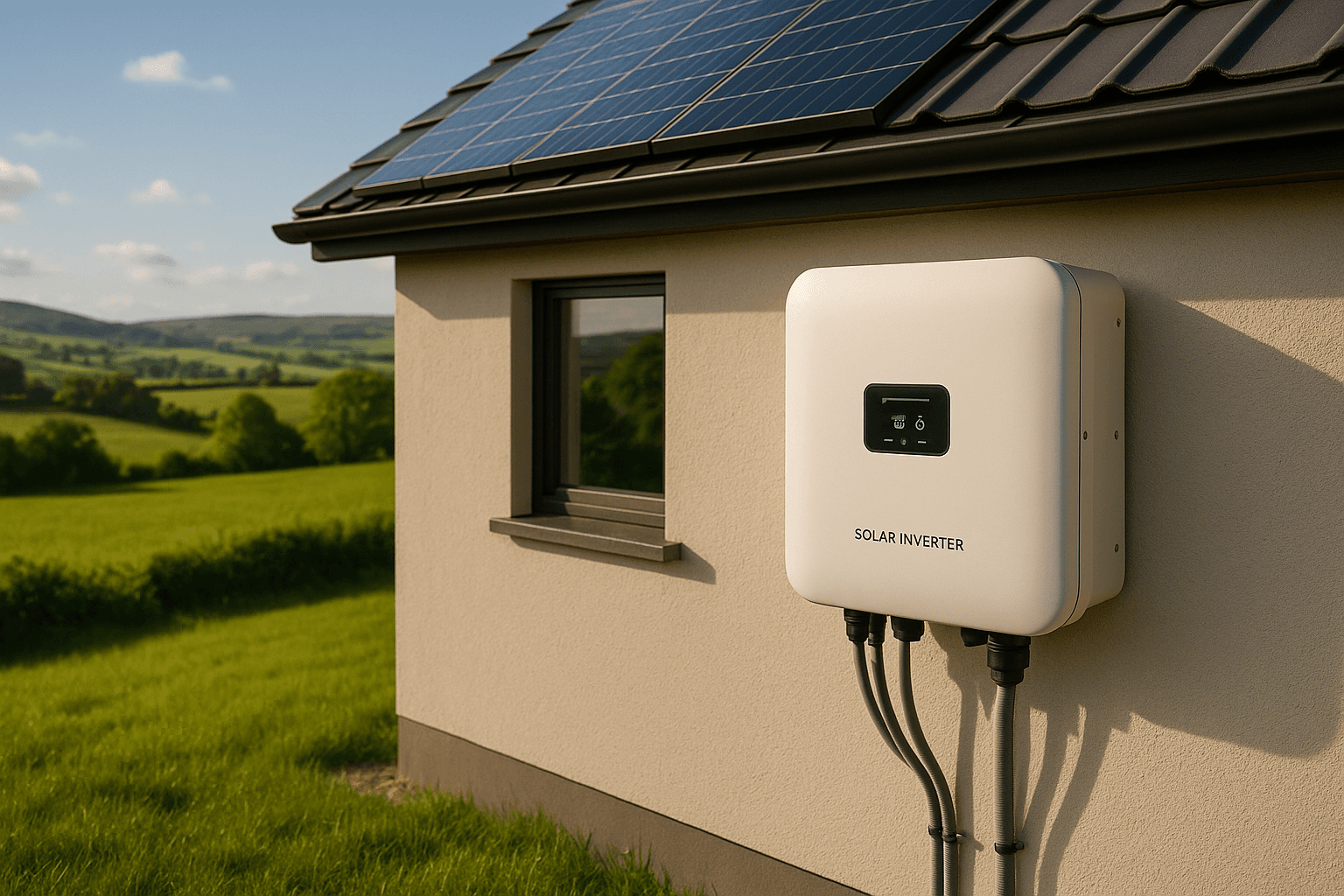
Ultimate Guide to Solar Inverter Installation in Ireland
Your solar inverter converts the DC electricity generated by your panels into the AC electricity that powers your home. It is the single most important component after the panels themselves — and choosing the wrong one can cost you 10-15% of your system's output. In Ireland in 2026, most installers recommend hybrid inverters for their flexibility, even if you are not planning battery storage yet. See our battery storage guide for more details. See our solar panel costs for more details. See our solar panel types for more details. See our installation process for more details.
This guide covers everything Irish homeowners need to know: the different types, costs, best brands, sizing rules, installation locations, and monitoring. Whether you are installing a new system or upgrading an existing one, the inverter decision is one you will live with for 10-25 years — so it pays to get it right.
What Does a Solar Inverter Do?
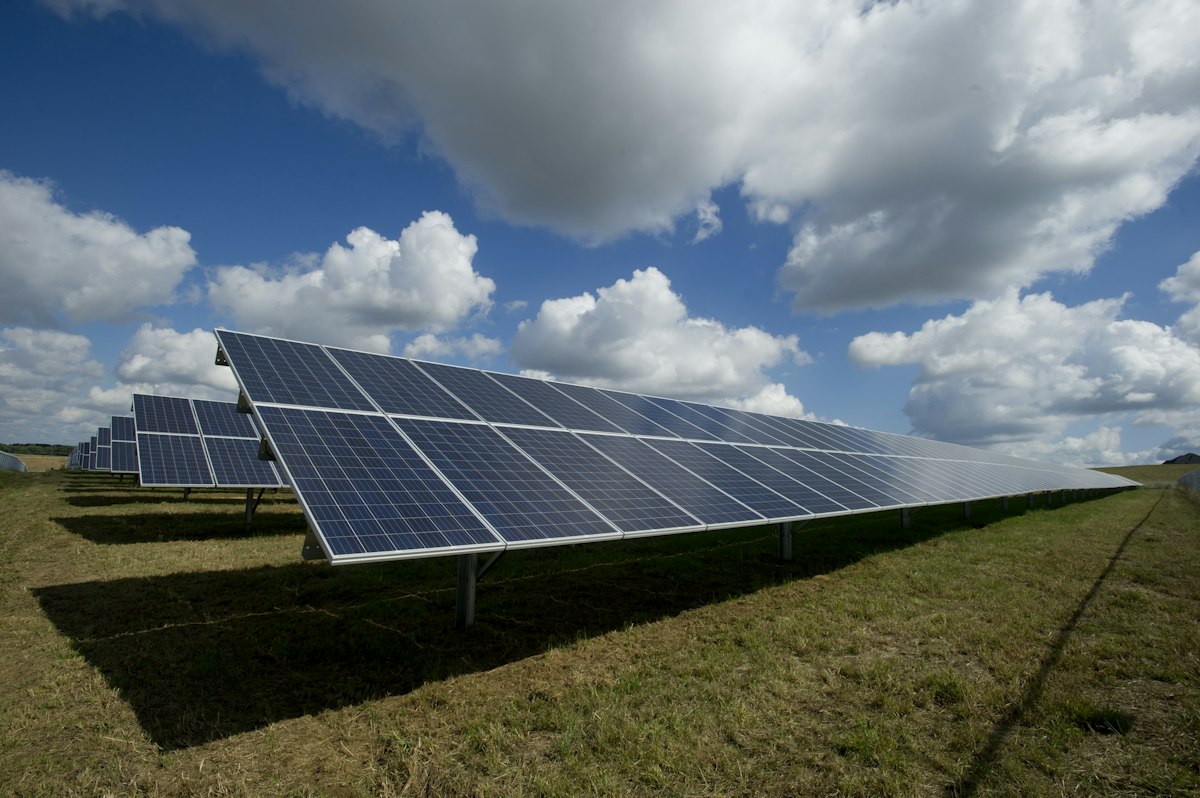
Solar panels generate direct current (DC) electricity when sunlight hits their photovoltaic cells. However, every appliance in your home — your kettle, washing machine, television, and heat pump — runs on alternating current (AC) electricity at 230V and 50Hz, which is the standard for the Irish grid.
The solar inverter sits between your panels and your home's electrical system, performing this critical DC-to-AC conversion in real time. Without it, the electricity your panels produce would be completely unusable.
But modern inverters do far more than simple conversion. They also:
- Maximise energy harvest — Using Maximum Power Point Tracking (MPPT), the inverter continuously adjusts to extract the maximum possible power from your panels, even as light conditions change throughout the day.
- Ensure grid compliance — The inverter synchronises your system's output with the Irish grid at 230V/50Hz, meeting ESB Networks requirements.
- Provide safety protection — Anti-islanding protection automatically disconnects your system during power outages, protecting utility workers and your home.
- Monitor system performance — Most inverters include WiFi connectivity and smartphone apps that let you track energy production, consumption, and savings in real time.
- Manage export limits — In Ireland, your inverter controls how much excess electricity is fed back to the grid, ensuring compliance with ESB Networks export limits.
Think of the inverter as the brain of your solar system. The panels are the muscles that capture energy, but the inverter makes intelligent decisions about how that energy is converted, used, stored, and exported. A high-quality inverter operating at 97-98% efficiency will convert nearly all of your panels' output into usable electricity. A poor-quality inverter operating at 93-94% efficiency wastes 3-5% of every kilowatt your panels generate — that lost energy adds up to hundreds of euros over the system's lifetime.
Types of Solar Inverter
There are four main types of solar inverter available in Ireland in 2026. Each has distinct advantages depending on your roof layout, budget, and future plans for battery storage.
| Inverter Type | How It Works | Best For | Pros | Cons | Typical Cost |
|---|---|---|---|---|---|
| String Inverter | Panels wired in series (a "string") feeding one central inverter | Simple south-facing roofs with no shading | Lowest cost, proven technology, easy to replace | Entire string affected if one panel shaded, no battery management | €500–€1,000 |
| Microinverter | Small inverter attached to each individual panel | Complex roofs, multiple orientations, shading issues | Panel-level optimisation, no single point of failure, 25-year warranty | Higher upfront cost, more components to potentially fail | €150–€250 per panel |
| Hybrid Inverter | Combines solar conversion with built-in battery management | Homes planning battery storage now or in future | Future-proof, battery-ready, manages self-consumption, backup power possible | Higher cost than string, features unused if no battery added | €1,000–€2,000 |
| Battery Inverter | Dedicated inverter for battery storage only, added to existing system | Retrofitting battery to an existing solar installation | Keeps existing inverter, adds storage capability | Extra component, additional cost, less efficient than hybrid | €800–€1,500 |
String inverters remain the most popular choice for straightforward installations. If your roof faces south or southeast with no chimneys, dormers, or trees casting shadows, a string inverter delivers excellent value. They are a mature technology with decades of proven performance, and replacement is straightforward if needed after 10-15 years.
Microinverters are the premium option. Each panel operates independently, so shading on one panel does not affect the rest. This makes them ideal for roofs with multiple orientations (for example, panels on both east and west-facing pitches) or where trees and chimneys cause partial shading. Enphase is the dominant microinverter brand in Ireland, and their 25-year warranty matches the lifespan of your panels.
Hybrid inverters are the fastest-growing category in Ireland and the one we most frequently recommend. For an additional €300-€600 over a standard string inverter, you get built-in battery management. This means you can add a battery at any time without paying for a separate battery inverter (which would cost €800-€1,500). Even if you do not plan to install a battery today, the cost of adding one later is significantly lower with a hybrid inverter already in place.
Battery inverters are for homeowners who already have a string inverter and want to add battery storage. While functional, this setup is less efficient than a hybrid because electricity is converted multiple times between DC and AC.
How Much Does a Solar Inverter Cost in Ireland?
Inverter costs in Ireland depend on the type, capacity, and brand. Here is a detailed breakdown of what you should expect to pay in 2026, including installation:
| System Size | String Inverter | Hybrid Inverter | Microinverters (per system) |
|---|---|---|---|
| 3kW (8 panels) | €500–€700 | €1,000–€1,300 | €1,200–€2,000 |
| 5kW (12-14 panels) | €700–€1,000 | €1,300–€1,800 | €1,800–€3,500 |
| 8kW (20 panels) | €900–€1,200 | €1,600–€2,200 | €3,000–€5,000 |
These prices include the inverter unit and standard installation. Additional costs may apply for complex wiring routes, meter upgrades, or non-standard mounting requirements.
Key points on inverter pricing in Ireland:
- The inverter typically represents 15-25% of your total solar system cost.
- Hybrid inverters cost €300-€600 more than string inverters — but save you €800-€1,500 on a future battery inverter.
- Microinverters are the most expensive upfront but offer 25-year warranties vs. 10-12 years for string/hybrid.
- Budget inverters with 5-year warranties may save €200-€300 initially but cost more over the system's lifetime due to earlier replacement.
- SEAI grants of up to €1,800 apply to the overall installation, helping offset inverter cost regardless of type chosen.
The real question is not "which inverter is cheapest?" but "which gives the lowest cost per kilowatt-hour over 25 years?" When you factor in warranty, efficiency, and future battery compatibility, a hybrid inverter almost always represents the best value.
For an accurate quote based on your specific roof, energy usage, and goals, request your free personalised assessment here.
String Inverter vs Microinverter vs Hybrid: Which Should You Choose?
Choosing the right inverter type depends on your specific situation. Use this decision guide to find the best match:
Step 1: Do you have shading issues?
- If trees, chimneys, or neighbouring buildings cast shadows on some panels for part of the day, microinverters or power optimisers with a string inverter are your best option. Shading on even one panel in a string can reduce the entire string's output by 20-40%.
- If your roof is shade-free throughout the day, move to Step 2.
Step 2: Do your panels face multiple directions?
- If you are splitting panels across east and west-facing roof pitches, or combining south and east orientations, microinverters allow each panel to operate independently at maximum efficiency. A string inverter with dual MPPT inputs can also handle two orientations effectively.
- If all panels face roughly the same direction, move to Step 3.
Step 3: Do you want battery storage now or in the future?
- If you plan to add a battery within the next 5 years — or even think you might — choose a hybrid inverter. The extra €300-€600 now saves €800-€1,500 later on a separate battery inverter.
- If you are certain you will never add battery storage, a string inverter is the most cost-effective choice for a simple south-facing roof.
Step 4: What is your budget?
- Tight budget: A quality string inverter (Solis, GoodWe) delivers reliable performance at the lowest cost.
- Mid-range budget: A hybrid inverter (Huawei, GoodWe) offers the best balance of cost and future-proofing — this is what we recommend for most Irish homes.
- Premium budget: Microinverters (Enphase) with panel-level monitoring and 25-year warranty offer the highest performance and longest lifespan.
Our recommendation for most Irish homeowners in 2026: A hybrid inverter. Battery storage costs are dropping rapidly, and the Clean Export Guarantee means exporting excess electricity earns you less than using it yourself. A hybrid inverter positions you to add a battery when prices make it worthwhile — without paying for a second inverter installation.
Not sure which option suits your roof and budget? Get a free assessment from our certified installers who will recommend the right inverter based on a survey of your property.
Best Solar Inverters Available in Ireland 2026
The Irish market is served by a handful of established inverter manufacturers. Here is how the top brands compare across the metrics that matter most:
| Brand | Type | Peak Efficiency | Warranty | Monitoring App | Price Range (5kW) | Key Strength |
|---|---|---|---|---|---|---|
| Huawei | String / Hybrid | 98.6% | 10 years (extendable to 20) | FusionSolar | €700–€1,500 | Best value hybrid, excellent app |
| SolarEdge | String + Optimisers | 99.2% (with optimisers) | 12 years (extendable to 25) | mySolarEdge | €900–€1,400 | Panel-level optimisation, strong monitoring |
| Enphase | Microinverter | 97.5% | 25 years | Enphase Enlighten | €1,800–€3,500 | Longest warranty, best for complex roofs |
| Fronius | String / Hybrid | 98.1% | 10 years (extendable to 20) | Fronius Solar.web | €800–€1,400 | Austrian quality, excellent build |
| GoodWe | String / Hybrid | 98.2% | 10 years (extendable to 15) | SEMS Portal | €600–€1,200 | Great value hybrid, growing market share |
| Solis | String / Hybrid | 97.8% | 10 years (extendable to 15) | SolisCloud | €500–€1,000 | Budget-friendly, reliable performance |
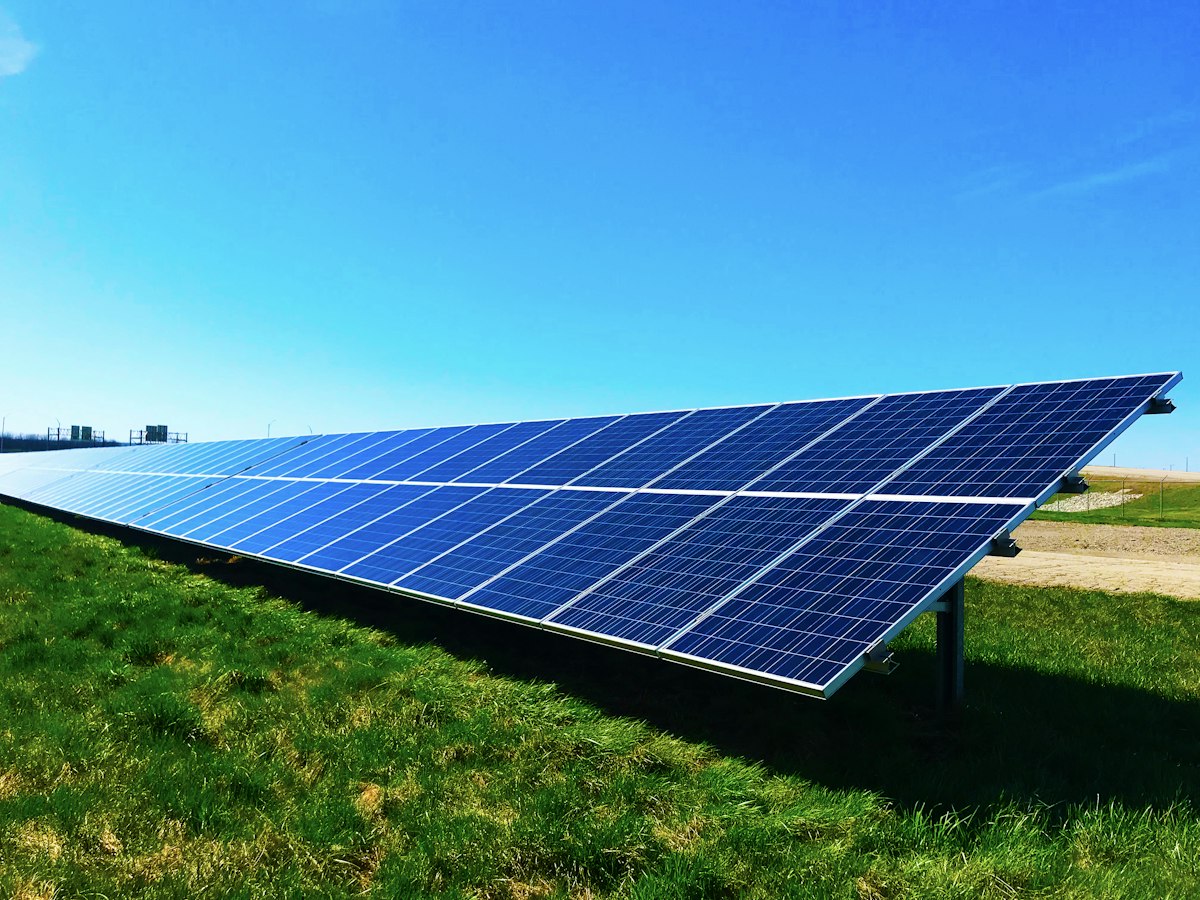
Huawei SUN2000 Series — The most popular inverter brand in Ireland. Their hybrid models offer exceptional efficiency at a competitive price, and the FusionSolar app is one of the best in the industry. Compact, quiet, and well-suited to Irish installations with a 10-year warranty extendable to 20 years.
SolarEdge — Uses a central inverter combined with power optimisers on each panel, giving you panel-level monitoring and shading resilience at a lower cost than microinverters. Excellent choice if you have partial shading but want to keep costs down.
Enphase IQ Series — The premium choice. Each panel gets its own microinverter with a 25-year warranty, meaning you will likely never need to replace them. The higher cost is justified for complex roof layouts or homeowners who want the longest possible system lifespan.
Fronius — Austrian manufacturer with an excellent reputation for build quality and reliability. A popular choice among experienced Irish installers who value durability and comprehensive monitoring through Solar.web.
GoodWe — A rapidly growing brand offering strong hybrid inverters at a competitive price. Their ET series hybrid inverters are well-regarded by installers — a solid mid-range choice balancing features with affordability.
Solis — The budget-friendly option manufactured by Ginlong Technologies, one of the world's largest inverter producers. Dependable DC-to-AC conversion at the lowest price point.
Choosing between these brands often comes down to your installer's recommendation, as most certified installers have preferred brands they know well and can service efficiently. Request a free quote to find out which brand your local installer recommends for your specific setup.
Hybrid Inverters: Why They're Worth the Extra Cost
We recommend hybrid inverters for the majority of Irish homes in 2026, and here is why the extra €300-€600 over a standard string inverter is one of the smartest investments you can make in your solar system.
Future-proofing for battery storage
Battery storage is becoming increasingly attractive for Irish homeowners. Electricity prices remain high, the Clean Export Guarantee pays relatively modest rates for exported electricity, and battery costs are falling year on year. Most solar industry experts expect home battery installations to surge over the next 3-5 years as prices drop below the €4,000 mark for a 5kWh system.
If you install a standard string inverter today and want to add a battery in 3-4 years, you will need a separate battery inverter costing €800-€1,500 — plus installation labour. With a hybrid inverter already in place, adding a battery is a much simpler and cheaper process: your installer connects the battery to the existing inverter's DC bus, which typically costs €200-€400 in labour. That is a net saving of €1,000 or more.
Better self-consumption management
Hybrid inverters are designed to intelligently manage energy flows. Even before you add a battery, many hybrid models offer features like:
- Time-of-use optimisation — The inverter can prioritise self-consumption during expensive peak tariff periods.
- Export limitation — Smart export management ensures you comply with ESB Networks requirements while maximising the energy you use yourself.
- Load management — Some hybrid inverters can communicate with smart devices like immersion heaters and EV chargers to direct excess solar energy where it provides the most value.
Backup power capability
When paired with a battery, a hybrid inverter can provide backup power during grid outages. While Ireland's grid is relatively reliable, power cuts do occur — particularly in rural areas during winter storms. A hybrid inverter with a battery can keep essential circuits (lights, fridge, internet router) running during outages, which is a significant advantage for families and anyone working from home.
The financial case is straightforward
| Scenario | String Inverter Now + Battery Later | Hybrid Inverter Now + Battery Later |
|---|---|---|
| Inverter cost | €700 | €1,100 |
| Battery inverter (when adding battery) | €1,000 | €0 (built in) |
| Battery installation labour | €600 | €300 |
| Total inverter-related cost | €2,300 | €1,400 |
| Saving with hybrid | €900 |
Even if you only have a 50% chance of adding a battery in the future, the expected saving (€450) far exceeds the extra €400 you pay for a hybrid inverter today. It is simply the more financially prudent choice for most homeowners.
For a personalised recommendation on whether a hybrid inverter makes sense for your home, request your free assessment here.
Solar Inverter Sizing: How to Match Inverter to Panels
Correctly sizing your inverter is crucial for system performance and compliance. An undersized inverter will clip your output on sunny days, while an oversized inverter wastes money and operates less efficiently at low power levels.
The basic sizing rule
Your inverter's rated AC output should be between 80% and 100% of your total solar panel DC capacity. This ratio is known as the DC/AC ratio (or sizing ratio).
| Panel Array Size (DC) | Minimum Inverter Size (AC) | Recommended Inverter Size (AC) | Maximum Inverter Size (AC) |
|---|---|---|---|
| 3.0 kWp | 2.5 kW | 3.0 kW | 3.0 kW |
| 4.0 kWp | 3.3 kW | 3.6–4.0 kW | 4.0 kW |
| 5.0 kWp | 4.0 kW | 4.6–5.0 kW | 5.0 kW |
| 6.0 kWp | 5.0 kW | 5.0–6.0 kW | 6.0 kW |
| 8.0 kWp | 6.5 kW | 7.0–8.0 kW | 8.0 kW |
Why oversizing panels slightly is a good strategy
In Ireland, solar panels rarely operate at their full rated capacity. The Standard Test Conditions (STC) rating on your panels assumes 1,000 W/m² of irradiance at 25°C — conditions that rarely occur simultaneously in Irish weather. In practice, your panels will typically produce 60-80% of their STC rating even on bright days.
This means a DC/AC ratio of 1.1:1 or even 1.2:1 (20% more panel capacity than inverter capacity) is perfectly sensible in Ireland. For example, a 6kWp panel array with a 5kW inverter will clip output for perhaps 10-20 hours per year, losing maybe 20-30 kWh. But the extra 1kWp of panels generates an additional 850-1,000 kWh annually — a massive net gain.
ESB Networks considerations
For residential installations in Ireland, the inverter's AC output must comply with ESB Networks requirements. Single-phase connections are limited to 6 kVA, while three-phase connections allow up to 11 kVA. Your installer will ensure your inverter and system design comply with these limits during the NC6 notification process.
MPPT inputs matter
If your panels face two different directions (for example, some east and some west), you need an inverter with at least two MPPT (Maximum Power Point Tracking) inputs. Each MPPT tracks the optimal voltage and current for its connected string independently. Most 5kW+ inverters come with dual MPPT as standard, but always check this specification if you have a split-orientation array.
Getting the sizing right requires a professional assessment of your roof, panel layout, and energy goals. Request a free quote and our certified installers will design a properly sized system for your home.
Where Should a Solar Inverter Be Installed?
The location of your inverter affects its performance, lifespan, accessibility, and noise impact. Here are the most common installation locations in Irish homes, with the pros and cons of each:
Garage (most popular choice)
- Sheltered from rain and direct sunlight
- Generally maintains a moderate temperature range
- Easy access for maintenance and monitoring
- Any minor humming noise is away from living spaces
- Short cable run if your consumer unit is nearby
- The best option for most Irish homes
Utility room or hot press area
- Convenient indoor location with good access
- Protected from temperature extremes
- Close to the main electrical panel in many homes
- Be aware of heat output — inverters generate warmth when working hard, which can raise temperatures in small enclosed spaces
- Faint humming may be audible in adjacent rooms
Attic
- Shortest cable run from rooftop panels, reducing DC losses
- Out of sight and out of the way
- Significant temperature concerns — attics in Ireland can reach 40-50°C in summer, causing the inverter to throttle output to protect itself. This can reduce your system's generation during the best production hours.
- Difficult to access for maintenance, monitoring, or replacement
- Generally not recommended unless other locations are unavailable
External wall mounting
- Some inverters are rated for outdoor use (IP65 rating), but exposure to Ireland's wind, rain, and salt air is a concern
- Suitable as a last resort if no indoor space is available
Key installation considerations:
- Temperature: Inverters operate best between 0°C and 35°C. Avoid locations that trap heat — thermal throttling reduces output.
- Ventilation: Ensure at least 30cm of clearance around the inverter. Never install in an enclosed cupboard without ventilation.
- Noise: Most inverters produce 20-40 dB during operation — barely noticeable in a garage but potentially irritating near bedrooms.
- Access: The DC isolator switch must be accessible in an emergency.
- Cable routing: Shorter runs between panels and inverter reduce energy losses, but balance this against temperature and access needs.
Your installer will recommend the best location during their site survey, taking into account your home's layout and the panel positions. Request a free site assessment to find the optimal inverter location for your property.
How Long Do Solar Inverters Last?
The lifespan of your inverter depends heavily on its type, brand, installation quality, and operating conditions. Here is what you can realistically expect in Ireland:
| Inverter Type | Typical Lifespan | Standard Warranty | Extended Warranty | Replacement Cost |
|---|---|---|---|---|
| String Inverter | 10–15 years | 5–12 years | Up to 20 years | €500–€1,200 |
| Hybrid Inverter | 10–15 years | 10 years | Up to 20 years | €1,000–€2,000 |
| Microinverter | 20–25+ years | 25 years | N/A (25 years standard) | €150–€250 per unit |
| Battery Inverter | 10–15 years | 5–10 years | Up to 15 years | €800–€1,500 |
Why string and hybrid inverters have shorter lifespans
String and hybrid inverters contain electrolytic capacitors and cooling fans — components with inherent wear-out mechanisms. After 10-15 years, these degrade to the point where the inverter may fail or lose efficiency. The good news is that inverter technology improves rapidly, so your replacement in 10-15 years will likely be smaller, more efficient, and cheaper in real terms. Think of it as a mid-life upgrade for your system.
Why microinverters last longer
Microinverters use simpler, more robust components with no cooling fans. Each unit handles only 300-500W, reducing thermal stress. Enphase microinverters are sealed units with no moving parts, designed for 25+ years of operation.
Planning for replacement costs
If you install a string or hybrid inverter, budget for a replacement around year 12-15 of your system's life. At today's prices, that means setting aside approximately:
- €50-€80 per year for a string inverter replacement fund
- €80-€130 per year for a hybrid inverter replacement fund
Over a 25-year panel lifespan, you will likely replace a string or hybrid inverter once. This replacement cost should be factored into your solar system's overall return on investment calculation. Even with one inverter replacement, most Irish solar systems deliver a 10-15% annual return on investment.
Extending your inverter's life
- Install in a cool, well-ventilated location (not an attic)
- Keep air vents and fans clear of dust and debris
- Ensure the inverter is not exposed to moisture or condensation
- Monitor for error codes and address issues promptly
- Have your system professionally inspected every 3-5 years
Common Inverter Problems and How to Fix Them
Even the best inverters can encounter issues. Here are the most common problems Irish homeowners report, along with practical troubleshooting steps:
1. Fault code or red/orange light
- What to do: Note the fault code on the screen or app and check the manual. Many faults are temporary — restart the inverter using the DC isolator switch (off for 60 seconds, then on).
- Call your installer if: The fault persists after restart, or you see isolation resistance faults (which can indicate water ingress or cable damage).
2. Circuit breaker tripping
- What to do: Do not repeatedly reset the breaker. Reset once and monitor — if it trips again within 24 hours, leave it off.
- Call your installer if: It trips twice in 24 hours, or if you notice any burning smell, scorch marks, or unusual sounds.
3. Low power output on sunny days
- What to do: Check your monitoring app for panel-level data. Inspect panels for shading, bird droppings, or debris. Verify DC isolator switches are ON.
- Call your installer if: Output is consistently 20%+ below expected levels after ruling out obvious causes.
4. WiFi connection drops
- What to do: This does not affect power generation. Check your WiFi signal reaches the inverter location, restart the WiFi module, or add a WiFi extender near the inverter.
- Call your installer if: The WiFi dongle appears physically faulty.
5. Unusual noises
- What to do: A faint hum is normal. Check mounting is secure and ventilation openings are clear.
- Call your installer if: The noise is new, getting louder, or accompanied by reduced performance.
6. "No AC Grid" or grid connection error
- What it means: The inverter cannot detect a stable grid connection — this can happen during power outages, or due to a tripped breaker or loose AC connection.
- What to do: Check whether your neighbours have a power outage too. Verify that the AC circuit breaker for the solar system is on.
- When to call your installer: If the error persists when the grid is confirmed as working and all breakers are on.
For any inverter problem you cannot resolve with these basic steps, contact our team for expert troubleshooting advice or to arrange an installer visit.
Monitoring Your Solar Inverter
Effective monitoring is your early warning system for problems and your daily confirmation that your investment is performing. Every major inverter brand now offers a free monitoring app, and spending 2-3 minutes checking your system's performance each week can catch issues before they cost you money.
Monitoring apps by brand:
- Huawei FusionSolar — One of the best-rated apps in the industry. Real-time generation, self-consumption ratio, export data, automatic fault alerts, and battery monitoring for hybrid systems.
- SolarEdge mySolarEdge — Excellent panel-level monitoring showing individual panel performance. Useful for identifying shading or fault issues on specific panels.
- Enphase Enlighten — The most detailed monitoring available with per-panel data, system health scores, and proactive remote fault detection.
- Fronius Solar.web — Comprehensive monitoring focused on energy balance and self-consumption analysis with good historical reporting.
- GoodWe SEMS Portal — Functional real-time monitoring with alerts and basic reporting, significantly improved in recent updates.
- Solis SolisCloud — Basic but effective monitoring covering generation, consumption (with optional CT clamp), and fault alerts.
What data to watch:
- Daily generation (kWh) — Compare this to expected output for the time of year. In Ireland, expect roughly 2-5 kWh per kWp in winter months (November-January) and 10-18 kWh per kWp on the best summer days (May-July).
- Self-consumption ratio — The percentage of generated solar energy you use directly rather than exporting. Aim for 50-70% without a battery, or 80-90%+ with battery storage. Higher self-consumption means greater savings.
- Peak power (kW) — Your system's maximum instantaneous output. If your peak power is consistently well below your system's rated capacity on sunny days, something may be wrong.
- Error or warning alerts — Set up push notifications so you are immediately alerted to any fault codes. Every day your system is down costs you money.
- Cumulative generation — Track your total kWh generated since installation. A 5kW system in Ireland should produce roughly 4,250-5,000 kWh per year. If your annual total is significantly below this, investigate.
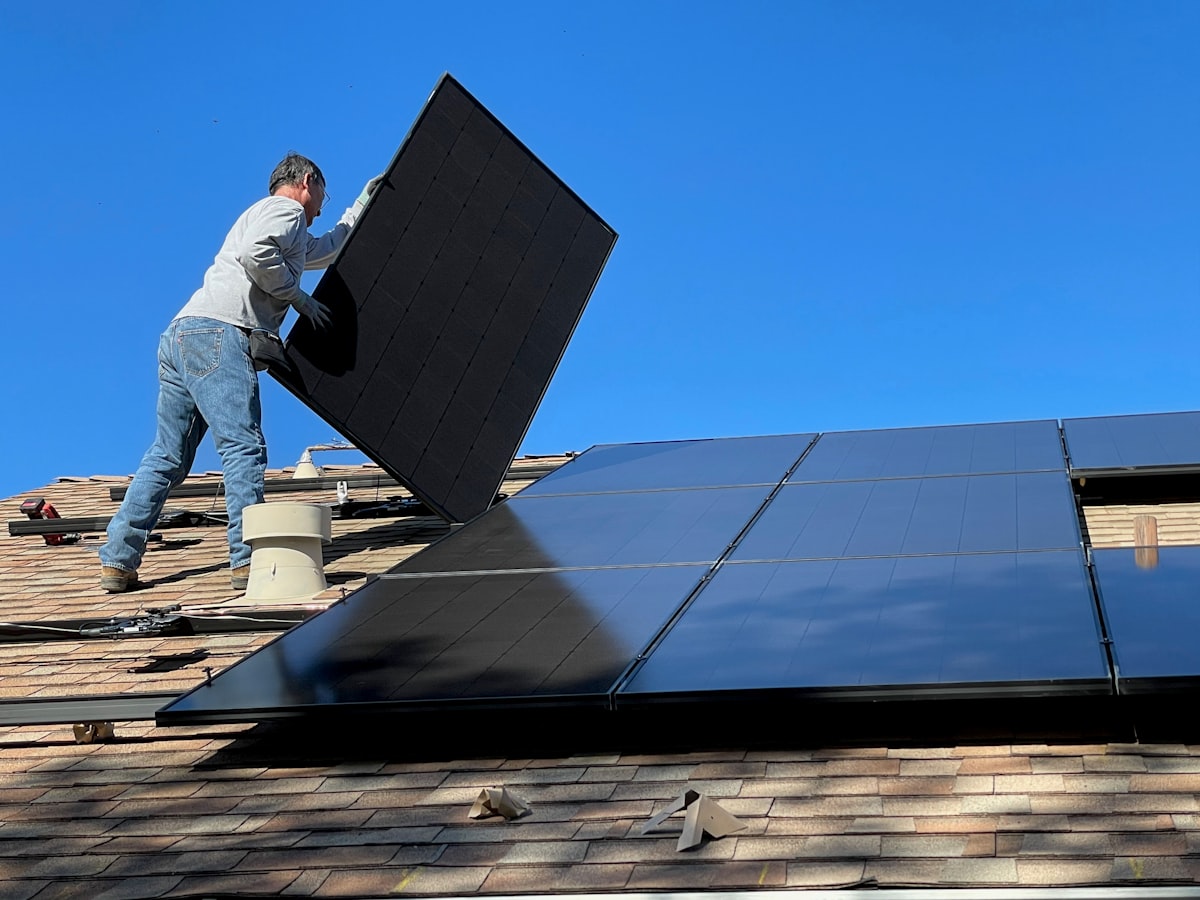
Pro tip: Many Irish homeowners find it helpful to compare their system's output with similar local installations. Some monitoring platforms (particularly Enphase and SolarEdge) offer community comparisons that show how your system stacks up against nearby systems of similar size. If your system is consistently underperforming compared to your neighbours, it is time to investigate or call your installer.
Frequently Asked Questions
Do I need planning permission for a solar inverter in Ireland?
No. Solar inverters are installed inside your home and do not require separate planning permission. The panels themselves are generally exempt for residential installations under current Irish regulations. Your installer will confirm exemption status during their site survey.
Can I install a solar inverter myself?
No. Installation must be carried out by a Registered Electrical Contractor (REC) in Ireland. This is a legal requirement for grid connection. DIY installation disqualifies you from the SEAI grant of up to €1,800 and voids manufacturer warranties.
How noisy is a solar inverter?
Most modern inverters produce a low hum of 20-40 dB during operation — roughly equivalent to a quiet whisper or a refrigerator. You will not notice it in a garage or utility room. Some inverters with cooling fans may produce slightly more noise during peak generation on hot days. If noise sensitivity is a concern, Huawei inverters are among the quietest on the market.
What happens to my inverter during a power cut?
A standard string inverter will shut down immediately during a power cut. This is a mandatory safety feature called anti-islanding protection — it prevents your system from feeding electricity into the grid while utility workers may be repairing lines. A hybrid inverter paired with a battery can switch to backup mode, powering essential circuits in your home independently of the grid.
Do solar inverters work in cloudy weather?
Yes. Your inverter works whenever your panels generate any electricity, which includes cloudy and overcast conditions. Output will be lower (typically 10-30% of rated capacity on heavily overcast days), but the inverter continuously converts whatever DC power is available. Ireland's diffuse light conditions mean your panels — and inverter — work year-round, just at varying output levels.
Can I add more panels later with the same inverter?
This depends on your inverter's capacity and available inputs. If your inverter has spare MPPT inputs and sufficient headroom in its DC input rating, additional panels can often be added. However, if the inverter is already at capacity, you would need to either replace it with a larger unit or add a second inverter. Discuss future expansion plans with your installer at the initial design stage to ensure your inverter can accommodate growth.
How long does inverter installation take?
The inverter installation itself takes approximately 2-3 hours as part of a full solar panel installation. If you are replacing an existing inverter or retrofitting a hybrid inverter, the job typically takes 3-5 hours including testing and commissioning. Your installer will handle the ESB Networks NC6 notification and any meter upgrade requirements.
What is the best inverter for a 4kW solar system in Ireland?
For a standard 4kW residential system in Ireland, we recommend a Huawei SUN2000 4kW hybrid inverter or a GoodWe ET 3.6kW hybrid. Both offer excellent efficiency, battery readiness, and strong monitoring apps at a reasonable price point. If your roof has shading issues, consider Enphase IQ7+ microinverters instead. For the most accurate recommendation, request a free assessment tailored to your specific roof and energy needs.
Does the SEAI grant cover the inverter cost?
The SEAI solar grant of up to €1,800 applies to your complete solar installation, which includes the inverter. The grant is not itemised separately for panels and inverter — it covers the whole system. To qualify, your installation must be carried out by an SEAI-registered installer using approved equipment. The grant amount does not change based on which inverter type you choose, so there is no financial penalty for choosing a hybrid over a string inverter.
What is the DC/AC ratio and why does it matter?
The DC/AC ratio is the relationship between your total solar panel capacity (measured in DC kWp) and your inverter's AC output rating (measured in kW). A ratio of 1.0:1 means your panels and inverter are equally matched. In Ireland, a ratio of 1.1:1 to 1.2:1 is often optimal because panels rarely reach full rated output in Irish light conditions. Slightly oversizing panels relative to the inverter maximises energy harvest during the majority of hours while losing minimal output to clipping on the rare brightest days.
Can I use my solar inverter with an EV charger?
Yes. Your solar system feeds electricity into your home's electrical system, and the EV charger draws from it. Some hybrid inverters (particularly Huawei and Fronius) can communicate with compatible smart EV chargers to prioritise solar energy for car charging, maximising self-consumption.
What warranty should I look for on a solar inverter?
For string and hybrid inverters, look for a minimum 10-year warranty. Huawei, Fronius, and GoodWe offer 10-year standard with extensions to 15-20 years. SolarEdge provides 12 years standard. Enphase microinverters come with 25 years. Be cautious of 5-year warranties — this often signals lower build quality.
Is it worth upgrading my existing inverter to a hybrid?
If your existing inverter is working well with no battery plans, there is no need to replace it prematurely. However, if it is approaching end of warranty or showing reduced performance, replacing it with a hybrid makes excellent sense — fresh warranty, improved efficiency, and battery readiness for just €300-€600 more than a string replacement. Contact us for a free upgrade assessment.
Related Articles

Lidl Plug-In Solar Panels: Are They Coming to Ireland? What You Need to Know (2026)
Lidl will sell plug-in solar panels for €200-€500 that save €100-€200/year. But a full installation saves €700-€950/year after the €1,800 SEAI grant. Full comparison inside.

Can You Sell Electricity Back to the Grid in Ireland? (Clean Export Guarantee Guide 2026)
Irish homeowners can sell surplus solar electricity back to the grid at €0.155-€0.185/kWh through the Clean Export Guarantee (CEG). Earn €300-€450/year tax-free. Full guide: rates by supplier, how to set up, and how to maximise earnings.
How to Choose Solar Security Lights for Your Home
Match brightness, motion sensors, battery life, and weather resistance to choose durable, energy-saving solar security lights for reliable home protection.