
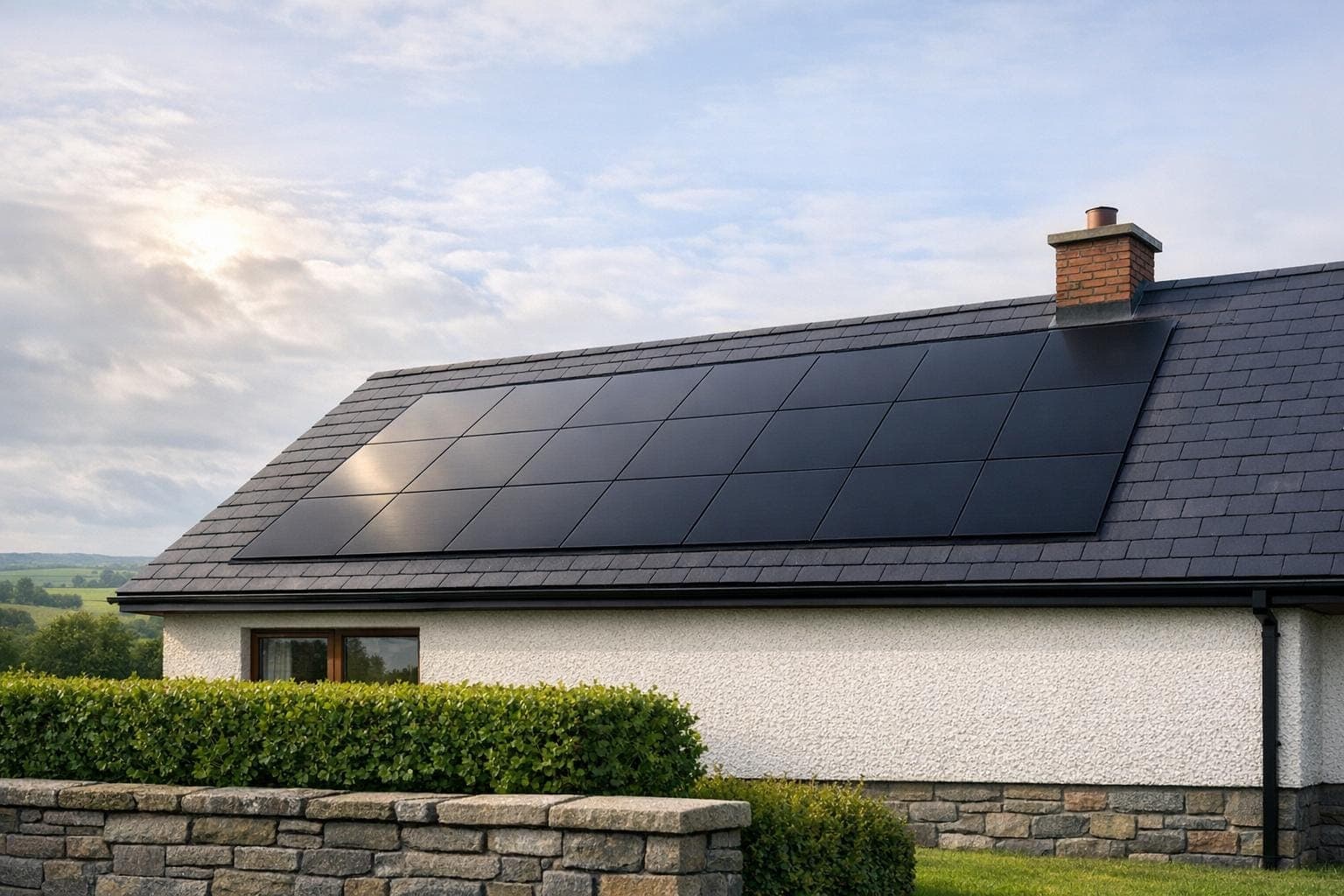
Thin-Film Panel Lifespan: What Irish Homeowners Should Know
Thin-film solar panels are a lightweight, flexible option for generating solar power, especially suited to Ireland’s cloudy and mild climate. While they are less efficient than crystalline panels and require more roof space, they perform better in low-light conditions and maintain efficiency over time. Their typical lifespan is 25–30 years, with annual efficiency loss as low as 0.4–0.6% in Ireland’s favorable weather.
Key points to consider:
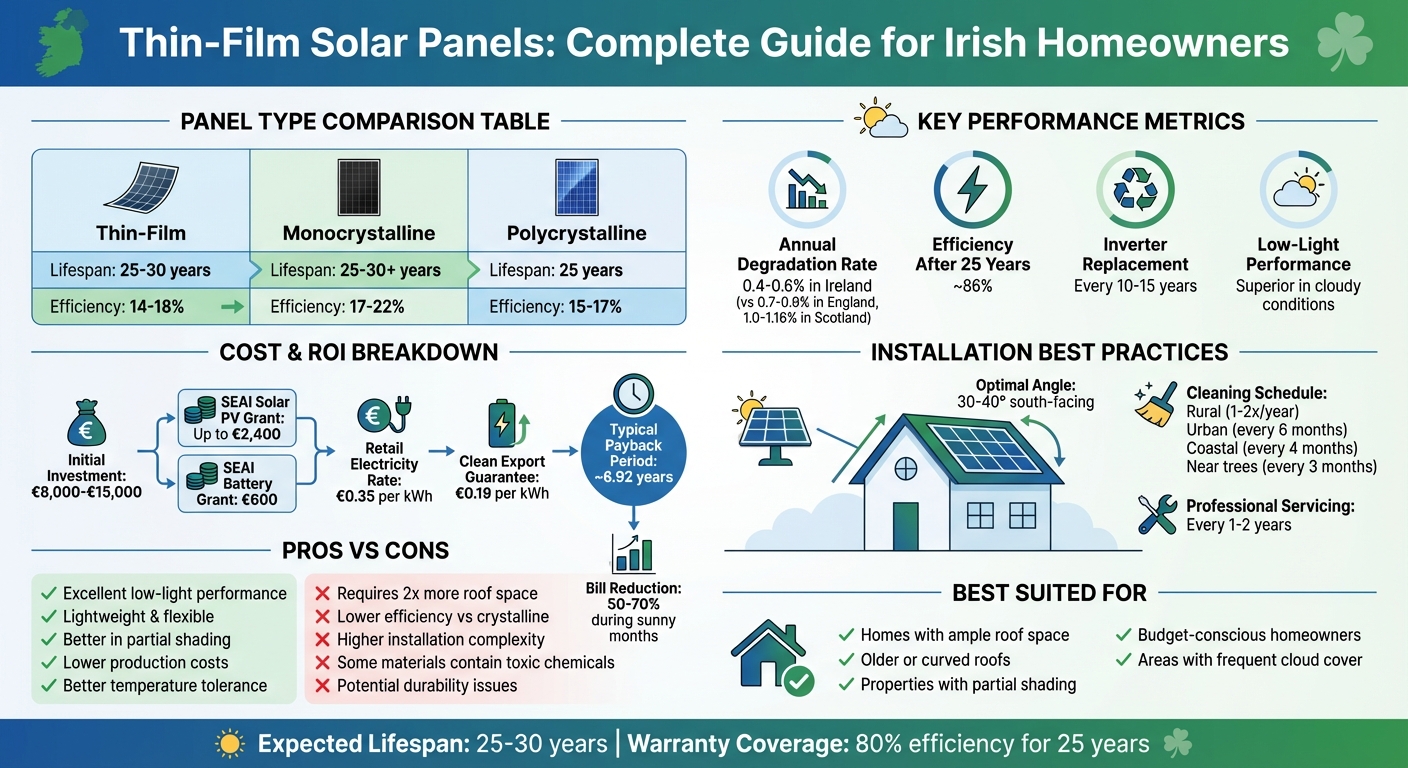
- Lifespan: 25–30 years, with warranties covering 80% efficiency for 25 years.
- Efficiency: Lower than crystalline panels (14–18%) but better in low-light settings. This ensures they work during Irish winters when daylight is limited.
- Maintenance: Minimal but requires regular checks; inverters need replacement every 10–15 years.
- Cost: Initial investment ranges from €8,000–€15,000, with grants up to €2,400 available.
- Best Use: Homes with ample roof space, older or curved roofs, or partial shading.
Thin-film panels are a practical choice for Irish homeowners prioritizing affordability and performance in overcast conditions, though they may not suit those with limited roof space or a need for maximum efficiency.
Thin-Film vs Crystalline Solar Panels: Lifespan, Efficiency & Cost Comparison for Irish Homes
Lifespan of Thin-Film Solar Panels
Expected Lifespan and Durability
Thin-film solar panels typically last between 25 and 30 years in Ireland, comparable to other solar technologies. However, they tend to be less durable than crystalline panels, which might mean more frequent maintenance or earlier replacement. The trade-off? Thin-film panels shine in low-light conditions, making them a great match for Ireland's often cloudy and rainy weather.
Manufacturers generally back their panels with 25-year warranties, ensuring at least 80% of their original efficiency over that period. As Martin Desmond, Managing Director at Wizer Energy, puts it:
"A premium solar panel should continue to perform at 80% efficiency, long after the warranty period ends".
This means that even after 30 years, these panels can still produce a significant amount of electricity.
Advancements in technology are starting to stretch these limits. While the industry standard remains 25–30 years, newer models show potential lifespans of 40 to 50 years. Historically, panels degraded at a rate of about 0.8% per year, but today's high-quality panels, often with improved warranties, see degradation as low as 0.2% annually. On average, most systems experience an annual efficiency decline of 0.35–0.5%.
It's important to note that while solar panels themselves can last decades, solar inverters - critical system components - usually need replacement every 10 to 15 years. Homeowners should plan for at least one inverter replacement over the system's lifetime. Despite their lower durability compared to crystalline panels, thin-film panels' excellent low-light performance makes them highly suitable for Ireland's climate.
Comparison Table: Panel Lifespan and Efficiency
Here's a breakdown of how thin-film panels compare to other types:
| Panel Type | Typical Lifespan (Years) | Efficiency Range (%) | Warranty Period (Years) |
|---|---|---|---|
| Thin-Film | 25–30 | 14–18 | 25 |
| Monocrystalline | 25–30+ | 17–22 | 25–30 |
| Polycrystalline | 25 | 15–17 | 25 |
While thin-film panels may not match the efficiency of monocrystalline models, they offer better performance in low-light and extreme weather conditions. This makes them particularly effective in regions like Ireland, where direct sunlight isn't the norm. Despite varying efficiency levels, the similar warranty periods across all types highlight manufacturers' confidence in their long-term reliability.
Performance in Ireland's Climate
Key Environmental Factors
Ireland's mild and rainy weather offers several perks for thin-film solar panels. The frequent rain acts as a natural cleaning system, washing away dust, pollen, and debris that could otherwise lower efficiency by up to 10%. Plus, the overcast skies common in Ireland allow these panels to capture scattered sunlight, ensuring they still generate power even on cloudy days.
Temperature is another big win for Ireland. Solar panels tend to lose about 0.35%–0.5% efficiency for every degree Celsius above 77°F (25°C). In hotter regions, where surface temperatures can hit 140°F–158°F (60°C–70°C), this heat loss adds up fast. But Ireland's cooler climate keeps panels operating near their ideal temperature, avoiding the overheating issues seen in warmer areas.
The mild weather also reduces wear and tear. Thermal stress - caused by the expansion and contraction of materials during temperature swings - can lead to microcracks in solar cells over time. Ireland’s steady climate minimizes this risk. However, it’s not all smooth sailing. While thin-film panels are designed to handle moisture, the persistent humidity can still impact parts like cabling and inverters if they aren’t properly sealed. Strong winds and hailstorms can also pose a threat to the more delicate structures of these panels.
All in all, Ireland’s natural cleaning effects and cooler temperatures help optimize performance while slowing down wear and tear.
Degradation Rates Over Time
Ireland’s moderate weather plays a big role in keeping solar panels efficient over the years. Studies show that panels in this climate degrade at a rate of just 0.4% to 0.6% annually. That means after 25 years, they can still operate at about 86% efficiency. This slower degradation is largely due to the lack of extreme heat and intense UV exposure, which reduces thermal cycling and the material damage it causes.
Interestingly, degradation rates vary across the British Isles. In Ireland, panels typically degrade at 0.4%–0.6% per year. Compare that to England, where rates range from 0.7% to 0.9%, or Scotland, where harsher conditions like heavy snow and hoarfrost push rates up to 1.0%–1.16%. These figures highlight the long-term benefits for Irish homeowners, as the local climate helps extend the lifespan and efficiency of their solar panels. Homeowners can use a solar panel calculator to estimate long-term savings based on these local conditions.
In short, Ireland’s climate not only boosts immediate solar panel performance but also ensures they remain reliable and efficient for decades.
Maintenance and Optimization
Regular Maintenance Practices
Thin-film panels are relatively low-maintenance, but keeping an eye on them ensures they perform at their best. A simple way to start is by monitoring energy output through your system's app each month. If you notice a sudden drop in performance, it could be a sign of an issue that needs attention. Seasonal visual inspections, ideally in spring and fall, can help you spot potential problems like cracks, discoloration (sometimes called "snail trails"), loose mounting brackets, or even bird nests.
While Ireland’s frequent rain usually does a good job of keeping panels clean, occasional manual cleaning might still be necessary. How often? That depends on the location. Areas near trees might require cleaning every three months, coastal spots every four months, urban environments every six months, and rural areas only once or twice a year. To avoid stressing the panels, clean them during cooler times of the day - early morning or late evening works best.
Professional servicing is also a good idea every 1–2 years. This allows experts to inspect electrical connections, inverters, and weatherproofing, ensuring everything is in top shape. When paired with quality installation, regular maintenance helps your panels deliver consistent performance over time.
Installation and Placement Best Practices
A well-thought-out installation is just as important as ongoing maintenance when it comes to maximizing the lifespan and efficiency of your solar panels. In Ireland, the best setup involves positioning panels to face south at a tilt of 30–40°. This angle not only optimizes sun exposure but also encourages rainwater runoff, which helps keep the panels clear of debris. For flat roofs, creating the right tilt is essential to ensure proper drainage.
Windy conditions call for extra attention to mounting. Panels should be securely attached to a sturdy racking system capable of withstanding strong storms. Regular inspections of brackets and mounts can confirm they remain secure over time. Shading is another factor to consider - trees, chimneys, or nearby buildings casting even partial shadows can significantly lower energy output. Proper placement avoids these pitfalls and ensures consistent performance.
Professional installation also plays a key role in protecting your system from Ireland’s persistent humidity. Sealing critical components like cabling and inverters helps prevent moisture damage. While upfront costs may feel steep, investing in high-quality installation reduces future maintenance headaches and keeps your panels running efficiently for their 25–30 year lifespan.
Advantages and Disadvantages for Irish Homeowners
Pros and Cons of Thin-Film Panels
When deciding whether thin-film solar panels are the right fit for your home, it's important to weigh their benefits against their limitations. These panels are particularly suited to Ireland's often overcast skies, but they also come with trade-offs that may not work for every homeowner.
One of their standout advantages is their superior low-light performance, making them a great match for Ireland's cloudy weather. They're also lightweight and flexible, which is ideal for curved roofs, older buildings, or structures that can't handle the weight of traditional crystalline panels. Thin-film panels are produced with less energy and fewer raw materials, which appeals to environmentally conscious homeowners. On top of that, they perform better in partial shading, so nearby obstructions like chimneys or trees won't significantly impact their output.
However, thin-film panels have some notable downsides. Their lower efficiency means they require about twice the roof space to generate the same power as crystalline panels. Finn Peacock, a Chartered Electrical Engineer, emphasizes this point:
"Thin film solar panels take up twice the roof space for the same power output."
For instance, a standard 3 kW system might need 345 feet of racking and 129 attachment points, compared to just 102 feet of racking and 40 attachment points for crystalline panels. Additionally, some thin-film materials, like Cadmium Telluride (CdTe), include toxic substances such as cadmium, which could pose risks if the panels are damaged.
| Pros | Cons |
|---|---|
| Performs well in low-light, cloudy conditions | Requires significantly more roof space for the same power output |
| Lightweight and flexible - ideal for weak or curved roofs | Lower efficiency compared to crystalline panels |
| Handles partial shading better | Potential durability issues may lead to higher maintenance |
| Lower production costs and reduced material use | Higher installation complexity and increased racking costs |
| Better temperature tolerance | Some materials contain toxic chemicals like cadmium |
Thin-film panels work best for homes with plenty of roof space, older structures with limited load capacity, or locations where shading is a concern. On the other hand, if your roof space is limited or you're focused on durability and efficiency, crystalline panels might be the better long-term choice, even though they come with a higher upfront installation cost. Balancing these pros and cons is key to making a worthwhile solar investment for your home.
Long-Term Value and Replacement
Warranty Coverage and When to Replace Panels
Thin-film solar panels typically come with a manufacturer's warranty lasting 20 to 25 years. These warranties generally consist of two parts: a product warranty, which covers defects in materials or workmanship (usually 10–25 years), and a linear performance warranty, which guarantees the panels will maintain a specific power output over time.
Martin Desmond, Managing Director at Wizer Energy, sheds light on this:
"Most manufacturers provide warranties to cover solar panels for around 25 years. During this warranty period, a high-quality solar panel shouldn't experience too many performance issues."
That said, keep in mind that many manufacturers do not include labor costs in their warranties. For instance, replacing a defective panel could cost you approximately $595 (about €550) for labor and a "truck roll" if you don’t have a specialized protection plan. Additionally, inverters - another critical component - typically have warranties of only 5 to 15 years and could cost between €1,000 and €2,000 to replace.
Signs that a panel might need replacing include a drop in output below 80% of its rated capacity, permanent discoloration, expanding micro-cracks caused by temperature changes, or moisture seeping into the protective layers. To catch issues early, monitor your system’s performance in real time. It’s also smart to schedule professional inspections every 12 to 24 months to check for physical damage like cracks or corrosion. Ignoring such damage could void your warranty.
Understanding these potential costs is crucial for accurately calculating the long-term financial benefits of your solar investment.
Calculating ROI for Irish Homeowners
Once you’ve factored in potential costs, the next step is to calculate your solar system's return on investment (ROI). By combining performance metrics with maintenance and replacement costs, you can get a clearer picture of its financial impact.
Start with your net upfront cost after applying government incentives. In Ireland, installation costs typically range from €8,000 to €15,000 before grants. Thanks to the SEAI (Sustainable Energy Authority of Ireland), homeowners can receive up to €2,400 for solar PV panels and an additional €600 for battery storage. On top of that, the 0% VAT rate on solar installations for private homes further reduces your initial expense.
Next, calculate your yearly savings. Electricity consumed directly at home is valued at around €0.35 per kWh (the retail rate), while any excess electricity exported back to the grid through the Clean Export Guarantee (CEG) earns about €0.19 per kWh. For example, a typical system with 10 panels (4.4 kWp) in Ireland could pay for itself in roughly 6.92 years, with homeowners often cutting their electricity bills by 50–70% during sunnier months.
| ROI Component | Value/Rate |
|---|---|
| Retail Electricity Rate | ~€0.35 per kWh |
| Clean Export Guarantee (CEG) | ~€0.19 per kWh |
| SEAI Solar PV Grant | Up to €2,400 |
| SEAI Battery Grant | €600 |
| Typical Payback Period | ~6.92 years |
Data from [22,28].
To maximize savings, run energy-intensive appliances during peak sunlight hours to use electricity at the higher retail rate instead of exporting it at the lower CEG rate. Adding battery storage can further increase self-consumption, potentially boosting usage from 35% to over 70%. While this adds to your upfront costs, it can significantly shorten the payback period. Lastly, remember that while thin-film panels generally last 25–30 years, components like inverters may need earlier replacements, so include these costs in your long-term calculations.
Conclusion
Final Thoughts on Thin-Film Panels
Thin-film solar panels strike a balance between affordability and efficiency, making them a practical choice for Irish homeowners. With lifespans ranging from 25 to 30 years and upfront costs typically between €5,000 and €7,500, they offer a budget-friendly option without compromising on durability. One of their standout features is their ability to perform well in low-light conditions, which is especially beneficial in Ireland's often overcast weather. As Joe Brennan, Founder of Going Solar, explains:
"Thin-film solar panels are an attractive option for Irish homeowners due to their affordability... making them a cost-effective choice for those on a budget".
While these panels do require more roof space and maintenance compared to crystalline models, they excel in handling partial shading - an important advantage for properties with nearby trees or unconventional roof layouts. Ireland's cooler climate also works to their benefit by reducing thermal degradation, helping the panels maintain around 86% efficiency after 25 years, with a degradation rate of just 0.6% annually.
It's worth noting that inverters typically need replacing every 10–15 years. To ensure optimal performance and longevity, regular professional inspections are essential, particularly to address potential moisture-related issues in Ireland's humid environment. Proper installation and consistent maintenance are critical to getting the most out of your system.
If affordability and reliable performance in low-light conditions are your priorities, thin-film solar panels are a practical solution. For expert advice tailored to Ireland's specific climate needs, visit Get Solar Panels.
Everything You Need To Know About Crystalline Silicon VS Thin-Film Solar Cells 2024 | AI-Automated
FAQs
Are thin-film panels worth it on a small roof?
Thin-film panels generally have a lifespan of 20–25 years and are less durable compared to other panel types. If you have a small roof with limited space and need reliable, long-term performance, thin-film panels might not be ideal. Instead, explore options that offer higher efficiency and longevity to ensure you get the most value from your roof space.
How does humidity affect thin-film systems in Ireland?
Ireland’s high humidity levels can pose challenges for thin-film solar panels. Moisture buildup is a common issue, as it can obstruct sunlight and lower energy production. Over time, this moisture can also speed up the wear and tear of the panels.
That said, modern solar panels are designed with protective features specifically aimed at resisting humidity, making them well-suited for Ireland’s damp conditions. To keep them performing at their best, regular maintenance is key. Ensuring the panels are properly sealed can also help prevent moisture-related problems, extending their lifespan and maintaining efficiency.
What hidden costs should I budget for over 30 years?
Over a 30-year period, it's wise to budget for potential expenses related to your solar system. These might include replacing components like inverters or batteries, which typically last 10-15 years. Regular maintenance - such as cleaning, inspections, and occasional repairs - should also be factored in. After the warranty period (usually around 25 years), you may need to replace panels if their efficiency declines. Additionally, there could be recycling or disposal costs at the end of the panels' lifespan. Preparing for these expenses provides a clearer picture of the long-term costs tied to your solar investment.
Related Blog Posts
Related Articles
How to Choose Solar Security Lights for Your Home
Match brightness, motion sensors, battery life, and weather resistance to choose durable, energy-saving solar security lights for reliable home protection.
Ultimate Guide to Solar Battery ROI in Ireland
Practical analysis of solar battery costs, payback, grants and savings in Ireland—how batteries affect self‑consumption, VAT, and 8–12 year ROI.
How to Adjust Solar Panels for Seasonal Changes
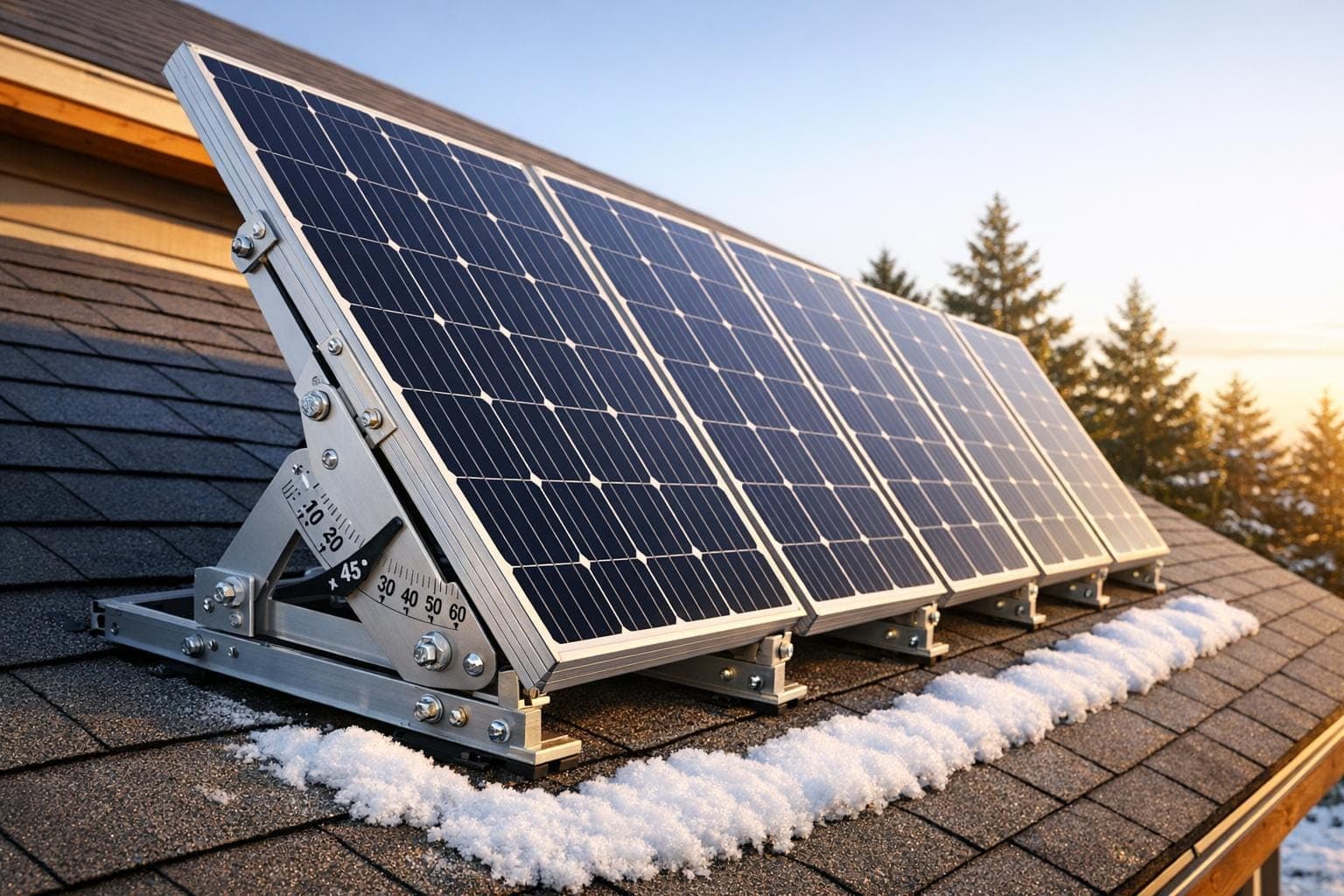
Adjust your solar panels twice yearly using simple latitude-based tilt changes to boost output 10–25%, improve snow shedding, and save on energy costs.