

Clean Export Guarantee Ireland 2026: How to Sell Solar Electricity Back to the Grid
The Clean Export Guarantee (CEG) allows Irish homeowners with solar panels to sell surplus electricity back to the grid at rates of €0.155 to €0.185 per kWh. A typical 4kWp solar system exports 2,000–2,500 kWh per year, earning €300–€450 annually — tax-free up to €400.
Since its introduction in 2022, the Clean Export Guarantee has transformed the economics of home solar power in Ireland. Instead of wasting the electricity your panels produce when you are not home or not using enough power, you can now export that surplus to the national grid and receive payment from your electricity supplier. This guide covers everything you need to know about the CEG in 2026: current rates from every major supplier, how to apply, realistic earnings projections, tax implications, and how to maximise your income.
What Is the Clean Export Guarantee (CEG)?
The Clean Export Guarantee (CEG) is a government-backed scheme that requires all licensed electricity suppliers in Ireland to offer a payment to microgeneration customers for surplus renewable electricity they export to the national grid. It was introduced by the Commission for Regulation of Utilities (CRU) and took effect on 15 February 2022.
In practical terms, the CEG means that if you have solar panels on your home and your system generates more electricity than you are using at any given moment, that excess power flows into the grid and your electricity supplier pays you for it. The payment appears as a credit on your electricity bill or, in some cases, as a direct payment.
The key features of the Clean Export Guarantee are:
- Mandatory participation by suppliers: All licensed electricity suppliers in Ireland must offer a CEG tariff to eligible microgeneration customers. This is not optional for them — it is a regulatory requirement set by the CRU.
- Market-based rates: Unlike a fixed government feed-in tariff, the CEG rate is set by each individual supplier. This means rates vary between providers, and you should compare them just as you would compare electricity purchase prices.
- Available to all microgeneration technologies: While most CEG participants use solar panels, the scheme also covers small wind turbines, micro-hydro systems, and other renewable microgeneration technologies up to 50kW capacity.
- Requires a smart meter: To participate, you must have a smart meter installed by ESB Networks so that exported electricity can be accurately measured.
- No cap on export volume: There is no limit on how much electricity you can export per year under the CEG, though your system size and generation capacity will naturally determine your export volumes.
The CEG replaced the previous informal arrangements where microgeneration customers received little or no payment for exported electricity. Before 2022, most Irish homeowners with solar panels simply lost any electricity they could not use at the point of generation. The CEG corrected this by creating a legal obligation for suppliers to pay for exported power.
How Much Can You Earn Selling Solar Electricity?
The amount you earn from the Clean Export Guarantee depends on two factors: the rate your supplier pays per kilowatt-hour (kWh) of exported electricity, and how much surplus electricity your solar system actually exports to the grid. Here are the current CEG rates offered by major Irish electricity suppliers in 2026:
| Electricity Supplier | CEG Rate (per kWh) | Annual Income (2,000 kWh export) | Annual Income (2,500 kWh export) |
|---|---|---|---|
| Electric Ireland | €0.185 | €370 | €462 |
| Energia | €0.180 | €360 | €450 |
| Bord Gáis Energy | €0.175 | €350 | €437 |
| SSE Airtricity | €0.160 | €320 | €400 |
| Flogas | €0.155 | €310 | €387 |
| Panda Power | €0.155 | €310 | €387 |
Rates shown are estimates for 2026 and may vary depending on your specific tariff plan. Always confirm the current CEG rate directly with your supplier before making a decision. Some suppliers bundle a higher CEG rate with specific electricity tariffs, so consider the overall package rather than the export rate alone.
As the table shows, Electric Ireland currently offers the highest CEG rate at €0.185 per kWh. However, the best overall deal for you depends on your total energy costs, not just the export rate. A supplier with a slightly lower CEG rate but significantly cheaper import electricity prices may save you more money overall.
It is worth noting that CEG rates have stabilised compared to the early years of the scheme. In 2022 and 2023, when wholesale electricity prices were elevated due to the energy crisis, some suppliers offered CEG rates above €0.20/kWh. As wholesale prices normalised through 2024 and 2025, export rates adjusted downward accordingly. The current rates of €0.155 to €0.185 per kWh represent a mature and sustainable level for the Irish market.
How the Clean Export Guarantee Works: Step by Step
Understanding the mechanics of how the CEG works will help you optimise your earnings and avoid surprises on your bill. Here is the complete process from generation to payment:
Step 1: Your Solar Panels Generate Electricity
Your solar panels convert sunlight into direct current (DC) electricity. Your inverter converts this into alternating current (AC) that your home can use. The electricity your panels produce is first used to power whatever is running in your home at that moment — lights, appliances, heating, the immersion heater, your electric vehicle charger, and so on.
Step 2: Surplus Electricity Flows to the Grid
When your solar panels are producing more electricity than your home is consuming, the surplus automatically flows out through your electricity meter and into the national grid. This happens instantly and automatically — there is no switch to flip or setting to configure. The laws of physics direct the excess power to the grid.
Step 3: Your Smart Meter Records the Export
Your smart meter records both the electricity you import from the grid (what you buy) and the electricity you export to the grid (what you sell). This is measured in 30-minute intervals. ESB Networks reads your smart meter remotely, so there is no need for a meter reader to visit your property.
Step 4: Your Supplier Calculates the Credit
At each billing cycle — typically every two months (bi-monthly) — your electricity supplier receives your meter data from ESB Networks. They multiply your total exported kWh by your agreed CEG rate to calculate your export credit. For example, if you exported 400 kWh in a billing period at a rate of €0.185/kWh, your credit would be €74.
Step 5: You Receive Payment or Credit
Most suppliers apply your CEG earnings as a credit against your electricity bill. This means your export income reduces the amount you owe for the electricity you imported. If your credit exceeds your bill amount in a given period (which is rare but possible in summer), the surplus typically carries forward to the next billing cycle. Some suppliers offer the option of a direct payment into your bank account instead of bill credit, though this is less common.
The entire process is automated once you are set up. You do not need to submit meter readings, file claims, or take any ongoing action to receive your CEG payments.
Who Is Eligible for the CEG?
To qualify for the Clean Export Guarantee in Ireland, you must meet all of the following requirements:
| Requirement | Details |
|---|---|
| Renewable microgeneration system | You must have an installed renewable energy generation system — typically solar PV panels, but also small wind turbines or micro-hydro. |
| Maximum capacity of 50kW | Your generation system must have a maximum export capacity (MEC) of 50kW or less. Most residential solar systems are 2kW to 10kW, well within this limit. |
| Smart meter installed | You must have a smart meter installed by ESB Networks. If you do not have one yet, ESB Networks will install one free of charge as part of the national smart meter rollout. You can request an early installation. |
| NC6 application approved | You must submit an NC6 application form to ESB Networks to register as a microgeneration customer and connect your system to the grid. |
| Registered with an electricity supplier | You must be a customer of an electricity supplier that offers a CEG tariff. All licensed suppliers are required to offer one, but you must actively sign up. |
| Safe Electric certification | Your solar installation must have been carried out or certified by a registered electrical contractor (RECI). A completion certificate is required for the NC6 process. |
| Irish property | The property must be located in the Republic of Ireland and connected to the ESB Networks distribution system. Northern Ireland has a separate scheme. |
There is no requirement to have received an SEAI grant to be eligible for the CEG. You qualify whether your solar panels were installed with or without grant assistance. Similarly, there is no restriction on when your panels were installed — if you had solar panels before the CEG was introduced, you can still apply and start receiving payments.
Both homeowners and landlords can avail of the CEG, as can small businesses with microgeneration systems under 50kW. The property does not need to be owner-occupied.
How to Set Up the Clean Export Guarantee
Setting up the CEG involves several steps across different organisations. Here is the complete process, from start to first payment:
Step 1: Install Your Solar Panel System
If you do not already have solar panels, you will need to have a system installed by an SEAI-registered and RECI-certified installer. The installer will provide you with the documentation you need for the NC6 application, including a wiring completion certificate and technical specifications of your system. If you are applying for the SEAI solar PV grant, the installer must be on the SEAI’s registered list.
Step 2: Submit the NC6 Application to ESB Networks
The NC6 form is your application to connect a microgeneration system to the electricity grid. This is submitted to ESB Networks (not your electricity supplier). The NC6 form requires the following information:
- Your MPRN (Meter Point Reference Number), found on your electricity bill
- Details of your microgeneration system (type, capacity, inverter details)
- Electrical completion certificate from your RECI-registered installer
- Confirmation that the installation complies with EN 50549-1 and ESB Networks technical standards
Your solar installer will typically complete and submit the NC6 form on your behalf as part of their installation service. Processing times vary, but ESB Networks generally processes NC6 applications within 4 to 8 weeks. You can submit the NC6 application online through the ESB Networks website.
Step 3: Get a Smart Meter Installed
If you do not already have a smart meter, ESB Networks will arrange to install one. In many cases, the smart meter installation is coordinated as part of the NC6 process. Smart meter installations are free of charge. ESB Networks will contact you to arrange a suitable installation date. The installation typically takes 30 to 60 minutes and requires a brief interruption to your electricity supply.
If you already have a smart meter, ESB Networks will reconfigure it remotely to record export data. This is done automatically as part of the NC6 approval process and does not require a visit to your property.
Step 4: Register for CEG with Your Electricity Supplier
Once your NC6 application has been approved and your smart meter is recording export data, you need to contact your electricity supplier to register for their CEG tariff. This is a separate step — your supplier will not automatically start paying you for exports just because ESB Networks has approved your NC6.
Most suppliers allow you to register for the CEG online or by phone. You will need your MPRN, proof of your approved NC6 application, and your account details. The registration process is straightforward and typically takes effect from your next billing cycle.
Step 5: Start Receiving Payments
From the date your CEG registration is active, all electricity you export will be measured and paid for according to your supplier’s CEG rate. Your first CEG credit will appear on your next electricity bill. The entire setup process, from solar installation to first CEG payment, typically takes 2 to 4 months.
How Much Will You Realistically Earn?
Theoretical earnings are one thing, but what can you actually expect to earn from the CEG? The answer depends on your system size, your household’s electricity consumption patterns, and how much surplus electricity you actually export.
A critical point that many people miss: you do not export all the electricity your solar panels produce. You only export the surplus — the power that exceeds your household’s consumption at that moment. A typical Irish household with a 4kWp solar system will self-consume 50–70% of the electricity generated and export the remaining 30–50%.
Here are realistic annual earnings projections based on typical Irish conditions and a range of system sizes:
| System Size | Annual Generation (kWh) | Estimated Export (kWh) | Export % | Annual CEG Income (Low Rate €0.155) | Annual CEG Income (High Rate €0.185) |
|---|---|---|---|---|---|
| 2kWp | 1,800–2,000 | 600–900 | 30–45% | €93–€139 | €111–€166 |
| 4kWp | 3,600–4,000 | 2,000–2,500 | 45–55% | €310–€387 | €370–€462 |
| 6kWp | 5,400–6,000 | 3,000–4,000 | 50–65% | €465–€620 | €555–€740 |
Several factors explain why larger systems export a higher percentage of their generation:
- A 2kWp system produces modest amounts of electricity that a typical Irish household can absorb quite efficiently, especially if someone is home during the day. Export percentages tend to be lower, in the 30–45% range.
- A 4kWp system — the most common residential size in Ireland — produces more than most households consume during peak solar hours (midday), leading to exports of 45–55% of total generation. This is the sweet spot for most homes.
- A 6kWp system generates significant surplus, particularly in summer. Without a battery to store excess energy, export percentages of 50–65% are typical, which means more CEG income but also lower self-consumption savings per kWh generated.
Important: The value of electricity you use yourself (self-consumption) is worth far more than the value of electricity you export. If you are paying €0.35/kWh to buy electricity from the grid, every kWh you self-consume from your solar panels saves you €0.35. Every kWh you export earns you only €0.155–€0.185. This is why maximising self-consumption should always be your first priority, with the CEG providing a valuable bonus for unavoidable surplus.
Seasonal Earnings Variation
Your CEG earnings will not be evenly distributed throughout the year. In Ireland, solar generation is heavily seasonal:
- May to August: Peak generation months. A 4kWp system may export 400–600 kWh per month, earning €60–€110 monthly from the CEG.
- March, April, September, October: Moderate generation. Exports of 150–300 kWh per month, earning €23–€55 monthly.
- November to February: Low generation. Exports may drop to 20–80 kWh per month, earning just €3–€15 monthly.
This seasonal pattern means roughly 70% of your annual CEG income will come from the April–September period. Plan your cash flow expectations accordingly.
CEG vs Feed-In Tariff: What Is the Difference?
Many people search for "feed-in tariff Ireland" when they are actually looking for information about the Clean Export Guarantee. While both concepts involve payment for exported renewable electricity, there are important differences:
| Feature | Feed-In Tariff (as in UK/Germany) | Clean Export Guarantee (Ireland) |
|---|---|---|
| Rate setting | Government sets a fixed, guaranteed rate | Each supplier sets their own competitive rate |
| Rate duration | Fixed for 15–25 years from installation | Can change with each billing cycle or tariff review |
| Payment basis | Often pays for all generation (not just export) | Pays only for electricity actually exported to the grid |
| Funding | Funded by a levy on all electricity bills | Funded by the purchasing supplier (part of their costs) |
| Supplier choice | Same rate regardless of supplier | Rates differ between suppliers — shopping around matters |
| Availability in Ireland | Ireland does not have a traditional feed-in tariff for domestic microgeneration | Active and available since February 2022 |
Ireland chose the CEG model rather than a traditional feed-in tariff for several reasons. The CEG approach uses market competition between suppliers to set rates, which the CRU believes delivers better long-term value than government-fixed rates. It also avoids the issue that plagued feed-in tariff schemes in other countries, where generous early rates created large long-term liabilities funded by all electricity consumers.
The downside of the CEG compared to a traditional feed-in tariff is the lack of long-term price certainty. With a feed-in tariff, you know exactly what you will earn for the next 15–25 years. With the CEG, rates can change, and there is no guarantee that today’s rates will be maintained. However, the CRU’s regulatory oversight ensures that suppliers must always offer a reasonable CEG rate, and market competition between suppliers provides some protection against rates falling dramatically.
If you see references to "feed-in tariffs" in Ireland, they are almost always referring to the Renewable Energy Feed-In Tariff (REFIT) scheme, which applies to large-scale commercial renewable energy projects, not to residential microgeneration. The CEG is the correct mechanism for homeowners with solar panels.
How to Maximise Your CEG Income
While the CEG provides a guaranteed payment for every kWh you export, there are several strategies to increase your total income from the scheme:
1. Choose the Supplier with the Best CEG Rate
CEG rates vary by up to €0.03/kWh between suppliers. Over a year, this difference can amount to €60–€75 for a typical 4kWp system. Review CEG rates regularly, as suppliers adjust them periodically. Be aware that some suppliers offer higher CEG rates as part of specific tariff packages that may have higher import electricity prices, so always calculate the net effect on your total bill.
2. Shift Energy-Intensive Tasks to Evening Hours
This may seem counterintuitive — conventional wisdom says to use electricity when the sun is shining. However, if you have a battery storage system, you can store solar electricity during the day and use it in the evening, while exporting more during the peak solar hours (10am–4pm) when generation exceeds both your household demand and battery charging needs. Without a battery, you should do the opposite: run your dishwasher, washing machine, and other heavy loads during peak solar hours to maximise self-consumption.
3. Optimise Battery Charging and Discharging
If you have a home battery, configure it to prioritise self-consumption first, then export surplus to the grid. Some smart battery systems allow you to set export schedules that align with periods of highest demand on the grid, though the CEG does not currently offer time-of-use export rates in most cases.
4. Ensure Your System Is Performing Optimally
A poorly maintained or underperforming solar system generates less electricity, which means less surplus to export. Keep your panels clean, check for shading issues from growing trees, and monitor your system’s output through your inverter’s app or monitoring platform. A 10% drop in system performance due to dirty panels or partial shading directly reduces your CEG income by the same percentage.
5. Consider a Larger System
If you are planning a new solar installation, a larger system will generate more surplus for export. However, remember that the economics favour self-consumption over export. A larger system is most cost-effective when it both increases your self-consumption (by covering more of your daytime electricity use) and increases your exports. If your roof space allows, a 4–6kWp system with a battery is typically the optimal configuration for maximising combined self-consumption savings and CEG income.
6. Time Discretionary Loads Strategically
Use timers on your immersion heater, electric vehicle charger, and other discretionary loads. In winter, when solar generation is low, run these during peak solar hours to maximise self-consumption. In summer, when surplus is abundant, your immersion heater can soak up excess generation during the day while you still export enough surplus to earn meaningful CEG income.
7. Monitor Your Export Data
Keep track of how much you are exporting each month. Most smart meter data can be accessed through your supplier’s online portal or app. Monitoring helps you identify patterns, spot problems early, and make informed decisions about when to shift consumption versus when to export.
Tax on Solar Export Income
One of the most common questions about the CEG is whether the income is taxable. The good news for most Irish homeowners is that the first €400 of annual income from domestic microgeneration is completely tax-free.
The €400 Tax-Free Threshold
The Revenue Commissioners confirmed that income from the sale of domestically generated renewable electricity is exempt from income tax, PRSI, and USC up to €400 per year. This exemption was introduced in Finance Act 2022 and applies from the 2022 tax year onwards. It is per household, not per person.
For the vast majority of Irish homeowners with solar panels, the €400 threshold is more than sufficient. A typical 4kWp system earns €300–€450 per year from the CEG, meaning most or all of your CEG income will fall within the tax-free allowance.
What If You Earn More Than €400?
If your annual CEG income exceeds €400, only the amount above €400 is subject to tax. This income is treated as “other income” for tax purposes and is subject to income tax at your marginal rate, plus PRSI and USC. For example, if you earn €500 from the CEG in a year, €400 is tax-free and the remaining €100 is taxable.
Earning more than €400 per year is only likely with larger systems (6kWp or above) or in exceptionally sunny years. If you have a 4kWp system with a high CEG rate, you might occasionally exceed the threshold in a good summer.
How to Report CEG Income
If your total annual CEG income is €400 or less, you do not need to report it to Revenue. If it exceeds €400, the excess should be declared on your annual tax return (Form 11 or Form 12 as applicable). Your electricity supplier may provide an annual statement of your CEG earnings to assist with tax reporting. Keep records of your export payments for your own reference.
Capital Gains Implications
The CEG income exemption applies to income tax only. If you sell your property, the presence of solar panels and the associated CEG income potential may increase the property’s value, but this is captured in the property’s sale price and would be subject to normal capital gains tax rules, not any special solar-related provisions.
CEG and Battery Storage: A Smart Combination
Combining a home battery storage system with the Clean Export Guarantee gives you unprecedented control over your energy economics. Here is how the two work together and why this combination is increasingly popular among Irish homeowners.
How Batteries and the CEG Interact
Without a battery, any surplus solar electricity your panels generate is immediately exported to the grid and paid for at the CEG rate (€0.155–€0.185/kWh). With a battery, you have a choice: store that surplus for later use in your home or export it to the grid.
Since self-consumed electricity is worth more than exported electricity (you save €0.35/kWh by not buying from the grid, versus earning €0.155–€0.185/kWh by exporting), the battery allows you to shift solar electricity to the evening and night when you would otherwise be buying from the grid. This increases your self-consumption savings significantly.
The Optimal Strategy
The most financially optimal strategy with a battery and the CEG is:
- First priority: Self-consume solar directly. Use solar electricity for any loads running during daylight hours.
- Second priority: Charge the battery. Once immediate household demand is met, charge your battery with surplus solar electricity.
- Third priority: Export to the grid. Once your battery is full and your household demand is met, export remaining surplus to the grid and earn the CEG rate.
- Evening and night: Use stored battery power. Discharge the battery to cover your evening and overnight electricity needs, avoiding grid imports at €0.35/kWh.
This hierarchy maximises the financial value of every kWh your solar panels produce. Most modern battery management systems and hybrid inverters can be configured to follow this logic automatically.
Impact on CEG Earnings
Adding a battery will typically reduce your CEG income because more electricity is stored for self-consumption rather than being exported. However, the overall financial benefit increases because the electricity you store and use later is worth more than the export payment you would have received.
For example, a 4kWp system without a battery might export 2,200 kWh per year, earning approximately €385 at €0.175/kWh. The same system with a 5kWh battery might export only 1,200 kWh per year, earning approximately €210 from the CEG. However, the 1,000 kWh that was stored and self-consumed instead of exported saves €350 on electricity bills (at €0.35/kWh import cost). The net benefit of the battery in this scenario is an additional €175 per year (€350 saved minus €175 lost CEG income).

Best Battery Options for CEG Optimisation
When choosing a battery to complement the CEG, consider the following:
- Capacity: A 5–10 kWh battery is ideal for most Irish homes with a 4–6kWp solar system. Too small a battery fills up quickly and does not significantly reduce exports. Too large a battery may never fully charge in winter and represents wasted investment.
- Smart management: Choose a battery system with intelligent energy management that can automatically optimise between self-consumption and export based on your household patterns and the CEG rate.
- Hybrid inverter compatibility: A hybrid inverter that manages both solar panels and battery storage simplifies the system and typically provides better optimisation than separate solar and battery inverters.
- Future-proofing: As time-of-use electricity tariffs become more common in Ireland, a battery with smart scheduling capabilities will be able to exploit price differences between peak and off-peak grid electricity in addition to the CEG.
Frequently Asked Questions
Can you sell electricity back to the grid in Ireland?
Yes. Under the Clean Export Guarantee (CEG), any homeowner or small business in Ireland with a renewable microgeneration system (such as solar panels) up to 50kW can sell surplus electricity back to the national grid. You need a smart meter and an approved NC6 connection with ESB Networks. Your electricity supplier pays you for every kWh you export, at rates ranging from €0.155 to €0.185 per kWh in 2026.
How much does Electric Ireland pay for solar export?
Electric Ireland’s CEG rate in 2026 is approximately €0.185 per kWh, which is currently the highest rate among major Irish electricity suppliers. A 4kWp solar system exporting 2,000–2,500 kWh per year to Electric Ireland would earn approximately €370–€462 annually. Check Electric Ireland’s website for their current rate, as it may change.
Do I need a smart meter for the CEG?
Yes. A smart meter is an essential requirement for the Clean Export Guarantee. The smart meter measures both the electricity you import from the grid and the electricity you export. Without a smart meter, there is no way to accurately measure your exports and calculate your CEG payments. ESB Networks installs smart meters free of charge as part of the national rollout. You can request an early installation by contacting ESB Networks.
Is income from selling solar electricity taxable?
The first €400 of annual income from domestic microgeneration is completely tax-free under Revenue Commissioners guidelines introduced in Finance Act 2022. This covers income tax, PRSI, and USC. Only income above €400 per year is taxable at your marginal rate. Most households with typical solar systems will earn within or close to the €400 threshold, meaning their CEG income is effectively tax-free.
What is the NC6 form and how do I apply?
The NC6 is the application form you submit to ESB Networks to register a microgeneration system for grid connection and export. It includes details of your solar system, your MPRN, and your installer’s electrical completion certificate. Most solar installers submit the NC6 form on your behalf as part of their installation service. You can also submit it directly through the ESB Networks website. Processing typically takes 4–8 weeks.
Can I switch electricity suppliers and keep the CEG?
Yes. Your NC6 registration with ESB Networks is independent of your electricity supplier. If you switch suppliers, your new supplier must offer you a CEG tariff (it is a regulatory requirement). You will need to register for the CEG with your new supplier, but you do not need to reapply for NC6 approval. Compare CEG rates between suppliers when switching, as rates vary significantly.
How long does it take to set up the CEG?
From the point of having solar panels installed, the typical timeline is: NC6 application processing (4–8 weeks), smart meter installation if needed (2–4 weeks, may overlap with NC6 processing), and supplier CEG registration (1–2 weeks). In total, expect 2–4 months from installation to first CEG payment. If you already have a smart meter, the process is faster.
Does the CEG rate change?
Yes. Unlike a fixed feed-in tariff, CEG rates are set by individual suppliers and can change over time. Suppliers typically review their rates periodically, and changes are influenced by wholesale electricity prices, competition, and regulatory requirements. The CRU oversees the CEG to ensure suppliers offer reasonable rates, but there is no guaranteed minimum rate. It is wise to review your supplier’s CEG rate annually and switch if a better deal is available.
Can I get the CEG without the SEAI grant?
Yes. The Clean Export Guarantee and the SEAI solar PV grant are completely separate schemes run by different bodies. The CEG is administered by the CRU and ESB Networks; the grant is administered by SEAI. You qualify for the CEG whether or not you received a grant for your solar panels. Even if you installed solar panels before any grants were available, you can still apply for the CEG.
What happens to my export credits if I produce more than I consume?
If your CEG credit exceeds your electricity bill amount in a given billing period, the surplus credit typically rolls over to your next bill. This is most likely to happen during summer months when solar generation peaks and electricity consumption for heating is low. Check with your supplier about their specific policy on surplus credits, as some may offer annual cash-outs while others roll credits forward indefinitely.
Is the CEG available in Northern Ireland?
No. The Clean Export Guarantee is a Republic of Ireland scheme, regulated by the CRU and operated through ESB Networks. Northern Ireland has its own separate arrangements for microgeneration, administered by NIE Networks. If you are in Northern Ireland, contact NIE Networks and your electricity supplier for information on their export payment schemes.
Can I get the CEG for a small wind turbine, not just solar panels?
Yes. The CEG covers all renewable microgeneration technologies up to 50kW, including small wind turbines, micro-hydro systems, and other renewable sources. The application process is the same: NC6 form to ESB Networks, smart meter, and registration with your supplier. Solar panels are by far the most common technology used with the CEG, but the scheme is technology-neutral.
What is the minimum system size for the CEG?
There is no minimum system size requirement for the CEG. Even a single solar panel connected to a micro-inverter could theoretically qualify, provided you complete the NC6 process and have a smart meter. In practice, very small systems (under 1kWp) produce minimal surplus and the administrative effort may not be worthwhile, but there is no technical or regulatory minimum.
Related Articles

Solar Panel Types for Irish Homes: Which One Should You Choose? (2026 Guide)
Compare solar panel types for Irish homes in 2026. Monocrystalline dominates at 20%+ efficiency, but what about thin-film, bifacial, and solar tiles? Costs, pros, cons.

SEAI Solar Panel Grant 2026: How Much, Who Qualifies & How to Apply
How to get the €1,800 SEAI solar panel grant in 2026. Eligibility, step-by-step application, what you need, common mistakes, and how long it takes to get paid.
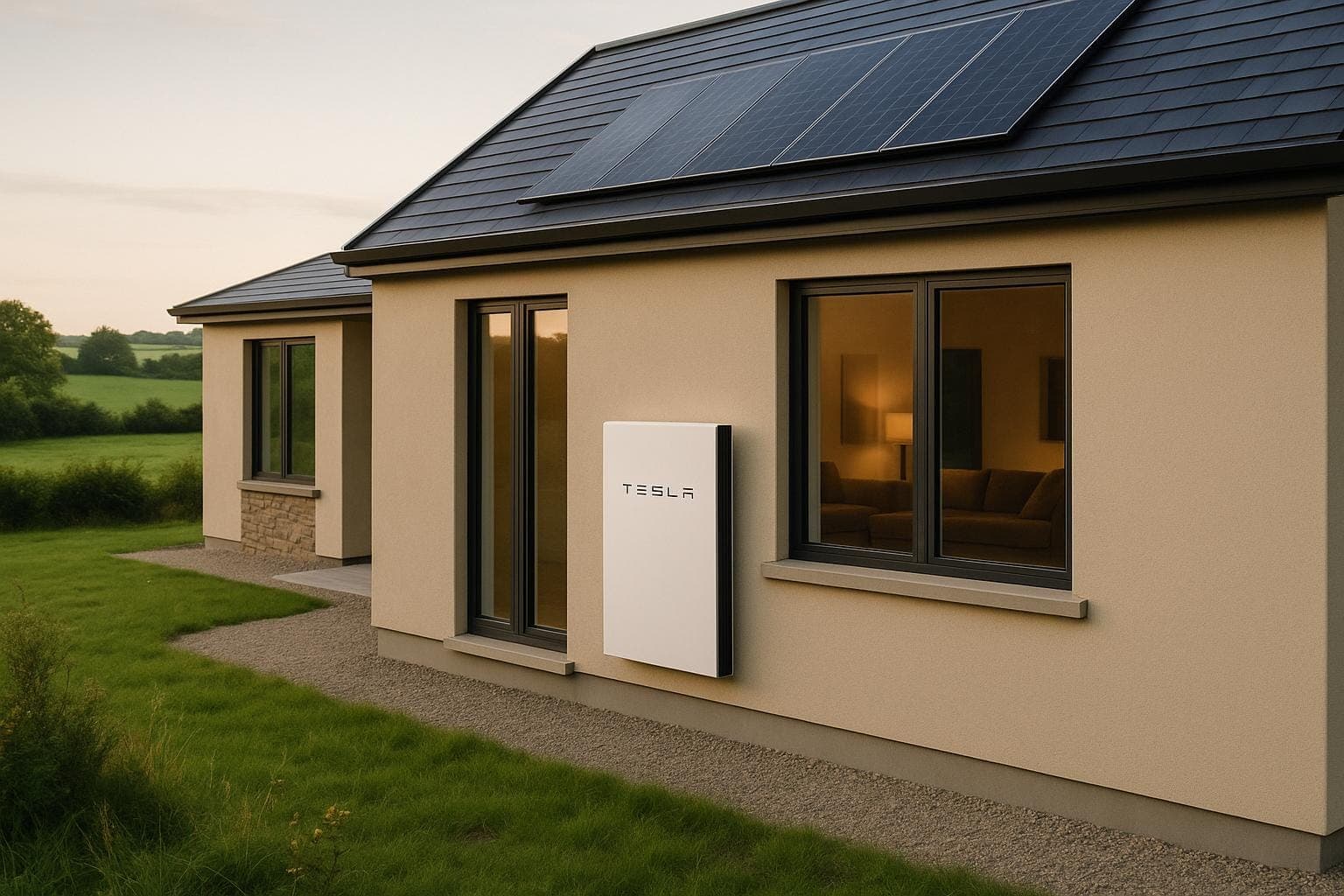
Tesla Powerwall Costs in Ireland 2026: Price, Specs, Alternatives & Is It Worth It?
Tesla Powerwall 3 costs €12,000–€15,000 installed in Ireland. 13.5 kWh capacity, built-in inverter, backup power. How it compares to Huawei Luna and GivEnergy.