
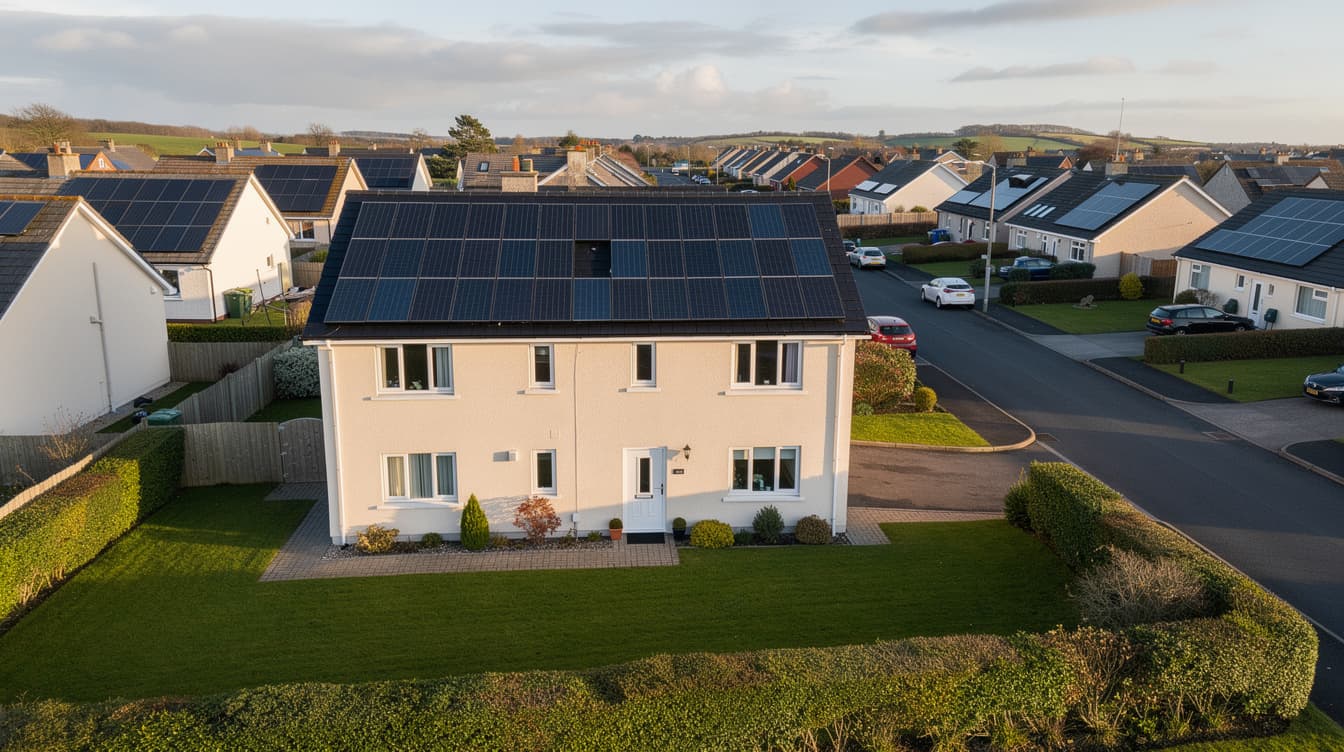
Solar Panel Grants Ireland 2026: Every Scheme, How to Apply & Who Qualifies
Three years ago the SEAI Solar PV grant for homeowners was €2,400 and required a Building Energy Rating of C or better. Neither is true in 2026. The maximum domestic grant is now €1,800, the BER requirement has been scrapped entirely, and a new property-age rule (must have been built and connected to the grid before 1 January 2021) replaced it. This guide walks through every solar panel grant currently available in Ireland in 2026, exactly what each one pays, who qualifies, and the step-by-step process to apply — including where most applications go wrong.
July 2026 update – grant timing & processing
SEAI reported an average grant payment turnaround of 17 working days post-install in Q2 2026 (down from 32 days in mid-2025). The €1,800 grant amount is confirmed for all 2026 installs and there is currently no indication of a mid-year reduction. Budget 2026 confirmed 0% VAT on residential solar PV runs through 31 December 2030 – the timing pressure of the "VAT deadline" that dominated 2024/25 has effectively lifted.
Quick Answer: Solar Panel Grants Ireland 2026
The SEAI Solar Electricity Grant pays homeowners up to €1,800 for solar PV installations of 2–6 kWp. Eligibility: home built and grid-connected before 1 Jan 2021, you must own and occupy, and no previous SEAI Solar PV grant claimed at that MPRN. Businesses use the SEAI Non-Domestic Microgen Grant (up to €162,600). Farms can use TAMS 3 (60% capped at €90,000). Communities apply via SEAI's Community Energy Grant scheme.
The Five Solar Grants Currently Available in Ireland (2026)
Five separate schemes fund solar panel installation in Ireland depending on your situation. They are mutually exclusive at the MPRN (meter point) level — you can only claim one solar PV grant per meter, ever.
| Scheme | Who Qualifies | Max Grant |
|---|---|---|
| SEAI Solar Electricity Grant | Homeowners, pre-2021 home | €1,800 |
| SEAI Non-Domestic Microgen Grant | Businesses, charities, sports clubs | €162,600 (1,000 kWp) |
| TAMS 3 (Solar Capital Investment) | Working farms (herd number) | €90,000 (60% of eligible cost) |
| SEAI Community Energy Grant | Community groups, SECs | Variable (50% typical) |
| Local Authority Solar Grants | Council tenants, public buildings | 100% via LA capital programme |
1. SEAI Solar Electricity Grant (Domestic) — The Headline Grant
This is the grant 95% of Irish homeowners are asking about. It's a flat per-kWp payment, claimed by your SEAI-registered installer on your behalf, and applied directly to your invoice so you never see the cash — the installer reduces your price by the grant amount.
How Much You Get in 2026
| System Size | Grant Calculation | Total Grant |
|---|---|---|
| 2 kWp | 2 × €700 | €1,400 |
| 3 kWp | 2 × €700 + 1 × €200 | €1,600 |
| 4 kWp | 2 × €700 + 2 × €200 | €1,800 (max) |
| 5 kWp | Capped at €1,800 | €1,800 (max) |
| 6+ kWp | Capped at €1,800 | €1,800 (max) |
The maths: €700 per kWp for the first 2 kWp, then €200 per kWp up to 6 kWp. The cap kicks in at exactly 4 kWp. There's no grant available above 6 kWp on a domestic install — if you want a bigger system, you pay the marginal cost out of pocket.
Eligibility Rules (2026)
To claim the SEAI Solar Electricity Grant you must satisfy all of these:
- You own the property (homeowner, not tenant)
- The home was built and connected to the grid before 1 January 2021
- No previous SEAI Solar PV grant has been claimed at that MPRN (meter point)
- You use an SEAI-registered installer (full list at seai.ie/grants/registered-companies)
- The system is at least 2 kWp — sub-2 kWp installs are ineligible
- The installer applies for and confirms grant approval before installation begins — retrospective claims are refused
Note what's no longer required (rules dropped in 2022/2023):
- No minimum BER rating — the old "C or higher" rule was removed
- No requirement to have a current BER on file
- No requirement for the home to be a primary residence (holiday homes qualify if owned by the applicant)
What Counts as "Pre-2021"?
The "built before 1 January 2021" rule has caught out a lot of recent buyers. SEAI defines "built" as the date the property was first connected to the grid (its MPRN energisation date), not the completion of construction. If your home was first energised on or after 1 January 2021, you don't qualify — even if planning permission, foundations, or block-and-render were all done in 2020. New builds are excluded because they're required to meet near-zero energy building (nZEB) standards that effectively bake solar PV into the cost of the home anyway.
You can check the energisation date on your meter via the ESB Networks MPRN portal (esbnetworks.ie/customer-hub).
Not Sure If You Qualify?
Our SEAI Grant Eligibility Checker takes 60 seconds and gives a yes/no on the €1,800 grant.
The Application Process — Step by Step
The SEAI Solar Electricity Grant is unusual in that the homeowner does not apply directly. Your installer handles the entire application on your behalf using their SEAI contractor portal. Here's what actually happens.
Step 1: Get Three Quotes from SEAI-Registered Installers
Only installers on the SEAI register can claim the grant. The registered list is published on seai.ie and refreshed monthly. If an installer isn't on the list, they can't claim the grant, no matter how good their pricing — you'd pay full price out of pocket.
Step 2: Choose an Installer and Sign a Contract
Most installers will quote net of grant from the start (e.g. "€6,800 fully installed after €1,800 SEAI grant"). The contract specifies the system size in kWp and the corresponding grant amount.
Step 3: Installer Submits Grant Application Pre-Install
The installer logs into the SEAI portal, enters your MPRN, property details, system size, and panel specification. SEAI typically returns an approval within 5–10 working days. Approval must be in place before any installation work starts. Starting work pre-approval voids the grant entirely.
Step 4: Installation Within Grant Validity Window
Once approved, you have 8 months to complete the installation. Most installers schedule the work within 4–14 weeks of approval depending on seasonal demand.
Step 5: Commissioning and Grant Drawdown
After the system is commissioned (powered up, Safe Electric cert issued, NC6/NC7 export application filed with ESB Networks), the installer uploads commissioning documentation to SEAI. Once approved, SEAI pays the grant directly to the installer, who in turn applies it to your invoice. You pay the post-grant balance.
Step 6: BER Update (Optional but Recommended)
While a BER is no longer a grant requirement, having a current BER post-install demonstrates the value-add for resale purposes. Solar PV typically improves your BER by 1–2 letter grades on Irish homes — a B3 home with 4 kWp often moves to a B1 or A3. The BER assessment costs €125–€250 separately.
2. SEAI Non-Domestic Microgen Grant (Businesses)
Any commercial or non-domestic MPRN can apply for the SEAI Non-Domestic Microgeneration Grant. This is open to limited companies, sole traders (where the building has a commercial MPRN), charities, schools, GAA clubs, sports halls, hotels, restaurants — essentially any non-residential building with grid access.
Grant Amount (2026)
- First 6 kWp: €700 per kWp (max €4,200)
- 6 kWp to 1,000 kWp: €200 per kWp
- Maximum total grant: €162,600 on a 1,000 kWp system
For typical commercial sizes: a 20 kWp system gets €7,000; 50 kWp gets €13,000; 100 kWp gets €22,800; 200 kWp gets €42,800.
Application process is similar to the domestic grant: an SEAI-registered installer submits via the contractor portal, approval before install, drawdown after commissioning. The maximum is one grant per non-domestic MPRN.
3. TAMS 3 Solar Capital Investment Scheme (Farms)
For working farms with an active herd number, the Department of Agriculture's Targeted Agricultural Modernisation Scheme (TAMS 3) is the higher-value option. TAMS 3 funds 60% of eligible solar PV cost with a per-farm grant cap of €90,000 (covering eligible spend up to €150,000).
For a 50 kWp shed install (typical for a 80–120 cow herd): gross cost €42,000, TAMS 3 grant €25,200, net €16,800. For a 100 kWp install (large dairy or pig unit): gross €95,000, TAMS 3 grant €57,000, net €38,000.
Critical TAMS 3 Rules
- Application via agfood.ie portal, opens in tranches (typically 4 per year)
- Approval must be in place before any spending; retrospective claims are refused
- System sized to farm consumption (limit varies, typically up to 6,000 kWh/livestock unit)
- Must complete within 24 months of approval
- You can't combine TAMS 3 with the SEAI Non-Domestic Grant on the same install — pick one
For most farms, TAMS 3 is significantly better than the SEAI Non-Domestic option (60% vs. roughly 20–25% for typical farm sizes). The only reason to skip TAMS 3 is timing — if you need to install urgently and can't wait for the next tranche, the SEAI Non-Domestic route is faster.
4. SEAI Community Energy Grant Scheme
Community groups, Sustainable Energy Communities (SECs), schools, and not-for-profits can apply for Community Energy Grants. These are tendered annually and fund both solar PV and broader retrofit measures (heating, insulation) as a single package.
Grant rates vary by project type and applicant. For a Sustainable Energy Community, solar PV on community buildings (community centres, parish halls, GAA pavilions) is typically funded at 50% of eligible cost. Some social-housing projects can attract up to 80% community grant funding.
Application is via SEAI's annual call (usually opens January, closes March). Projects need a third-party Project Coordinator and an SEC mentor — this isn't a quick-turnaround grant.
5. Local Authority Solar Programs
Several Irish local authorities run their own solar capital programmes for council-owned housing and public buildings. Dublin City Council, Cork City Council, and Fingal County Council have all installed solar on council tenant homes at no cost to the tenant (capital funded by the LA, electricity benefit passes to the tenant). Council tenants can't apply directly — the programmes are administered by the housing department of each authority.
If you rent from a council, check with your housing officer whether your estate is in scope. Most ongoing 2026 LA solar rollouts target Band C and D BER homes for the biggest carbon impact per euro.
What About Battery Storage Grants?
There is currently no separate SEAI grant for solar batteries in Ireland. The 2022 Energy Storage Initiative consultation considered a battery grant scheme, but no grant has been launched as of mid-2026. SEAI's position is that battery storage payback is heavily dependent on tariff structure and self-consumption profile, and a flat grant would be poorly targeted.
What you can do: claim the SEAI Solar Electricity Grant (€1,800) on the PV portion, and pay for the battery in cash. The 0% VAT on solar PV applies to battery storage when supplied as part of a solar install (Revenue eBrief 094/23). Standalone battery retrofits to existing PV are at 23% VAT.
0% VAT on Solar PV — The Hidden Grant
Most articles miss this: since May 2023, the supply and installation of residential solar PV in Ireland has been at 0% VAT. This was originally a 24-month measure but the Finance Act 2025 extended it to 31 December 2030 (Budget 2025 extension).
The effective saving: on a €7,500 install, 23% VAT would be €1,400. Combined with the €1,800 SEAI grant, your total Irish government support is roughly €3,200 on a typical 4 kWp install — about 42% of the gross cost.
The 0% VAT is automatic and requires no application — any SEAI-registered installer will quote 0% VAT on a residential job. If you see VAT charged on a domestic quote in 2026, the installer is non-compliant.
Ready to Apply for Your Grant?
We connect you with three SEAI-registered installers who handle the grant paperwork end-to-end. No upfront cost, no obligation.
Common Reasons Solar Grant Applications Are Refused
From SEAI's published statistics, roughly 4% of grant applications are refused outright and another 8% delayed for documentation issues. The four most common reasons:
- Property energised after 1 January 2021 — check your MPRN energisation date before applying
- Installation started before grant approval — the most common failure mode; do not let your installer begin even site survey work before SEAI approval is back
- Previous grant claimed at the same MPRN — if a previous owner claimed an SEAI Solar PV grant on the property, you can't claim again (you'll see "no grant available" returned at portal lookup)
- Installer not currently on the SEAI register — installers are added and removed monthly; verify on the seai.ie list at quote stage, not at install stage
How the Solar Grant Affects the Clean Export Guarantee
Claiming the SEAI Solar PV grant has no negative impact on your Clean Export Guarantee (CEG) export payments. The CEG (currently ~18–24c/kWh average across Irish suppliers in mid-2026) pays you for every kWh exported to the grid, and it's a separate scheme from the SEAI capital grant.
Income tax exemption: the first €400 of CEG income per year is tax-free through to 2026 inclusive (extended in Finance Act 2024). For a typical 4 kWp household exporting 1,500–2,000 kWh/year at 19c, that's about €285–€380 of CEG income — comfortably under the tax-free cap.
FAQ: Solar Panel Grants Ireland 2026
Can I claim the €1,800 grant if I install solar myself (DIY)?
No. The SEAI Solar Electricity Grant requires installation by an SEAI-registered installer with a full Safe Electric certificate. DIY solar (legal under MEC/SI 469 of 2022 for systems under 11kW) is ineligible for the grant. If grant access matters more than DIY savings, use a registered installer.
Can a landlord claim the grant on a rental property?
Yes, landlords can claim the €1,800 SEAI Solar Electricity Grant on rental properties, provided the property meets all other eligibility criteria (built and connected before 1 Jan 2021, no previous grant at that MPRN). The grant goes to the property owner (you), not the tenant. Landlords applying via a limited company use the same domestic scheme as long as the building is residential.
Does the grant cover battery storage?
No, the SEAI Solar Electricity Grant covers solar PV panels and inverter only. Battery storage is paid for separately (no grant available), but qualifies for 0% VAT when supplied as part of the solar install. Most installers itemise the battery separately on the invoice for clarity.
How long does grant approval take?
Typically 5–10 working days from installer submission. SEAI quotes a 4-week service standard but most approvals come back faster. Allow 6–8 weeks from quote acceptance to grant approval through to installer scheduling.
Can I get the grant if I've already had solar panels installed?
Only if no SEAI grant was previously claimed at your MPRN. If a previous owner claimed under the old €2,400 scheme (2018–2023) or the current €1,800 scheme, the MPRN is exhausted and you can't apply again, even if the original panels were removed.
What changed in 2026?
The grant rates have been stable through 2024–2026 at the current €700/€200 per kWp structure. The Finance Act 2025 confirmed 0% VAT to 31 October 2026 and extended the €400 CEG income tax exemption through 2026. The pre-2021 build cut-off remains in place. No major changes are forecast for 2026, though Department of Climate consultations on a potential battery grant scheme are ongoing.
Can I apply for the grant before I own the property?
No, the application requires homeowner status confirmed on the property. If you're buying a home and intending to install solar, wait until closing, then apply. Some homeowners include the solar install as a post-completion works package with the seller's installer, but the grant claim still needs to come after ownership transfer.
Bottom Line: Use the Eligibility Checker, Then Get Three Quotes
The fastest path to actually claiming a solar grant in Ireland in 2026: confirm eligibility (60 seconds via the SEAI Grant Eligibility Checker), then get three quotes from SEAI-registered installers via our free quote comparison. The installer handles the grant application, drawdown, and applies it to your invoice automatically. You pay only the post-grant balance, at 0% VAT, with no paperwork on your side beyond signing the contract.
The current €1,800 grant plus 0% VAT plus the 18–24c/kWh Clean Export Guarantee plus €400/year tax-free CEG income is the most generous solar PV support package the Irish state has ever offered. With 0% VAT confirmed through 31 December 2030, there's a real timing premium on getting your install done while both VAT relief and the current grant amount remain.
Related Articles
Vacant Property Refurbishment Grant + Solar Ireland 2026: How to Stack €50k VPRG With €1,800 SEAI
Stack the €50,000 Vacant Property Refurbishment Grant with the €1,800 SEAI Solar PV grant in Ireland 2026 — real refurb numbers, timing, traps.

Cheapest Solar Panels Ireland 2026: Where to Save Without Ruining Your Payback
Cheapest legitimate solar routes in Ireland 2026: budget SEAI installs, DIY vs grant maths, Lidl plug-ins & where the price actually comes from.
Solar Panel Cost Per kWp Ireland 2026: Real Prices, Grant Effect & Curve by Size
Per-kWp solar pricing in Ireland 2026: €1,650-€2,000 pre-grant, €1,200-€1,550 net. Curve by system size, SEAI grant cliff at 4 kWp, levelised cost 6-8 c/kWh.