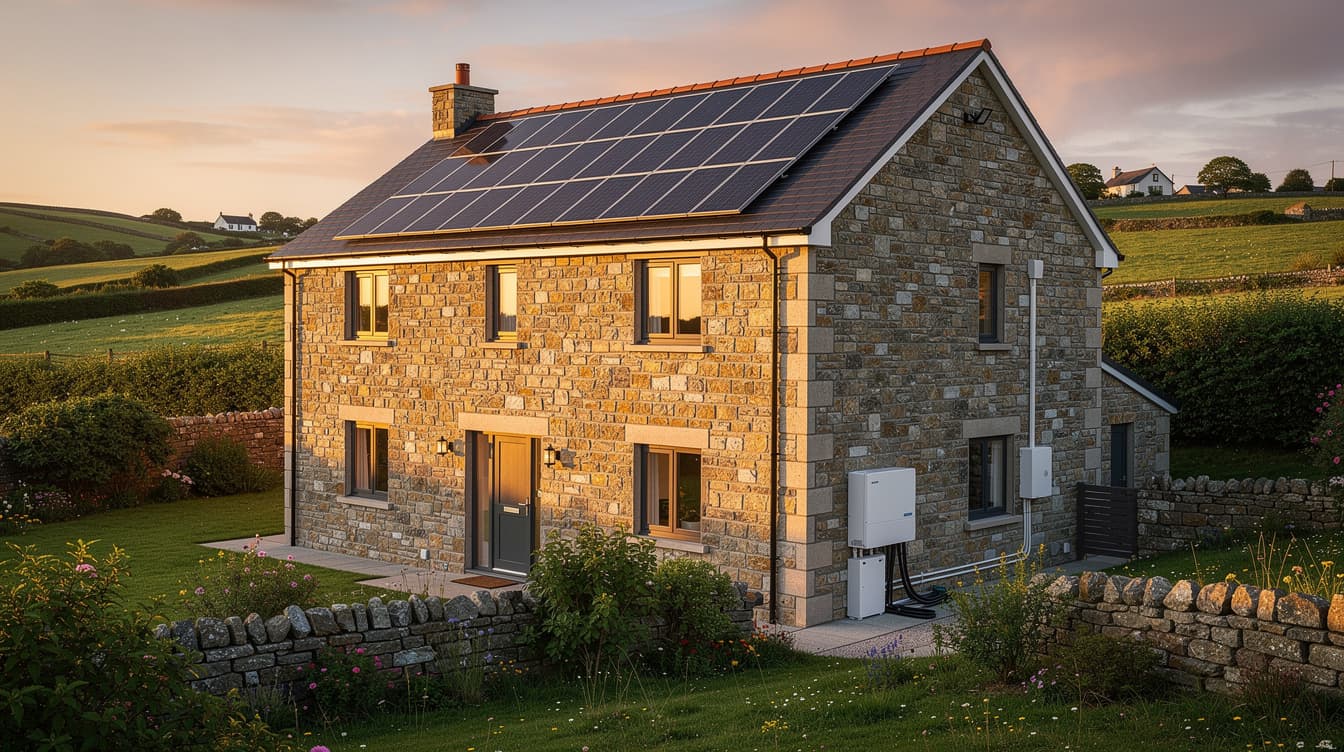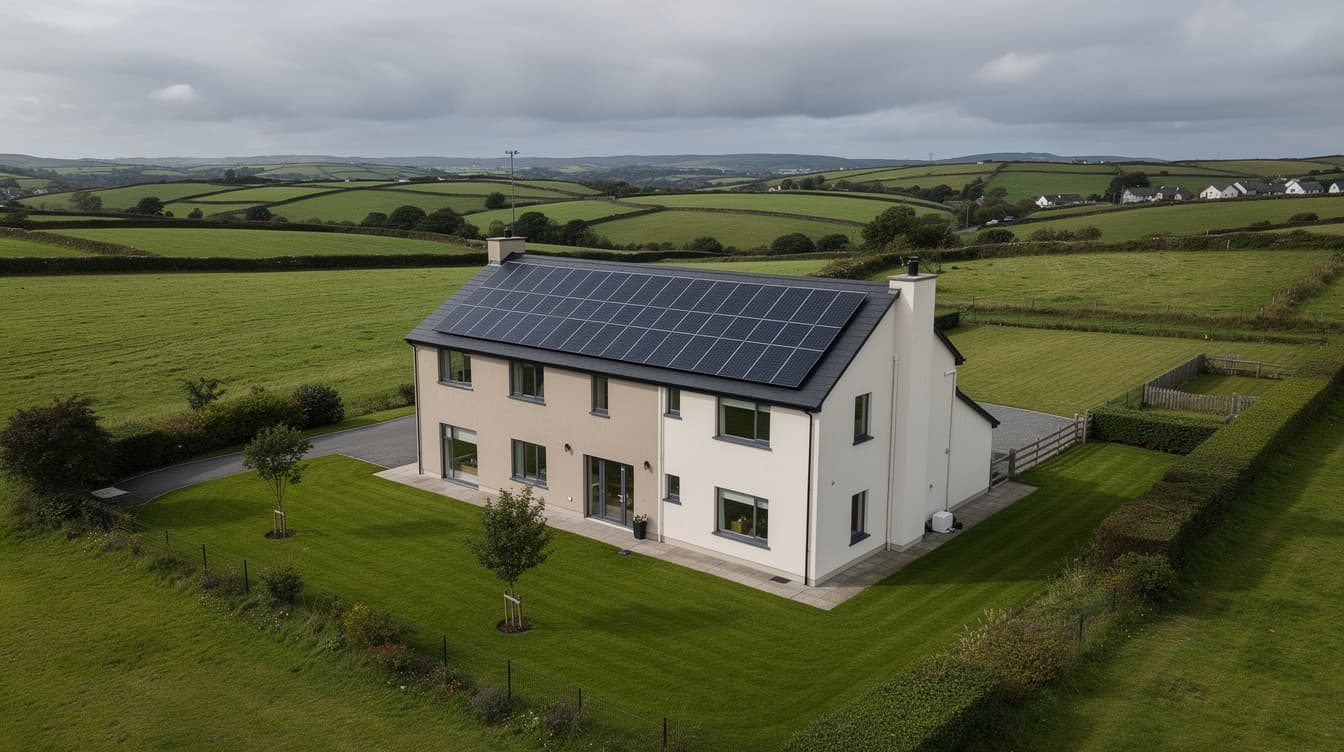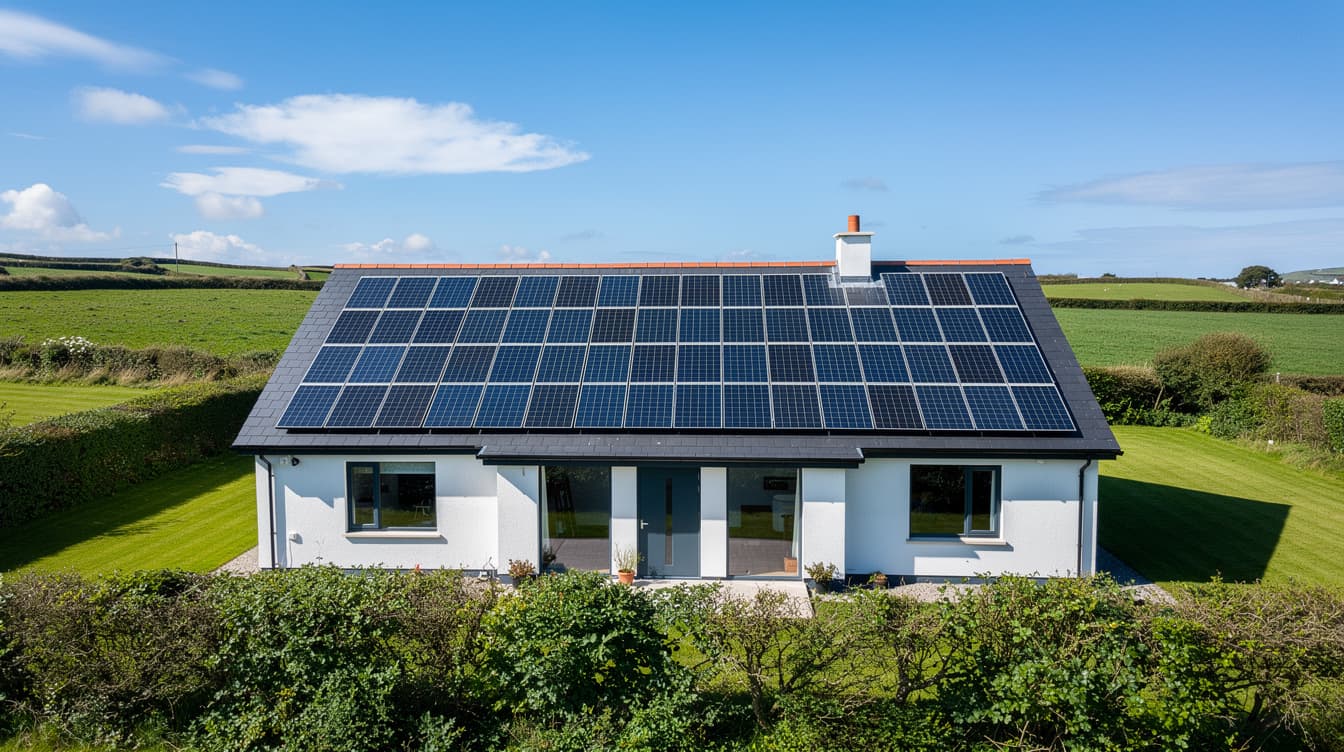
Average Solar Panel Output in Ireland
A typical 4kWp solar panel system in Ireland produces 3,400 to 4,000 kWh of electricity per year — equivalent to roughly 85-100% of the average Irish household's annual consumption. That translates to 9-11 kWh per day averaged across the year, peaking at 18-22 kWh on long summer days and dropping to 2-5 kWh on short winter days.
Understanding exactly how much electricity solar panels produce in Ireland is the single most important factor in deciding whether solar is worth the investment for your home. This guide breaks down the real-world numbers by system size, month, region, and conditions — so you can make an informed decision based on data, not guesswork. See our whether solar panels are worth it for more details.

Average Solar Panel Output in Ireland: The Key Numbers
Ireland receives between 950 and 1,100 kWh/m² of solar irradiance per year, depending on your location. The south and southeast coasts receive the most sunlight, while the northwest receives the least. Despite Ireland's reputation for cloud cover, these irradiance levels are sufficient to make solar panels a strong financial investment.
Here are the definitive numbers for solar panel output in Ireland in 2026:
| Metric | Value |
|---|---|
| Annual output per 1 kWp installed | 850–1,000 kWh |
| Annual output for a 4kWp system | 3,400–4,000 kWh |
| Average daily output (4kWp, year-round) | 9–11 kWh |
| Peak summer daily output (4kWp, June) | 18–22 kWh |
| Winter daily output (4kWp, December) | 2–5 kWh |
| Solar irradiance (Ireland average) | 950–1,100 kWh/m²/year |
| Performance ratio (real-world vs theoretical) | 80–85% |
| Annual panel degradation | ~0.5% per year |
These figures assume a south-facing roof with a tilt angle of 30-35 degrees and minimal shading — the optimal conditions for Irish homes. East-west facing roofs typically produce 15-20% less, while significant shading can reduce output by 25% or more. See our roof space guide for more details.
The bottom line: a standard 4kWp residential system in Ireland will generate enough electricity to cover most or all of an average household's annual needs. With the SEAI grant reducing upfront costs and the Clean Export Guarantee paying you for surplus electricity exported to the grid, the financial case for solar in Ireland has never been stronger. See our solar panel costs in Ireland for more details.
Solar Panel Output by System Size
Solar panel systems in Ireland range from small 2kWp installations suited to apartments and low-consumption households, up to 10kWp systems for larger homes with high electricity usage or electric vehicles. The table below shows what each system size produces annually, daily, and monthly.
| System Size | Number of Panels (approx.) | Annual Output (kWh) | Daily Average (kWh) | Monthly Average (kWh) |
|---|---|---|---|---|
| 2 kWp | 5 | 1,700–2,000 | 4.7–5.5 | 142–167 |
| 3 kWp | 7-8 | 2,550–3,000 | 7.0–8.2 | 213–250 |
| 4 kWp | 10 | 3,400–4,000 | 9.3–11.0 | 283–333 |
| 5 kWp | 12-13 | 4,250–5,000 | 11.6–13.7 | 354–417 |
| 6 kWp | 15 | 5,100–6,000 | 14.0–16.4 | 425–500 |
| 8 kWp | 20 | 6,800–8,000 | 18.6–21.9 | 567–667 |
| 10 kWp | 25 | 8,500–10,000 | 23.3–27.4 | 708–833 |
The most popular residential system size in Ireland is 4kWp, which uses approximately 10 modern panels (each rated at around 400W). This size qualifies for the maximum SEAI solar grant and produces enough electricity for most three- to four-bedroom homes.
If you have an electric vehicle, a heat pump, or consistently high electricity consumption, a 5kWp or 6kWp system may be more appropriate. Homes with both an EV and a heat pump often benefit from 8-10kWp systems, particularly if paired with battery storage to maximise self-consumption.
Not sure which system size is right for your home? Request a free, no-obligation quote and our team will recommend the optimal system based on your roof, usage, and budget.
Monthly Solar Panel Output in Ireland
Solar panel output in Ireland varies dramatically across the year. The long daylight hours of May, June, and July deliver exceptional generation, while the short days of November, December, and January produce significantly less. Understanding this seasonal pattern is essential for setting realistic expectations.
The table below shows typical monthly output for a 4kWp solar panel system in Ireland:
| Month | Daylight Hours (approx.) | 4kWp Output (kWh) | Daily Average (kWh) | % of Annual Output |
|---|---|---|---|---|
| January | 7.5–8.5 | 120–160 | 3.9–5.2 | 3.5–4.0% |
| February | 9–10.5 | 160–210 | 5.7–7.5 | 4.5–5.5% |
| March | 11–12.5 | 270–330 | 8.7–10.6 | 7.5–8.5% |
| April | 13.5–14.5 | 370–440 | 12.3–14.7 | 10.5–11.5% |
| May | 15.5–16.5 | 440–520 | 14.2–16.8 | 12.5–13.5% |
| June | 16.5–17 | 460–540 | 15.3–18.0 | 13.0–14.0% |
| July | 16–16.5 | 430–510 | 13.9–16.5 | 12.0–13.0% |
| August | 14–15 | 370–440 | 11.9–14.2 | 10.5–11.0% |
| September | 12–13 | 270–330 | 9.0–11.0 | 7.5–8.5% |
| October | 10–11 | 170–220 | 5.5–7.1 | 5.0–5.5% |
| November | 8–9 | 110–150 | 3.7–5.0 | 3.0–3.5% |
| December | 7–8 | 80–120 | 2.6–3.9 | 2.0–3.0% |
As you can see, roughly 60% of your annual solar output comes in the five months from April to August. The three peak months (May, June, July) alone deliver around 38% of total annual generation. This concentration of output in summer means you will export more electricity to the grid during these months and rely more on grid electricity during winter.
This seasonal pattern is one of the key reasons battery storage is becoming increasingly popular in Ireland — it allows you to store excess daytime generation for use in the evening, increasing the amount of solar electricity you consume directly rather than exporting at lower rates.

Solar Panel Output by County and Region
Solar panel output varies across Ireland due to differences in solar irradiance, cloud cover, and latitude. The southeast of Ireland receives the most sunshine, while the northwest receives the least. However, the difference between the best and worst locations is only around 15-20%, meaning solar panels are viable everywhere in Ireland.
The table below shows expected output for a 4kWp system by region:
| Location | Solar Irradiance (kWh/m²/year) | 4kWp Annual Output (kWh) | Daily Average (kWh) |
|---|---|---|---|
| Waterford | 1,050–1,100 | 3,700–4,000 | 10.1–11.0 |
| Cork | 1,020–1,080 | 3,600–3,900 | 9.9–10.7 |
| Kerry | 1,000–1,070 | 3,550–3,850 | 9.7–10.5 |
| Dublin | 980–1,050 | 3,500–3,800 | 9.6–10.4 |
| Galway | 960–1,030 | 3,400–3,700 | 9.3–10.1 |
| Belfast | 940–1,010 | 3,350–3,650 | 9.2–10.0 |
| Donegal | 920–1,000 | 3,250–3,600 | 8.9–9.9 |
Waterford and the southeast coast consistently rank as Ireland's sunniest areas, receiving up to 1,100 kWh/m² of solar irradiance annually. Cork and Kerry also perform well, benefiting from the milder southern climate. Dublin sits in the middle, while Galway, Belfast, and Donegal receive slightly less sunshine due to their more northerly and westerly positions.
However, it is important to emphasise that even Donegal — Ireland's least sunny county for solar — still produces roughly 90% of what Waterford generates. The difference amounts to just 400-500 kWh per year, or roughly 1-2 kWh per day. Solar panels are a sound investment anywhere on the island of Ireland.
Want to know exactly how much a solar system would produce at your address? Get a personalised output estimate with your free quote.
What Affects Solar Panel Output in Ireland?
Several factors determine how much electricity your solar panels will actually produce. Understanding these variables helps you optimise your installation and set realistic expectations.
Roof Orientation
South-facing roofs produce the maximum output in Ireland. A due-south orientation captures the most sunlight throughout the day. Southeast and southwest-facing roofs produce approximately 95% of a south-facing system. East or west-facing roofs produce around 80-85% — still worthwhile, but you should factor this into your sizing calculations. North-facing roofs are generally not recommended for solar panels in Ireland.
Tilt Angle
The optimal tilt angle for solar panels in Ireland is 30-35 degrees from horizontal. This angle maximises annual energy capture by balancing summer and winter sun positions. Most Irish roofs have a pitch between 30 and 45 degrees, which is close to ideal. Flat roofs require mounting frames to achieve the correct tilt. A tilt of 20 degrees or 45 degrees still delivers around 95% of optimal output, so small deviations from the ideal are not a major concern.
Shading
Shading is one of the most significant factors affecting solar panel output. Even partial shading from a chimney, tree, or neighbouring building can dramatically reduce output — not just on the shaded panel, but potentially across the entire string of panels connected to the same inverter. Modern systems use optimisers or microinverters to mitigate this effect, but avoiding shading at the design stage is always preferable.
Panel Type and Efficiency
Modern monocrystalline panels typically offer efficiencies of 20-22%, meaning they convert 20-22% of sunlight hitting them into electricity. Higher-efficiency panels produce more power per square metre of roof space, which is particularly important if you have limited roof area. The most common residential panels in Ireland are now 400-430W monocrystalline modules.
Inverter Efficiency
The inverter converts DC electricity from your panels into AC electricity for your home. Modern string inverters achieve 96-98% efficiency, while microinverters typically operate at 95-97%. A high-quality inverter is essential — it is the component most likely to need replacement during the 25-30 year lifespan of your panels.
Temperature
Solar panels actually perform better in cooler temperatures. For every degree Celsius above 25°C, panel output drops by approximately 0.3-0.5%. Ireland's mild climate is an advantage here — panels rarely overheat, meaning they operate closer to their rated efficiency for most of the year. This partially compensates for Ireland's lower irradiance compared to hotter countries.
Soiling and Dirt
Dust, bird droppings, pollen, and general dirt accumulation can reduce panel output by 2-5% if left uncleaned. Ireland's frequent rainfall helps keep panels relatively clean, but periodic inspection and cleaning — particularly after extended dry spells — ensures optimal performance.
How to Calculate Your Solar Panel Output
You can estimate your solar panel output using a straightforward formula. While professional installers use sophisticated modelling software (such as PVsol or PVGIS), this calculation gives you a reliable ballpark figure.
The Formula
Annual Output (kWh) = System Size (kWp) x Solar Irradiance (kWh/m²/year) x Performance Ratio
Step-by-Step Worked Example
Let's calculate the expected output for a typical 4kWp system installed on a south-facing roof in Dublin:
Step 1: Determine your system size
System size = 4 kWp (ten 400W panels)
Step 2: Find the solar irradiance for your location
Dublin solar irradiance = approximately 1,000 kWh/m²/year (you can check exact figures for your location using the EU's PVGIS tool at re.jrc.ec.europa.eu/pvg_tools)
Step 3: Apply the performance ratio
A typical performance ratio for a well-installed residential system is 0.82 (82%). This accounts for inverter losses, cable losses, temperature effects, shading, soiling, and panel degradation.
Step 4: Calculate
Annual Output = 4 kWp x 1,000 kWh/m²/year x 0.82 = 3,280 kWh per year
Step 5: Convert to daily and monthly averages
Daily average = 3,280 / 365 = 9.0 kWh per day
Monthly average = 3,280 / 12 = 273 kWh per month
This calculation gives you a conservative estimate. In practice, a well-installed 4kWp system in Dublin with minimal shading often produces 3,400-3,800 kWh per year, as performance ratios of 83-85% are achievable with modern equipment.
For a more precise estimate tailored to your specific roof, orientation, and shading conditions, request your free personalised solar assessment.
Solar Panel Output on Cloudy Days
This is the number one concern for Irish homeowners considering solar panels — and understandably so. Ireland averages around 1,400 hours of sunshine per year, with many days featuring heavy cloud cover. So how do solar panels perform when the sky is overcast?
The key fact is this: solar panels do not need direct sunlight to generate electricity. They work with diffuse (scattered) light, which passes through clouds.
Here is what to expect on different types of days: See our different panel types and their efficiency for more details.
| Weather Condition | Output as % of Rated Capacity | 4kWp System Output (typical day) |
|---|---|---|
| Clear, sunny day (summer) | 80–100% | 18–22 kWh |
| Partly cloudy | 40–70% | 8–15 kWh |
| Overcast / light cloud | 25–40% | 5–9 kWh |
| Heavy overcast / rain | 10–25% | 2–5 kWh |
| Very heavy rain / storm | 5–15% | 1–3 kWh |
Even on the cloudiest winter day, a 4kWp system will still produce 1-3 kWh — enough to run your fridge, lights, router, and other background appliances. On a typical overcast summer day, you might still generate 8-12 kWh, which is a substantial amount of electricity.
Ireland's climate actually has a silver lining for solar: the mild temperatures mean panels operate efficiently without overheating, and the long summer daylight hours (up to 17 hours in June) partially compensate for cloud cover. A cloudy day with 16 hours of diffuse light can still produce meaningful amounts of electricity.
The annual output figures quoted throughout this guide already account for Ireland's typical weather patterns, including cloudy and rainy days. When we say a 4kWp system produces 3,400-4,000 kWh per year, that includes all the overcast days averaged in.
Solar Panel Output in Winter vs Summer
The contrast between winter and summer solar output in Ireland is significant, and understanding it helps you plan how to use and store your solar electricity effectively.
| Factor | Winter (December) | Summer (June) |
|---|---|---|
| Daylight hours | 7–8 hours | 16.5–17 hours |
| Peak sun hours | 1.5–2 hours | 5–6 hours |
| 4kWp daily output | 2–5 kWh | 15–22 kWh |
| 4kWp monthly output | 80–120 kWh | 460–540 kWh |
| Sun angle (solar noon) | ~15° above horizon | ~60° above horizon |
| Self-consumption potential | High (you use most of what you generate) | Lower (excess exported to grid) |
In June, your 4kWp system can produce 4-5 times more electricity than in December. However, winter production is not negligible — 80-120 kWh per month can still offset a meaningful portion of your electricity bill.
An important consideration: your electricity consumption pattern is typically the opposite of your solar production pattern. You use more electricity in winter (heating, lighting, shorter days) and less in summer. This mismatch is why battery storage and the Clean Export Guarantee (which pays you for exported electricity) are both important components of maximising the financial return from solar panels in Ireland.
The transition months of March-April and September-October are particularly productive because output is reasonably high while your household consumption is also above summer minimums. These months often deliver the best self-consumption ratios.
How to Maximise Your Solar Panel Output in Ireland
Once your solar panels are installed, there are several practical steps you can take to ensure they deliver the maximum possible output over their 25-30 year lifespan.
1. Ensure Optimal Orientation and Tilt at Installation
The single most impactful decision is made at installation time. A south-facing roof at 30-35 degrees is ideal. If your roof does not face due south, do not worry — southeast or southwest orientations only reduce output by around 5%. If you have both east and west-facing roof surfaces, splitting panels across both can actually provide a wider generation window throughout the day.
2. Minimise Shading
Before installation, assess your roof for shading throughout the day and across seasons. The winter sun sits much lower in the sky, so objects that do not cause shading in summer may cast shadows on your panels in winter. Trees are a common culprit — consider trimming overhanging branches. A professional installer will conduct a shading analysis as part of the survey.
3. Keep Panels Clean
While Ireland's rain does a reasonable job of cleaning panels naturally, periodic checks are worthwhile. Bird droppings, lichen, and fallen leaves can create persistent hot spots that reduce output. A visual inspection every 3-6 months is recommended, with a gentle clean using water and a soft brush if needed. Avoid abrasive materials or pressure washers, which can damage the panel surface.
4. Monitor Your System
Install a monitoring system (most modern inverters include this) and check it regularly. Monitoring allows you to spot drops in performance quickly — which could indicate a faulty panel, inverter issue, or new shading problem. Many monitoring apps send automatic alerts if output drops below expected levels.
5. Maximise Self-Consumption
You save the most money by using solar electricity directly rather than exporting it. Simple strategies include running your washing machine, dishwasher, and tumble dryer during daylight hours. If you have a hot water immersion heater, a solar diverter can automatically use excess solar electricity to heat your water.
6. Consider Battery Storage
A battery system (typically 5-10 kWh capacity) stores excess daytime solar generation for use in the evening and overnight. This can increase your self-consumption from around 30-40% (without battery) to 60-80% (with battery), significantly improving your financial return.
7. Schedule Regular Professional Inspections
Have your system professionally inspected every 3-5 years. A qualified technician will check electrical connections, inverter performance, mounting integrity, and overall system health. This small investment protects your much larger investment in the solar system itself.

Want to ensure your system is designed for maximum output from day one? Get a free professional assessment of your roof and a tailored system design.
Real-World Solar Panel Output: What Irish Homeowners Report
Manufacturer datasheets quote panel output under Standard Test Conditions (STC) — 1,000 W/m² irradiance, 25°C cell temperature, and AM 1.5 spectrum. Real-world conditions in Ireland differ significantly from these laboratory standards, so understanding the gap between theoretical and actual output is essential.
The Performance Ratio
The performance ratio (PR) measures how much of the theoretical maximum output a system actually delivers. In Ireland, well-installed residential systems typically achieve a performance ratio of 80-85%. This means if the theoretical maximum for your system is 4,000 kWh, you should expect 3,200-3,400 kWh in practice.
The losses that account for the 15-20% gap include:
- Inverter conversion losses: 2-5%
- Cable and wiring losses: 1-2%
- Temperature effects: 1-3% (minimal in Ireland's cool climate)
- Shading: 0-10% (varies by installation)
- Soiling and dirt: 1-3%
- Panel mismatch: 1-2%
- Degradation: 0-5% (increases with panel age at ~0.5% per year)
What Irish Homeowners Actually See
Based on data from Irish homeowners and monitoring platforms, here is what typical systems actually produce:
- A 3.6kWp system (nine 400W panels) in County Cork, south-facing, 32° tilt: 3,450 kWh in its first year — a specific yield of 958 kWh/kWp, exceeding expectations.
- A 4kWp system in Dublin, south-southeast facing, 38° tilt: 3,520 kWh — a specific yield of 880 kWh/kWp, consistent with Dublin's irradiance.
- A 6kWp system in Galway, southwest-facing, 35° tilt: 5,100 kWh — a specific yield of 850 kWh/kWp, reflecting the slightly lower irradiance in the west.
These real-world figures consistently fall within the 850-1,000 kWh/kWp range cited throughout this guide. Most homeowners report that their systems meet or slightly exceed the estimates provided by their installers.
Panel Degradation Over Time
Solar panels degrade at approximately 0.5% per year. This means after 10 years, your panels will produce around 95% of their original output, and after 25 years, approximately 87.5%. Modern panels come with performance warranties guaranteeing at least 80-85% of rated output after 25 years. In practice, degradation is often lower than warranted levels.
A system installed in 2026 producing 3,600 kWh in its first year would still be producing approximately 3,420 kWh in year 10 and around 3,150 kWh in year 25. These are still substantial amounts of electricity, and the financial savings continue throughout the panel lifespan.
Frequently Asked Questions
How much electricity does a solar panel produce per day in Ireland?
A single 400W solar panel in Ireland produces an average of 0.9-1.1 kWh per day across the year. In summer, this rises to 1.5-2.2 kWh per day, while in winter it drops to 0.2-0.5 kWh per day. A full 4kWp system (ten 400W panels) produces 9-11 kWh per day on average.
Do solar panels work in Ireland?
Yes, solar panels work very effectively in Ireland. Despite the perception of constant cloud cover, Ireland receives 950-1,100 kWh/m² of solar irradiance annually — enough for a 4kWp system to generate 3,400-4,000 kWh per year. This covers 85-100% of the average Irish household's electricity consumption. Solar panels work with diffuse light (scattered through clouds), not just direct sunshine, so they generate electricity on cloudy days too.
What is the best angle for solar panels in Ireland?
The optimal tilt angle for solar panels in Ireland is 30-35 degrees from horizontal, facing due south. This angle maximises total annual energy capture. However, angles between 20 and 45 degrees still produce within 95% of optimal output. Most Irish roof pitches fall within this range, making them suitable for solar panels without additional mounting adjustments.
How much does a 4kW solar system produce per day?
A 4kWp solar system in Ireland produces an average of 9-11 kWh per day when averaged across the entire year. On a sunny summer day in June, it can produce 18-22 kWh. On a short winter day in December, output drops to 2-5 kWh. On a typical cloudy day, you can expect 5-9 kWh.
How much does a 6kW solar system produce in Ireland?
A 6kWp solar system in Ireland produces approximately 5,100-6,000 kWh per year, or 14-16.4 kWh per day on average. In summer months, daily output can reach 27-33 kWh, while winter days produce 3-7.5 kWh. This system size is suitable for larger homes or households with electric vehicles.
What is the solar panel output in Cork per month?
Cork enjoys some of Ireland's best solar irradiance at 1,020-1,080 kWh/m²/year. A 4kWp system in Cork typically produces: January 130-170 kWh, February 170-220 kWh, March 290-350 kWh, April 390-460 kWh, May 460-540 kWh, June 480-560 kWh, July 450-530 kWh, August 390-460 kWh, September 280-350 kWh, October 180-230 kWh, November 120-160 kWh, December 90-130 kWh.
Are solar panels worth it in Ireland in 2026?
Solar panels are an excellent investment in Ireland in 2026. With the SEAI grant reducing upfront costs, the Clean Export Guarantee providing income for surplus electricity, zero VAT on installations, and electricity prices remaining high, most systems pay for themselves within 5-7 years and then provide free electricity for the remaining 18-23 years of their lifespan. A 4kWp system can save the average household between 800 and 1,200 euro per year on electricity bills.
How long do solar panels last in Ireland?
Solar panels are warranted for 25-30 years and typically last 30-40 years in practice. The maritime climate in Ireland is not particularly harsh on panels — the cool temperatures actually help maintain efficiency. Panels degrade at approximately 0.5% per year, so after 25 years they still produce around 87.5% of their original output. Inverters may need replacement once during this period, typically after 10-15 years.
Do I need planning permission for solar panels in Ireland?
Most residential solar panel installations in Ireland are exempt from planning permission under current regulations. Roof-mounted panels on houses are generally considered exempt development, provided they do not extend more than 150mm above the roof surface and do not cover more than 50% of the total roof area. However, there are specific restrictions for protected structures, architectural conservation areas, and some apartment buildings. Your installer will advise on any planning requirements specific to your property.
Can solar panels power my entire house in Ireland?
A 4kWp solar system produces 3,400-4,000 kWh per year, which matches the average Irish household consumption of approximately 4,200 kWh. However, this does not mean you will be completely off-grid. You will export surplus electricity during sunny daytime periods and import from the grid at night and during winter. With battery storage, you can increase your self-sufficiency to 60-80%. Full off-grid living requires a much larger system with substantial battery storage and is not practical or cost-effective for most Irish homes.
What is the Clean Export Guarantee and how does it affect solar panel value?
The Clean Export Guarantee (CEG) requires electricity suppliers to pay you for surplus solar electricity you export to the grid. Current rates range from approximately 18-24 cents per kWh exported, depending on your supplier. This means even electricity you cannot use directly still generates income. A typical 4kWp system might export 40-60% of its generation (without battery storage), generating 250-500 euro per year in export payments on top of the savings from electricity you use directly.
How much roof space do I need for solar panels?
A modern 400W solar panel measures approximately 1.7m x 1.1m, requiring about 1.9 m² of roof space. A standard 4kWp system (ten panels) therefore needs approximately 19 m² of unshaded, south-facing roof space. This is equivalent to roughly half the roof area of a typical semi-detached house. If your roof space is limited, higher-efficiency panels (420-430W) can reduce the area needed slightly.
Still have questions about solar panel output for your specific property? Request your free, personalised solar assessment today and get expert advice tailored to your home, location, and energy needs.
Related Articles
Lidl Plug-In Solar Panels: Are They Coming to Ireland? What You Need to Know (2026)
Lidl will sell plug-in solar panels for €200-€500 that save €100-€200/year. But a full installation saves €700-€950/year after the €1,800 SEAI grant. Full comparison inside.
Can You Sell Electricity Back to the Grid in Ireland? (Clean Export Guarantee Guide 2026)
Irish homeowners can sell surplus solar electricity back to the grid at €0.155-€0.185/kWh through the Clean Export Guarantee (CEG). Earn €300-€450/year tax-free. Full guide: rates by supplier, how to set up, and how to maximise earnings.

How to Choose Solar Security Lights for Your Home
Match brightness, motion sensors, battery life, and weather resistance to choose durable, energy-saving solar security lights for reliable home protection.