Can I Put Solar Panels on an East or West Facing Roof in Ireland?
Yes, you absolutely can — and should — put solar panels on an east or west facing roof in Ireland. East and west facing panels produce 80-85% of the output of south-facing panels, which still delivers excellent savings and a payback period of just 6-8 years. In fact, for many Irish homes — especially semi-detached houses with east-west roof orientations — a split system with panels on both sides often outperforms a single south-facing array.
If you have been told that your east or west facing roof is not suitable for solar panels, that advice is outdated. Modern solar panel technology, combined with falling installation costs and the SEAI grant of up to €2,400, means that non-south-facing systems are now firmly in the "excellent investment" category. Thousands of Irish homeowners with east-west roofs are already generating significant solar power and cutting their electricity bills dramatically.
In this comprehensive guide, we will cover exactly how much power east and west facing panels produce in Ireland, compare real-world savings figures, explain why split east-west systems are often the smartest choice for Irish homes, and help you decide whether solar panels are worth it for your specific roof orientation.
Can You Put Solar Panels on an East or West Facing Roof?
Yes — east and west facing solar panels produce 80-85% of the output of south-facing panels in Ireland. That is not a compromise. That is still an outstanding return on investment that delivers real savings from day one.
Here is why this matters in practical terms. A typical 4kWp south-facing system in Ireland generates around 3,400-3,800 kWh per year. The same 4kWp system on an east or west facing roof generates around 2,720-3,230 kWh per year. At current electricity prices of approximately 35-40 cent per kWh, that east or west system is still saving you €950-€1,290 per year — more than enough to deliver a payback period of 6-8 years even before you factor in the SEAI grant.
The reason east and west facing panels perform so well in Ireland comes down to our climate. Unlike countries closer to the equator where the sun tracks a high, narrow arc across the southern sky, Ireland sits at a latitude of approximately 53° North. This means the sun takes a long, low path across the sky, spending significant time in the east and west portions. On a typical Irish summer day, the sun rises in the north-east and sets in the north-west, meaning east and west facing panels receive direct sunlight for many hours.
Additionally, Ireland's famously overcast skies actually work in favour of non-south-facing panels. On cloudy days — which account for a large proportion of Irish weather — sunlight arrives as diffuse radiation scattered across the entire sky rather than as direct beams from the south. This diffuse light hits east and west facing panels almost as effectively as south-facing ones, narrowing the performance gap significantly.
The bottom line: if you have an east or west facing roof with minimal shading and a reasonable pitch angle, solar panels are absolutely worth installing. Do not let an outdated myth about south-facing-only suitability stop you from making one of the best investments available to Irish homeowners in 2026.
Ready to find out what solar would cost on your east or west facing roof? Get your free personalised quote here — it takes 60 seconds and there is zero obligation.
How Much Do East and West Facing Panels Produce?
The single most important question for homeowners with non-south-facing roofs is: how much electricity will my panels actually generate? The answer depends on your roof's compass orientation, pitch angle, and local shading conditions. But as a general guide for Irish conditions, here is how different orientations compare.
Solar Panel Output by Roof Orientation in Ireland
| Roof Orientation | % of South-Facing Output | Estimated Annual Output (4kWp System) | Rating |
|---|---|---|---|
| Due South (180°) | 100% | 3,400 - 3,800 kWh | Excellent |
| South-East (135°) / South-West (225°) | 95% | 3,230 - 3,610 kWh | Excellent |
| East (90°) | 80 - 85% | 2,720 - 3,230 kWh | Very Good |
| West (270°) | 80 - 85% | 2,720 - 3,230 kWh | Very Good |
| North-East (45°) / North-West (315°) | 60 - 65% | 2,040 - 2,470 kWh | Moderate |
| Due North (0°/360°) | 50% | 1,700 - 1,900 kWh | Generally Not Recommended |
These figures are based on a standard roof pitch of 30-35 degrees, which is the most common pitch for Irish residential roofs. The output ranges reflect variations in local weather patterns, with sunnier south-east counties (Wexford, Waterford, Kilkenny) typically achieving the higher end and cloudier north-west counties (Donegal, Galway, Mayo) coming in at the lower end.
As you can see from the table, the drop-off from south to east or west is relatively modest — just 15-20%. Compare that to the jump from east/west to north-facing, which loses an additional 30-35 percentage points. This is why solar professionals consistently recommend east and west facing installations while being more cautious about north-facing roofs.
It is also worth noting that these percentages assume a fixed tilt angle. If your roof pitch is steeper or shallower than average, the output percentages shift slightly. We cover optimal tilt angles for east/west systems in the optimisation section below.
For a detailed breakdown of panel output in different Irish conditions, see our complete guide to average solar panel output in Ireland.
East vs West Facing: Is There a Difference?
In terms of total annual energy production, east and west facing panels produce virtually identical amounts of electricity in Ireland. Both orientations achieve 80-85% of south-facing output. However, there is one crucial difference: when that electricity is generated during the day.
East-Facing Panels: Morning Generators
East-facing panels catch the morning sun from sunrise through to early afternoon. They typically reach peak production between 9am and 12pm and then taper off as the sun moves westward in the afternoon. This generation profile suits households where:
- Someone is home during the morning (parents with young children, retirees, remote workers)
- You run your washing machine, dishwasher, or tumble dryer in the morning
- You have an electric vehicle that you charge during morning hours
- Your immersion heater runs on a morning timer
West-Facing Panels: Afternoon and Evening Generators
West-facing panels do the opposite — they start generating meaningful power from late morning and reach peak production between 1pm and 5pm, continuing to generate well into the evening during summer months. This profile suits households where:
- The house is empty during the morning (traditional working households)
- Peak electricity usage is in the evening — cooking, heating water, running appliances
- You want to maximise export to the grid during afternoon peak demand periods
- You have a battery storage system that you want to charge for evening use
Which Is Better: East or West?
For most Irish households, west-facing panels have a slight practical advantage. The reason is simple: the majority of Irish homes have their highest electricity consumption in the late afternoon and evening. West-facing panels are still generating significant power during this period, which means more of your solar electricity is consumed directly rather than exported to the grid. Since self-consumed electricity saves you the full retail rate (35-40c/kWh) while exported electricity earns you the much lower Clean Export Guarantee rate (currently around 18-24c/kWh), maximising self-consumption directly translates to higher savings.
That said, the difference between east and west is marginal in annual financial terms — typically €50-100 per year. If your only viable roof space faces east, do not hesitate. East-facing panels are an excellent investment.
And if you have both an east and west facing roof? That opens up the best option of all — a split system, which we cover next.
Split System: Panels on Both East AND West Roofs
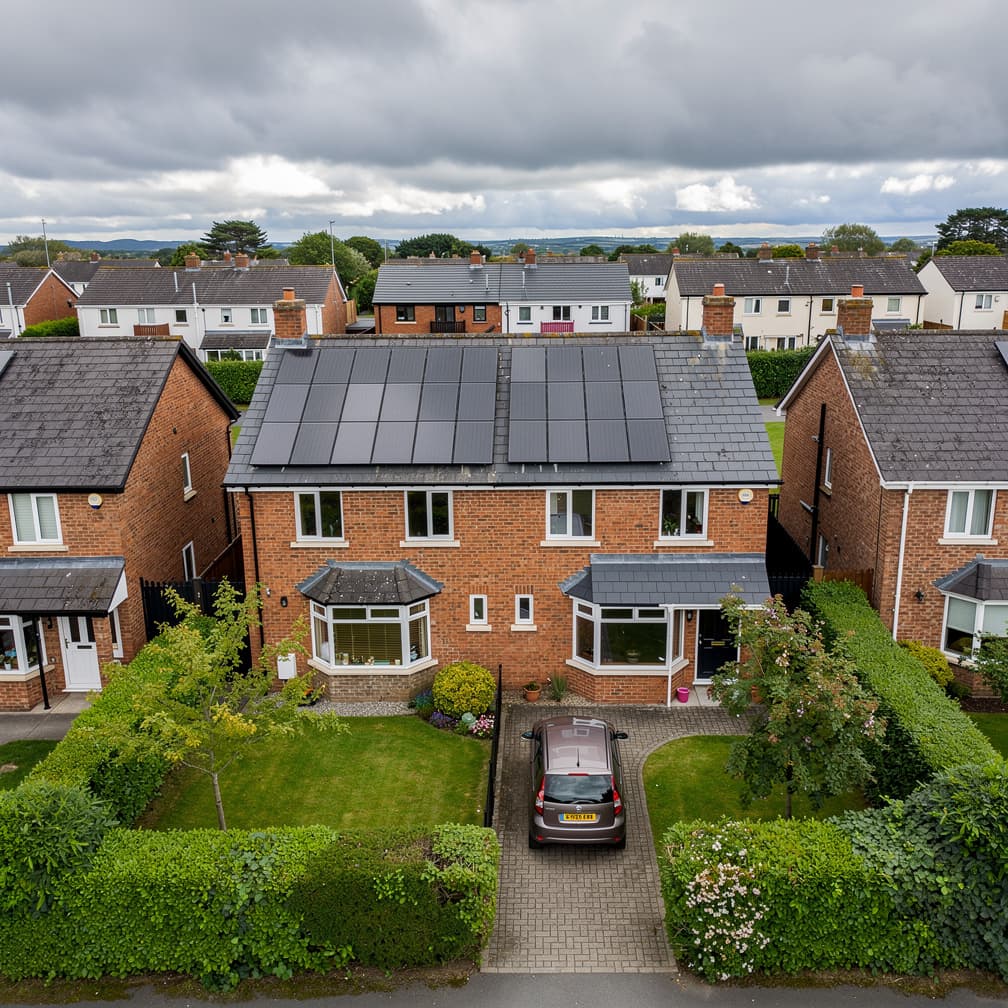
For thousands of Irish homes — particularly semi-detached and terraced houses where the roof ridge runs north-south — a split east-west system with panels on both sides of the roof is not just a viable option. It is often the optimal configuration.
How a Split East-West System Works
A split system divides your total panel capacity across both roof faces. For example, a 4kWp system might have 2kWp (5 panels) on the east-facing roof and 2kWp (5 panels) on the west-facing roof. Each set of panels generates electricity during its optimal window, and together they provide a broad, even generation curve throughout the entire day.
Why Split Systems Often Outperform South-Facing
This might sound counterintuitive, but a well-designed split east-west system can deliver better real-world financial returns than a south-facing system of the same capacity. Here is why:
- Longer generation window: East panels generate from sunrise to early afternoon; west panels generate from late morning to sunset. Combined, you have meaningful solar generation across 10-14 hours per day in summer — compared to 6-8 hours of peak production from a south-facing system.
- Higher self-consumption: Because the generation is spread more evenly across the day, it better matches your household's natural electricity consumption pattern. Instead of a massive midday peak that exceeds your needs (and gets exported at low rates), you get steady generation that you actually use.
- More total roof space utilised: Semi-detached homes typically have limited south-facing roof space (because there is no south-facing roof at all). A split system uses both available roof faces, allowing you to install more total panel capacity than you could on a single face. More panels means more power, even at 80-85% efficiency per face.
- Reduced grid export waste: A 4kWp south-facing system might export 60-70% of its generation because it all arrives in a midday burst. A 4kWp split system might only export 40-50% because the generation is spread when you are more likely to be using it.
This is exactly why understanding your available roof space is so important when planning a solar installation.
Real-World Example: Semi-Detached Home in Dublin
Consider a typical 3-bed semi-detached home in South Dublin with a ridge running north-south, giving equal east and west facing roof areas. The homeowner installs a 4.1kWp split system: 2.05kWp on the east face and 2.05kWp on the west face.
- Total annual generation: approximately 3,100 kWh (82% of what a theoretical south-facing system would produce)
- Self-consumption rate: 55% (vs typical 35% for a south-facing system of the same size)
- Annual savings: approximately €1,050 (higher than the €980 a south-facing system would save, despite lower total generation, because more electricity is consumed on-site)
This is the key insight that many people miss: total generation is not the same as total savings. A system that generates slightly less but at more useful times can save you more money.
Wondering what a split system would look like for your home? Request your free personalised solar quote and our SEAI-approved installer will assess both roof faces and recommend the optimal configuration.
Real Savings from East/West Facing Solar Panels in Ireland
Let us put real numbers on the table. The following comparison uses 2026 electricity prices (approximately 38c/kWh retail rate), the current SEAI grant of up to €2,400, and the Clean Export Guarantee rate of approximately 21c/kWh. All figures assume a standard 3-4 bed Irish home with average electricity consumption of 4,200 kWh per year.
Savings Comparison: South vs East vs West vs Split System
| Configuration | System Size | Annual Output | Self-Consumption Rate | Annual Savings | Net Cost (After SEAI Grant) | Payback Period |
|---|---|---|---|---|---|---|
| South-facing | 4kWp | 3,600 kWh | 35% | €1,010 | €4,600 | 4.6 years |
| East-facing | 4kWp | 2,950 kWh | 45% | €920 | €4,600 | 5.0 years |
| West-facing | 4kWp | 2,950 kWh | 50% | €960 | €4,600 | 4.8 years |
| Split East-West (2kWp + 2kWp) | 4kWp | 2,950 kWh | 55% | €1,050 | €4,800 | 4.6 years |
Key takeaways from this table:
- The east and west facing systems have a payback period only 0.2-0.4 years longer than due south — virtually negligible over a 25-30 year panel lifespan.
- The split east-west system actually matches the south-facing payback period despite lower total generation, because its higher self-consumption rate means more electricity is used at the full retail rate rather than exported at the lower feed-in rate.
- West-facing slightly outperforms east-facing due to better alignment with typical household consumption patterns.
- Even the "worst" scenario — a purely east-facing 4kWp system — delivers a 5-year payback and €920 in annual savings. Over 25 years, that is over €23,000 in total savings from a net investment of €4,600.
The savings figures above are conservative. If electricity prices continue to rise — as they have consistently over the past decade — actual returns will be significantly higher. Many industry analysts project electricity prices of 42-48c/kWh by 2028-2030, which would increase annual savings by 15-25%.
For a full breakdown of solar panel costs in Ireland including installation, equipment, and available grants, see our comprehensive cost guide.
Advantages of East/West Over South-Facing
We have already touched on some of these, but it is worth spelling out the genuine advantages that east-west orientations — and particularly split systems — have over south-facing installations. These are not consolation prizes. They are real, practical benefits.
1. Longer Daily Generation Window
A south-facing system generates the bulk of its electricity in a concentrated 5-6 hour window around solar noon. A split east-west system generates meaningful electricity across 10-14 hours. This means your home is powered by solar for more of the day, reducing your reliance on grid electricity across morning, afternoon, and early evening.
2. Flatter, More Useful Generation Curve
South-facing panels produce a sharp peak at midday — exactly when most households use the least electricity (because everyone is at work or school). East-west systems produce a gentler, flatter curve that better matches real household consumption patterns. Less wasted peak, more useful steady generation.
3. Higher Self-Consumption Without a Battery
Because the generation profile of an east-west system more closely matches household demand, you naturally consume a higher percentage of what you generate. Typical self-consumption rates for split east-west systems (50-60%) significantly exceed south-facing systems (30-40%) — even without installing a battery. This is important because self-consumed electricity is worth roughly twice as much as exported electricity.
4. Better Return on Investment for Battery Storage
If you do add a battery, an east-west system charges it more effectively. South-facing panels dump a massive amount of energy into the battery at midday, often hitting the battery's capacity limit while the sun is still shining. East-west panels charge the battery more gradually across the day, making better use of the battery's full capacity.
5. More Total Capacity on Your Roof
Homes with limited or no south-facing roof space (semi-detached, terraced, or houses with roof features on the south face) can install more total capacity by using both east and west faces. More capacity means more total generation, which can more than offset the per-panel efficiency difference. Check our guide on whether your roof has space for solar panels to assess your options.
6. Reduced Inverter Stress
A south-facing system hits its maximum output in a short, intense burst that pushes the inverter hard. A split east-west system spreads the load more evenly, which can reduce inverter stress and potentially extend its operational life — a practical consideration given that inverter replacement is the main maintenance cost over a solar system's 25-30 year lifespan.
When East or West Facing Panels Are NOT Worth It
While we firmly believe that the vast majority of east and west facing roofs in Ireland are excellent candidates for solar panels, there are specific situations where the investment may not deliver adequate returns. Here is when to think twice.
Heavy Shading
Shading is the number one enemy of solar panel performance, regardless of orientation. If your east or west facing roof is significantly shaded by tall trees, neighbouring buildings, or chimneys for large portions of the day, the already-reduced output from a non-south orientation gets cut further. A roof that receives less than 3-4 hours of direct sunlight during summer months is unlikely to deliver a reasonable payback period.
That said, partial shading can often be mitigated with microinverters or power optimisers, which allow each panel to operate independently rather than being dragged down by one shaded panel. If shading is your concern, mention it when you request your quote and the installer will assess whether microinverters solve the problem.
Very Steep Roof Pitch (Over 50 Degrees)
The steeper your roof, the more sensitive solar panels become to orientation. On a shallow 15-20 degree roof, the difference between south and east/west is minimal. On a steep 50+ degree roof, east and west facing panels lose more output because they are angled away from the optimal sun position. If your east or west facing roof has a pitch exceeding 50 degrees, the output drops to around 65-70% of south-facing — still potentially viable, but less compelling financially.
Combined With a Primarily North Aspect
A roof that faces north-east or north-west (rather than true east or true west) sees a meaningful additional reduction in output. North-east and north-west orientations typically achieve 60-65% of south-facing output, which extends the payback period to 8-10 years. This is still worthwhile for many homeowners, but it is a different conversation from the 80-85% achieved by true east or true west.
Very Low Electricity Consumption
If your household electricity consumption is very low (under 2,500 kWh per year) and you are considering a large system on an east or west facing roof, a significant portion of the generated electricity will be exported at the lower feed-in tariff rate. In this scenario, a smaller system might be more cost-effective, or you might consider adding a battery to store excess generation for evening use.
Planning or Structural Constraints
In rare cases, planning restrictions (listed buildings, conservation areas) or structural concerns (roof condition, load-bearing capacity) may make installation impractical regardless of orientation. A qualified SEAI-approved installer will identify any such issues during their site survey.
What About North-Facing Roofs?
We would not be giving you the full picture without addressing the elephant in the room: north-facing roofs. Unlike east and west orientations, which we wholeheartedly endorse, north-facing roofs require honest, careful consideration.
Due North: Generally Not Recommended
A due-north facing roof in Ireland typically produces approximately 50% of the output of a south-facing roof. For a 4kWp system, that means roughly 1,700-1,900 kWh per year, generating annual savings of around €500-600. With a net system cost of approximately €4,600 after the SEAI grant, the payback period stretches to 8-9 years — and that assumes minimal shading and optimal tilt.
While the system would still generate positive returns over its 25-30 year lifetime, the significantly longer payback period and lower annual savings mean the investment is less compelling. For most homeowners, the same capital invested in home insulation, a heat pump, or other energy efficiency measures would deliver better returns.
North-East and North-West: Marginal but Possible
North-east and north-west orientations sit in a middle ground. At 60-65% of south-facing output, they can still deliver a reasonable return — especially if:
- You have a shallow roof pitch (under 25 degrees), which reduces the orientation penalty
- You have high electricity consumption, maximising the value of self-consumed solar electricity
- You are combining with panels on another roof face as part of a larger system
- You plan to add battery storage to maximise the value of generated electricity
If your roof has a north-east or north-west orientation and you are interested in exploring your options, it is still worth requesting a free assessment. An experienced installer can use satellite imagery and shading analysis to give you an accurate production estimate for your specific roof.
Optimising Your East/West System
Once you have decided to go ahead with an east or west facing installation, there are several design choices that can help you squeeze the maximum output and savings from your system.
Optimal Tilt Angle for East/West Panels
For south-facing panels in Ireland, the optimal tilt angle is approximately 30-35 degrees from horizontal. For east and west facing panels, the optimal tilt is slightly lower — around 25-30 degrees. This shallower angle allows the panels to capture more of the sky's available light throughout the day rather than being biased toward a specific sun position.
In practice, most homeowners install panels flush with their existing roof slope, which typically falls in the 25-40 degree range for Irish homes. If your roof pitch is within this range, flush-mounting is perfectly fine and avoids the additional cost and wind-loading concerns of angled mounting brackets. Only if your roof pitch is particularly steep (over 45 degrees) or very shallow (under 15 degrees) is it worth considering adjustable mounting to optimise the angle.
Microinverters vs String Inverters for Split Systems
The choice of inverter technology is particularly important for split east-west systems, where panels on different roof faces experience different sunlight conditions throughout the day.
String inverters connect all panels in a series "string." They are cheaper but perform best when all panels receive similar sunlight. For a split east-west system with a single string inverter, the panels on the shaded side (whichever side the sun is not on) can drag down the performance of the entire string. To mitigate this, a dual-string inverter with separate MPPT (Maximum Power Point Tracking) inputs should be used — one string per roof face.
Microinverters are installed on each individual panel, allowing every panel to operate at its maximum potential independently. They are ideal for split systems because the east-facing panels and west-facing panels never interfere with each other's performance. Microinverters cost approximately €50-80 more per panel but can increase total system output by 5-15% compared to a basic single-string inverter on a split system. For more on this comparison, see our detailed string vs micro inverters cost comparison.
Our recommendation for split east-west systems: either a dual-MPPT string inverter (the more cost-effective option) or microinverters (the performance-maximising option). Never use a single-MPPT string inverter for a split system — the performance loss will far exceed the money saved.
Panel Selection for Non-South Orientations
For east and west facing installations, the type of solar panel you choose can make a meaningful difference. Higher-efficiency monocrystalline panels (21-23% efficiency) are particularly advantageous for non-optimal orientations because they extract more energy from the available light. While they cost slightly more per panel, the increased output often justifies the premium on east/west installations where every percentage point of efficiency counts.
Panels with good low-light performance are also worth prioritising. Look for specifications that mention strong performance in diffuse light conditions — this is especially relevant in Ireland where diffuse radiation accounts for a significant portion of annual solar energy.
Adding Battery Storage
A battery storage system pairs exceptionally well with east-west solar installations. The morning generation from east-facing panels can charge the battery, which then powers your home through the midday gap, while west-facing panels take over for the afternoon and charge the battery again for evening use. This maximises self-consumption and can push your annual savings up by an additional €200-400.
That said, battery storage adds €3,000-5,000 to the system cost. For most homeowners, the priority should be installing the panels first — the panels alone deliver the primary financial return. You can always add a battery later when prices continue to fall.
Monitoring and Smart Controls
A good monitoring system is particularly valuable for east-west installations. By tracking your generation pattern across the day, you can identify the best times to run high-consumption appliances. Many modern inverters come with smartphone apps that show real-time generation, and smart plugs or timers can automatically schedule your dishwasher, washing machine, or immersion heater to run during peak solar generation hours.
For split systems, monitoring each roof face independently helps you verify that both sides are performing as expected and quickly identify any issues like panel-level shading or inverter faults.
Frequently Asked Questions
Do solar panels work facing east?
Yes, east-facing solar panels work very well in Ireland. They produce approximately 80-85% of the output of south-facing panels, which translates to excellent savings and a typical payback period of 5-6 years after the SEAI grant. East-facing panels generate most of their electricity in the morning hours, which suits households with morning electricity usage patterns.
Is a west-facing roof good for solar panels?
A west-facing roof is an excellent candidate for solar panels in Ireland. West-facing panels produce 80-85% of south-facing output and have a slight practical advantage over east-facing panels for most households because they generate electricity during the late afternoon and evening when home electricity consumption is typically highest. The payback period for a west-facing system is typically 4.8-6 years.
Can I have solar panels on both sides of my roof?
Absolutely. A split east-west system with panels on both sides of the roof is one of the most popular and effective configurations for Irish homes, especially semi-detached and terraced houses. The combined output from both sides provides a broad, even generation curve throughout the day, and the higher self-consumption rate often means better financial returns than a single south-facing array of the same size.
What direction should solar panels face in Ireland?
The ideal direction for solar panels in Ireland is due south (180 degrees), which maximises total annual generation. However, south-east, south-west, east, and west orientations all deliver strong returns. South-east and south-west achieve 95% of south-facing output, while east and west achieve 80-85%. The only orientation generally not recommended is due north, which drops to approximately 50%. For most Irish homes, the available roof orientation is more than adequate for a worthwhile solar installation.
How much less do east-facing solar panels produce compared to south-facing?
East-facing solar panels in Ireland produce approximately 15-20% less than south-facing panels on an annual basis. For a 4kWp system, this means generating around 2,720-3,230 kWh per year compared to 3,400-3,800 kWh from a south-facing system. While the total generation is lower, the financial impact is smaller than the generation gap suggests because east-facing panels often achieve higher self-consumption rates.
Do I need planning permission for east-west solar panels in Ireland?
In most cases, no. Solar panels on residential roofs in Ireland are generally exempt from planning permission under the Planning and Development Regulations, regardless of which direction the roof faces. The exemption applies provided the panels do not project more than 15cm above the roof surface and do not exceed 12 square metres (or 50% of the total roof area, whichever is less). For homes in conservation areas or on protected structures, additional restrictions may apply — your installer will advise on your specific situation.
Can I get the SEAI grant for east or west facing solar panels?
Yes. The SEAI solar PV grant is available regardless of your roof orientation. The grant provides up to €2,400 for solar panel installations on Irish homes (built and occupied before 2021). The amount is based on system size, not orientation: €800 per kWp for the first 2kWp, then €250 per kWp for the next 2kWp, up to a maximum of €2,100 for a 4kWp+ system. Your SEAI-approved installer handles the grant application on your behalf.
Are east/west panels worth it without a battery?
Yes, absolutely. East and west facing solar panels deliver excellent returns without a battery. In fact, we recommend most homeowners install panels first and consider adding a battery later. The panels alone provide a 5-6 year payback period on east/west roofs. A battery can increase savings further by storing excess generation for evening use, but it is an optional enhancement rather than a requirement for making the system financially viable.
How many solar panels can I fit on my east or west facing roof?
The number of panels that fit on your roof depends on the roof dimensions, not the orientation. A standard solar panel measures approximately 1.7m x 1.0m (1.7 square metres). Most Irish semi-detached homes can fit 6-10 panels per roof face, giving a total system size of 2.5-8kWp for a split east-west system. Our guide on roof space for solar panels can help you estimate your capacity, or simply request a free quote and the installer will calculate the exact figure.
Do east and west facing solar panels work in winter in Ireland?
Yes, though output is reduced — as it is for all orientations during winter. East and west facing panels typically produce around 15-20% of their annual output during the October-February period in Ireland. The shorter days and lower sun angle affect all orientations, and the relative performance gap between south and east/west actually narrows during winter months because diffuse light (which dominates Irish winters) is less directional. For more detail, see our article on solar panel output in Irish winters.
Should I get microinverters for my east-west split system?
Microinverters or a dual-MPPT string inverter are strongly recommended for split east-west systems. A single-MPPT string inverter will cause the east and west panels to interfere with each other's performance, reducing total output by 10-15%. Microinverters allow each panel to operate independently and typically add €400-600 to the total system cost for a 4kWp installation — an investment that pays for itself within 2-3 years through increased generation. See our inverter comparison guide for more details.
What roof pitch is best for east or west facing panels in Ireland?
The optimal roof pitch for east and west facing panels in Ireland is approximately 25-30 degrees from horizontal — slightly shallower than the 30-35 degree optimum for south-facing panels. However, the difference in output across the 20-40 degree pitch range is small (less than 5%), so if your roof falls within this range, installing panels flush with the roof is the most practical and cost-effective approach. Roof pitches above 45 degrees begin to see more significant output reductions for east/west orientations.
Can I mix different panel sizes or types on east and west roofs?
Yes, you can use different panel types or quantities on each roof face — though matching panels on each individual face is recommended. Using microinverters makes this particularly straightforward, as each panel operates independently. This flexibility is useful when your east and west roof faces have different available areas, allowing you to maximise the total capacity across both sides.
Still have questions about whether your east or west facing roof is suitable for solar panels? The fastest way to get a definitive answer is to request a free, no-obligation assessment from an SEAI-approved installer in your area. They will analyse your specific roof using satellite imagery and provide accurate generation and savings estimates for your home — completely free, with zero pressure to proceed.
Related Articles
Lidl Plug-In Solar Panels: Are They Coming to Ireland? What You Need to Know (2026)
Lidl will sell plug-in solar panels for €200-€500 that save €100-€200/year. But a full installation saves €700-€950/year after the €1,800 SEAI grant. Full comparison inside.
Can You Sell Electricity Back to the Grid in Ireland? (Clean Export Guarantee Guide 2026)
Irish homeowners can sell surplus solar electricity back to the grid at €0.155-€0.185/kWh through the Clean Export Guarantee (CEG). Earn €300-€450/year tax-free. Full guide: rates by supplier, how to set up, and how to maximise earnings.

How to Choose Solar Security Lights for Your Home
Match brightness, motion sensors, battery life, and weather resistance to choose durable, energy-saving solar security lights for reliable home protection.