Ireland's #1 Solar Installation Service — Connecting You With Top SEAI-Approved Installers
Off-Grid Solar Costs in Ireland: Guide 2025

Off-Grid Solar Costs in Ireland 2026: Complete Guide

Published: Last Updated:

A complete off-grid solar system in Ireland costs between €8,000 and €25,000 depending on the size of your home and energy needs. This includes solar panels, a battery bank, inverter, charge controller, and installation. While going fully off-grid is more expensive than a grid-connected system, it makes financial sense when your property faces grid connection costs of €10,000-€30,000+ — common in rural Ireland. See our grid-connected solar panel costs for more details. See our battery storage options for more details. See our solar inverter guide for more details.

This guide covers everything you need to know about off-grid solar in Ireland for 2026: realistic costs broken down by system size, what equipment you need, battery sizing for Irish winters, planning permission rules, SEAI grant eligibility, and an honest assessment of whether going fully off-grid is the right choice for your situation. See our SEAI grants for more details.

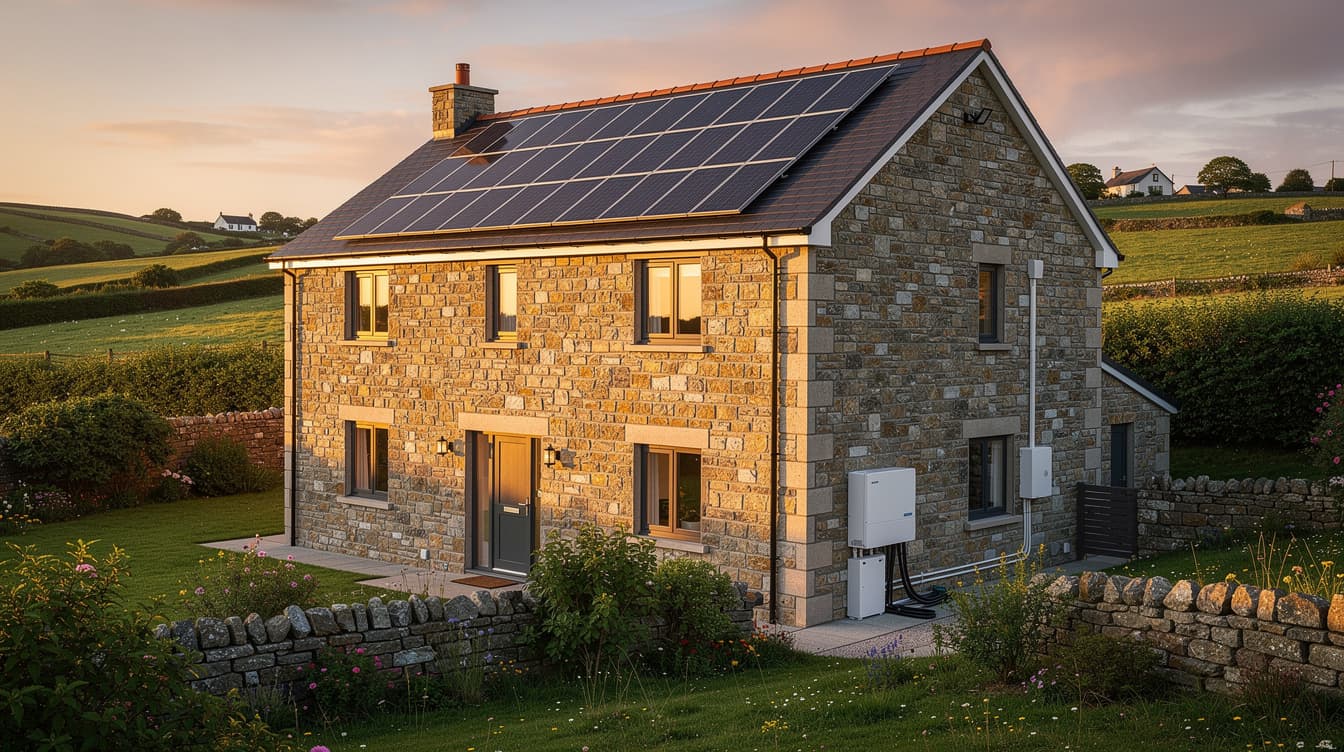
Remote Irish stone cottage with solar panels and no grid connection
Off-grid solar systems give energy independence to rural Irish homes where grid connection can cost €10,000-€30,000+

How Much Does an Off-Grid Solar System Cost in Ireland?

The total cost of an off-grid solar system in Ireland in 2026 ranges from roughly €4,000 for a basic cabin setup to €25,000+ for a full-house system capable of powering a family home year-round. The price depends primarily on system size, battery capacity, and whether you install it yourself or hire a professional.

Here is a breakdown by system size:

System Size Typical Use Solar Panels Battery Bank Inverter Charge Controller Wiring & Sundries Total (Installed)
Small (1-2 kW) Cabin, shed, garden office €800 – €1,400 €1,200 – €2,500 €500 – €900 €150 – €300 €200 – €400 €4,000 – €7,500
Medium (3-5 kW) Small to medium home €2,000 – €3,500 €3,500 – €7,000 €1,200 – €2,500 €300 – €600 €400 – €800 €8,000 – €15,000
Large (8-10 kW) Full family home €4,500 – €7,000 €7,000 – €14,000 €2,500 – €4,000 €500 – €1,000 €600 – €1,200 €16,000 – €25,000+

These prices reflect 2026 Irish market rates including VAT. DIY installation can reduce costs by 20-30%, but professional installation is strongly recommended for larger systems due to the complexity of off-grid wiring and the safety implications of large battery banks.

The single biggest cost driver is the battery bank — it typically accounts for 35-50% of the total system cost. Unlike a grid-connected system where the grid acts as your backup, an off-grid system needs enough battery storage to get you through multiple cloudy days, especially during Ireland's long winters.

Key Cost Comparison

A grid-connected 4 kW solar system in Ireland costs approximately €5,000-€7,000 after the SEAI grant. A comparable off-grid system costs €10,000-€15,000 — roughly double — because of the battery bank and charge controller requirements. However, if your property doesn't have a grid connection and ESB Networks quotes you €15,000-€30,000 to install one, off-grid solar becomes the more economical choice.

What's Included in an Off-Grid Solar Setup?

An off-grid solar system has more components than a standard grid-connected installation. Here is what each part does and what it costs in Ireland in 2026:

Solar Panels (€800 - €7,000)

The panels themselves are the energy source. For off-grid systems, you want high-efficiency monocrystalline panels to maximise generation from Ireland's limited winter sunlight. A typical 400W panel costs €150-€250 in Ireland. A 3 kW system needs 7-8 panels; a 10 kW system needs 25 panels.

Off-grid systems benefit from oversizing the panel array — installing more capacity than you technically need ensures better charging during the short, overcast days from November to February.

Battery Bank (€1,200 - €14,000)

This is the heart of any off-grid system. Your battery bank stores energy generated during the day for use at night and during cloudy periods. The size you need depends on your daily energy consumption and how many days of autonomy you want (typically 2-3 days for Ireland).

In 2026, the two main battery technologies for off-grid use in Ireland are:

  • Lithium iron phosphate (LiFePO4): €400-€600 per kWh. 10+ year lifespan, 80-90% depth of discharge, lighter weight, no maintenance. The preferred choice for most new installations.
  • Lead-acid (AGM or gel): €150-€250 per kWh. 3-5 year lifespan, only 50% usable capacity, heavier, requires ventilation. Cheaper upfront but more expensive over 10 years when replacements are factored in.

For a typical Irish home using 12-15 kWh per day, you would need a 30-45 kWh lithium battery bank for 2-3 days of autonomy — costing €12,000-€27,000. This is why most off-grid homes in Ireland combine a moderately sized battery bank with a backup generator.

Off-Grid or Hybrid Inverter (€500 - €4,000)

The inverter converts DC power from your panels and batteries into 230V AC for your appliances. Off-grid inverters must create their own AC waveform, unlike grid-tied inverters that sync with the grid's frequency.

Hybrid inverters that work both off-grid and grid-connected are popular as they allow future grid connection. Brands commonly used in Ireland include Victron Energy (the most popular for off-grid due to its modular design), SMA Sunny Island, and Growatt SPF series.

Charge Controller (€150 - €1,000)

The charge controller sits between the solar panels and the battery bank, regulating the charging voltage and current to protect the batteries. MPPT (Maximum Power Point Tracking) controllers are essential for Irish conditions — they extract up to 30% more energy from the panels than cheaper PWM controllers, which matters enormously when sunlight is at a premium.

For systems over 2 kW, expect to pay €300-€600 for a quality MPPT controller. Victron SmartSolar and EPEver Tracer are popular choices in Ireland.

Backup Generator (€1,000 - €4,000)

Virtually every off-grid home in Ireland includes a backup generator. During December and January, solar generation can drop to 10-20% of summer output. A diesel or petrol generator provides essential backup power and can charge your batteries during extended cloudy periods.

A 3-5 kW inverter generator costs €1,000-€2,500. Diesel generators are more fuel-efficient for regular use. Some off-grid homeowners also add small wind turbines as a secondary source, though small wind in Ireland has a mixed track record.

Wiring, Mounting, and Balance of System (€400 - €1,500)

This covers DC cabling, battery cables, AC distribution board, earthing, surge protection, mounting rails, and cable management. Roof-mounted kits add €200-€400. Ground-mounted arrays cost more (frame and foundations) but are easier to maintain and can be oriented optimally.

Off-Grid vs Grid-Connected Solar: Which Is Right for You?

This is the most important decision to get right. For the majority of Irish homeowners who already have a grid connection, a grid-connected solar system is the better financial choice. But for specific situations — particularly rural properties without an existing grid connection — off-grid solar is the smarter option.

Factor Off-Grid Solar Grid-Connected Solar
Total Cost (4 kW system) €10,000 – €15,000 €5,000 – €7,000 (after SEAI grant)
Battery Storage Essential — €3,500 – €14,000 Optional — €3,000 – €6,000
Complexity High — requires careful sizing and management Low — plug and play with grid as backup
Reliability Depends on system design and backup generator Very high — grid provides constant backup
SEAI Grant Available No (grant is for grid-connected only) Yes — up to €1,800
Electricity Export Income No — no grid to export to Yes — Clean Export Guarantee (CEG)
Maintenance Higher — batteries, generator servicing Low — panels and inverter only
Energy Independence Complete — no electricity bills Partial — still connected to grid
Winter Performance Challenging — generator backup needed No issue — grid fills the gap
Payback Period 10 – 20 years (vs grid connection cost) 5 – 7 years
Best For Remote properties, no grid connection Homes with existing grid connection

Our honest recommendation: If your home already has a grid connection, grid-connected solar is almost always the better investment. You get the SEAI grant, earn from exports, and have the grid as free backup with a 5-7 year payback. However, if ESB Networks has quoted you €10,000-€30,000+ for a new grid connection, off-grid solar deserves serious consideration — that money may be better invested in a system giving complete energy independence.

Considering a grid-connected solar system? If you already have mains electricity, a grid-connected system with SEAI grant support is likely your best option. Get a free quote here to see what a professional installation would cost for your home.

Off-Grid Solar for Rural Ireland

Off-grid solar is not a niche curiosity in Ireland — it is a practical necessity for many rural properties. Ireland has some of the highest grid connection costs in Europe for remote sites, and thousands of properties across the country face prohibitive costs to get mains electricity.

Garden shed with solar panel for off-grid power
A small off-grid solar setup on a garden shed — a popular and affordable DIY project

Remote Farmhouses

Many older farmhouses in the west and northwest of Ireland have outbuildings, annexes, and restored dwellings that remain off-grid. For these properties, a 5-8 kW off-grid solar system with a backup generator provides reliable power at a fraction of what a new ESB connection would cost — particularly when the nearest pole is hundreds of metres away across difficult terrain.

Holiday Homes and Retreats

Ireland's coastline and countryside are dotted with holiday cottages where grid connection was never installed or has lapsed. Off-grid solar is ideal for seasonal use: a 2-3 kW system with modest battery storage handles lighting, refrigeration, water pumping, and device charging. Because these homes are typically unoccupied during the worst winter months, the seasonal limitations of solar are less of a concern.

Bog Land and Mountain Properties

Properties on bog land or in mountainous areas face the highest grid connection costs in Ireland. ESB Networks charges based on distance and terrain difficulty — running poles across bogland can cost €1,000+ per pole. Homeowners in Connemara, West Kerry, Donegal, and West Cork regularly face quotes of €20,000-€30,000+ for grid connections. At those prices, a well-designed off-grid solar system is the more economical long-term solution.

New Rural Builds

If you are building a new home on a rural site with a substantial grid connection quote, designing as off-grid from the outset has significant advantages. You can specify energy-efficient appliances, orient the roof for maximum solar gain, and build in battery storage and generator housing from the start rather than retrofitting later.

Off-Grid Solar for Cabins, Sheds and Garden Offices

Not every off-grid project involves powering a full house. Some of the most practical and cost-effective off-grid installations in Ireland are small-scale systems for outbuildings.

Garden Offices

A 1-2 kW off-grid system with a 5 kWh lithium battery can power a laptop, monitor, lighting, Wi-Fi router, and a small heater during warmer months. Total cost: €3,000-€5,000. This is often cheaper than running an electrical supply from your house to the garden, which requires a registered electrician and groundwork.

Agricultural Sheds

Farm buildings used for workshops, storage, or animal housing benefit greatly from off-grid solar. A basic system with LED lighting and a few sockets costs as little as €1,500-€3,000. For sheds requiring power tools or refrigeration, a larger 2-3 kW system with a 10 kWh battery bank runs €4,000-€7,000.

Cabins and Glamping

A cabin with lighting, USB charging, a small fridge, and a water pump runs comfortably on a 1 kW system with a 2.4 kWh battery — costing €2,000-€3,500 installed. This is one area where DIY is genuinely practical, as the systems are low-voltage, small-scale, and not connected to mains supply.

The DIY Advantage for Small Systems

For systems under 2 kW, DIY installation is a realistic option. The kits are widely available online, the voltages involved (12V or 24V DC) are safe to work with, and plenty of Irish-specific YouTube tutorials exist. You can set up a basic 12V system for a shed with a single 400W panel, a PWM charge controller, a 100Ah leisure battery, and a small inverter for under €800. It will not power a house, but it will run lights, charge devices, and power small appliances.

Battery Storage for Off-Grid Systems

Battery storage is where off-grid solar gets both expensive and technically complex. Getting the battery sizing right is critical — too small and you will run out of power during cloudy spells; too large and you have wasted money on capacity you will never use.

How to Size Your Battery Bank

The formula for battery sizing is straightforward:

Battery capacity needed = Daily energy use x Days of autonomy / Depth of discharge

Example: 12 kWh/day x 3 days / 0.8 (lithium) = 45 kWh battery bank

Example: 12 kWh/day x 3 days / 0.5 (lead-acid) = 72 kWh battery bank

For Ireland specifically, "days of autonomy" is the key variable. In summer, 1-2 days is sufficient. But from November to February, you can experience 5-7 consecutive days with minimal solar generation. This is why a backup generator is considered essential for off-grid homes in Ireland — sizing a battery bank for a full week of winter autonomy would be prohibitively expensive.

Lithium vs Lead-Acid: The Full Comparison

Feature Lithium (LiFePO4) Lead-Acid (AGM/Gel)
Cost per kWh (usable) €450 – €700 €300 – €500
Lifespan 10 – 15 years (4,000+ cycles) 3 – 5 years (800-1,200 cycles)
Depth of Discharge 80 – 90% 50%
Weight (per kWh) ~12 kg ~35 kg
Maintenance None Regular checks, ventilation needed
Cold Weather Performance Good (charging limited below 0°C) Fair (capacity drops in cold)
10-Year Cost of Ownership €450 – €700 per kWh €600 – €1,000+ per kWh (2-3 replacements)
Best For Primary off-grid systems Budget installations, seasonal cabins

Our recommendation for 2026: Lithium (LiFePO4) batteries are now the clear winner for any off-grid system you plan to rely on daily. The upfront cost premium is recovered within 5-6 years due to the longer lifespan and deeper discharge capability. Lead-acid still makes sense for seasonal cabins or very budget-conscious installations where the system is a convenience rather than a necessity.

Winter Battery Considerations for Ireland

Ireland's maritime climate creates specific challenges for off-grid battery systems:

  • Temperature: While Ireland rarely drops below -5°C, battery capacity decreases in cold weather. Lithium batteries should not be charged below 0°C — install them in an insulated enclosure or indoor space.
  • Humidity: Ireland's high humidity can cause corrosion on battery terminals and connections. Good ventilation and regular inspection of connections is important, particularly for lead-acid batteries which off-gas during charging.
  • Cycling patterns: In winter, batteries may go through deep cycles daily (discharging to 20-30% state of charge) which shortens their lifespan. Oversizing the battery bank slightly reduces the depth of each cycle and extends battery life.
  • Generator integration: Your charge controller and inverter should be configured to automatically start the backup generator when the battery drops below a set threshold (typically 20-30% for lithium). Victron systems handle this integration particularly well.
Large lithium battery bank for off-grid solar system in rural Ireland
A properly sized battery bank is the most critical — and expensive — component of an off-grid system

Can You Go Fully Off-Grid in Ireland?

Yes, you can go fully off-grid in Ireland — but it requires careful planning, realistic expectations, and a willingness to adapt your energy use to the seasons. Let us be completely honest about what this involves.

The Summer Reality (April – September)

Off-grid solar in Ireland works brilliantly for roughly six months of the year. From April to September, a well-sized system will generate more electricity than most households need. Battery banks stay fully charged, there is surplus power to spare, and you may barely think about energy management. Ireland receives 4-5 peak sun hours per day during summer months, and a 5 kW system can generate 20-25 kWh daily.

The Winter Reality (October – March)

This is where the challenge lies. In December and January, Ireland averages just 0.5-1.0 peak sun hours per day. A 5 kW system that generates 25 kWh in June might produce only 3-5 kWh in December. Meanwhile, your energy consumption is likely higher due to shorter days (more lighting), colder temperatures (more heating), and more time spent indoors.

The maths is stark: if your home uses 12 kWh per day and your panels generate 4 kWh, you have an 8 kWh daily deficit. Over a week of cloudy weather, that is a 56 kWh shortfall. Even a large 30 kWh battery bank would be depleted in under four days without supplementary generation.

How Off-Grid Homes in Ireland Actually Manage Winter

Successful off-grid households in Ireland use several strategies to bridge the winter gap:

  • Backup generator: The most common solution. Running a diesel generator for 2-4 hours charges the battery bank and tops up the system. Expect to use 200-400 litres of diesel per winter season, costing €300-€600.
  • Aggressive energy management: Switching to minimal energy use during dark periods — LED lighting only, limiting high-draw appliances, using gas for cooking and heating water.
  • Wood or solid fuel heating: Most off-grid homes in Ireland use a stove or range for space heating and hot water rather than electric heating, which would be impractical on solar alone.
  • Wind turbine supplementation: Wind generation peaks in winter when solar is weakest. A small wind turbine (1-5 kW) can complement solar, though planning permission and maintenance challenges mean they are not a universal solution.
  • Lifestyle adaptation: Many off-grid households embrace the seasonal rhythm — using summer surplus for workshops and intensive appliances, while keeping winter usage minimal.

The Honest Bottom Line

Going fully off-grid in Ireland is absolutely possible, and hundreds of families do it successfully. But it requires active energy management, a backup generator for winter, and a willingness to adapt habits. If you want the same energy experience as a grid-connected home with zero effort, off-grid is not for you. If you value independence and are willing to engage with your energy system, it can be deeply rewarding.

SEAI Grants for Off-Grid Solar

This is a common area of confusion, so let us be clear: the main SEAI solar PV grant is designed for grid-connected systems and is not available for off-grid installations.

What the SEAI Solar Grant Covers

The SEAI (Sustainable Energy Authority of Ireland) provides grants of up to €1,800 for solar PV installations on homes built and occupied before 2021. However, the grant has specific requirements:

  • The system must be installed by an SEAI-registered contractor
  • The property must be connected to the electricity grid
  • The system must be connected to the grid via an ESB Networks NC6 application
  • A BER assessment must be completed before and after installation

Off-grid systems, by definition, do not connect to the grid — so they do not qualify for this grant.

What About the Battery Grant?

The SEAI battery storage grant (up to €600 per kWh, capped at €3,000) is similarly only available for grid-connected systems. Your battery must be part of a grid-connected solar installation with the appropriate inverter and metering.

Any Grants Available for Off-Grid?

There are limited options:

  • TAMS (Targeted Agricultural Modernisation Schemes): Farmers may be eligible for grants covering solar installations on agricultural buildings, including off-grid setups. The TAMS III scheme provides grant rates of 40-60% depending on the applicant category. Contact your local Teagasc advisor for current eligibility.
  • Leader Programme: Some rural development Leader programmes have funded off-grid renewable energy projects in the past. Availability varies by region and funding cycle.
  • Better Energy Communities: The SEAI's community grant programme can sometimes support off-grid projects as part of a broader community energy plan.

The lack of grant support is another reason grid-connected solar is the better financial choice for homes that already have mains electricity. If you are eligible for the SEAI grant, get a free quote for a grid-connected system before committing to an off-grid approach.

Planning Permission for Off-Grid Solar in Ireland

Planning permission rules for solar panels in Ireland depend on how and where the panels are installed. The rules were significantly relaxed in 2022 under SI 235, but there are still distinctions that off-grid installers need to be aware of.

Diesel backup generator next to battery bank in rural Ireland
A backup generator is recommended for full off-grid systems to cover extended winter periods

Roof-Mounted Solar Panels

Solar panels mounted on the roof of a house, agricultural building, or outbuilding are generally exempt from planning permission under the following conditions:

  • Panels must not extend more than 15 cm above the roof surface
  • Panels must not extend above the ridge line of the roof
  • The total area of panels must not exceed 50 sq m (or 75% of the total roof area, whichever is less)
  • The building must not be a protected structure or in an Architectural Conservation Area (ACA)

These exemptions apply regardless of whether the system is grid-connected or off-grid.

Ground-Mounted and Standalone Solar Arrays

This is where off-grid systems differ, as many off-grid properties use ground-mounted arrays (which can be oriented more optimally than a roof). The planning exemptions for ground-mounted solar are more limited:

  • Ground-mounted arrays in the curtilage of a house are exempt if the total area does not exceed 25 sq m
  • The array must not exceed 2 metres in height
  • The array must not be located in front of the front wall of the house
  • Only one ground-mounted array per house is exempt

For larger ground-mounted arrays — which may be necessary for a 8-10 kW off-grid system — you will likely need planning permission. Check with your local authority before proceeding.

Agricultural Land

Solar panels on agricultural buildings are exempt up to 300 sq m of roof area. Ground-mounted solar on agricultural land may also be exempt under certain conditions, but for large arrays intended to power a dwelling, planning permission is generally required.

One-Off Rural Houses

If building a new off-grid home, include the solar installation in your overall planning application. The local authority can assess the solar array, battery housing, and generator enclosure as part of the development — often the simplest approach.

Off-Grid Solar System Sizing: How to Calculate What You Need

Properly sizing an off-grid solar system is the single most important step in the process. An undersized system will leave you without power; an oversized system wastes money. Here is a step-by-step method with a worked example for an Irish home.

Step 1: Calculate Your Daily Energy Consumption

List every electrical appliance in your home, its wattage, and how many hours per day you use it. Multiply watts by hours to get watt-hours (Wh) per day.

Appliance Watts Hours/Day Wh/Day
LED Lighting (10 bulbs) 100 5 500
Fridge/Freezer 150 24 (cycling) 1,200
Washing Machine 500 1 500
Laptop + Router 80 10 800
TV 100 4 400
Kettle 2,000 0.25 500
Microwave 1,000 0.25 250
Water Pump 500 1 500
Phone/Device Charging 50 4 200
Miscellaneous 500

Total daily consumption: 5,350 Wh (5.35 kWh)

Add a 20% safety margin for inefficiencies: 5.35 x 1.2 = 6.4 kWh/day

Step 2: Determine Solar Panel Capacity Needed

In Ireland, the worst-case scenario for solar generation is winter. Use the winter average of 1.0 peak sun hours per day (December-January) for sizing if you want to minimise generator use:

Panel capacity = Daily consumption / Peak sun hours / System efficiency

6.4 kWh / 1.0 hours / 0.85 = 7.5 kW of panels

However, sizing for the absolute worst case is extremely expensive. Most off-grid homeowners in Ireland accept generator backup in winter and size for a more practical 2.0 peak sun hours (annual average):

6.4 kWh / 2.0 hours / 0.85 = 3.8 kW of panels

Rounded up: 4 kW system (10 x 400W panels)

Step 3: Size the Battery Bank

For 2 days of autonomy with lithium batteries (80% depth of discharge):

Battery capacity = Daily use x Days of autonomy / Depth of discharge

6.4 kWh x 2 / 0.8 = 16 kWh battery bank

A 16 kWh lithium battery bank at €450-€600/kWh costs €7,200-€9,600. This gives you two full days without any solar generation before the generator needs to kick in.

Step 4: Select the Inverter

Your inverter must handle the peak load — the maximum power draw when multiple appliances run simultaneously. In our example, the kettle alone draws 2,000W. If the kettle and washing machine run together, that is 2,500W. Add a safety margin:

Inverter size = Peak load x 1.25 safety factor

2,500W x 1.25 = 3,125W minimum — choose a 3.5 kW or 5 kW inverter

Step 5: Total System Cost Estimate

For our worked example (modest off-grid home, 6.4 kWh/day usage):

Component Specification Estimated Cost
Solar Panels 10 x 400W (4 kW) €2,000 – €2,800
Battery Bank 16 kWh LiFePO4 €7,200 – €9,600
Off-Grid Inverter 5 kW hybrid €1,500 – €2,500
MPPT Charge Controller 60A €350 – €500
Backup Generator 3 kW diesel €1,200 – €2,000
Mounting & Wiring Ground-mount frame, cables, DB €600 – €1,000
Installation Labour Professional install €1,500 – €2,500
Total €14,350 – €20,900

This system would power a modest Irish home with careful energy management and generator backup during the darkest winter weeks. If the alternative is a €20,000 ESB grid connection plus ongoing electricity bills, this off-grid system pays for itself within 8-12 years.

Ground-mounted solar panel array next to an Irish farmhouse
With careful sizing and a backup generator, off-grid solar can reliably power an Irish home year-round

Frequently Asked Questions

How much does an off-grid solar system cost in Ireland?

A complete off-grid solar system in Ireland costs between €4,000 and €25,000+ depending on system size. A small cabin system (1-2 kW) costs €4,000-€7,500. A medium home system (3-5 kW) costs €8,000-€15,000. A full-house system (8-10 kW) costs €16,000-€25,000+. The battery bank is the largest single expense, typically accounting for 35-50% of the total cost.

Can I get an SEAI grant for an off-grid solar system?

No. The SEAI solar PV grant (up to €1,800) and battery grant (up to €3,000) are only available for grid-connected systems installed by SEAI-registered contractors. Off-grid systems do not qualify. Some agricultural grants (TAMS III) may cover off-grid solar on farm buildings. If you have an existing grid connection and want to benefit from the SEAI grant, request a free quote for a grid-connected system.

Is off-grid solar viable in Ireland's climate?

Yes, but with caveats. Off-grid solar works excellently from April to September (3-5 peak sun hours daily). From November to February, generation drops to 0.5-1.0 peak sun hours, making a backup generator essential. Hundreds of Irish homes operate successfully off-grid with a combination of solar, batteries, and diesel generator backup.

How many solar panels do I need for an off-grid home in Ireland?

A typical Irish household using 6-8 kWh per day needs a 4-6 kW system (10-15 x 400W panels). To minimise generator use in winter, oversize to 8-10 kW (20-25 panels). The exact number depends on daily consumption, available space, and how much generator backup you accept.

How long do off-grid solar batteries last?

Lithium iron phosphate (LiFePO4) batteries last 10-15 years with 4,000+ charge cycles. Lead-acid batteries last 3-5 years with 800-1,200 cycles. Given the heavy cycling demands of off-grid living in Ireland (daily deep discharges in winter), lithium batteries are strongly recommended despite the higher upfront cost. Over a 15-year period, one set of lithium batteries costs less than three sets of lead-acid.

What size battery bank do I need for off-grid in Ireland?

For a home using 6-8 kWh per day with 2 days of autonomy, you need a 15-20 kWh lithium battery bank (or 24-32 kWh lead-acid, since only 50% is usable). For 3 days of autonomy, scale up to 22-30 kWh lithium. Most off-grid homes in Ireland opt for 2 days of battery autonomy combined with a backup generator, as sizing for longer autonomy becomes prohibitively expensive.

Do I need planning permission for off-grid solar panels in Ireland?

Roof-mounted solar panels are generally exempt from planning permission provided they do not extend more than 15 cm above the roof or beyond the ridge line, and the total area does not exceed 50 sq m. Ground-mounted arrays are exempt up to 25 sq m and 2 metres in height. Larger ground-mounted systems needed for full off-grid homes may require planning permission — check with your local planning authority.

What is the best inverter for off-grid solar in Ireland?

Victron Energy is the most popular brand for off-grid installations in Ireland, particularly the MultiPlus and Quattro ranges. They offer excellent off-grid performance, modular expansion, and sophisticated battery management. Growatt SPF and SMA Sunny Island are also reliable options. For off-grid use, you need an inverter that can create its own AC waveform — standard grid-tied inverters will not work without a grid connection.

Can I add an off-grid system to my existing house?

Yes. You can retrofit an off-grid solar system to an existing property. However, if your home currently has a grid connection, it makes far more financial sense to install a grid-connected solar system and benefit from the SEAI grant, 0% VAT, and electricity export income. Get a free quote to compare the cost of a grid-connected system for your home. Off-grid retrofitting is best suited to properties that genuinely cannot get grid access or face very high connection costs.

How much does it cost to maintain an off-grid solar system?

Annual maintenance costs are approximately €200-€500, covering generator servicing (€100-€200), diesel fuel (€300-€600), battery inspection, and panel cleaning. Over 20 years, also budget for one battery replacement (€5,000-€12,000 for lithium) and one inverter replacement (€1,500-€3,000).

Is it cheaper to go off-grid or connect to the ESB grid?

It depends entirely on the grid connection quote. If ESB Networks quotes you under €5,000 for a grid connection, connecting to the grid and installing a grid-connected solar system (with SEAI grant) is almost always cheaper. If the grid connection quote is €15,000-€30,000+, an off-grid solar system becomes competitive. The break-even point is typically around €10,000-€15,000 in grid connection costs — above that, off-grid starts to make financial sense.

Can I use an electric car with an off-grid solar system?

Technically yes, but challenging. Charging an EV adds 7-10 kWh to your daily consumption, meaning you would need to double or triple your solar and battery system. A more practical approach is charging the EV at public chargers or a workplace and using the home system for household needs only.

What happens during a prolonged cloudy spell in winter?

During 5-7 days of heavy cloud, panels may generate only 1-2 kWh per day against a need of 6-8 kWh. Your battery bank will deplete, and the backup generator will need to run 2-4 hours daily. This is normal and expected — no off-grid solar system in Ireland can avoid generator use entirely during deep winter. Budget €300-€600 per year for generator fuel.

Ready to Explore Your Options?

Whether you are considering off-grid solar for a remote property or a grid-connected system for your home, getting accurate pricing for your specific situation is the essential first step.

For grid-connected systems: Get a free, no-obligation quote from SEAI-registered installers in your area. Most Irish homeowners save €1,000-€1,500 per year on electricity bills with a properly sized grid-connected solar system.

Related Articles