Can a Boiler Work with Solar Panels? Exploring the Possibilities
Yes, solar panels can work with your boiler — and the combination can dramatically reduce your heating costs. The most popular and cost-effective method is a solar immersion diverter (€300-€500), which uses surplus electricity from your solar panels to heat your hot water cylinder for free. For homeowners wanting to go further, combining solar PV with a heat pump can eliminate up to 80-90% of your heating bills. See our solar panel costs for more details.
In Ireland, where the average household spends €1,800-€2,500 per year on heating alone, the question of whether solar panels can work alongside your existing boiler is one of the most important energy decisions you can make in 2026. Whether you have an oil boiler, gas boiler, or are considering a heat pump upgrade, solar panels can integrate with every setup — the only difference is how much you save.
This guide covers exactly how solar panels work with every type of Irish heating system. We break down the costs, savings, and best combinations so you can make an informed decision. From the simple €300 immersion diverter that pays for itself in under two years to the premium solar-plus-heat-pump setup that virtually eliminates heating bills — every option is explored in detail.
Can Solar Panels Power Your Boiler? The Short Answer
Yes — solar panels can power your boiler, but how they do it depends on the type of solar panel and the type of boiler. The two main routes are: using a solar immersion diverter to heat your hot water cylinder with surplus PV electricity, or pairing solar PV with a heat pump for full central heating. Both methods work exceptionally well in Irish conditions and are used by thousands of homeowners across the country.
Here is a quick summary of how solar panels interact with different boiler types:
| Heating System | How Solar Helps | Potential Savings | Upfront Cost (Solar Add-on) |
|---|---|---|---|
| Oil Boiler + Solar PV | Immersion diverter heats hot water; solar reduces electricity bills | €400–€800/year | €300–€500 (diverter only) |
| Gas Boiler + Solar PV | Immersion diverter heats hot water; solar reduces electricity bills | €350–€700/year | €300–€500 (diverter only) |
| Heat Pump + Solar PV | Solar powers the heat pump directly; near-zero heating bills | €1,200–€2,000/year | €8,000–€14,000 (heat pump) |
| Electric Boiler + Solar PV | Solar directly offsets electricity used for heating | €500–€900/year | €0 (direct connection) |
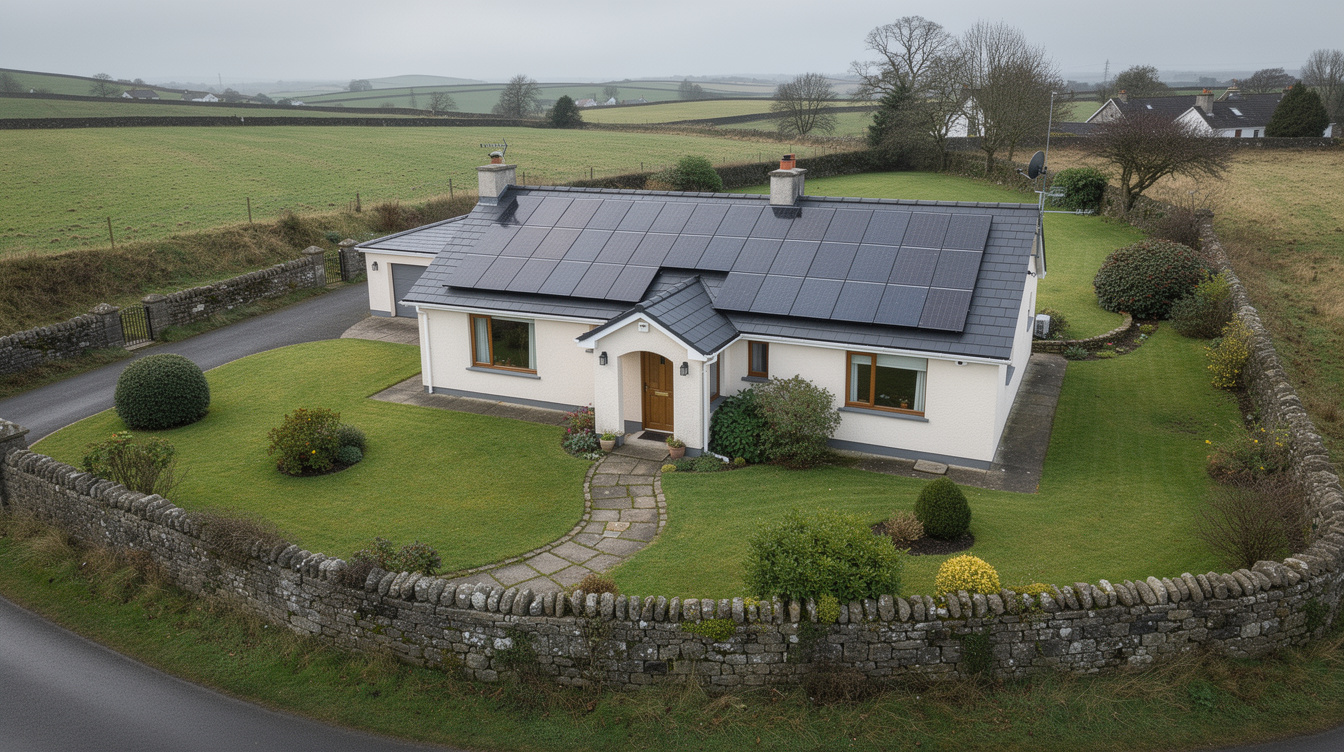
The most common and cost-effective approach for Irish homeowners in 2026 is to keep your existing oil or gas boiler for central heating while adding a solar immersion diverter to handle your hot water. This gives you immediate savings with minimal investment. The diverter automatically detects when your solar panels are producing more electricity than your home is using and redirects that surplus energy to your immersion heater — giving you free hot water for roughly 8-9 months of the year.
For homeowners looking for maximum savings, the solar PV plus heat pump combination is the gold standard. A heat pump uses electricity to extract heat from the outside air (even in Irish winter temperatures), and when that electricity comes from your own solar panels, your heating costs drop to near zero. This combination is increasingly popular in new builds and deep retrofits across Ireland.
The key takeaway is this: solar panels do not directly fire up your oil or gas boiler. Instead, they either heat your water through a diverter (replacing the need for your boiler to do that job) or they power a heat pump that handles all your heating needs electrically. Both approaches are proven, practical, and deliver real savings for Irish households.
Solar PV vs Solar Thermal: What's the Difference?
Before diving deeper into how solar works with boilers, it is essential to understand the two types of solar technology available in Ireland: Solar PV (photovoltaic) panels and Solar Thermal panels. They look similar on your roof but work in completely different ways.
Solar PV panels convert sunlight into electricity. This electricity can power your home, be exported to the grid, stored in a battery, or — crucially for this article — diverted to heat your water via an immersion heater. Solar PV is by far the more popular and versatile option in Ireland in 2026. See our battery storage for more details.
Solar thermal panels (also called solar collectors) use sunlight to directly heat water flowing through tubes on your roof. This hot water is then stored in a specially designed twin-coil hot water cylinder. Solar thermal is specifically designed for water heating and nothing else.
Here is a detailed comparison:
| Feature | Solar PV | Solar Thermal |
|---|---|---|
| What it produces | Electricity | Hot water only |
| Typical cost (installed) | €5,000–€12,000 (3-6 kW) | €3,000–€5,500 |
| SEAI grant (2026) | Up to €2,100 | €1,200 |
| Net cost after grant | €2,900–€9,900 | €1,800–€4,300 |
| Can power appliances? | Yes — all household electricity | No |
| Can heat water? | Yes — via immersion diverter | Yes — directly |
| Can power heat pump? | Yes | No |
| Can export to grid? | Yes — earn via MSS/CEG | No |
| Works in winter? | Yes — reduced output | Yes — reduced output |
| Maintenance | Very low | Moderate (glycol fluid, pump checks) |
| Lifespan | 25-30 years | 15-20 years |
| Roof space needed | 15-25 m² for 3-6 kW | 3-5 m² |
| Overall value for money | Excellent — best all-round option | Good for water heating only |
Our recommendation for 2026: Solar PV is the better investment for almost every Irish homeowner. While solar thermal is slightly more efficient at heating water per square metre of panel, solar PV gives you vastly more flexibility. Your PV electricity can heat water (via a diverter), power your home, charge an EV, run a heat pump, and earn export income. Solar thermal can only heat water. See our SEAI grants for more details. See our solar panel output guide for more details.
The economics have shifted decisively in favour of PV. In 2015, solar thermal was the go-to for water heating. By 2026, PV panel prices have dropped so significantly that a PV system with an immersion diverter costs roughly the same as a solar thermal installation but does far more. The SEAI grant for PV is also more generous at up to €2,100, compared to €1,200 for solar thermal.
The only scenario where solar thermal still makes sense is if you have very limited roof space (a flat of 3-5 m² is enough for thermal, versus 15+ m² for a meaningful PV system) or if you already have a twin-coil cylinder and want the simplest possible hot water solution.
For the rest of this article, when we refer to "solar panels" working with your boiler, we are primarily talking about Solar PV panels — as these offer the most flexibility and value for combining with any heating system.
How a Solar Immersion Diverter Works
A solar immersion diverter is the simplest, cheapest, and most effective way to connect your solar panels to your hot water system. It is the single best upgrade you can add to an existing solar PV system if you have a hot water cylinder with an immersion heater — which the vast majority of Irish homes do.
Here is how it works, step by step:
- Your solar panels generate electricity during the day. On a typical Irish day, a 4 kW system might produce 3-4 kWh during peak sunshine hours (roughly 10am-3pm).
- Your home uses some of that electricity. Fridges, lights, appliances, and devices all draw power. Whatever is left over is "surplus" electricity.
- Without a diverter, surplus electricity is exported to the grid. You receive a small payment (typically 18-24c/kWh under the Microgeneration Support Scheme), but you are essentially giving away cheap energy.
- With a diverter, surplus electricity is automatically sent to your immersion heater. The diverter monitors your electricity flow in real time. The instant it detects surplus energy flowing to the grid, it redirects that energy to your hot water cylinder instead.
- Your water heats up for free. Over the course of a sunny day, the diverter can deliver 3-6 kWh of energy to your cylinder — enough to fully heat 100-150 litres of water to 60°C.
The beauty of a solar immersion diverter is its simplicity. It requires no changes to your plumbing, no new cylinder, and no modification to your boiler. It simply plugs into your electrical system between your solar inverter and your consumer unit (fuse board), with a connection to your existing immersion heater. A qualified electrician can install one in 2-3 hours.
Popular solar immersion diverters available in Ireland in 2026:
| Diverter Brand | Typical Cost (Installed) | Key Features |
|---|---|---|
| Eddi by MyEnergi | €400–€500 | Smart app control, dual load capability, works with Zappi EV charger |
| SolarEdge Immersion Diverter | €350–€450 | Integrates with SolarEdge inverters, simple setup |
| iBoost+ | €300–€400 | Wireless sender, digital display, timer function |
| Catch Power Green Catch | €350–€450 | Australian-designed, robust, good app monitoring |
What savings can you expect? The average Irish household spends €400-€600 per year heating water. With a solar immersion diverter and a decent PV system (3-6 kW), you can expect to get free hot water for 7-9 months of the year — from roughly March to October. During summer months, you will likely have more surplus electricity than your cylinder can absorb. During winter, you will still need your boiler or immersion timer to top up.
Realistic annual savings from a solar immersion diverter: €200-€400 per year on water heating costs. At a cost of €300-€500, the diverter pays for itself in 1-2 years — making it one of the fastest-payback renewable investments available in Ireland.
If you already have solar panels but do not have a diverter, adding one is a no-brainer. If you are planning a new solar installation, make sure your installer includes one in the quote. Request a free solar and diverter quote here to find out exactly how much you could save.
Can Solar Panels Heat Your Radiators?
This is one of the most common questions Irish homeowners ask, and the answer requires some nuance. Solar PV panels alone cannot directly heat your radiators in the way your oil or gas boiler does. However, when combined with a heat pump, solar panels can absolutely provide all the energy needed to heat your radiators and your entire home.
Here is why solar PV cannot directly power radiators through a traditional boiler:
- Oil and gas boilers burn fuel to heat water. They do not run on electricity (except for a small amount to power the pump and controls).
- Even if you have an electric boiler, the electricity demand for heating a full home via radiators is enormous — far more than a typical domestic PV system can supply in real time, especially during winter when heating demand is highest and solar output is lowest.
- Radiator systems require water heated to 55-75°C, which demands a lot of energy delivered consistently over hours.
The solution: Solar PV + Heat Pump = Solar-Heated Radiators
A heat pump changes the equation entirely. Here is why:
- A heat pump uses electricity to move heat from the outside air (air-source) or ground (ground-source) into your home. For every 1 kWh of electricity it consumes, it produces 3-4 kWh of heat (this ratio is called the Coefficient of Performance or COP).
- A typical Irish home needs 10,000-15,000 kWh of heat per year. With a COP of 3.5, a heat pump needs only 2,800-4,300 kWh of electricity to deliver that heat.
- A 6 kW solar PV system in Ireland generates roughly 5,000-5,500 kWh per year — more than enough to cover the heat pump's electricity needs on an annual basis.
The catch is timing. Your heat pump needs the most electricity in winter, when your solar panels produce the least. In practice, you will use grid electricity to run your heat pump during winter months and generate surplus solar electricity during summer. Over the full year, the numbers balance out — and with a battery storage system, you can shift even more of your solar electricity to when it is needed.
For homeowners with existing radiator systems, switching to a heat pump does require some consideration. Traditional radiators work best with high water temperatures (60-75°C), while heat pumps are most efficient at lower temperatures (35-45°C). This means you may need to:
- Upgrade to larger radiators that deliver the same heat at lower water temperatures
- Install underfloor heating in some or all rooms (ideal for heat pumps as it operates at 35-40°C)
- Improve insulation so your home needs less heat overall (often required for SEAI heat pump grants anyway)
The bottom line: if your question is "can solar panels heat my radiators?", the answer is yes — but you need a heat pump as the intermediary. Solar panels generate the electricity, the heat pump multiplies it into heat, and your radiators (or underfloor heating) distribute that heat throughout your home. It is an incredibly efficient system that thousands of Irish homeowners are now using.
Solar Panels + Oil Boiler: How They Work Together
Ireland remains one of the most oil-dependent countries in Europe for home heating. Approximately 40% of Irish homes still use oil-fired central heating — particularly in rural areas where the gas network does not reach. If you are one of these homeowners, the good news is that solar panels pair very well with oil boilers.
Here is how the combination works in practice:
Your oil boiler continues to handle central heating (radiators). Nothing changes here. Your boiler fires up as normal during cold months, circulating hot water through your radiators. Solar PV does not interfere with this process in any way.
A solar immersion diverter takes over hot water duties. Instead of running your oil boiler for 30-60 minutes each day just to heat the water cylinder (a common practice in Irish homes), your solar panels do this for free during daylight hours. Your boiler only needs to heat water during winter months when solar output is insufficient.
Solar electricity reduces your household electricity bill. Beyond heating, your PV panels power your lights, appliances, and devices — cutting your electricity bill by 50-70% in many cases.
Realistic savings for an Irish home with oil boiler + solar PV + diverter:
| Saving Category | Annual Saving | Notes |
|---|---|---|
| Hot water (via diverter) | €200–€400 | Free hot water for 7-9 months |
| Electricity bill reduction | €400–€700 | Based on 4-6 kW system |
| Grid export income (MSS) | €100–€200 | Surplus electricity sold at 18-24c/kWh |
| Reduced oil usage | €100–€200 | Boiler runs less (no daily hot water cycle) |
| Total annual savings | €800–€1,500 | Depends on household size and consumption |
There is an important practical point for oil boiler homes. Many Irish households with oil boilers run the boiler once or twice daily specifically to heat the water cylinder — even during summer when no radiator heating is needed. This burns 500-1,000 litres of oil per year just for hot water, costing €500-€1,000 at current prices. A solar immersion diverter eliminates almost all of this summer oil usage, which is where the biggest savings come from.
For oil-dependent homes, adding solar PV with a diverter is one of the smartest investments you can make in 2026. It does not require you to rip out your oil boiler — you simply add a new layer of savings on top of your existing system. When your boiler eventually reaches end of life (typically after 15-20 years), you will then be in a perfect position to switch to a heat pump, with your solar panels already in place to power it.
If you heat your home with oil and want to know exactly how much solar panels could save you, get a personalised quote from verified Irish installers here.
Solar Panels + Gas Boiler: The Combination
If you live in Dublin, Cork, Limerick, Galway, Waterford, or any other urban area served by the Bord Gáis network, chances are you have a gas boiler. Gas central heating is used by roughly 35% of Irish homes, and it combines with solar PV in exactly the same way as an oil boiler — with a few key differences worth noting.
The setup is identical: Solar PV panels on the roof, an immersion diverter redirecting surplus electricity to your hot water cylinder, and your gas boiler continuing to handle central heating through radiators. The diverter works exactly the same regardless of whether your boiler runs on oil, gas, or LPG.
Where gas differs from oil:
- Gas is already cheaper than oil per kWh of heat. The average gas-heated Irish home spends €1,200-€1,800 per year on gas, compared to €1,500-€2,500 for oil. This means the absolute savings from a solar diverter may be slightly lower for gas homes, but the percentage savings are similar.
- Gas boilers are more efficient than oil boilers. A modern condensing gas boiler runs at 90-94% efficiency, while even a good oil boiler manages 85-92%. This means less energy is wasted and fewer kWh are needed overall.
- Gas combi boilers do not have a hot water cylinder. This is critical. If you have a combi boiler (which heats water on demand without a storage cylinder), you cannot use a standard immersion diverter because there is no immersion heater to divert to. You would need to either install a hot water cylinder with an immersion element (costing €500-€1,000 extra) or focus your solar savings on electricity reduction and grid export only.
- Gas system boilers and regular boilers work perfectly with diverters. If your gas boiler heats a separate hot water cylinder (identifiable by having a large tank, usually in a hot press), then a diverter will work perfectly.
Realistic savings for a gas-heated Irish home with solar PV:
| Saving Category | With Hot Water Cylinder | With Combi Boiler (No Cylinder) |
|---|---|---|
| Hot water (via diverter) | €150–€350/year | N/A — no cylinder to divert to |
| Electricity bill reduction | €400–€700/year | €400–€700/year |
| Grid export income | €80–€150/year | €150–€250/year (more surplus available) |
| Reduced gas usage | €80–€150/year | Minimal |
| Total annual savings | €710–€1,350 | €550–€950 |
As you can see, gas-heated homes with a hot water cylinder benefit significantly more from solar panels than those with combi boilers. If you have a combi boiler and are considering solar, it may be worth installing a hot water cylinder at the same time. The extra €500-€1,000 cost for a cylinder and immersion element will pay for itself within 2-3 years through the additional diverter savings.
Gas boilers in Ireland are increasingly seen as a transitional heating solution. The Irish government's Climate Action Plan targets phasing out fossil fuel heating in new builds (already in effect) and encouraging existing homeowners to switch to heat pumps over time. If you install solar PV now, you are future-proofing your home — the panels will seamlessly power a heat pump when you eventually make the switch.
For gas-heated homes in Dublin, Cork, or other urban areas, request a free solar assessment to see your exact savings potential.
Solar Panels + Heat Pump: The Ultimate Combo
If there is one combination that represents the future of home heating in Ireland, it is solar PV panels paired with an air-source heat pump. This setup can reduce your combined heating and electricity costs by 70-90%, effectively eliminating your reliance on fossil fuels. It is the most environmentally friendly and — over a 15-20 year horizon — the most economically rewarding option available to Irish homeowners in 2026.
How the combination works:
An air-source heat pump sits outside your home (similar in size to an air conditioning unit) and extracts heat from the outdoor air — even when temperatures drop to -5°C or below. It uses electricity to compress a refrigerant, which amplifies the extracted heat and transfers it to your central heating system and hot water cylinder. For every 1 kWh of electricity consumed, the heat pump produces 2.8-4.5 kWh of heat, depending on outdoor temperature and system efficiency.
When your solar panels are generating electricity, that power goes directly to the heat pump (and the rest of your home) for free. During times when solar production exceeds your total demand, excess electricity can be stored in a home battery, diverted to your hot water cylinder, or exported to the grid for income. During times when solar production is insufficient (evenings, cloudy days, winter), you draw from the grid as normal — but because the heat pump is so efficient, your grid electricity costs for heating are still far lower than any fossil fuel alternative.
Cost and savings analysis: Solar PV + Heat Pump
| Component | Cost Range | SEAI Grant | Net Cost |
|---|---|---|---|
| Solar PV (4-6 kW) | €6,000–€11,000 | Up to €2,100 | €3,900–€8,900 |
| Air-source heat pump | €8,000–€14,000 | €3,500 | €4,500–€10,500 |
| Battery storage (optional, 5-10 kWh) | €3,500–€7,000 | €600 | €2,900–€6,400 |
| Immersion diverter | €300–€500 | N/A | €300–€500 |
| Total (without battery) | €14,600–€25,900 | Up to €5,600 | €9,000–€20,300 |
| Total (with battery) | €18,100–€32,900 | Up to €6,200 | €11,900–€26,700 |
Annual savings compared to traditional heating:
| Previous Heating System | Old Annual Heating Cost | New Annual Cost (Solar + Heat Pump) | Annual Saving |
|---|---|---|---|
| Oil boiler | €1,800–€2,500 | €300–€600 | €1,200–€2,000 |
| Gas boiler | €1,200–€1,800 | €250–€500 | €700–€1,400 |
| LPG boiler | €2,000–€3,000 | €300–€600 | €1,400–€1,800 |
| Electric storage heaters | €2,200–€3,500 | €200–€500 | €1,700–€3,000 |
These savings do not include the additional €400-€700 saved on general household electricity from solar PV, or the €100-€200 earned from grid export. When you factor everything in, a solar PV plus heat pump system can deliver total annual savings of €1,500-€3,000+ compared to a fossil fuel setup.
The payback period for the full solar + heat pump combination typically ranges from 7-12 years, depending on your current fuel costs and the size of the system installed. Given that solar panels last 25-30 years and heat pumps last 15-20 years, you are looking at 15-20+ years of dramatically reduced energy costs after the system has paid for itself.
For the best results, consider installing the solar panels and heat pump at the same time. Many Irish installers now offer combined packages, and installing together reduces total labour costs. Get a combined solar and heat pump quote from trusted Irish installers here.
How Much Can You Save on Heating with Solar?
The amount you can save depends on three main factors: the size of your solar PV system, what you combine it with (diverter, battery, heat pump), and what type of home you live in. To help you estimate your potential savings, here is a detailed breakdown by house type and system configuration.
Annual savings by system configuration and house type:
| Configuration | 2-Bed Apartment / Terraced House | 3-Bed Semi-Detached | 4-Bed Detached | Large Rural Home (5+ Bed) |
|---|---|---|---|---|
| Solar PV only (no diverter) | €300–€500 | €450–€700 | €550–€850 | €650–€1,000 |
| Solar PV + immersion diverter | €450–€750 | €650–€1,000 | €800–€1,300 | €950–€1,500 |
| Solar PV + diverter + battery | €550–€900 | €800–€1,250 | €1,000–€1,600 | €1,200–€1,900 |
| Solar PV + heat pump | €900–€1,400 | €1,300–€2,000 | €1,700–€2,500 | €2,100–€3,200 |
| Solar PV + heat pump + battery | €1,050–€1,600 | €1,500–€2,300 | €1,900–€2,800 | €1,800–€3,600 |
Important notes on these figures:
- Savings are calculated against a baseline of oil heating at €1.10-€1.20/litre and electricity at 35-42c/kWh (typical Irish rates in early 2026).
- Solar PV system sizes assumed: 2-3 kW for apartments, 3-4 kW for semi-detached, 5-6 kW for detached, and 6-8 kW for large rural homes.
- Savings include both direct heating savings and electricity bill reductions.
- Grid export income (€80-€250/year depending on system size) is included.
- Actual savings will vary based on your specific energy consumption, roof orientation, shading, and lifestyle patterns.
The table makes the value proposition clear. For homeowners with an existing boiler (oil or gas), adding solar PV with an immersion diverter is the sweet spot of cost versus benefit — delivering €650-€1,500 in annual savings for a relatively modest investment. For those prepared to invest more, the solar PV plus heat pump combination delivers €1,300-€3,600 in annual savings and eliminates fossil fuel dependence entirely.
Payback periods by configuration:
| Configuration | Typical Net Cost (After SEAI Grant) | Typical Annual Savings | Payback Period |
|---|---|---|---|
| Solar PV + diverter (4 kW) | €4,500–€7,500 | €650–€1,000 | 5-8 years |
| Solar PV + diverter + battery | €7,500–€13,500 | €800–€1,250 | 7-11 years |
| Solar PV + heat pump | €9,000–€20,000 | €1,300–€2,000 | 7-12 years |
| Solar PV + heat pump + battery | €12,000–€26,000 | €1,500–€2,300 | 8-13 years |
With energy prices in Ireland continuing to sit well above pre-2022 levels, these payback periods have shortened considerably. Five years ago, a solar PV system took 8-12 years to pay back. In 2026, the combination of higher electricity prices, better SEAI grants, lower panel costs, and the addition of export income means most systems pay for themselves within 5-8 years.
To get an accurate savings estimate for your specific home, request a personalised solar assessment from certified Irish installers.
Should You Replace Your Boiler with a Heat Pump?
This is the big question facing hundreds of thousands of Irish homeowners in 2026. If you already have solar panels — or are planning to install them — does it make sense to replace your oil or gas boiler with a heat pump?
The short answer: it depends on the age of your boiler, the insulation level of your home, and your financial situation. Here is a framework to help you decide.
Replace your boiler with a heat pump NOW if:
- Your boiler is over 15 years old and approaching end of life
- Your home has a BER rating of C1 or better (or you are planning a deep retrofit to achieve this)
- You have or are installing solar PV panels
- You want to eliminate fossil fuel costs and price volatility
- You are willing to invest €8,000-€14,000 (minus €3,500 SEAI grant = €4,500-€10,500 net cost)
- Your home can accommodate underfloor heating or larger radiators for optimal heat pump efficiency
Keep your boiler for now and just add solar PV + diverter if:
- Your boiler is less than 10 years old and working well
- Your home has poor insulation (BER D or worse) and you are not planning a retrofit soon
- Your budget is limited and you want the fastest return on investment
- You want to reduce costs now and upgrade to a heat pump later when your boiler needs replacing
The SEAI heat pump grant in 2026:
The Sustainable Energy Authority of Ireland (SEAI) offers a grant of €3,500 towards the cost of an air-source heat pump for existing homes. This is available through the Better Energy Homes scheme and the National Home Energy Upgrade Scheme. To qualify, your home must have been built before 2011, the work must be done by an SEAI-registered contractor, and your home must meet minimum insulation standards (or have insulation upgraded as part of the project).
If you combine a heat pump with solar PV, you can claim both the heat pump grant (€3,500) and the solar PV grant (up to €2,100), bringing your total SEAI support to up to €5,600. Add a battery (€600 grant) and the total rises to up to €6,200 in grants.
The financial case for switching:
| Scenario | Cost of New Oil Boiler | Cost of Heat Pump (Net After Grant) | Annual Saving with Heat Pump + Solar | Extra Payback Time vs. New Boiler |
|---|---|---|---|---|
| Replacing 20-year-old oil boiler | €3,000–€4,500 | €4,500–€10,500 | €1,200–€2,000 | 1-4 years extra |
| Replacing 20-year-old gas boiler | €2,500–€4,000 | €4,500–€10,500 | €700–€1,400 | 2-5 years extra |
When your old boiler needs replacing, the incremental cost of choosing a heat pump over a new boiler is surprisingly small — just €1,500-€6,000 more after grants. Given the annual savings of €700-€2,000, that incremental cost pays for itself within 1-5 years. After that, you save money every single year for the 15-20 year life of the heat pump.
For homes where the boiler still has years of life left, the smartest strategy is to install solar PV with a diverter now, enjoy the immediate savings, and plan for a heat pump when your boiler eventually needs replacing. This staged approach spreads the cost over time while capturing savings from day one.
If you are unsure whether a heat pump is right for your home, or you want to compare the costs of solar-only versus solar-plus-heat-pump, request a free assessment from experienced Irish renewable energy installers. They can evaluate your home's insulation, heating system, and roof suitability to give you accurate projections.
Practical Considerations for Irish Homeowners
Before committing to any solar-plus-heating upgrade, there are several practical factors specific to Ireland that you should be aware of.
Hot water cylinder requirements: To use a solar immersion diverter, you need a hot water cylinder with an immersion heater element. Most Irish homes built before 2010 have these as standard (the familiar "hot press" with a large copper or stainless steel cylinder inside). Newer homes with combi boilers may not have a cylinder, in which case one will need to be installed. A standard 150-200 litre cylinder with an immersion element costs €500-€1,000 installed.
Roof orientation and space: South-facing roofs are ideal for solar PV in Ireland, but east-west split installations also perform well — typically achieving 85-90% of the output of a south-facing system. You need approximately 6-8 m² of roof space per kW of solar panels. A typical 4 kW system requires about 25-30 m² of unshaded roof area.
Planning permission: Solar PV panels are generally exempt development in Ireland, meaning no planning permission is required for domestic installations. However, there are limits: panels must not project more than 150mm from the roof surface, must not be higher than the highest part of the roof, and the total area must not exceed 12 m² (or 50 m² for industrial/commercial buildings). Installations on protected structures or in architectural conservation areas require planning permission.
BER rating improvement: Installing solar PV typically improves your BER (Building Energy Rating) by 1-2 grades. Adding a heat pump can improve it by 2-4 grades. A better BER rating increases your property value — research from the ESRI suggests each BER grade improvement adds approximately 1.5-2% to a home's value.
Grid connection: If your solar PV system is 6 kW or less (which covers most domestic installations), you can connect to the ESB grid under the simplified NC6 process. Systems over 6 kW may require a more detailed grid application. Your installer handles this process as part of the installation.
Microgeneration Support Scheme (MSS): In 2026, Irish homeowners with solar PV can sell surplus electricity back to the grid through their electricity supplier. Export rates vary by supplier but typically range from 18-24c per kWh. This provides a useful income stream, though using electricity yourself (saving 35-42c/kWh) is always more valuable than exporting it.
Frequently Asked Questions
Can solar panels heat water in Ireland?
Yes, solar panels can heat water in Ireland very effectively. The most popular method is using a solar PV system with an immersion diverter. The diverter detects surplus electricity from your solar panels and automatically redirects it to your hot water cylinder's immersion heater. A typical 4-6 kW PV system with a diverter can provide free hot water for 7-9 months of the year (roughly March to October). During the remaining winter months, you will need your boiler or immersion timer to supplement. Annual savings on water heating alone are typically €200-€400.
Can solar panels replace a gas boiler?
Solar panels alone cannot fully replace a gas boiler because PV panels generate electricity, not heat, and a gas boiler burns gas. However, solar panels combined with a heat pump can completely replace a gas boiler. The solar panels generate electricity that powers the heat pump, and the heat pump provides all your central heating and hot water. This combination eliminates your gas bill entirely. Many Irish homeowners in urban areas (Dublin, Cork, Limerick) are making this switch in 2026, particularly when their gas boiler reaches end of life.
Do solar panels work with oil heating?
Yes, solar panels work excellently alongside oil heating systems. While solar PV does not directly power an oil boiler (which burns kerosene), adding a solar immersion diverter means your solar panels handle hot water heating during sunnier months — reducing the amount of oil your boiler needs to burn. Solar also reduces your electricity bill, and surplus electricity earns export income. Together, these savings typically amount to €800-€1,500 per year for an oil-heated Irish home. Your oil boiler continues to handle radiator heating as normal.
What is a solar immersion diverter?
A solar immersion diverter is a small electrical device (roughly the size of a hardback book) that monitors the electricity flow in your home. When it detects that your solar panels are producing more electricity than your household is using, it automatically diverts that surplus electricity to your hot water cylinder's immersion heater. This means instead of exporting cheap electricity to the grid, you use it to heat your water for free. Popular brands include the Eddi by MyEnergi (€400-€500), iBoost+ (€300-€400), and SolarEdge immersion diverter (€350-€450). Installation takes 2-3 hours by a qualified electrician.
How much does it cost to add solar panels to an existing boiler system?
The cost of adding solar PV to an existing boiler system in Ireland in 2026 ranges from €5,000 to €12,000 before the SEAI grant, depending on system size. After the SEAI grant of up to €2,100, the net cost is typically €2,900-€9,900. Adding an immersion diverter costs an additional €300-€500. The total investment for a typical 4 kW system with a diverter is €5,500-€8,000 net after grants. This setup works with any boiler type — oil, gas, LPG, or electric — and delivers annual savings of €650-€1,500.
Can solar panels power underfloor heating?
Solar panels cannot power underfloor heating directly (as underfloor systems require heated water or electrical heating mats). However, solar PV combined with a heat pump is an ideal match for underfloor heating. Heat pumps operate most efficiently at the low water temperatures that underfloor heating uses (35-40°C, compared to 55-75°C for radiators). The solar panels provide free electricity to run the heat pump, and the heat pump delivers gentle, even warmth through your underfloor system. This is considered the most efficient home heating combination available in Ireland.
Do I need a new hot water cylinder for solar panels?
In most cases, no. If your home already has a hot water cylinder with an immersion heater element (check your hot press — if there is a switch on the wall that activates an electric water heater, you have one), then a solar immersion diverter can be connected to your existing setup. You do not need a special solar-rated or twin-coil cylinder for PV with a diverter. The only situation where you might need a new cylinder is if you have a combi boiler with no cylinder at all, or if your existing cylinder is very old and poorly insulated. A new 150-200 litre cylinder with immersion element costs €500-€1,000 installed.
How many solar panels do I need to heat my water?
To reliably heat your hot water via an immersion diverter, you need enough surplus solar electricity — typically 2-4 kWh per day during sunnier months. A 3 kW solar PV system (roughly 7-8 panels) will usually generate enough surplus to heat a 150-litre cylinder on most days from March to October. A 4-6 kW system (10-15 panels) will produce surplus more consistently and heat water even on partially cloudy days. The more panels you have, the more often your water will be fully heated by solar — but even a modest 2 kW system can make a meaningful contribution to your hot water needs.
Is solar thermal or solar PV better for heating water in Ireland?
In 2026, solar PV with an immersion diverter is the better choice for most Irish homeowners. While solar thermal panels are slightly more efficient at converting sunlight into hot water per square metre, solar PV offers far greater versatility — it can heat water, power your home, charge an EV, run a heat pump, and earn export income. The SEAI grant for PV (up to €2,100) is also more generous than for solar thermal (€1,200). The only scenario where solar thermal wins is if you have very limited roof space (3-5 m² is enough for thermal) or specifically need a system that only provides hot water.
Can solar panels work with a back boiler?
Yes, solar panels can work alongside a back boiler (a boiler fitted behind a fireplace or stove). Back boilers heat water that is stored in a hot water cylinder, and that same cylinder can receive heat from a solar immersion diverter. The two systems work independently — your back boiler heats the water when you light the fire, and the solar diverter heats the water when the sun is shining. During summer months when you are unlikely to be lighting fires, the solar diverter takes over hot water duties entirely. This is a particularly useful combination for rural Irish homes that use solid fuel stoves with back boilers.
What SEAI grants are available for solar panels and heat pumps in 2026?
In 2026, the SEAI offers the following grants for homeowners: Solar PV panels — up to €2,100 (€900 for the first 2 kWp, then €300 per additional kWp up to 4 kWp); Battery storage — €600; Air-source heat pump — €3,500; Ground-source heat pump — €3,500; Solar thermal — €1,200. If you combine solar PV, battery, and heat pump, you can claim up to €6,200 in total grants. These grants are available for homes built before 2011 and must be installed by SEAI-registered contractors. Check your grant eligibility and get a quote here.
How long do solar panels last, and will they outlive my boiler?
Solar PV panels are designed to last 25-30 years, with most manufacturers offering 25-year performance warranties guaranteeing at least 80% of original output. Inverters typically last 10-15 years and may need replacing once during the panel lifespan. By contrast, oil boilers last 15-20 years and gas boilers 12-15 years. This means your solar panels will almost certainly outlive your current boiler — and potentially your next one too. When your boiler eventually needs replacing, your solar panels will be ready to power a heat pump, maximising the return on your original solar investment.
Can I add solar panels to my home without changing my boiler?
Absolutely. Adding solar panels does not require any changes to your existing boiler. Your boiler continues to work exactly as before — the solar panels simply add a new layer of electricity generation and (with a diverter) hot water heating. This is the most common approach in Ireland: homeowners install solar PV and an immersion diverter alongside their existing oil or gas boiler, immediately reducing both electricity costs and hot water heating costs. No plumbing changes are needed, no boiler modifications, and no disruption to your existing heating system. The solar installation is entirely separate from your boiler.
What happens to my solar panels if the power goes out?
Standard grid-tied solar PV systems shut down during a power cut for safety reasons — this protects ESB workers repairing the grid from encountering unexpected electricity. This means your solar panels, immersion diverter, and heat pump will not operate during a power outage unless you have a battery system with backup functionality. Some battery systems (like the Tesla Powerwall or Huawei LUNA) offer backup power that keeps essential circuits running during outages. If power security is important to you, ask your installer about battery backup options when getting your solar quote.
Ready to find out how solar panels can work with your specific heating system? Whether you have an oil boiler, gas boiler, or are considering a heat pump, the first step is getting a personalised assessment of your home. Our network of SEAI-registered installers can evaluate your roof, heating system, and energy usage to give you accurate costs and savings projections — completely free and with no obligation.
Related Articles

How Much Do Solar Panels Save Per Month in Ireland? (Real 2026 Numbers)
Solar panels save €60–€145/month in Ireland in 2026. Real monthly breakdown by system size, season and household type with CEG export rates.

Solar Panels and Heat Pumps in Ireland 2026: The Smart Combo That Slashes Your Bills
Solar panels and heat pumps in Ireland 2026: real costs, SEAI grants up to €14,300, annual savings and the right installation order for Irish homes.

Solar Panels Dublin 2026: Complete Installation Guide, Costs & Installers
Solar panels in Dublin 2026: real installation costs, yield figures, planning exemptions and how to choose from 100+ SEAI-registered Dublin installers.