
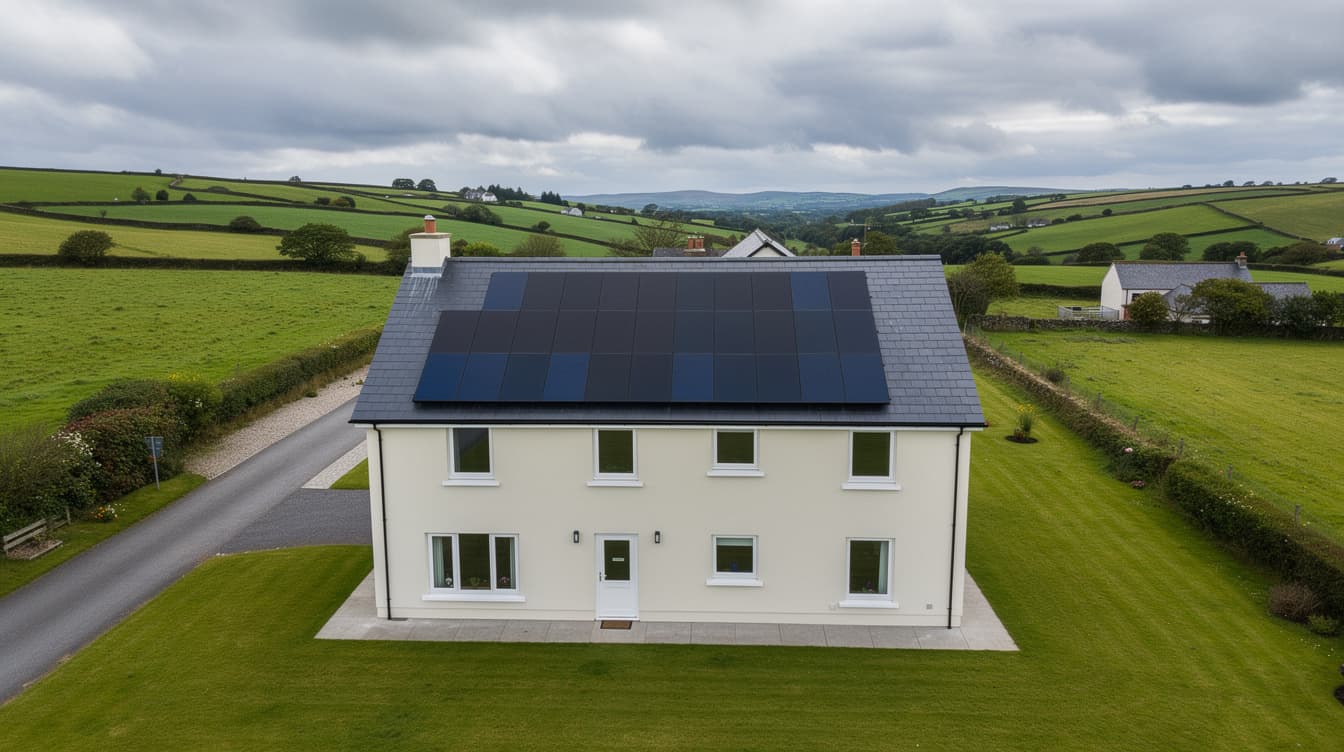
North-Facing Solar Panels Ireland 2026: Real Output, Payback & When It's Worth It
One of the most common reasons Irish homeowners are told they "can't get solar" is a north-facing roof. The installer takes one look at the orientation and writes them off. That advice was reasonable in 2018 when panels cost €800/kWp and the SEAI grant only covered south-facing systems. In 2026, with panel prices down 65%, a 0% VAT rate, the €1,800 SEAI grant and the 19c Clean Export Guarantee, the maths on a north-facing solar system in Ireland looks very different. This guide walks through the actual yield penalty, when north-facing still pays back, and the alternative angles worth considering first.
Quick Answer: North-Facing Solar Panels in Ireland
A north-facing solar PV system in Ireland generates roughly 60–70% of what the same system would produce facing south — about 600–700 kWh per kWp installed per year versus 900–1,000 kWh for south. With current panel prices (€1,400–€1,700 per kWp post-grant) and 19c CEG export rates, payback typically lands at 9–12 years versus 6–8 for south-facing. It's worth it if you have no other roof option, but a smaller east/west split is almost always a better engineering answer if any pitch faces those directions.
How Much Output Does a North-Facing Solar System Lose in Ireland?
Ireland's solar yield curve is shallower than southern Europe because so much of the annual irradiation arrives as diffuse light through cloud cover — about 55–65% of total irradiation, against 30–40% in Spain or southern France. Diffuse light arrives from every direction at roughly equal intensity, which is why north-facing panels in Ireland still produce meaningful output. In Andalusia a north-facing panel might generate 50% of south. In Cork or Galway it's closer to 65–70%.
The European Commission's PVGIS database, which is the reference dataset SEAI installers use to size systems, gives the following expected annual yields per kWp for a representative Irish midlands location (Athlone), at a 30° roof pitch:
| Roof Orientation | Annual Yield (kWh per kWp) | % of South-Facing | 4 kWp System Output |
|---|---|---|---|
| South (180°) | 935 kWh | 100% | 3,740 kWh |
| South-East / South-West | 910 kWh | 97% | 3,640 kWh |
| East / West (90°/270°) | 820 kWh | 88% | 3,280 kWh |
| North-East / North-West | 720 kWh | 77% | 2,880 kWh |
| North (0°) — 30° pitch | 640 kWh | 68% | 2,560 kWh |
| North (0°) — 45° pitch | 560 kWh | 60% | 2,240 kWh |
The single most important number above is that roof pitch matters more than orientation once you're on the north side. A flatter (15–25°) north-facing roof loses only about 25–30% relative to south. A steep (45°+) north-facing roof loses 40%+. If you have a low-pitch Irish bungalow facing north, your penalty is smaller than the headline figure suggests.
Does the SEAI Grant Apply to North-Facing Solar Panels?
Yes, fully. The €1,800 SEAI Solar Electricity Grant is paid per-kWp installed and is not adjusted for orientation, roof pitch, or expected yield. Provided your home was built and connected to the grid before 1 January 2021, you own and occupy it, and no previous SEAI Solar PV grant has been claimed at the MPRN, you qualify regardless of which way the panels point. The grant pays €700/kWp for the first 2 kWp plus €200/kWp for the next 2 kWp, capped at €1,800 for a 4 kWp system.
This is a meaningful subsidy on a north-facing install. On a 4 kWp system costing around €7,500 gross, the €1,800 grant brings the net cost to €5,700. At 0% VAT (in effect until 31 October 2026 under the Finance Act 2025) the price you pay matches what's on the quote.
The Economics: When Is North-Facing Worth It in 2026?
Let's run the same 4 kWp system three ways — south, east-west split, and pure north — on identical installed cost, identical export tariff (19c CEG), and identical self-consumption assumptions (35% of generation used in the home, 65% exported). All figures based on average Irish import electricity prices of 35c/kWh (Bord Gáis, Electric Ireland and Energia standard tariffs in early 2026).
| Scenario | Annual Output | Self-Use Savings | CEG Export Income | Annual Value | Payback (€5,700 net) |
|---|---|---|---|---|---|
| South-facing 4 kWp | 3,740 kWh | €458 | €462 | €920 | 6.2 years |
| East-West split 4 kWp | 3,280 kWh | €459 (higher self-use ratio) | €353 | €812 | 7.0 years |
| North 30° pitch 4 kWp | 2,560 kWh | €313 | €316 | €629 | 9.1 years |
| North 45° pitch 4 kWp | 2,240 kWh | €274 | €277 | €551 | 10.4 years |
The honest takeaway: north-facing solar in Ireland is profitable, but the payback is 50–70% longer than south-facing. Over a 25-year panel warranty, a north-facing 4 kWp still returns roughly €15,700 in self-use savings and CEG income against €5,700 capital cost — an internal rate of return of around 9% post-tax. That's better than most fixed-income investments available to Irish households, but the case is much weaker than south-facing where IRR is typically 14–17%.
When North-Facing Solar Makes Sense
Five situations where a north-facing install is genuinely the right answer:
- You have no other roof option. Detached urban homes with garages and outbuildings sometimes have only a north-facing main pitch. If the alternative is no solar at all, north-facing pays back.
- Daytime electricity load is high. Working-from-home households, EV charging during daylight hours, heat pumps and immersion diverters all push self-consumption ratios up. Higher self-use means the orientation penalty matters less because import savings at 35c far exceed CEG income at 19c.
- The north roof is a flat or low-pitch roof. A north-facing pitch under 20° loses only 20–25%. A flat north-facing roof (think modern Dublin apartment block roofs or commercial buildings) can be tilted with a frame to face south.
- You're combining with a battery. Batteries shift north-facing's lower midday peak into the evening, capturing more of the 35c import-displacement savings. The economics of a north + battery system are closer to a south-facing system without battery.
- Listed buildings or conservation areas with rear-facing rules. Some Irish planning conservation areas (notably parts of Dublin 2, Dublin 6 and several town centre ACAs) require panels to be invisible from the street, which forces them onto the rear pitch — sometimes north.
When You Should NOT Install North-Facing Solar
Three situations where the answer is to stop and look at alternatives first:
- You have any east or west pitch available. An east/west split system produces 25–35% more energy than pure north and has near-identical install cost. Always check rear and side roof aspects before defaulting to north.
- Steep north pitch (45°+) with no high-load daytime use. A steep north-facing 4 kWp without daytime self-consumption is around an 11–13 year payback. That's the worst-case Irish solar economics. Consider a smaller 2 kWp system to capture the €1,400 grant (€700 × 2 kWp) with lower capital exposure.
- Significant shading on the north roof. North roofs in Irish suburban estates often face trees, neighbouring two-storey homes or chimney stacks that shade what little sun reaches them. Shading on an already-handicapped orientation kills the economics. Get a Solar Pathfinder shading survey before committing.
Not Sure What Your Roof Will Yield?
Our calculator estimates output by roof orientation, pitch and Irish location.
The Three Alternatives to North-Facing Worth Considering First
1. East-West Split System
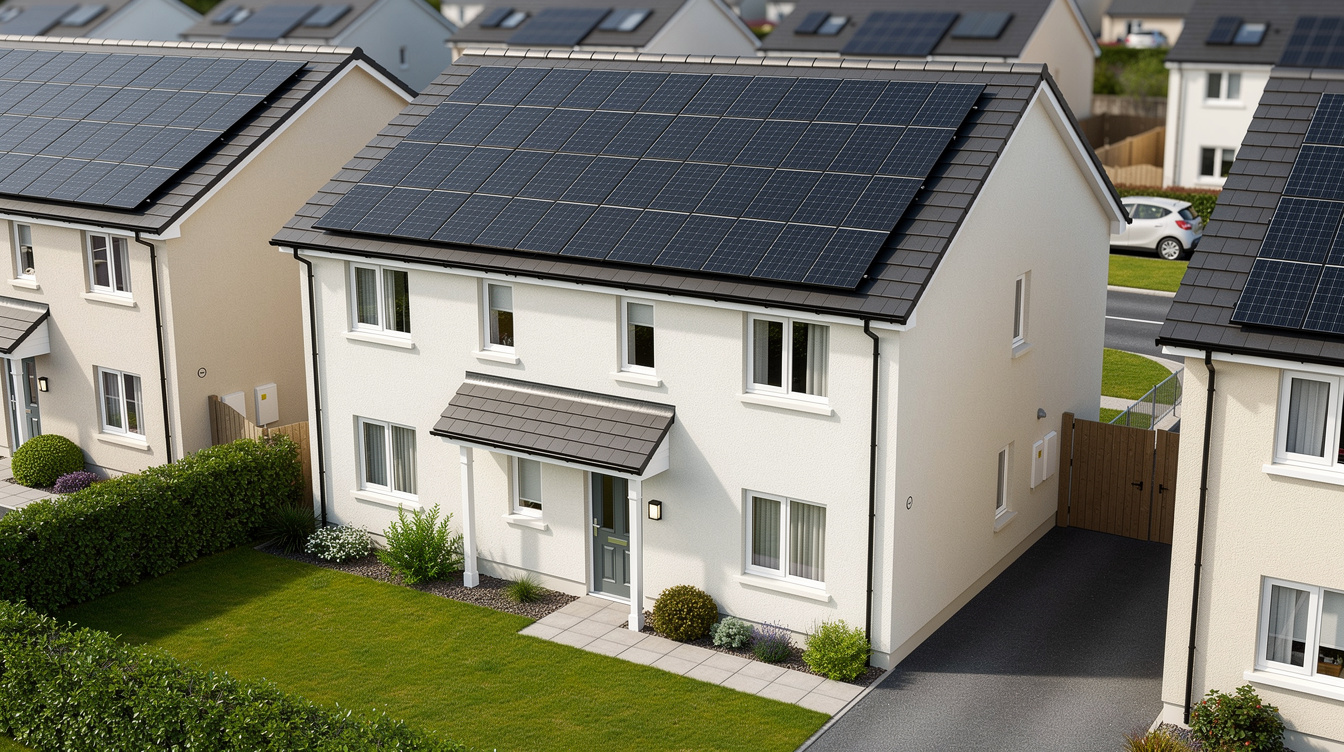
If your home has an east and west pitch (typical for most semi-detached and terraced Irish houses), split the array across both. East-west produces 88% of south-facing output annually with one significant operational advantage: it spreads generation across the day, producing morning power from east and afternoon power from west. The midday peak that south-facing systems generate is often wasted at 19c export when an east-west system would have shifted some of that energy to the morning shower or evening cooking peaks where you save 35c.
For households not at home midday, east-west often outperforms south on actual euros saved despite producing less total kWh. Ask your installer to model your specific load shape before assuming south is best.
2. Ground-Mount in the Garden
SI 92 of 2022 (the planning exemption for domestic solar) allows ground-mounted PV up to 25 sq m in a rear garden without planning permission, provided it's at least 4 m from the rear boundary and 10 m from the house. That's enough for a 4–5 kWp ground-mount array facing true south at the ideal Irish tilt of 30–35°. Installation cost is €500–€1,000 higher than rooftop due to the ground frame and longer cable runs, but you trade orientation and shading completely.
This is a credible alternative for homes with significant garden space and a north-only roof, particularly if the garden is south of the house. It's not always practical — many urban Irish gardens are small or have boundary trees — but it's worth asking your installer to quote it.
3. Garage or Outbuilding Roof
Detached garages, sheds and outbuildings on the south side of a property can carry a separate, smaller solar array even if the main house is north-facing. Provided the outbuilding is electrically connected back to the house MPRN (most are), the array generates to the household supply. Combined garage + main house cabling adds €500–€1,500 to the install but unlocks south-facing yield without needing to use the north roof at all.
Practical Considerations for North-Facing Installs
Inverter sizing on lower-yield orientations
Most SEAI-registered installers default to a 1:1 DC:AC ratio (5 kWp panels with a 5 kW inverter). On a north-facing system that's wasteful because the panels will rarely hit their nameplate output. A 1.2:1 or 1.3:1 ratio (5 kWp panels paired with a 4 kW inverter) reduces inverter cost by €200–€400 with no meaningful generation loss on a north-facing array. Ask your installer specifically about this if the orientation penalty applies.
Microinverters or DC optimisers
North-facing roofs often have higher per-panel performance variation (a tree shadowing one corner, partial chimney shading) than south-facing roofs. Microinverters (Enphase) or DC optimisers (SolarEdge) handle this by treating each panel independently. The premium over a string inverter is around €500–€1,000 on a 4 kWp system but the yield uplift on a shaded north install can be 5–15%, paying back the upgrade within 4–6 years.
Panel choice matters more on low-yield roofs
On a south-facing roof in Ireland the difference between a 410 W and 450 W panel is marginal because both saturate well below their peak rating. On north-facing, every additional watt of nameplate counts because the limiting factor is irradiance, not inverter clipping. Specify higher-Wp panels (440–460 W range) for north installs. The cost premium is typically €200–€400 on a 4 kWp system, well worth it.
What Quotes for North-Facing Should Look Like
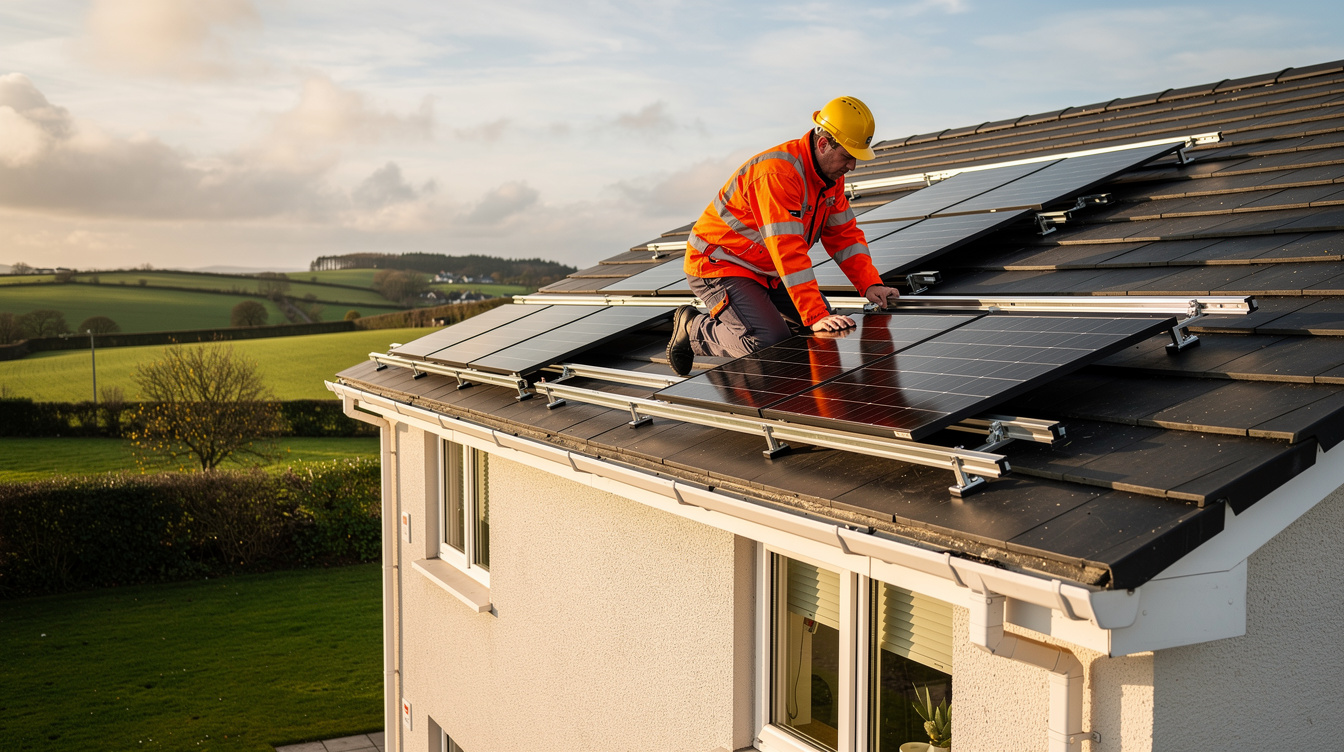
A credible installer quoting a north-facing system will include all of the following in writing:
- PVGIS-modelled annual yield specific to your address. Reject any quote that uses a generic "Ireland average" of 850–900 kWh/kWp without site-specific modelling. Reputable installers run PVGIS for your exact coordinates, orientation and pitch.
- Year-1 and 25-year yield projections. The 25-year figure should apply 0.5%/year degradation, equivalent to roughly 88% of year-1 output by year 25.
- Self-consumption assumption (state the percentage). Honest installers will ask about your typical usage pattern before assuming a self-use ratio. A north-facing quote claiming 50%+ self-use without question is overly optimistic.
- Pessimistic and optimistic payback scenarios. Good quotes show both: a base case at 35c import and 19c export, and a downside case at 30c import and 9c minimum CEG (the regulated floor).
- Shading analysis if any obstruction is present. Solar Pathfinder or Solmetric Suneye photo with shading percentages for each panel position by season.
FAQ: North-Facing Solar Panels in Ireland
Can solar panels work facing north in Ireland?
Yes. North-facing solar panels in Ireland produce roughly 60–70% of what the same panels would produce facing south, thanks to Ireland's high diffuse light component. They still pay back over 9–12 years with current grants and CEG export rates.
How much output do north-facing solar panels lose in Ireland?
About 30–40% versus south-facing, depending on roof pitch. A 30° north-facing roof loses around 32%. A 45° north-facing roof loses around 40%. A flat or low-pitch (15°) north-facing roof loses only 22–25%.
Do I still qualify for the SEAI grant on a north-facing solar system?
Yes. The €1,800 SEAI Solar Electricity Grant is paid per-kWp installed regardless of roof orientation. There is no minimum yield requirement and no orientation rule in the grant criteria.
Should I install fewer panels on a north-facing roof to save money?
Generally yes if you don't have high daytime electricity use. A 2 kWp north-facing system captures the €1,400 grant (€700 × 2 kWp) and exposes you to far lower capital. Many installers will scale a north install down if asked.
Will a battery improve north-facing economics?
Yes, significantly. A 5 kWh battery typically lifts self-consumption from 35% to 65–75% on a north-facing array, shifting more energy to 35c import-displacement savings rather than 19c export income. Payback on the battery itself is 7–9 years in this configuration.
Is east-west a better option than north?
Almost always yes. East-west produces 88% of south versus 60–70% for north, at the same install cost. If you have any east or west roof option, take it. Pure north is the last resort.
Can I tilt north-facing panels to face south on a frame?
On a sloped tile/slate roof, no — SI 92 planning exemption requires panels to be mounted parallel to the roof plane. On a flat north-facing roof (commercial or modern Irish apartment buildings) you can use a south-tilted frame at 30–35°, and this is common practice.
Does panel choice matter more for north-facing installs?
Yes. North-facing yield is constrained by irradiance, not inverter capacity, so higher-wattage panels (440–460 W) generate more usable energy than they would on a saturated south-facing roof. The 4–7% panel cost premium is worth it.
Bottom Line: North-Facing Solar Pays Back, But Get Three Quotes
North-facing solar panels in Ireland are a viable installation in 2026 thanks to the combination of the €1,800 SEAI grant, 0% VAT to October 2026, the 19c Clean Export Guarantee, and the inherent forgiveness of Ireland's diffuse-light climate. Payback lands at 9–12 years versus 6–8 for south-facing — longer, but still a 9% internal rate of return over 25 years.
That said, almost every Irish home has a better orientation available somewhere on the property. Before committing to north-facing, get your installer to quote east-west split, ground-mount and outbuilding alternatives. The cost difference is rarely more than €1,000 and the yield improvement is typically 25–35%.
The cleanest way to compare options is to get three SEAI-registered installers to quote your home, with each asked to propose their preferred orientation strategy. Differences in approach often reveal which installer has actually inspected the roof versus which has run a desk-bound estimate.
Related Articles
Solar Panels on Slate Roofs Ireland 2026: Real Costs, Fixings, Broken Slates & Which Roofs Say No
Solar on slate in Ireland 2026: real €6,560 net 4kW quote, under-slate hook vs hanger bolts, broken slate rules and which roofs get a no.
Cheapest Solar Panels Ireland 2026: Where to Save Without Ruining Your Payback
Cheapest legitimate solar routes in Ireland 2026: budget SEAI installs, DIY vs grant maths, Lidl plug-ins & where the price actually comes from.
Solar Panel Cost Per kWp Ireland 2026: Real Prices, Grant Effect & Curve by Size
Per-kWp solar pricing in Ireland 2026: €1,650-€2,000 pre-grant, €1,200-€1,550 net. Curve by system size, SEAI grant cliff at 4 kWp, levelised cost 6-8 c/kWh.