
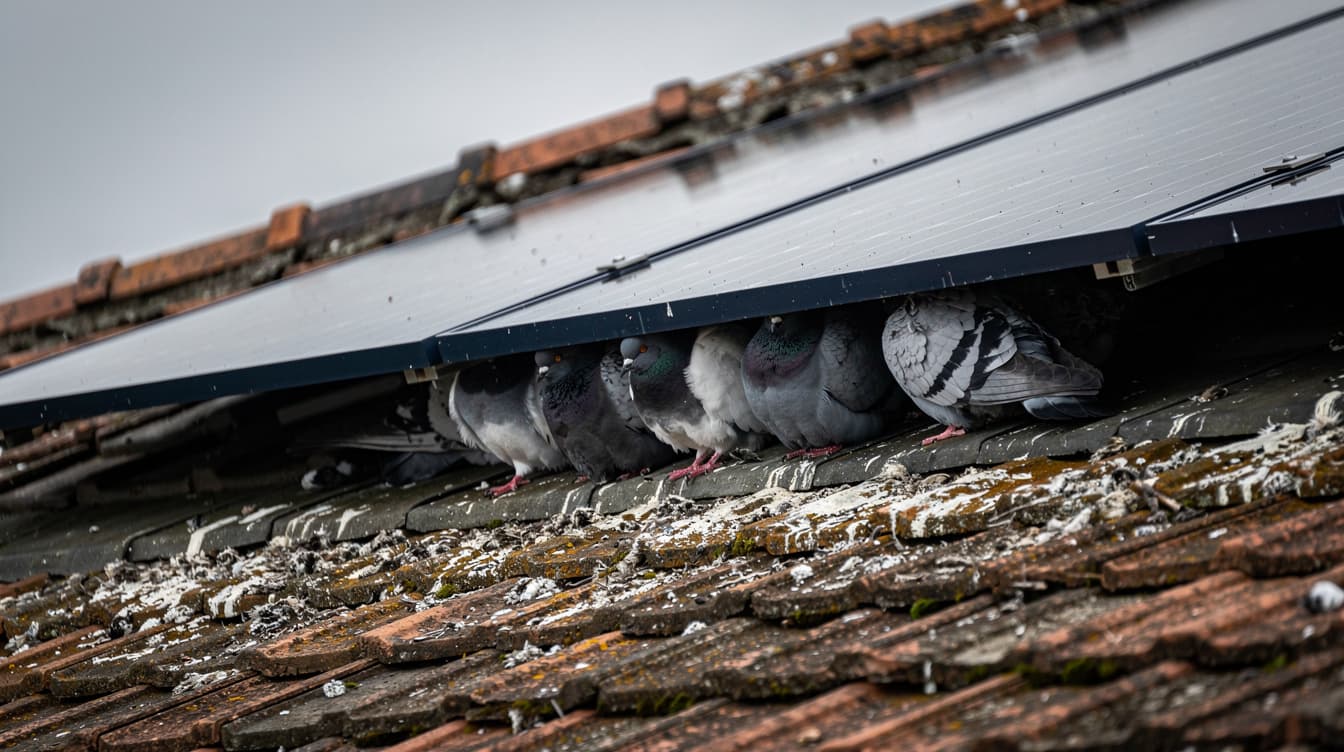
Solar Panel Bird Proofing Ireland: How to Stop Pigeons Nesting Under Your Panels
Pigeons nesting under your solar panels? You’re not alone. It’s one of the most common complaints from solar panel owners in Ireland — and it’s more than just a nuisance. Bird droppings reduce panel efficiency by up to 30%, nesting material creates fire risks, and the mess can damage your roof tiles. The good news: bird proofing your solar panels costs €300–€800 for a typical Irish home and solves the problem permanently. Here’s how it works, what it costs, and whether you should DIY or hire a professional.
Solar panels create the perfect sheltered spot for pigeons, starlings, and seagulls. The gap between the panel and your roof is warm, dry, and protected from wind and predators. Once birds discover it, they move in fast — and they don’t leave voluntarily. A single pair of pigeons can produce up to 12 chicks per year, and within months you can have a full colony living under your panels.
This guide covers the practical solutions available in Ireland, what they cost, and how to choose the right option for your installation.
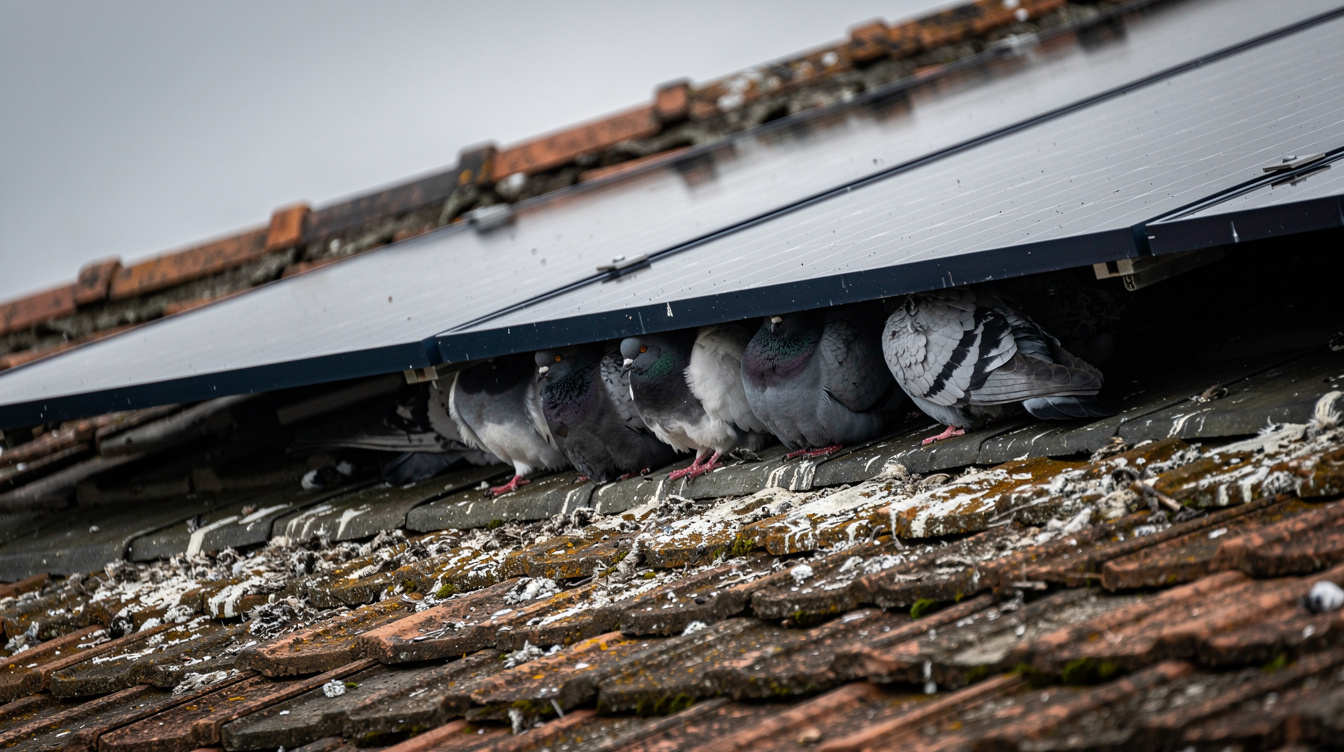
Why Birds Under Solar Panels Are a Serious Problem
It might seem harmless at first — a few pigeons roosting on your roof. But the consequences build up quickly:
- Reduced panel efficiency — Bird droppings on panel surfaces block sunlight. Even partial shading from droppings can reduce a panel’s output by 20–30%. On a typical 10-panel system, that’s €150–€300 in lost energy per year.
- Roof damage — Acidic bird droppings corrode roof tiles, flashing, and gutters. Nesting material traps moisture against your roof surface, accelerating decay.
- Fire risk — Nesting material (twigs, feathers, dried droppings) packed against electrical wiring and panel components is a genuine fire hazard. Several incidents have been reported in the UK and Ireland.
- Gutter blockage — Nesting debris washes into gutters during rain, causing blockages and overflow that can lead to damp problems.
- Noise — Cooing, scratching, and chick-feeding sounds at dawn are not what you signed up for when you went solar.
- Health risks — Pigeon droppings carry diseases including psittacosis, salmonella, and histoplasmosis. Dried droppings become airborne dust that can enter your home through vents.
- Panel warranty issues — Some manufacturers may question warranty claims if bird damage has been left unaddressed.
The 4 Main Bird Proofing Methods
There are several approaches to keeping birds out from under solar panels. Here’s how they compare:
| Method | Cost (Typical Irish Home) | Effectiveness | Lifespan | DIY Friendly? |
|---|---|---|---|---|
| Wire mesh/bird guard | €300–€800 | Excellent | 20+ years | Moderate |
| Plastic clip-on skirts | €200–€500 | Good | 10–15 years | Yes |
| Bird spikes | €150–€400 | Fair (edges only) | 10+ years | Yes |
| Deterrent devices (ultrasonic/visual) | €30–€100 | Poor | 1–3 years | Yes |
1. Wire Mesh Bird Guard (Recommended)
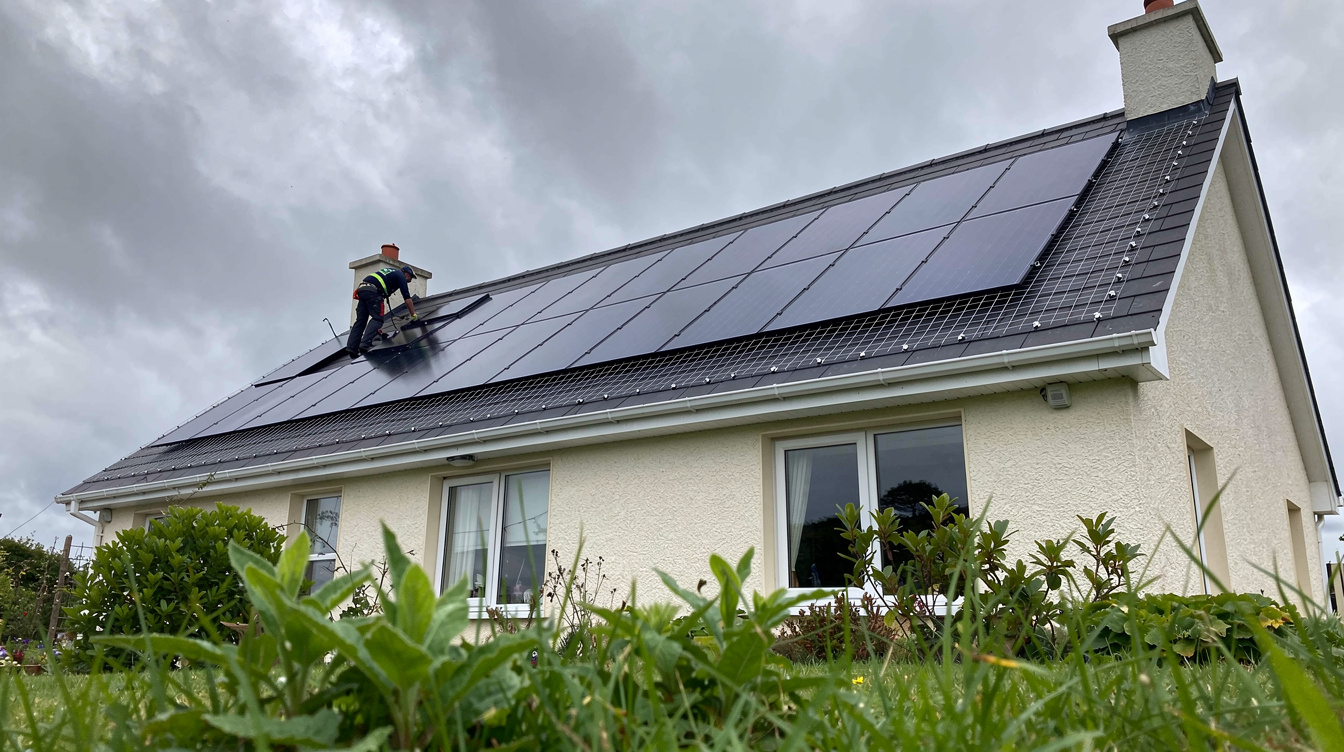
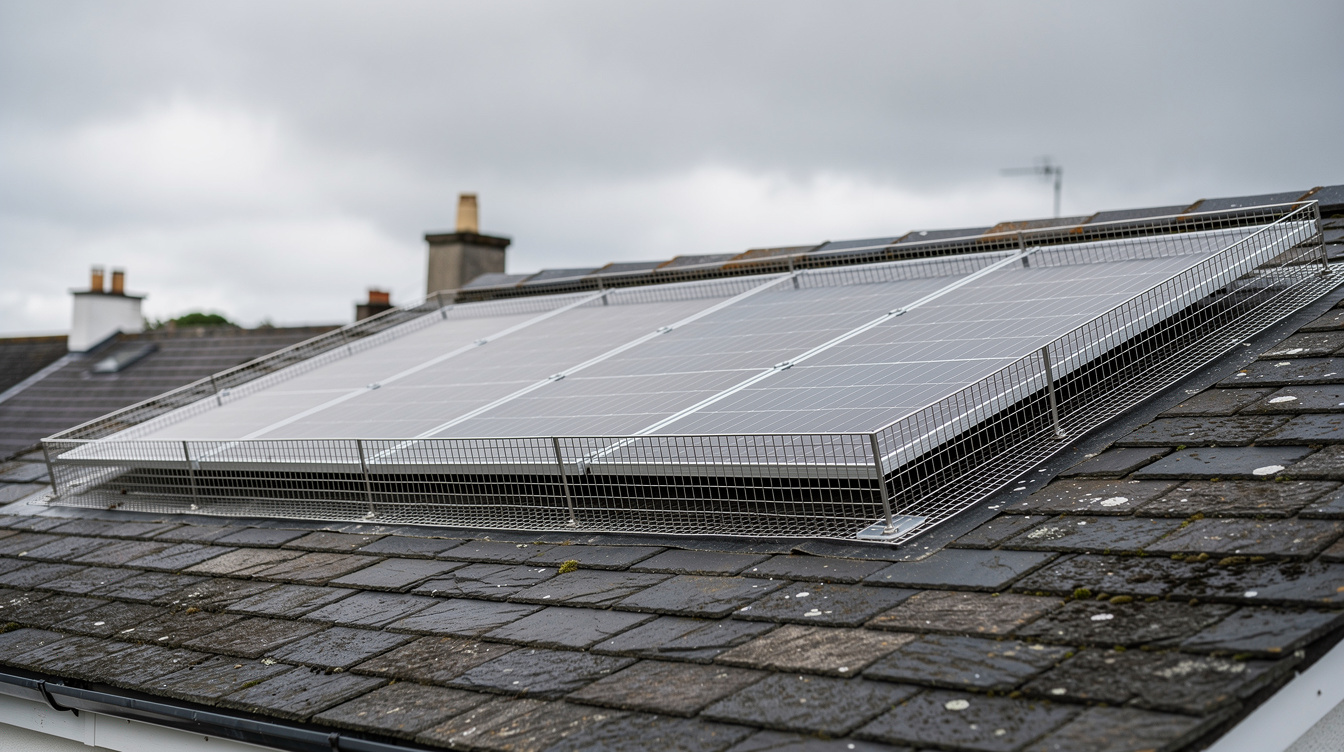
This is the gold standard and by far the most popular solution in Ireland. A galvanised or stainless steel wire mesh is fitted around the entire perimeter of your solar panel array, closing off the gap between the panels and the roof. The mesh clips onto the panel frames without drilling into panels or roof tiles.
Pros:
- Completely blocks access — no gaps for birds to squeeze through
- Doesn’t affect panel ventilation (the mesh allows airflow)
- No drilling into panels or roof required (clips attach to panel frames)
- Stainless steel versions last 25+ years — the lifetime of your panels
- Virtually invisible from ground level
Cons:
- Needs professional installation for safety (working at height)
- Must remove existing nests before fitting
2. Plastic Clip-On Panel Skirts
Plastic skirts (sometimes called “SolarSkirt” or similar branded products) clip onto the bottom edge of panels to close the gap. They’re cheaper than full mesh but only protect the lower edge — birds can still access from sides or top on some installations.
Best for: Panels mounted flush with minimal side gaps, where birds primarily enter from the bottom edge.
3. Bird Spikes
Stainless steel or plastic spikes attached to panel edges prevent birds from landing and walking under panels. They’re effective at stopping perching but don’t fully seal the gap — determined pigeons can still squeeze past spikes.
Best for: Supplementary protection on exposed edges, or for seagull deterrence (seagulls are too large to fit under panels but land on top).
4. Ultrasonic and Visual Deterrents
Plastic owls, reflective tape, ultrasonic devices — these are widely sold online but generally don’t work for established pigeon problems. Pigeons are intelligent urban birds and quickly learn to ignore fake predators and noise makers. Save your money.
Need Bird Proofing for Your Solar Panels?
Get quotes from installers who offer bird proofing as part of their solar maintenance services.
What Does Bird Proofing Cost in Ireland?
The cost depends on your system size, roof height, and accessibility. Here’s what to expect in 2026:
| System Size | Wire Mesh (Professional) | DIY Mesh Kit | Includes Nest Removal? |
|---|---|---|---|
| 6–8 panels | €300–€450 | €80–€150 | Usually yes |
| 10–14 panels | €400–€650 | €120–€200 | Usually yes |
| 16–20 panels | €550–€800 | €180–€280 | Usually yes |
| Scaffolding surcharge | €200–€400 extra | N/A | — |
Pro tip: If you’re getting solar panels installed for the first time, ask your installer about adding bird proofing during installation. It’s significantly cheaper to do it while they’re already on the roof with scaffolding — often just €150–€250 as an add-on, compared to €400–€800 as a standalone job later.
DIY vs. Professional Installation
You can buy solar panel bird mesh kits online from Irish suppliers for €80–€280 depending on system size. The kits typically include PVC-coated galvanised mesh, aluminium or plastic clips, and a cutting tool.
When DIY makes sense:
- Single-storey bungalow with easy roof access
- You’re comfortable working at height with a ladder
- No existing bird nests to remove
- Panels are easily accessible from the edges
When to hire a professional:
- Two-storey or higher — working at height is dangerous and may require scaffolding
- Active bird nests present (removing nests during breeding season requires care — see legal section below)
- Complex roof geometry with multiple panel arrays
- You want a guarantee on the work
Safety first: Falls from height are the leading cause of workplace fatalities in Ireland. If you have any doubt about safely accessing your roof, hire a professional. The €200–€500 difference is not worth a life-changing injury.
Legal Considerations in Ireland
All wild birds, their nests, and their eggs are protected under the Wildlife Act 1976 (as amended) in the Republic of Ireland. This means:
- You cannot remove an active nest (one with eggs or chicks) at any time of year without a licence from the National Parks and Wildlife Service (NPWS).
- Pigeons are an exception — feral pigeons (as distinct from wood pigeons) are listed under the Wildlife Act as species that can be controlled without a licence. However, it’s still best practice to avoid disturbing active nests with chicks.
- Seagulls are fully protected — herring gulls, lesser black-backed gulls, and other gull species are protected. You cannot remove their nests without an NPWS derogation licence.
The safest approach: install bird proofing between October and February, outside the main nesting season. If you find active nests during installation, a professional pest controller will know how to proceed legally.
When Should You Bird Proof?
The ideal timing depends on your situation:
| Scenario | Best Time | Why |
|---|---|---|
| During initial solar installation | At the same time | Cheapest option; scaffolding already in place |
| You notice birds investigating | Immediately | Prevent before they nest — much easier than removing later |
| Existing bird problem | October–February | Outside nesting season; legal compliance |
| Seagull problem (coastal areas) | September–January | Well outside gull breeding season (April–August) |
Getting Solar Panels Installed?
Ask your installer about bird proofing as an add-on — it’s much cheaper during initial installation.
How to Find a Bird Proofing Installer in Ireland
Several types of companies offer solar panel bird proofing in Ireland:
- Solar installation companies — Many solar installers now offer bird proofing as an add-on service, both during installation and as a retrofit. This is often the best option because they understand panel systems and mounting hardware.
- Pest control companies — Companies like Rentokil, Owl Pest Control (Dublin), and local pest controllers offer bird proofing services. They’re particularly useful if you need nest removal first.
- Solar maintenance specialists — Companies that specialise in solar panel cleaning often also offer bird proofing.
Always check:
- They have public liability insurance for working at height
- They use stainless steel or galvanised mesh (not cheap plastic that degrades in UV)
- They provide a guarantee (10 years minimum for mesh installations)
- They will remove existing nests as part of the job
Will Bird Proofing Affect My Solar Panels?
A properly installed bird guard has no negative effect on your solar panels:
- No shading — The mesh sits below the panel surface and doesn’t cast shadows on the cells
- No ventilation reduction — Wire mesh allows full airflow underneath panels (important for cooling and efficiency)
- No warranty issues — Clip-on mesh systems don’t drill into panels or modify them in any way. Your panel warranty remains intact.
- No roof damage — Quality installations use clips that attach to panel frames, not roof tiles or slates
In fact, bird proofing improves panel performance by preventing the efficiency losses caused by bird droppings. A panel covered in pigeon droppings can lose 20–30% of its output. Keeping birds away keeps your panels clean and generating at full capacity.
Seagulls vs. Pigeons: Different Problems, Different Solutions
If you live in a coastal area (Dublin Bay, Galway, Cork, Wexford), seagulls may be your main concern rather than pigeons. The approach differs:
- Pigeons nest under panels. Wire mesh around the perimeter is the solution.
- Seagulls are too large to fit under panels. They nest on top of or beside panels. Bird spikes on panel edges and along ridge tiles are more effective.
- Seagulls are fully protected under Irish wildlife law — you need an NPWS derogation to interfere with their nests. Pigeons have more relaxed rules.
- Seagull droppings are larger and more corrosive than pigeon droppings. Regular panel cleaning is essential in coastal areas regardless of bird proofing.
Frequently Asked Questions
Does bird proofing void my solar panel warranty?
No, provided the mesh is installed using clip-on systems that don’t drill into panels or modify them. All major panel manufacturers accept clip-on bird guards.
How long does bird mesh last?
Stainless steel mesh: 25+ years (matches panel lifespan). Galvanised mesh: 15–20 years. PVC-coated galvanised: 20+ years. Always choose stainless steel if budget allows.
Can I remove pigeon nests myself?
Feral pigeons are not as strictly protected as other wild birds in Ireland, so you can remove their nests. However, it’s best done outside breeding season (March–September) and with proper protective equipment (mask, gloves) due to health risks from dried droppings.
My installer didn’t offer bird proofing. Is that normal?
Unfortunately, yes. Many solar installers in Ireland don’t proactively offer bird proofing. It’s worth asking about it before installation — adding it during initial installation is much cheaper than retrofitting later.
Is there a grant for bird proofing?
No. The SEAI solar grant covers panel installation but not bird proofing accessories. However, some installers bundle bird proofing into their quoted price, effectively getting it partially covered. Ask when getting quotes.
Ready to Protect Your Solar Investment?
Get quotes from solar professionals who can bird proof your panels and keep them performing at peak efficiency.
The Bottom Line
Bird proofing is one of the best-value investments you can make to protect your solar panels. At €300–€800 for professional installation (or €80–€280 DIY), it prevents thousands of euros in lost efficiency, roof damage, and cleaning costs over the lifetime of your system. If you’re getting panels installed for the first time, add bird proofing during installation — it costs a fraction of what it would as a retrofit. If you already have a bird problem, act before the next nesting season to avoid legal complications and escalating damage.
Your solar panels are a 25-year investment. A one-time bird proofing job protects that investment for the same duration.
Related Articles
Solar Panel Costs Ireland 2026: Complete Price Breakdown by System Size
Solar panel costs in Ireland 2026: €3,100–€11,700 after SEAI grants. Full breakdown, brand comparison & ROI calculator. Get an accurate quote today.
SEAI Solar Panel Grant 2026: How to Apply, Eligibility & Step-by-Step Guide
Get up to €1,800 with the SEAI solar panel grant in 2026. Landlords now eligible. See eligibility rules, application steps & mistakes to avoid.
Best Solar Batteries Ireland 2026: GivEnergy vs Tesla Powerwall vs Huawei Compared
Compare top solar batteries in Ireland for 2026: GivEnergy, Huawei LUNA2000 & Tesla Powerwall 3. Full specs, pricing & ROI. Find the best value today.