
Solar Panels Clare 2026 — Costs, Grants and the Best Installers
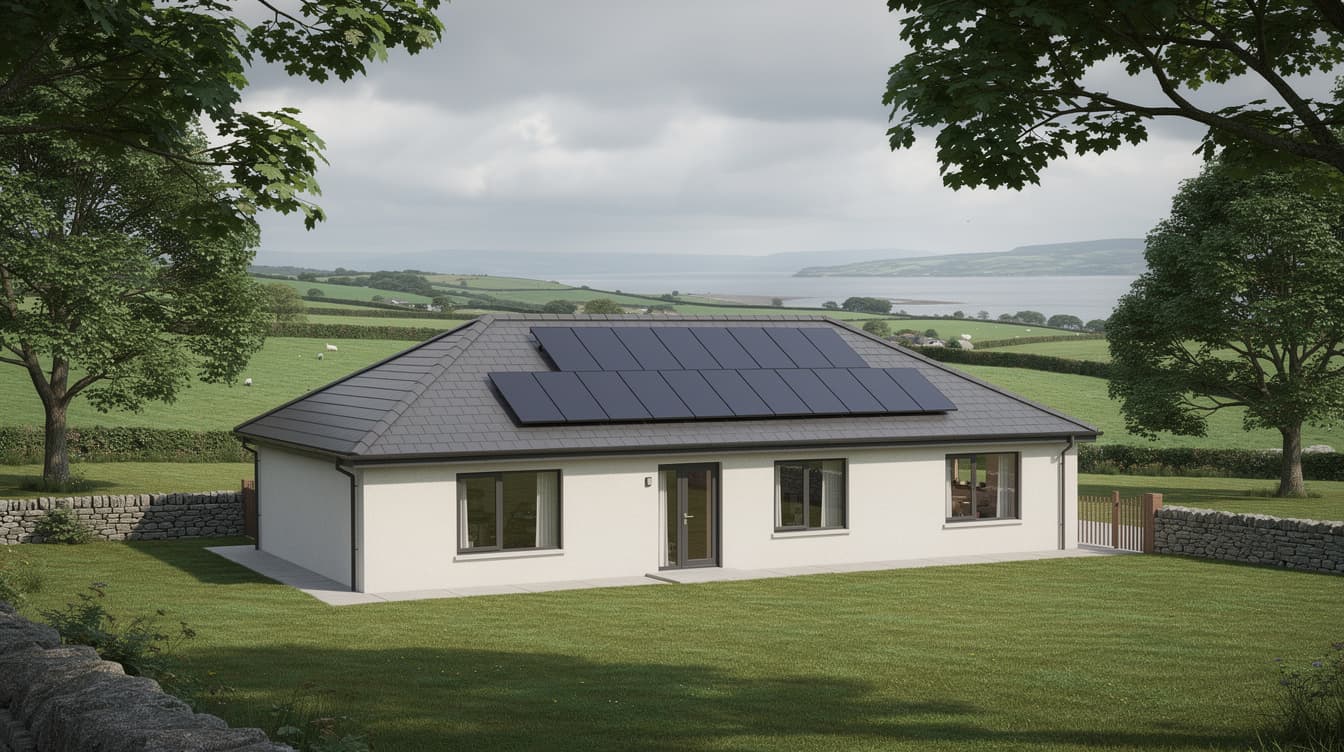
Clare is the West of Ireland solar story that nobody talks about. The headline assumption — that the Wild Atlantic Way is too cloudy and too windy for solar to make sense — is wrong. Yields in east Clare around Killaloe and Scariff are within 3% of Dublin. Even on the Atlantic edge at Lahinch and Doolin, you get 920–945 kWh per kWp annually, which still pays back inside 8 years on a domestic install. And Clare has something most counties don’t: a high concentration of bungalow stock with simple roof geometry that brings install costs down by 4–6%.
The other thing that makes Clare interesting in 2026: the Shannon estuary commuter belt. Households running from Ennis, Newmarket-on-Fergus, Sixmilebridge and Shannon town into Limerick city or out to Shannon Industrial Estate are heavy car-fuel spenders, and the EV-plus-solar economics in Clare are among the strongest in the country thanks to the average drive distance.
The catches: the Burren limestone region around Ballyvaughan, Carron and Fanore has planning constraints that don’t apply elsewhere, and a chunk of west Clare sits inside the Atlantic-exposed coastal zone where wind-loading specifications add to install cost. This guide covers all of it, in 2026 numbers.
Get a Clare Solar Quote
Three free quotes from SEAI-registered installers covering Ennis, Shannon, Killaloe and the Atlantic west.
Quick answer: Clare solar costs and payback in 2026
A typical 4 kWp domestic install in Clare costs €8,400–€9,800 gross, or €6,600–€8,000 net of the €1,800 SEAI Solar PV Grant. Yields range from 945–970 kWh per kWp in east Clare around Killaloe to 920–945 on the Atlantic coast. A 4 kWp array generates 3,680–3,880 kWh per year. Combined import savings and CEG export income come in at €870–€990 a year on a no-battery domestic install. Net payback: 7.0–8.5 years.
EV households fare even better. With Ennis-to-Limerick and Shannon-to-Limerick commute distances averaging 35–55 km return daily, a 5 kWp array paired with a smart EV charger like myenergi zappi delivers 11,000–14,000 free EV miles per year, displacing €1,100–€1,500 in fuel cost on top of the import-savings benefit. Combined payback on the system drops to 6–7 years for a Shannon estuary commuter household.
Farms: a 15 kWp TAMS 3-funded install on a Clare dairy or suckler holding costs the farmer €9,400–€11,600 net of the 60% grant. With 13,800–14,500 kWh of annual generation, payback runs 2.5–3.2 years.
Yields by Clare area: east vs Atlantic
Clare has the widest internal yield variation of any Munster county. The Lough Derg shore in the east benefits from a mild, dry rain-shadow microclimate. The Atlantic edge from Doolin to Loop Head sees more cloud and more humidity. The Burren limestone plateau is somewhere in between — high direct sunshine hours but more low cloud days.
| Clare area | Typical yield (kWh/kWp/yr) | Notes |
|---|---|---|
| Killaloe, Scariff, Mountshannon | 955–970 | East Clare, Lough Derg rain shadow — best in county |
| Ennis, Newmarket-on-Fergus, Sixmilebridge | 940–965 | Central Clare, Shannon estuary commute belt |
| Shannon town, Bunratty | 945–965 | Low-lying estuary, broadly average |
| Ballyvaughan, Lisdoonvarna, Burren | 935–955 | Burren limestone — good sunshine hours, cloudier than east |
| Lahinch, Liscannor, Doolin | 925–945 | North-west coast, more sea cloud |
| Kilrush, Kilkee, Loop Head | 920–945 | South-west Atlantic, fully Atlantic-exposed |
The headline: east Clare (Killaloe area) yields are essentially Dublin-equivalent. West Clare yields are 3–5% lower but still well inside the band where solar pays back inside 8 years. Don’t let coastal-cloud myths stop you — even Lahinch yields beat the EU-average for solar PV.
Cost by system size in Clare (2026)
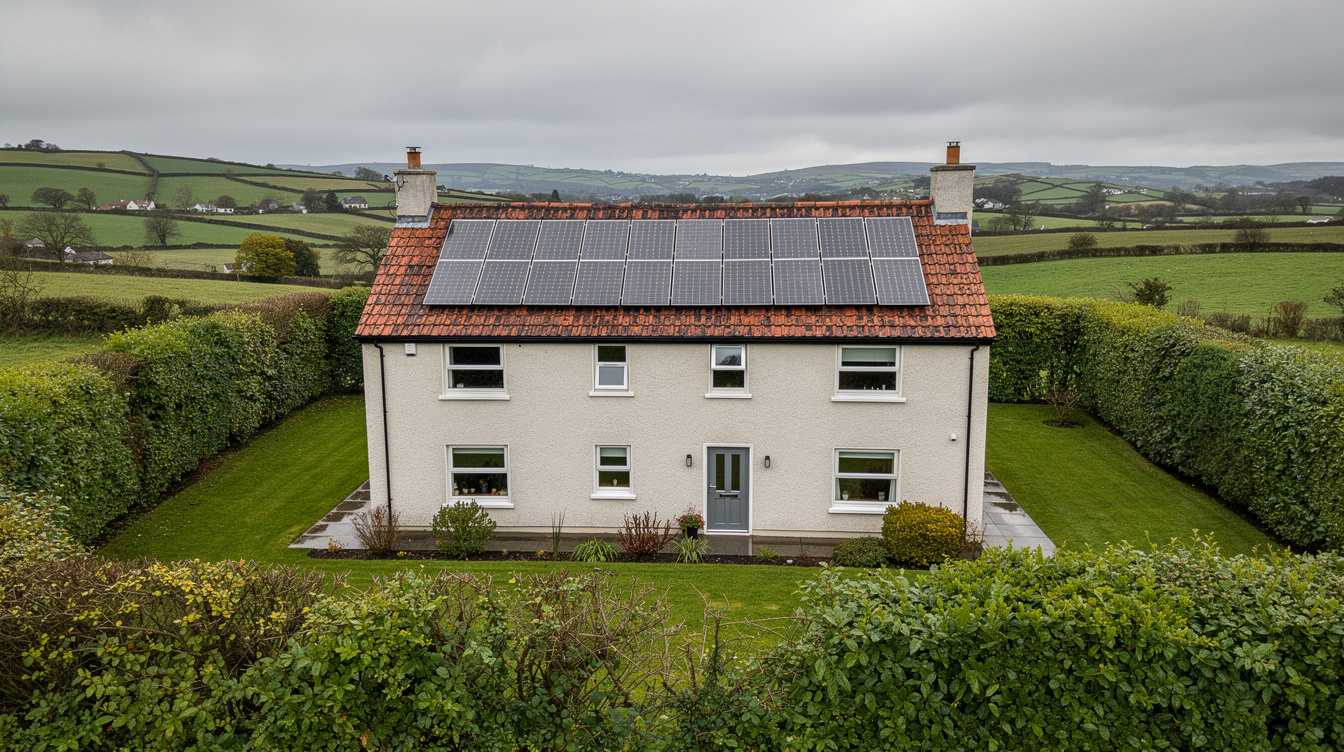
Clare install pricing sits a touch above Limerick city and well below Dublin commuter belt — roughly 3–5% under the national average. The big driver is the bungalow-heavy housing stock (single-storey scaffold is fast and cheap) and the established west-of-Ireland installer base based in Limerick and Galway servicing the county.
| System size | Panels | Gross price | After €1,800 grant | Best fit |
|---|---|---|---|---|
| 3 kWp | 7–8 | €7,100–€8,300 | €5,300–€6,500 | 2–3 bed bungalow, holiday cottage |
| 4 kWp | 9–10 | €8,400–€9,800 | €6,600–€8,000 | 3 bed semi, 4 bed bungalow — Clare average |
| 5 kWp | 11–12 | €9,500–€11,000 | €7,700–€9,200 | 4 bed detached, EV commuter household |
| 6 kWp | 13–14 | €11,000–€12,600 | €9,200–€10,800 | Large detached, EV + heat pump |
| 15 kWp (farm) | 33–36 | €23,500–€29,000 | €9,400–€11,600 (after 60% TAMS 3) | Dairy parlour, suckler holding, mixed |
Batteries: €3,500–€4,200 for a 5 kWh AC-coupled battery. Tesla Powerwall 3 (13.5 kWh) sits at €7,700–€9,100 in Clare. EV charger integration adds €850–€1,200.
Coastal install premium: if you live within roughly 2 km of the open Atlantic between Doolin and Loop Head, expect a 4–7% wind-loading premium on the install. This covers higher-spec fixings, additional rail bracing and (in some cases) marine-grade hardware. It’s worth it: skipping the spec is the single most common reason for premature mount failure in west Clare.
The Burren and Clare planning realities
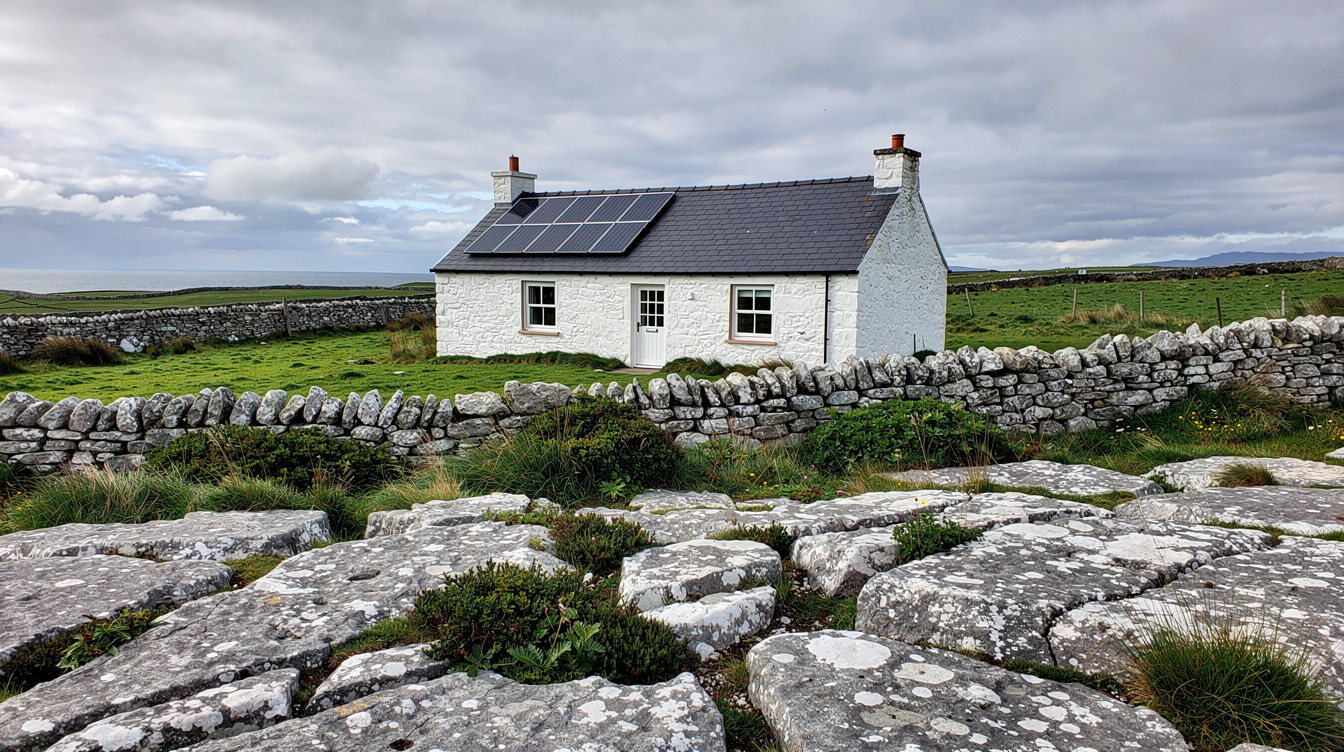
Clare has more planning sensitivity than most Munster counties because of the Burren limestone region. Roughly 250 sq km of the Burren is designated under three overlapping protections: the Burren and Cliffs of Moher UNESCO Global Geopark, the Burren Special Area of Conservation, and parts of the Burren National Park itself. Add the Cliffs of Moher Coastal Special Protection Area and you have a sizeable north-west chunk of the county where domestic rooftop solar is allowed but visually constrained.
Outside the Burren, planning is straightforward. The standard Planning and Development (Solar Panels) Regulations 2022 apply: no cap on roof area, no setback, no notification for domestic rooftop solar in Ennis, Shannon, Killaloe, Sixmilebridge, Kilrush and the rest of the county. The Burren-specific notes:
- Burren National Park core (Mullaghmore, Knockanes): The park itself is uninhabited but Section 5 declarations are encouraged for any visible rooftop install within 1 km of the park boundary.
- Architectural Conservation Areas: Ennis town centre, Kilrush market square, Lisdoonvarna, Doolin village core. Matt-black panels are strongly preferred. Inverter ideally hidden from the street.
- Protected structures (~510 in Clare): Section 5 declaration needed. Around €165 fee, 6–10 weeks turnaround. The Burren has unusually high protected-structure density — 18th and 19th century farmhouses and cottages with original stone roofs.
- Cliffs of Moher SPA buffer: Properties within the SPA visual buffer (roughly 3 km from the cliffs) need a Section 5. Most are holiday cottages.
- Ground-mount on farms over 50 sq m: Needs full planning. The Burren karst landscape adds an ecological assessment requirement on top.
Practical take: if you’re in Ennis, Shannon, Sixmilebridge, Killaloe, Scariff, Newmarket-on-Fergus or Kilrush, planning is essentially a non-issue. If you’re in Ballyvaughan, Carron, Fanore, Doolin, Lisdoonvarna or anywhere within 5 km of the Cliffs of Moher, expect a Section 5 step and a slightly longer overall timeline.
The Shannon estuary commuter case
The dense band of housing from Ennis through Newmarket-on-Fergus, Sixmilebridge, Cratloe and Shannon town — the Shannon estuary commuter belt — is the single best EV-plus-solar opportunity in Munster. Roughly 38,000 working-age households sit within 25 km of Limerick city centre or Shannon Industrial Estate, with an average daily commute distance (return) of 42 km.
The maths for a Shannon commuter household:
- EV electricity demand for daily commute: 42 km × 250 working days × 0.17 kWh/km = ~1,790 kWh/year
- Smart-charging from solar (zappi): 60–75% of EV demand can be captured directly from solar in summer, dropping to 25–35% in winter. Annual average: ~45%.
- EV electricity from solar: ~800 kWh/year free
- Equivalent diesel/petrol displaced: ~4,700 km at €0.11/km = €520 saved on fuel cost (on top of import savings on the rest of the solar generation)
For two-EV households (increasingly common around Ennis), this doubles. A 6 kWp system with two zappis can deliver €1,000–€1,300 in pure EV-fuel displacement on top of the standard solar savings — pulling combined payback under 7 years.
TAMS 3 and the Clare farm case
Clare has roughly 6,400 working farms — one of the larger farm bases in Munster. The split: roughly 35% suckler beef, 25% dairy, 25% sheep, 10% mixed and 5% tillage and equine. The TAMS 3 Solar Capital Investment Scheme covers 60% of the cost of a registered farm solar install with a €90,000 ceiling.
Why Clare farms do well on TAMS 3:
- Dairy farms in east Clare have parlour and bulk-tank cooling loads that pair well with solar between 9am and 5pm.
- Suckler and sheep operations on west Clare uplands have less daytime load — but combined with the Microgeneration Support Scheme export rate of 18–22c/kWh, even modest self-consumption produces fast payback.
- Equine yards near Tipperary border have water-heating, lighting and lunging-ring loads that match daytime solar generation well.
- Coastal exposure premium applies to farms within 2 km of the Atlantic. Most install on inland-facing barn roofs to avoid the spec uplift.
A representative 15 kWp east Clare dairy install:
- Gross install: €24,000
- TAMS 3 60% grant: €14,400
- Farmer net: €9,600
- Annual generation (960 kWh/kWp): 14,400 kWh
- Self-consumption 50%: 7,200 kWh at avoided import cost 33c: €2,376
- Export 7,200 kWh at MSS 20c: €1,440
- Total annual benefit: €3,816
- Payback: 2.5 years
Choosing a Clare installer in 2026
The active installer landscape covering Clare:
- Three Limerick-based installers — service all of central, east and south Clare. Competitive pricing, 3–4 week lead time, strong on Powerwall and battery.
- Two Galway-based installers — cover north Clare from Galway side. Slightly higher pricing, 4–5 week lead time, strong on Burren planning experience.
- One Clare-headquartered installer (Ennis) — cheapest, fastest (2–3 week), good for standard residential but less Powerwall 3 depth.
- Several Dublin nationals — quote into the Shannon corridor, 7–10% premium, 5–7 week lead time, deepest warranty.
Critical questions for Clare quotes:
- How many Clare installs have you completed in the last 12 months?
- Do you handle Burren-area Section 5 declarations? (Critical if you’re in or near the Burren/Cliffs of Moher.)
- What’s your coastal wind-loading specification? (Critical within 2 km of the Atlantic.)
- Are you handling SEAI grant paperwork end-to-end?
- For farms: do you have TAMS 3 paperwork experience?
- What’s included in the quote — scaffolding, DC isolators, inverter location, monitoring, certification?
- What’s your aftercare process if something fails after install?
Browse the Clare solar installers directory for the current list, or use the quote form below for three matched SEAI-registered quotes.
Five Clare payback scenarios
Scenario 1: Killaloe 3-bed bungalow, retired couple, oil heating. 4 kWp south-facing, eddi diverter. €8,900 gross, €7,100 net of grant. Annual output 3,860 kWh, self-consumption 32% baseline boosted to 58% by diverter feeding immersion = 2,239 kWh saved at 35c = €784, plus 1,621 kWh exported at 18c = €292. Total: €1,076/yr. Payback: 6.6 years — the strongest Clare scenario thanks to east-county yields and immersion displacement.
Scenario 2: Ennis 4-bed detached, two adults, one EV commuting to Limerick. 5 kWp south-facing, 5 kWh battery, zappi EV charger. €13,200 gross, €11,400 net of grant. Annual output 4,750 kWh, self-consumption 72% (EV+battery+heat pump) = 3,420 kWh saved at 35c = €1,197, plus 1,330 kWh exported at 18c = €239. Total: €1,436/yr. Payback: 7.9 years.
Scenario 3: Shannon town 3-bed semi, family of 4, gas heating. 4 kWp south-east, no battery. €8,700 gross, €6,900 net of grant. Annual output 3,820 kWh, self-consumption 36% = 1,375 kWh saved at 35c = €481, plus 2,445 kWh exported at 18c = €440. Total: €921/yr. Payback: 7.5 years.
Scenario 4: Lahinch coastal holiday let, 3-bed cottage. 3 kWp south-facing with coastal spec. €8,200 gross, €6,400 net of grant. Annual output 2,790 kWh, self-consumption 22% (low occupancy outside peak season) = 614 kWh saved at 35c = €215, plus 2,176 kWh exported at 18c = €392. Total: €607/yr. Payback: 10.5 years — slower because of low occupancy, but the export-dominant profile still works.
Scenario 5: East Clare dairy farm, 15 kWp barn install. €24,000 gross, €9,600 net of 60% TAMS 3. Annual output 14,400 kWh, mixed self-consumption + MSS export = €3,816/yr. Payback: 2.5 years.
Model Your Clare Payback
Use our Ireland solar calculator with your specific roof, consumption and battery scenario.
Common Clare solar questions
Will solar work on the Atlantic west coast? Yes. Even Doolin and Loop Head yields are 920–945 kWh/kWp — about 4–6% under east Clare but well within the band where solar pays back inside 10 years on a domestic install. Don’t skip solar because of coastal cloud cover — you’ll be giving up a real return.
What’s the wind-loading premium I keep seeing in quotes? Properties within roughly 2 km of the open Atlantic in west Clare get a 4–7% spec premium. This covers heavier mounting rails, additional through-roof fixings and marine-grade hardware. It’s required to meet Eurocode wind-loading classifications and is the single most important spec to insist on if you’re anywhere from Lahinch to Loop Head.
Do I need planning permission? Outside the Burren and the Cliffs of Moher SPA buffer, almost never. Inside those zones, a Section 5 declaration is typically required — around €165 and 6–10 weeks. Section 5 doesn’t block your install, it just delays it.
What’s the best Clare area for solar economics? Killaloe and east Clare around Lough Derg have the best yields and the lowest planning friction. Ennis and the Shannon estuary commute belt have the best EV-plus-solar economics. Both are stronger than the Burren and the Atlantic coast on pure payback.
Will batteries pay back in Clare? Standalone, a 5 kWh battery typically adds 9–14 months to payback because the CEG export rate of 18c/kWh means uncaptured export is still worthwhile. Where batteries make sense in Clare specifically: heat-pump households (long evening loads), Atlantic-coast holiday lets with grid reliability issues, and households planning to add an EV within a year.
How long will my install take? 4 kWp install: 1.5–2 days. With battery: 2–3 days. Inside Burren/Cliffs of Moher buffer: add 6–10 weeks of planning lead time but the on-roof time is unchanged.
Is my farm eligible for TAMS 3? If you’re a registered Irish farmer with a herd number and at least three years of farm income, yes. Confirm 2026 tranche windows on the Department of Agriculture website.
The bottom line for Clare
Clare is a much stronger solar county than its Atlantic reputation suggests. East Clare yields are Dublin-equivalent. Central Clare and the Shannon estuary commuter belt have the best EV-plus-solar economics in Munster. Even the Burren and Atlantic coast work — you just need an installer who understands the planning and coastal-spec realities. Avoid generic Dublin-quoted national prices unless you have a specific reason; the established Limerick and Galway installers know the county and price it fairly.
Ready for Clare Solar Quotes?
Three free quotes from SEAI-registered installers covering Ennis, Shannon, Killaloe, the Burren, and the Atlantic west.
Related Articles
Solar Panels Longford 2026: Costs, Grants, Installers & Real Yields
Longford solar 2026: 4kWp costs €6,800–€8,200 pre-grant, 6–8 year payback, best installers, CEG rates and TAMS farm guide.
Solar Panels Laois 2026 — Costs, Grants and the Best Installers
Real 2026 Laois solar costs, €1,800 SEAI grant, yields from Portlaoise to Slieve Bloom, M7/M8 EV commuter maths and TAMS 3 tillage farm payback.
Solar Panels Roscommon 2026 — Costs, Grants and the Best Installers
Real 2026 Roscommon solar costs, €1,800 SEAI grant, yields from Athleague to Boyle, lakeshore second-home maths and TAMS 3 farm payback.