
Solar Panels Roscommon 2026 — Costs, Grants and the Best Installers
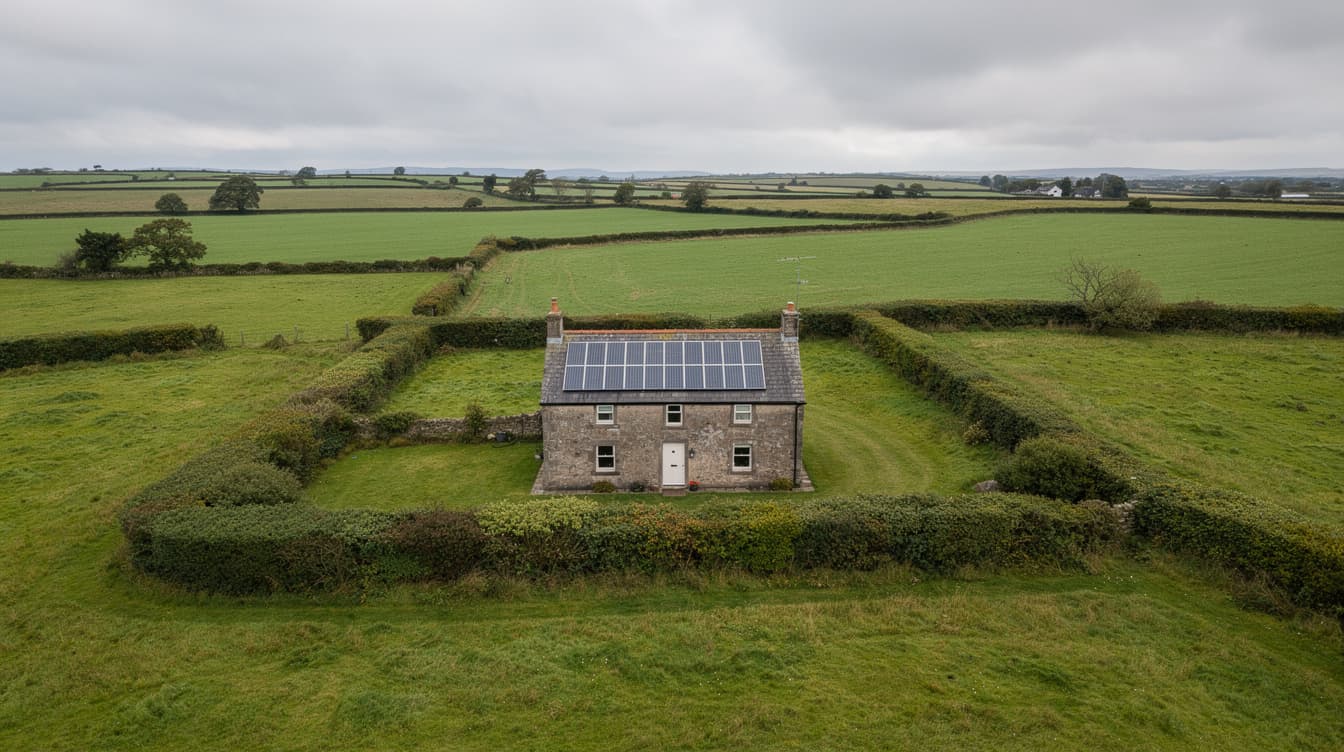
Roscommon is the quietest solar county in Connacht. Population density is the lowest in the province outside Leitrim, the active installer base in the county is thin, and most Roscommon households quote out to Athlone, Galway or Sligo rather than locally. That sounds like a disadvantage. In practice it’s the opposite: yields in the mid-Shannon flatlands around Roscommon town, Athleague and Lecarrow are among the best in Connacht (lower convective cloud than the Atlantic-facing west), and a thin installer market means quote spreads are wider, which rewards anyone willing to pull three quotes instead of one.
Roscommon also has two distinct solar sub-markets that don’t exist in most counties. The Lough Key and Lough Ree lakeshore zones around Boyle, Cootehall, Knockvicar and Lecarrow have a large concentration of second-homes and holiday cottages where battery-heavy or off-grid-leaning systems make economic sense even when the headline payback looks slow. And the Shannon callows farmland from Lanesborough down through Athleague has some of the cleanest, flattest TAMS 3 install conditions in the country — large barn roofs, no shading, no planning friction.
This guide covers 2026 Roscommon pricing, yields by area, the planning realities for protected structures and lakeshore properties, and five worked payback scenarios from a Boyle holiday cottage to a Castlerea suckler farm.
Get a Roscommon Solar Quote
Three free quotes from SEAI-registered installers covering Roscommon town, Boyle, Castlerea and the lakeshore zones.
Quick answer: Roscommon solar costs and payback in 2026
A typical 4 kWp domestic install in Roscommon costs €8,500–€9,900 gross, or €6,700–€8,100 net of the €1,800 SEAI Solar PV Grant. Yields run from 940–960 kWh per kWp in the north around Boyle and Lough Key to 970–985 in the south around Roscommon town and Athleague. A 4 kWp array generates 3,760–3,940 kWh per year. Combined import savings and CEG export income come in at €870–€1,010 a year on a no-battery domestic install. Net payback: 6.8–8.5 years.
The Roscommon quote-spread story: because the active installer base in the county is small (one Roscommon-based installer, three Athlone-side regional, two Galway-side, one Sligo-side, plus several Dublin nationals quoting in), the gap between the cheapest and most expensive quote for the same 4 kWp install can be €1,800–€2,400. That’s wider than any other Connacht county. The implication is simple: pull three quotes, not one.
Farms: a 15 kWp TAMS 3-funded install on a Roscommon suckler or dairy holding costs the farmer €9,400–€11,400 net of the 60% grant. With 14,100–14,800 kWh of annual generation, payback runs 2.5–3.0 years.
Yields by Roscommon area
Roscommon yields vary more by altitude and proximity to lakes than by east/west — the county is largely a flat-to-rolling inland landscape with the Shannon basin running its eastern edge. The lake districts in the north have slightly higher cloud-clinging, while the southern Shannon callows and Athleague plains are exceptionally open.
| Roscommon area | Typical yield (kWh/kWp/yr) | Notes |
|---|---|---|
| Roscommon town, Athleague, Knockcroghery | 970–985 | South-central flatlands — best yields in county |
| Lecarrow, Lanesborough side | 965–985 | Shannon callows belt — open, flat, low cloud |
| Strokestown, Tarmonbarry | 960–980 | Central north, mixed farming country |
| Castlerea, Ballaghaderreen | 955–975 | West Roscommon, slightly more cloud from Mayo direction |
| Boyle, Cootehall, Knockvicar | 940–960 | Lough Key district, lake-clinging cloud lowers yield 2–3% |
| Roosky, Carrick-on-Shannon side | 950–975 | North-east Shannon corridor |
The headline: south Roscommon yields beat anything in Galway and most of Mayo. North Roscommon around Boyle yields 2–3% lower because Lough Key produces local convective cloud, but it’s still well inside the band where solar pays back inside 8–9 years on a domestic install. If you’re in Athleague, Roscommon town or Lecarrow, you’re effectively at Midlands yields — on par with Westmeath and Longford.
Cost by system size in Roscommon (2026)
Roscommon pricing runs broadly in line with Galway and Sligo — about 2–4% under the national average. The county has no concentrated install hub of its own, so most quotes come from Athlone, Galway, Sligo or Dublin. Travel-to-site is the main pricing variable. Households on the Athlone side (Roscommon town, Athleague, Lecarrow) get the most competitive pricing because three Athlone installers actively quote the area. North Roscommon (Boyle, Cootehall) gets slightly higher pricing because Sligo and Galway installers add a small travel premium and Carrick-on-Shannon installers in Leitrim can be cheaper.
| System size | Panels | Gross price | After €1,800 grant | Best fit |
|---|---|---|---|---|
| 3 kWp | 7–8 | €7,200–€8,400 | €5,400–€6,600 | 2–3 bed bungalow, holiday cottage |
| 4 kWp | 9–10 | €8,500–€9,900 | €6,700–€8,100 | 3 bed semi, 4 bed bungalow — Roscommon average |
| 5 kWp | 11–12 | €9,600–€11,100 | €7,800–€9,300 | 4 bed detached, EV household |
| 6 kWp | 13–14 | €11,100–€12,700 | €9,300–€10,900 | Large detached, EV + heat pump |
| 15 kWp (farm) | 33–36 | €23,400–€28,600 | €9,400–€11,400 (after 60% TAMS 3) | Suckler, dairy, mixed farm |
Batteries: €3,500–€4,200 for a 5 kWh AC-coupled battery. Tesla Powerwall 3 (13.5 kWh) is €7,700–€9,200 in Roscommon — expect the higher end if you’re north of Boyle because Powerwall-certified installers are concentrated around Athlone and Galway. EV charger integration adds €850–€1,200.
The quote-spread reality: we’ve seen real 4 kWp Roscommon quotes ranging from €7,900 (cheapest Athlone-based) to €10,300 (Dublin national) on the same install spec. That’s a €2,400 spread for the same 9-panel system. The discipline that matters in Roscommon more than anywhere is: three quotes, identical spec sheet, compare line-by-line.
Lakeshore second-homes: where solar + battery actually shines
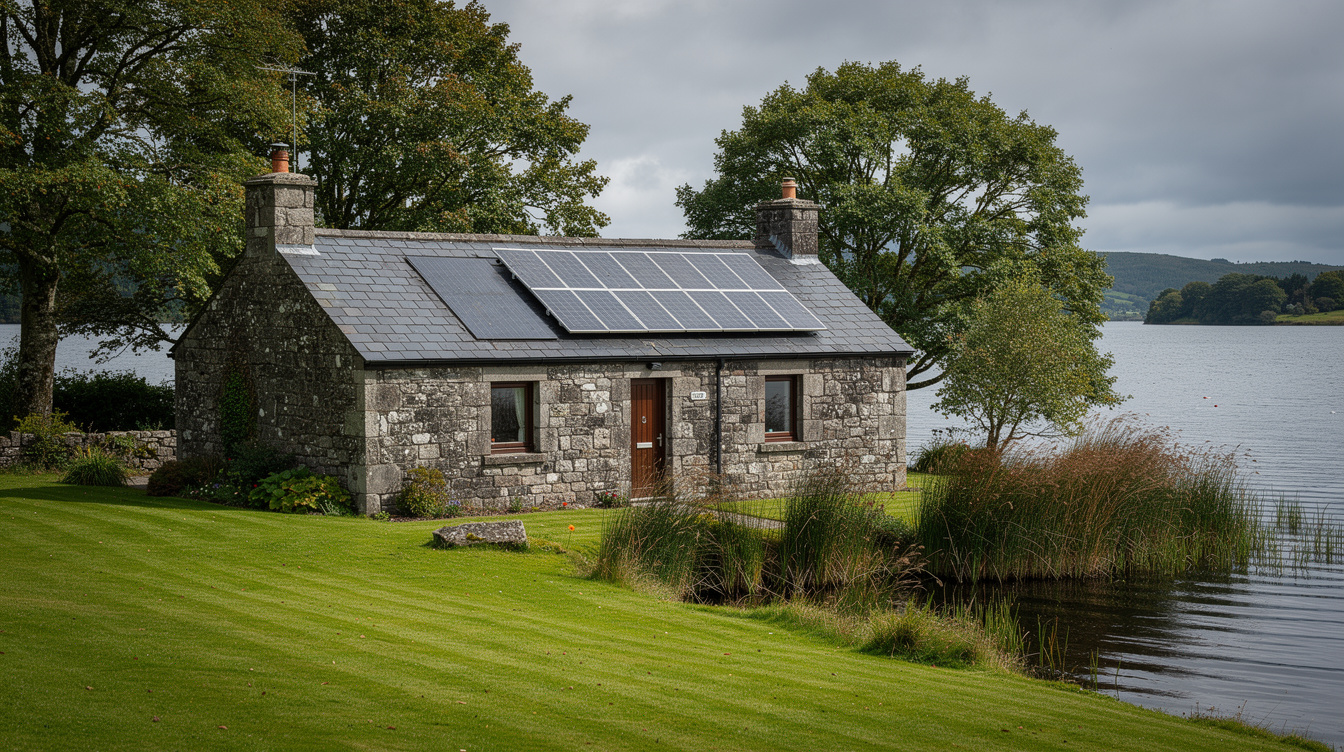
The Lough Key and Lough Ree corridors are the Roscommon angle the rest of the country doesn’t share. Roughly 1,400 second-homes and holiday cottages sit within 2 km of those lakeshores, concentrated around Cootehall, Knockvicar, Boyle, Lecarrow, Knockcroghery and the Lough Ree islands. The economics here look different to a standard owner-occupied install:
- Low occupancy = low daytime self-consumption. A holiday cottage occupied 40–90 nights a year captures only 10–20% of solar output on a no-battery install. The other 80–90% exports at 18–22c/kWh.
- Battery transforms the maths. A 5 kWh AC-coupled battery captures 25–35% of generation for evening occupancy use, lifting effective self-consumption to 35–55%. Payback shifts from 11–13 years to 8–10 years.
- Off-grid-lean for boathouses and outbuildings. Many lakeshore properties have detached boathouses, summer rooms or workshop sheds with intermittent power needs. A 2–3 kWp system with 10 kWh of storage can power these without grid connection — useful where new grid quotes from ESB run €3,500–€8,000.
- Grid stability. Some Lough Key shoreline properties experience repeat brownouts during winter storms. Solar + battery with passthrough provides usable backup for fridge/freezer/heating circulators even during 6–12 hour outages.
Worth noting: lakeshore Architectural Conservation Area designations apply around Boyle Abbey, the Lough Ree heritage zone and several mid-19th century shoreline estates. Always check with Roscommon County Council before specifying panel colour or location on a heritage property.
Planning realities in Roscommon
Roscommon planning is some of the most permissive in the country. The standard Planning and Development (Solar Panels) Regulations 2022 apply: no cap on roof area, no setback, no notification for domestic rooftop solar in any of the major towns (Roscommon, Boyle, Castlerea, Ballaghaderreen, Strokestown) or any rural townland. The exceptions to be aware of:
- Boyle Architectural Conservation Area: covers the town centre, Boyle Abbey precinct and the main mall. Matt-black panels are strongly preferred. Inverter ideally hidden from the street. Section 5 not always required, but a courtesy pre-application call to the council is sensible.
- Protected structures (~380 in Roscommon): Section 5 declaration needed. Around €165 fee, 6–10 weeks turnaround. The county has the usual 18th and 19th century farmhouses and shopfront buildings.
- Lough Ree and Lough Key heritage zones: Section 5 advisable within 200m of designated heritage shoreline. Slate-roof properties around Boyle Abbey usually need to use slate-effect mounting.
- SAC/NHA designations: Lough Ree, the River Suck callows and the Bog of Allen marginal area on the Roscommon–Galway border are designated SACs. Domestic rooftop solar is unaffected; new ground-mount over 50 sq m on protected land requires a Natura Impact Statement.
- Ground-mount on farms over 50 sq m: Needs full planning. Roscommon County Council has historically been fast on agricultural solar applications — typically 8–10 weeks turnaround.
Practical take: planning is rarely a blocker in Roscommon. Outside Boyle town centre and the lakeshore heritage zones, you can install domestic rooftop solar without notifying anyone. Just keep the council courtesy call in mind if you’re inside the Boyle ACA or within sight of Lough Key.
TAMS 3 and the Roscommon farm case
Roscommon has approximately 4,800 working farms. The split skews to drystock: roughly 50% suckler beef, 20% sheep, 15% dairy, 10% mixed (beef + tillage) and 5% equine and tillage-only. The TAMS 3 Solar Capital Investment Scheme covers 60% of the cost of a registered farm solar install with a €90,000 ceiling.
Why Roscommon farms do well on TAMS 3:
- Suckler and sheep farms have low daytime electricity loads but the €90,000 ceiling combined with MSS export rates of 18–22c/kWh means a 15–20 kWp barn install still produces 3–4 year payback even on largely-exported generation.
- Dairy farms around Athleague and Strokestown have parlour and bulk-tank cooling loads that pair beautifully with solar between 9am and 5pm. These are some of the best self-consumption profiles in Connacht.
- Mixed beef-tillage holdings in south Roscommon have grain-drying, ventilation and yard-lighting loads that match daytime solar well during harvest months.
- Barn roof geometry is exceptional in Roscommon. Most working farms have large, south-facing, low-pitch corrugated metal sheds with zero shading, allowing easy 20–30 kWp installs without any roof gymnastics.
- Ground-mount on poor-quality land. Several Roscommon farms have boggy or callows margin land that’s low-value for grazing. A 50 kWp ground-mount on 0.1 hectare turns that into €7,000–€10,000/yr of income.
A representative 15 kWp Roscommon suckler farm install:
- Gross install: €23,800
- TAMS 3 60% grant: €14,280
- Farmer net: €9,520
- Annual generation (970 kWh/kWp): 14,550 kWh
- Self-consumption 35% (typical drystock load): 5,090 kWh at avoided import cost 33c: €1,680
- Export 9,460 kWh at MSS 20c: €1,892
- Total annual benefit: €3,572
- Payback: 2.7 years
Choosing a Roscommon installer in 2026
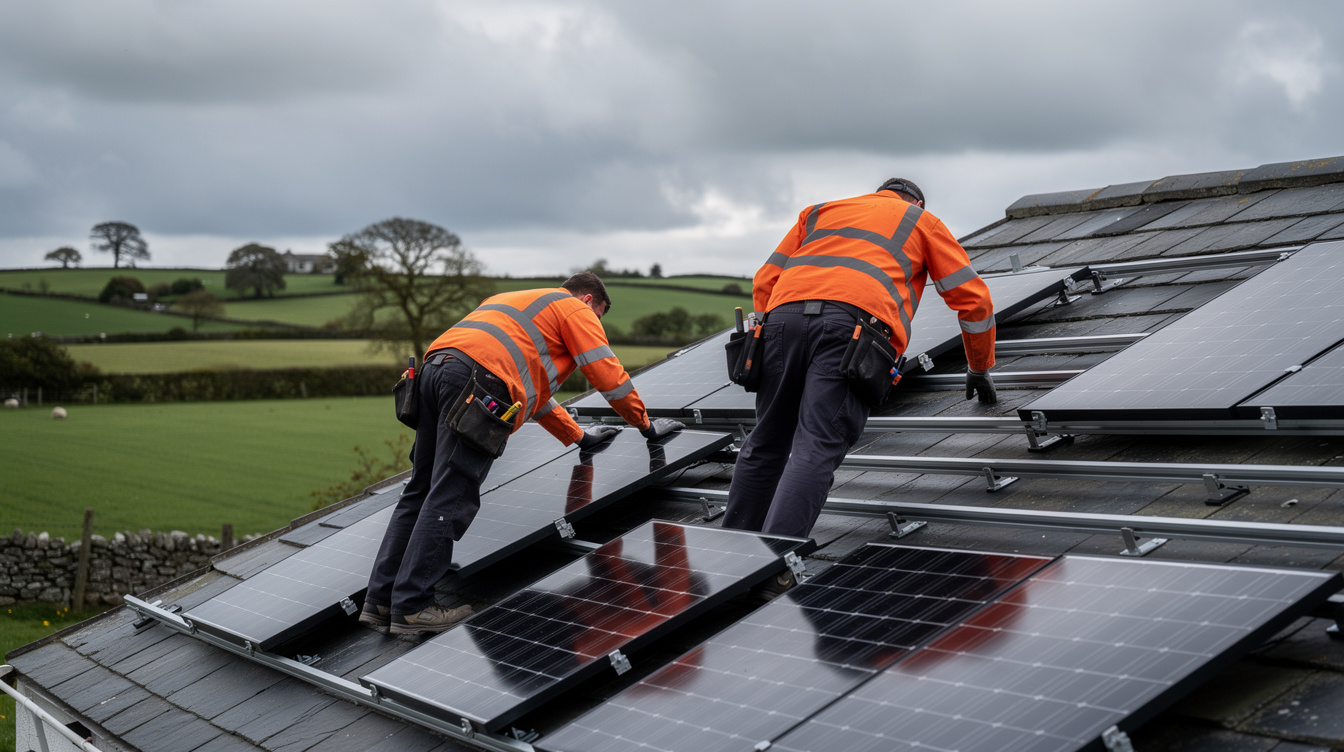
The active installer landscape covering Roscommon:
- One Roscommon-headquartered installer — cheapest for south Roscommon, 2–3 week lead time, but limited Powerwall and battery depth.
- Three Athlone-side regional installers — cover south and east Roscommon comfortably. Competitive pricing, 3–4 week lead time, strong Powerwall experience.
- Two Galway-side installers — service west Roscommon (Castlerea, Ballaghaderreen) and the Roscommon–Galway border. 4–5 week lead time.
- One Sligo-side and one Leitrim-side installer — cover north Roscommon (Boyle, Cootehall). 3–5 week lead time.
- Several Dublin nationals — quote in. 8–12% travel premium, 5–7 week lead time, deepest warranty.
Critical questions for Roscommon quotes:
- How many Roscommon installs have you completed in the last 12 months? (If the answer is <3, you’re looking at a long-distance regional installer not yet familiar with the area.)
- What’s your travel-to-site charge? Is it bundled or itemised?
- Do you handle Boyle ACA or protected-structure Section 5 declarations?
- For lakeshore properties: do you have battery experience? (Critical if you’re in a second-home or off-grid-leaning install.)
- For farms: do you have TAMS 3 paperwork experience and are you handling the application end-to-end?
- What’s your no-show recovery process if an install team can’t make it that week? (More relevant in low-density counties where one weather delay can knock a small installer’s schedule by 2 weeks.)
- What’s included in the quote — scaffolding, DC isolators, inverter location, monitoring, certification, SEAI grant paperwork?
Browse the Roscommon solar installers directory for the current list, or use the quote form below for three matched SEAI-registered quotes covering the county.
Five Roscommon payback scenarios
Scenario 1: Athleague 4-bed bungalow, family of four, oil heating. 4 kWp south-facing, eddi diverter. €8,700 gross, €6,900 net of grant. Annual output 3,940 kWh (980 kWh/kWp), self-consumption 31% baseline boosted to 56% by diverter feeding immersion = 2,206 kWh saved at 35c = €772, plus 1,734 kWh exported at 18c = €312. Total: €1,084/yr. Payback: 6.4 years — one of the strongest Roscommon scenarios thanks to south-county yields and immersion displacement.
Scenario 2: Roscommon town 3-bed semi, two adults, gas heating. 4 kWp south-west, no battery. €8,500 gross, €6,700 net of grant. Annual output 3,880 kWh, self-consumption 33% = 1,280 kWh saved at 35c = €448, plus 2,600 kWh exported at 18c = €468. Total: €916/yr. Payback: 7.3 years.
Scenario 3: Boyle 3-bed detached, one EV, electric heating. 5 kWp south-east, 5 kWh battery, zappi charger. €13,300 gross, €11,500 net of grant. Annual output 4,750 kWh (950 kWh/kWp), self-consumption 74% (EV+battery+heating) = 3,515 kWh saved at 35c = €1,230, plus 1,235 kWh exported at 18c = €222. Total: €1,452/yr. Payback: 7.9 years.
Scenario 4: Cootehall lakeshore holiday cottage, occupied 80 nights/year. 3 kWp south-facing, 5 kWh battery. €9,700 gross, €7,900 net of grant. Annual output 2,850 kWh, self-consumption (with battery for evening occupancy) 38% = 1,083 kWh saved at 35c = €379, plus 1,767 kWh exported at 18c = €318. Total: €697/yr. Payback: 11.3 years — slower than owner-occupied, but the brownout backup + boathouse loads + future occupancy upside make it work for many lakeshore owners.
Scenario 5: Castlerea-area suckler farm, 15 kWp barn install. €23,800 gross, €9,520 net of 60% TAMS 3. Annual output 14,550 kWh, mixed self-consumption + MSS export = €3,572/yr. Payback: 2.7 years.
Model Your Roscommon Payback
Use our Ireland solar calculator with your specific roof, consumption and battery scenario.
Common Roscommon solar questions
Why is the quote spread so wide in Roscommon? Because no single installer dominates the county. Six or seven installers actively quote in from Athlone, Galway, Sligo, Leitrim and Dublin, plus one Roscommon-headquartered installer. They each have different travel costs, lead times and overhead structures, so the same 4 kWp install attracts quotes from €7,900 to €10,300. This is unusual — in counties with dense installer presence the spread is typically €1,000–€1,500. The discipline that matters: pull three quotes and compare like-for-like.
Does solar work on a lakeshore second-home? Yes, but the economics are different. Without a battery you’ll export 80–90% of generation at the CEG rate (18c/kWh), which means payback runs 10–13 years rather than 7–9. With a 5 kWh battery, evening-occupancy self-consumption rises and payback shifts to 8–11 years. Add the brownout-backup benefit and the second-home solar case is strong — especially if you’re planning to move full-time within 5–10 years.
Do I need planning permission in Roscommon? Outside the Boyle Architectural Conservation Area and the small set of protected structures, almost never. Domestic rooftop solar is fully exempt under the 2022 regulations. Ground-mount over 50 sq m on farms always needs planning.
What about the Lough Key area — is it heritage-restricted? The Boyle Abbey precinct and the immediate Lough Key heritage zone (roughly 200 m from designated shoreline) have heritage sensitivity. A Section 5 declaration is advised but rarely refused — you may be asked to use matt-black panels or slate-effect mounting on conservation cottages.
Will batteries pay back in Roscommon? For a typical owner-occupied 4–5 kWp install, a 5 kWh battery typically adds 9–14 months to payback because the CEG export rate of 18c/kWh means uncaptured export is still worthwhile. Where batteries make sense in Roscommon specifically: lakeshore second-homes (essential), EV households (good), brownout-prone areas (good), and farms with evening drystock loads (marginal).
How long will my install take? 4 kWp install: 1.5–2 days on roof. With battery: 2–3 days. Total project elapsed time from quote acceptance to commissioning is 4–7 weeks in Roscommon, depending on installer backlog and grant paperwork.
Is my Roscommon farm eligible for TAMS 3? If you’re a registered Irish farmer with a herd number and at least three years of farm income, yes. Confirm 2026 tranche windows on the Department of Agriculture website.
The bottom line for Roscommon
Roscommon is a stronger solar county than its quiet reputation suggests. South Roscommon yields beat anything in Galway and Mayo. Planning is permissive. TAMS 3 economics are excellent thanks to clean barn-roof geometry. The unique angle is the wide quote spread — in Roscommon, three quotes is non-negotiable. The unique opportunity is the lakeshore second-home and small-farm market, which most installers underprice because they don’t fully understand the battery and off-grid-lean economics. If you take time to research and pull comparable quotes, Roscommon is one of the best-value solar counties in Ireland.
Ready for Roscommon Solar Quotes?
Three free quotes from SEAI-registered installers covering Roscommon town, Boyle, Castlerea and the lakeshores.
Related Articles
Solar Panels Longford 2026: Costs, Grants, Installers & Real Yields
Longford solar 2026: 4kWp costs €6,800–€8,200 pre-grant, 6–8 year payback, best installers, CEG rates and TAMS farm guide.
Solar Panels Laois 2026 — Costs, Grants and the Best Installers
Real 2026 Laois solar costs, €1,800 SEAI grant, yields from Portlaoise to Slieve Bloom, M7/M8 EV commuter maths and TAMS 3 tillage farm payback.
Solar Panels Clare 2026 — Costs, Grants and the Best Installers
Real 2026 Clare solar costs, €1,800 SEAI grant, yields from Killaloe to Loop Head, Shannon estuary EV economics, Burren planning and TAMS 3 farms.