
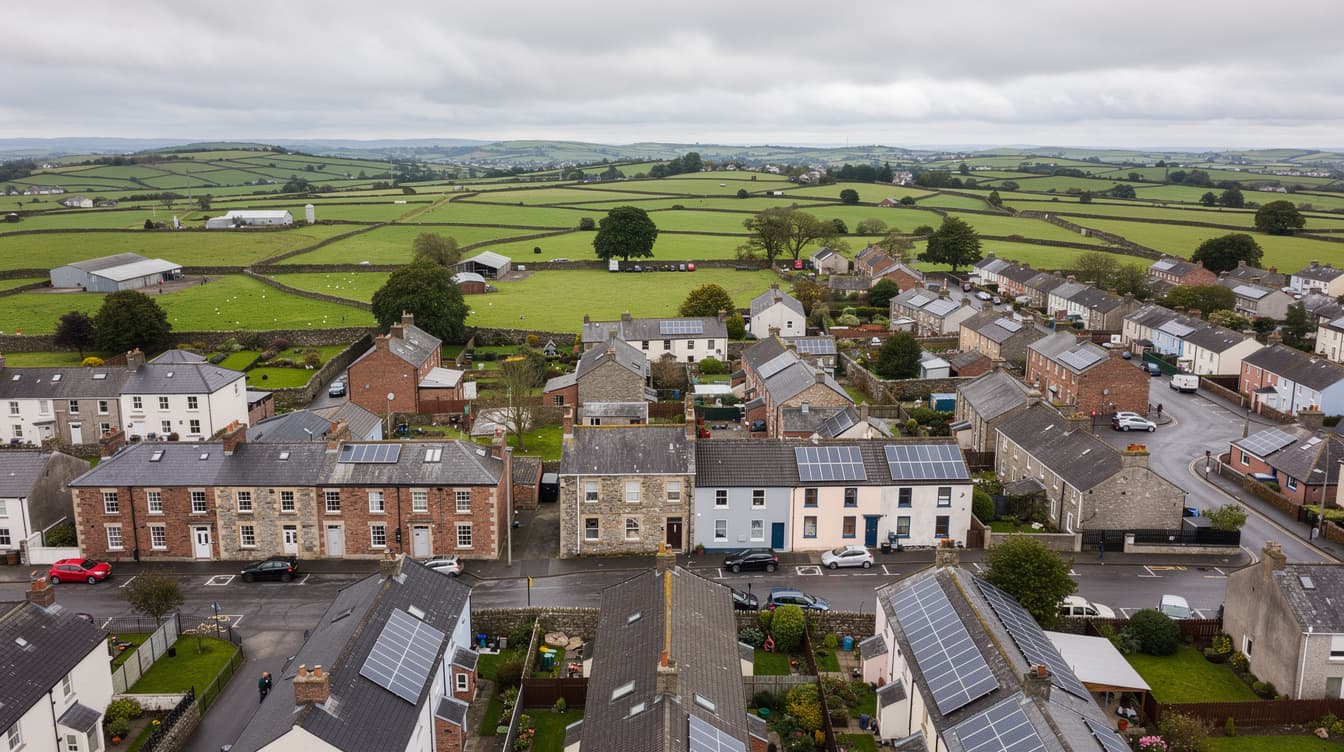
Solar Panels Longford 2026: Costs, Grants, Installers & Real Yields
Longford is one of the quieter counties in the Irish solar market — small population, no motorway spine, and no big-city installer scene. But the numbers here work as well as anywhere in the country. Longford homes have among the highest oil-heating dependence in Leinster (roughly 46% of dwellings on oil per SEAI 2024 fuel poverty mapping), plenty of detached and semi-detached stock with unshaded pitched roofs, and midlands solar yields that come in only 3–4% below the national average despite the county’s inland location.
The catch: fewer local installers means longer waits and thinner competition on price. This 2026 guide walks through what a Longford solar install actually costs today, where the €1,800 SEAI grant sits, which installers are actively covering the county, and the real yield numbers you can expect on a Longford rooftop.
Get a Longford Solar Quote
Free quotes from SEAI-registered installers covering Longford, Granard, Ballymahon and Edgeworthstown.
Quick answer: Longford solar costs and payback in 2026
For a typical Longford 3-bed semi or detached home, the 2026 numbers land here:
| System size | Panels-only cost | With 5kWh battery | Annual yield | Payback |
|---|---|---|---|---|
| 3kWp (7–8 panels) | €5,800–€6,800 | €9,200–€10,400 | ~2,650 kWh | 7–9 yrs |
| 4kWp (9–10 panels) | €6,800–€8,200 | €10,400–€12,000 | ~3,540 kWh | 6–8 yrs |
| 6kWp (14–15 panels) | €9,200–€11,200 | €12,800–€14,900 | ~5,300 kWh | 6–8 yrs |
| 8kWp (18–20 panels) | €11,500–€13,600 | €15,200–€17,800 | ~7,100 kWh | 7–9 yrs |
All prices are before the €1,800 SEAI Solar PV grant. 0% VAT on residential PV is applied at the invoice level (runs until 31 December 2026). Payback assumes an average Q3 2026 unit rate of 31c/kWh, evening standing charge, and a moderate CEG export rate of 20c/kWh from a competitive supplier like Bord Gáis or Energia.
Longford solar yield: how the midlands compare
Solar yield in Ireland is driven by irradiance (how much sunlight reaches the panel) and cloud cover, not by county borders. Longford sits at 53.7°N in the midlands lowlands, roughly 60m above sea level for most of the county, with the average irradiance dataset from EU JRC PVGIS at 1,010–1,040 kWh/kWp/year for an optimally-tilted south-facing array — about 3.5% below the Wexford/Waterford coast benchmark but 2% above the far northwest coast.
What this means in real numbers: a 4kWp array facing south at 35° on a Longford rooftop generates roughly 3,500–3,700 kWh per year. On an east-west split roof (very common in Longford newer estates), yield drops to about 3,050–3,300 kWh per year, or roughly 15% lower.
| Location | Yield (kWh/kWp/yr) | Notes |
|---|---|---|
| Longford town | 1,020 | Reference site, open aspect |
| Granard | 1,010 | Slightly cloudier north-Longford |
| Edgeworthstown | 1,030 | Central Longford, good yields |
| Ballymahon | 1,035 | Shannonside microclimate |
| Lanesborough | 1,025 | West Longford, open lakeside |
| Drumlish | 1,000 | Slightly higher elevation, mild penalty |
Practical implication: a Longford install is not meaningfully worse than a Dublin one. Where Longford differs is in the housing stock (mostly detached rural, more space for larger arrays) and in the grid connection profile (single-phase overhead lines on much of the rural network, occasional NC6 export limits — see below).
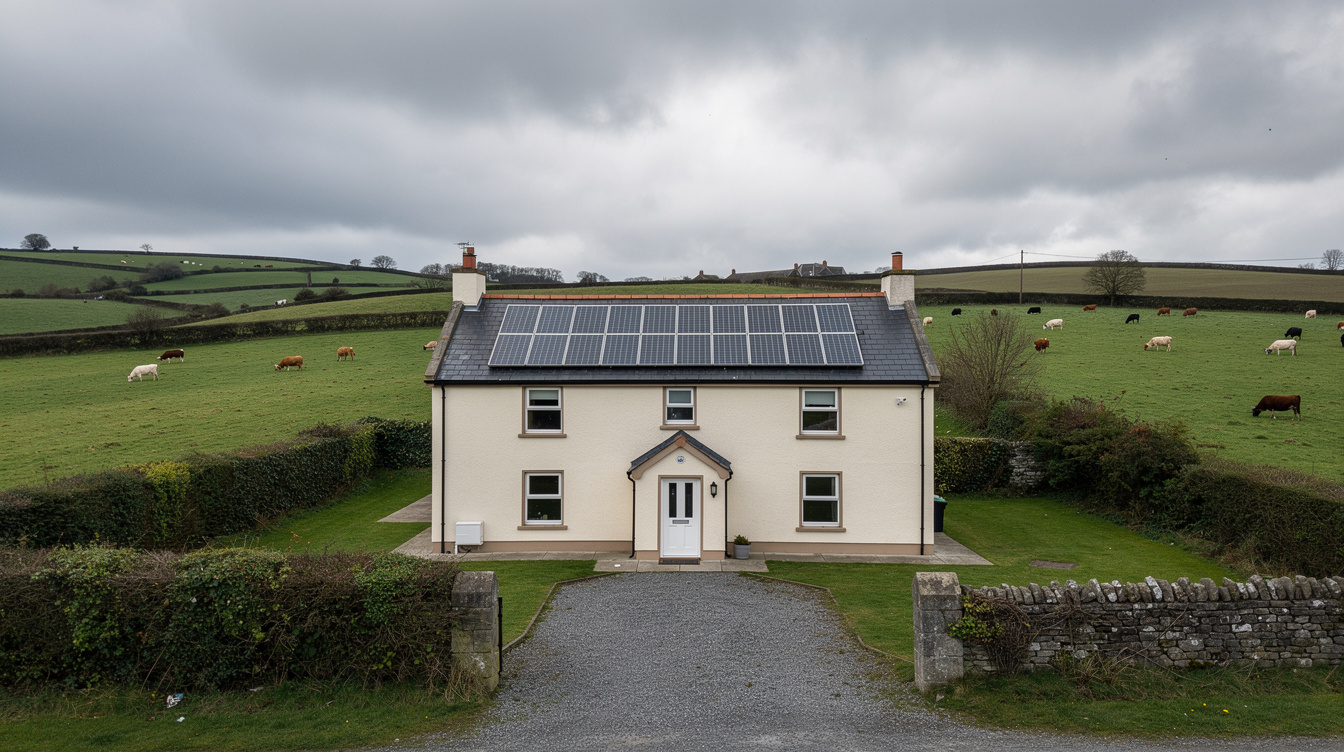
The €1,800 SEAI grant for Longford homes
The SEAI Solar Electricity Grant is the same €1,800 headline for Longford homeowners as it is nationally. Eligibility, per SEAI current guidance:
- The dwelling must have been built and occupied before 1 January 2021.
- No prior SEAI Solar PV grant has been drawn on the MPRN.
- The applicant must be the property owner (owner-occupier or landlord).
- The installer must be SEAI-registered and appear on the current Installer Register.
- Grant approval must be issued before the installation starts.
Turnaround in 2026 sits around 8–15 working days for grant approval. Post-install, you upload the paid invoice, the DEC (Declaration of Works) and the NC6-approved status, and the grant lands in your bank account 5–10 working days later. See our step-by-step SEAI grant application guide for the full workflow.
Check Your Longford Grant Eligibility
Two-minute check tells you if your Longford property qualifies for the €1,800 SEAI grant.
Longford housing stock and what it means for solar
Longford’s domestic stock, per CSO Census 2022, is roughly:
- Detached homes: 68% of occupied dwellings (highest share of any Leinster county after Laois).
- Semi-detached: 18%.
- Terraced/townhouse: 10%.
- Apartments: 4%.
What this means for solar: most Longford properties have plenty of roof area (typically 45–90 m² on the main pitch), single dwelling roofs uncomplicated by shared party walls, and often clear southern aspects because the county is largely flat farmland. This is close to the ideal profile for a straightforward 5–8 kWp install.
The downside: much of the housing is rural with single-phase overhead ESB Networks supply, meaning if you want to install >6 kWp you may need to check the export limit on your NC6 application. See our ESB Networks NC6 microgeneration guide for how single-phase properties are limited.
Which installers cover Longford in 2026?
Longford is not big enough to sustain a dedicated local installer, so the market is served by regional installers who cover neighbouring counties too. In 2026 the active installer set covering Longford is dominated by:
- Athlone-based installers covering Westmeath and Longford together — typically 25–40 minute travel time to Longford town.
- Mullingar-based installers reaching south Longford (Ballymahon, Edgeworthstown).
- Cavan/Monaghan installers reaching north Longford (Granard, Drumlish).
- Dublin-Midlands operators with weekly Longford routes, usually with slightly higher call-out surcharges.
Practical tip: get quotes from at least three installers, one of each of the above regional bases if possible. Athlone-based typically offer slightly better labour rates on account of shorter travel; north-facing installers from Cavan may be booked further out but tend to be more familiar with the local housing typology.
All quotes should come from SEAI-registered installers — see our SEAI installer verification guide for the 2-minute check.
Longford solar for farms — the TAMS 3 angle
Longford has about 3,500 active farms (CSO Farm Structure Survey 2020), most of them mixed grazing/tillage on smaller acreages by national standards. For farms, the SEAI grant doesn’t apply — the relevant scheme is TAMS 3 (Targeted Agricultural Modernisation Scheme) under Ireland’s CAP Strategic Plan.
TAMS 3 solar PV pays 60% of eligible costs up to a €90,000 ceiling per farm (young trained farmer rate). The scheme covers PV, mounting, inverter, and battery storage — but requires a farm-use case (dairy, poultry, tillage drying, workshop) with genuine daytime electrical load. Purely export-oriented installs do not qualify.
A typical Longford dairy or beef farm install under TAMS 3 sits at:
- 12–20 kWp roof-mounted or ground-mounted array.
- Gross project cost: €18,000–€32,000.
- TAMS 3 grant: €10,800–€19,200 (60%).
- Net farm outlay: €7,200–€12,800.
- Payback: typically under 4 years on any farm with continuous daytime load.
See our detailed solar for Irish farms 2026 guide for TAMS 3 mechanics.
The CEG angle for Longford homes
The Clean Export Guarantee (CEG) is the payment you receive from your electricity supplier for surplus solar exported back to the grid. As of Q3 2026, the CEG rates from the main suppliers are:
| Supplier | CEG rate (c/kWh) | Notes |
|---|---|---|
| Bord Gáis | 24.0c | Highest headline rate 2026 |
| Energia | 21.0c | Reliable, no minimum export |
| Electric Ireland | 21.0c | Bundled with residential unit rate |
| SSE Airtricity | 21.0c | Standard rate |
| Pinergy | 20.0c | Smart-tariff specialists |
Longford homes with typical retiree or work-from-home occupancy tend to self-consume 45–60% of daytime generation, exporting the balance. On a 4kWp Longford install, that’s roughly 1,600–2,000 kWh per year exported — equivalent to €336–€480/year in CEG payments at 21c/kWh. Adding a 5kWh battery moves the self-consumption ratio into the 75–85% range, cutting your exported kWh but raising your bill savings and reducing your vulnerability to CEG rate cuts. Full guide: CEG rates 2026 explained.
Battery storage in Longford: worth it or not?
Batteries make more economic sense when your household consumption is heavily evening-loaded — typical of dual-income working households. On a rural Longford detached home with an oil boiler and evening cooking + TV + lighting load of 3–5 kWh, a 5kWh battery pays for itself over 8–11 years including grid arbitrage on a smart tariff.
A battery is more marginal if:
- The house has electric heating (immersion or storage heaters) that already runs on Night Rate.
- The main occupants are home during the day (retirees, remote workers) — direct self-consumption already high without a battery.
- The main evening load is a heat pump running on Night Rate — the arbitrage is already captured by the tariff.
See our battery sizing guide for how to match battery capacity to your specific Longford load profile.
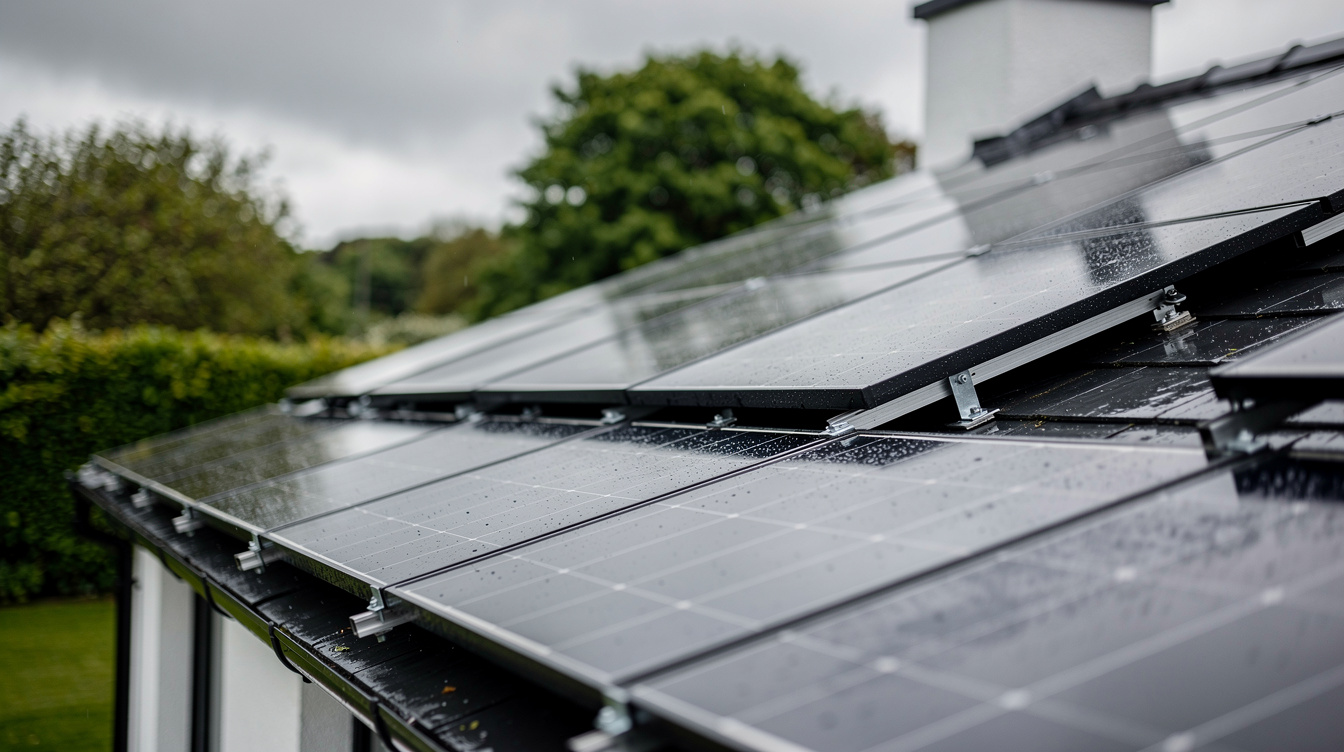
Longford solar — heating pairing
With 46% of Longford homes on oil, the pairing question matters. What are Longford homeowners actually doing with solar in 2026?
Solar + oil boiler (keep oil, offset with solar)
Most common. Panels reduce your electricity bill by €700–€1,100/year on a 4kWp install; the oil boiler continues to do winter space heating. Simplest install, cheapest capital, but does nothing to your heating fuel cost.
Solar + immersion diverter (hot water offset)
A power diverter (e.g. Eddi, Solar iBoost) sends any surplus solar generation to the immersion heater rather than exporting it. On a Longford summer this typically covers 80–100% of hot water needs from May to September and 30–50% year-round. Diverter hardware costs €550–€850 including install. See solar and immersion heaters 2026.
Solar + heat pump (electrify heating)
Long-term the strongest economic play but the largest upfront cost. A heat pump replaces oil, typically 3–4× more efficient per unit of energy delivered, and pairs well with a slightly oversized (6–8 kWp) PV array. In Longford this needs decent fabric — if you have solid stone walls with no insulation, do wall insulation first. Combined SEAI Better Energy Homes grants for solar + heat pump can total €7,500 or more.
Common Longford solar mistakes
- Not accounting for chimney shading. Longford has a lot of traditional 2-storey homes with side chimneys casting winter shadows on a portion of the roof. A competent installer will use shade-tolerant microinverters or optimisers on affected strings; a poor one will just place panels around the shadow and lose 15% yield.
- Assuming NC6 approval is automatic. On single-phase rural lines with older overhead transformers, ESB Networks may impose a lower export limit (e.g. 4 kW instead of 6 kW). Get NC6 in writing before signing an install contract for >6 kWp.
- Choosing the cheapest quote without checking SEAI registration. A handful of low-cost operators active in the midlands are not SEAI-registered, which means no grant. Verify at seai.ie/grants/installer-register.
- Ignoring the CEG supplier switch. Many Longford homes are still on legacy tariffs paying 0c CEG. Switch to Bord Gáis or Energia post-install to unlock €300–€500/year of export revenue.
- Choosing tiny battery capacity. 2.4 kWh "starter" batteries are often too small to be economically meaningful for the average Longford detached home — either go 5kWh+ or skip the battery until year 3–5 when prices drop further.
Longford solar checklist
If you’re a Longford homeowner considering solar in 2026, here’s the sequence we’d follow:
- Check your MPRN and confirm the property is pre-2021 built (grant eligibility). Use our eligibility checker.
- Get 3 quotes from SEAI-registered installers covering Longford — ideally one Athlone, one Mullingar, one Cavan direction.
- Compare the quotes on: panel wattage per unit (aim for 425W+ modules), inverter brand (Solis, Fronius, GivEnergy, Sungrow), workmanship warranty (10 years minimum), NC6 handling.
- Apply for the SEAI grant online, wait for approval before scheduling install.
- Switch electricity supplier to a competitive CEG-paying supplier (Bord Gáis or Energia) either before install or immediately after commissioning.
- File the NC6 with ESB Networks (installer usually handles this) and register the export MPRN with your new supplier.
- Track output monthly for the first year — expect ∼1,020 kWh per kWp of installed capacity.
Get 3 Longford Solar Quotes
Free, no-obligation quotes from SEAI-registered installers covering Longford, Granard, Ballymahon, Edgeworthstown.
FAQ
Do I need planning permission for solar in Longford?
No, in most cases — Ireland’s 2022 planning exemption regulations apply nationwide. Panels on a residential roof, up to 300 m² total array area, are exempt provided they don’t protrude more than 50cm above the roof surface and the property is not in a designated architectural conservation area. See our planning permission 2026 guide for the exceptions.
Are Longford yields really worse than Dublin?
Only marginally — about 3–4% lower per JRC PVGIS. In practical terms, a 4kWp Dublin array generates around 3,650 kWh/year; a 4kWp Longford array around 3,540 kWh/year. Not a meaningful difference in the payback maths.
How long does a Longford install take?
Site survey to switch-on typically 4–10 weeks in 2026. Grant approval 2–3 weeks, install day itself 6–10 hours for a straightforward 4kWp job, NC6/CEG commissioning 2–4 weeks post-install.
Will solar heat my Longford home?
Solar PV generates electricity, not heat, so it doesn’t directly warm the house. To convert PV into space heating you need either a heat pump or electric heating elements. See our best heating system with solar guide.
Which is the best time of year to install in Longford?
Late winter to early spring (Feb–April) is ideal — you catch the full summer generation curve from month 1. Autumn (Sep–Oct) installs are fine but you’ll wait 3–5 months before seeing meaningful bill savings.
What about hail and storms in the midlands?
Modern solar panels are rated for hailstones up to 25mm at 80 km/h — more than adequate for typical Irish midlands weather. Mounting rails must be rated for the local wind exposure (typically Zone 2 in Longford). All SEAI-registered installers design to these standards.
Can I install ground-mounted panels in Longford?
Yes — if you have the garden or yard space, ground-mounted arrays actually deliver 3–5% higher yields than roof-mounted equivalents because you can optimise tilt and orientation freely. Planning exemption applies up to 60 m² ground-mounted array (2022 regulations). See our ground-mounted solar guide.
The one-sentence version
Longford in 2026 is a genuinely strong solar market despite its low profile — midlands yields within 4% of the national average, oil-dominated heating stock that pairs well with either an immersion diverter or a heat pump, and a competitive installer set based out of Athlone, Mullingar and Cavan — with typical 4kWp payback of 6–8 years after the €1,800 SEAI grant.
Ready to Go Solar in Longford?
Get three free quotes from SEAI-registered installers covering your part of the county.
Related Articles
Solar Panels Laois 2026 — Costs, Grants and the Best Installers
Real 2026 Laois solar costs, €1,800 SEAI grant, yields from Portlaoise to Slieve Bloom, M7/M8 EV commuter maths and TAMS 3 tillage farm payback.
Solar Panels Roscommon 2026 — Costs, Grants and the Best Installers
Real 2026 Roscommon solar costs, €1,800 SEAI grant, yields from Athleague to Boyle, lakeshore second-home maths and TAMS 3 farm payback.
Solar Panels Clare 2026 — Costs, Grants and the Best Installers
Real 2026 Clare solar costs, €1,800 SEAI grant, yields from Killaloe to Loop Head, Shannon estuary EV economics, Burren planning and TAMS 3 farms.