
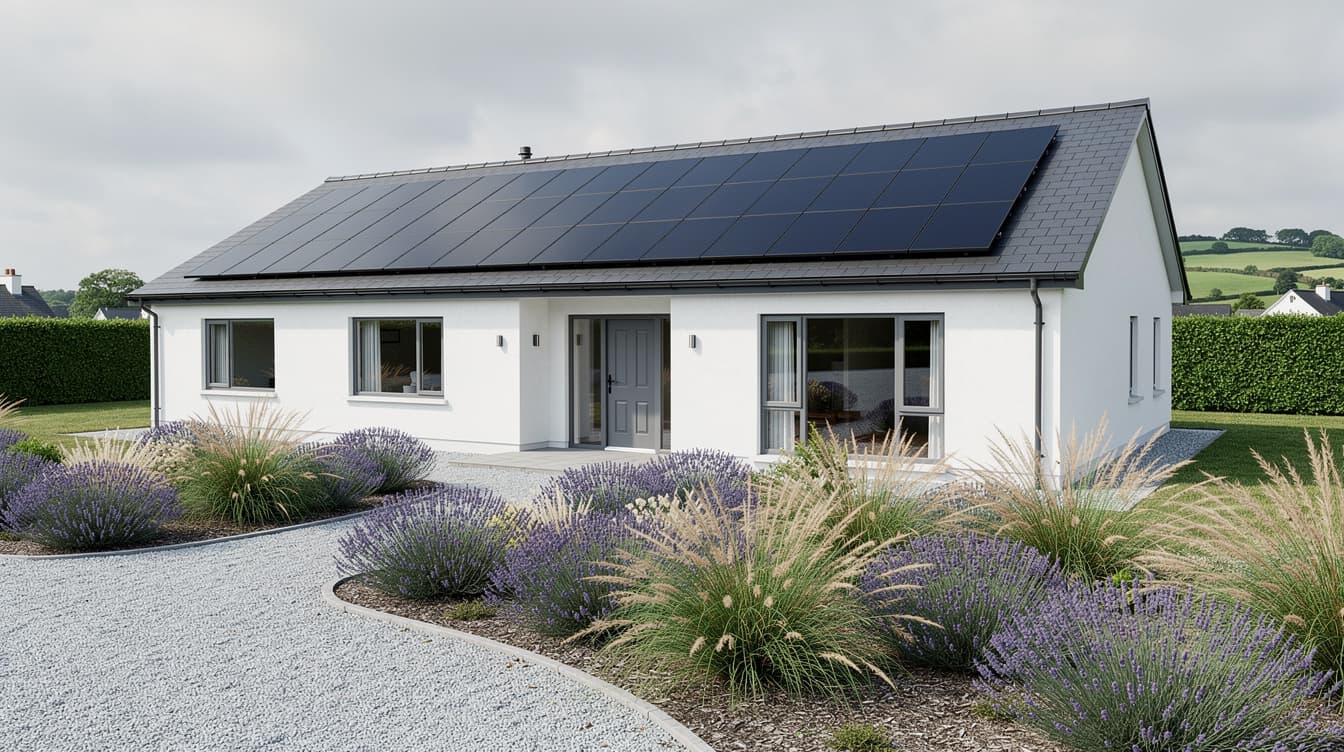
Best Heating System to Pair with Solar Panels in Ireland (2026): The Honest Comparison
Pair solar PV with the wrong heating system and you’ll export 60% of your generation back to the grid for 20c/kWh while paying 40c/kWh to buy it back at night. Here’s what actually works in an Irish home in 2026.
You can have the best solar PV system in the country on your roof. If your house is heated by gas while you’re generating 4–5 kWh an hour at midday, none of that solar power is replacing your gas bill. It’s being sold back to the grid at the Clean Export Guarantee rate of 18–24c/kWh — then you’re buying gas at 9c/kWh anyway. The two systems just don’t interact.
The heating system you pick determines how much of your own solar power you actually use. And in Ireland in 2026, with the grid €1,800 PV grant and up to €12,500 in heat pump grants now available, the case for pairing them properly has never been stronger.
This guide ranks every realistic heating option for an Irish home against one question: how well does it pair with solar PV?
The headline ranking
Here’s the short version. Detail and caveats follow.
| Rank | Heating system | How well it pairs with solar PV |
|---|---|---|
| 1 | Air-to-water heat pump (plus immersion diverter for hot water) | Excellent. Daytime heating + hot water = up to 70% self-consumption |
| 2 | Air-to-air heat pump (with electric immersion for hot water) | Very good. Lower install cost, no grant though |
| 3 | Gas/oil boiler + solar diverter to immersion + battery | Decent for hot water; boiler doesn’t use solar at all |
| 4 | Direct electric (storage heaters, panel heaters) + solar diverter | Wasteful unless on night-rate tariff with battery |
| 5 | Solid fuel (wood, peat, coal) + solar diverter to immersion only | No real pairing — solar only helps with hot water |
Why pairing matters: the self-consumption math
A typical 4kWp solar system in Ireland generates around 3,400 kWh per year. The blunt economic question is: how much of that 3,400 kWh do you actually use inside your house, and how much gets exported to the grid?
| Scenario | Self-consumption % | Annual savings (4kWp, 4-person home) |
|---|---|---|
| Solar PV only, gas heating, both adults out 8–6 | 25–30% | €520–€680 |
| Solar PV + immersion diverter, gas heating | 40–50% | €700–€900 |
| Solar PV + 5kWh battery + immersion diverter | 55–65% | €900–€1,150 |
| Solar PV + heat pump + immersion diverter | 60–70% | €1,200–€1,500 |
| Solar PV + heat pump + battery + EV charger | 75–85% | €1,800–€2,400 |
The pattern: every extra device you can run on solar electricity instead of grid imports doubles down on the savings. Heat pumps are uniquely good at this because they convert 1 kWh of solar electricity into roughly 3–4 kWh of heat (that’s the COP — coefficient of performance).
See what your home could save
Get a personalised quote for solar + heating from SEAI-registered installers in your area.
1. The winner: solar PV + air-to-water heat pump
This is the optimal pairing for almost every detached, semi-detached, or terraced Irish home built to BER B3 or better — or older homes that have had a deep retrofit. Here’s why:
- Daytime load matches solar generation. Heat pumps run for long, low-power cycles — not short bursts. A 9kW air-to-water heat pump draws roughly 2–3kW continuously when heating. That maps almost perfectly to a 4–6kWp solar array’s midday output.
- COP multiplier. Every 1 kWh of solar electricity becomes 3–4 kWh of heat at the radiators. So a 4kWp system can effectively power ~12,000 kWh worth of heat per year.
- The hot water tank doubles as a battery. Excess solar diverts to the cylinder via an iBoost+ or Eddi. The cylinder is your “thermal battery” — no expensive lithium needed for hot water.
- Combined grants. €1,800 SEAI PV grant + €6,500–€12,500 SEAI heat pump grant (depending on whether you do a full home energy upgrade) = the most subsidised pairing.
Real numbers, 2026:
| Item | Cost (after grants) |
|---|---|
| 5kWp solar PV (− €1,800 grant) | €6,500–€8,500 |
| 9kW air-to-water heat pump install (− €6,500 grant) | €9,500–€14,000 |
| myenergi Eddi or iBoost+ solar diverter | €700–€1,000 |
| Total installed cost | €16,700–€23,500 |
| Annual saving vs. oil + grid PV-less baseline | €2,400–€3,200 |
| Payback period | 7–9 years |
If you’re replacing an oil boiler in an older home with a poor BER, factor in insulation upgrade costs too — you’ll need at least 250mm of roof insulation and most cavity walls pumped before a heat pump can run efficiently. The SEAI One Stop Shop scheme bundles these into a single grant application.
2. The dark horse: solar PV + air-to-air heat pump
If you’ve been told air-to-air heat pumps don’t exist in Ireland — they do. They’re air-conditioning units that also heat. The trade-offs vs. air-to-water:
- Cheaper install — €3,000–€8,000 vs. €9,500–€14,000 for an air-to-water system. No grant, but install is faster (1–2 days vs. a week).
- No radiator integration — heat is blown from indoor units, room-by-room. Some homeowners hate this; others (especially in apartments and 1-bed extensions) love it.
- Still excellent solar pairing — COP of 3–4, daytime load match.
- Doesn’t do hot water — you keep your existing immersion (powered by solar diverter) or a small standalone hot water heat pump.
This is the right pick for: renters who’ve gone solar-via-balcony, mid-floor apartments, small extensions, and homes where a full air-to-water retrofit isn’t worth the disruption. See our full air-to-air heat pumps guide for the specifics.
3. Solar PV + existing gas/oil boiler + diverter
This is what 60% of Irish solar adopters actually have, simply because they kept their existing boiler. It’s a decent compromise, not optimal.
The key add-on is a solar power diverter (Eddi, iBoost+, Apollo Gem) that routes excess solar PV into your immersion element instead of exporting it. Expect:
- Solar covers ~30–40% of household electricity directly
- Diverter to immersion covers ~80% of summer hot water (April–September), 30% in winter
- Gas/oil boiler still handles 100% of space heating — solar doesn’t touch it
- Annual saving: €700–€900 with 4kWp system on an average 12,000 kWh-a-year home
When this makes sense: your gas boiler is < 5 years old, your home is on the gas grid with a service contract, you have no plans to retrofit for 5+ years, and you simply want solar PV as an electricity bill reducer.
When to upgrade: if your boiler is 10+ years old and due replacement anyway, do the heat pump install at the same time as solar. The labour overlap saves €1,500–€2,500.
4. Solar PV + direct electric heating + diverter
If your home is heated by storage heaters or wall-mounted panel heaters (common in apartments, holiday lets, and some 1990s-built homes without gas connections), pairing with solar is tricky but doable.
The honest answer: solar PV doesn’t pair well with electric heating because storage heaters charge overnight on cheap rate, and panel heaters demand 1.5–3 kW instantly — usually when it’s coldest (December–February evenings), exactly when your solar output is near zero.
The fix: combine with a substantial battery (10–15 kWh) and a smart EV-style tariff (Electric Ireland Home Electric+ Night Boost, Energia Smart Drive). Charge the battery on cheap night-rate electricity, then run the heaters off the battery during expensive day-rate hours. Solar tops the battery up in the morning.
Cost: this stack runs €14,000–€20,000 installed. It works, but the payback is 12–15 years and a heat pump retrofit is usually a better answer.

5. Solid fuel + solar PV
If you’re still on a stove or solid-fuel boiler (peat briquettes, wood, anthracite), the only solar pairing is via the immersion diverter to your hot water cylinder. Space heating doesn’t interact with PV at all.
That’s fine in itself — your hot water bill goes to near-zero May–September. But the bigger opportunity is converting to a heat pump and abandoning solid fuel entirely — particularly under the SEAI deep retrofit grant which can cover up to €25,000 of total cost if your starting BER is poor.
The four pairings ranked by 10-year cost of ownership
For a typical 4-person Irish home using 5,500 kWh of electricity + 14,000 kWh of heat per year:
| Setup | Capex (net of grant) | 10-yr energy bill | 10-yr total |
|---|---|---|---|
| Oil boiler, no solar (baseline) | €0 (existing) | €38,000 | €38,000 |
| Oil boiler + 4kWp solar + diverter | €7,800 | €30,000 | €37,800 |
| Gas boiler + 4kWp solar + diverter | €7,800 | €24,000 | €31,800 |
| Heat pump + 5kWp solar + diverter | €18,500 | €9,500 | €28,000 |
| Heat pump + 6kWp solar + 10kWh battery | €26,000 | €4,500 | €30,500 |
Two things jump out:
- The heat pump + solar pairing wins on total cost over 10 years — even though the upfront is highest. You’re effectively pre-paying ten years of energy bills.
- Adding a battery doesn’t help at 2026 prices for an oil-displacement setup. The battery’s cost roughly equals the extra savings. Batteries make more sense as PV system size grows past 6kWp.
The install order: solar first or heat pump first?
If you can’t do both at once (most homeowners can’t), the order depends on your starting point:
| Your current heating | Install order |
|---|---|
| Oil boiler > 12 years old | Heat pump first. Replace before next winter; solar later |
| Gas boiler < 5 years old | Solar first. Get the bill savings rolling while your boiler is still good |
| New build with heat pump already | Solar immediately. Payback drops to 5–6 years thanks to the self-consumption boost |
| Direct electric / storage heaters | Insulation first, then heat pump + solar together if budget allows |
| Solid fuel | SEAI deep retrofit: insulation + heat pump + solar as one project |
See our solar vs. heat pumps: which first guide for the full decision tree.
The diverter question: do I need one?
If you have solar PV and a hot water cylinder with an immersion element (you almost certainly do unless you have a combi gas boiler), then yes — a solar diverter is the cheapest single upgrade you can make to boost self-consumption.
The numbers:
- Cost: €700–€1,000 supplied + fitted
- Savings: €180–€320/year on hot water vs. heating from gas/electric
- Payback: 3–5 years
- No grant. Not SEAI-eligible directly — pays for itself fast though
Top brands in Ireland 2026: myenergi Eddi (most popular, integrates with EV charger), Marlec Solar iBoost+ (cheapest), Apollo Gem (Irish-made). All do roughly the same job. See our detailed power diverter comparison.
Compare solar + heating quotes
Tell us about your home and we’ll match you with SEAI-registered installers who quote on both together.
Frequently asked questions
Will my heat pump still run if there’s a power cut?
No — standard heat pumps require grid power. Even with solar PV, the inverter shuts down during grid outages for safety. A battery with backup mode (Tesla Powerwall 3, BYD HVS, Sigenergy) is needed for off-grid resilience — expect €6,000–€12,000 extra.
Can I keep my gas boiler as backup for the heat pump?
Yes, in a hybrid system — the heat pump handles most of the load and the gas boiler kicks in only on the coldest days. This setup is common in poorly insulated older homes. The SEAI grant rules treat this as a heat pump install for grant purposes.
What COP should I expect from an Irish heat pump?
Real-world average annual COP (SCOP) for a modern air-to-water heat pump in Ireland is 3.0–3.5. That means 1 kWh of electricity gives 3.0–3.5 kWh of heat. Marketing claims of 4.5–5.0 are lab figures at warm outdoor temperatures — not Irish winters.
Is solar thermal (hot water panels) better than PV + immersion diverter?
No, not anymore. Solar thermal made sense when PV was €3,000/kWp. At 2026 PV prices of €1,300–€1,600/kWp, a PV array with a diverter delivers more total energy at lower cost, with no glycol-loop maintenance.
If I have natural gas, is switching to a heat pump worth it?
Marginal in pure economics if you have a modern condensing gas boiler and a good-BER home. Worth it for: future-proofing (gas connection charges keep rising), comfort (constant-temperature radiators feel different to gas-fired blasts), and resale value (B2+ BER homes sell 5–10% faster).
Can I run an EV charger off solar too?
Yes, and you should. A myenergi Zappi charger paired with an Eddi diverter prioritises EV charging from solar surplus first, then immersion, then export. This is the optimal stack for a household running solar + heat pump + EV.
What about underfloor heating — does it pair with solar PV any differently?
Better, actually. Underfloor heating runs at lower temperatures (35–45°C vs. 55–65°C for radiators), which pushes the heat pump’s COP closer to 4.0. Solar self-consumption goes up because the heat pump runs longer at lower power. If you’re building new or doing a major retrofit, underfloor + heat pump + solar PV is the modern Irish gold standard.
Putting it together: the 2026 recommendation
For most Irish homeowners doing this in 2026, the best pairing — in terms of total ten-year ownership cost, comfort, future-proofing, and grant capture — is:
- A 5–6kWp solar PV array (south or south-west pitched roof, 3-string MPPT inverter)
- An air-to-water heat pump sized to your insulated heat-loss (typically 7–11kW for a 3-bed semi)
- A solar diverter to the hot water cylinder
- Skip the battery initially; revisit in year 3 once you see your actual usage pattern
If you can get all of this done in a single SEAI One Stop Shop project, you’ll capture both grants in one application, save on labour overlap, and likely come out around €17,000–€22,000 net of grants. The 10-year energy savings vs. an oil baseline will be €25,000–€32,000. The 25-year picture is even better.
Ready to Go Solar?
Get your free personalised quote from SEAI-registered installers.
Further reading: Heat Pumps and Solar Panels Together: The Complete 2026 Guide, Air to Water Heat Pumps Ireland 2026, Air to Air Heat Pumps Ireland 2026, Solar Power Diverters Ireland, Solar vs. Heat Pumps: Which First.
Related Articles
Solar Panel System Cost by Number of Panels Ireland 2026: 8, 12, 14, 20, 24 Panel Prices
What 8, 12, 14, 16, 20 or 24 solar panels actually cost in Ireland 2026 — net after €1,800 SEAI grant & 0% VAT, output kWh, roof area & battery add-ons.
6kW Solar System Cost Ireland 2026: Real Prices, Output & Payback
6kW solar costs €7,700–€10,500 net after the €1,800 SEAI grant and 0% VAT in Ireland 2026. Real quote, 5,270 kWh/yr output, EV/battery ROI.

Average Cost of Solar Panels Ireland 2026: What Homeowners Really Pay
Real 2026 Ireland solar prices by kW size, region and battery option. Average 5kW after SEAI grant: €7,100-€9,000. Full breakdown inside.