
Air to Air Heat Pumps Ireland 2026: Costs, vs Air-to-Water & Why There's No SEAI Grant
Air to Air Heat Pumps Ireland 2026: Costs, vs Air-to-Water & Why There's No SEAI Grant
Air-to-air heat pumps are the cheapest, fastest way to get heat-pump efficiency into an Irish home — but they don't qualify for the €6,500 SEAI grant, and they won't heat your hot water. Here's exactly what they cost, where they make sense, and the trade-off you're making versus an air-to-water system in 2026.
Walk into a Harvey Norman or DID Electrical in 2026 and you'll see “heating and cooling” units priced from €700. Walk into an SEAI-registered heat pump installer and you'll be quoted €14,000 for an air-to-water system. Both are heat pumps. Both run on the same physics. The difference is what they heat — air vs water — and that single design choice ripples through everything: price, grants, hot water, noise, planning permission, and how warm your house actually feels in February.
Air-to-air heat pumps (often called split-system air conditioners, mini-splits, or reversible ACs) are the quiet success story of Irish heating. They're not a replacement for central heating in a poorly insulated bungalow. But for a well-insulated extension, an attic conversion, a home office that needs heating and cooling, or a small apartment where ripping out radiators isn't an option — they often beat air-to-water on every metric except eligibility for grants. This guide explains exactly when they win, when they lose, and what you'll really pay in 2026.
What is an air-to-air heat pump?
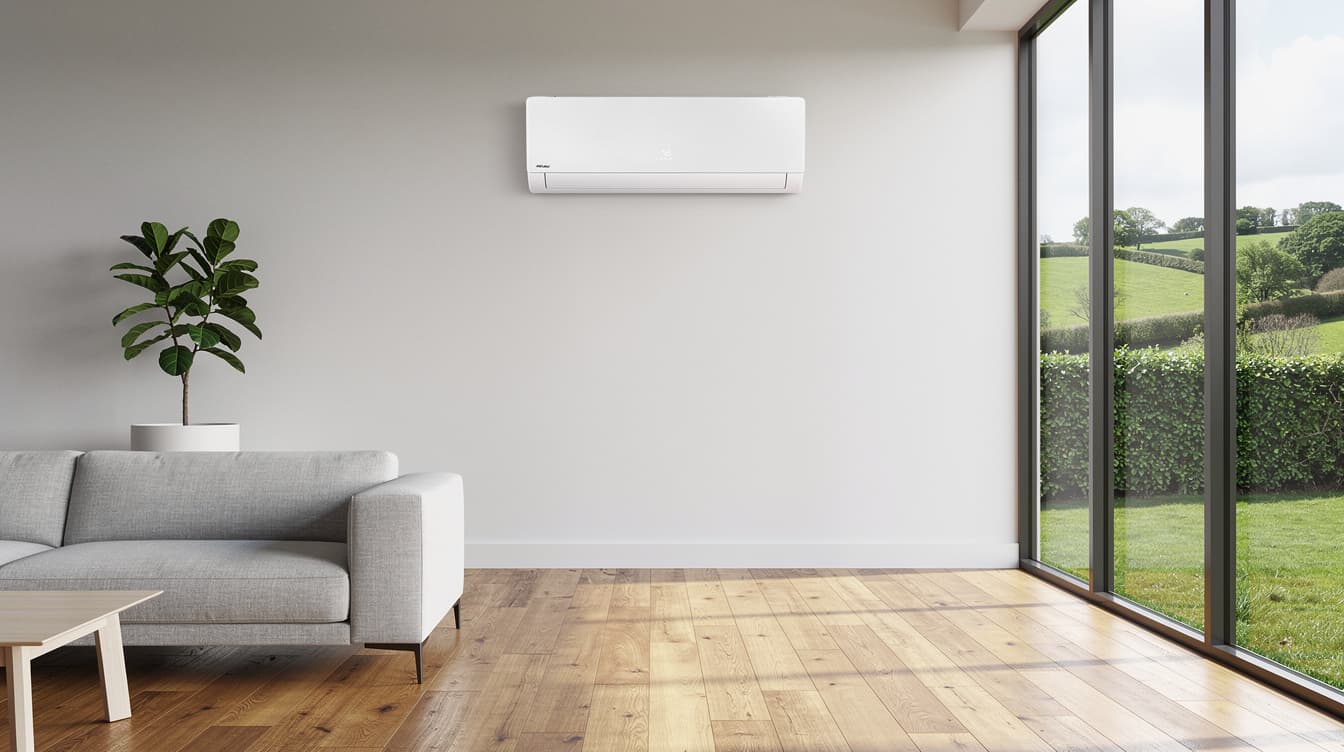
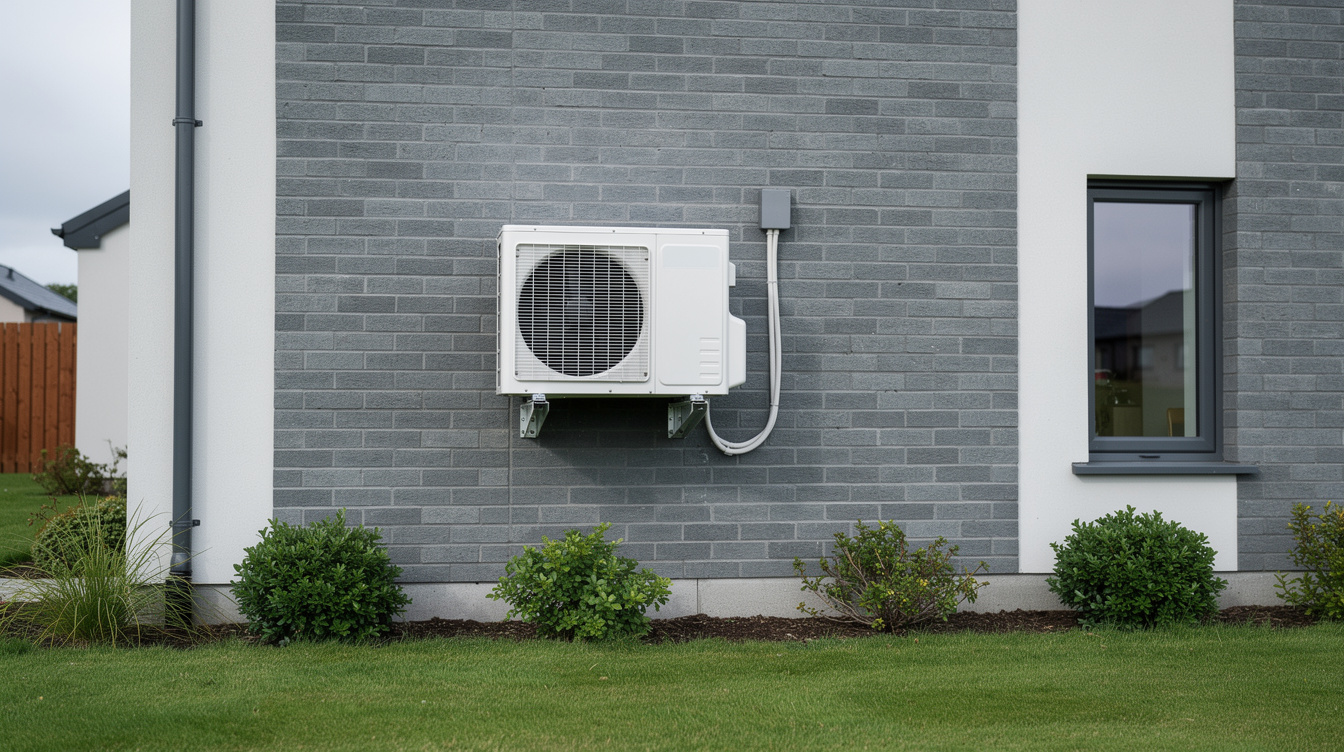
An air-to-air heat pump is the same technology as a fridge, running in reverse. An outdoor unit pulls heat out of the ambient air (yes, even at 0°C — there's still heat energy in 0°C air), compresses the refrigerant to raise its temperature, and pipes it indoors to a wall-mounted unit (the “split”) that blows warm air directly into the room.
Unlike an air-to-water heat pump, there are no radiators, no underfloor heating, and no hot water cylinder involved. The heat goes straight from the refrigerant into the room air via a fan-coil. That makes them:
- Much cheaper to install — no plumbing, no radiator replacement, no cylinder
- Much faster to install — a day, sometimes half a day for a single split
- Reversible — they cool in summer (genuinely useful as Irish summers warm)
- Room-by-room — each indoor unit heats its own zone
- Useless for hot water — you keep your existing immersion, gas boiler, or oil tank for showers
What does an air-to-air heat pump cost in Ireland 2026?
Prices in 2026 have come down materially since 2022 as the European reversible-AC market has matured. Expect these all-in installed prices including a competent F-gas-registered technician fitting a single 2.5–3.5kW split (enough for one decent-sized room or open-plan kitchen-diner):
| System Type | Indoor Units | Typical Use Case | Installed Price 2026 |
|---|---|---|---|
| Single split (DIY-grade) | 1 | Home office, conservatory | €1,200–€1,800 |
| Single split (premium — Daikin/Mitsubishi) | 1 | Main living room | €1,800–€2,800 |
| Multi-split (2 zones) | 2 | Living + bedroom | €3,200–€4,500 |
| Multi-split (3 zones) | 3 | Open plan + 2 bedrooms | €4,500–€6,500 |
| Whole-house ductless (4–5 zones) | 4–5 | 3-bed semi as primary heat | €7,500–€11,000 |
For comparison, an SEAI-registered air-to-water heat pump install in Ireland 2026 typically costs €14,000–€19,000 before the €6,500 grant (so €7,500–€12,500 net). For a single zone or a couple of rooms, air-to-air wins on cash up front by thousands.
Ready to Go Solar?
Get your free personalised quote from SEAI-registered installers.
Why there's no SEAI grant for air-to-air heat pumps
This is the single biggest disappointment for Irish homeowners researching the option. Under SEAI's 2026 Better Energy Homes scheme, the €6,500 heat pump grant covers only air-to-water and ground-source heat pumps that provide both space heating and domestic hot water. Air-to-air systems are excluded because:
- They don't heat water (no hot water cylinder integration)
- SEAI's BER methodology treats them as supplementary heating, not primary
- They've historically been associated with cooling-first products that increase summer electricity use in EU markets
The same exclusion applies to the SEAI One Stop Shop deep retrofit pathway. If you want grant money, your only heat-pump route is air-to-water (the €6,500 grant plus a typical €500 BER assessment and admin fee return).
The plain math: if the State has to throw €6,500 of grant money at air-to-water to make it cost-competitive, that tells you something about the underlying installed-price difference.
Air-to-air vs air-to-water heat pumps: head-to-head
| Factor | Air-to-Air | Air-to-Water |
|---|---|---|
| Installed cost (whole house) | €7,500–€11,000 | €14,000–€19,000 (gross) |
| SEAI grant | €0 | €6,500 |
| Net cost | €7,500–€11,000 | €7,500–€12,500 |
| Heats hot water? | No | Yes |
| Provides cooling? | Yes (reversible) | No (heat only) |
| Typical SCOP (Ireland) | 3.8–4.5 | 3.2–4.0 |
| BER impact | Modest (supplementary) | Significant (primary heat) |
| Install time | 1–2 days | 5–10 days |
| Existing radiators? | Keep as backup | Often need upgrading |
| Wall-mounted units visible? | Yes, one per room | No (pipes/rads only) |
| Planning permission | Usually exempt | Usually exempt |
| Annual running cost (3-bed) | €900–€1,300 | €1,100–€1,500 |
When air-to-air actually makes sense in Ireland
The honest answer is “more often than the heat-pump industry will tell you.” Five common Irish scenarios where air-to-air is the right call:
1. The extension or attic conversion
You added a bedroom or office and the existing boiler can't reach it efficiently. Running new radiator pipes through finished walls costs €1,500–€2,500. A single air-to-air split does the same job for €1,400 and adds summer cooling for free. This is the most common Irish use case in 2026 and the cheapest.
2. The apartment owner
Most Irish apartments have one electric storage heater per room and no plumbing for retrofitting wet heat. SEAI's air-to-water grant assumes you have radiators or can install underfloor heating — not realistic in a 1990s Dublin city centre block. A 2-zone air-to-air split delivers genuine heat-pump efficiency in apartments where air-to-water can't physically go.
3. The well-insulated modern home with gas central heating
Your A-rated 2018 semi already has efficient gas heating. Ripping it out for a heat pump makes no economic sense at current gas prices. But adding one or two air-to-air splits to your most-used rooms (living area, master bedroom) lets you run the boiler less in shoulder seasons and gives you cooling in July. Many Irish homeowners now treat this as the “solar-PV-powered overlay” on top of their gas system.
4. The holiday home or rental
You don't live there most of the year, freezing pipes are a risk, and you need quick on-demand heat for guests. Air-to-air units turn on in 90 seconds, don't freeze when the property is empty, and don't require draining systems. Air-to-water systems are overkill here.
5. The solar PV self-consumption play
This is the smart-money 2026 angle. If you've installed a 4–6kW solar PV system (or you're planning to), your panels produce most kWh on warm summer afternoons — exactly when you need cooling, not heating. Running a reversible air-to-air unit on your own surplus solar costs you 0c/kWh instead of the 19.5c/kWh you'd otherwise get exporting to the grid. Combined with a power diverter to your hot water cylinder, this maximises solar self-consumption to 70%+.
When air-to-air is the wrong choice
Three scenarios where you should walk straight past the “split AC” aisle and book an SEAI-registered air-to-water installer instead:
- You're doing a deep retrofit and want the BER jump. Air-to-water with proper weather compensation will lift a C3 to a B2 or B1. Air-to-air, treated as supplementary, won't.
- Your house is poorly insulated and big. A 220m² 1970s detached with single-pane glazing needs distributed heat from radiators across many rooms. Trying to do that with 5 wall-mounted splits is ugly, expensive, and noisier than one quiet air-to-water unit feeding existing rads.
- You hate the look of indoor units. Wall splits are visible, modern, and unmistakeable. If you want invisible heating in a period property, air-to-water with concealed pipework is the only option.
Best air-to-air brands sold in Ireland 2026
| Brand | Best for | SCOP (typical) | Single-split installed |
|---|---|---|---|
| Daikin Perfera/Sensira | Quiet operation, Wi-Fi standard | 4.6 | €2,200–€2,800 |
| Mitsubishi Electric Kirigamine | Low ambient performance (down to -25°C) | 4.8 | €2,400–€3,000 |
| Panasonic Etherea | nanoe X air purification | 4.5 | €2,000–€2,600 |
| LG Artcool | Styling, mid-price | 4.3 | €1,800–€2,400 |
| Samsung Wind-Free | No-draught comfort mode | 4.4 | €1,900–€2,500 |
| Toshiba Haori/Seiya | Value premium brand | 4.2 | €1,700–€2,200 |
| Hisense / Haier / Midea | Budget end, decent SCOP | 4.0 | €1,200–€1,700 |
The SCOP (Seasonal Coefficient of Performance) numbers above are the Eurovent-rated heating SCOPs for “Average” climate — Ireland sits slightly warmer than Average, so expect real-world performance very close to or slightly above these numbers in well-insulated homes.
Running cost: what an air-to-air heat pump actually adds to your ESB bill
This is where the technology stops being abstract. Assume a 3.5kW indoor split serving a 30m² open-plan living/kitchen area in a B2-rated semi, run for ~6 hours/day at an effective heating output of 2.4kW average:
- Heat delivered: 2.4kW × 6h = 14.4 kWh/day of warmth
- Electricity drawn (at SCOP 4.4): 14.4 / 4.4 = 3.3 kWh/day
- At 0.345€/kWh (2026 average day rate): €1.13/day
- Over a 6-month heating season (~180 days): ~€205
For comparison, a 24kW gas combi boiler doing the same job uses about 17 kWh of gas/day at 0.10€/kWh = €1.71/day = ~€308/season.
You're saving roughly €100/year per room you switch to air-to-air, plus you get cooling for free in summer. Stack this against a typical €2,200 install and the simple payback is 9–12 years — faster if you self-consume solar PV.

Installation: F-gas, planning permission & what to look for in a quote
Three rules you should know before you sign any quote in Ireland 2026:
F-gas certification is mandatory
Any installer working with refrigerant pipework in the EU must hold an F-gas certificate (Category I for the technician, Category 1 for the company). Ask to see it before they pierce a wall. Uncertified installs are illegal and void manufacturer warranties.
Planning permission is normally exempt
Under the Planning and Development Regulations, an outdoor unit is exempt from planning permission if it's:
- Less than 2.0m above ground level
- Not within 3m of any boundary with another property
- The total combined external unit footprint does not exceed 0.5m²
Apartment owners need management company consent before mounting outdoor units on the building exterior — this is the usual blocker, not the planning rules.
A good quote should specify
- Exact brand & model number of indoor and outdoor units
- Cooling and heating capacity in kW
- SCOP and SEER ratings (heating and cooling efficiency)
- Pipe length included (standard 3–5m; extra metres cost)
- Bracket type and outdoor unit mounting location
- Wi-Fi controller included or extra
- Warranty period (parts/labour separately — Daikin offers 5 years parts as standard)
- Annual F-gas leak check included for the first 2 years
Air-to-air heat pumps with solar panels: the 2026 combo
The strongest argument for air-to-air in 2026 isn't about heating — it's about cooling powered by your own solar.
Irish summers are warming. 2025 saw multiple weeks above 25°C in Dublin and Cork. South- and west-facing rooms in modern airtight homes now regularly hit 28°C indoors in July. A solar PV system produces its peak output during those exact hot afternoons. Running a 1kW air-to-air unit in cooling mode from your own surplus PV costs you nothing in fuel and replaces 3kWh of cooling that would otherwise need 0.85kWh of grid electricity at 34.5c/kWh = 29c/hour of comfort.
For a household already considering solar, adding a single Daikin or Mitsubishi split for the bedroom adds €2,000 to the project but unlocks year-round value — warmth in shoulder season and cool sleep in July. Pair it with battery storage and you've got a self-sufficient micro-HVAC setup that's resilient to outages too.
Ready to Go Solar?
Get a free quote and ask installers about combining solar with an air-to-air heat pump for self-consumption.
Frequently asked questions
Will an air-to-air heat pump work in Irish winters?
Yes — Ireland's heating-design temperature is only -1°C to -3°C in most counties, well within the comfortable operating range of every modern inverter-driven split. Mitsubishi and Daikin systems specifically rated for Northern European climates deliver full heating output down to -15°C. The Irish winter is genuinely easy for these systems.
Are they noisy?
Indoor units run at 19–30 dB(A) in “quiet” mode — quieter than a fridge. Outdoor units typically run at 48–55 dB(A) at full speed, dropping to 35–40 dB(A) overnight. Position the outdoor unit away from bedroom windows and you'll never hear it.
Do they qualify for the 0% VAT solar incentive?
No. The 0% VAT for domestic solar PV does not extend to heat pumps of any kind. Standard 23% VAT applies on air-to-air systems sold in Ireland 2026, included in the prices quoted above.
Will it affect my BER rating?
An air-to-air system installed as supplementary heat (alongside your gas/oil boiler) usually gives a modest BER lift — typically half a band. Installed as the primary heat source for the whole home, it can lift a C-rating to a B, but the BER assessor needs to see that it's sized to deliver the full design heating load.
Can I install it myself to save money?
No. Any refrigerant connection requires F-gas certification by EU law. “Pre-charged” DIY kits exist but most underperform and many void warranty. The labour is around €500–€800 of any quote — not worth the risk for that saving.
What's the lifespan?
Premium brands (Daikin, Mitsubishi, Panasonic, LG) typically last 15–20 years with annual cleaning. Budget brands 8–12 years. Compressors are the failure point — check warranty terms specifically on compressor cover, not just “parts.”
Will it heat my hot water if I add a tank?
No. Air-to-air systems can't heat water. If you want hot water from a heat pump you need either air-to-water, or a dedicated heat-pump hot water cylinder (a separate product, around €2,800–€3,500 installed) which is itself a small air-to-water unit just sized only for water.
Ready to Go Solar?
Get your free personalised quote from SEAI-registered installers in your county.
Further reading
Related Articles
Solar Panel System Cost by Number of Panels Ireland 2026: 8, 12, 14, 20, 24 Panel Prices
What 8, 12, 14, 16, 20 or 24 solar panels actually cost in Ireland 2026 — net after €1,800 SEAI grant & 0% VAT, output kWh, roof area & battery add-ons.
6kW Solar System Cost Ireland 2026: Real Prices, Output & Payback
6kW solar costs €7,700–€10,500 net after the €1,800 SEAI grant and 0% VAT in Ireland 2026. Real quote, 5,270 kWh/yr output, EV/battery ROI.
5kW Solar System Cost Ireland 2026: Real Prices, Output & 25-Year ROI
5kW solar system costs €6,700–€9,200 net after the €1,800 SEAI grant and 0% VAT in Ireland 2026. Full itemised breakdown, real output data & battery ROI.