
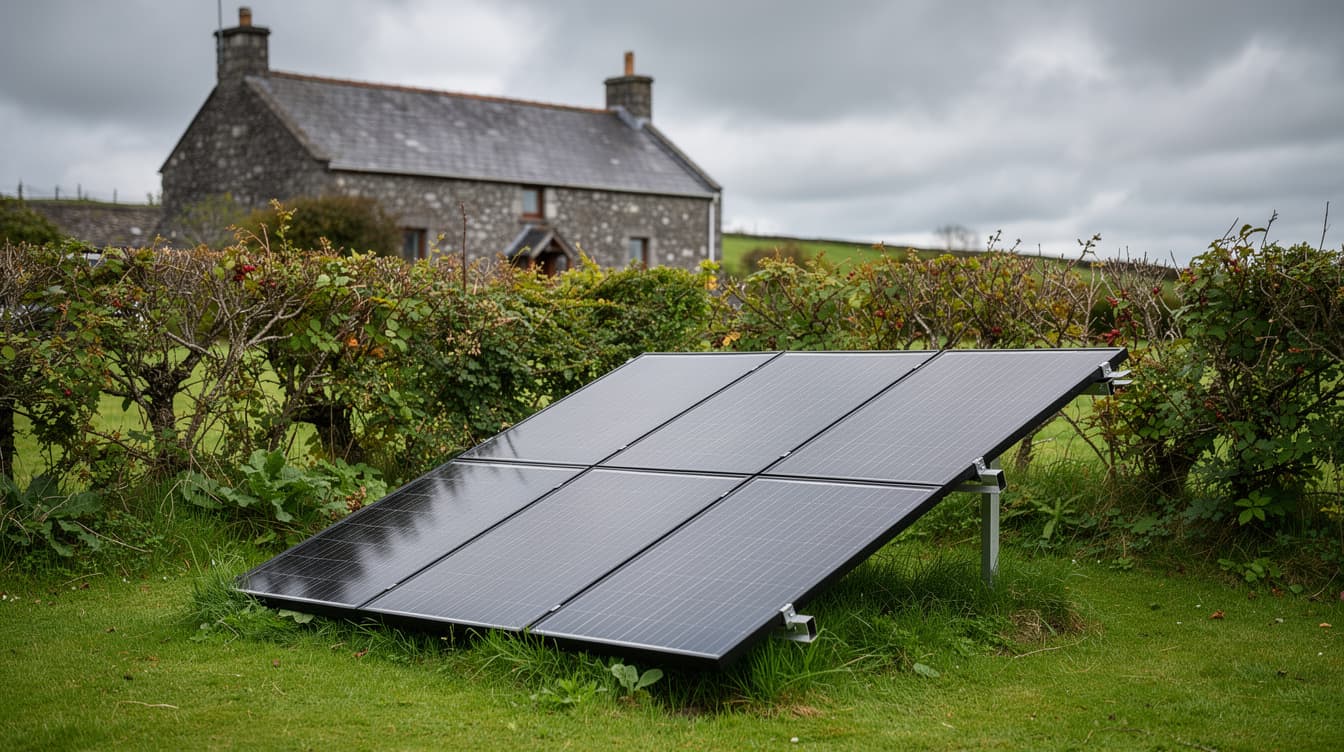
Ground-Mounted Solar Panels Ireland 2026: Real Costs, Planning & When It Beats the Roof
Most Irish solar quotes assume the roof is the answer. But if you have a north-facing house, a slate roof the installer will not touch, a listed cottage, or simply an unused corner of a paddock catching the southern sun, a ground-mounted array can outperform the roof option by 10–15% in annual yield — and it will not require a scaffold, a roof survey, or a battle with your insurer over penetrations.
The catch is that ground-mount adds €1,000–€3,500 to the bill, comes with a strict planning envelope, and forces you to think about cable runs, foundations, and security in a way that a rooftop system never does. This is the honest 2026 picture of what ground-mounted solar costs in Ireland, when it is worth it, and what installers should be building for you.
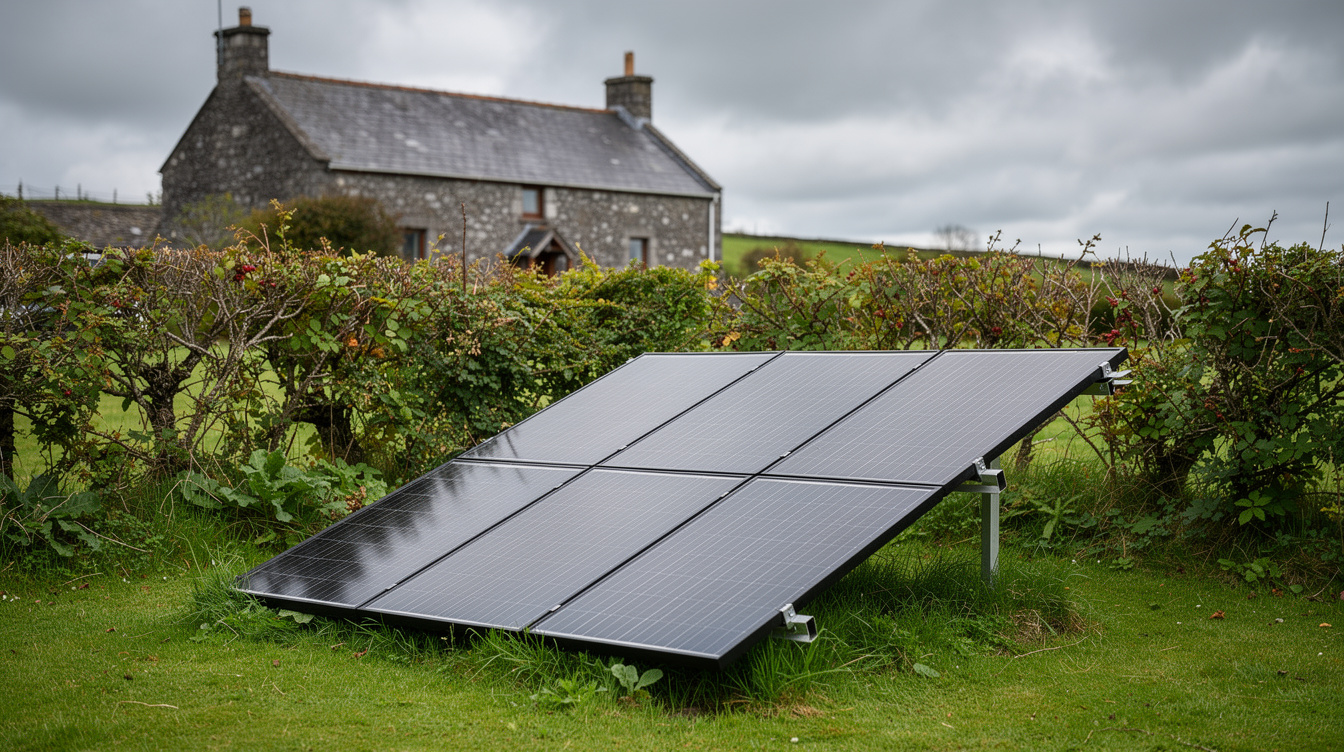
Ground-mount vs roof-mount: the honest comparison
Nine out of ten Irish domestic PV systems still go on the roof, and rightly so — a south-pitched Irish roof at 30–40° is close to the theoretical optimum for our latitude and gets the panels above pets, kids, and shrubs for free. But the roof is not always the best sun-catcher on the property.
| Factor | Roof-mount | Ground-mount |
|---|---|---|
| 4.4 kWp installed cost (2026, pre-grant) | €8,300–€9,000 | €9,130–€11,250 |
| SEAI grant eligibility | Yes (€1,800) | Yes (€1,800) |
| Typical yield vs optimum roof | Baseline (100%) | 100–115% (perfect tilt/orientation) |
| Yield vs compromised roof | 70–85% (east/west, shaded) | 100–115% |
| Roof penetrations | Yes (rail feet through slate/tile) | None |
| Planning envelope (2026 exempt) | Effectively unlimited on principal roof | Max 25 m², 2 m high, 2 m from boundary |
| Cleaning & maintenance access | Roof access needed | Broom-and-bucket from ground |
| Vandalism / theft risk | Low | Higher — consider fencing/lighting |
The lift you get from a ground-mount is real when your roof is the problem. A 4 kWp array pointing 45° east-of-south on a shaded slate roof will land around 3,000–3,300 kWh a year. Move the same panels onto a ground frame at 35° due south with clear sightlines and you are looking at 4,000–4,200 kWh — a 25–35% real-world lift that pays back the extra hardware cost inside six or seven years even on today’s modest CEG export tariff.
When a ground-mount actually makes sense in Ireland
Ground-mount is not a substitute for a working roof — it is a rescue plan for the roofs that will never work well. In our experience the shortlist looks like this:
- North-facing principal roof. The classic case. A north-pitched Irish roof will lose 25–30% of the annual yield of the equivalent south pitch, and no amount of optimisers rescues that. A ground array in a south-facing garden closes the entire gap.
- Listed or protected structure. If your home is a protected structure or sits inside an Architectural Conservation Area, roof mounts often need full planning permission (and the local authority may refuse them for visual impact). Ground-mount in the rear garden, screened by planting, is usually the pragmatic route.
- Fragile roof coverings. Original Bangor Blue slate, thatched cottages, aged Rosemary tiles — installers legitimately refuse to fix rails to these because a single cracked slate can cascade into a five-figure re-roof. Ground-mount removes the roof risk entirely.
- Shed, garage, or outbuilding as the destination. Farm sheds, workshops, and detached garages often have profiled steel roofs that are easier to mount than a slate house — but for a home-office cabin, a ground array beside the building is usually simpler than a bespoke bracket system.
- Large arrays over the domestic exemption. Anything above about 6–7 kWp on a house roof still fits the roof exemption comfortably. But farms, guest houses, and small businesses running a 10–20 kWp system will often site the array in a paddock and take the planning permission if the site warrants it.
If your roof is south-ish, unshaded, and structurally fine, ground-mount is almost certainly the wrong answer. The extra €1,000–€3,500, the planning envelope, and the security overhead are only worth carrying when the roof is compromised.
Not Sure If Ground-Mount Fits Your Site?
Get a free site assessment from SEAI-registered installers who quote both options honestly.
Planning permission for ground-mount in 2026
The Planning and Development Regulations (as amended by SI 235/2022) set out the rules that keep a domestic ground-mount inside the “exempted development” envelope, meaning you do not need to apply to your local authority. Miss any one of these and you either resize the array or lodge a planning application.
The 2026 residential ground-mount exemption
- Panel area: the total collector area may not exceed 25 m². That is roughly ten to twelve full-size (450–500 W) panels — enough for a ~4.4–5 kWp array.
- Height: no part of the array may sit more than 2 m above ground level. A 35° tilt on a standard 2 m panel puts the top edge at about 1.6–1.7 m, so a domestic tilt fits comfortably.
- Boundary setback: at least 2 m clear from any boundary wall, fence, or hedge.
- Front of house: the array must be behind the front wall of the dwelling. You cannot ground-mount in the front garden and stay exempt.
- Private open space: at least 25 m² of private open space must remain after the panels go in. This is the clause most people miss on smaller urban gardens.
If your home is a protected structure, sits in an Architectural Conservation Area, or lies within one of the small residual Solar Safeguarding Zones (mostly near Baldonnel), the exemption does not apply and full planning permission is required regardless of the array size.
What ground-mount actually costs in 2026
The most useful way to think about ground-mount cost is as a per-kWp uplift over the equivalent roof system, not a totally new number. The panels, inverter, cabling standards, DC isolators, and grant paperwork are identical — what changes is the mounting structure and the groundwork.
| Line item | Roof-mount 4.4 kWp | Ground-mount 4.4 kWp |
|---|---|---|
| Panels (10 × 440 W) | €1,650 | €1,650 |
| Hybrid inverter (5 kW) | €1,400 | €1,400 |
| Mounting structure | €450 (roof rails) | €1,400 (galvanised frame) |
| Foundations / anchors | Included | €700–€1,400 (screws, piers or ballast) |
| Cabling & trenching to house | €250 (roof to loft) | €550–€900 (15–30 m armoured trench) |
| Labour & commissioning | €1,600 | €1,900 (extra groundwork day) |
| SEAI paperwork & commissioning cert | €250 | €250 |
| Total pre-grant | €8,300–€9,000 | €9,130–€11,250 |
| SEAI Solar PV grant (2026) | −€1,800 | −€1,800 |
| Net cost to homeowner | €6,500–€7,200 | €7,330–€9,450 |
The uplift is real but not brutal. If ground-mount delivers 25% more annual generation than the compromised roof it replaces — which is typical when the alternative is a north pitch or a shaded east-west split — the extra €1,000–€2,000 pays back inside seven years at the current CEG export tariff, and much faster if you self-consume the extra kilowatt-hours.
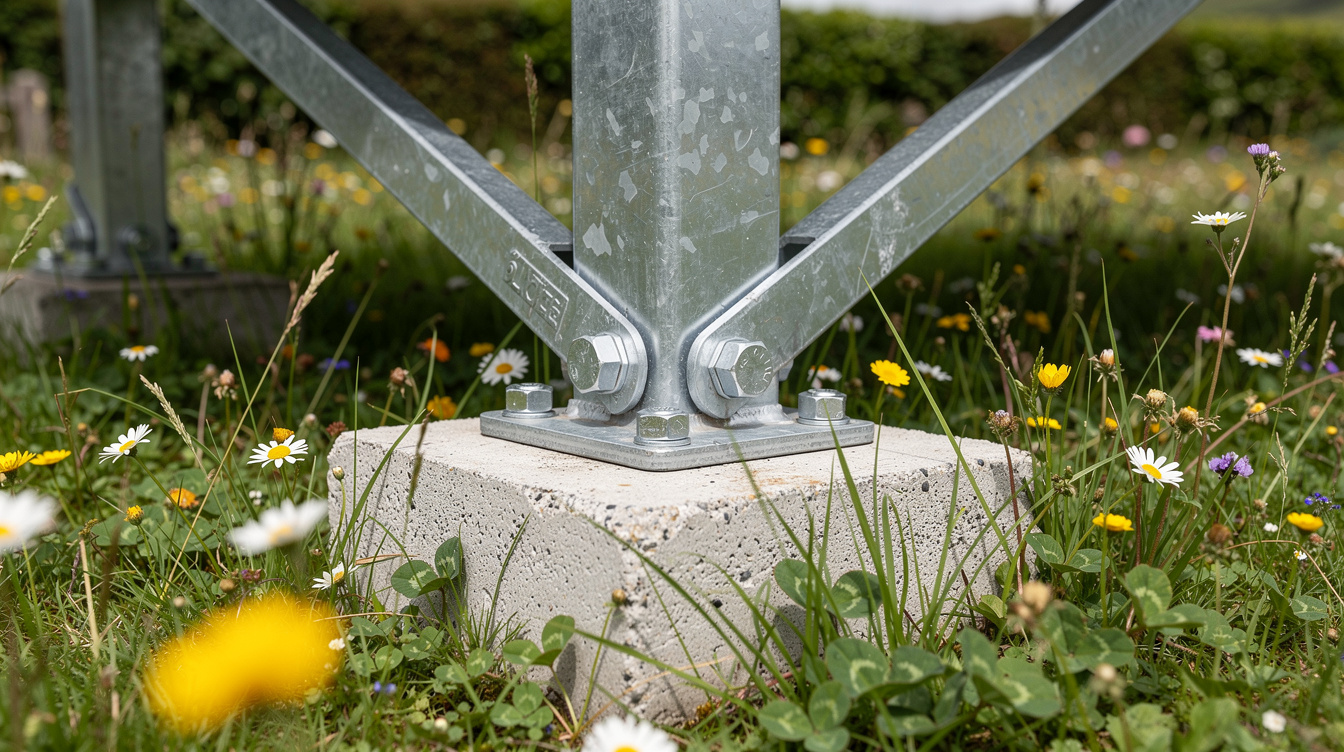
Foundations: screws, piers, or ballast?
The single biggest cost variable in a ground-mount is the foundation. Ireland’s wet, wind-loaded conditions rule out some of the shortcuts you see used in continental Europe.
Ground screws (most common for domestic)
Large helical steel screws driven 1.2–1.6 m into the soil with a hydraulic drive head. No concrete, no curing, and the installer can be commissioning the array the same day the frame goes in. Works on most Irish garden soils — boulder clay, loam, and even stony ground with the right drive head. The exception is bedrock within 1 m of surface, which is common in the Burren, parts of Connemara, and around Wicklow granite outcrops.
Concrete piers (long-life, high-wind sites)
Excavated holes filled with reinforced concrete, tied to the frame via cast-in bolts or brackets. Two days of curing before the frame can be loaded. Preferred on exposed sites — anywhere within 10 km of the Atlantic coast — because they resist the pull-out forces that a Storm Béibhinn or Éowyn-force gust generates on a tilted panel. Adds €300–€500 versus screws.
Ballast (rocky ground or where you cannot dig)
Precast concrete blocks (like Murphy Precast’s solar bases, made in Kildare) sitting on the surface with the frame bolted to them. Zero excavation makes them the only option on shallow bedrock and the fastest option where a service (gas, water) runs under the array footprint. The trade-off is weight: you need 200–400 kg of concrete per panel to hold the array down in Irish winds, and you cannot practically move it once installed.
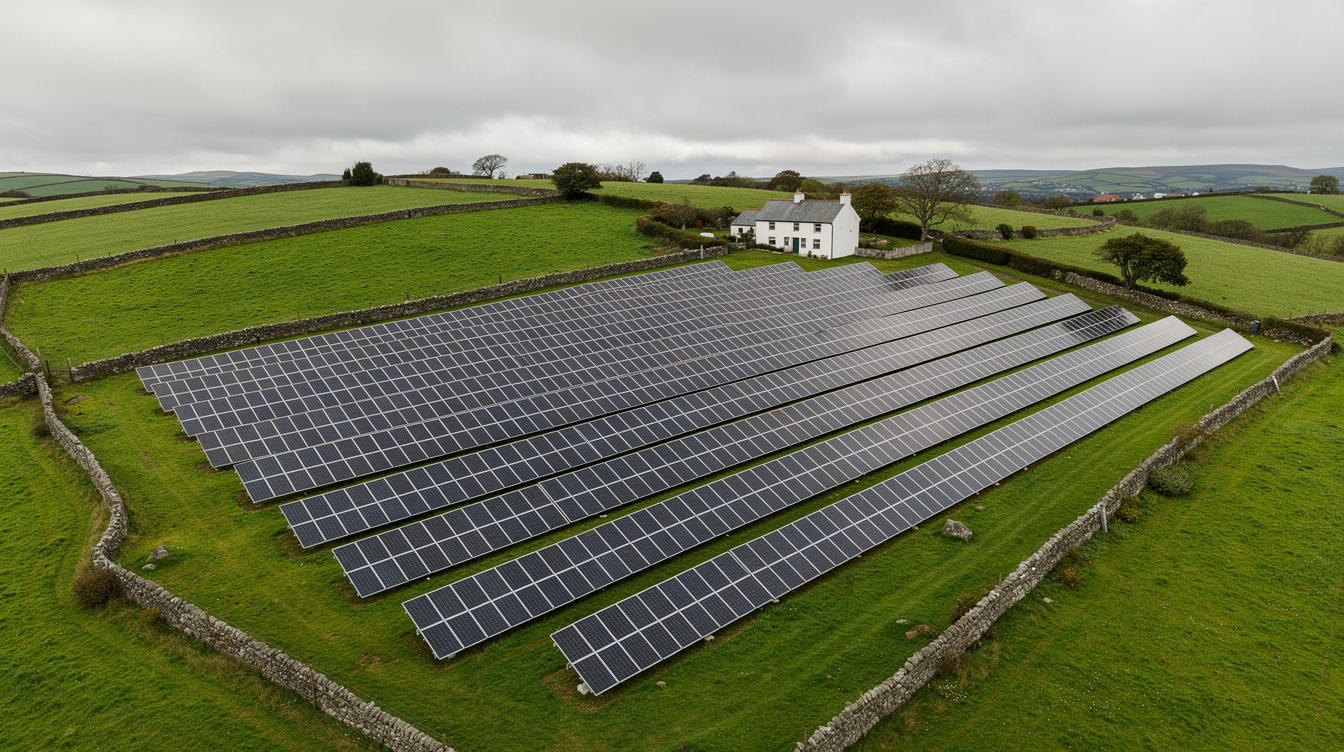
Cable runs, inverters, and where to place them
The cable run from a garden array back to the fuse board is the detail that installers most often underprice. Every extra metre of DC cable to the inverter costs money, adds voltage drop, and needs to be either buried in armoured conduit (SWA) or run overhead. Practical rules:
- Keep the DC run under 30 m if you can. Voltage drop above that gets awkward and you may need larger conductors.
- Mount the hybrid inverter indoors, close to the fuse board. Not on the outside wall next to the array, unless you have a proper IP66 enclosure — Irish winter humidity kills wall-mounted inverters faster than any other single fault.
- Run SWA in trench at 450 mm minimum depth with yellow warning tape 150 mm above. If you are trenching anyway, drop in an EV charger conduit at the same time — you will thank yourself in three years.
- Add a DC isolator at both ends — one at the array, one at the inverter. Non-negotiable for Irish DC installation certs.
A real Irish ground-mount case study
Mary and Tom, a retired couple in west Cork, own a two-storey period farmhouse with the principal roof facing north-west — the worst possible orientation for solar. Three separate installers quoted a roof array between 2022 and 2024, and every quote came in with the honest disclaimer that annual yield would be around 2,900 kWh from a nominally 4.4 kWp system.
In April 2026 they installed a 4.8 kWp ground-mount in the paddock behind the house instead:
- 11 × 435 W Longi HiMO 6 panels, black frame
- Galvanised A-frame on eight ground screws, 35° tilt, due south
- 25 m SWA cable to a Sungrow SH5.0RT hybrid inverter in the utility room
- Total pre-grant cost: €10,140
- SEAI grant: €1,800
- Net cost: €8,340
First-year generation to end of June 2026 is on track for 4,650 kWh — almost exactly the 60% lift they were promised over the roof option. Payback on the extra €1,400 they paid for ground-mount versus a compromised roof will complete inside four years.
Common ground-mount mistakes to avoid
- Underspec’d frame steel. A 25 m/s gust on a tilted 20 m² array generates real pull-out forces. Insist on hot-dip galvanised (not painted) steel with a written 25-year corrosion warranty.
- Undersized cable. A cheap 4 mm² DC run over 40 m loses noticeable yield to voltage drop across the year. 6 mm² is the sensible minimum for domestic ground-mount.
- No security consideration. Panels at ground level are physically reachable. Motion-triggered lighting, a low fence, and connecting the inverter alarm to your phone are the cheap defences.
- Ignoring shading. A ground array in front of a mature ash tree will look great in April and awful by August. Walk the site at midday in summer AND winter before committing to the location.
- Trenching without a duct spare. The trench is 80% of the labour. Never trench without dropping in a spare 32 mm duct for a future EV charger, external tap, or Cat 6 run.
Ready to Cost a Ground-Mount for Your Site?
Compare quotes from SEAI-registered installers who build both ground and roof systems.
Frequently asked questions
Does a ground-mount qualify for the SEAI grant?
Yes. The SEAI Solar Electricity Grant pays up to €1,800 on domestic ground-mount arrays exactly as it does on roof-mount, provided the property was built before 2021 and no previous PV grant has been drawn on the MPRN. Your installer must be SEAI-registered and the system must be commissioned to EN 62446.
Do I need planning permission for a small garden array?
Not if the total panel area is 25 m² or less, the array height is under 2 m, it sits 2 m from any boundary, and it is behind the front wall of the house — the standard exempted-development criteria. Full details on the current 2026 exemption limits are covered in our planning permission guide.
Will a ground array beat my south-facing roof?
No. If your principal roof faces south, is unshaded, and sits between 25° and 45°, roof-mount will always be cheaper and yield the same energy. Ground-mount is only a winner when the roof is compromised — north pitch, heavy shading, listed structure, or a fragile roof covering.
How much space do I actually need?
A domestic 4.4 kWp array occupies roughly 22–24 m² of panel area. Once you add a 2 m clear boundary setback and a maintenance walkway, budget on a footprint of about 40–60 m² of clear, south-facing garden or paddock.
Can I DIY the frame and hire an electrician for the connection?
Technically some homeowners do, but it will not qualify for the SEAI grant, will not get a NC6 grid connection through ESB Networks, and your home insurer will treat it as an unregistered installation. See our full guide to DIY solar in Ireland for the honest limits.
Get Your Ground-Mount Quote Today
Compare tailored 2026 pricing from local SEAI-registered installers — ground or roof, no obligation.
Related Articles
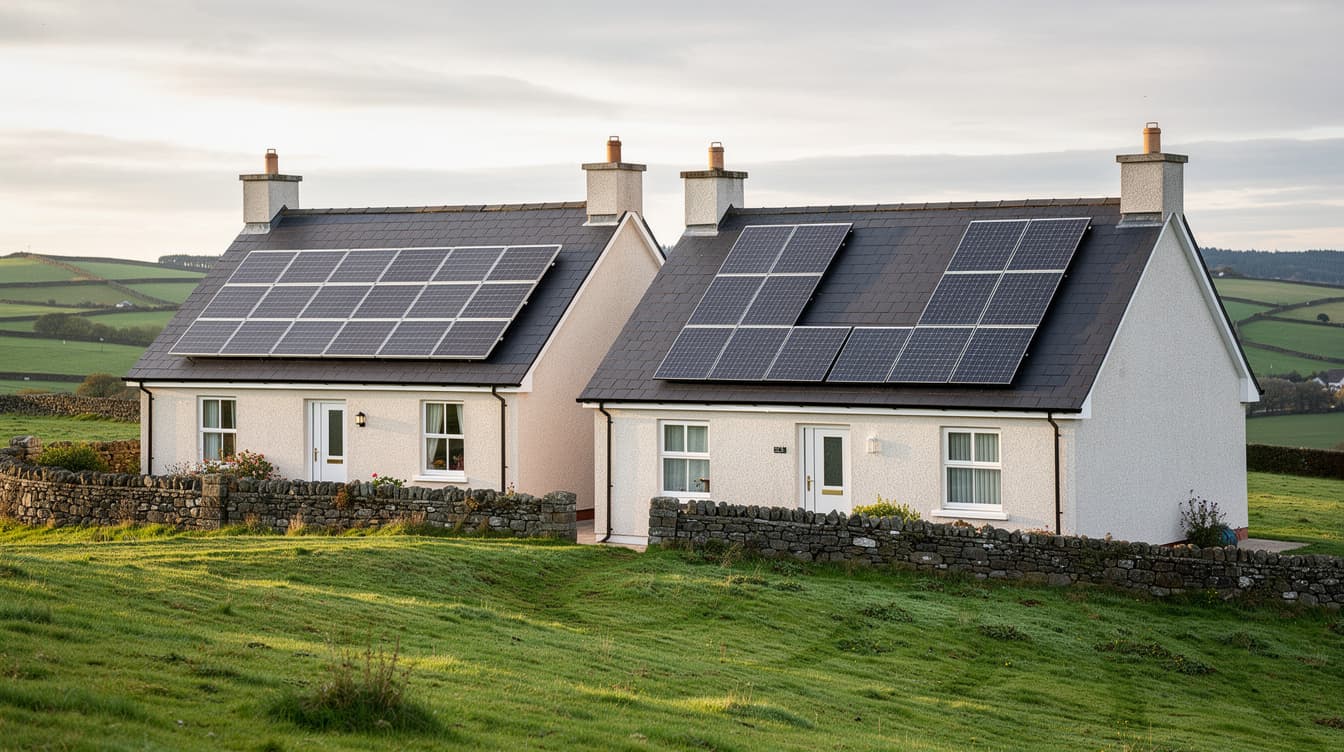
East-West vs South-Facing Solar Panels Ireland 2026: Which Actually Wins?
South-facing wins on kWh, east-west wins on self-consumption. 2026 numbers, real household examples and dual-MPPT wiring notes.
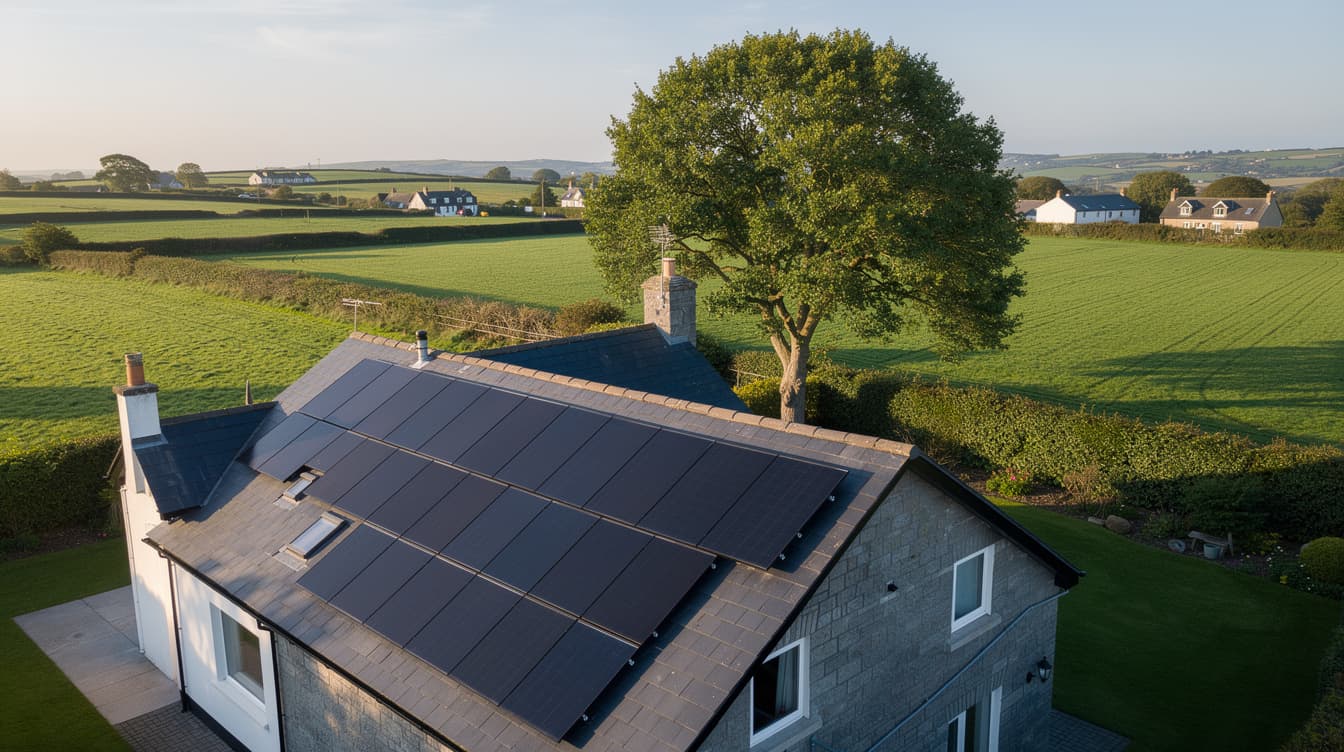
Solar Panel Shading Ireland 2026: Trees, Chimneys & Real Output Loss
How much output do you lose from trees, chimneys or dormers shading Irish solar panels? 2026 guide with mitigation costs and decision tree.
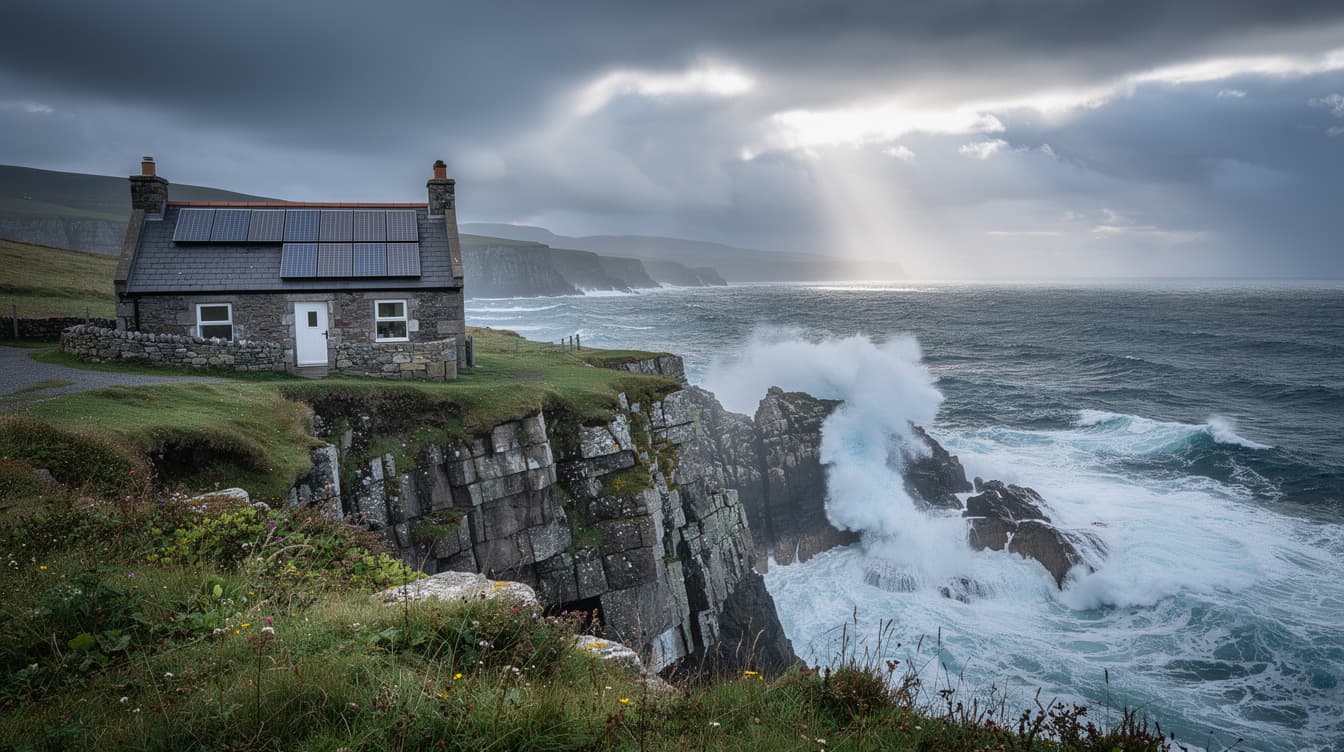
Coastal Solar Panels Ireland 2026: Salt-Air Corrosion & Marine-Grade Install Guide
Fitting solar within 3km of the Irish coast? 2026 guide to salt-air corrosion, marine-grade racking, warranty exclusions and 6-monthly maintenance.