
Balcony Solar Power Ireland 2026: What’s Legal, What Works & What It Costs
Walk down any German street in 2026 and you’ll see them clipped to balcony railings: two rigid solar panels facing outward, a small inverter behind, one Schuko plug going through a window into a socket. Germans call it a Balkonkraftwerk and there are now over 1.2 million of them installed.
In Ireland, we call it a compliance headache. Balcony solar is entirely possible on Irish balconies and terraces, but the German plug-and-play model is not legal here. This is the guide to what actually works – the products, the ESB Networks rules, the management-company reality – for anyone with a balcony, a terrace, or a flat-roof outbuilding who wants to generate their own electricity in 2026.
The 30-second summary
- Balcony solar is legal in Ireland if installed by a Safe Electric registered electrician and (for grid-connected systems) notified to ESB Networks via the NC6 microgeneration form.
- “Plug-and-play” German-style Schuko kits are not compliant on Irish sockets – the plug protection rules differ.
- Realistic output from a 2-panel (800W peak) balcony install in Ireland: 350–600 kWh/year, saving €95–€170/yr on your electricity bill.
- Typical kit cost: €550–€1,100 for the hardware, plus €250–€500 for a Safe Electric certification.
- The biggest blocker isn’t ESB – it’s your management company’s balcony modification rules.
What “balcony solar” actually means
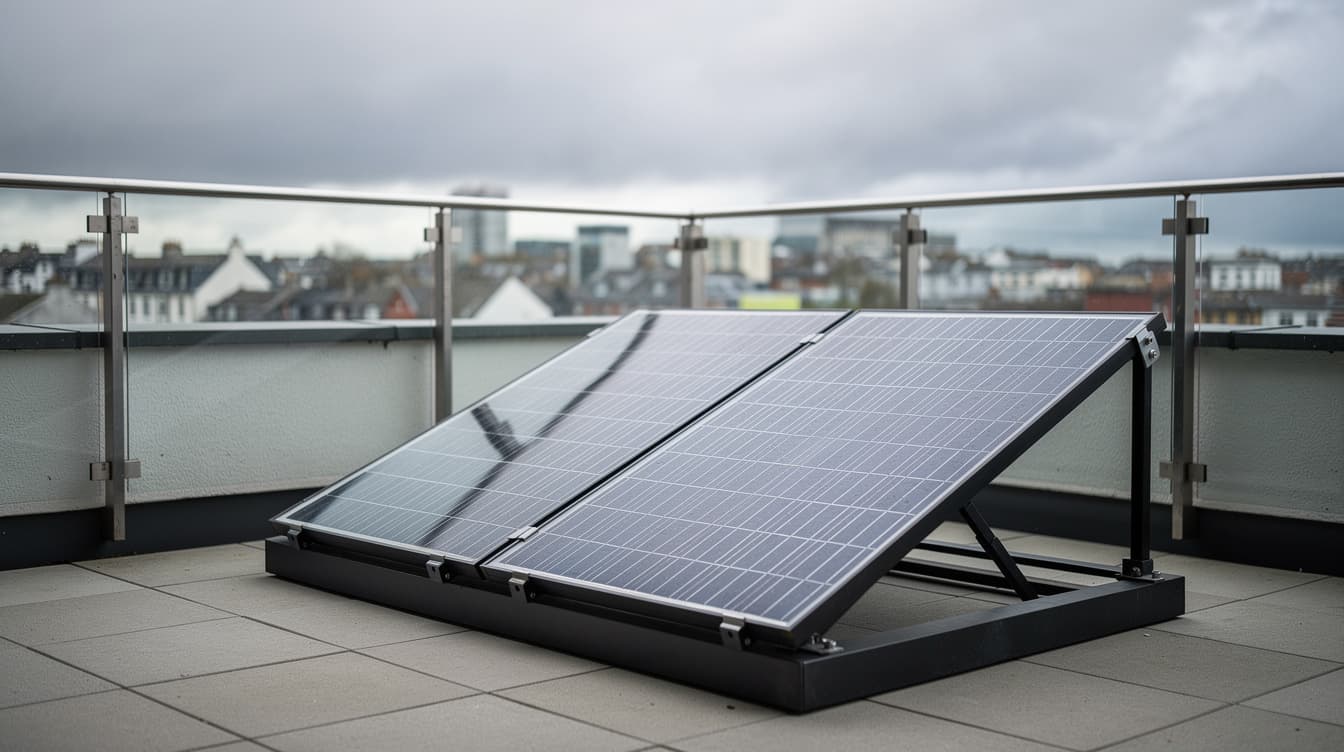
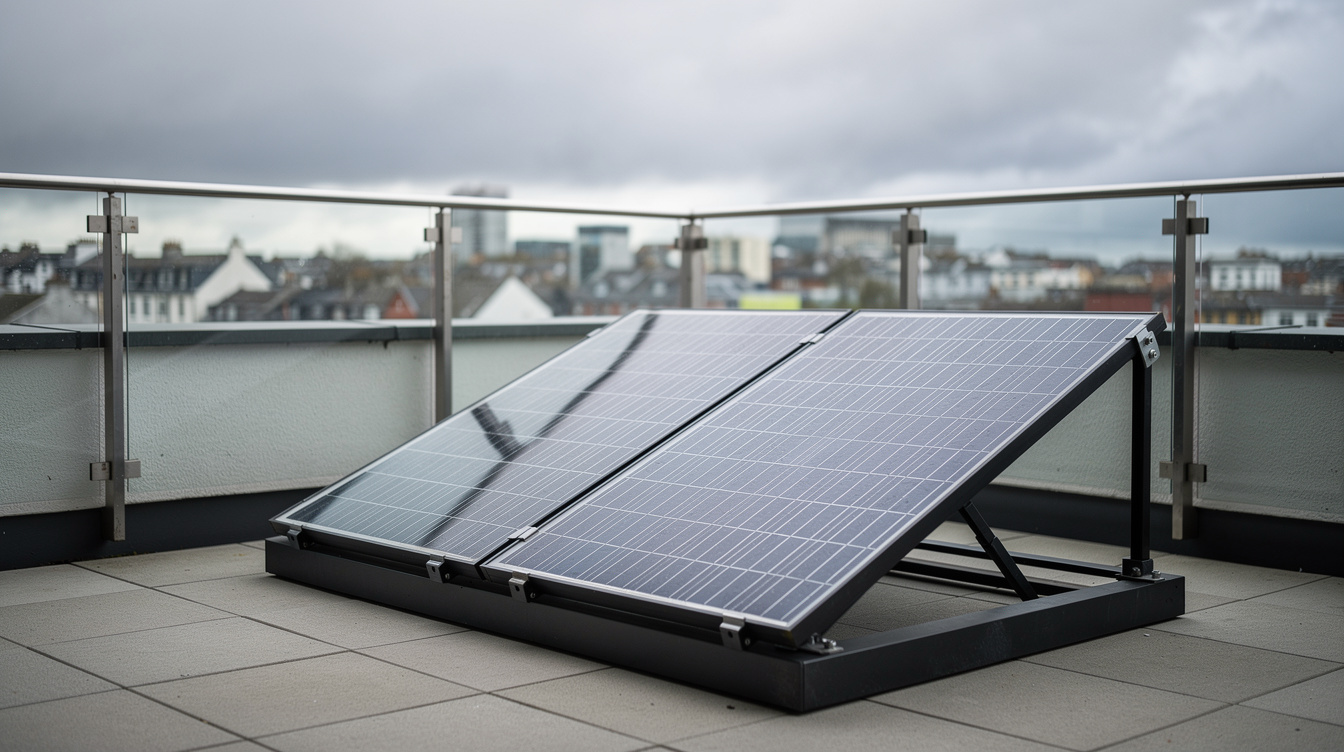
Balcony solar is any small-scale (usually 400W–900W total) PV installation designed to mount on a balcony railing, terrace floor, or apartment terrace wall – using a micro-inverter that feeds directly into the household electrical circuit rather than a full roof array with a hybrid inverter and battery.
The physical setup is nearly always:
- 1–2 rigid solar panels (410W–465W each, similar to full-roof panels)
- 1 micro-inverter rated 300W–800W AC output
- Mounting brackets (railing clamps, angled ballast frames, or wall brackets)
- An AC cable that goes to a dedicated circuit inside the flat
In Germany, Austria and now the Netherlands the AC cable ends in a household Schuko plug and pushes power backwards through your ring main whenever the sun is out. Ireland (and Great Britain, and Belgium) do not permit this – the grid connection point must be a dedicated hard-wired circuit certified by a registered electrician. That’s the single biggest difference between Irish balcony solar and continental Balkonkraftwerk.
What Irish law actually says (2026)
There is no single “balcony solar” regulation. What matters is a stack of three separate requirements:
1. ESB Networks NC6 notification
Any generation source connected to the grid – regardless of size – must be registered on ESB Networks’ NC6 microgeneration form. This is free and takes 2–4 weeks to process. Without it, your balcony solar is technically an unauthorised parallel generator.
2. Safe Electric registered electrician
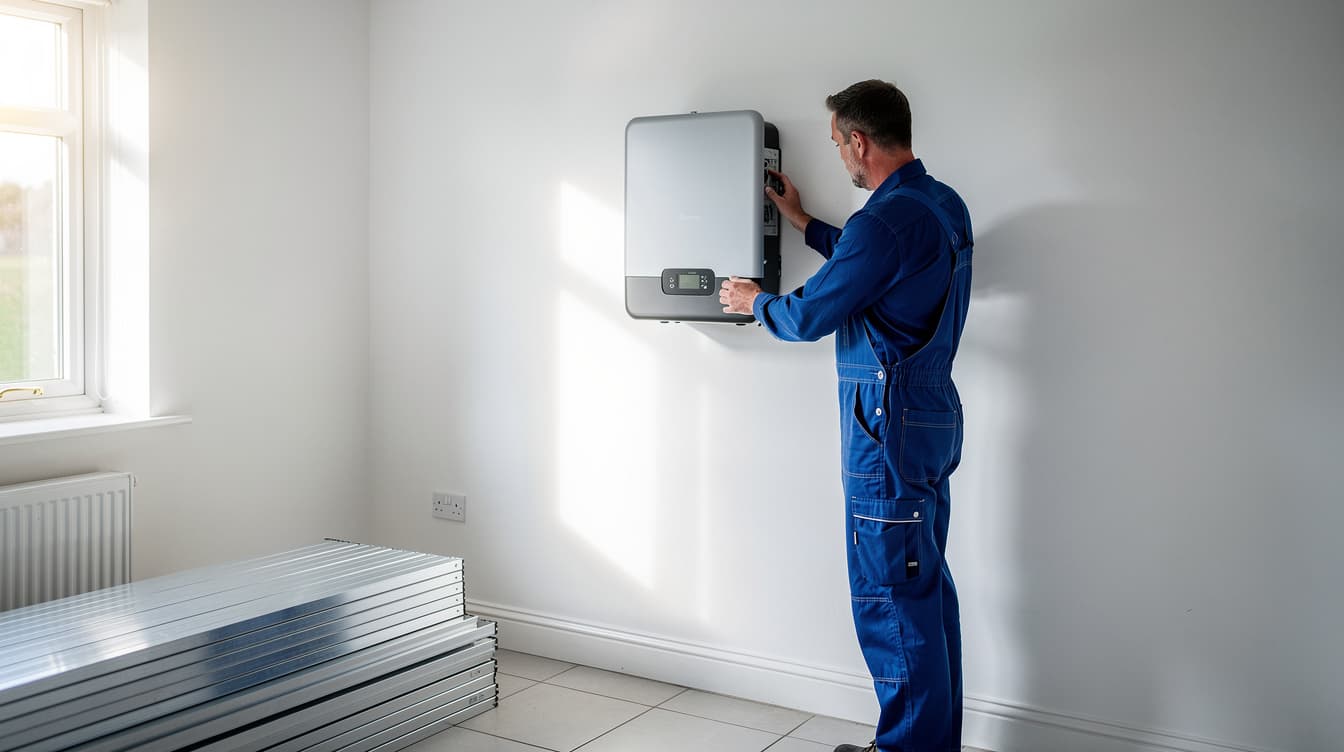
The connection between the AC output of your micro-inverter and your household circuits must be made by an electrician registered with Safe Electric. This is what turns a €600 hardware kit into a €900–€1,300 finished install. The electrician will typically add a small dedicated fused circuit off the consumer unit for the balcony solar feed.
3. I.S. EN 50549-1 compliant inverter
Ireland requires micro-inverters to be certified to I.S. EN 50549-1 with Irish grid settings enabled (voltage/frequency trip points differ from German settings). Enphase IQ8, APsystems EZ1-M and Hoymiles HM/HMS models with EU firmware all meet this – German-branded “Schuko plug” balcony kits usually don’t.
Off-grid balcony solar (no ESB required)
Everything above assumes you’re grid-tied. A separate class of balcony solar exists that never touches the mains: a panel charges a small battery (EcoFlow River, Bluetti EB3A, Jackery 300) and you power a phone charger, lamp or laptop off the battery. Perfectly legal, no NC6 needed, no electrician needed. Payback is slower (the battery’s ~€300 add-on eats into savings) but it’s the go-to path for renters.
Thinking about full roof solar instead?
If you own a house or top-floor apartment with roof rights, a proper install pays back 3–4× faster than a balcony kit.
How much electricity will an Irish balcony actually produce?
Ireland gets roughly 1,000–1,100 kWh/kWp/year on an optimally-tilted, south-facing roof. A balcony install almost never gets that:
| Balcony orientation | Tilt (panels flat against railing) | Annual yield for 800W install | Annual bill saving @ 32c/kWh (60% self-consumed) |
|---|---|---|---|
| South-facing, 15° tilt (angled bracket) | Best possible | 640–720 kWh | €123–€138 |
| South-facing, 90° vertical (clamped flat to railing) | Common | 440–520 kWh | €85–€100 |
| East or West, 90° | Common | 320–400 kWh | €62–€77 |
| North-facing | — | 150–220 kWh | €30–€42 |
| Terrace/flat roof, 30° south | Best case | 700–820 kWh | €135–€158 |
The 60% self-consumption assumption is generous but realistic for balcony solar – small systems tend to run background baseload (fridge, wifi router, standby loads) which is on 24/7. Larger arrays export more.
The single biggest yield-killer: shading
Balconies below the top floor are typically shaded for 4–6 hours of the day by the balcony above. A 40% shading factor takes your 500 kWh annual estimate down to 300 kWh – and payback from 6 years to 10 years. If your balcony spends most of the day in shadow, the numbers do not work.
Real 2026 balcony solar kits available in Ireland
These are the products actually sold or shipped to Irish customers in mid-2026, with realistic UK/IE pricing. Prices exclude the Safe Electric installation cost.
| Product | Panels + Inverter | Hardware price (2026) | EN 50549-1 IE settings? |
|---|---|---|---|
| EcoFlow PowerStream 800W | 2 × 400W + 800W micro | €599–€749 | Yes (firmware selectable) |
| Zendure SolarFlow Hyper 2000 | 2–4 × 425W + 800W micro + optional battery | €799–€1,650 with battery | Yes |
| APsystems EZ1-M 800 + 2 panels | 2 × 430W + 800W micro | €520–€690 | Yes |
| Hoymiles HMS-800W-2T + 2 panels | 2 × 450W + 800W micro | €480–€650 | Yes |
| Enphase IQ8HC + 2 panels (bespoke) | 2 × 460W + 366–384W micro each | €750–€950 | Yes (installer configures) |
| Lidl / Aldi seasonal plug-in kits | 1–2 × 300W with Schuko plug | €149–€349 | No – not IE compliant for grid feed |
The Lidl and Aldi kits (see our Lidl solar panels guide) are attractively priced but ship with German Schuko plugs and default inverter settings. In Ireland they are legal only for off-grid use (charging a portable battery), not for feeding your household circuits.
Mounting on Irish balconies – the details that matter
Balcony solar is a load-bearing engineering problem more than an electrical one. Irish balconies are typically:
- Cantilevered concrete slabs with a steel railing (1990s+ apartments)
- Steel Juliet balconies (city centre 2000s new-builds)
- Timber decks on top-floor terraces (Victorian conversions)
Each demands different mounting. Two panels + rail brackets typically add 25–35 kg to the outer face of the railing, plus wind loading. Irish wind loads on exposed apartment balconies can hit 1.2 kN/m² in coastal cities – that’s roughly 60 kg of horizontal force on each panel in a storm.
Bracket types
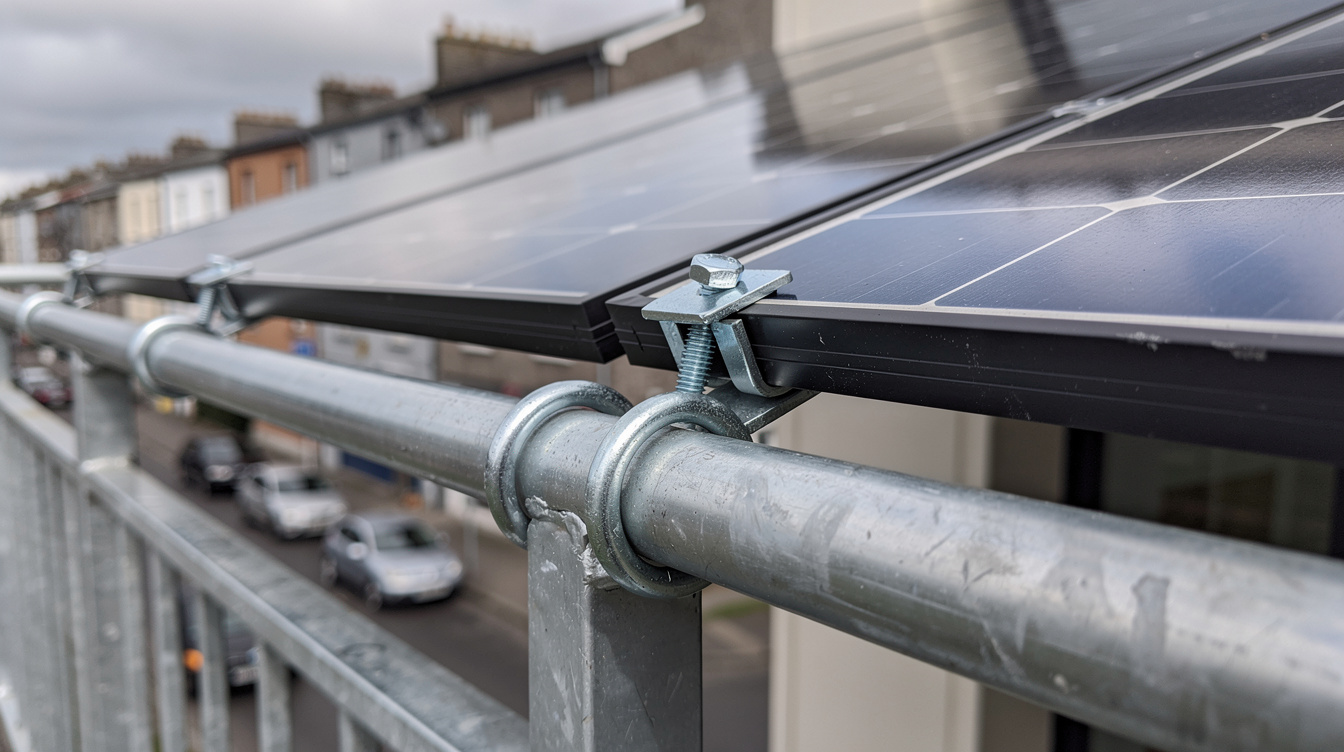
- Railing clamps – U-bolts that clamp panels to the vertical rail bars. Cheapest, easiest, but load transfers to the railing anchor bolts. Get your railing inspected before adding permanent load.
- Angled ballast frames – sit on the balcony floor with weighted feet, tilt the panels at 15–30°. No fixing to the building; boosts yield 15–25%. Takes up floor space.
- Wall brackets – through-bolted to the balcony’s parapet wall. Strongest, but permanent modification – management company almost certainly needs to approve.
Cable routing into the flat
You need to get an AC cable from the balcony (outside) to a dedicated fused circuit (inside). Three routes, in order of installer preference:
- Drill a 20mm hole through the wall next to the balcony door frame (needs freeholder consent)
- Route through the balcony door’s weep-hole or a purpose-cut window frame slot (needs door manufacturer’s approval to maintain warranty)
- Run through an open trickle vent on an aluminium window (no drilling, but weatherproofing is DIY)
All three options are things an Irish Safe Electric electrician will do routinely. What they cannot do is drill through structural walls or fire compartment walls without freeholder/OMC consent.
The OMC (management company) problem
If you’re in an apartment block or a managed estate, your Owners’ Management Company’s lease and house rules will almost always say:
- No attachments or modifications to the external walls or balconies
- No penetrations of any building envelope element
- All electrical alterations affecting common services require prior written consent
Solar panels clamped to your balcony railing tick all three. In practice, most Irish OMCs will:
- Refuse permission by default (managing agents are risk-averse)
- Reconsider if you provide a Chartered Engineer’s letter confirming the railing load capacity
- Sometimes require a bond/deposit against future removal cost
- Insist on ballasted/non-fixing systems only (angled frames on the floor)
Get the consent in writing before ordering the kit. Reversing an unauthorised install is expensive, embarrassing, and can trigger buildings insurance issues.
The renter angle
Renters have two options: negotiate a floor-standing (no attachment) system with the landlord’s consent, or go entirely off-grid (panel + portable battery, no household wiring). The 2026 legislative changes proposed by Minister O’Brien would create a specific renter’s pathway for plug-in solar, but as of July 2026 nothing has changed in law – renter installations must still meet full Safe Electric requirements.
Payback maths – the honest version
Here are three realistic Irish scenarios:
Scenario 1: Owner-occupier top-floor apartment, south terrace
- Kit: 2 × 430W panels + APsystems EZ1-M + angled ballast frame
- Hardware: €620
- Safe Electric install (dedicated circuit + NC6): €450
- Total: €1,070
- Annual yield: 620 kWh, self-consumed 60%, exported 40% at CEG 22c
- Annual saving: (620 × 0.6 × €0.32) + (620 × 0.4 × €0.22) = €119 + €55 = €174/yr
- Payback: 6.2 years. 25-year value: ~€3,300.
Scenario 2: Mid-floor west-facing balcony, panels vertical on railing
- Kit: 2 × 400W panels + Hoymiles inverter + railing clamps
- Hardware: €530
- Safe Electric install: €400
- Total: €930
- Annual yield: 360 kWh, self-consumed 70%
- Annual saving: €93
- Payback: 10 years. Marginal.
Scenario 3: Renter off-grid setup, south terrace
- Kit: 1 × 430W panel + EcoFlow River 2 Pro portable station
- Total: €599
- Powers: phone charging, laptop, one lamp, wifi router when unplugged from mains
- Direct offset: ~150 kWh/yr = €48 annual saving
- Payback: 12+ years. Not really about payback – it’s about resilience and blackout backup.
Insurance and buildings warranty implications
Your household contents insurance won’t typically cover a balcony solar kit as “contents” because it’s attached to the building exterior. Most Irish insurers (Aviva, AIG, Zurich, FBD) will either:
- Add it under “buildings” if you own the freehold, at a small premium uplift
- Refuse cover if it’s attached to leasehold common areas without OMC consent
- Cover the panels themselves as a separately-listed personal item on contents
Notify your insurer before installing, and keep the Safe Electric completion cert (RECI form) – without it, any electrical damage claim will be refused.
When balcony solar makes sense – and when it doesn’t
Good fit
- You own a top-floor apartment or duplex with south or south-west orientation
- You’re on a smart tariff with high peak-hour rates (Home Electric+, Smart Data)
- You work from home during daylight (higher self-consumption)
- Your OMC is willing to grant consent (typically small blocks under 20 units)
Poor fit
- Ground or first-floor apartment with 4–6 hours of overshadowing
- North or heavily-oriented east balcony
- You’re out of the house 9–5 every day (self-consumption drops below 40%)
- OMC has already refused similar applications in the block
- You’re considering it as a substitute for a full-roof install (10× more energy for 3× the cost)
Not sure if balcony or roof is right for you?
If you own a house or have roof rights, a proper roof install pays back in half the time – and qualifies for the €1,800 SEAI grant.
Frequently asked questions
Can I get the SEAI €1,800 grant for balcony solar?
No. The SEAI PV grant applies to systems 2–6 kWp, roof-mounted or ground-mounted, on the applicant’s owned home built before 1 Jan 2021. Balcony solar systems are typically 0.4–0.9 kWp, below the SEAI minimum threshold. See our full SEAI grant eligibility checker.
Do I still need to apply for NC6 registration for a small 800W system?
Yes. ESB Networks requires notification for any grid-tied generator regardless of size. The NC6 form is free and takes 15 minutes to complete online. See our NC6 walkthrough.
Can I qualify for the Clean Export Guarantee with balcony solar?
Yes, provided the NC6 is registered and your supplier offers a smart meter export tariff. The CEG payment is typically 20–24c/kWh in 2026 (see our CEG guide). Balcony systems export little (60–120 kWh/yr for the average install) so this adds €15–€25 to annual returns, not thousands.
What’s the difference between balcony solar and plug-in solar?
Balcony solar refers to location (balcony/terrace mounting); plug-in solar refers to connection method (plugs into a standard socket vs hard-wired). In Ireland, all balcony solar must currently be hard-wired via a registered electrician – so “plug-in balcony solar” is not a legal option here in 2026, though Minister O’Brien has indicated openness to changing this.
Will legalising Balkonkraftwerk-style plug-in solar change everything?
Potentially. Germany’s April 2024 simplification (raising the plug-in threshold to 800W, removing installer requirements) triggered a market boom – adoption trebled in 12 months. If Ireland follows suit in 2026 or 2027, hardware-only kits at €300–€500 would become viable for renters, cutting the payback below 4 years for well-sited installs.
What about wind and storm damage?
A properly-installed balcony solar system (Safe Electric certified, engineer-signed for the mounting bracket) is rated for winds up to 130 km/h. That’s stronger than most named Irish storms. Poorly-clamped or DIY installs are the ones that end up on the ground floor after a February gale.
Can I combine balcony solar with a home battery?
Yes, if the battery is a “behind-the-meter” storage unit fed from the same AC circuit. Zendure SolarFlow, EcoFlow PowerStream and Anker Solix systems all now offer 1–5 kWh battery add-ons designed for balcony use. Payback with a battery is 8–12 years, longer than the panel-only version.
How long do balcony solar panels last?
Same as roof panels: 25+ years, with typical output warranty of 85% of original at year 25. Micro-inverters have shorter warranties (10–15 years) and are the first component likely to need replacement.
The bottom line
Balcony solar in Ireland in 2026 is a €900–€1,300 project that saves €90–€170 per year in the best cases. It’s legal but not cheap, and the biggest barrier is your management company rather than ESB Networks. For most Irish apartment dwellers, it’s a nice-to-have symbolic gesture rather than a serious energy investment – the payback maths only really works on top-floor south-facing terraces with an owner-occupier and a permissive OMC.
For everyone else, watch the legislation. If Ireland follows Germany’s 2024 simplification and legalises 800W plug-in balcony systems without the Safe Electric hard-wire requirement, hardware-only kits at €400–€600 with 5–7 year payback become the norm – and Irish balconies could start looking a lot more like Berlin.
Have a house rather than an apartment?
A proper roof install pays back 3–4× faster and qualifies for the €1,800 SEAI grant. Get quotes from SEAI-registered installers.
Related Articles
3-Phase Voltage Ireland Explained: 400V, 230V & Home Solar 2026
Ireland’s 3-phase mains is 400V line-to-line and 230V line-to-neutral. Full explainer on tolerance bands, voltage rise, inverter over-voltage trips & how to check your supply.
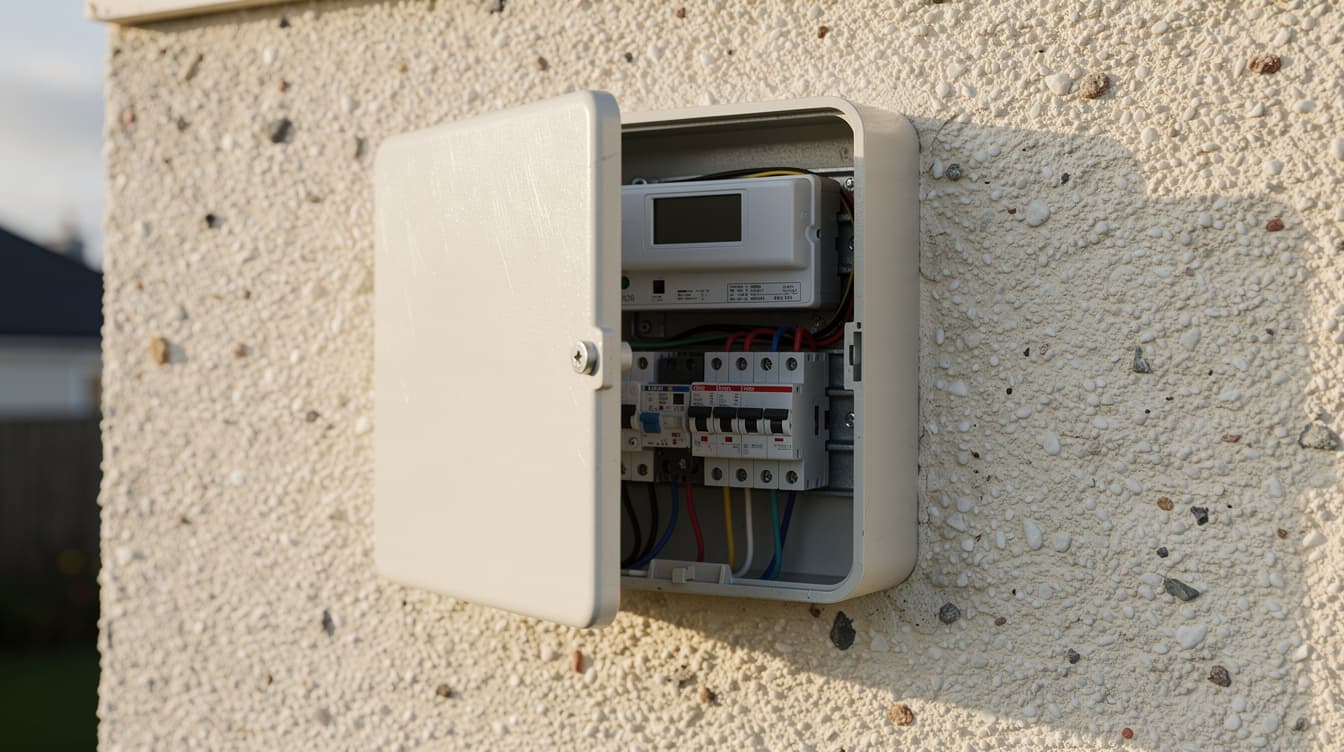
MPRN Ireland 2026: What Your Meter Point Reference Number Is & Why Every Solar Installer Asks for It
Every Irish solar quote asks for your MPRN. What the 11-digit number means, where to find it, and the SEAI grant mistake it prevents.
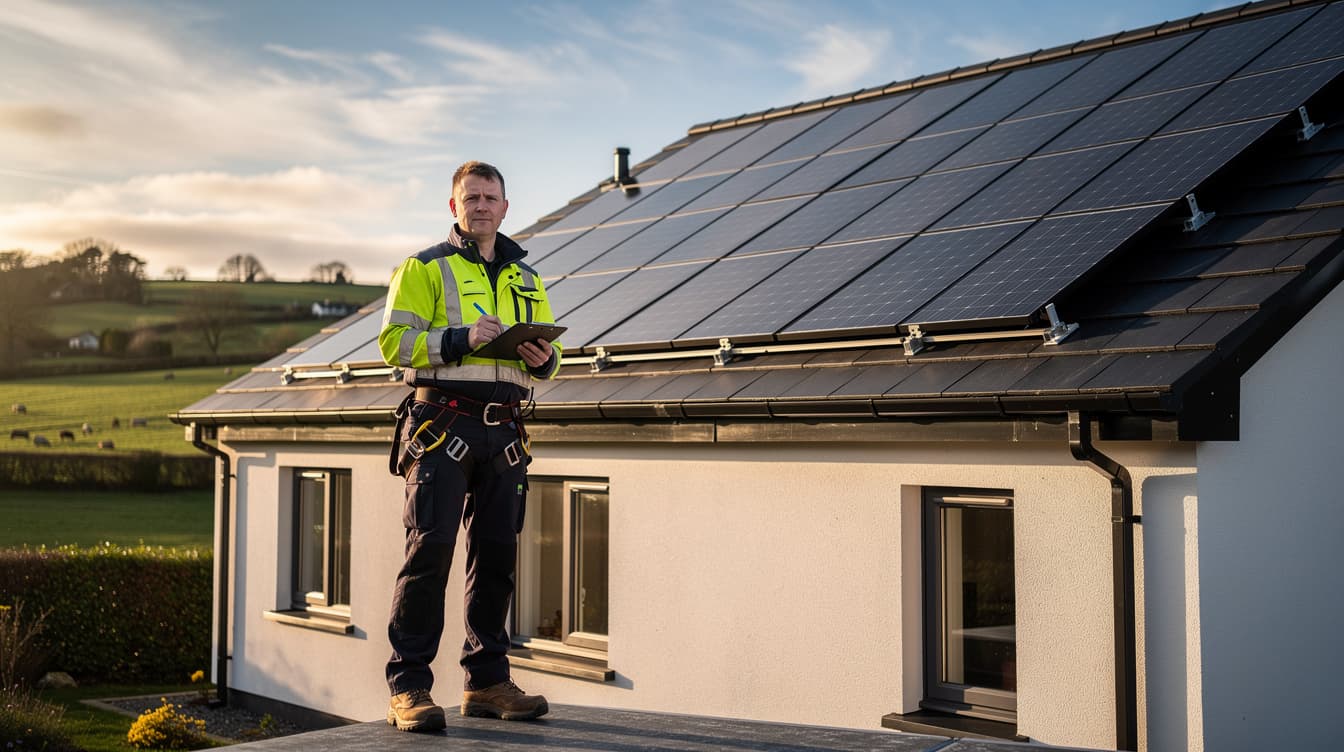
ESB Networks NC6 Form Ireland 2026: The Solar Homeowner's Walkthrough
Every Irish solar homeowner needs an NC6 filed with ESB Networks. Timeline, common installer mistakes, and how to spot a stalled application.