
3-Phase Voltage Ireland Explained: 400V, 230V & Home Solar 2026
Updated 2 August 2026. If you’re on a three-phase supply in Ireland — or thinking about upgrading to one for a heat pump, EV charger, or larger solar array — the first thing to know is the voltage. Ireland’s three-phase mains is 400 V line-to-line and 230 V line-to-neutral, and understanding what those two numbers actually mean makes the difference between a solar inverter that runs cleanly for 25 years and one that trips off every sunny afternoon on a "grid over-voltage" fault.
This is the technical companion to our broader three-phase solar guide. Here we focus specifically on voltages, the EN 50160 tolerance band, voltage rise, and how ESB Networks polices what your inverter is allowed to push back to the grid.
The two numbers: 230 V and 400 V
An Irish three-phase supply delivers three separate 230 V waveforms, offset from each other by 120 electrical degrees. Between any live phase and the neutral wire, you measure 230 V AC (that’s the same voltage as a normal single-phase socket). Between any two live phases, the two 230 V waveforms combine geometrically to give 400 V AC (specifically, 230 × √3 = 398 V, rounded to 400).
| Measurement | Nominal voltage | Typical live range | Common name |
|---|---|---|---|
| Phase to neutral (L–N) | 230 V AC | 216 – 253 V | Single-phase / low voltage |
| Phase to phase (L–L) | 400 V AC | 376 – 440 V | Three-phase / high voltage LV |
| Frequency (all cases) | 50 Hz | 49.5 – 50.5 Hz | Mains frequency |
Everything in Ireland uses this same TN-C-S "PME" 4-wire arrangement — three live phases (typically labelled L1, L2, L3 or brown/black/grey) plus a shared neutral. That combined neutral is why a three-phase board can feed single-phase circuits at 230 V without any transformer — you just pick a phase and connect neutral.
Why Ireland is 400/230 and the UK used to be 415/240
Older Irish and UK installations were nominally rated at 415 V line-to-line and 240 V line-to-neutral. On 1 January 1995 the European harmonised standard EN 50160 came into force, and every European country’s low-voltage distribution was declared to be 400/230 V nominal. In practice nothing physically changed — the tolerance band was simply widened from ±6% around 240 V to +10%/−6% around 230 V, so the old 240 V network sits comfortably at the upper end of the new spec.
If you see a legacy nameplate showing "415 V 3-phase" or "240 V single-phase" — equipment plates, older transformer labels, industrial motors — the equipment is fully compatible with modern 400/230 V supply. The numbers describe the same physical thing, just with different labelling conventions.
Voltage tolerance: what ESB Networks is obliged to deliver
Under EN 50160 and the Irish Distribution Code, ESB Networks must keep 95% of 10-minute average voltage readings at your meter within ±10% of nominal — so 207 V to 253 V phase-to-neutral, or 360 V to 440 V phase-to-phase. During the other 5% of the time, voltage can dip to 85% or spike to 110% (up to 253 V single-phase) for short periods and still be compliant.
In practice, most Irish residential supplies sit around 232–245 V phase-to-neutral in normal conditions. Rural end-of-line premises and lightly-loaded suburban circuits tend to run hot (240–250 V); industrial and heavily loaded areas run closer to nominal (225–235 V). This is where solar systems collide with grid design.
Getting a 3-Phase Solar Quote?
Free quotes from SEAI-registered installers experienced with three-phase installs.
Voltage rise: the reason your solar inverter cuts out
When your solar inverter exports current to the grid, it has to push its output voltage slightly higher than the grid voltage at the point of common coupling — that’s just Ohm’s law. On a lightly-loaded transformer with long service cables, that "push" can lift the local voltage at your meter into or above the 253 V ceiling.
When the inverter’s measured grid voltage exceeds 253 V for more than a set time (typically 10 minutes rolling average, or 1.5 seconds for sudden spikes above 264 V), the ESB Networks NC6 rules require it to shut down and stop exporting. You’ll see this in inverter logs as "OV-G-V01", "grid over-voltage", "AC over-voltage", or a similar code depending on brand.
The three-phase advantage: on a three-phase inverter, exported current is spread across three phases instead of one, so the per-phase voltage rise is roughly one-third what it would be on the same output pushed through a single phase. A 6 kW single-phase export causes ~3 V rise on a typical Irish rural cable. The same 6 kW spread across three phases causes ~1 V rise per phase. If you’re rural, three-phase can be the difference between a system that exports cleanly and one that’s constantly tripping.
How to identify your supply
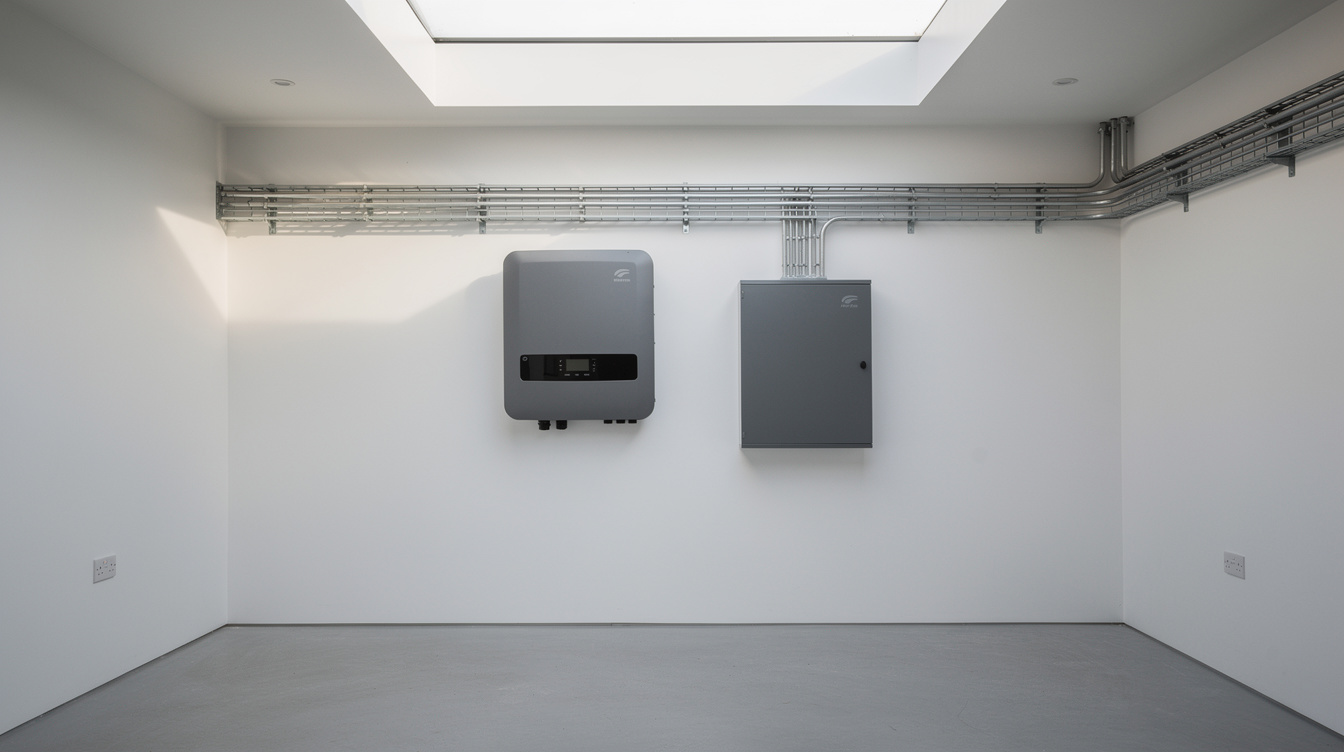
You do not need an electrician to work out whether your home has three-phase supply. Three visual checks at your meter cabinet, in order of certainty:
- Count the meter tails at the top of the cutout. Single-phase supply: two thick cables (one live, one neutral). Three-phase supply: four thick cables (three lives, one neutral), typically labelled L1/L2/L3/N or coloured brown/black/grey/blue.
- Look at your main fuse. Single-phase homes have one ESB main fuse in the cutout. Three-phase homes have three side-by-side fuses (usually 63 A or 80 A each).
- Look at the meter itself. A single-phase MID/smart meter is a shorter, narrower unit. A three-phase meter is roughly 50% wider and has three sets of terminals visible behind the polycarbonate window.
You must not open the meter cabinet or touch anything inside — the cutout on the ESB side is unmetered and live at all times — but everything above can be checked visually through the cabinet door.
Solar inverter voltage settings you should know
Every grid-tied inverter sold in Ireland comes with a set of grid-protection thresholds mandated by ESB Networks NC6 rules. On modern models (Sungrow, SolarEdge, Fronius, Fox ESS, Growatt), the installer selects the "Ireland" or "EN 50549-1-IE" grid code at commissioning, which loads these settings:
| Protection | Threshold | Trip time |
|---|---|---|
| Over-voltage stage 1 | 253 V (10-min avg) | 3 s |
| Over-voltage stage 2 | 264 V | 1.5 s |
| Under-voltage stage 1 | 207 V | 3 s |
| Under-voltage stage 2 | 184 V | 0.2 s |
| Over-frequency | 50.5 Hz | 0.5 s |
| Under-frequency | 47.5 Hz | 0.5 s |
These thresholds are non-negotiable — installers cannot legally loosen them to "fix" nuisance tripping. If your inverter is tripping regularly on OV-G-V01, the correct fix is either upgrading to three-phase, moving the tap on your local ESB transformer (an ESB Networks job, free but with a 4–12 week wait), or reducing exported current with active power derating or a battery storage system.
Three-phase load balancing for solar
A three-phase supply lets a household distribute loads across L1, L2, and L3. A well-designed three-phase board splits circuits roughly evenly — sockets on one phase, cooker/oven on another, immersion and EV charger on the third — so that any one phase carries a manageable share of the total load.
Modern three-phase hybrid inverters (Sungrow SH10RT, SolarEdge SE10K, Fox ESS H3, Fronius Symo Hybrid) actively balance their AC output across all three phases — regardless of how uneven the household loads are — and modulate export per phase to stay within voltage limits. This is a big shift from earlier three-phase inverters that simply pushed one-third of the DC power to each phase, which under uneven loads could still trip on the highest-voltage phase.
Practical implication for solar: if you have three-phase supply, insist on a three-phase inverter even for smaller systems (5 kW). Fitting a single-phase inverter to just one phase of a three-phase board is legal but wastes the export-headroom benefit and can create voltage-rise problems specific to that one phase.
Common voltage-related inverter fault codes
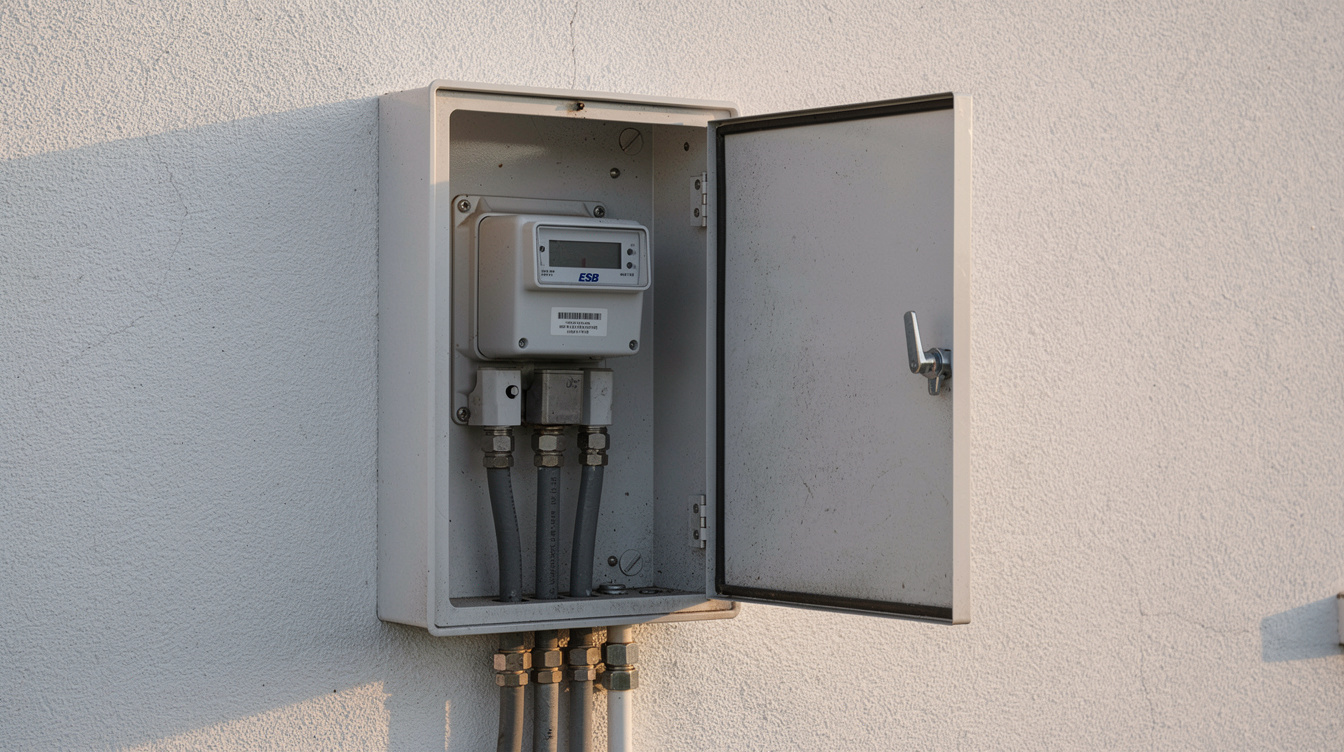
- OV-G-V01 / Grid V. Fault / AC Over-Voltage — grid voltage above 253 V for >3 s. Most common Irish issue on rural single-phase systems in summer. Fix: transformer tap, three-phase upgrade, or storage.
- UV-G-V01 / AC Under-Voltage — voltage below 207 V for >3 s. Rare in Ireland; usually indicates a serious grid fault or a bad neutral connection.
- Grid Freq. Fault / OF-G / UF-G — frequency outside 47.5–50.5 Hz. Almost always a genuine grid disturbance, not a system fault. Ignore isolated occurrences.
- Grid Loss / Islanding Protection — inverter has detected the grid has disappeared. This is required behaviour during power cuts to protect line workers. Only concerning if it happens with grid clearly present.
- Phase Sequence Error (three-phase only) — L1, L2, L3 are wired in the wrong order. Installer error at commissioning; fixed by swapping any two live tails.
Measuring your own voltage
The cheapest useful check is a plug-in mains voltage meter (roughly €15–€25 on Amazon or in electrical wholesalers). Plug it into a socket close to your main distribution board and log the reading at three times: 6am (baseline), 2pm sunny (peak solar export if you have it), and 8pm (peak evening load).
- All three readings 220–240 V: your supply is healthy. Any inverter tripping is likely a genuine grid excursion, not a chronic voltage-rise issue.
- 2pm reading noticeably higher than the other two (e.g. 246 V vs 230 V): voltage rise is happening at your premises. This is normal in rural areas but worth documenting if your inverter starts tripping.
- All readings persistently above 250 V: your ESB transformer tap is set too high for your circumstances. Contact ESB Networks (1800 372 999) and log a Power Quality Report. They will send an engineer with a datalogger; if voltage is confirmed above 253 V for >5% of a week, they will re-tap the transformer at no cost.
FAQ
Is 400 V dangerous compared to 230 V single-phase?
Both are lethal in the wrong circumstances — a 230 V shock across the chest kills roughly 15 people a year in Ireland. But 400 V is genuinely more dangerous per contact because the higher voltage more easily arcs across small air gaps and through skin resistance. Only qualified electricians (RECI-registered for domestic three-phase) should work on three-phase panels beyond isolating the main switch.
Can I run a normal 230 V appliance from a three-phase supply?
Yes — three-phase distribution boards feed 230 V single-phase circuits by picking one phase and combining with neutral. Your kettle, TV, and washing machine plug into 230 V sockets exactly as they would on a single-phase house.
What voltage does a three-phase EV charger use?
An 11 kW or 22 kW three-phase home charger uses all three phases simultaneously at 400 V line-to-line, drawing 16 A (11 kW) or 32 A (22 kW) per phase. The car’s onboard charger sees the 400 V three-phase input and rectifies it internally.
Can I upgrade single-phase to three-phase just for solar export headroom?
You can, but it’s rarely worth it on cost alone. ESB Networks charges €1,800–€4,500 for the upgrade depending on distance from the transformer, and there’s typically a €1,000–€2,500 electrician cost to re-wire your consumer unit. Only makes sense if you were already planning a heat pump, workshop, EV, or a very large solar array (>8 kWp). See our three-phase solar guide for a full cost breakdown.
My inverter says "277 V" on the nameplate — is that Irish-compatible?
277 V is the North American 480/277 V three-phase phase-to-neutral voltage. That inverter is North American spec and cannot be used in Ireland — it will not accept a 230 V phase-to-neutral input, and it isn’t certified to any European grid code. Buy only inverters explicitly listed on the ESB Networks type-tested equipment register.
Plan a 3-Phase Solar Install?
Get quotes from SEAI installers experienced with three-phase homes.
Related reading
Related Articles
MPRN Ireland 2026: What Your Meter Point Reference Number Is & Why Every Solar Installer Asks for It
Every Irish solar quote asks for your MPRN. What the 11-digit number means, where to find it, and the SEAI grant mistake it prevents.
ESB Networks NC6 Form Ireland 2026: The Solar Homeowner's Walkthrough
Every Irish solar homeowner needs an NC6 filed with ESB Networks. Timeline, common installer mistakes, and how to spot a stalled application.
Solar Panels & Three-Phase Electricity Ireland 2026: NC6 Rules, Inverters & Payback
Three-phase Irish homes can export 11 kW under NC6, fit 10-25 kW inverters and run heat pump + EV + solar together. Real 2026 prices and payback scenarios.