
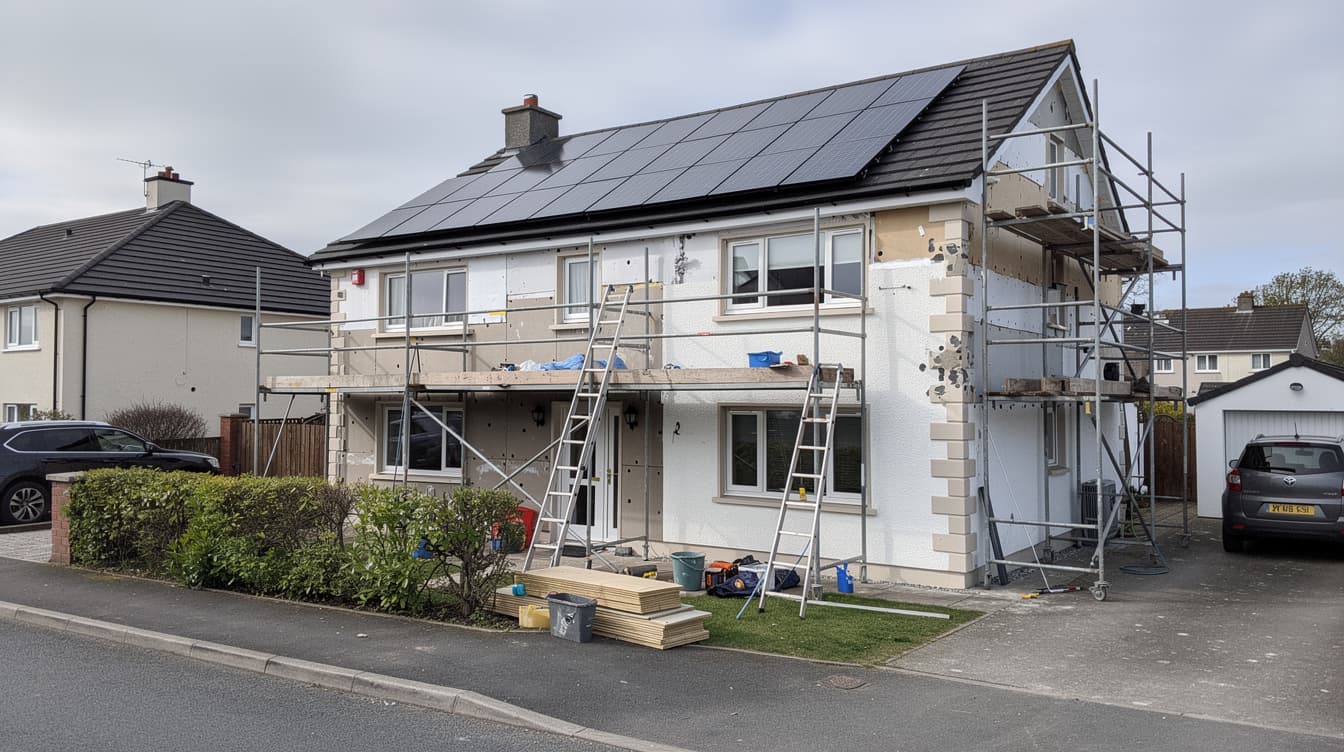
BER Rating Ireland 2026: Scale, Cost & How Solar PV Boosts Your Rating
Your BER — Building Energy Rating — is the alphabet letter (A1 to G) on the certificate that gets stuck to every Irish house when it’s sold, rented, or seriously renovated. It looks like a school grade and behaves like one: it tells anyone looking at your home how much energy it will burn through over a year for heating, hot water, and ventilation. By 2026 it’s also a thing that drives real money. A B2 rating versus a D2 rating can be worth €25,000–€60,000 of valuation difference on a typical 3-bed semi, and the gap is widening as the EU’s Energy Performance of Buildings Directive recast (transposed into Irish law in 2025) requires every rented home to reach at least a D by 2030 and a C by 2033.
This guide explains what the BER scale actually measures, what each rating costs in fuel per year on a typical Irish home, what a SEAI assessor does on the visit, what an assessment costs in 2026, and — the bit most people are asking — how much your rating jumps if you add solar PV, a heat pump, insulation, or a combination of those upgrades. Numbers are 2026-current, sourced from SEAI DEAP 4.2 (the official assessment software) and recent Irish published assessor data.
The BER scale — what each letter actually means
BER is measured in kWh per square metre per year (kWh/m²/yr) of primary energy use. Lower number = better rating. The Irish scale, set out under SI 666/2006 and updated in SI 243/2012, runs from A1 (best) to G (worst):
| Rating | kWh/m²/yr | Typical home | Annual energy bill (130 m² semi) |
|---|---|---|---|
| A1 | < 25 | Passive house standard | €450–€700 |
| A2 | 25–50 | Most new builds since 2019 | €700–€1,050 |
| A3 | 50–75 | Best end of 2010s new builds | €1,050–€1,450 |
| B1 | 75–100 | Deep-retrofit 1980s semi | €1,450–€1,800 |
| B2 | 100–125 | Strong retrofit, late 2000s new build | €1,800–€2,200 |
| B3 | 125–150 | Solid mid-2000s build | €2,200–€2,600 |
| C1 | 150–175 | Partial retrofit older home | €2,600–€3,000 |
| C2 | 175–200 | 1990s build, basic spec | €3,000–€3,450 |
| C3 | 200–225 | Older home with attic insulation | €3,450–€3,900 |
| D1 | 225–260 | Typical 1970s/80s untreated | €3,900–€4,450 |
| D2 | 260–300 | Solid block 1960s/70s semi | €4,450–€5,100 |
| E1 | 300–340 | Older cottages, basic spec | €5,100–€5,750 |
| E2 | 340–380 | Stone-walled rural home | €5,750–€6,400 |
| F | 380–450 | Pre-1960 single-leaf, leaky | €6,400–€7,600 |
| G | > 450 | Worst-case old farmhouse | €7,600+ |
Two things worth noting. First: BER measures primary energy, not delivered energy — so electric heating gets a 2.0× multiplier vs. gas because of grid losses. A house heated by direct electric storage heaters will always rate worse than the same house with a gas boiler, even at identical real energy use. Second: BER does not measure how warm your house actually is. It measures what the building would consume under a standardised assumed occupancy and indoor temperature. Your actual bill can be lower (you don’t heat all rooms) or higher (you have the heat on 14 hours a day with the back door open).
What a BER assessment costs in Ireland 2026
An assessment is conducted by a SEAI-registered BER assessor — the public register is at ndber.seai.ie. Prices vary by location and house size:
- Standard 3-bed semi: €150–€220 (Dublin commuter belt commands the upper end)
- 4-bed detached: €180–€280
- 5-bed+ or non-standard layout: €250–€400
- Apartments: €130–€180
- Rural homes > 30 km from assessor base: add €30–€80 travel surcharge
The visit itself takes 60–120 minutes. The certificate (BER + Advisory Report) lands by email in 5–10 working days. It is valid for 10 years or until a significant energy-affecting change is made. If you add solar, a heat pump, or do attic insulation after assessment, the existing BER is stale and a fresh assessment is needed to capture the new rating.
When you legally need a BER
Under SI 243/2012 (the Building Energy Rating Regulations) and EU Directive 2010/31, you must have a published BER:
- Before selling a residential property — the agent cannot advertise without the BER number and rating on the listing
- Before renting a residential property — same rule, BER must appear on the letting advertisement
- For new builds — provisional BER must be lodged with the planning compliance certificate; final BER after completion
- Following major renovation (where >25% of the building envelope is altered) — new BER required within 9 months of works completion
Penalties for advertising or letting without a BER run to €5,000 plus prosecution under SI 243/2012. The Residential Tenancies Board has been actively enforcing on landlords since 2024.
How much does each upgrade lift your BER?
This is what most people actually want to know. The numbers below are typical DEAP 4.2 outputs from real Irish assessments published 2025–2026, modelled on a 130 m² 1980s semi-detached starting at D1 (rating value ~245 kWh/m²/yr) with a gas boiler and single-glazed windows.
| Upgrade | Typical BER drop | D1 home becomes… | Net cost (after grant) |
|---|---|---|---|
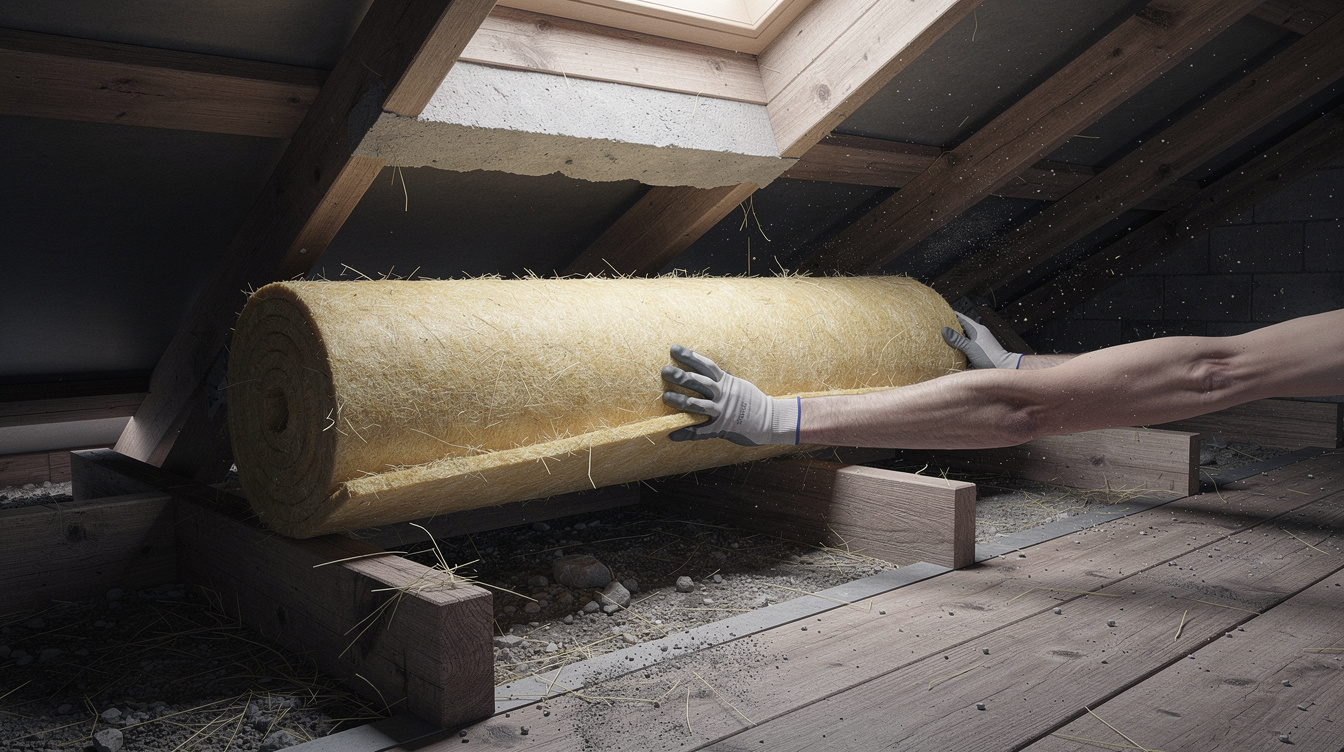
| Attic insulation (270 mm) | −15 to −25 kWh/m² | C3 or C2 | €1,000–€1,500 (after €800 SEAI grant) |
| Cavity wall insulation | −20 to −30 kWh/m² | C3 or C2 | €700–€1,200 (after €1,700 grant) |
| External wall insulation (EWI) | −35 to −55 kWh/m² | C1 or B3 | €12,000–€18,000 (after €8,000 grant) |
| Triple-glazed windows (full house) | −15 to −25 kWh/m² | C3 or C2 | €9,000–€15,000 (after €4,000 grant via OSS) |
| Solar PV 4 kWp | −20 to −30 kWh/m² | C3 or C2 | €5,800–€7,000 (after €1,800 SEAI grant) |
| Solar PV 6 kWp + 5 kWh battery | −30 to −40 kWh/m² | C2 or C1 | €10,000–€11,500 (after grant) |
| Air-to-water heat pump | −60 to −90 kWh/m² | B3 or B2 | €7,500–€13,000 (after €6,500 grant) |
| Full deep retrofit (One Stop Shop) | −150 to −200 kWh/m² | A3 or A2 | €32,000–€55,000 (after €28,000 grant) |
A few things stand out. Heat pumps deliver the biggest single jump because they replace a fossil-fuel boiler with a system that has a coefficient of performance around 3.5 — one unit of electricity in, 3.5 units of heat out — and the DEAP calculation rewards that heavily. Solar PV is the next-best discrete win, and the only one that gives you ongoing income via the Clean Export Guarantee. EWI is brutal for cost-per-BER-letter but transforms thermal comfort. Attic insulation is by far the best value per euro of any single upgrade.
How solar PV specifically affects your BER
Solar PV is treated by DEAP as a renewable contribution to the primary energy balance. The software does not just credit you for the kWh you generate — it credits the displaced primary energy you would otherwise have bought from the grid, multiplied by the grid’s carbon and energy factor. In practice, a 4 kWp south-facing array on a Leinster home generating ~3,900 kWh/year delivers approximately −22 to −28 kWh/m²/yr off the BER value of a 130 m² home. That is generally enough to jump one full band (D1 to C3, or C2 to B3).
Three nuances make solar more or less effective on the BER calculation:
- Self-consumption fraction matters. DEAP assumes a default 40% self-consumption. If you have a battery (or an immersion diverter heating your hot water tank), the assessor can use measured or modelled higher figures, lifting the BER credit further.
- Battery storage adds its own credit in DEAP 4.2 (battery support introduced 2022 update), worth roughly an additional −5 to −10 kWh/m².
- Solar thermal (hot water) vs solar PV are treated differently. Solar thermal goes through a different DEAP module and typically delivers −10 to −15 kWh/m². Most modern households are better off with PV + immersion diverter, but solar thermal can still be a sensible add-on for very high hot-water-demand homes.
Three worked retrofit scenarios
Scenario A: Tight budget, single upgrade — D2 to C2
A 1985 3-bed semi in Mullingar starts at D2 (290 kWh/m²). Homeowner has €7,000 cash. Options:
| Pick | Net cost | New BER | Annual saving |
|---|---|---|---|
| Attic + cavity insulation | €2,300 | C2 | €560 |
| Solar PV 4.0 kWp | €6,400 | C3 | €820 |
| Both (within €8.7k budget) | €8,700 | B3 | €1,380 |
Scenario B: Mid-spend, two-step approach — D1 to B2
1992 detached in Galway, 140 m², currently D1 (240 kWh/m²). Owner spreads over 2 years: insulation upgrade Y1, heat pump + solar Y2.
Year 1: Attic + cavity + 8 high-spec triple-glazed window units. Net €6,800 after grants. BER moves to C1.
Year 2: Air-to-water heat pump (€9,200 net) + 4.4 kWp solar PV (€6,600 net). Total Y2 €15,800. BER moves to B2. Total programme spend €22,600 over 2 years for ~€2,400 annual energy saving and a B2 rating that adds an estimated €30,000+ to valuation.
Scenario C: Full deep retrofit via One Stop Shop — F to A3
Owner-occupied 1965 farmhouse in north Tipperary, currently F (rating 410 kWh/m²), oil boiler. Goes through SEAI’s One Stop Shop programme: full external wall insulation, attic upgrade, triple-glazed windows, air-tightness works, mechanical ventilation with heat recovery (MVHR), 7 kWp solar PV with 10 kWh battery, air-to-water heat pump replacing the oil boiler.
- Gross programme cost: €78,000
- SEAI OSS grant package: €38,000
- Net cost to homeowner: €40,000 (financed via low-cost SEAI Home Energy Upgrade Loan at fixed 3% over 10 years)
- BER: F (410) → A3 (62)
- Annual energy bill: from ~€6,900 down to ~€1,100
- Carbon emissions: from ~9 tonnes CO&sub2;/yr to ~0.6 tonnes CO&sub2;/yr
- Estimated valuation lift: €55,000–€80,000
Why landlords need to care about BER right now
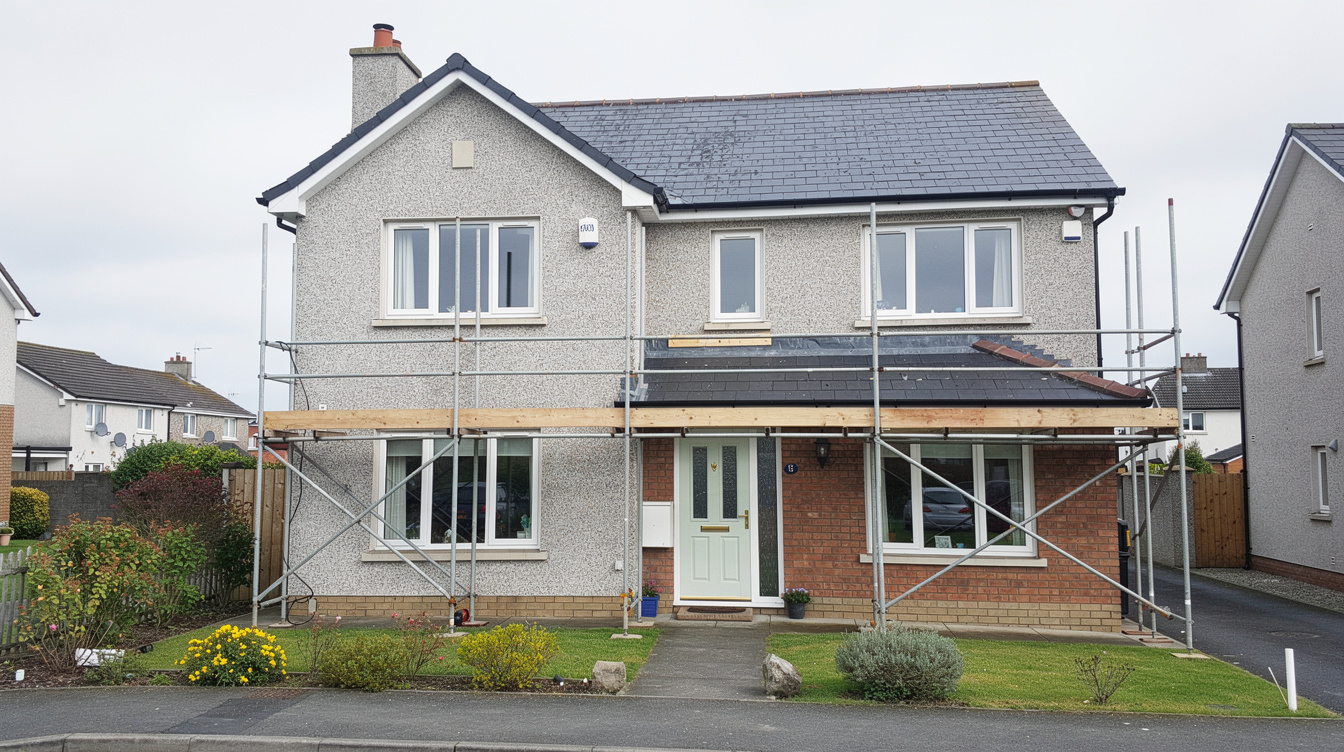
Ireland is transposing the EU’s revised Energy Performance of Buildings Directive (EPBD recast, adopted May 2024). Under the published Irish implementation pathway:
- From 2030: No residential property may be advertised for rent in Ireland below a D rating.
- From 2033: The minimum lifts to C.
- From 2040: Minimum lifts to B2 (target subject to review).
The 2030 cliff is closer than it looks. Properties currently rated E or F will need at least one substantial upgrade — typically attic + wall insulation, or a heat pump — to clear the bar. Tax breaks for landlords doing the works are being expanded under the 2025 Finance Act’s Section 97B relief, with up to €10,000 of upgrade costs deductible from rental income over 7 years.
Boost Your BER With Solar PV
A 4 kWp install typically lifts a D1 home to C3 and pays back in ~7 years. Get a free quote.
The order to do upgrades in
Most assessors and One Stop Shop project managers will guide you through this, but the order matters — doing things out of sequence is one of the most common ways to overspend by €5,000+:
- Air-tightness and ventilation first. Any home being upgraded toward B-rating territory needs an air-tightness test (€250–€450) and a clear ventilation strategy. Sealing up a leaky house without ventilation creates condensation, mould, and indoor air quality problems.
- Insulation second. Attic, then cavity (if applicable), then external or internal wall insulation. Do this before sizing the heating system — otherwise you pay for an oversized heat pump.
- Windows third. Replace single-glazing or worn double-glazing with high-spec triple. Do this before air-tightness retest.
- Heating system fourth. Now that the house has been brought to a lower heat demand, size the heat pump (or upgraded gas boiler) correctly. A common €8,000 mistake: installing a 12 kW heat pump in a leaky house that only needed 6 kW once it was insulated.
- Solar PV last. Once electrical demand and the heat pump load are known, size the PV array (and battery if you’re adding one). Solar fitted first then heat pump second usually ends up undersized for the new electric heating load.
The exception: if your roof is being re-slated or re-tiled, fit solar at the same time. Mounting on a fresh roof saves €800–€1,400 versus going back up later.
How to actually book a BER
- Search the SEAI BER Assessor Register at
ndber.seai.ie. Filter by your county. The register shows every active assessor and their listed contact details. - Get three quotes. Prices vary €50–€100 for the same house. Don’t auto-pick the cheapest — ask how recent their experience is with your house type.
- Prepare documentation: original house construction year, U-value records of any past insulation works (attic, cavity), boiler service records, MPRN, photos of insulation thickness if you can access the attic.
- Be present during the visit. Walk the assessor through every upgrade you’ve had done. Undeclared upgrades are penalised by DEAP’s default values, which assume worst-case construction. A two-minute conversation about your 200 mm of attic insulation can be worth a full BER band.
- Verify the published BER on the SEAI public register at
ndber.seai.ie/BERResearchTool. It will appear there 1–3 working days after publication.
BER FAQs
Does solar PV qualify for the SEAI Home Energy Grant?
Yes — via the standalone Solar PV grant of up to €1,800 (one-step pathway), or bundled into a One Stop Shop deep retrofit with higher grant rates. Eligibility: home built and occupied before 1 Jan 2021, homeowner-occupier, no prior PV grant on that MPRN. Apply through your registered installer.
How long is a BER certificate valid?
10 years, or until you make a change that materially affects energy performance (new heating system, solar PV, insulation, windows). After such a change you need a fresh assessment to publish the updated rating — otherwise the public register continues to show the older, lower rating.
Can I do a DIY BER calculation to estimate what mine will be?
SEAI publishes a public-facing energy estimator at seai.ie, but it cannot produce a valid published BER — only a registered assessor running licensed DEAP 4.2 software and uploading to the central register can do that. The estimator is useful as a sense-check.
Will adding solar void my existing BER?
It doesn’t void it legally — you can still sell/rent against the old certificate — but the certificate now under-represents your home’s real performance, which is bad for resale value. Most homeowners doing a meaningful upgrade re-do the BER and republish to capture the improvement.
How does BER affect my mortgage?
All major Irish lenders (AIB, BOI, PTSB, Avant, Finance Ireland) now offer green mortgage discounts of 0.20–0.40 percentage points for homes rated B3 or better. On a €350,000 mortgage that’s €700–€1,400/year saved over the life of the loan — sometimes more than the energy savings themselves.
What’s the cheapest single upgrade from a BER perspective?
Attic insulation is the best ratio of BER points per euro on virtually every Irish home. Cavity wall insulation is a close second where cavity construction allows. External wall insulation delivers the biggest comfort upgrade but is the worst BER-per-euro of the major works.
The bottom line on BER
A BER is not just a sticker. It is, in 2026, the single number that drives mortgage pricing, rental compliance, valuation premiums, and your annual energy bill. For most Irish homes built between 1960 and 2010, the journey from current rating to a regulatory-safe C or a market-attractive B is a multi-step upgrade programme, not a single fix. Solar PV is a fast-payback discrete step that lifts one BER band on its own and stacks neatly on top of insulation and heat pump upgrades. The order matters — insulate first, then size the heating system, then size the solar — but the destination is the same: a warmer house, a smaller bill, and a rating that lets your home compete.
Lift Your BER — Compare Solar Quotes
A 4 kWp install plus battery typically moves a D-rated home into the C band. Free quotes from SEAI-registered installers.
Related Articles
BER Rating Calculator Ireland 2026: How to Estimate Your Home’s Energy Rating
Estimate your home's BER on the new 2026 A0-G scale, learn how DEAP calculates it, and see which upgrades lift the rating most in Ireland.
Selling a House With Solar Panels in Ireland 2026: BER Uplift, Buyer Docs & Contract Traps
Real 2026 data on the sale price boost from solar in Ireland, the exact docs your buyer's solicitor needs, SEAI grant transfer rules and PPA contract traps.
BER Rating Ireland 2026: Grade Scale, Cost & How Solar Lifts Your Score
Full BER rating Ireland 2026 guide: A1-G scale explained, assessment cost €150-€350, what assessors check, and how solar PV lifts your grade 1-2 bands.