
Bird Proofing Solar Panels Ireland 2026: Costs, Mesh vs Spikes & Warranty Rules
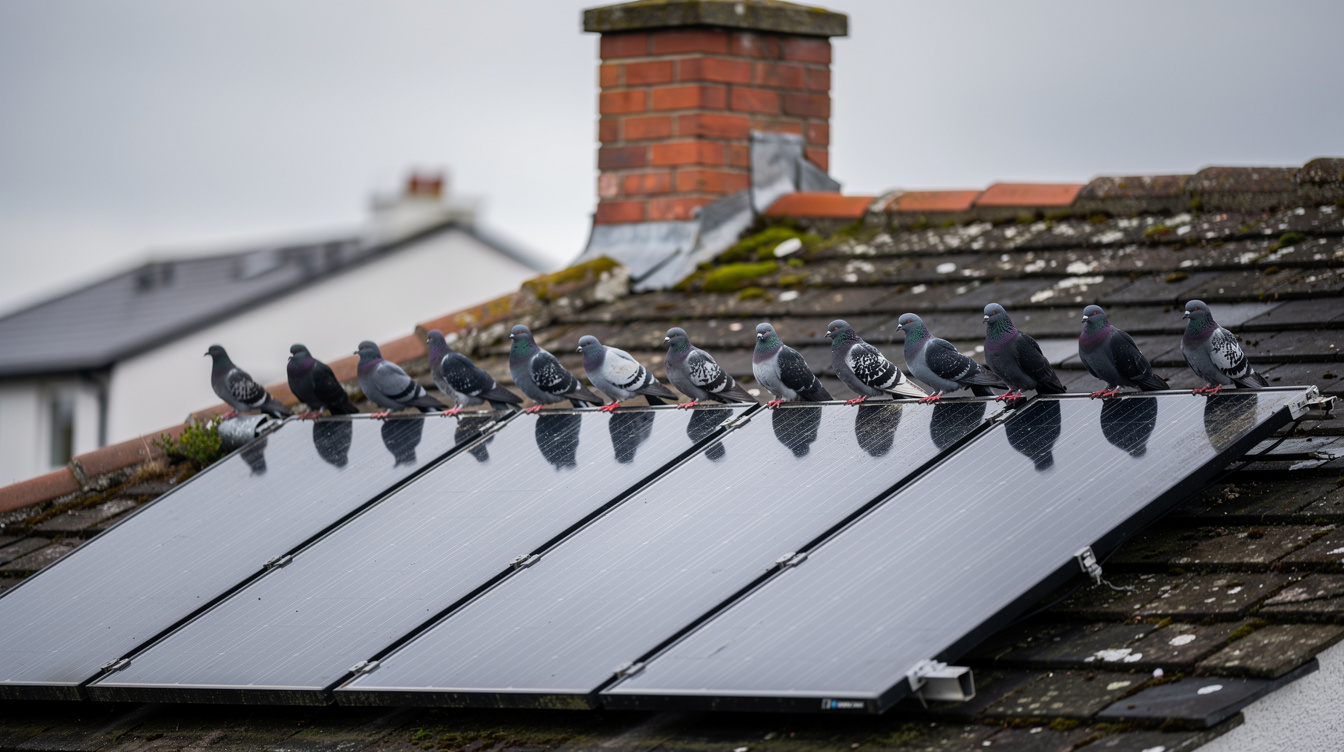
If you live near the coast, in a suburb with mature trees, or anywhere pigeons already loiter on your gutters, there is a decent chance that within 12 months of installing rooftop solar panels you will hear scratching and cooing coming from the cavity underneath them. Pigeons and gulls treat the 100–150 mm gap between panel and tile as an ideal nesting site: warm, dry, sheltered from Irish weather, and defensively perfect against predators.
Bird proofing is the single most common retrofit request that Irish solar owners raise in their second year — and it’s also the one most installers quietly leave out of the initial quote. This guide covers what works, what doesn’t, what it costs in 2026, and how to avoid the biggest mistake homeowners make: waiting until the birds have already nested.
In a sentence
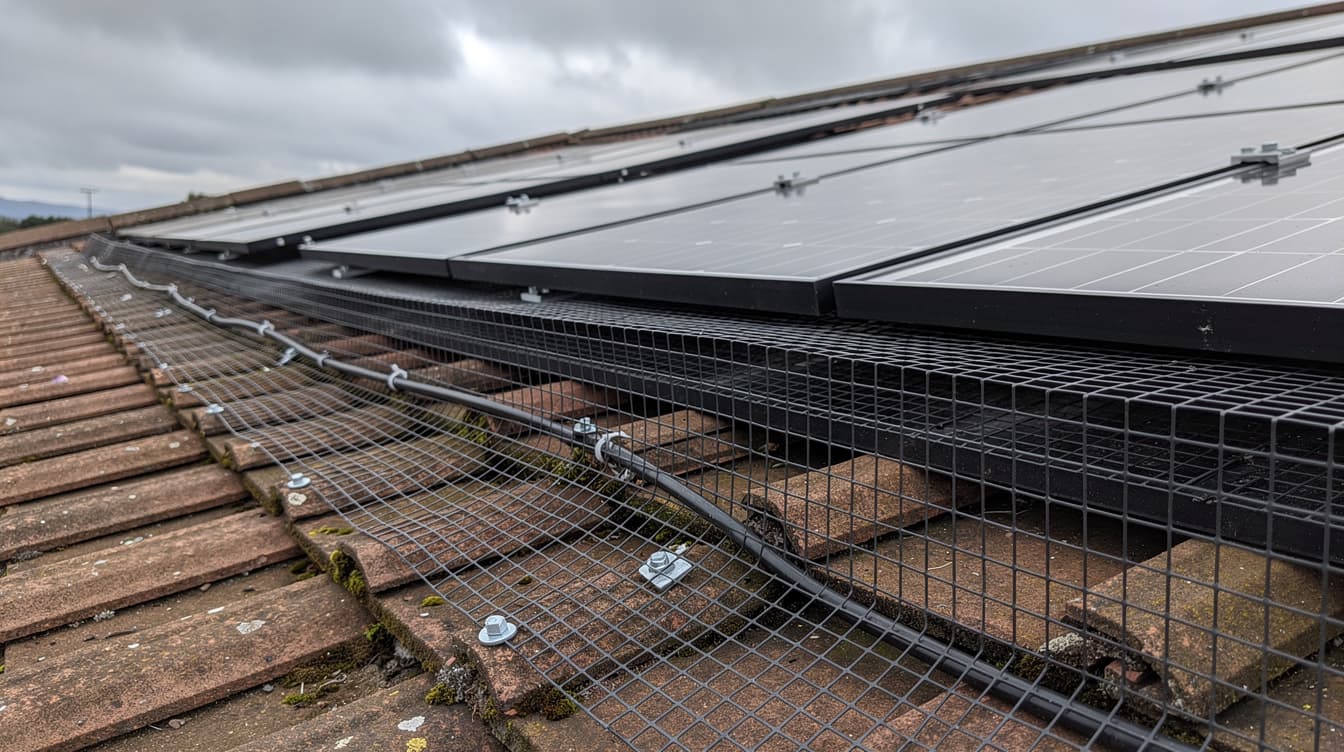
Fitting stainless-steel mesh around the perimeter of your array at install time typically adds €200–€400 to the quote. Retrofitting after birds have moved in costs €600–€1,400, requires nest removal and often a clean-down, and rarely restores the panels to pristine condition.
Why birds love the space under your panels
A standard Irish rooftop install leaves a gap of roughly 100–150 mm between the underside of the panel frame and the roof surface. That gap exists for ventilation — PV cells lose around 0.4% of their output per degree Celsius above 25°C, so airflow across the back keeps them cool and productive. For a feral pigeon or a herring gull, though, it is a five-star hotel:
- Sheltered from prevailing wind and rain — a big win in an Irish winter.
- Warm. Panels absorb heat during the day and radiate it downward at night.
- Predator-proof. Cats, magpies and sparrowhawks can’t reach under the frame.
- Structurally boxed in. Pigeons will use the same nest site year after year once they establish it, and they raise 4–6 clutches per year given enough food.
Feral pigeons (Columba livia domestica) are the primary offender in Dublin, Cork, Limerick and Waterford. On the west and south coasts — particularly Galway, Sligo, Clare, Kerry, Wexford and coastal Louth — herring gulls and lesser black-backed gulls cause even more disruption because they’re larger, noisier, and legally protected during nesting season.
What damage do they actually cause?
Homeowners often ask whether bird proofing is worth spending money on, or whether the birds are cosmetic nuisance rather than genuine problem. It’s the latter — and here is what the industry sees most often:
| Damage type | How it happens | Typical repair cost |
|---|---|---|
| Guttering blockage | Nest materials (twigs, feathers, straw) wash off the roof and clog downpipes, causing overflow | €120–€250 |
| Panel soiling / output loss | Droppings accumulate on lower panel edges, shading cells — a shaded cell can drop the string output by 20–40% | €120–€180 per clean |
| Cable damage | DC cables get pecked, chewed and soaked in acidic droppings, degrading insulation over 2–3 years | €400–€900 to re-cable |
| Tile / felt erosion | Acidic guano (pH 3.5–4.5) breaks down concrete tiles and roofing felt over years | €600–€1,800 for section re-roof |
| Attic pest infestation | Bird mites, red poultry mites and lice migrate from nests into loft cavities | €250–€600 pest treatment |
| Noise complaints | Gulls in particular are extremely loud — dawn chorus starts around 04:30 in summer | Priceless (or a very light sleeper problem) |
A poll of Irish solar installers published on the Compare Solar NI forum in 2025 estimated that around 1 in 4 solar systems fitted without bird proofing shows measurable output loss within three years, and about 1 in 12 requires cable repair by year five.
Your four practical options
There is no single “best” solution — the right choice depends on your budget, aesthetics preference, and whether you have birds already nesting. Here are the four approaches Irish installers actually use in 2026:
1. Stainless-steel mesh / clip-on skirt
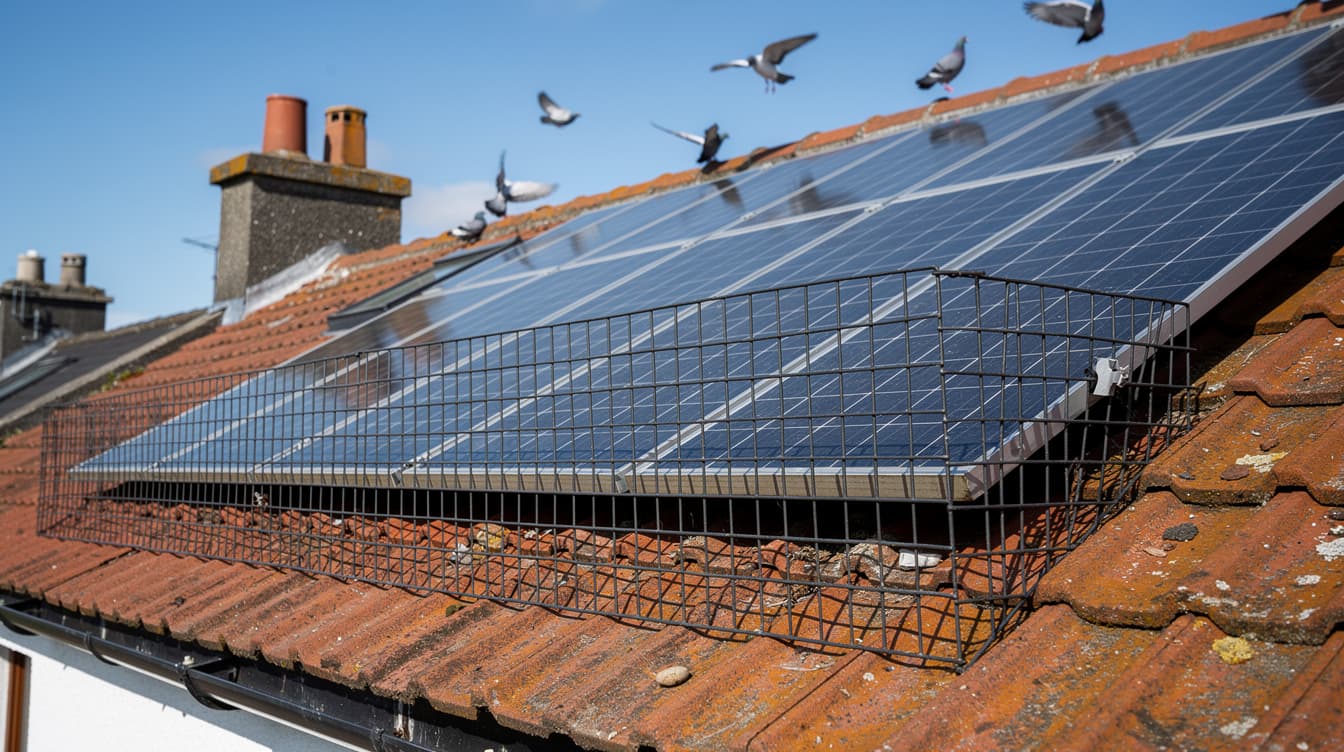
The industry default. A perforated stainless-steel or powder-coated aluminium mesh (typically 8 mm hole size) is clipped or bolted around the entire perimeter of the array using stainless steel clips that grip the panel frame — no drilling into the panels themselves, which would void the warranty.
- Cost fitted at install time: €200–€400
- Cost retrofitted: €600–€1,200 depending on array size and roof access
- Lifespan: 15–25 years (matches panel life)
- Best for: most Irish homeowners
Look for a proprietary clip system (SolaSkirt, Ecopower and Solar Panel Guard are the three brands most commonly stocked by Irish installers) rather than generic chicken wire cable-tied to the mounts. Cable ties fail in 3–5 years in UV, and generic mesh sags and lets pigeons force their way through.
2. Roof spikes along ridge and eaves
Plastic or stainless steel spike strips fitted to the ridge tiles and gutter line to stop birds landing near the panels in the first place. Cheap and unobtrusive from ground level.
- Cost: €80–€200 for a typical Irish semi-D
- Best for: preventing landing rather than nesting — useful in combination with mesh, not on its own
- Weakness: spikes stop birds landing on the spiked spot, but they will simply hop or fly to the space under the panels a metre away
3. Full panel cage / enclosure
Sometimes used on commercial installs. Complete perimeter mesh plus intermediate mesh between panel rows on flat or low-pitch arrays.
- Cost: €800–€1,500 for a domestic array
- Best for: flat roofs, ballasted arrays, commercial systems, or homes with a severe existing infestation
4. Sonic / visual deterrents
Reflective tape, plastic owls, ultrasonic devices. Popular in DIY forums, ineffective in practice. Pigeons habituate within 2–4 weeks. Save your money.
Getting Solar in 2026?
Ask installers to quote bird proofing as a line item — adding it at install is 3–5× cheaper than retrofitting later.
The real 2026 cost breakdown
Here are the actual prices Irish installers charged in the first half of 2026, based on quotes gathered across Dublin, Cork, Galway and Limerick. Pricing has crept up around 8% year-on-year, driven mostly by scaffold-hire costs.
| Scenario | Panels | At install | Retrofit (clean roof) | Retrofit + nest removal |
|---|---|---|---|---|
| Small 2-bed semi-D | 6–8 | €180–€280 | €550–€750 | €750–€1,050 |
| Standard 3-bed semi-D | 10–12 | €240–€350 | €700–€950 | €900–€1,300 |
| 4-bed detached | 14–16 | €280–€420 | €850–€1,150 | €1,100–€1,500 |
| 5-bed detached / two-storey extension | 18–24 | €350–€550 | €1,000–€1,400 | €1,350–€1,900 |
Retrofit pricing includes scaffold hire (typically €350–€550 for a 3-day rental on a two-storey house) plus 1–2 installer-days. If the pest control company also needs to bag guano for disposal, add €150–€250 — bird droppings are classed as hazardous waste in Ireland under S.I. No. 126/2011.
Warranty implications: read this before you DIY
Most panel manufacturers — including JA Solar, Longi, Trina, Jinko, and REC — explicitly void the panel product warranty (typically 25–30 years) if anything is drilled or bonded to the panel frame or backsheet. That includes:
- Screwing brackets into the panel frame
- Adhesives bonded to the frame or glass
- Anything that penetrates the backsheet
Only frame-clip systems that grip the extruded aluminium panel edge without penetration are warranty-safe. If your installer proposes to screw mesh into the frame, walk away. A single non-warranty repair on a 25-year system dwarfs any saving on the proofing job.
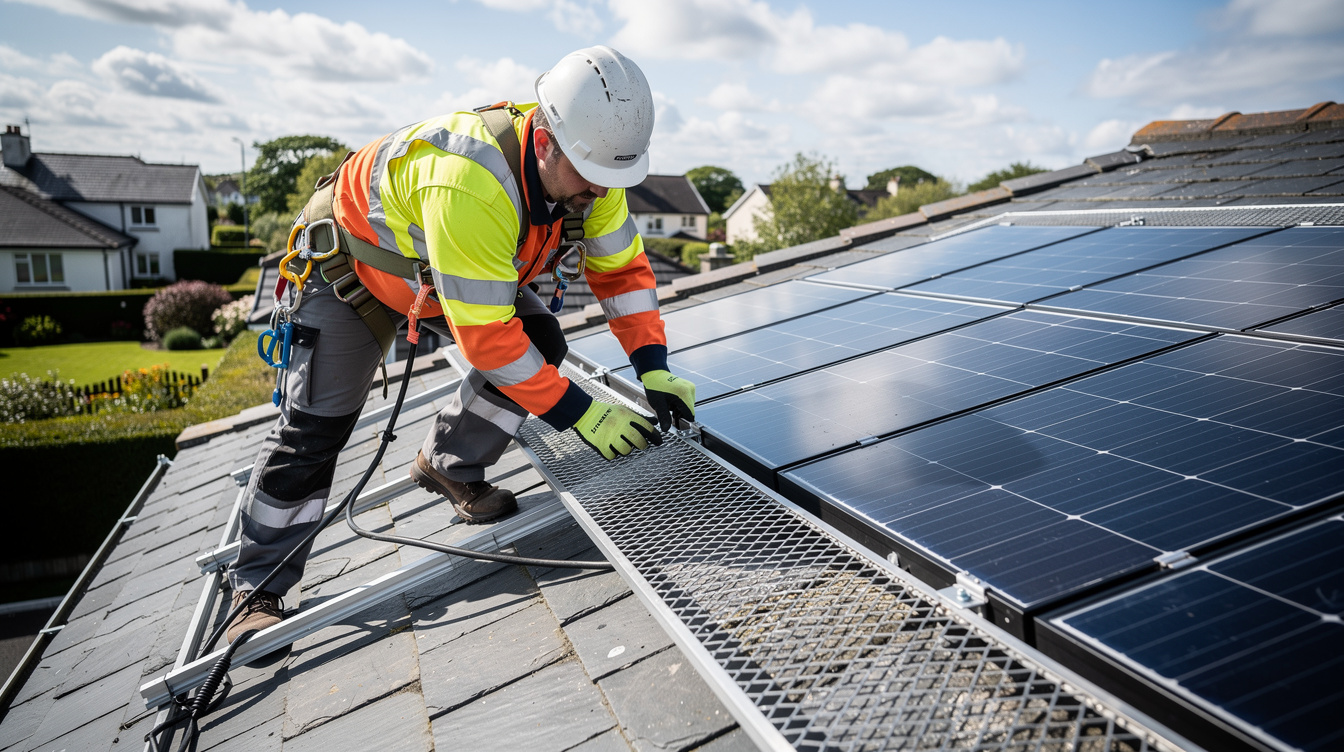
Similarly, your system installation warranty (usually 5–10 years from the installer, plus 12–15 years on inverters) may be voided if a non-SEAI-registered pest control firm goes on the roof and disturbs the mounting rails. If in doubt, use the original installer or one recommended by them.
Legal considerations (yes, really)
Ireland’s Wildlife Acts 1976–2023 protect all wild birds during the breeding season. Herring gulls, lesser black-backed gulls, and even feral pigeons in some circumstances are protected once they have started building a nest or laying eggs. That has three practical consequences for solar owners:
- You cannot remove an active nest between March and August without a licence from the National Parks and Wildlife Service. In practice, licences are only granted where there is a genuine safety or health risk.
- Bird proofing should be fitted between September and February — before the nesting season starts. Any competent pest-control firm knows this; if they offer to install mesh over an occupied nest in June, they are proposing to break the law.
- If a nest is already present in spring, your only option is to wait until fledglings have left (usually by end of August), then immediately install proofing before the birds return.
Cleaning up guano is unregulated, but professional pest firms in Ireland dispose of it through licensed waste contractors under S.I. No. 126/2011 and provide a certificate. Ask for one.
DIY: when it’s reasonable, and when it isn’t
If your solar panels are on a single-storey extension, dormer or bungalow — low enough to reach with a stable ladder — you can fit clip-on mesh yourself for around €80–€150 in materials from an Irish supplier such as SolaSkirt Ireland, Bird Free (Cork), or Solar Guard IE. Budget half a day for a 10-panel array.
What you should absolutely not DIY:
- Any work on a two-storey roof — falls are the leading cause of construction fatalities in Ireland and a €500 saving is not worth the risk. Get scaffolding or use a professional.
- Removing an active or recently vacated nest without PPE. Bird droppings and nesting material carry Chlamydia psittaci, Histoplasma and salmonella. Full FFP3 respirator plus disposable coveralls is the minimum, not a dust mask.
- Anything involving disturbing the panel mounting rails or DC cabling — that is installer territory.
Warning
If you already have a nest under your panels and it is May, June or July, do not touch it. Wait until September, then move fast — the birds will return to the same site the following spring within days of your inaction.
Frequently asked questions
Do I need bird proofing if I live rurally with no obvious pigeon problem?
Feral pigeons are essentially only an urban problem, but gulls are widespread across coastal Ireland, and jackdaws happily colonise rural rooftops. Even inland, starlings and swifts will occasionally nest under panels. If the marginal cost at install time is €200–€400, it is close to insurance-value spend regardless of your local bird population.
Will bird proofing reduce panel airflow and cook the cells?
Perforated mesh with 40–60% open area (which is the industry standard for panel guards) does not measurably restrict convective cooling. Manufacturers including JA Solar and Longi explicitly permit mesh proofing in their installation manuals provided open area exceeds 40%. Solid skirts (no perforation) can reduce output by 1–3% in summer and are not recommended.
My installer said bird proofing isn’t needed — are they right?
They are right in the sense that a solar system will function without it. They are wrong if they imply birds won’t be an issue. Ask for the bird proofing line-item to be added to the quote — if they refuse, that is a signal to compare with another installer.
Does home insurance cover damage caused by nesting birds?
Almost never. Most Irish home policies (Aviva, Allianz, RSA, Zurich and AXA all reviewed) exclude damage caused by pests, vermin, birds or insects. Guttering blockage and clean-up costs come out of your own pocket. Some policies will cover consequential water damage if the initial cause was accidental, but you will typically face a fight.
How long before I see droppings on my new panels?
In a suburban Irish neighbourhood with existing pigeon activity, it typically takes 3–6 months for the first pair to investigate and 12–18 months for full nesting. Coastal properties with gull activity often see nesting attempts in the first spring after install.
Can I claim bird-proofing costs against the SEAI grant?
No. The SEAI Solar PV grant (€1,800 in 2026) covers the panels, inverter and installation labour to a set formula. Bird proofing, mounting extras, and any aesthetic additions are outside the eligible cost basis. You pay for it directly.
Bottom line
If you are getting solar panels installed in Ireland in 2026, ask for perimeter mesh proofing to be quoted as a line item. The typical €200–€400 add-on at install time is the single best value insurance you can buy for the system. Retrofitting after birds have moved in is 3–5× more expensive and rarely restores the roof to pristine condition.
If you already have panels without proofing and haven’t seen bird activity yet, book a proactive retrofit for September or October — before next spring’s nesting season starts. If birds are already nesting, wait until August, then act immediately.
To compare quotes from SEAI-registered installers who include bird proofing as standard, use the form below. Or run the underlying numbers on our solar panel calculator to see whether the marginal spend fits your 25-year ownership budget.
Free Quotes from Vetted Irish Installers
Get matched with SEAI-registered installers who include bird proofing at install time, not as an upsell after the fact.
Related Articles
Removing & Reinstalling Solar Panels for a Re-Roof Ireland 2026: Real Costs, Insurance & Warranty Rules
Removing and reinstalling a 4 kWp solar array for a roof replacement costs €1,200–€1,850 in 2026 Ireland. Insurance rules, warranty pitfalls, upgrade vs reinstall.
Storm & Lightning Damage to Solar Panels Ireland 2026: Insurance, Surge Protection, Repairs
How Irish solar systems survived Storm Éowyn's 183km/h gusts. Wind loading zones, surge protection costs, home insurance gotchas, before-storm checklist.
Bird Proofing Solar Panels Ireland 2026: Pigeon Guards, Costs & DIY vs Pro
Pigeons nest under solar panels — here's how to stop them. Costs, mesh vs skirting, install-day vs retrofit prices, DIY safety notes.