
Storm & Lightning Damage to Solar Panels Ireland 2026: Insurance, Surge Protection, Repairs
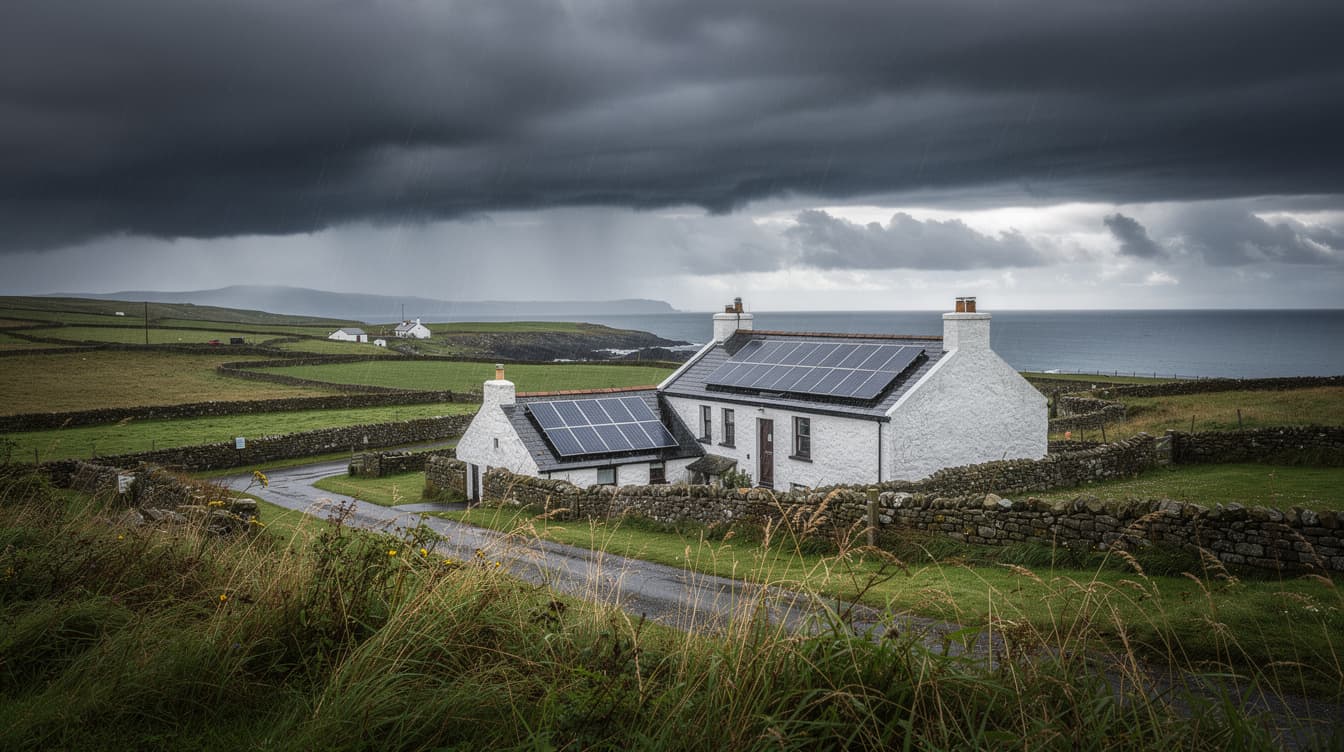
At 05:00 on 24 January 2025, Mace Head atmospheric station in Connemara recorded a wind gust of 183 km/h — the highest ever officially measured in Ireland, breaking a record that had stood for 80 years. Storm Éowyn left 715,000 homes without power, ripped roofs off buildings across the west, and put the country's roughly 130,000 domestic solar installations to a stress test nobody had planned for.
The reassuring news? Damage rates on properly installed systems were low. Insurers we spoke to reported that fewer than 2% of solar-equipped homes filed weather-related PV claims after Éowyn. The unreassuring news? Where damage did happen, it was often catastrophic — and the split between claims paid and claims refused came down to details most homeowners had never heard of.
Here is the definitive 2026 guide to storm and lightning damage on Irish solar installations: what actually happens in a storm, how surge protection works, what your home insurance covers (and does not), and the checklist to run before the next Atlantic depression arrives.
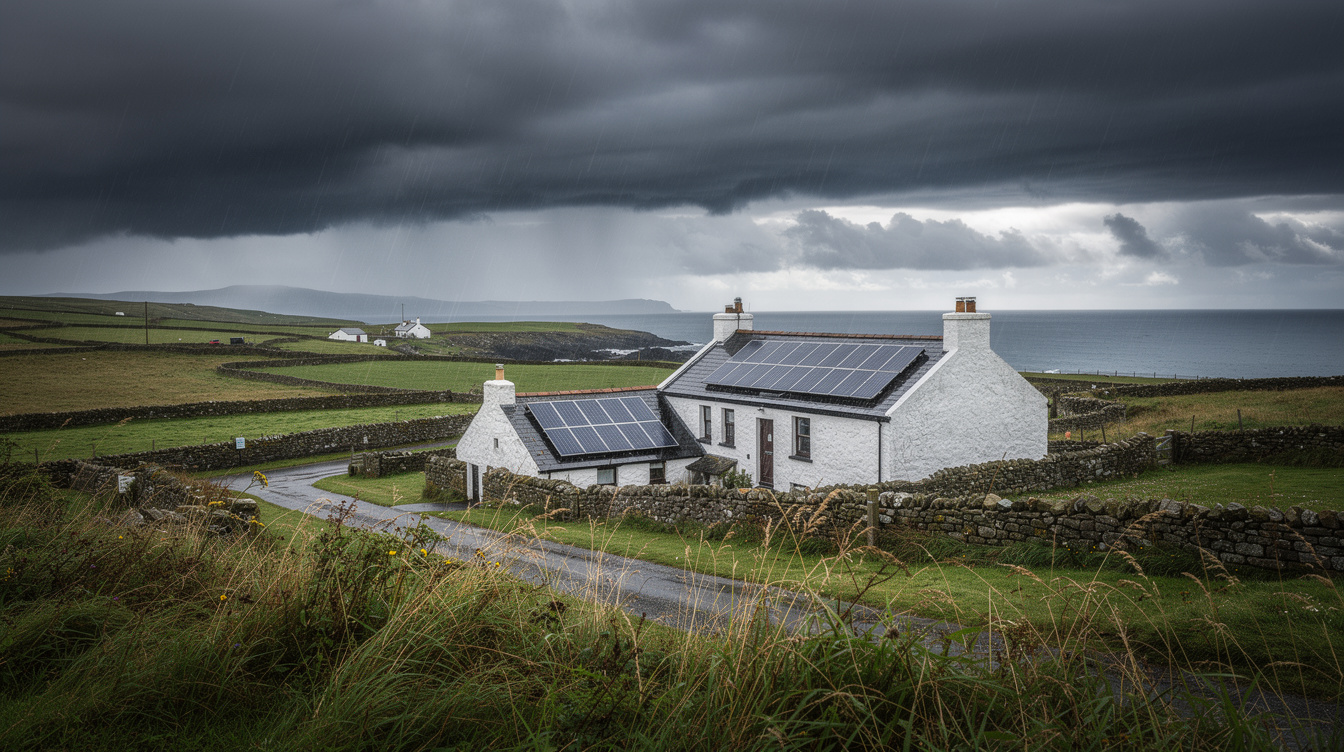
What Actually Happens in an Irish Storm
Solar panels themselves are among the most weather-resistant parts of your home. A standard 400 W panel is engineered to withstand:
- Front load: 5,400 Pa (roughly 550 kg per square metre of snow, which Ireland effectively never sees)
- Back load: 2,400 Pa (equivalent to sustained winds of ~200 km/h before the frame itself fails)
- Hail: 25 mm hailstones at 82 km/h (IEC 61215 standard test)
In practice, the panel is almost never what fails first in an Irish storm. The failure points, in order of frequency, are:
| Failure Point | Typical Cause | Frequency (post-Éowyn) |
|---|---|---|
| Slate/tile displacement around mounts | Wind loading + old mortar | Most common |
| Roof-hook or clamp working loose | Undertorqued at install | Common |
| Flying debris cracking glass | Neighbour's slate/branch impact | Occasional |
| Inverter surge damage | Nearby lightning strike | Rare but expensive |
| Whole array lifted from roof | Structural attachment failure | Very rare (bad installs only) |
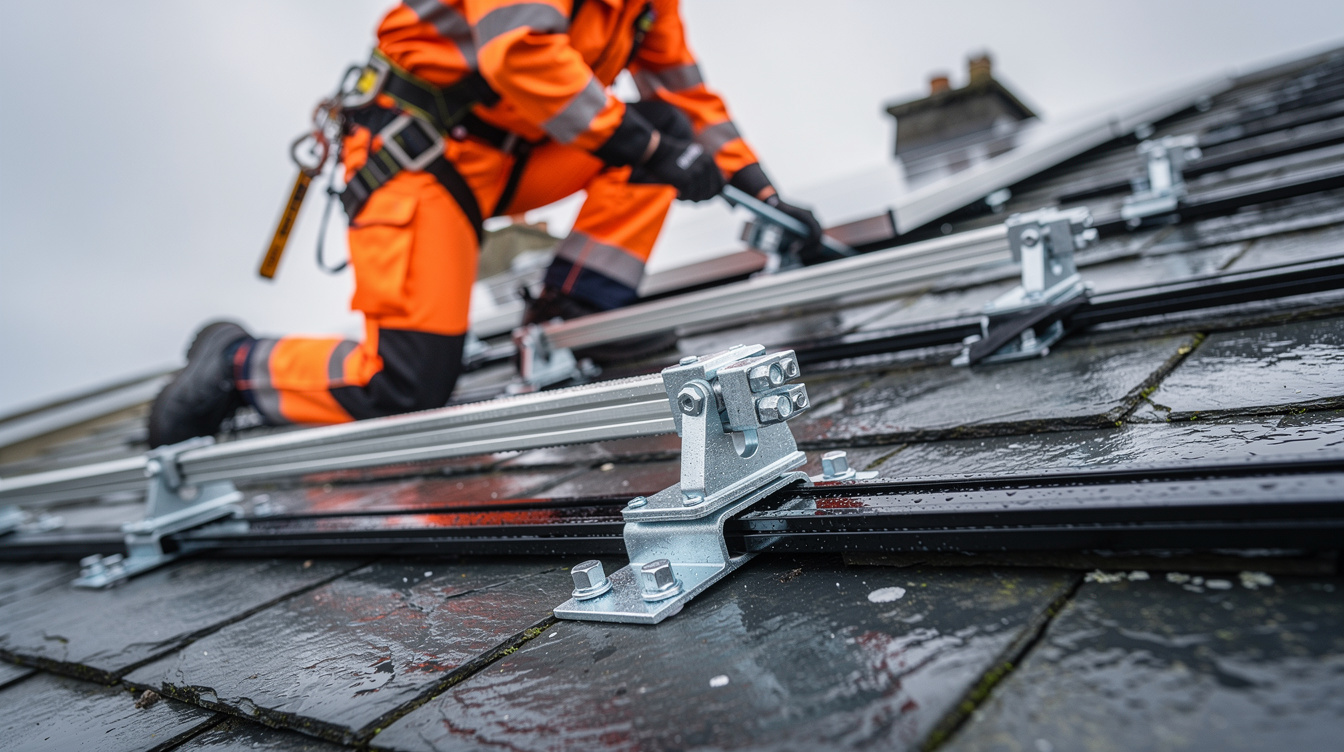
The pattern is clear: the panel is almost never the weak link. It is the interface between the panel and the roof — the mounting system, the flashing, and the underlying slates or tiles — that fails.
Wind Loading in Ireland — What Your Installer Should Calculate
Irish weather codes require solar mounts to be sized against site-specific wind loads under the EN 1991-1-4 (Eurocode 1) wind loading standard. The design wind speed varies by region. A rough guide for July 2026:
| Region | Design Wind Zone | Basic Wind Speed (vb,0) |
|---|---|---|
| Atlantic coast (Mayo, Galway, Kerry, Donegal) | Zone 4 | 28 m/s (~100 km/h) |
| West/Southwest inland | Zone 3 | 26 m/s |
| Midlands / East Coast | Zone 2 | 24 m/s |
| Sheltered Midlands / Dublin | Zone 1 | 22 m/s |
These are "basic" wind speeds — the storm-return-period calculation raises them substantially. In practice, a coastal Connemara install needs roof hooks spaced roughly every 0.9–1.1 metres, versus 1.4–1.6 metres for a sheltered Dublin suburb. That difference is why a system that costs €9,500 in Naas can cost €10,800 in Belmullet — the extra hardware is real, not a rip-off.
Red flag: if a quote for a Connemara install doesn't include roughly 30–40% more roof hooks than a Dublin equivalent, ask the installer for their wind loading calculation. A missing calculation is the single most common cause of storm failure.
Lightning — The Real Risk Is Not What You Think
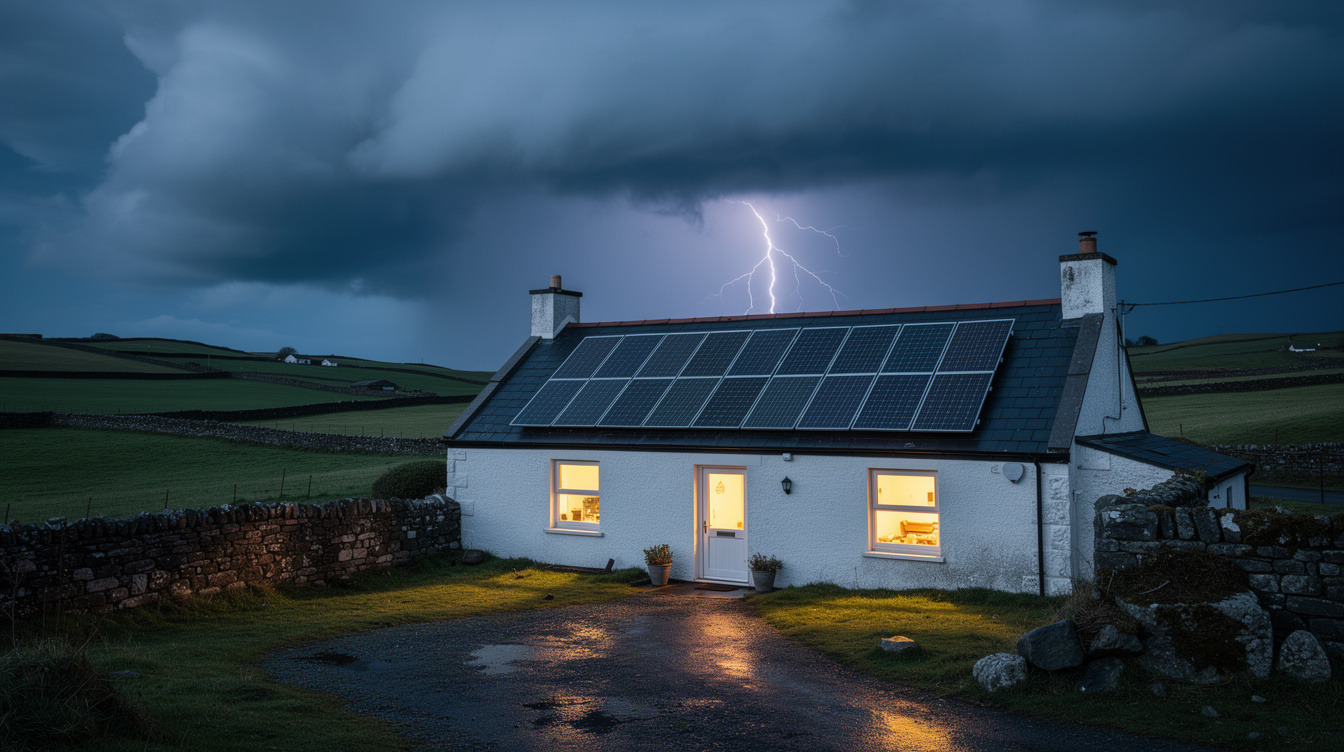
A direct lightning strike on a solar panel is astronomically rare in Ireland. Met Éireann records around 50,000 lightning strikes to ground per year across the country — roughly one strike per square kilometre per decade. The odds of one hitting your specific rooftop are microscopic.
The real risk is indirect surge damage. When lightning hits within a few hundred metres — a nearby tree, ESB pole or hilltop — it induces a huge transient voltage spike on the DC and AC wiring of your solar system. That spike will happily walk into your inverter, MPPT, and any connected battery, cook the semiconductors and leave you with a €1,800–€3,500 replacement bill.
Get a Storm-Ready Solar Quote
SEAI-registered installers who calculate wind loading and fit SPDs as standard.
Surge Protection Devices (SPDs)
The counter is a Type 2 Surge Protection Device, installed on both the DC side (between panels and inverter) and the AC side (between inverter and consumer unit). SPDs work by dumping the transient spike to earth in nanoseconds, protecting the sensitive electronics downstream.
| SPD Location | Purpose | Cost fitted |
|---|---|---|
| DC side (in inverter isolator) | Protects inverter from panel-side surge | €120 – €180 |
| AC side (at consumer unit) | Protects appliances and grid gear | €180 – €260 |
| Type 1+2 (exposed hilltop sites) | Direct-strike-rated protection | €350 – €450 |
SPDs are required by ET 101/IS 10101 wiring rules on new installs since 2023 for any residential PV system in Ireland. If your system was installed before 2023, check — there is a good chance you don't have them. Retrofitting a full Type 2 pair typically costs €280–€430, and it's the single highest-value insurance move you can make.
Earthing and equipotential bonding
Beyond SPDs, the mounting rails and inverter chassis should be bonded to your home's main earth. Poorly earthed installs are a much bigger risk than exposure to lightning itself — the system will happily survive one nearby strike with good earthing and no SPDs; without earthing, it may not survive a big electrical transient at all.
Storm Éowyn Lessons — What Actually Failed
Following Storm Éowyn in January 2025, loss assessors and installers we contacted flagged four recurring failure patterns. If you already have solar, these are the things worth checking before autumn 2026:
- Undertorqued clamps. On older €7–8k budget installs from 2022–2023, some installers were torquing panel clamps to hand-tight rather than the 12–16 Nm the manufacturer specifies. Under Éowyn's uplift pressure, panels chattered loose from the rails.
- Roof hooks screwed into slate battens rather than rafters. Cheaper installs sometimes catch a batten instead of the structural rafter. Fine in normal wind — fatal in a Zone-3 gust.
- No SPDs on pre-2023 installs. Multiple inverter failures were reported in the days after Éowyn, blamed on grid instability and transient spikes when power was restored region-by-region.
- Missed flashing. Water ingress through failed flashing around roof hooks caused ceiling damage that was often more expensive than the solar damage itself. This is what caught out homeowners with insurers — the claim was refused as “consequential water damage from a maintenance defect,” not a storm claim.
Home Insurance and Solar — What Is Actually Covered
Most Irish home insurance policies (Allianz, AXA, Aviva, RSA, FBD, Zurich, Chill/123.ie) cover solar PV automatically as part of the building sum insured, provided you notified them at install. Storm damage, lightning strikes and impact from fallen objects are all standard covered perils.
Six things to confirm with your insurer
- Are the panels declared? Adding solar increases the rebuild cost of the home. If you didn't update the sum insured after install, you may be underinsured — and Irish insurers apply averaging (they pay the same proportion of your claim as your cover was of your true value).
- Is the inverter covered? Some policies treat the inverter as “electrical/mechanical goods” and exclude wear-and-tear and internal breakdown. Lightning surge is usually covered; slow degradation is not.
- Is the battery covered? Batteries are typically valued at €3,000–€6,000. Confirm they are declared and covered against fire, surge and physical damage.
- What's the excess? Standard excess is €250. Solar-specific perils sometimes carry a €500 excess — check the policy.
- Is roof damage from the mounts covered? If a poorly-fitted hook lifted a slate and let water in, insurers may exclude “faulty workmanship.” This is one of the biggest gotchas.
- Are you required to have SPDs? A minority of policies now list surge protection as a policy condition post-2023 for PV homes. Missing SPDs on a lightning claim can be grounds for refusal.
Typical premium impact
Adding €12,000 of solar and battery equipment to a home insurance policy typically adds €15–€45 to the annual premium. That is genuinely small — but not declaring the equipment is a false economy that can void the whole policy in a claim scenario. Full breakdown in our home insurance and solar guide.
Before-the-Storm Checklist
Ahead of a Met Éireann orange or red wind warning, spend 30 minutes on the following:
- Do not turn off the DC isolator at the panel array. This isolates the inverter from grid but the panel string still produces voltage. Turn off the AC isolator at the consumer unit only.
- If you have a red weather warning and can safely reach the AC isolator, switch off the inverter to protect against grid switching surges when power is restored.
- Clear loose objects near the array: aerials, satellite dishes, garden furniture, wheelie bins. Wind-driven debris does more panel damage than the wind itself.
- Photograph the array in good order, including a wide roof shot. If damage happens, this is your baseline for the insurance claim.
- Check when your last install service was. Most installers offer a €120–€180 pre-storm inspection that includes clamp re-torquing, flashing check and SPD test. This pays for itself the first time you avoid a slipped panel.
After-the-Storm Damage Assessment
If your system doesn't restart when grid power returns, the checklist below saves you a wasted callout fee:
- Do not climb up to inspect the roof yourself. Wet slate is lethal. Use binoculars from the ground.
- Check the inverter display. If it powers on but reports fault codes (F13, ISO fault, etc.), photograph the code and phone your installer.
- Check the monitoring app. A total blackout across the array usually means an AC-side fault; individual panel dropouts point to string or optimiser issues.
- If you smell burnt electronics near the inverter, isolate it at the AC breaker immediately and call your installer — do not attempt to reset.
- Log the fault by 48 hours after the storm. Insurance policies typically require notification within 30 days of the loss event; the paper trail matters.
Need a Post-Storm Inspection?
Get a callout from an SEAI-registered installer in your county for a full system check.
FAQ
Can lightning destroy solar panels?
A direct strike will, but they are extraordinarily rare in Ireland. The realistic risk is a nearby-strike induced voltage surge that damages the inverter and battery. Type 2 SPDs on both DC and AC sides protect against this at around €300–€450 fitted — and are code-required on new installs since 2023.
Do solar panels attract lightning?
No. Solar panels are not particularly conductive and their presence does not measurably change the local probability of a lightning strike. The height of your roof and any nearby taller structures matter far more than whether panels are fitted.
Should I turn off my solar panels in a storm?
Turn off the AC isolator at the consumer unit before a red warning. Do not touch the DC isolator at the array — panels always produce voltage in daylight and you shouldn't interfere with the DC side yourself.
Are solar panels covered by home insurance in Ireland?
Yes, provided you have declared them and updated your sum insured. Storm, lightning surge, fire, theft and impact are standard covered perils on all mainstream Irish home insurance policies. Consequential water damage from “faulty workmanship” is a common exclusion — the mount and flashing must be well fitted.
What wind speed can solar panels survive?
The panel itself is rated to roughly 200 km/h before frame failure. The limiting factor is your mounting system, which is sized to your regional design wind speed (100 km/h basic on the Atlantic coast, 80 km/h basic in sheltered Dublin), then engineered with safety factors to survive gusts well above that. Storm Éowyn's 183 km/h peak gust caused very few PV structural failures on properly installed systems.
How much does surge protection cost to retrofit?
Retrofitting a full Type 2 SPD pair (DC + AC) on an existing solar install typically costs €280–€430 fitted. For exposed hilltop sites, add a Type 1+2 device for around €350–€450 more. Compared to a €1,800–€3,500 inverter replacement or a €5,000+ battery replacement, it is the highest-value maintenance spend on a PV system.
Does the SEAI grant cover surge protection?
New installs claimed under the SEAI €1,800 solar PV grant must comply with ET 101/IS 10101 wiring rules, which include SPDs. Grant-eligible installs since 2023 will have SPDs included — if your installer quoted a system without them and claimed grant funding, that's a compliance issue worth raising.
Bottom Line
Modern solar installations survive Irish storms remarkably well — the panels are engineered for it, and Storm Éowyn's stress test showed that the failure rate on properly installed systems is well under 2%. The homeowners who suffered serious damage were almost all in one of three categories: budget installs with undertorqued clamps, pre-2023 systems without surge protection, or systems the insurer never knew about.
Two actions cover 90% of the risk. First, if your install is more than three years old and doesn't have visible Type 2 SPDs on both the DC and AC sides, get them fitted — €280–€430 for the highest-value maintenance spend on the system. Second, notify your home insurer of the system in writing and confirm the sum insured has been increased to reflect it. Everything else is smaller.
Related reading: Solar panels and home insurance in Ireland · Removing solar for re-roofing · Solar panel warranty guide 2026.
Related Articles
Bird Proofing Solar Panels Ireland 2026: Pigeon Guards, Costs & DIY vs Pro
Pigeons nest under solar panels — here's how to stop them. Costs, mesh vs skirting, install-day vs retrofit prices, DIY safety notes.
SolarEdge vs Enphase Ireland 2026: Price, Warranty & Which Wins on Irish Roofs
Full Ireland 2026 comparison: SolarEdge vs Enphase microinverters. Real installer prices, warranty gap, shading gains, and which wins for Irish roofs.
East-West vs South-Facing Solar Panels Ireland 2026: Which Actually Wins?
South-facing wins on kWh, east-west wins on self-consumption. 2026 numbers, real household examples and dual-MPPT wiring notes.