
East-West vs South-Facing Solar Panels Ireland 2026: Which Actually Wins?
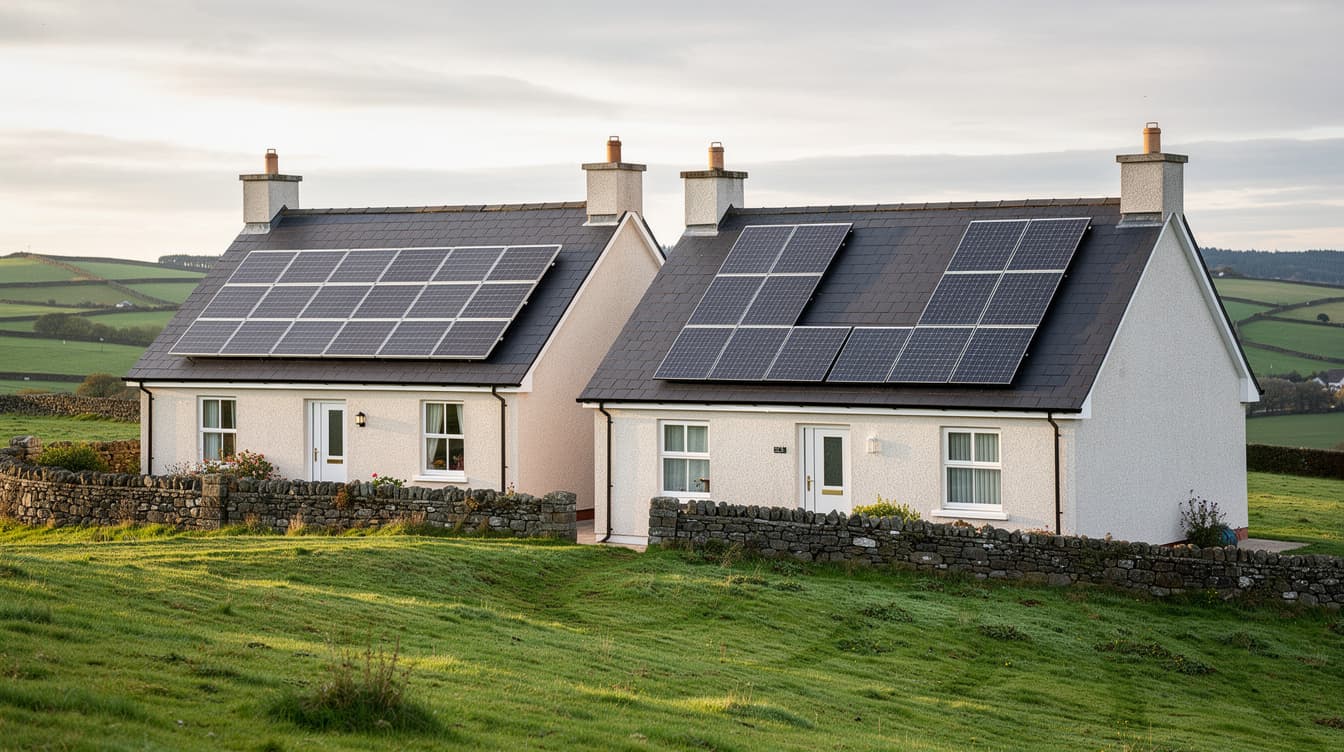
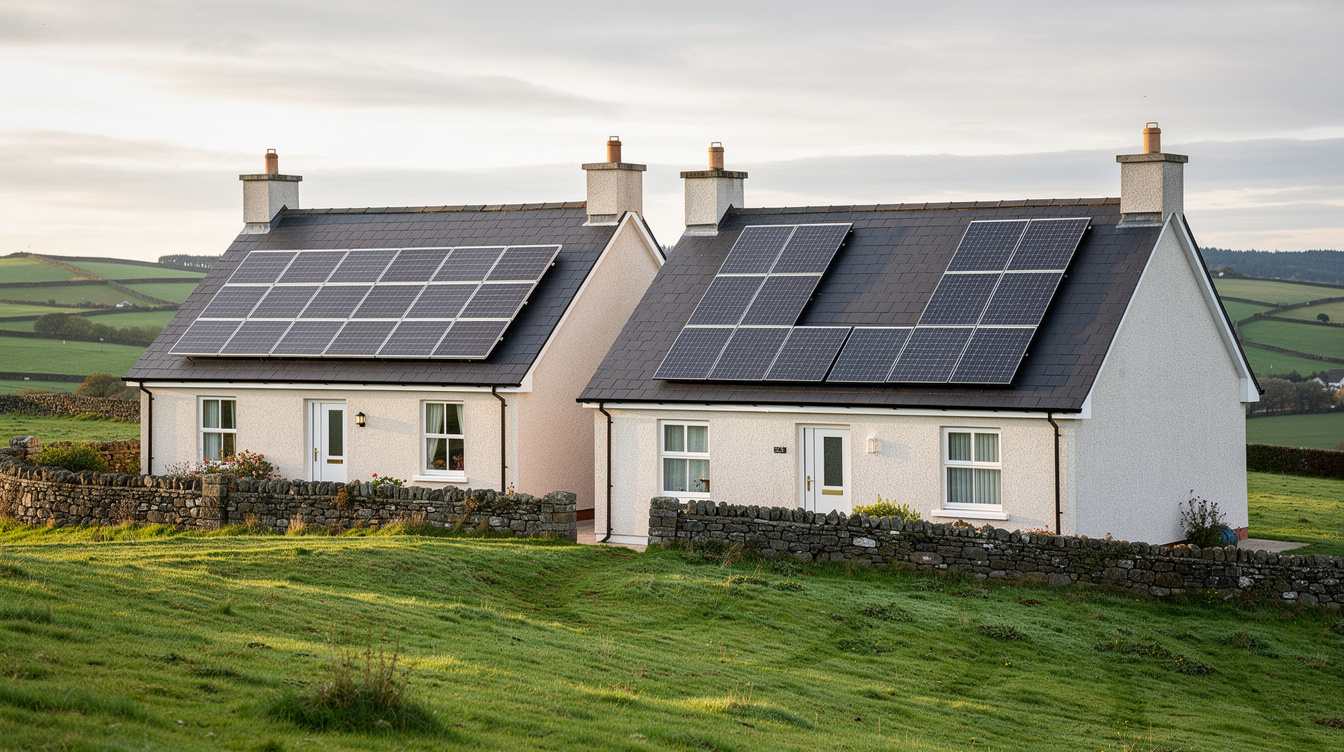
Roof orientation is the second most-argued point on Irish solar quotes, after price. Every homeowner has heard "south-facing is best" – and yet almost nobody actually has an ideal south-facing roof. Most Irish semi-detached and end-terraced houses have their long roof slope running east-west, giving two roof faces – one east, one west – that catch the sun for a big chunk of the day but never at peak intensity.
So the real 2026 question isn't "is south-facing best?" It's "does splitting my array east-west actually cost me money – or does it save me money?" The answer, done properly, depends less on how much electricity you generate and much more on when you use it.
The one-line answer
A south-facing 5.5 kWp array generates about 10–15% more kWh per year than an equivalent east-west split. But an east-west array typically self-consumes 15–25 percentage points more of what it generates – because production is spread across breakfast and dinner rather than concentrated at midday. Once you multiply through Ireland's 2026 Clean Export Guarantee (CEG) rates, most households end up within 3–6% of each other in annual euro savings. On the right household, east-west actually wins.
Ireland's solar generation curve, by orientation
PVGIS – the European Commission's free solar modelling tool – publishes hour-by-hour generation profiles for any Irish postcode. Simplifying to annual output per kWp installed, at 30° pitch, unshaded:
| Orientation | Annual kWh per kWp (Dublin PVGIS) | % of south-facing baseline |
|---|---|---|
| Due south (S), 30° | 955 kWh/kWp | 100% |
| South-east (SE), 30° | 925 kWh/kWp | 97% |
| South-west (SW), 30° | 920 kWh/kWp | 96% |
| Due east (E), 30° | 810 kWh/kWp | 85% |
| Due west (W), 30° | 805 kWh/kWp | 84% |
| 50/50 East + West split, 30° | 815 kWh/kWp | 85% |
| North-east or north-west, 30° | 680–720 kWh/kWp | 72–75% |
The gap between south and east-west split is about 15% of raw output – but crucially, the east-west generation curve is much flatter. Instead of one big peak at midday, you get two smaller peaks around 10am and 3pm, and a broad shoulder of useful generation from 8am to 6pm.
Why the generation shape matters more than the total
Solar in Ireland pays you two different rates depending on what happens to each kWh:
- Self-consumed kWh: you avoid buying that kWh from the grid at 27–34 c/kWh depending on your tariff.
- Exported kWh: your supplier pays you a Clean Export Guarantee rate of 18–24 c/kWh depending on who you're with.
The gap between those two rates – roughly 9–12 c/kWh – is your load-shifting reward. Every kWh you can consume in the house rather than export earns you that gap. And this is where east-west arrays quietly beat south-facing ones.
A south-facing array dumps most of its energy in the 11am to 2pm window – a time when nobody is home in the average Irish household, the kettle is off, the washing machine finished at 8am, and the immersion is coasting. Result: high export percentage, lower blended value per kWh.
An east-west array pushes generation into breakfast (kettle, toaster, showers, hair dryer, immersion top-up) and dinner (oven, kettle again, TV, dishwasher). Those loads are naturally higher and the electricity gets used directly. Result: higher self-consumption, higher blended value per kWh.
Real 2026 worked example: same house, three orientations
Base case: 5.5 kWp array, dual-earner Meath household with two commutes, no battery, on Bord Gáis Weekend Discount (31c day / 21c CEG). Total household consumption 5,400 kWh/yr.
Orientation A: South-facing 30°
- Annual generation: 5,250 kWh
- Self-consumption without battery: ~28% (household is out 9am–5pm)
- Self-consumed: 1,470 kWh × 31c = €456
- Exported: 3,780 kWh × 21c = €794
- Total annual benefit: €1,250
Orientation B: East-West split (50/50), 30°
- Annual generation: 4,480 kWh (15% less than south)
- Self-consumption without battery: ~42% (breakfast + dinner peaks align)
- Self-consumed: 1,880 kWh × 31c = €583
- Exported: 2,600 kWh × 21c = €546
- Total annual benefit: €1,129
Orientation C: South-east 30° (compromise)
- Annual generation: 5,090 kWh
- Self-consumption: ~32%
- Self-consumed: 1,629 kWh × 31c = €505
- Exported: 3,461 kWh × 21c = €727
- Total annual benefit: €1,232
South-facing wins by €121/yr against east-west. On a 25-year lifetime that's roughly €3,000 – real money, but comfortably less than the 15% headline generation gap suggests. Add a 5 kWh battery and the maths inverts entirely: east-west with battery captures 78% self-consumption and can pull ahead of south-facing at the annual-euro line.
Model your specific roof, not the internet's
SEAI-registered installers in our network run PVGIS by-orientation modelling for every quote. See your east/west/south numbers side by side.
The four households where east-west wins
Rules of thumb, borne out by generation data on live installs across our network:
- Two-earner households out of the house 9am–5pm. Morning + evening peak alignment matters more than midday total.
- Households on smart tariffs with a 5–7pm peak rate. East-west generation still hits the 4pm shoulder; south-facing has largely rolled off by then.
- Homes with an EV that charges evenings. West-facing panels catch the sunset window right as the EV is plugging in.
- Homes with a battery. East-west's flatter curve loads the battery more evenly through the day, avoiding the "full battery by 11am, wasted afternoon" problem that south-facing systems hit in June.
The three households where south-facing still clearly wins
- Retirees or WFH homeowners at home all day. They soak up the midday peak directly.
- Households with electric-heated pool, hot tub or workshop equipment that runs long midday loads.
- Homeowners without a battery who want the highest possible export earnings – south-facing simply generates more.
Split-array wiring – the two ways installers do it
Not all east-west arrays are wired the same. The subtle install choice can shave or add a couple of percent to annual output:
Method 1: single string across both facets
All panels wired in a single series string feeding one MPPT input on the inverter. Simplest and cheapest, but the east and west panels drag each other – the west panels can't push their peak because they're stuck matching the east side's morning current, and vice versa.
Method 2: separate strings, dual-MPPT hybrid inverter
East panels wired to MPPT input 1, west panels to MPPT input 2. Each MPPT tracks its side independently. The inverter combines the outputs on the AC side. Recovers 3–5% additional annual generation vs the single-string setup and is the modern default on all decent 2026 hybrid inverters (Sungrow SH-RS, GivEnergy Gen 3, SolaX X1-Hybrid, Fox ESS EP series).
Ask your installer to confirm your inverter has dual MPPT and that each facet is wired to a separate input. If the answer is "single string" on an east-west split, push for the dual-MPPT setup – the cost is usually zero to a few hundred euro, and it pays for itself in year 3.
The battery-decision cross-over point
Adding a 5 kWh battery to either orientation changes the maths dramatically. Same base household as above, adding a Pylontech 5.12 kWh battery for €3,200 fitted:
| Config | Self-consumption | Annual benefit |
|---|---|---|
| South-facing, no battery | 28% | €1,250 |
| South-facing, 5 kWh battery | 65% | €1,586 |
| East-west, no battery | 42% | €1,129 |
| East-west, 5 kWh battery | 78% | €1,472 |
South-facing with battery still wins on total euros (€1,586 vs €1,472) but the gap tightens to ~7%. Meanwhile east-west with battery costs €800–€1,200 less at install (fewer optimisers needed on a well-modelled east-west split) which recovers most of the gap over 15–20 years.
The compromise nobody talks about: south-east + south-west arrays
If your roof runs approximately NE-SW rather than pure E-W (common on Irish suburban estates built in a herringbone pattern), the two roof faces might be roughly south-east and south-west. That's a much better combination than pure east-west:
- Both facets get an extra 12–15% total kWh vs pure E-W
- The generation curve is still spread – peaks around 10am and 3pm
- Self-consumption stays high at 38–45% without battery
SE-SW splits are quietly the best-of-both-worlds orientation, and they're common on Irish estates from the 1990s and 2000s. If your roof is on that axis, the answer is almost always to split rather than pick one side.
The four questions to ask your installer about orientation
- What is the exact compass bearing of each of my roof facets? (Ask for the number, not "roughly south".)
- What is the PVGIS-modelled kWh/kWp for each facet at my postcode?
- If you're splitting the array, is each facet wired to a separate MPPT input?
- What self-consumption ratio have you modelled for my household – and what evidence?
Any competent 2026 installer will answer all four in 5 minutes. Anyone who defaults to "we always put panels south if there's room" without explaining the trade-off doesn't understand your bill.
What if the roof is genuinely south-facing but limited in area?
A very common Irish scenario: the south-facing roof is a small hipped section, room for maybe 6 panels, and the bigger east-and-west faces sit alongside it. The right answer is nearly always to fill the south face first (highest kWh/kWp) and then extend to east and west with a dual-MPPT hybrid inverter. Trying to squeeze a 5–6 kWp array onto a 6-panel south face by stacking them at odd tilts or spilling onto north-facing scraps almost always underperforms a balanced multi-facet layout.
Roof pitch: less important than orientation, but still matters
Ireland is at ~53° N, so the theoretical optimum panel tilt is around 35°. But panel output is remarkably tolerant to tilt error:
- 25–40° tilt: within 3% of optimum
- 15–50° tilt: within 8% of optimum
- 10° or 60° tilt: 12–15% penalty
- Flat (0°): 20% penalty plus persistent moss/soiling problems
Standard Irish domestic roof pitches are 30–42.5°, comfortably inside the sweet spot. See our tilt angle guide for the full breakdown.
The pure-north exception
If your roof is genuinely north-facing and you have no other option, it's worth the maths. See our dedicated north-facing guide – the short version is that it can still work if grants remain generous and your household loads suit the flattened profile, but payback stretches to 9–12 years vs 6–7 for south.
Get orientation-specific quotes
SEAI-registered installers in our network will model south, east-west or split configurations side by side. You choose based on real numbers.
FAQ
Does it matter if my south-facing roof has a slight tilt off-south?
Within 20° either side of due south, generation is within 4% of the peak. Not worth agonising over. Only if you're beyond 30° off south does the orientation start to nudge you toward a split-array discussion.
Can I mix panel types on east and west facets?
Technically yes – but only if each facet is on its own MPPT string. Mixing panel wattages within a single string forces the string to match the weakest panel. If you have to add a smaller panel size on one facet (e.g. an awkward chimney gap), keep it on its own MPPT input.
Does an east-west split cost more to install?
Typically €300–€600 more than the equivalent south-facing array – extra roof hooks, extra flashings, longer cable runs. Some of that is recovered by needing fewer optimisers because a well-modelled split has less shading complexity.
What about the SEAI grant – does it care about orientation?
No. The €1,800 SEAI grant is flat regardless of orientation, provided the installer is registered and the equipment is Triple E listed. See our SEAI grant guide.
Will my mortgage bank care about roof orientation?
Green mortgage products don't ask – they only need proof of a BER improvement or grant-supported install. Your green mortgage lender won't care whether the panels are east, south or west.
How do I check my roof's actual bearing?
Use Google Maps in satellite view, drop a pin on your house, and read the compass overlay. Or use a free app like "Compass" on iOS/Android held flat against a south-facing wall. Any answer within 10° of the true bearing is close enough for solar modelling.
Bottom line
South-facing wins on raw kWh generation. East-west wins on self-consumption ratio. In annual euros for a typical Irish household in 2026, the two are usually within 5–10% of each other – and the decision often comes down to household schedule and whether a battery is on the quote.
Don't let an installer default you to one option without seeing the modelling for both. Ask for the PVGIS numbers, the self-consumption assumptions, and the dual-MPPT wiring plan. On a well-briefed quote you'll have the answer in a week – and you'll know exactly what trade-off you're making.
Ready to see orientation options side-by-side? Our free quote form connects you with SEAI-registered installers who model each roof facet individually.
Related Articles
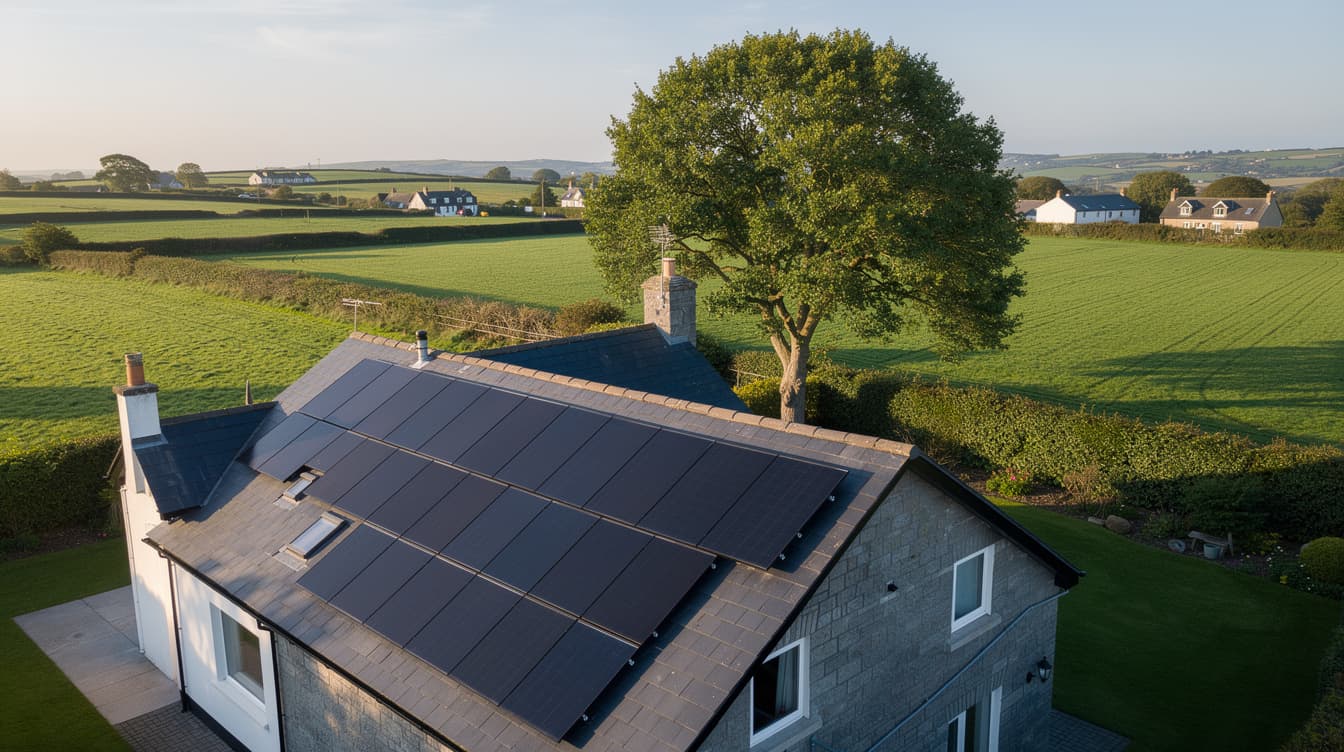
Solar Panel Shading Ireland 2026: Trees, Chimneys & Real Output Loss
How much output do you lose from trees, chimneys or dormers shading Irish solar panels? 2026 guide with mitigation costs and decision tree.
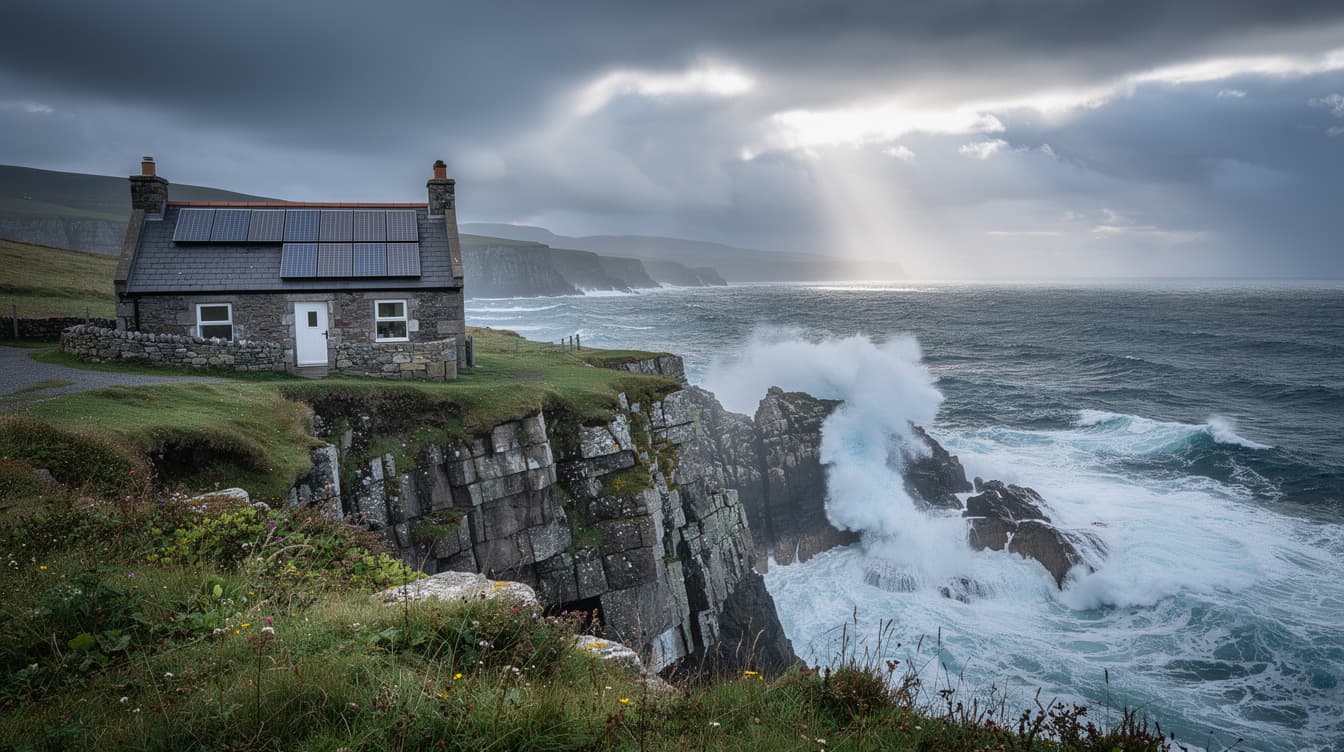
Coastal Solar Panels Ireland 2026: Salt-Air Corrosion & Marine-Grade Install Guide
Fitting solar within 3km of the Irish coast? 2026 guide to salt-air corrosion, marine-grade racking, warranty exclusions and 6-monthly maintenance.

Solar Panels & Old Roofs Ireland 2026: When Your Roof Is Too Old for Panels
Is your Irish roof too old for solar? 2026 guide to slate vs concrete tile, age cheat sheet, re-roof break-even and 5 walk-away signs to spot first.