
Solar Panel Tilt Angle Ireland 2026: Optimal Pitch, Flat-Roof Frames & Real Output Impact
Ask any Irish installer what tilt angle they mount panels at, and you’ll get the same shrug: “whatever the roof is.” That’s the reality of retrofit solar in Ireland — the roof pitch decides the tilt, and there’s usually nothing to adjust. But if you have a flat roof, a shed, a ground mount, or you’re specifying a new build, the tilt angle is a real design choice with real money on the line.
This guide covers the actual maths for Ireland’s latitude, what happens at each pitch you’re likely to find on Irish housing, when adjustable mounts are worth the cost, and how tilt interacts with battery sizing and CEG export. Everything is from PVGIS-modelled output for Irish locations and current 2026 installer prices.
Not Sure Your Roof Angle Works?
Get a free site assessment from SEAI-registered installers who’ll model your specific roof.
The short answer: 35° is optimal, but 20–50° is fine
Ireland sits between 51.4°N (Cork) and 55.4°N (Malin Head). For year-round annual output on a south-facing surface, PVGIS modelling puts the theoretical optimum at 35–38° depending on location. But the curve is very flat — go 15° off in either direction and you lose only 2–3% of annual output. That’s why installers rarely worry about it: your roof is almost certainly close enough.
| Tilt angle | Annual output vs 35° | Summer vs winter split | Where you’ll find it |
|---|---|---|---|
| 0° (flat) | −10% | Summer heavy | Ballasted flat roof (avoid) |
| 10° | −5% | Summer heavy | Low-tilt flat roof mounts |
| 20° | −2% | Balanced | Modern low-pitch bungalows |
| 30° | −0.5% | Balanced | Most 2000s+ Irish estates |
| 35–38° | Optimum | Balanced | Older semi-Ds, dormers |
| 45° | −1% | Winter heavy | Steep-pitch Victorian, cottages |
| 55° | −4% | Winter heavy | Very steep dormer, gable end |
| 75° | −15% | Winter-dominant | Wall-mount / vertical façade |
| 90° (wall) | −28% | Winter-dominant | Balcony solar, cladding |
Modelled at 53°N (roughly Athlone), south-facing, ideal horizon. Regional variation across Ireland is under 1% for these numbers.
What tilt is Irish housing built at?
The pitch of Irish roofs is not random — it’s driven by rainfall, planning norms, and construction era. Here’s what you’ll find:
- Georgian and Victorian (pre-1900): 40–50°. Steep pitches suited slate and cleared rainfall fast. Close to optimum for solar.
- Interwar cottages, 1900–1940s: 35–45°. Standard Irish rural pitch. Basically at the optimum.
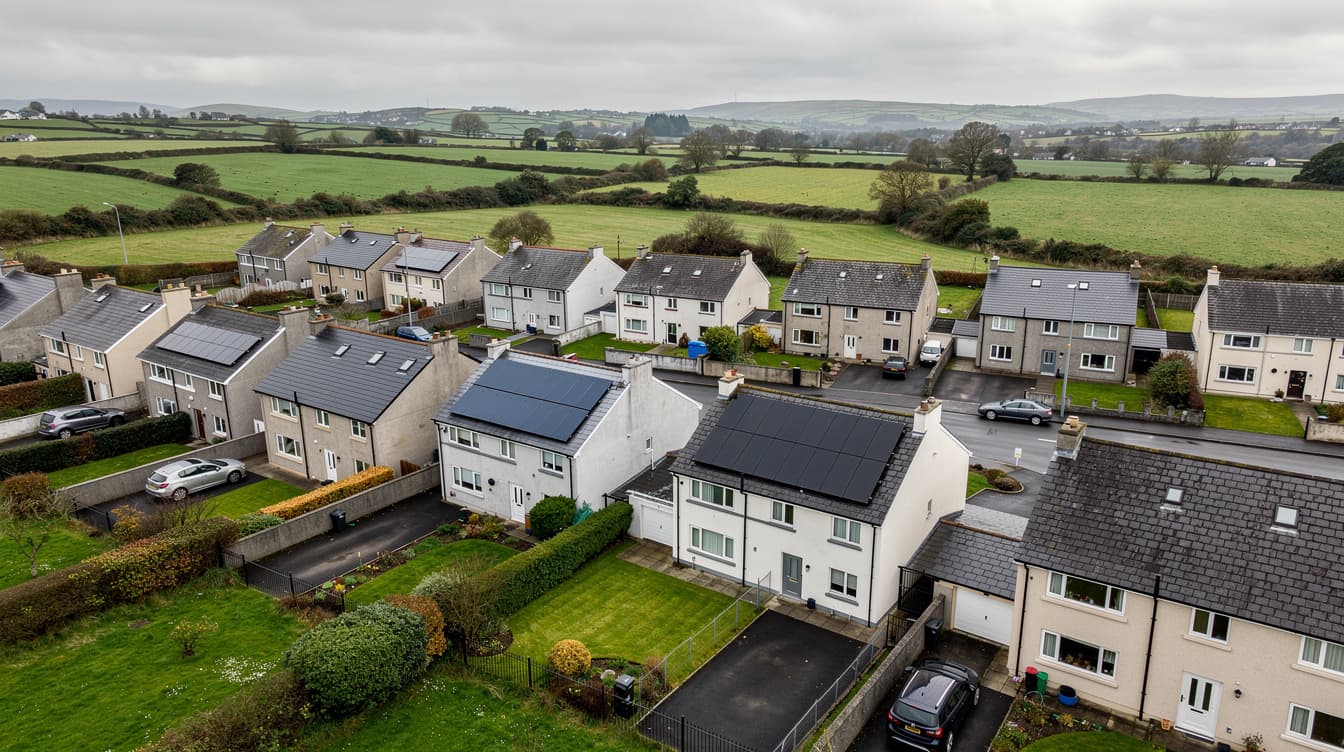
- Council semi-Ds, 1950s–70s: 30–35°. Slate or concrete tile. A degree or two under optimum — makes no practical difference.
- Timber-frame estates, 1990s–2000s: 30–35°. Concrete tile roofs, mostly.
- Modern A-rated builds, 2015+: 22–30°. Shallow pitches for architectural reasons. A little sub-optimal but only 1–2% loss.
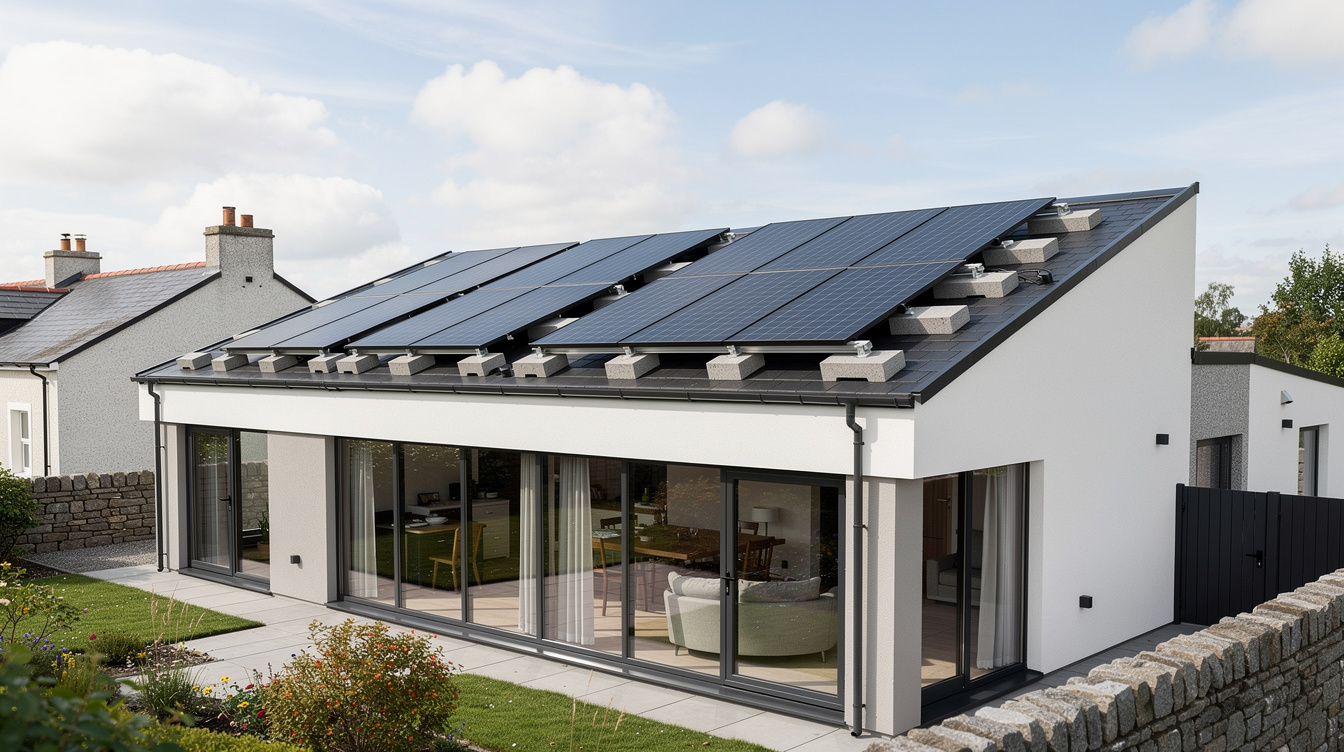
- Contemporary flat-roof extensions: 0°, mounted with tilt frames at 10–15°. Low-tilt because ballast weight and wind uplift matter more than a few percent of yield.
Bottom line: if you’re on any Irish pitched roof, tilt is a solved problem. Orientation (which way it faces) matters far more than tilt.
Flat roofs: the one case where tilt matters
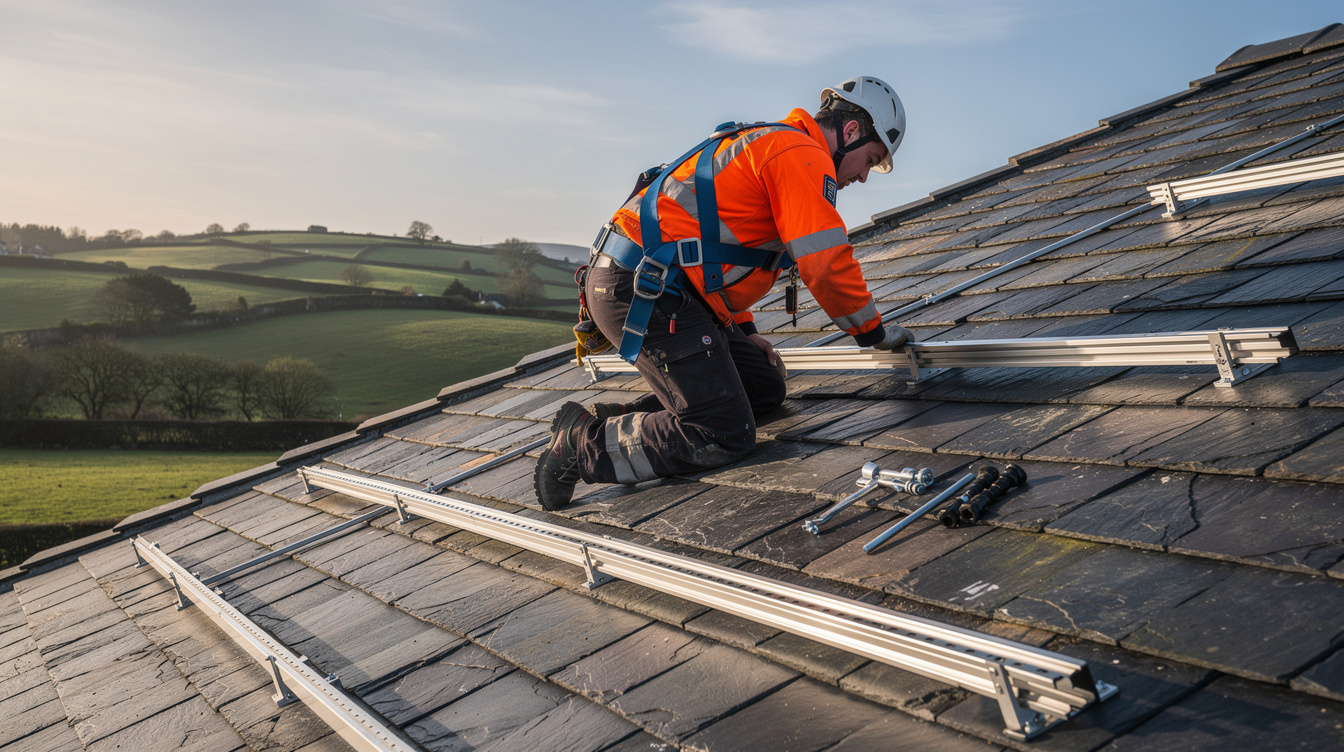
Extensions, garages, apartment blocks and commercial roofs are where tilt becomes a genuine decision. You can’t just lay panels flat — you’ll lose ~10% output, dirt won’t rinse off, and manufacturers won’t honour some warranties. You need a tilt frame. The question is how steep.
Low tilt (10–15°)
This is what most Irish installers default to on flat roofs. Reasons:
- Less ballast: a 30° frame catches roughly twice the wind load of a 10° one. That means twice the ballast blocks, twice the roof loading, and twice the structural sign-off.
- Panels closer together: low tilt means less inter-row shading, so you can pack more kWp onto the same roof.
- Only 5% output loss vs 35°: for the ballast savings, most installers take the trade.
Medium tilt (25–35°)
Used when you have plenty of roof area but want maximum output per panel, or when the roof is fully accessible and rated for the wind loads. Realistic on ground mounts, farm sheds, and larger commercial jobs where inter-row shading can be managed with spacing.
East-west split on flat roofs
A clever trick: instead of one row of south-facing tilted panels, you fit two rows back-to-back — one facing east, one facing west, both at 10–15°. You lose ~15% peak output vs south, but you fit roughly 60% more kWp on the same roof (no gaps between rows). Net output is higher, and the daily curve is flatter (better for self-consumption). Increasingly standard on Irish commercial flat roofs.
Adjustable tilt mounts — are they worth it?
Every year or two an owner asks: what if I fit an adjustable mount and change the tilt seasonally? Steep for winter, shallow for summer? On paper, seasonal tilting boosts annual output by 3–5% in Ireland. In practice:
- Adjustable ground-mount frames cost roughly €150–€350 per panel extra vs fixed. On a 6-panel array that’s €900–€2,000 up-front.
- The 4% output gain on a 6-panel (2.6kWp) array is roughly 90 kWh/year — worth €25–€35 at current export/import rates.
- Payback is 30+ years. The frame will outlive nothing else in your system by that margin.
- You have to actually go outside and adjust it 2–4 times a year. Most people forget or can’t be bothered by year two.
Verdict: not worth it for domestic. The only case that stacks up is a hobbyist ground-mount setup where the frame was going to be over-spec’d anyway.
Tilt vs orientation — which matters more?
If you have a choice between fixing tilt or fixing orientation, always fix orientation first. Here’s the impact side by side on a 4kWp Irish system:
| Change | Annual output impact |
|---|---|
| Tilt 20° vs 35° (both south) | −2% |
| Tilt 45° vs 35° (both south) | −1% |
| Orientation SW vs S (35°) | −3% |
| Orientation E vs S (35°) | −15% |
| Orientation N vs S (35°) | −30% |
| 50% shade (any tilt) | −40 to −60% |
Shading dominates. Orientation matters second. Tilt is usually a rounding error.
Steep pitch: hidden costs
Older cottages and Victorian houses with 45–55° pitches are close to solar-optimal, but they carry install-cost premiums that most homeowners don’t hear about until quotes come in:
- Scaffolding on all elevations: steep pitches often need scaffolding beyond just the working face. That’s €600–€1,200 more on the quote.
- Two-day install becomes three: installers work slower on steep roofs. That’s another labour day, roughly €400.
- Slate handling: old natural slates crack easily. Any that break during installation must be sourced and replaced — sometimes tricky for Bangor or Killaloe slates.
- Wind uplift: steep panels catch more wind, so mount spacing on rails must be tighter, adding brackets.
None of this is a reason not to solar a steep-roof house. Just budget an extra €800–€1,500 vs a standard estate roof.
Tilt and the winter-vs-summer question
A lot of Irish solar buyers care about winter more than the average. That’s because winter is when import prices bite hardest and when a battery makes the difference between paying €0.40/kWh grid vs 4c CEG-recouped solar. Does a steeper tilt help?
Marginally. At 55° tilt, December–January output is roughly 8–10% higher than at 30° tilt. But winter output is so low in Ireland (roughly 4% of annual production happens in December on a 4kWp system) that this “boost” is 10 kWh over the whole month — worth €4.
If you genuinely need more winter output, a battery does more for you than a tilt change ever will. See our solar battery guide and solar calculator to size properly.
Ground-mounted arrays: pick your tilt freely
The one Irish scenario where you can genuinely choose tilt is a ground-mount system. Common on rural properties, sheds, and TAMS-grant farm installs. Here’s what installers actually recommend:
| Ground mount tilt | Best for | Watch out for |
|---|---|---|
| 25° | Windy sites (west coast, Donegal, Kerry) | Dirt build-up in low corners |
| 35° | Most Irish rural sites | Standard wind loading — no issue |
| 45° | Snow country (uncommon in Ireland) | Higher wind loading, taller frame |
Most Irish ground-mount installs land at 30–35°. That’s the sweet spot for output, wind loading, and dirt-shedding. If the site is exposed (coastal Donegal, Mayo, Kerry) drop it to 25° and add ballast to the frame legs.
Flat Roof or Ground Mount Job?
Get quotes from installers experienced in tilt-frame and ground-mount designs.
Common tilt questions
My roof pitch is 22°. Is that too shallow?
No. You’re losing 1–2% of annual output vs a steeper roof. That’s well inside the noise of installer sizing assumptions.
Should I ask for the panels to be tilted off the roof plane?
Almost never. Tilt frames on pitched roofs add cost, look bad, catch wind, and gain you 1–3% of output. Only makes sense if the roof pitch is under 10°.
Do all installers use the same tilt on flat roofs?
No. Ranges from 8° (aggressive low-tilt) to 30°. Ask what they’re proposing and why — ballast weight is the usual driver. Low-tilt (10–15°) is the modern default in Ireland.
Does tilt affect the SEAI €1,800 grant?
No. SEAI eligibility rules cover MCS/SEAI installer registration, system sizing, and inverter type — not tilt angle.
Does hail matter for tilt?
Not in Ireland. Hail damage is negligible here relative to countries where it’s a design factor. Any Tier 1 panel handles Irish weather at any realistic tilt.
What tilt for a bifacial panel?
Slightly steeper — around 30–40° on ground mounts — because the rear side benefits from ground-reflected light, which is stronger at steeper angles. See our bifacial guide.
Can I mount panels vertically on a south wall?
Yes, and it’s becoming more common on new builds for architectural reasons. Expect ~28% less annual output than the same panel on an optimally tilted roof. Winter output is close to roof-mounted values, so the loss is concentrated in summer.
What to ask your installer
When quotes come in, the tilt-related things worth asking:
- Confirm the pitch they’ve measured your roof at — not what they assumed from a floor plan.
- For flat-roof installs: what tilt frame are they using, what ballast, and have they done wind-load calculations?
- For east-west facing pitched roofs: are they splitting the array across both, or only using one? Ask them to model both scenarios in PVsyst or PVGIS.
- For ground mount: is the frame galvanised, has it been engineered for the site wind zone, and how deep are the foundations?
Most Irish installers do this properly by default. Asking is just a way of confirming they’re thinking about your specific site rather than pushing a template.
Ready to Go Solar?
Get your free personalised quote from SEAI-registered installers.
Data sources: PVGIS 5.3 (JRC European Commission) for output modelling at Irish latitudes; SEAI Solar PV Domestic scheme rules 2026; installer quotes gathered from active operators April–June 2026. Last reviewed July 2026.
Related Articles
Solar Panel Installation Cost Breakdown Ireland 2026: Where Every Euro Goes
Every line of an Irish solar install quote explained for 2026: panels 22%, inverter 14%, labour 18%, scaffolding 6%, margin 20-26%. Spot inflated quotes and negotiate fairly.
Solar Inverter Sizing Ireland 2026: DC:AC Ratio, Types & Brand Guide
How to size a solar inverter for Irish conditions. 1.2-1.3:1 DC:AC ratio, ESB NC6 6kW rule, hybrid vs string vs microinverter, top brand picks for 2026.
Cheapest Solar Panels Ireland 2026: Where to Save Without Ruining Your Payback
Cheapest legitimate solar routes in Ireland 2026: budget SEAI installs, DIY vs grant maths, Lidl plug-ins & where the price actually comes from.