
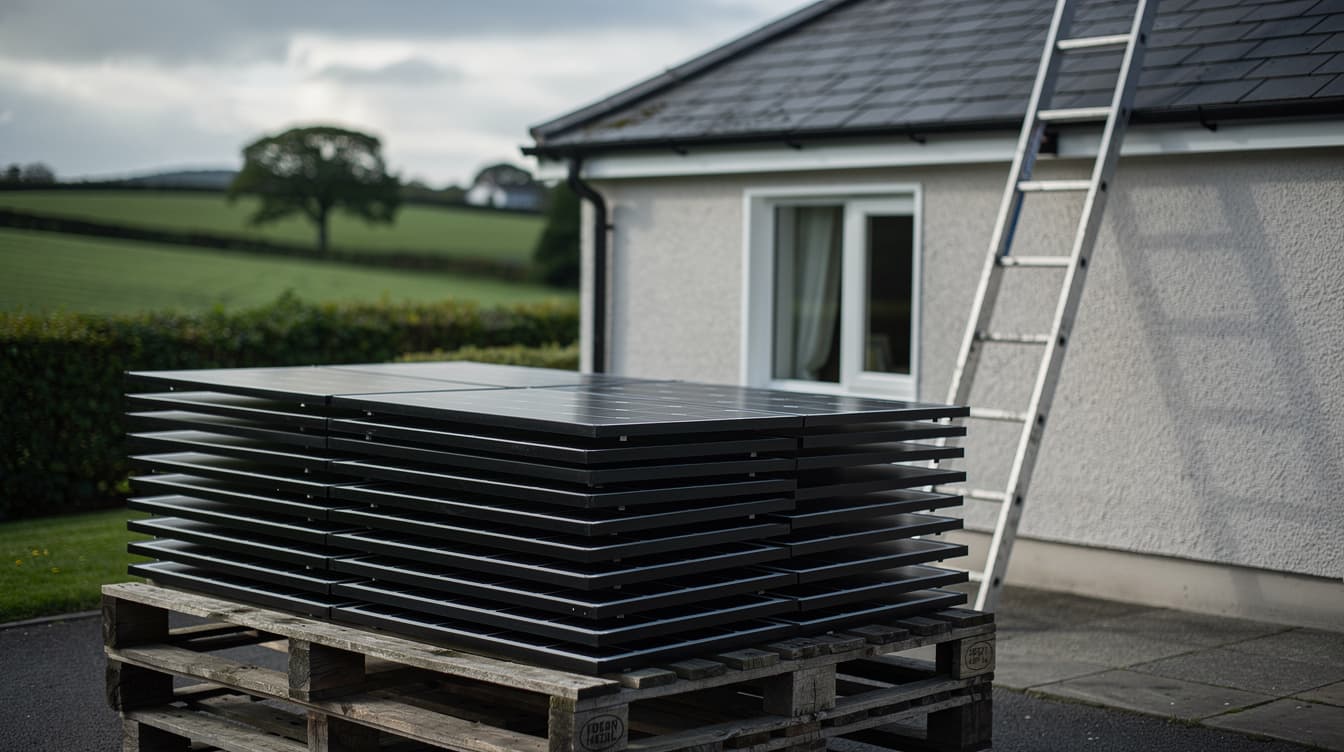
Solar Panel Installation Cost Breakdown Ireland 2026: Where Every Euro Goes
Most Irish solar quotes arrive as a single headline number — "€9,800 supplied and installed" — with no breakdown of where the money actually goes. That makes it impossible to spot inflated markup, missing scope, or where one installer is shaving margin while another is loading on accessories. This 2026 guide opens up the actual cost structure of an Irish solar PV installation, line by line: what panels really cost the installer, the inverter, mounting kit, cabling, labour, scaffolding, certification, the SEAI grant deduction, and the realistic margin range. By the end you'll know what every euro of a quote is paying for and where there's room to negotiate.
Quick Answer: Solar Install Cost Breakdown Ireland 2026
A typical Irish residential 4 kWp solar PV install costs €7,200–€8,800 before grant, €5,400–€7,000 after the €1,800 SEAI grant, at 0% VAT. Of that, panels are roughly 22%, the inverter 14%, mounting and cabling 10%, labour 18%, scaffolding 6%, certification 4%, and installer margin 20–26%. Battery storage adds €3,500–€5,500 separately. Quotes outside this range either include extras (batteries, EV chargers, hot water diverter) or have unusually thin/thick margin.
The Full Cost Breakdown of a Typical 4 kWp Irish Solar Install (2026)
The table below itemises every cost line in a typical 4.4 kWp residential install (10 panels at 440 W, hybrid inverter, no battery), based on prices observed across SEAI-registered installers in Q1–Q2 2026. The "installer cost" column reflects what the contractor pays for the component or labour. The "homeowner price" column reflects the line shown on a typical quote after margin is applied.
| Line Item | Installer Cost | Homeowner Price | % of Total Quote |
|---|---|---|---|
| 10 × 440 W panels (Jinko, Longi, JA) | €1,400 | €1,750 | 22% |
| 4 kW hybrid inverter (GivEnergy, Sungrow, Solis) | €900 | €1,150 | 14% |
| Mounting rails, brackets, clamps, slate hooks | €320 | €450 | 5.6% |
| DC + AC cabling, MC4 connectors, conduit | €180 | €280 | 3.5% |
| DC isolators, AC switch, breakers, surge protection | €220 | €300 | 3.8% |
| Scaffolding (2-storey, 5-day hire) | €420 | €480 | 6% |
| Install labour (2 installers × 2 days) | €1,120 | €1,420 | 18% |
| Electrician sign-off + Cert 3 + ESB Networks paperwork | €220 | €320 | 4% |
| SEAI grant application + drawdown admin | €80 | €150 | 1.9% |
| Smart monitoring app + commissioning | €60 | €180 | 2.3% |
| Insurance, indirect overhead, warranty cover | €180 | €320 | 4% |
| Installer net margin (~15–20% net) | — | €1,200 | 15% |
| Gross quote (before grant) | €5,100 | €8,000 | 100% |
| Less SEAI grant (4 kWp eligible) | — | −€1,800 | — |
| Homeowner net price | — | €6,200 | — |
Panels: 22% of Cost — Where the Real Variation Hides
Panel pricing in 2026 has collapsed from where it stood in 2022. A Tier-1 Chinese 430–450 W mono-PERC or TOPCon panel landed in Ireland costs the installer between €130–€150 per panel (around €0.30–€0.34 per Wp). What you pay on the quote depends entirely on what tier panel they're proposing:
| Panel Tier | Installer Cost (per panel) | Homeowner Price (per panel) | Example Brands |
|---|---|---|---|
| Budget mono-PERC 410–430 W | €110–€130 | €145–€170 | Risen, Jolywood, Astronergy |
| Tier-1 TOPCon 430–450 W | €130–€160 | €165–€195 | Jinko Tiger Neo, JA Solar, Longi Hi-MO |
| Premium Heterojunction (HJT) 440–460 W | €180–€220 | €220–€270 | Meyer Burger, REC Alpha Pure |
| Premium Western-made 400–420 W | €240–€290 | €290–€340 | SunPower Maxeon, Panasonic, LG Neon |
The honest reality: for Irish conditions Tier-1 TOPCon panels deliver 95% of the performance of premium HJT or Western-made panels at 60–75% of the price. Premium panel choices add €800–€1,500 to a typical install and pay back over the panels' warranty period only if they materially outperform — which in Ireland's diffuse-light climate is rarely the case. Spend the upgrade money on a hybrid inverter or larger system instead.
The Inverter: 14% of Cost — Specify Hybrid Always
A 4 kW hybrid string inverter from a top-tier brand costs the installer €800–€1,000 in 2026. Non-hybrid inverters are €100–€250 cheaper. The price premium for hybrid has collapsed to the point where there's no rational reason to specify non-hybrid on a new install. The full pricing range:
- Budget string inverter (Solis S5, Growatt MIN-XH): €700–€900 installer cost, €850–€1,100 on quote
- Mid-tier hybrid (Sungrow SH-RS, Solis S6 Hybrid, GoodWe DNS-D): €850–€1,100 installer cost, €1,100–€1,400 on quote
- Premium hybrid (GivEnergy AC3, Sigenergy SigenStor): €1,100–€1,400 installer cost, €1,400–€1,800 on quote
- Microinverter system (Enphase IQ8): €180–€230 per panel-microinverter, so €1,800–€2,300 for 10 panels installer cost, €2,200–€2,800 on quote
Microinverters cost roughly €800–€1,200 more than a hybrid string on a 4 kWp system. That premium is worth paying only if your roof has significant shading or multiple orientations. On simple unshaded south-facing roofs it's overkill.
Mounting Kit & Cabling: 9% of Cost — Mostly Hidden Labour
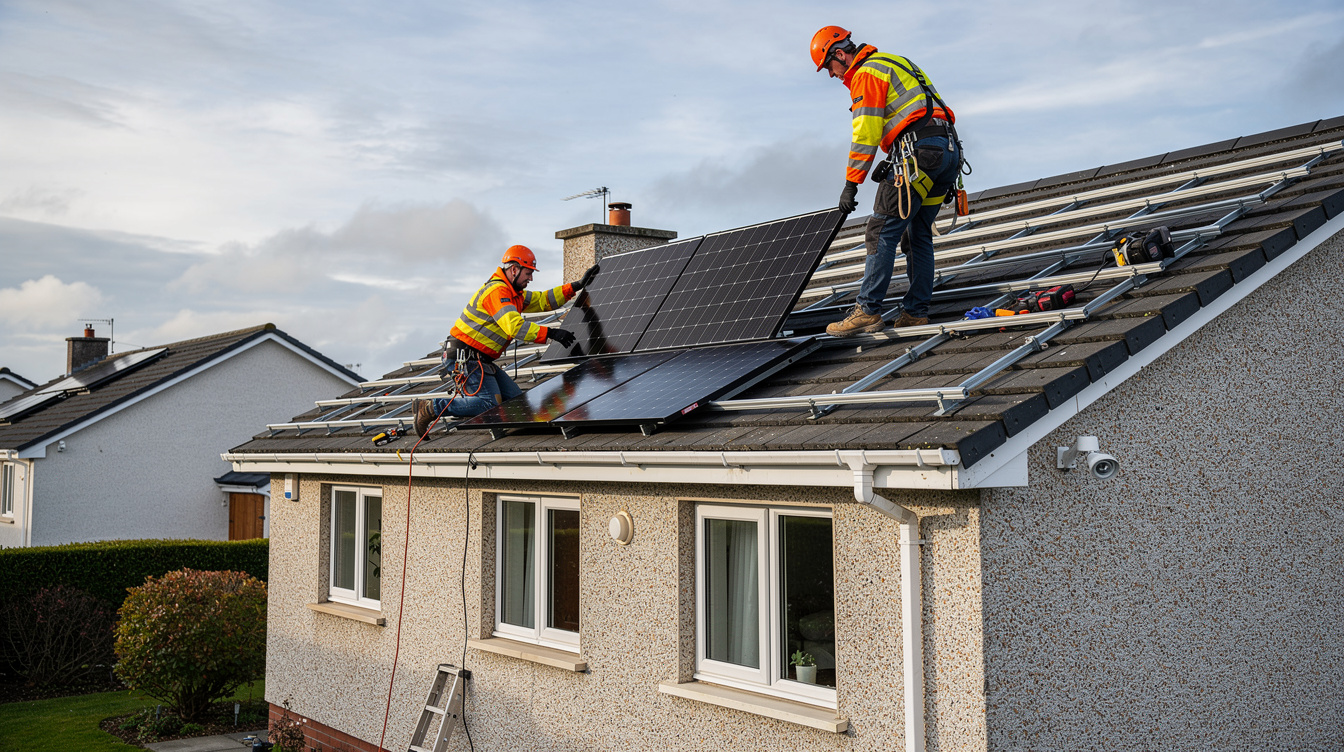
Mounting hardware is largely a commodity in 2026. A 10-panel rail set, clamps, slate hooks and grounding hardware costs an installer €280–€380 depending on roof type. Slate roofs add €40–€80 versus tile for the specialist hooks. Flat roofs cost €120–€200 more for ballasted frames.
What inflates this line on quotes is the labour buried inside: roof-walking time, lifting panels onto a 2-storey roof, drilling through tile or slate, and weatherproofing every penetration. A good installer will charge €380–€500 for the whole kit including weatherproofing. A lazy quote will pad this line to €600+ as hidden margin.
Scaffolding: 6% — The Line Most Quotes Skip
Two-storey Irish homes legally require scaffolding for any roof work under HSA Working at Heights regulations. Single-storey bungalows can be done from a tower scaffold or single platform but most installers still erect proper scaffolding for safety. Scaffolding hire in Ireland in 2026 runs:
- 2-storey rear or front elevation, 5-day hire: €380–€480
- 2-storey full wrap, 5-day hire: €550–€700
- 3-storey or awkward access: €700–€1,000+
- Tower scaffold for bungalow: €180–€260
Watch for quotes that say "scaffolding not included" in the small print — that's a €400+ surprise on installation day. Reputable installers always include scaffolding in the headline price unless you explicitly opt to arrange it yourself.
Labour: 18% — Two Installers, Two Days
A standard residential install needs a two-person team (one electrician with mains works qualification, one solar installer) for two days: day 1 for scaffolding, panel lift and mounting; day 2 for cabling, inverter, sign-off and commissioning. Total labour cost to the installer is around €1,000–€1,200 including PRSI, training, vehicle and overhead. Quoted as €1,400–€1,600.
Larger systems (8–10 kWp) add 1–2 extra installer-days. Batteries add 1 installer-day for wiring and commissioning.
Certification & Paperwork: 4% — Mandatory, Often Padded
Every SEAI-registered solar installation requires a Cert 3 RECI/ECSSA electrical certificate from the qualifying electrician, plus ESB Networks NC6 paperwork for grid connection. The combined cost of certification administration is €200–€280 for the installer. Quoted as €280–€400.
SEAI grant application admin is roughly an hour of office work per job. Many installers pad the "grant admin" line on quotes to €150–€200, which is inflated — if a quote breaks this out separately at €200+ it's a sign of margin loading.
Installer Margin: 15–20% Net — Where You Can Actually Negotiate
The headline margin in solar installs looks high (20–30%) but after vehicle, insurance, office, marketing, sales commission, warranty provisions and bad-debt allowance, the average Irish SEAI-registered installer takes home a net 12–18% on each job. That's the negotiating envelope: ask too aggressively below that and the installer walks away. Ask within it and most installers will trim 5–10% to win a quote against competition.
A €7,800 quote that walks down to €7,200 after negotiation is the typical pattern when you have three quotes on the table. Beyond that, the installer is either cutting corners (skipping scaffolding insurance, swapping to a lower-tier panel, using non-SEAI-eligible inverter) or losing money.
Cost by System Size: How the Numbers Scale
Larger systems are cheaper per kWp because labour, scaffolding, certification and inverter all spread across more panels. The economy-of-scale curve looks like this:
| System Size | Typical Quote (Pre-Grant) | SEAI Grant | Net Price | € per kWp (Net) |
|---|---|---|---|---|
| 2.2 kWp (5 panels) | €4,800–€5,600 | €1,400 | €3,400–€4,200 | €1,550–€1,910 |
| 3.5 kWp (8 panels) | €6,400–€7,400 | €1,800 | €4,600–€5,600 | €1,310–€1,600 |
| 4.4 kWp (10 panels) | €7,200–€8,800 | €1,800 | €5,400–€7,000 | €1,230–€1,590 |
| 5.3 kWp (12 panels) | €8,200–€10,000 | €1,800 | €6,400–€8,200 | €1,210–€1,550 |
| 6.6 kWp (15 panels) | €9,400–€11,400 | €1,800 | €7,600–€9,600 | €1,150–€1,460 |
| 8.0 kWp (18 panels) | €11,000–€13,200 | €1,800 | €9,200–€11,400 | €1,150–€1,430 |
Note the curve: per-kWp cost falls from around €1,750 at 2.2 kWp to €1,250 at 8 kWp. The biggest jump is between 2.2 kWp and 4.4 kWp because the SEAI grant maxes out at €1,800. Above 4 kWp you're paying gross for every additional panel.
See What Your Roof Could Save
Our Ireland-specific calculator estimates system size, grant, output and payback.
Add-On Costs: Battery, EV Charger, Hot Water Diverter
Quotes for a "full home solar package" often bundle add-ons that push the headline price above €15,000. Here's what each adds:
| Add-On | Installed Cost | Payback Years |
|---|---|---|
| 5 kWh battery storage | €3,500–€4,500 | 7–9 years |
| 10 kWh battery storage | €5,500–€7,000 | 8–10 years |
| Eddi/MyEnergi hot water diverter | €750–€950 | 3–5 years |
| 7.4 kW EV charger (Zappi, Wallbox) | €1,100–€1,600 | N/A (utility) |
| Bird/squirrel mesh perimeter | €180–€260 | Loss-prevention |
The hot water diverter (Myenergi Eddi or Solis equivalent) is the highest-payback add-on. It routes surplus solar to your immersion heater, displacing roughly €200–€300 of annual gas or electric water heating cost. Payback under 5 years is standard.
What VAT Treatment Looks Like in 2026
The Finance Act 2022 cut VAT on solar PV supply-and-install for private dwellings from 13.5% to 0%, and Finance Act 2025 extended this through to 31 October 2026. This applies to:
- Solar panels and racking
- Inverters (including hybrid)
- Battery storage when supplied as part of the solar install
- Cabling, isolators, monitoring hardware
- Labour to install all of the above
It does NOT apply to:
- Standalone battery retrofits to existing solar (13.5% VAT)
- EV chargers (23% VAT)
- Heat pumps installed independently of solar (9% VAT)
- Commercial or non-dwelling installations (23% VAT)
This is why timing matters in 2026: any solar install completed and invoiced by 31 October 2026 captures 0% VAT. Beyond that, in absence of further legislation, the rate reverts. That's an automatic 13.5% saving (around €1,000–€1,400 on a typical install) you don't want to lose to delay.
Red Flags That Tell You a Quote Is Inflated
- Headline number above €12,000 for a 4 kWp install without battery. Either premium Western-made panels (overkill) or 25–35% margin loading. Walk.
- "Scaffolding not included." Add €400–€700 to the headline. Reputable installers include this.
- "Grant admin: €250". Real cost is €80–€100. Anything over €200 is hidden margin.
- "Premium German/Korean panels". Specific brand should be named (Meyer Burger, REC, LG Neon). Vague "premium" descriptors hide rebranded Tier-2 Chinese.
- No inverter brand named. The single most important brand to identify on a quote. If they won't tell you, it's because the inverter is generic.
- Quote valid for less than 14 days. Pressure tactic to prevent comparison.
- No SEAI registration number on quote. Without it the grant cannot be claimed. Verify on the SEAI register at seai.ie.
- "0% finance" without showing cash price separately. Almost always the finance cost is built into a higher cash price.
How to Get Three Like-for-Like Quotes
Three quotes is the single biggest leverage point in pricing. To get comparable quotes that you can actually negotiate on:
- Specify a fixed panel count and wattage range ("10 panels at 430–450 W") rather than a kWp target
- Specify inverter type (hybrid string OR microinverter) and require named brand
- Include scaffolding in scope explicitly
- Ask each installer to provide the same monitoring app/portal
- Ask for the same warranty length on panels (25 years standard), inverter (10 years standard), workmanship (5+ years), and bird mesh (3+ years)
- Specify SEAI grant claim included in the price
- Ask for the quote to itemise labour, materials and certification separately
Once you have three itemised quotes you can compare line by line. Differences over €500 on a single line are negotiation opportunities.
FAQ: Solar Panel Installation Cost Ireland 2026
What is the average cost of solar panel installation in Ireland 2026?
A typical 4 kWp residential install costs €7,200–€8,800 before grant, €5,400–€7,000 after the €1,800 SEAI grant, at 0% VAT. Larger 6–8 kWp systems run €9,400–€13,200 before grant.
What percentage of a solar install cost goes to panels versus labour?
Panels are roughly 22%, the inverter 14%, mounting and cabling 9%, scaffolding 6%, labour 18%, certification 4%, and installer margin 20–26% of the gross quote.
How much can I negotiate off a solar quote in Ireland?
Typically 5–10% off the headline number when you have three quotes on the table. Beyond that the installer is either cutting corners or losing money. A €7,800 quote walking to €7,200 is the typical successful negotiation pattern.
What is included in the SEAI grant?
The €1,800 SEAI Solar Electricity Grant covers solar PV panels and the inverter only. Battery storage is paid for separately. The grant is paid directly to the installer who deducts it from your invoice.
Does the price include scaffolding and certification?
It should but doesn't always. Reputable installers include both. Always confirm scaffolding is in scope — otherwise it's a €400–€700 surprise. Cert 3 electrical sign-off and ESB Networks NC6 paperwork should always be included.
Why are larger systems cheaper per kWp?
Labour, scaffolding, certification, the inverter and the SEAI grant application are largely fixed costs. Spreading them across more panels reduces €/kWp. The biggest jump is between 4 kWp and 6 kWp because the SEAI grant maxes out at 4 kWp.
What happens to install cost when 0% VAT ends in October 2026?
Costs rise by 13.5% on supply-and-install for domestic homes unless legislation extends the relief. On a typical €7,800 install that's around €1,050 more out of pocket. There's a real timing incentive to install before October 2026.
Are battery storage costs included in the SEAI grant?
No. The SEAI grant covers solar PV only. Battery storage is paid for separately but qualifies for 0% VAT when supplied as part of the same solar install.
Bottom Line: Know Where the Money Goes, Then Get Three Quotes
Solar installation cost in Ireland in 2026 is roughly €1,700–€2,000 per kWp at quote (pre-grant), falling to €1,200–€1,500 per kWp net (post-grant) on systems above 4 kWp. Of that, around 50% is hardware (panels, inverter, mounting, cabling), 25% is labour and certification, and 20–25% is installer margin and overhead.
Comparing three quotes line by line — with the same panel count, named inverter brand, scaffolding included, and SEAI grant claim — is the single biggest lever for getting a fair price. Add the 0% VAT timing deadline of October 2026 and there's a clear case for moving sooner rather than later.
Start with three SEAI-registered installer quotes via our free quote comparison. Itemised quotes only — refuse anything that arrives as a single headline number.
Related Articles
Solar Panel Tilt Angle Ireland 2026: Optimal Pitch, Flat-Roof Frames & Real Output Impact
Ireland tilt angle 2026: 35° optimum, why 20–50° is fine, flat-roof frames, ground mount, adjustable mounts and real PVGIS output numbers.
Solar Panel Cost Per kWp Ireland 2026: Real Prices, Grant Effect & Curve by Size
Per-kWp solar pricing in Ireland 2026: €1,650-€2,000 pre-grant, €1,200-€1,550 net. Curve by system size, SEAI grant cliff at 4 kWp, levelised cost 6-8 c/kWh.
Solar Inverter Sizing Ireland 2026: DC:AC Ratio, Types & Brand Guide
How to size a solar inverter for Irish conditions. 1.2-1.3:1 DC:AC ratio, ESB NC6 6kW rule, hybrid vs string vs microinverter, top brand picks for 2026.