
Bifacial Solar Panels Ireland 2026: Real Gains, Costs & Where They Actually Pay Off
Bifacial solar panels catch light on both sides – the front from the sun and the back from ground reflection. In sunny, high-albedo places (snow, sand, white gravel) they can push 15–25% more energy than a same-wattage monofacial panel. In Ireland – overcast, grass-covered, mostly domestic roofs – the real-world gain sits closer to 3–8%, and only if the panels are mounted where the rear side actually sees light. For a typical Irish rooftop retrofit, bifacial is a nice-to-have, not a game-changer. For a ground mount, farm shed or car port, the picture flips.
Bifacial panels have gone from “utility-scale only” to the default choice on most tier-1 manufacturer datasheets in 2026. Longi, Trina, JA Solar and JinkoSolar all now ship their flagship N-type TOPCon modules as bifacial by default, and the price gap versus monofacial has narrowed to a few percent. That means Irish installers increasingly quote bifacial panels whether or not the customer asked. This guide unpacks what “bifacial” actually means for an Irish home or business, how much extra energy you can realistically expect, and where the upgrade genuinely pays off.
What makes a panel bifacial?
A conventional (monofacial) solar panel has a solar cell layer sandwiched between a glass front and an opaque white or black plastic backsheet. Sunlight hits the front; anything that reaches the back is absorbed by the plastic and lost as heat.
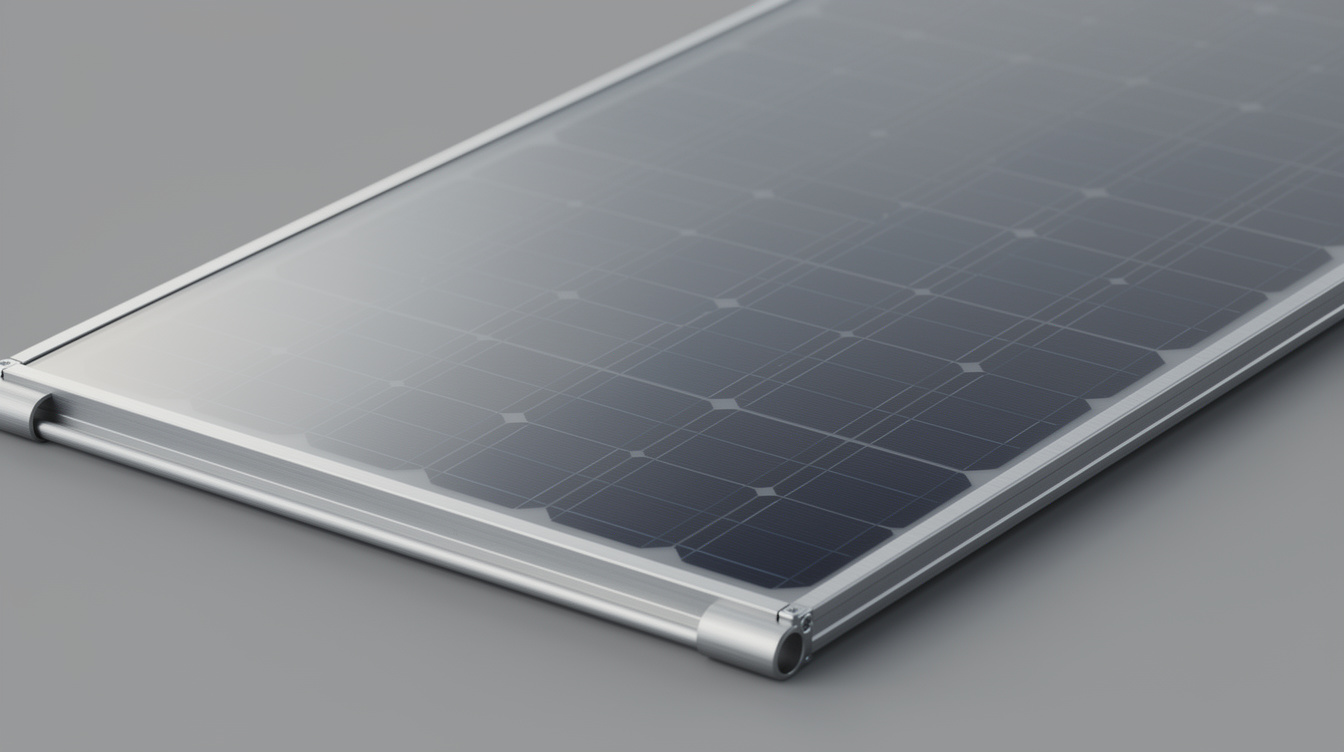
A bifacial panel replaces that opaque backsheet with a second sheet of glass (or, on some models, a transparent polymer). The solar cells themselves are the same – usually N-type TOPCon or HJT (heterojunction) – but they’re designed with contacts on both sides so light hitting the rear generates additional current. The extra glass makes the panel heavier (typically 25–28 kg versus 20–22 kg for a monofacial 440 W panel) and slightly thicker, but also more durable – most bifacial panels carry 30-year linear performance warranties versus 25 years for monofacial.
The bifacial gain – theory versus Ireland
The extra energy a bifacial panel produces is called the bifacial gain, expressed as a percentage over the same-wattage monofacial. Manufacturers quote it on datasheets somewhere between 10% and 30%. Those numbers assume ideal conditions:
- High ground reflectivity (albedo) – snow (~80%), white gravel (~40%), light concrete (~30%)
- Panels raised off the ground with clear space behind
- Optimal tilt for direct sun and diffuse sky light on both sides
- Rows spaced far enough apart that the panel in front doesn’t shade the rear of the one behind
Ireland struggles to hit any of those. Grass has an albedo of ~20%, wet grass or bog closer to 15%, and slate roofs about 10%. Our sky is overcast for most of the year, which actually helps diffuse light reach the rear – but the overall irradiance is lower to start with. Here’s what independent field studies and Irish installer data suggest for realistic bifacial gain by mounting type:
| Mounting scenario | Ground/backdrop | Realistic bifacial gain |
|---|---|---|
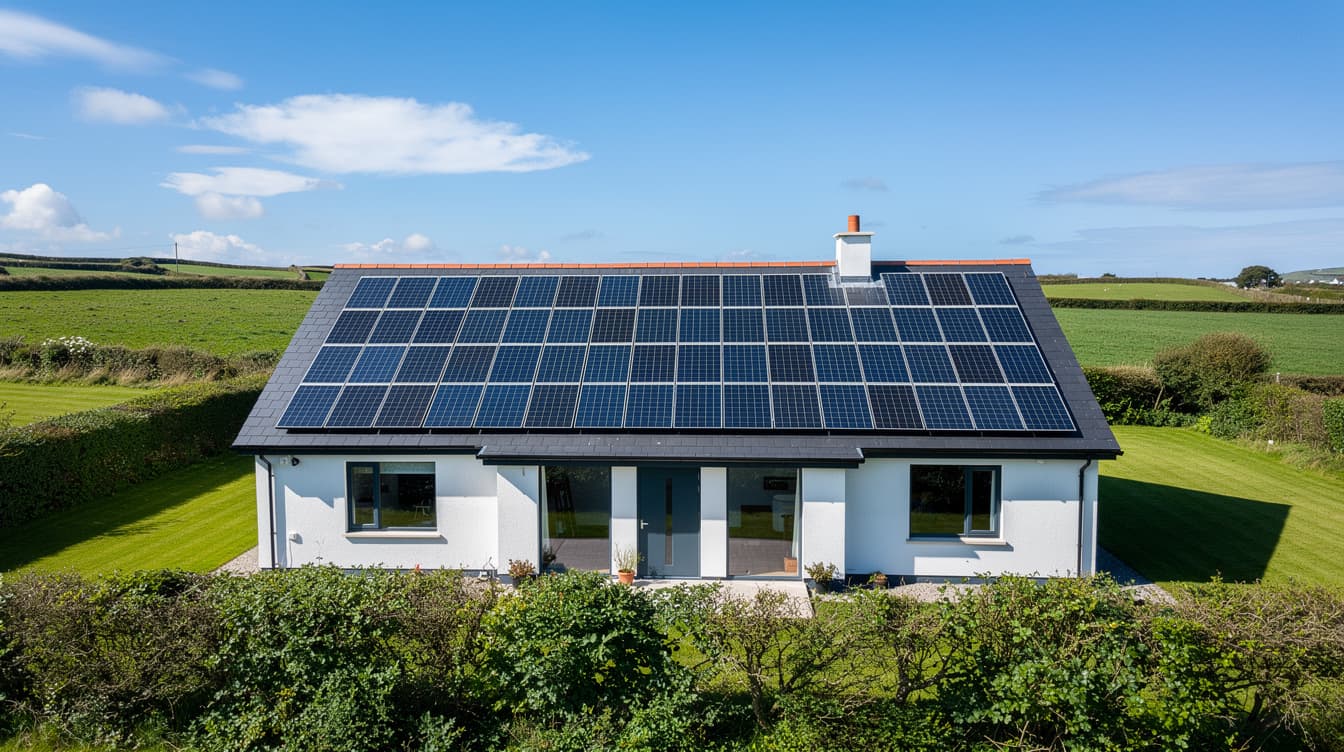
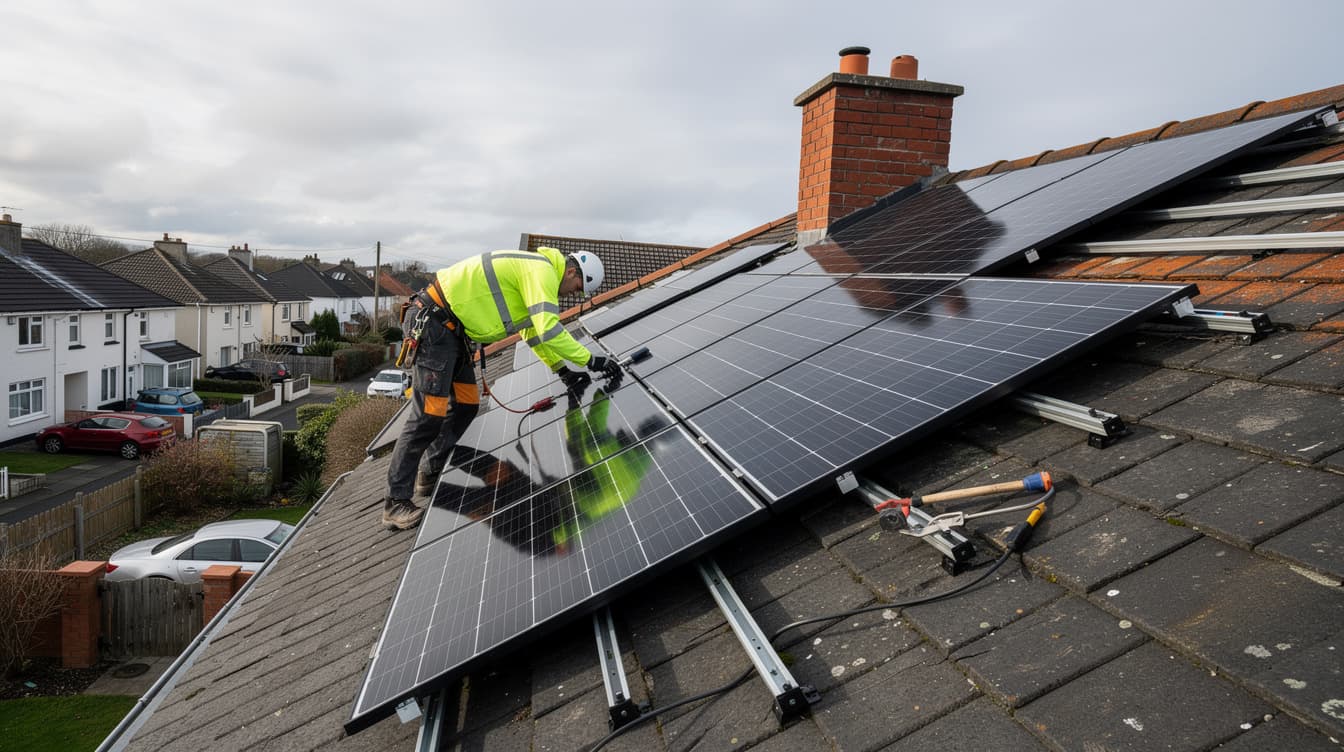
| Typical Irish pitched roof | Slate/tile visible through gaps – but flush mounted | 1–3% |
| In-roof (integrated) mount | Sealed against roof – no rear light | 0% |
| Flat roof, tilted rack, black membrane | Dark rubber roof (~8% albedo) | 2–4% |
| Flat roof, tilted rack, white membrane | White TPO roof (~60% albedo) | 8–12% |
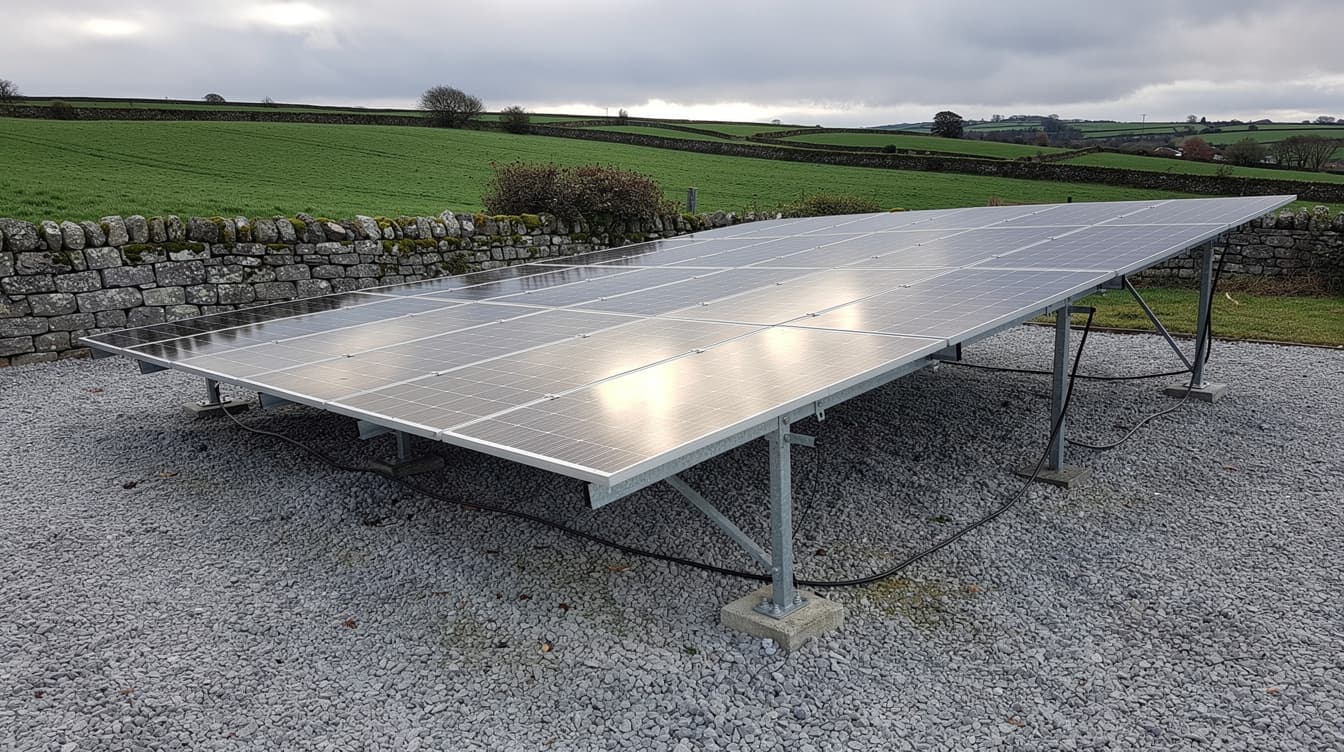
| Ground mount, grass | Green grass (~20% albedo) | 5–8% |
| Ground mount, gravel/stone | Light gravel (~35% albedo) | 10–15% |
| Solar carport / vertical fence array | Tarmac, concrete, open sky both sides | 12–20% |
| Agri-PV over pasture (elevated) | Grass with height gap | 7–10% |
The pattern: the further the rear surface is from a dark solid object and the more reflective the surroundings, the more useful bifacial becomes. Flat against a rooftop it’s essentially wasted glass.
What bifacial costs versus monofacial in Ireland
The price premium has collapsed. In 2022 bifacial was 15–20% more expensive per watt. In 2026 the wholesale price gap on tier-1 modules is under 5%, and for some suppliers zero – JA Solar’s Deep Blue 4.0 and Trina’s Vertex S+ ship bifacial as the standard model. The extra cost you actually see on an Irish quote is usually driven by:
- Panel weight – the extra 5–6 kg per module can push a big roof over the mounting rail’s load rating, forcing an upgrade.
- Mounting kit – some rail systems can’t clamp the frameless bifacial modules; the framed versions are fine.
- Labour – two people are required for panels over 25 kg under Irish HSA guidance, which some installers charge slightly more for.
A typical 4 kWp system on an Irish home – roughly 9 panels – costs around €7,500–€9,000 fully installed before the €1,800 SEAI grant. Choosing bifacial modules adds €150–€400 to that total in 2026, depending on brand. See our 2026 solar panel cost guide for the full breakdown.
Get quoted on both types
Compare quotes from SEAI-registered installers who can price your job in bifacial and monofacial side by side.
Where bifacial actually pays off in Ireland
Based on the gain table above and the small cost premium, here’s where the maths tips in favour of bifacial:
1. Farm sheds and outbuildings
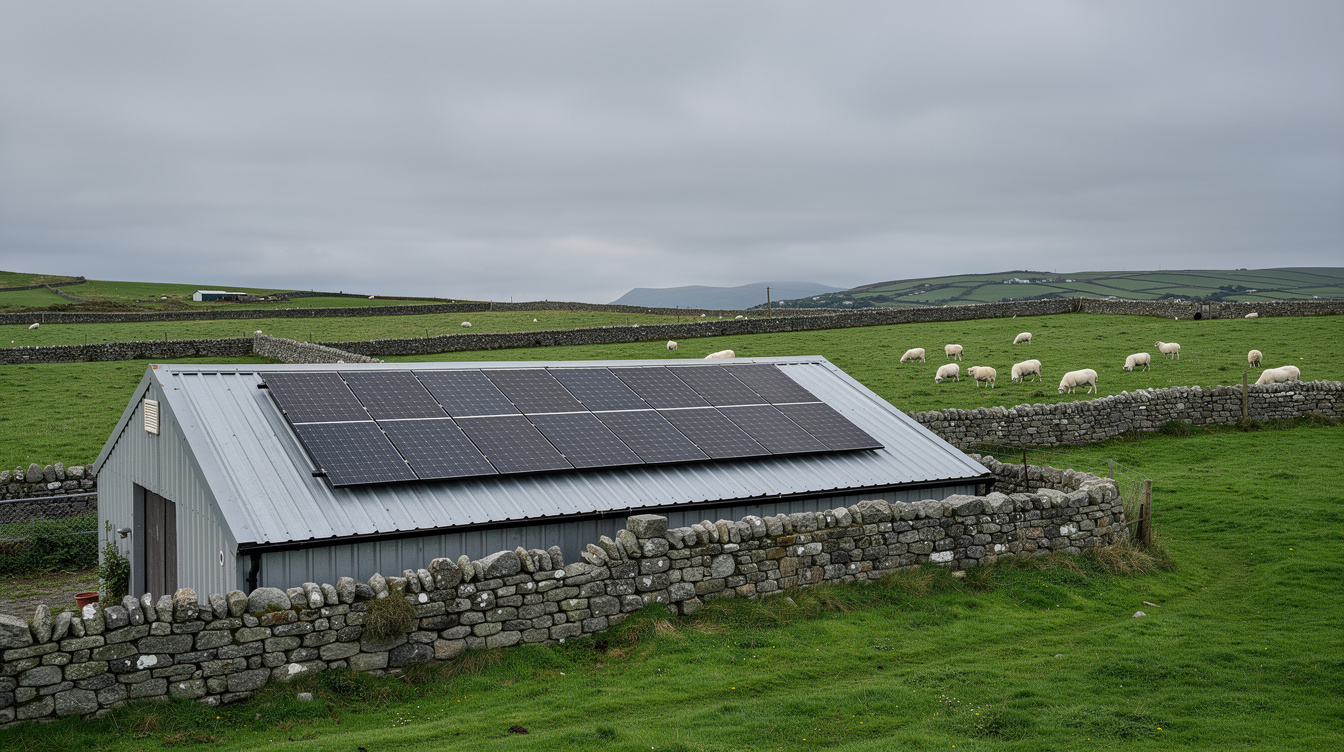
Metal-clad sheds with tilted panels above a light-coloured slab, gravel yard or corrugated iron get 8–12% bifacial gain. Combined with the larger arrays typical on farm buildings – often 15–25 kWp – the extra generation is meaningful. On a 20 kWp shed system, a 10% gain is roughly 1,800 kWh/year of extra output. See our farm solar guide for typical shed layouts.
2. Ground-mounted arrays
Any ground mount with 60 cm+ of clearance behind the panels benefits. On grass, the gain is around 5–8%; on light gravel or a rendered wall behind, it climbs to 10–15%. Since ground mounts are usually the choice for people with unshaded gardens or field space (and generally larger systems), the volume of extra output justifies the small cost premium.
3. Solar carports
Best-case scenario for bifacial. The tarmac below reflects ~15–20% of light, and there’s clear space both sides. Real-world gains of 12–18% are common, and the maths gets even better if you’re charging an EV underneath – every extra kWh is one you don’t buy from the grid. See our solar carport guide.
4. Vertical (east-west facing) fence arrays
An emerging niche but growing fast: bifacial panels mounted vertically on a garden or field fence, one face east, one face west. They catch morning sun on one side, evening sun on the other, and produce a much flatter daily curve than a roof array. Great fit for people with battery storage and heavy evening use. Real-world energy per installed watt is 60–75% of a south-facing roof array but the shape of the output is far more useful.
Where bifacial doesn’t pay off
Flat against a pitched slate or tile roof, bifacial is a solved cosmetic gimmick – the manufacturer’s test conditions can’t occur, so the gain is 1–3% at best. Worse, some in-roof (integrated) mounting systems trap the rear glass against roofing membrane, which can slightly raise operating temperature and cost you 1–2% output. For most Irish home retrofits, monofacial N-type TOPCon panels give you the same warranty, similar efficiency (22–23%), and lower cost. Save the bifacial premium for a different upgrade – battery storage or a bigger inverter.
Bifacial and shading – a small extra advantage
One quiet benefit rarely mentioned on datasheets: when the front side is partially shaded by a chimney, aerial or overhanging branch, the rear side is often still catching diffuse sky light. This means a bifacial panel loses slightly less output to partial shading than a monofacial one – roughly 5–10% less loss on a moderately shaded string. It’s not enough on its own to justify the upgrade for a shaded roof, but it’s a real effect. See our guide on how shading affects panel efficiency for the bigger picture.
Warranty and durability – the underrated bifacial win
The double-glass construction is genuinely more durable than a glass/polymer sandwich. Key differences:
| Attribute | Monofacial (glass/backsheet) | Bifacial (glass/glass) |
|---|---|---|
| Product warranty | 12–15 years | 15–25 years |
| Performance warranty | 25 years / 87.4% output | 30 years / 87.4% output |
| Annual degradation rate | 0.55% per year | 0.35–0.4% per year |
| PID (potential-induced degradation) risk | Higher – polymer moisture ingress possible | Very low – glass is impermeable |
| Fire class | Typically Class C | Typically Class A |
| Hail impact resistance | 25 mm hail at 23 m/s | 35 mm hail at 27 m/s |
For an Irish home planning a 30-year hold on the panels – roughly the current thinking on residential PV – the extra 5 years of warranty and lower annual degradation matter more than the small first-year output gain. Over 30 years, a bifacial panel with 0.35% degradation retains about 89.5% output; a monofacial with 0.55% retains 83.5%. That’s 6 percentage points of extra output in year 30 alone.
Common myths about bifacial in Ireland
“Bifacial panels work at night” – no. There has to be some ambient light, and moonlight is far too weak to produce measurable current. Ignore any datasheet or marketing claim otherwise.
“They’re not worth it in cloudy Ireland” – partly. On roofs, largely true. On ground mounts, farm sheds and carports, the gain is real and pays back the small premium in 3–5 years.
“The rear side generates as much as the front” – no. Rear efficiency is typically 70–80% of front, and the amount of light reaching the rear is a fraction of what hits the front. The gain is a bonus, not a doubling.
“They break more often because of the extra glass” – the opposite. Glass-glass modules have lower long-term failure rates than glass-backsheet, based on 15 years of utility-scale field data. Backsheet delamination is a well-documented failure mode that glass-glass simply doesn’t suffer from.
Should you specifically ask for bifacial on your Irish quote?
Here’s the short answer by installation type:
- Standard pitched roof retrofit – don’t bother asking. If the installer’s tier-1 supplier ships bifacial as the default (increasingly common), you’ll get it anyway. Otherwise stick with monofacial N-type TOPCon.
- Flat roof with white or light-coloured membrane – yes, specifically request bifacial. The gain is real and the cost premium is small.
- Ground mount or garden array – yes, always request bifacial. This is what it’s designed for.
- Farm shed / outbuilding – yes, especially if the shed roof is metal-clad and there’s a bright surface underneath.
- Solar carport – absolutely. Any carport project skipping bifacial in 2026 is leaving 10–15% output on the table.
- New build with in-roof integrated panels – no. The rear side is sealed against the roof, so you’re paying extra for nothing.
Not sure which panel type fits your roof?
Get 3 quotes from SEAI-registered installers – we’ll match you with specialists who can advise on bifacial vs monofacial for your exact setup.
Bifacial-first panel models to look for on Irish quotes in 2026
The main brands your installer is likely to quote as bifacial:
- JA Solar Deep Blue 4.0 Pro (JAM66D45) – 615 W bifacial N-type, 23.6% efficiency, 30-year warranty. Common on commercial and ground-mount Irish jobs.
- Trina Vertex S+ NEG21C.20 (bifacial) – 505 W residential module, glass-glass, 25-year product warranty. Increasingly used on domestic pitched roof work by tier-1 Irish installers.
- Longi Hi-MO 9 (LR8-66HGD) – 660 W bifacial with back contact HPBC 2.0 cells, 24.8% efficiency – the current commercial market leader.
- JinkoSolar Tiger Neo N-type bifacial – 480 W residential, mature technology, widely stocked by Irish distributors.
- REC Alpha Pure-RX – 470 W bifacial HJT (heterojunction) with 25-year full warranty. Premium option; often quoted by higher-end installers.
Cross-check any brand quoted against our best solar panels Ireland 2026 guide before signing.
Frequently asked questions
Do bifacial panels need special inverters?
No – any modern string or hybrid inverter handles them fine. The rear-side current is added on the panel itself, so what reaches the inverter is a single higher-current output. That said, you should size the inverter with the bifacial gain in mind – a 5 kW inverter feeding 5 kWp of bifacial with 10% gain will clip during peaks. Aim for a DC-to-AC ratio of ~1.2 rather than the usual ~1.15.
Are bifacial panels heavier than my roof can take?
Most Irish pitched roofs on standard rafters handle bifacial fine – the extra 5 kg per panel is well within load allowances. Older roofs, particularly cut-timber roofs in period homes, should have a structural check regardless of panel choice. See our roof suitability guide.
Can I get the SEAI grant on bifacial panels?
Yes – the €1,800 SEAI Solar PV grant applies to the installation, not the specific panel technology, as long as the installer is registered and the modules meet IEC 61215 and IEC 61730 standards, which all tier-1 bifacial panels do. Full details in our SEAI grant guide.
Are bifacial panels more efficient in low light?
Slightly, yes. The N-type TOPCon or HJT cells inside most 2026 bifacial modules have better low-light response than the older P-type PERC cells common in cheaper monofacial panels. Expect around 2–3% more output at 200 W/m² irradiance – typical of an overcast Irish morning – before any bifacial gain is added.
What’s the payback difference?
On a typical €7,500 residential retrofit, adding bifacial costs about €200–€400 extra. The extra generation on a roof array is small (~50–150 kWh/year) which pushes payback by around 6 months. On a ground mount or carport, the extra generation is 500–1,500 kWh/year and the premium pays back in under 3 years – a clear win.
Do bifacial panels look different?
Yes – from the ground you can often see through the gaps between the cells because the backsheet is transparent glass. Some homeowners find this more attractive (lighter, less industrial); others prefer the traditional black look. All-black bifacial variants exist but usually add another 3–5% to the price.
Bottom line for Irish homeowners in 2026
Bifacial solar panels are the default on ground mounts, carports and farm sheds – if you’re quoted anything else for those installations, ask why. On a standard pitched roof retrofit they’re a small upgrade – not because the extra rear-side energy is meaningful (it isn’t, flush-mounted), but because glass-glass panels last longer, degrade slower and carry better warranties. For under €400 extra on a €7,500 job that’s a fair trade for 30 years of ownership. Just don’t buy the marketing claim that they’ll produce dramatically more electricity on a slate roof – they won’t.
Ready to Go Solar?
Get your free personalised quote from SEAI-registered installers.
Related Articles
Solar Panel Temperature Coefficient Ireland 2026: How Heat Affects Output
What temperature coefficient really means for Irish solar output, real cell temps by season, 2026 brand rankings, and why low-light beats heat spec in Ireland.
SEAI-Registered Solar Installers Ireland 2026: How to Verify (60-Second Check)
The 60-second SEAI verification check every Irish homeowner should do before signing. Common installer scams, what registered means and paperwork you must receive.
Best Solar Setup Ireland 2026: Complete System Design Guide
The best solar setup for Ireland 2026 — panels, inverter, battery, diverter and installer — with 4 real-world configurations, prices and paybacks.