
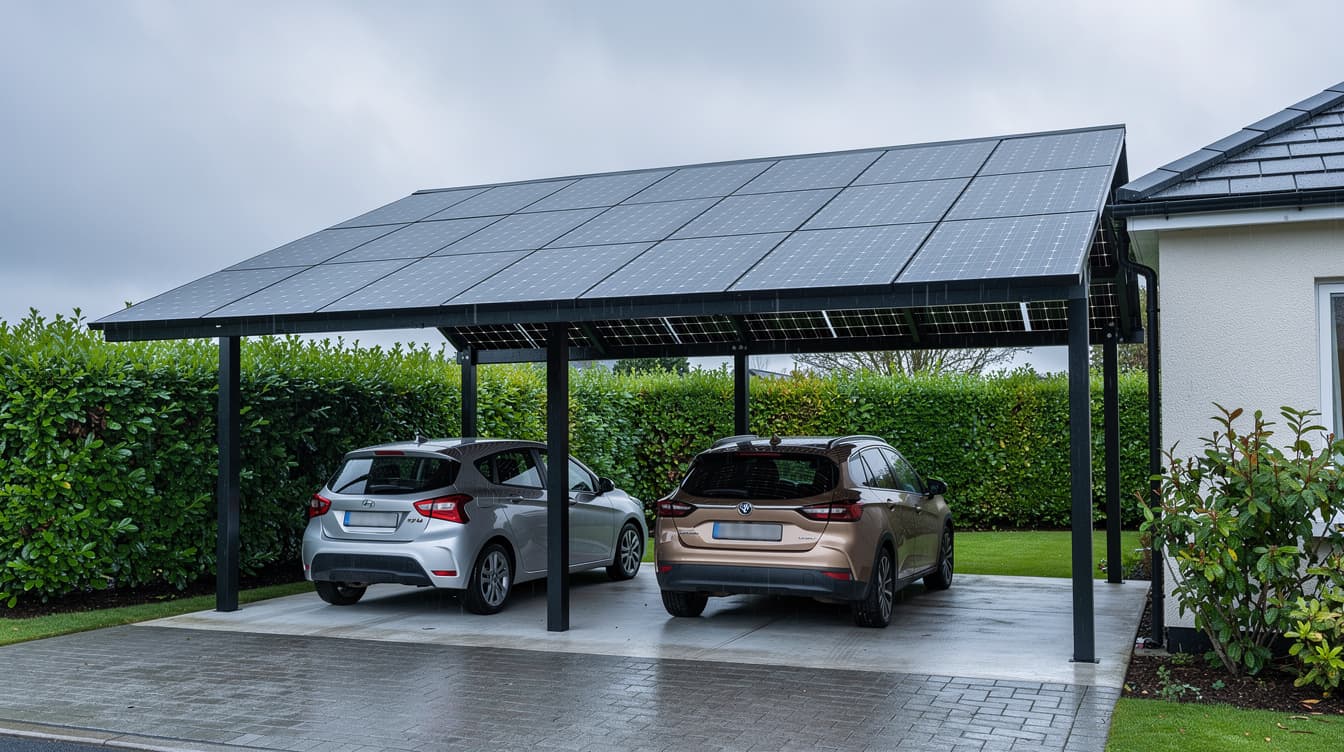
Solar Carports Ireland 2026: Costs, Planning & When They Beat a Roof Install
A solar carport in Ireland costs roughly €9,000 to €22,000 fully installed in 2026, depending on whether it’s a 2-bay steel structure with 4 kW of panels or a 4-bay aluminium build with 8 kW plus an EV charger. It’s more expensive than a roof install per kilowatt – but it’s the right answer when the roof is unusable, when planning permission complicates things, or when you want dedicated shelter for an EV. The €1,800 SEAI grant does apply if the carport is on the same MPRN as your home.
Solar carports are the middle ground between a roof PV install and a ground-mounted array. You get south-facing panels, a rain-tight parking spot, and – if you spec it right – an EV charger fed by your own solar. In Ireland in 2026 they still make up under 2% of domestic solar installs, but they solve a very specific set of problems no other route does. This guide walks through when a carport actually beats a roof install, what it really costs, and how the planning rules work.
When a solar carport is the right call
Rooftop solar is almost always cheaper per kWp installed. The carport wins when one of these is true:
- Your roof isn’t suitable. Heavy shading, north-only orientation with steep pitch, structural weakness, a re-roof that’s more than 5 years overdue, or a slate/tile the installer won’t warrant.
- Your house is a protected structure. Protected structures face Section 5 declarations and often outright refusal for roof PV. A detached carport avoids the main dwelling entirely.
- You’re building a new driveway or replacing a rotten timber car port anyway. The incremental cost of adding solar is much lower than a standalone build.
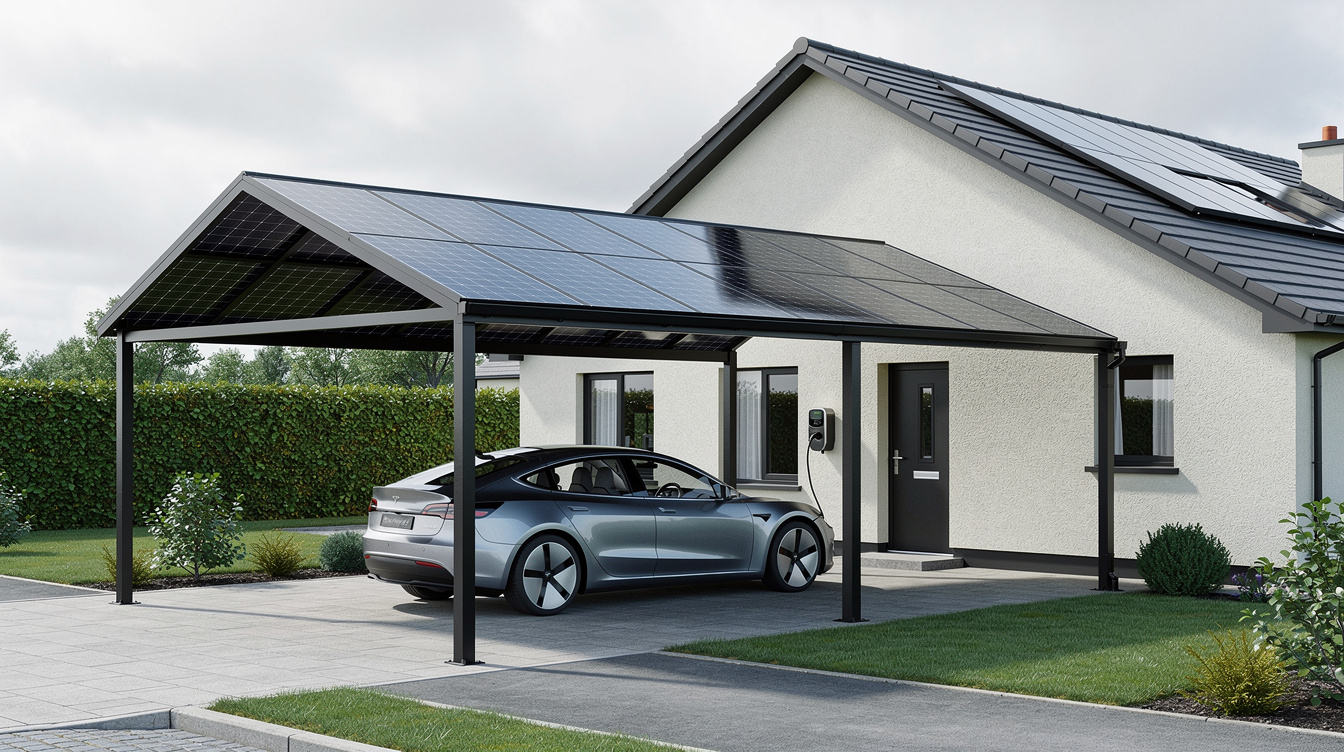
- You have an EV and want dedicated solar EV charging. A carport puts panels directly above the car with the shortest DC cable run possible – efficient, tidy, and future-proof.
- You want more capacity than the roof allows. A big enough carport can add 4–10 kWp on top of an existing roof array without touching the house structure.
If none of those apply, put the panels on the roof and skip the carport. The cost gap is real.
Solar carport cost breakdown Ireland 2026
Real quoted prices from Irish installers in mid-2026. Structure only means frame + roof, no panels. Full turnkey is the price you actually pay.
| Configuration | Panels | Structure only | Full turnkey |
|---|---|---|---|
| Single-bay steel (1 car) | 2.4 kWp | €3,200–€4,800 | €7,500–€9,500 |
| Two-bay steel (2 cars) | 4.0–4.8 kWp | €4,500–€6,500 | €10,000–€13,500 |
| Two-bay aluminium (2 cars) | 4.8 kWp | €6,500–€9,000 | €13,500–€16,500 |
| Four-bay steel (4 cars) | 8.0 kWp | €7,500–€11,000 | €18,000–€22,000 |
| EV charger add-on (7 kW) | — | — | +€900–€1,500 (before ZEVI grant) |
The structure is where the money goes. A 4 kWp roof install lands around €7,500–€9,500 turnkey; the same 4 kWp as a carport is €10,000–€13,500. You’re paying €2,500–€4,500 for the shelter itself, which is fair — a standalone timber carport with no PV would cost roughly the same.
Ready to Go Solar?
Get your free personalised quote from SEAI-registered installers.
Does the €1,800 SEAI grant cover a solar carport?
Yes — if the carport is on the same MPRN as the dwelling. The SEAI Solar PV grant is written around the home, not around a specific mounting method. The eligibility rules that matter are:
- The home must be built and occupied before 1 January 2021.
- You must be the homeowner (owner-occupier, not a landlord claiming for a tenant).
- The PV must be installed by an SEAI-registered installer using approved products from the SEAI Triple E list.
- The system must connect to the same MPRN that gets the grant — so a carport wired back to the house consumer unit is fine. A carport on a separate meter isn’t.
- No prior PV grant claimed at that MPRN.
The grant caps at €1,800 for systems 2 kWp and up, regardless of where you mount the panels. In practice most carports are grant-eligible. The paperwork is identical to a roof install; the BER re-assessment step is the same.
Planning permission for solar carports Ireland 2026
This is where carports get complicated fast. The 2022 planning exemption that removed most permission requirements for domestic rooftop PV does not automatically extend to standalone structures. What actually applies:
Exempted development — small carports
Under Class 3 of Schedule 2 Part 1 of the Planning and Development Regulations, a domestic outbuilding is exempted development if:
- The floor area, combined with any existing outbuildings in the rear garden, does not exceed 25 m².
- The height doesn’t exceed 4 m (pitched roof) or 3 m (any other roof).
- It’s in the rear garden — not the front, not to the side of the house line.
- The remaining private open space in the rear garden is at least 25 m².
A two-bay carport is roughly 30–36 m² and typically sits in front of the house next to the driveway. Two red flags there: it’s over 25 m², and it’s forward of the front building line. Both push it out of exempted development.
When you need planning permission
If your carport is forward of the front building line, larger than 25 m², or replaces an existing car port that had permission — you’ll need a full planning application. Budget:
- Planning fees: €65 domestic application fee to the local authority.
- Architect or planning consultant drawings: €800–€1,800.
- Time: 8–12 weeks for a straightforward application, longer if third-party observations are lodged.
If in doubt — and honestly, if the carport is on the driveway you should assume you’re in doubt — get a Section 5 declaration from the local authority first. It costs €80 and gives you a written ruling on whether permission is required. Cheaper than building something you have to remove.
EV chargers under a solar carport — the whole point for many buyers
The most compelling reason to build a solar carport in 2026 is EV charging. A 7.4 kW home charger paired with a 4 kWp carport array means most of your daytime charging comes straight off the panels, not the grid. On a bright day in April you’ll pull 20–25 kWh into the car for free, versus roughly €7.50 off a night-rate smart tariff.
Practical setup notes:
- Use a solar-aware charger like the myenergi zappi, Wallbox Pulsar Max with PV mode, or Andersen A2 with dynamic PV matching. These charge only from surplus solar unless you override them.
- Wire the charger back to the house consumer unit, not to a separate carport board. That keeps everything on the same MPRN — important for both the SEAI grant and the Clean Export Guarantee.
- Apply for the ZEVI EV Home Charger Grant (up to €300) — it stacks with the SEAI Solar PV grant. You don’t have to own an EV yet to claim it.
- Don’t mount the charger on the carport post unless the post is rated for the cable pull. Mount it on the wall of the house or on a purpose-built pedestal.
Steel vs aluminium vs timber — frame options
| Frame | Cost (2-bay) | Lifespan | Weight | Best for |
|---|---|---|---|---|
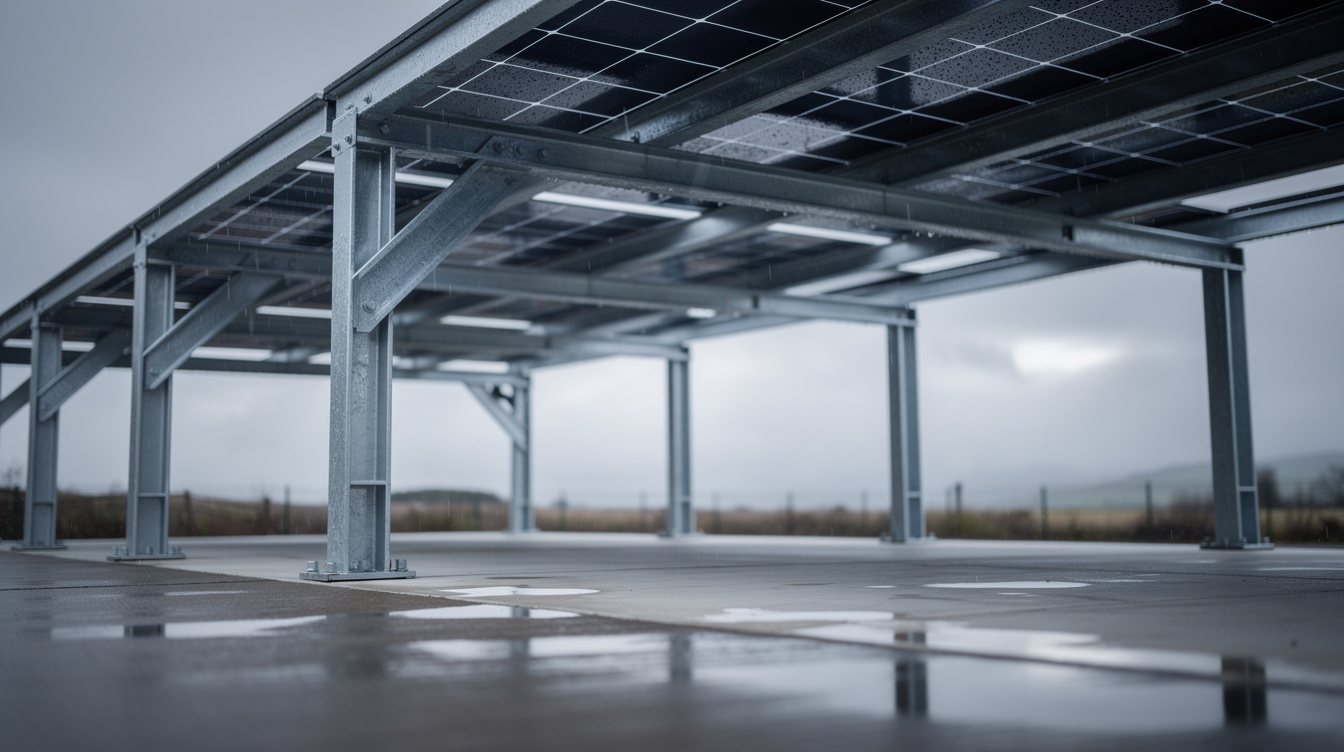
| Galvanised steel | €4,500–€6,500 | 30+ yrs | Heavy | Inland, low-visibility installs |
| Aluminium | €6,500–€9,000 | 40+ yrs | Light | Coastal (Kerry, Mayo, Donegal), premium finish |
| Timber (oak/larch) | €5,500–€8,500 | 15–25 yrs | Medium | Aesthetic-driven, rural properties |
For a coastal home in Kerry, Mayo, or Donegal, spend the extra on aluminium. Galvanised steel in salt-air rusts through the coating faster than the spec sheet suggests. Timber looks beautiful but requires re-treatment every 3–5 years to hit its full lifespan — factor that into ownership cost.
Yield expectations — how much a carport actually produces in Ireland
A carport array behaves like a roof array angled to whatever the carport roof is angled to. The typical spec is a 5–10° pitch (nearly flat, sloped enough to shed water) facing the driveway.
- 4 kWp carport, south-facing driveway: ~3,600 kWh/year. Roughly 5% below an optimal 30° south-facing roof.
- 4 kWp carport, east-west driveway: ~3,200 kWh/year. About 15% below optimal, but self-consumption is often higher because generation stretches morning and evening.
- Full winter output (Dec): ~7 kWh/day on a bright day, ~1 kWh on a wet dark day. Same as any roof install — winter yields are low across Ireland.
The flat pitch penalty is smaller than most people expect. Where you lose is snow shedding (rare issue in Ireland) and rainwater self-cleaning, both of which are worse on low-tilt roofs. Plan on an extra cleaning cycle every 2–3 years.
Payback period — be realistic
A 4 kWp roof install in Ireland with a battery pays back around 7–9 years. A 4 kWp carport install pays back 10–13 years assuming the same self-consumption and export tariff. The extra cost of the structure adds 2–4 years to the payback clock.
Two things can pull the payback back in line with a roof install:
- You’d have paid for the structure anyway. If the driveway needed a car port for weather protection, only the incremental cost of adding PV matters, and the payback on that increment is 5–7 years — same as any roof install.
- The carport enables an EV charger that displaces public rapid charging. Charging at public rapid networks costs 55–70 c/kWh; charging at home costs 8–25 c/kWh depending on tariff and solar share. A high-mileage driver can save €800–€1,500 a year, dropping the payback to 6–8 years.
Installation timeline — what happens week by week
- Week 0: Structural drawings, planning check or Section 5 application if needed, deposit paid.
- Week 4–8: Ground works — concrete pad or ground screws. Ground screws are quicker (single-day install) and reversible; a concrete pad is stronger for large 4-bay structures.
- Week 8–10: Steel or aluminium frame erected. Usually a 2–3 day job for a 2-bay.
- Week 10–11: Roof cladding (if any), PV mounting rails, panels, DC and AC wiring back to the house.
- Week 11: Hybrid inverter, battery and EV charger connected. ESB Networks NC6 form submitted.
- Week 12–14: Commissioning, BER re-assessment, SEAI grant claim submitted.
Add 8–12 weeks upfront if you need a full planning application. Add 2–3 weeks for ESB Networks NC6 turnaround.
Thinking about a solar carport?
Get quotes from SEAI-registered installers who’ve done structural PV before — not everyone has.
What can go wrong — and how to avoid it
- Undersized posts. A carport post sized for wind but not for the panels + snow + wind combined can flex in a storm and shear roof cladding. Ask the installer for the structural calculations and the wind zone assumption.
- Foundation frost heave. Ground screws driven to the wrong depth can lift in a hard freeze and misalign the entire array. Minimum 1.5 m depth for Irish frost-line safety.
- Drainage. A flat carport that doesn’t drain to a gutter dumps rainwater directly onto the parked car and the driveway paving. Spec a gutter and a downpipe to a soakaway.
- Inverter placement. The hybrid inverter needs to sit somewhere dry and ventilated. Mounting it on the carport post exposed to the weather voids most warranties. Wire it back to the house utility room.
- No planning check. Building without exemption certainty and getting a retention refusal is the worst outcome. Section 5 first.
Solar carport FAQ
Can I add a solar carport to an existing solar roof array?
Yes, and it’s common. The two arrays run into a single hybrid inverter (or separate inverters into a single ESB connection). You’ll need ESB Networks approval to exceed 6 kW export — single-phase supplies are capped at 6 kW export by default, three-phase up to 11 kW.
Do carports need building control (BC/BCAR)?
Domestic structures under 40 m² are generally outside the BCAR scope for full commencement notices, but you still need the frame designed to Eurocode wind loading. Ask for the structural calc sheet.
Can I use bifacial panels on a carport?
Yes, and it’s where bifacials genuinely add value — the underside sees ground reflection from the driveway. Expect a 4–8% yield uplift over standard mono panels. See our TOPCon vs HJT vs IBC guide for the panel types worth spending on.
Will a carport affect my house insurance?
Notify your insurer — both when built and when the PV is commissioned. Most Irish home insurers add solar without an additional premium if declared. A carport built without notification and then damaged in a storm can invalidate the claim entirely. See our full insurance guide.
Is a carport worth it if I don’t have an EV?
Marginal. If you’re never getting an EV, put the panels on the roof and skip the structure cost. The only exception is if your roof genuinely can’t take PV — then the carport is your route in.
The bottom line
A solar carport in Ireland in 2026 is a specialist tool. If your roof is unusable, or if you’re driving an EV and want dedicated solar charging, it’s a rational build with a real payback story — particularly if you’d have paid for the structure anyway. If your roof is available and unshaded, put the panels there and save €3,000–€5,000.
The SEAI grant applies, the planning rules are workable if you plan around them, and the installation timeline is a few weeks longer than a roof job. The single biggest error we see is homeowners commissioning a carport before checking Section 5 planning status — do that first.
Ready to Go Solar?
Get your free personalised quote from SEAI-registered installers.
Related Articles
Average Cost of Solar Panels Ireland 2026: What Homeowners Really Pay
Real 2026 Ireland solar prices by kW size, region and battery option. Average 5kW after SEAI grant: €7,100-€9,000. Full breakdown inside.
Solar Panel Financing Ireland 2026: Loans, Grants & Payment Options
Every way to fund a solar install in Ireland in 2026: SEAI 2.99% loan, credit unions, green mortgages, bank green loans, real APR figures compared.
20 Solar Panels Ireland 2026: Cost, Output, Battery & Payback
What 20 solar panels cost in Ireland 2026 (€12.7-18.6k net after grant), 7,600-8,100 kWh output, roof space, battery choice and payback vs 10 or 14 panels.