
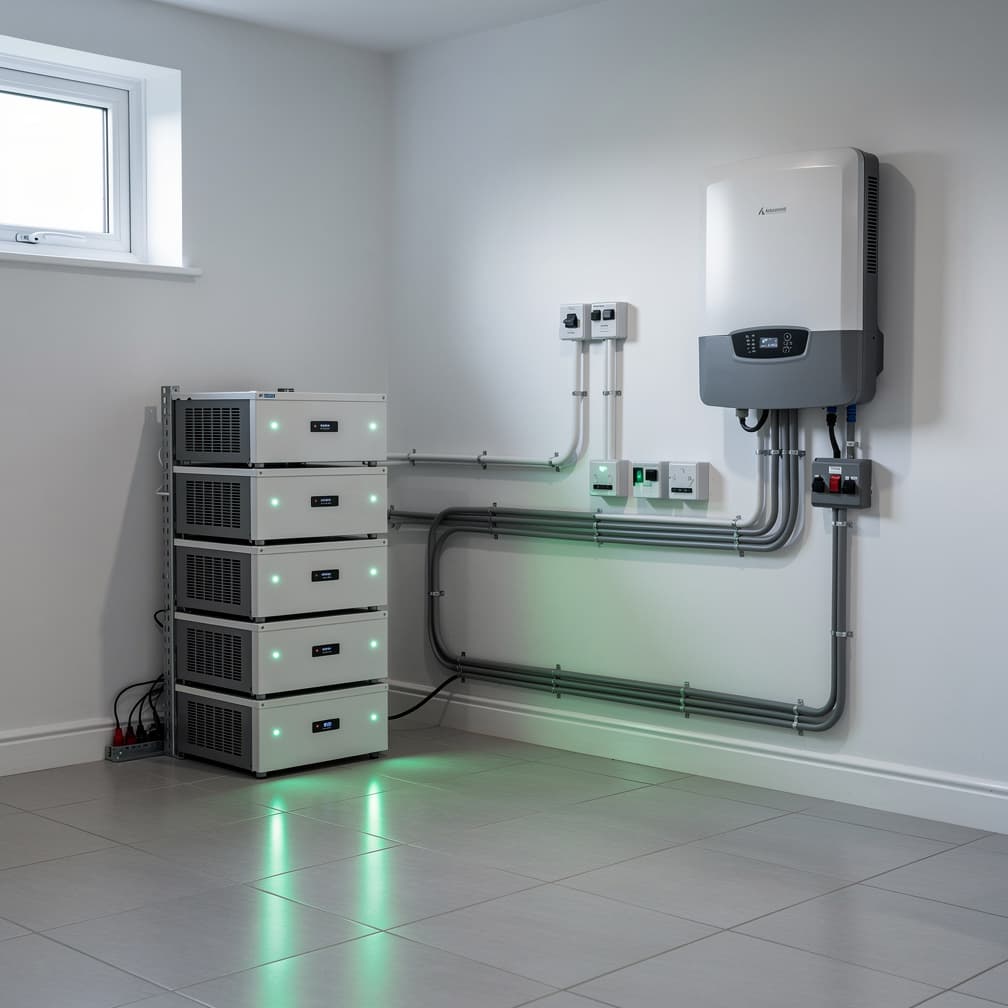
Off-Grid Solar Battery Sizing Ireland: How to Design a System That Actually Works
Going off-grid in Ireland requires careful planning. A typical 3-bed family home needs a 20–25 kWp solar array, 40–55 kWh of battery storage, and a backup generator — costing €40,000–€66,000 in total. Get the sizing wrong and you will either run out of power in winter or massively overspend. This guide walks you through every component, with Ireland-specific sizing calculations, battery comparisons, and realistic cost breakdowns.
Ireland's maritime climate makes off-grid solar more challenging than in sunnier countries. Our winters are long and cloudy, with solar output dropping to 10–15% of summer levels between November and February. But with the right system design — and an honest assessment of what solar can and cannot do in Irish weather — off-grid living is absolutely achievable. Hundreds of Irish homes already do it.
This guide is the companion piece to our Off-Grid Solar Costs in Ireland guide. While that article covers the big picture, this one goes deep on the technical sizing decisions that determine whether your system actually works year-round.
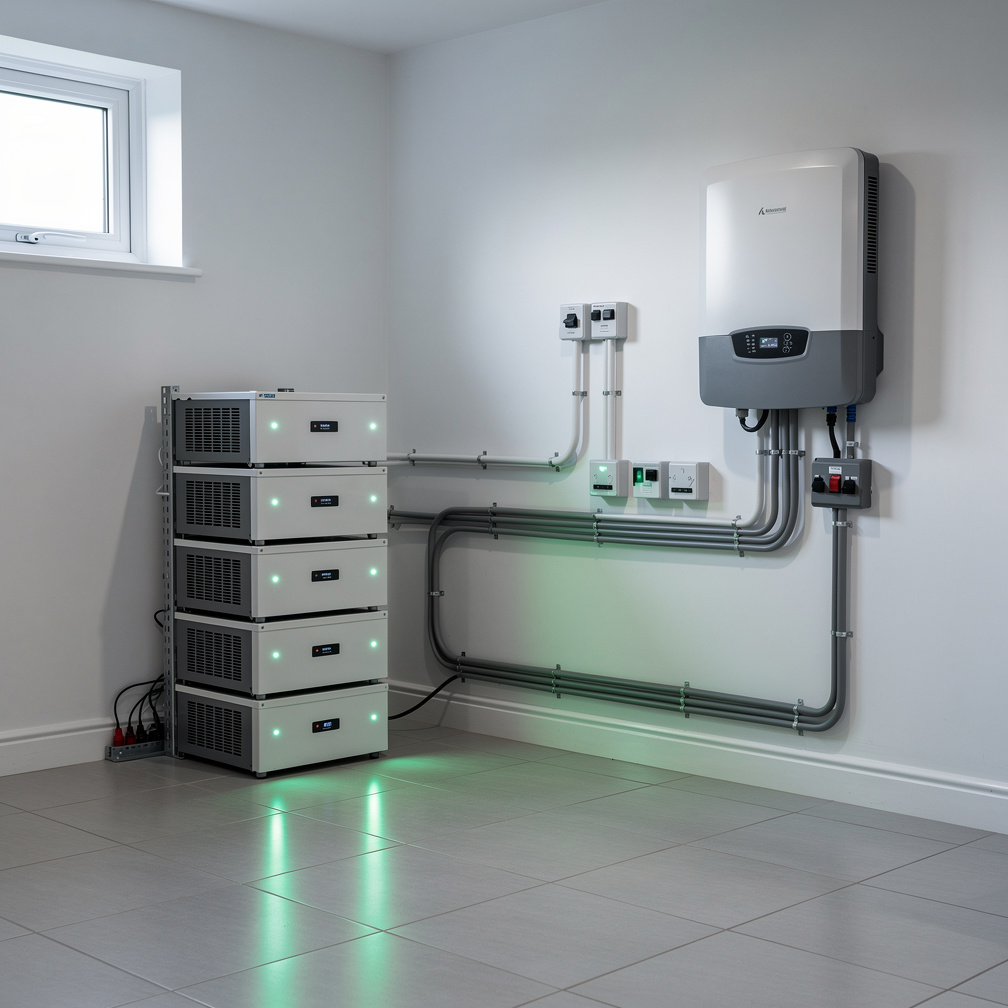
Step 1: Calculate Your Daily Electricity Consumption
Everything starts with knowing how much electricity you actually use. The national average Irish household uses approximately 4,200 kWh per year (about 11.5 kWh per day), but this varies enormously based on house size, occupants, heating system, and lifestyle.
Typical Daily Consumption by House Size
| Dwelling | Annual kWh | Daily Average | Winter Daily |
|---|---|---|---|
| Small cabin / 1-bed | 2,000–3,000 | 5.5–8.2 kWh | 7–11 kWh |
| 2-bed house | 3,000–4,200 | 8.2–11.5 kWh | 11–15 kWh |
| 3-bed semi-detached | 4,000–5,500 | 11–15 kWh | 14–20 kWh |
| 4-bed detached | 5,500–8,000 | 15–22 kWh | 20–29 kWh |
Critical note on heating: Most Irish homes use oil or gas for heating. If you are going off-grid and plan to use a heat pump, add 3,000–8,000 kWh per year (8–22 kWh per day in winter) depending on your home's insulation and BER rating. This massively increases your battery and solar requirements.
Major Electricity Consumers
| Appliance | Daily kWh | Notes |
|---|---|---|
| Fridge/freezer | 1.0–1.5 | Runs 24/7 |
| Electric cooker/oven | 1.5–2.5 | 1–2 hours use per day |
| Washing machine | 0.5–1.0 | Per load |
| Tumble dryer | 2.0–3.5 | Per load — huge consumer, avoid if possible |
| Immersion heater | 2.0–4.0 | Per hour — use a solar diverter or timer |
| Lighting (LED) | 0.5–1.5 | Whole house, more in winter |
| TV/entertainment | 0.5–1.0 | 4–6 hours per day |
| Laptop/devices | 0.3–0.5 | Per device |
| Electric kettle | 0.3–0.5 | 3–5 boils per day |
| Heat pump | 8–22 | Winter only — varies hugely with insulation |
| EV charger | 7–10 | Per full charge — schedule for sunny days |
Tip: Before designing your system, track your actual electricity usage for at least a month using a smart plug or your meter readings. Estimates are useful, but real data is better. If you are building a new off-grid home, design for energy efficiency first — high insulation, LED lighting, efficient appliances, and a wood stove for heating will drastically reduce your solar and battery requirements.
Step 2: Size Your Battery Bank
The battery bank is the heart of any off-grid system. It stores solar energy generated during the day for use at night and during cloudy periods. The key question is: how many days of autonomy do you need?
Days of Autonomy for Ireland
"Days of autonomy" means how many days your battery bank can power your home with zero solar input. Ireland's weather makes this critical:
- Minimum: 3 days — bare minimum for Ireland. Even in summer, we get 2–3 consecutive overcast days
- Recommended: 4–5 days — for year-round off-grid without a generator (very difficult in practice)
- With backup generator: 2–3 days — the most practical approach. The generator kicks in during extended cloudy periods
Battery Sizing Formula
The formula is straightforward:
Battery capacity (kWh) = Daily consumption (kWh) × Days of autonomy ÷ Depth of Discharge (DoD)
For LiFePO4 (lithium iron phosphate) batteries — the standard for off-grid — usable depth of discharge is 90%. For older lead-acid batteries, it is only 50%.
Battery Sizing Examples
| Home Type | Daily Use | 3-Day Autonomy (LiFePO4) | 5-Day Autonomy (LiFePO4) |
|---|---|---|---|
| Small cabin | 6 kWh | 20 kWh | 33 kWh |
| 2-bed house | 10 kWh | 33 kWh | 56 kWh |
| 3-bed family | 14 kWh | 47 kWh | 78 kWh |
| 4-bed detached | 18 kWh | 60 kWh | 100 kWh |
Our recommendation: Size for 3 days of autonomy and include a backup generator. This gives the best balance of cost and reliability. Sizing for 5 days without a generator costs roughly 70% more and still will not guarantee you get through a bad Irish winter without running out.
Step 3: Choose Your Batteries
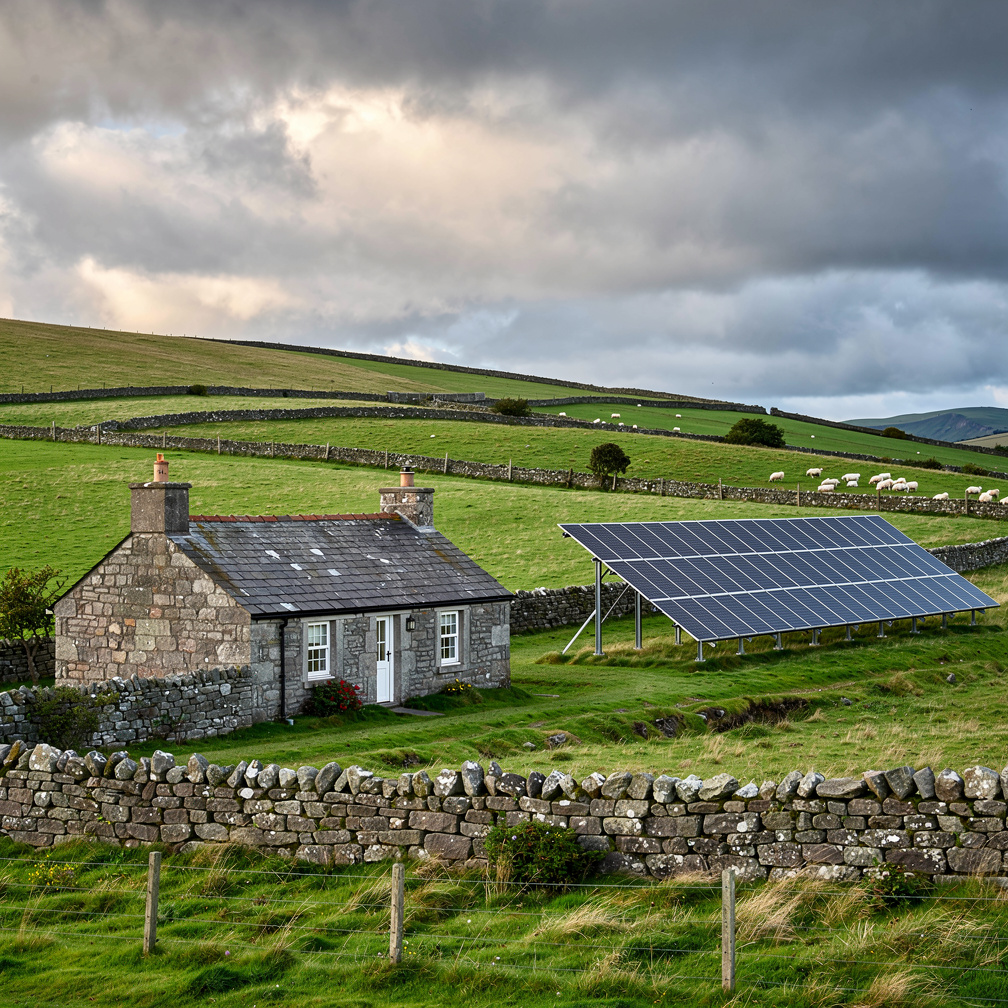
LiFePO4 (lithium iron phosphate) is the only sensible choice for off-grid battery storage in 2026. Compared to lead-acid, LiFePO4 offers 3–4 times the cycle life, 90% usable capacity (vs 50%), lighter weight, and no maintenance. The upfront cost is higher, but the lifetime cost per kWh stored is far lower.
Best Off-Grid Batteries for Ireland (2026)
| Battery | Capacity | Price (Ireland) | €/kWh | Cycle Life | Best For |
|---|---|---|---|---|---|
| Pylontech US5000 | 4.8 kWh | €1,100–€1,400 | €230–290 | 6,000 | Best value, most popular |
| BYD LVS | 4.0 kWh module | €1,000–€1,400 | €250–350 | 6,000 | High quality, pairs well with Victron |
| Sunsynk SSLB | 5.12 kWh | €1,200–€1,600 | €235–310 | 6,000 | Good value with Sunsynk inverters |
| GivEnergy | 9.5 kWh | €2,500–€3,500 | €265–370 | 6,000 | Integrated ecosystem, good app |
| Tesla Powerwall 3 | 13.5 kWh | €8,500–€10,500 | €630–780 | Unlimited* | Premium, integrated inverter |
| Victron Smart LiFePO4 | 2.56 kWh | €1,800–€2,200 | €700–860 | 5,000 | Premium quality, expensive |
*Tesla warrants to 70% capacity at 10 years.
Our Recommendation
Pylontech US5000 is the clear winner for off-grid in Ireland. At €230–290 per kWh, it is the most affordable LiFePO4 option with an excellent track record. The modules are stackable (up to 16 units for approximately 77 kWh), compatible with most hybrid and off-grid inverters, and widely supported by Irish installers.
For example, a 3-bed home needing 47 kWh of storage would require 10 × Pylontech US5000 modules, costing approximately €11,000–€14,000.
BYD LVS is the premium alternative — slightly more expensive but very high build quality and excellent compatibility with Victron inverters.
Tesla Powerwall 3 is not recommended for off-grid purely on cost grounds. At €630–780 per kWh, building a 47 kWh bank would cost €30,000–€37,000 — roughly triple the price of Pylontech for similar capacity. Tesla is better suited to grid-tied homes with backup.
Step 4: Size Your Solar Array
Ireland receives approximately 900–1,100 kWh per kWp per year of solar irradiance, depending on location. The southeast (Wexford, Waterford) gets the most; the west coast (Galway, Kerry) gets the least.
Monthly Solar Output per kWp in Ireland
| Month | kWh per kWp per day | Relative Output |
|---|---|---|
| January | 0.3–0.6 | Very low |
| February | 0.8–1.2 | Low |
| March | 1.5–2.2 | Moderate |
| April | 2.5–3.5 | Good |
| May | 3.5–4.5 | Excellent |
| June | 3.8–4.8 | Peak |
| July | 3.5–4.5 | Excellent |
| August | 3.0–4.0 | Good |
| September | 2.0–3.0 | Moderate |
| October | 1.0–1.8 | Low |
| November | 0.5–0.8 | Very low |
| December | 0.3–0.5 | Minimal |
The seasonal variation is stark. A 20 kWp array that generates 90 kWh on a good June day will produce just 6–10 kWh on a December day. This is why a backup generator is essential for off-grid homes in Ireland — no economically sensible solar array can cover winter consumption alone.
Sizing Rule of Thumb
Install 1.5–2.0 kWp per kWh of daily consumption. This covers approximately 80–90% of your annual electricity needs, with the backup generator filling the winter gap.
| Home Type | Daily Use | Recommended Array | Annual Output |
|---|---|---|---|
| Small cabin | 6 kWh | 8–12 kWp | 7,200–13,200 kWh |
| 2-bed house | 10 kWh | 14–20 kWp | 12,600–22,000 kWh |
| 3-bed family | 14 kWh | 20–28 kWp | 18,000–30,800 kWh |
| 4-bed detached | 18 kWh | 28–36 kWp | 25,200–39,600 kWh |
Yes, the annual output exceeds annual consumption — that is deliberate. You need the oversized summer production to keep batteries charged and compensate for the months when solar output is minimal.
Ground-Mount vs Roof-Mount
Most off-grid systems of 20+ kWp will need a ground-mounted array (or a combination of roof and ground). Planning permission is generally required for ground-mounted arrays exceeding 25 square metres — which is most systems over 5 kWp. Budget €3,000–€8,000 for ground-mount frames and foundations.
Step 5: Choose Your Inverter
The inverter converts DC power from your solar panels and batteries into AC power for your home. For off-grid, you need a true off-grid or hybrid inverter — not a standard grid-tied inverter.
Off-Grid Inverter Comparison
| Inverter | Capacity | Price | Off-Grid Rating | Generator Integration |
|---|---|---|---|---|
| Victron MultiPlus-II | 3–5 kVA | €1,800–€2,400 | Excellent | Excellent — auto-start, current limiting |
| Victron Quattro-II | 5–15 kVA | €3,500–€4,500 | Excellent | Best in class — dual AC input |
| Sunsynk 8kW Hybrid | 8 kW | €1,500–€2,200 | Good | Basic — less sophisticated than Victron |
| GivEnergy 6kW Hybrid | 6 kW | €1,500–€2,000 | Fair | Limited — designed for grid-tied with backup |
| SolarEdge Energy Hub | 5–10 kW | €2,500–€3,500 | Poor | Not designed for off-grid |
Our Recommendation
Victron is the gold standard for off-grid. The MultiPlus-II (for smaller systems) or Quattro-II (for larger homes) paired with Victron SmartSolar MPPT charge controllers is the most proven and reliable off-grid setup available. Key advantages:
- True off-grid design — not a grid-tied inverter with backup mode bolted on
- Excellent generator integration — auto-start/stop based on battery state, programmable charge current limiting to avoid overloading the generator
- Parallel operation — stack multiple units for more power
- Massive ecosystem — MPPT charge controllers, Cerbo GX monitoring, VRM cloud portal
- Compatible with Pylontech, BYD, and many other battery brands
Sunsynk is a solid budget alternative if Victron is out of your price range. The 8 kW and 12 kW hybrid inverters support off-grid mode and are growing rapidly in the Irish and UK market.
Inverter Sizing
Your inverter must handle your peak household load with headroom for motor startup surges (pumps, compressors, etc.):
- Small cabin: 3–5 kVA (single Victron MultiPlus-II)
- 2-bed house: 5–8 kVA
- 3-bed family: 8–10 kVA (Victron Quattro-II or 2 × MultiPlus-II in parallel)
- 4-bed detached: 10–15 kVA (multiple Victron units)
Rule of thumb: Oversize by 25–50% versus your expected peak load. A kettle (3 kW) + oven (2.5 kW) + immersion (3 kW) running simultaneously is 8.5 kW — your inverter must handle this comfortably.
Step 6: Plan Your Backup Generator
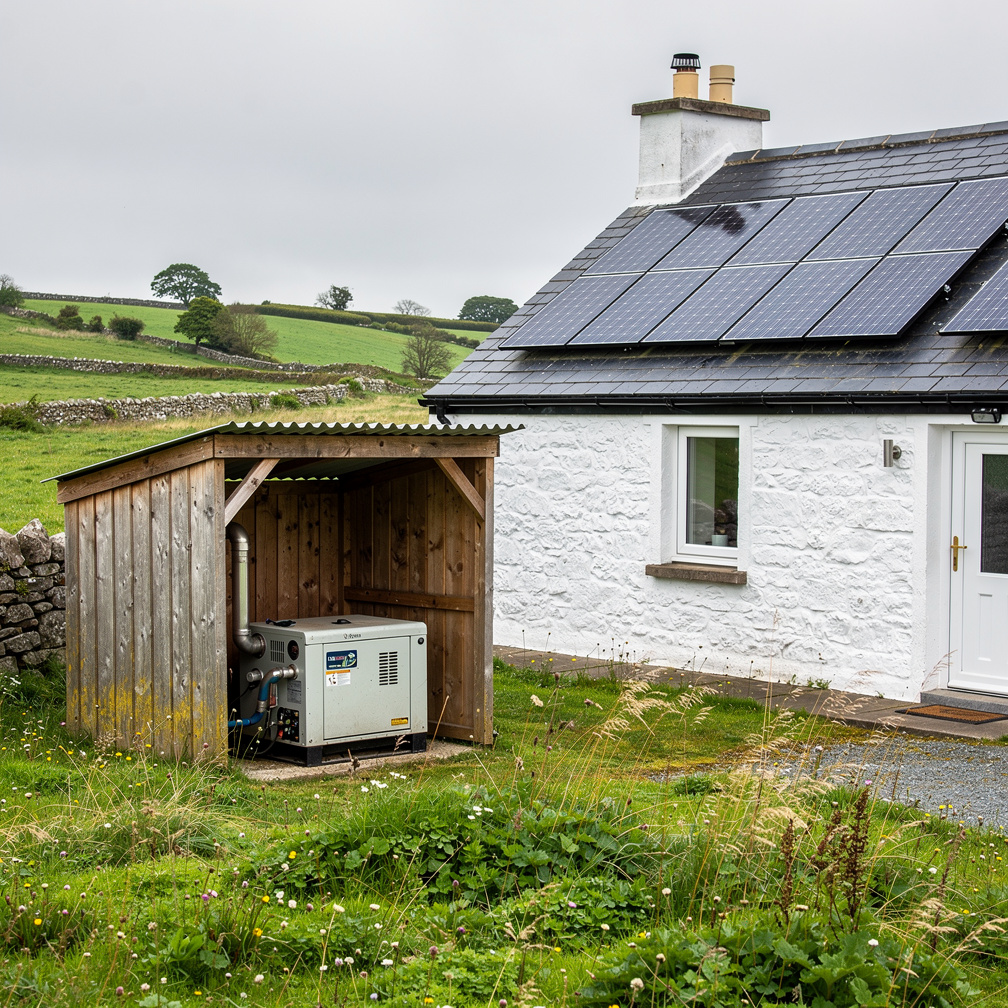
A backup generator is not optional for year-round off-grid living in Ireland. Anyone who tells you otherwise has not lived through an Irish November to February without grid power.
Here is the reality: a 20 kWp solar array generates approximately 6–10 kWh on a December day. A 3-bed home uses 14–20 kWh per day in winter. That is a daily deficit of 4–14 kWh. After 2–3 overcast days, your battery bank is empty.
Generator Sizing
| Home Type | Generator Size | Run Time to Charge | Cost |
|---|---|---|---|
| Small cabin | 3–5 kW | 3–4 hours | €1,500–€3,000 |
| 2-bed house | 5–8 kW | 4–6 hours | €2,500–€4,000 |
| 3-bed family | 5–8 kW | 5–7 hours | €2,500–€5,000 |
| 4-bed detached | 8–12 kW | 6–8 hours | €3,500–€6,000 |
Fuel Options
- Diesel: Most reliable and common. A family home might use 500–1,000 litres per winter season (approximately €800–€1,600). Noisy but dependable.
- LPG/Propane: Cleaner, quieter, good for residential areas. Slightly more expensive per kWh than diesel.
- Petrol: Only for small/portable generators. Not suitable for primary off-grid backup.
Auto-Start Is Essential
With a Victron system, the generator can be configured to auto-start when battery state of charge drops below a threshold (e.g., 20%) and auto-stop when it reaches a target (e.g., 80%). This means the system manages itself — you do not need to manually start the generator at 2am when the batteries run low.
Estimated annual generator run time for a well-sized off-grid home in Ireland: 300–600 hours, primarily November to February.
Complete System Costs (2026)
Small Cabin / Holiday Home (6 kWh/day)
| Component | Specification | Cost |
|---|---|---|
| Solar array | 8–10 kWp | €6,000–€10,000 |
| Battery bank | 20–25 kWh (Pylontech) | €5,500–€7,500 |
| Inverter/charger | Victron MultiPlus-II 5kVA | €2,000–€2,500 |
| MPPT controllers | 1–2 units | €800–€1,500 |
| Mounting, wiring, BOS | — | €2,000–€3,500 |
| Installation | — | €2,000–€4,000 |
| Backup generator | 3–5 kW diesel | €1,500–€3,000 |
| Total | €18,000–€32,000 |
3-Bed Family Home (14 kWh/day)
| Component | Specification | Cost |
|---|---|---|
| Solar array | 20–25 kWp | €16,000–€25,000 |
| Battery bank | 40–55 kWh (Pylontech) | €10,000–€16,000 |
| Inverter/charger | Victron Quattro-II or 2× MultiPlus | €4,000–€6,000 |
| MPPT controllers | 2–3 units | €1,500–€2,700 |
| Mounting, wiring, BOS | — | €3,000–€5,000 |
| Installation | — | €4,000–€7,000 |
| Backup generator | 5–8 kW diesel | €2,500–€5,000 |
| Total | €40,000–€66,000 |
4-Bed Large Home (18 kWh/day)
| Component | Specification | Cost |
|---|---|---|
| Solar array | 30–40 kWp | €24,000–€40,000 |
| Battery bank | 55–75 kWh | €14,000–€22,000 |
| Inverter system | Multiple Victron units | €6,000–€10,000 |
| MPPT controllers | 3–4 units | €2,500–€4,000 |
| BOS + installation | — | €8,000–€15,000 |
| Backup generator | 8–12 kW | €3,500–€6,000 |
| Total | €58,000–€97,000 |
Planning Permission and Regulations
Off-grid solar installations in Ireland must comply with several regulations:
Planning Permission
- Roof-mounted panels: Generally exempt if under 50 sq.m, not projecting more than 15 cm above the roof, and not on a protected structure
- Ground-mounted arrays: Exempt up to 25 square metres. Above 25 sq.m (which is most systems over 5 kWp), planning permission is required. Budget €500–€2,000 and 8–12 weeks for the application
- Battery enclosures: Small indoor installations (utility room, garage) do not need planning. Large external battery containers may require permission
Electrical Regulations
- All electrical work must be carried out by a Registered Electrical Contractor (REC) registered with Safe Electric
- The installation must comply with I.S. 10101 (Irish Wiring Regulations)
- For fully off-grid systems with no grid connection, the NC6 form (ESB Networks notification) is not required — but professional installation and certification is still mandatory
Building Regulations
- New off-grid builds must comply with all Building Regulations, including Part L (energy efficiency) and nZEB (Nearly Zero Energy Building) requirements
- An off-grid solar system helps meet nZEB, but the home must demonstrate compliance through the DEAP methodology
Off-Grid vs Grid-Tied with Battery: Which Should You Choose?
Before committing to a full off-grid system, consider whether a grid-tied system with battery storage might meet your needs at a fraction of the cost:
| Factor | Off-Grid | Grid-Tied + Battery |
|---|---|---|
| Total cost (3-bed home) | €40,000–€66,000 | €9,000–€16,000 |
| SEAI grant eligible | Possibly not | Yes (up to €1,800) |
| Electricity bills | €0 + €800–€1,600/year fuel | €200–€600/year (reduced) |
| Export income (CEG) | Not available | €300–€450/year |
| Generator required | Yes | No |
| Winter reliability | Depends on generator | Grid provides backup |
| Total independence | Yes | No |
For most Irish homeowners with a grid connection, a grid-tied system with battery storage is significantly better value. The grid acts as an infinite backup — no generator fuel, no anxiety about running out in January.
Off-grid makes sense if:
- You have no grid connection and the cost to connect exceeds €15,000–€20,000
- You are building a remote rural home or cabin where ESB connection is impractical
- You genuinely want energy independence and accept the higher cost and complexity
Frequently Asked Questions
Can I go fully off-grid without a generator in Ireland?
Technically yes, but it requires an enormous battery bank (70–100+ kWh) and oversized solar array (30–40 kWp) for even a modest home. The cost is prohibitive for most people. A small diesel generator costing €2,000–€3,000 that runs 300–600 hours per year is far more practical and saves tens of thousands on battery and solar capacity.
How long will my batteries last?
LiFePO4 batteries like Pylontech and BYD are rated for 6,000 cycles at 90% depth of discharge. With one cycle per day, that is over 16 years. In practice, most batteries will last 15–20 years before needing replacement, by which time prices will have fallen further.
What happens if I use more electricity than planned?
Your battery bank depletes faster and the generator runs more often. The system will not fail — it will just use more diesel. This is why we recommend oversizing both batteries and solar by 20–30% if budget allows.
Can I add more batteries later?
Yes, with modular batteries like Pylontech US5000. You can start with a smaller bank and add modules as needed. However, mixing old and new batteries can reduce overall efficiency, so it is better to install the full bank from the start if possible.
Do I need a wind turbine as well?
Wind can complement solar well in Ireland — we have excellent wind resources, especially on the west coast. A small wind turbine (1–5 kW) generates more in winter when solar is weakest. However, domestic wind turbines require planning permission, are noisy, need maintenance, and are less cost-effective than solar per kWh. Most off-grid homes in Ireland find a combination of oversized solar + generator more practical than solar + wind.
The Bottom Line
Designing an off-grid solar system for Ireland is more complex than a standard grid-tied installation, but the principles are straightforward: calculate your consumption, size your batteries for 3 days of autonomy, install 1.5–2× the kWp of solar per kWh of daily use, choose a Victron or Sunsynk inverter, and include a backup generator for winter.
The cost is significant — €40,000–€66,000 for a typical family home — but if grid connection is impractical or you value energy independence, it is a sound long-term investment. With LiFePO4 batteries lasting 15–20 years, solar panels lasting 25–30 years, and zero electricity bills, the system will pay for itself over time.
Need help with the costs? Read our companion guide: Off-Grid Solar Costs in Ireland: Complete Breakdown. Or contact us for personalised advice on your off-grid project.
Related Articles
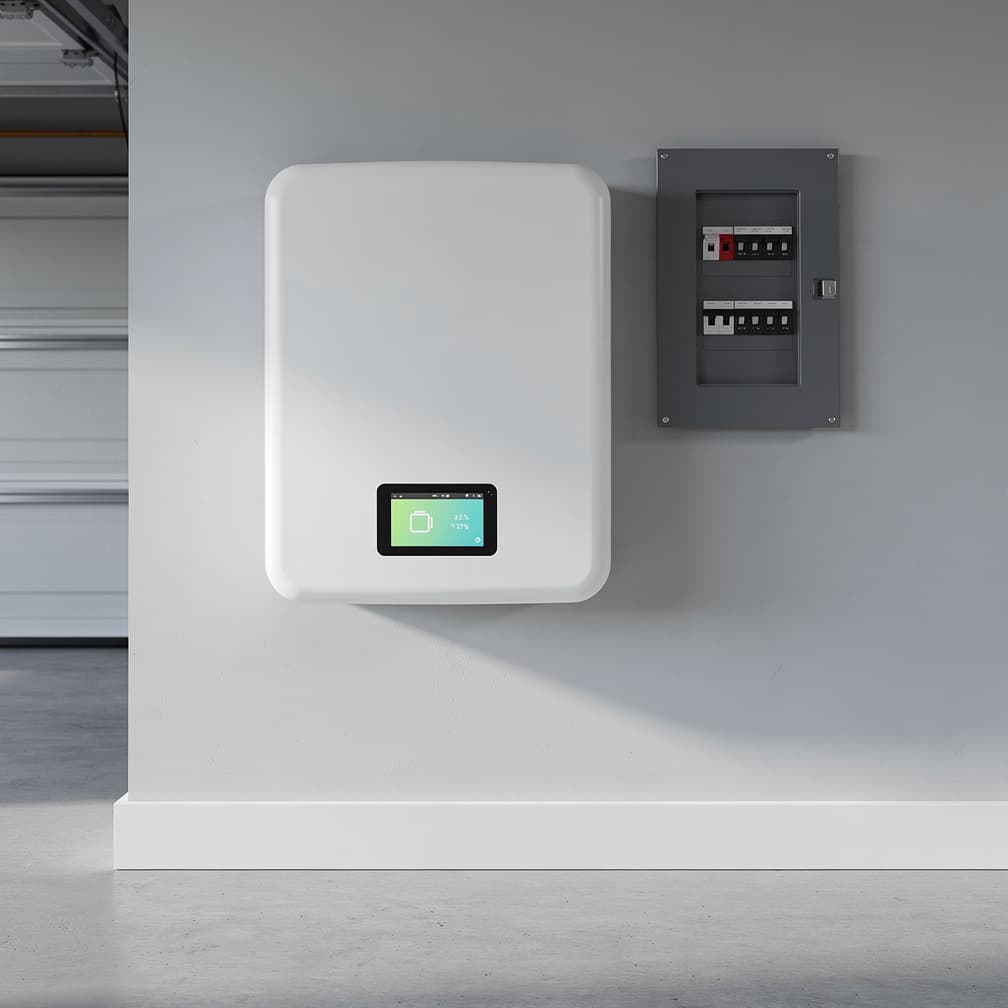
Best Solar Batteries Ireland 2026: GivEnergy vs Tesla Powerwall vs Huawei Compared
Compare the best solar batteries in Ireland for 2026. GivEnergy from €3,500, Huawei LUNA2000 from €3,500, Tesla Powerwall 3 from €8,000. Full specs, pricing, ROI calculations, and whether a battery or diverter is better value.
Solar Panel Costs Ireland 2026: Complete Price Breakdown by System Size
How much do solar panels cost in Ireland in 2026? From €4,600 for 2.6kWp to €13,500 for 8.8kWp before grants. After SEAI grant: €3,100–€11,700. Full cost breakdown, brand comparison, ROI calculator, and what to look for in quotes.
SEAI Solar Panel Grant 2026: How to Apply, Eligibility & Step-by-Step Guide
The SEAI solar panel grant gives Irish homeowners up to €1,800 towards solar PV installation in 2026. Landlords now eligible. Complete step-by-step application guide, eligibility rules, documentation, and common mistakes to avoid.