
Solar Panels Cavan 2026 — Costs, Grants & Installers
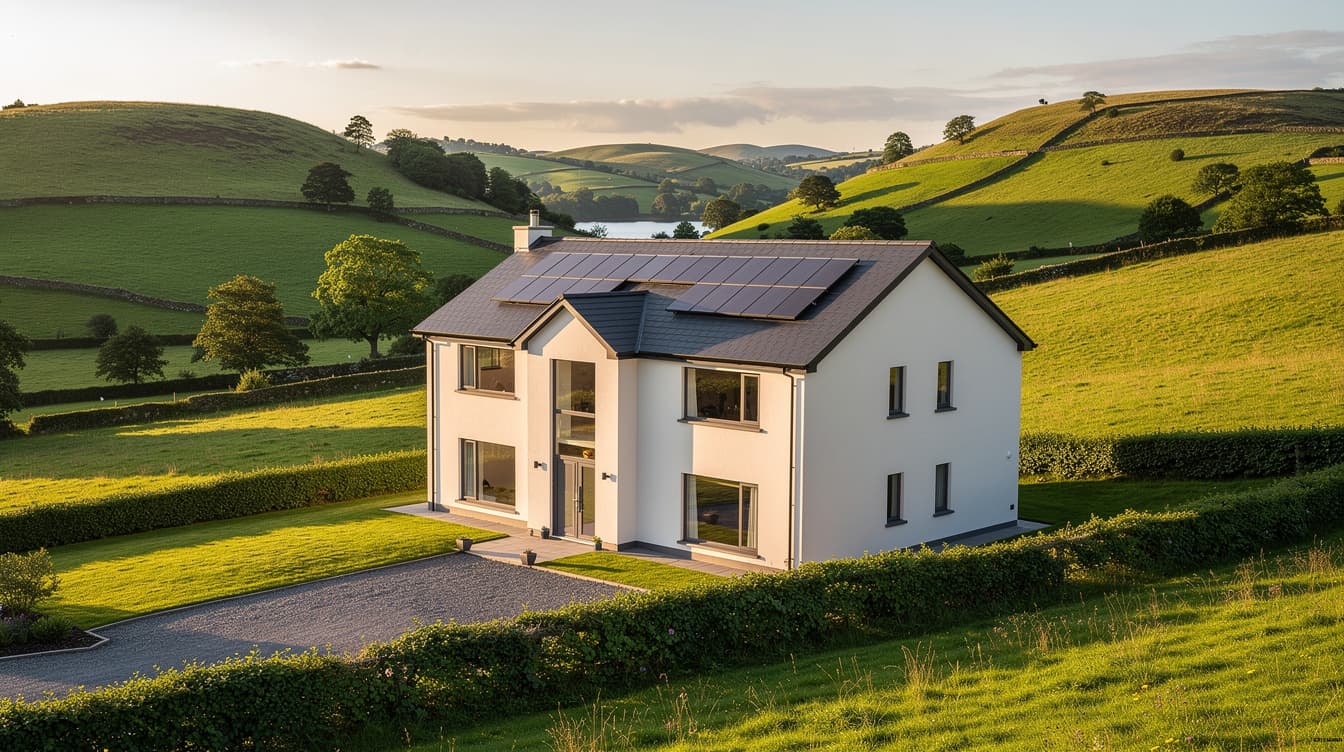
Cavan is a county shaped by two things that matter for solar: drumlins and lakes. Three hundred and sixty-five lakes — one for every day, according to the tourist board — sit in a landscape of small, rounded glacial hills called drumlins. The drumlins force houses, sheds and farms onto whatever aspect the hill happens to give them, which means Cavan roofs face every direction of the compass roughly equally. That single fact pushes Cavan’s solar economics in a direction you do not see in Wexford or Tipperary, where most roofs end up south-facing because the land is flat enough to choose.
The other Cavan-specific item: it is a small market. Population about 81,000. Roughly a dozen SEAI-registered installers do meaningful volume in the county, and most of them are based in Cavan town, Virginia or just over the border in Monaghan and Fermanagh. Lead-times on installs are longer than in Dublin or Cork commuter belts — typically 8–14 weeks for a domestic install in summer 2026 — and grant-pre-approval-to-install runs at the longer end of the national norm.
This guide covers 2026 Cavan solar pricing, the drumlin aspect problem (and how to solve it with east–west arrays and dual-MPPT inverters), yields by area (Cavan town, Virginia M3-belt, Kingscourt, Belturbet, Lough Sheelin/Sheelin shore), lakeshore planning constraints, the M3-commuter EV maths from Virginia and Bailieborough, the cross-border Enniskillen comparison, and five worked payback scenarios from a Cavan town semi to a Bailieborough dairy farm.
Get a Cavan Solar Quote
Three free quotes from SEAI-registered installers covering Cavan town, Virginia, Bailieborough, Cootehill, Belturbet and Kingscourt.
Quick answer: Cavan solar costs and payback in 2026
A typical 4 kWp domestic install in Cavan costs €8,200–€9,300 gross, or €6,400–€7,500 net of the €1,800 SEAI Solar PV Grant. Yields are middle-of-the-Republic: 880–905 kWh per kWp in the Virginia and Bailieborough drumlin belt (lower than Drogheda, comparable with Sligo or Leitrim), with some shelter-induced drop on north-facing drumlin slopes and lakeshore mist zones. A 4 kWp Cavan array generates 3,540–3,650 kWh a year. Combined import savings and CEG export income land at €820–€950 a year on a no-battery domestic install. Net payback: 7.0–9.0 years.
The Cavan headline: more Cavan roofs face east or west than south. That is unusual nationally and it shifts the optimal spec. The standard 10-panel south roof installation is rarely the right answer here. The right answer is usually a split east/west array on the two slopes of a drumlin gable roof, wired through a dual-MPPT inverter. That setup delivers 92–94% of what a pure south install would, spreads the generation across more hours, and is much friendlier to a battery and an EV.
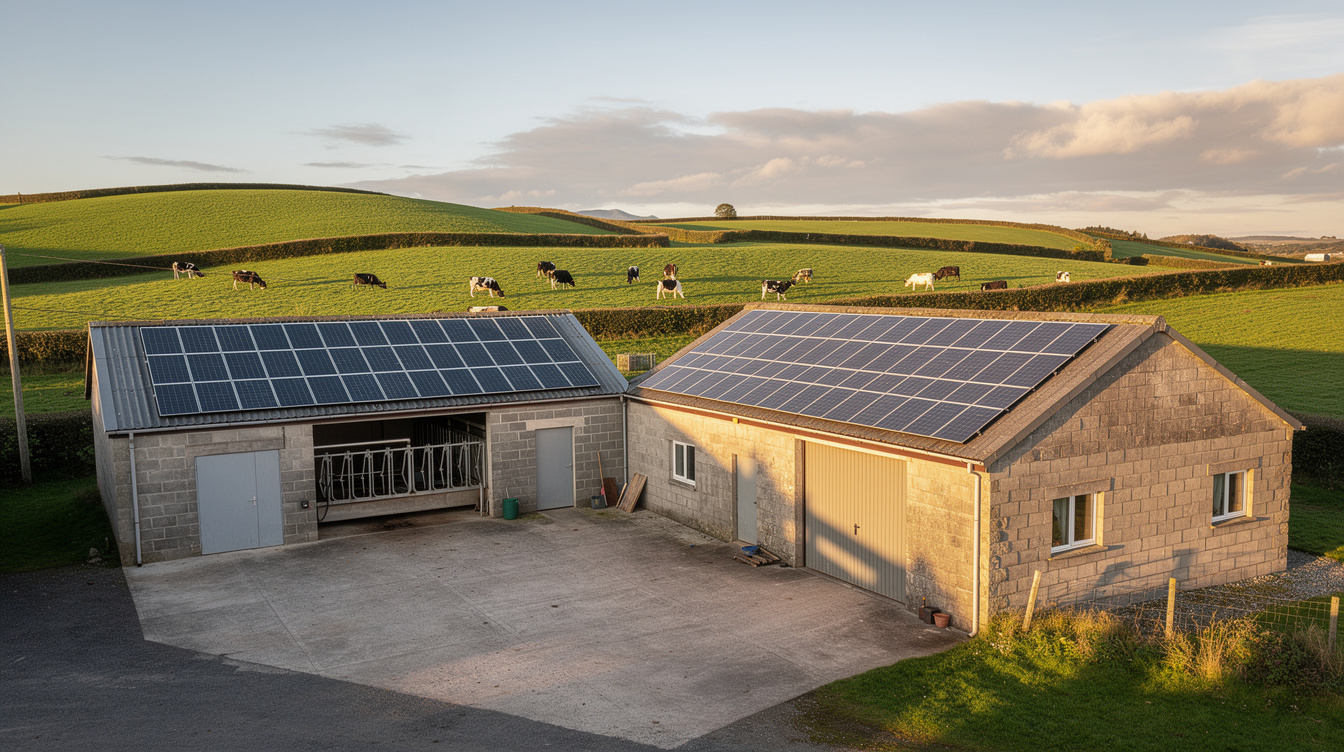
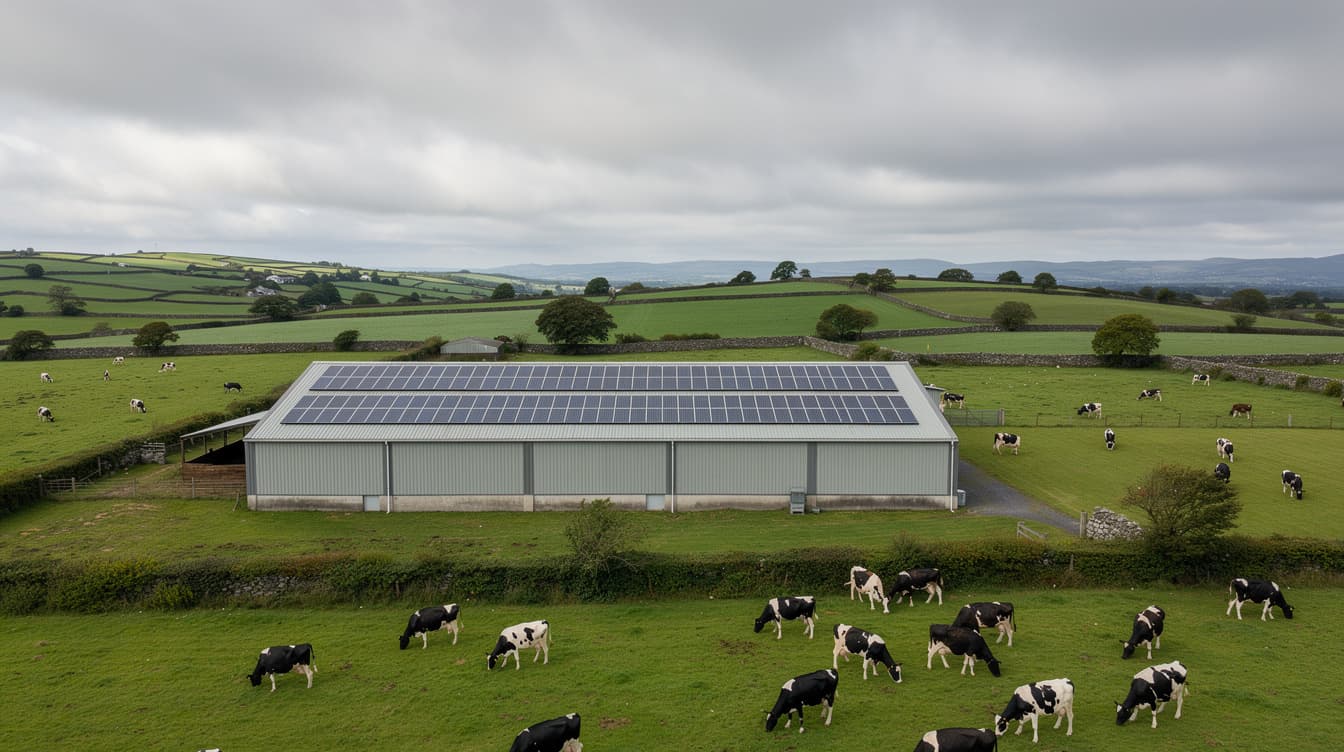
Farms: Cavan is dairy country. Around 4,500 active farms, average herd size around 60–80 cows. Roof areas on milking parlours are smaller than the Golden Vale but plentiful, and TAMS 3 grant uptake on 10–18 kWp installs is strong. East-facing morning-milking sheds are well-matched to a 10 kWp array on simple economics: payback runs 3.5–4.3 years.
Solar yields by area in Cavan
Cavan has remarkably even yields by area — the county spans only about 50 km north to south and 40 km east to west, latitude varies by less than half a degree, and there is no coastline or mountain spine to throw shadows. The interesting differences are micro: south-facing drumlin slopes vs north-facing ones, lakeshore mist zones, and which side of the M3 you sit on.
| Area | Typical south-facing yield (kWh/kWp/yr) | Notes |
|---|---|---|
| Virginia & Bailieborough (M3 belt) | 895–915 | Best in county; lower elevation, sheltered drumlin valleys, decent commuter aspect ratio of roofs. |
| Cavan town & Butlersbridge | 885–905 | Town centre roofs often constrained; suburban estates south of N3 strongest. |
| Cootehill & Shercock | 885–905 | North-east drumlin belt; lots of east/west aspect roofs. |
| Kingscourt & Mullagh | 890–910 | Close to Meath line; flatter terrain, more south-aspect roofs. |
| Belturbet & Ballyconnell | 880–900 | North-west Cavan; cross-border catchment. |
| Blacklion & Glangevlin (Cuilcagh foothills) | 870–895 | Higher elevation; Cuilcagh ridge throws afternoon shadow on west aspects. |
| Lough Sheelin & Lough Oughter shores | 875–900 | Lakeshore morning mist clips March–October yields by ~2%; planning sensitivities (see below). |
The county-wide narrow yield band (875–915) means installer-quoted “expected generation” numbers vary mostly by their inverter sizing assumption and shade model, not by where you are in Cavan. A quote claiming a Virginia install will produce 4,200 kWh from 4 kWp is either using a brand-new TOPCon spec at near-perfect aspect, or it is rounded up to win the job. Cross-check against the table above and ask for the shading model output.
The drumlin aspect problem (and why east–west arrays win in Cavan)
Drumlins are oval glacial hills, typically 30–50 m high, formed in the last ice age. Cavan has more of them per square kilometre than almost anywhere in Europe. They sit in the landscape in long parallel ridges trending roughly north-east to south-west. That is the orientation of glacier flow during the last advance. Houses and farm sheds built on drumlin sides almost always end up with gable roofs facing north-east and south-west, or east and west.
A pure south-facing 4 kWp array in Cavan produces about 3,600 kWh/yr. The same panels split into a 2 kWp east + 2 kWp west array on a drumlin gable produce about 3,360 kWh/yr — 93% of the south total, but spread across a wider daily window. The east side picks up morning generation that south arrays miss (5–6% bonus from 06:00–09:00 in summer), and the west side carries late-afternoon generation past 17:00 when household demand is climbing.
What this means for system spec:
- Dual-MPPT inverter: required to optimise east and west strings independently. Any modern hybrid 5 kW inverter from the mainstream brands does this. A single-MPPT cheap-spec install will cost you 4–6% of yield on an E/W array.
- Self-consumption is higher: the daily generation curve matches typical household load better than a south curve does. A no-battery E/W install achieves 38–42% self-consumption on a typical Cavan 3-bed (vs 32–36% on a pure south install).
- Battery economics shift: the battery savings flatten because there is less midday surplus to time-shift. A 5 kWh battery on an E/W array in Cavan adds ~€180 of annual savings vs ~€260 on a south array. Sizing batteries smaller (3.5–5.1 kWh) is often the right call.
- String design: avoid stringing east and west panels in series — whichever side is in shade pulls the other down. Dual-MPPT with each side on its own string is non-negotiable.
A surprising upside: the M3-commuter household charging an EV from 18:30 onwards benefits more from a west-leaning array in Cavan than a south one. The afternoon-into-evening generation tail lines up with car plug-in time. We work that scenario at Bailieborough in Section 9.
Lakeshore planning: Lough Sheelin, Lough Oughter, the protected views
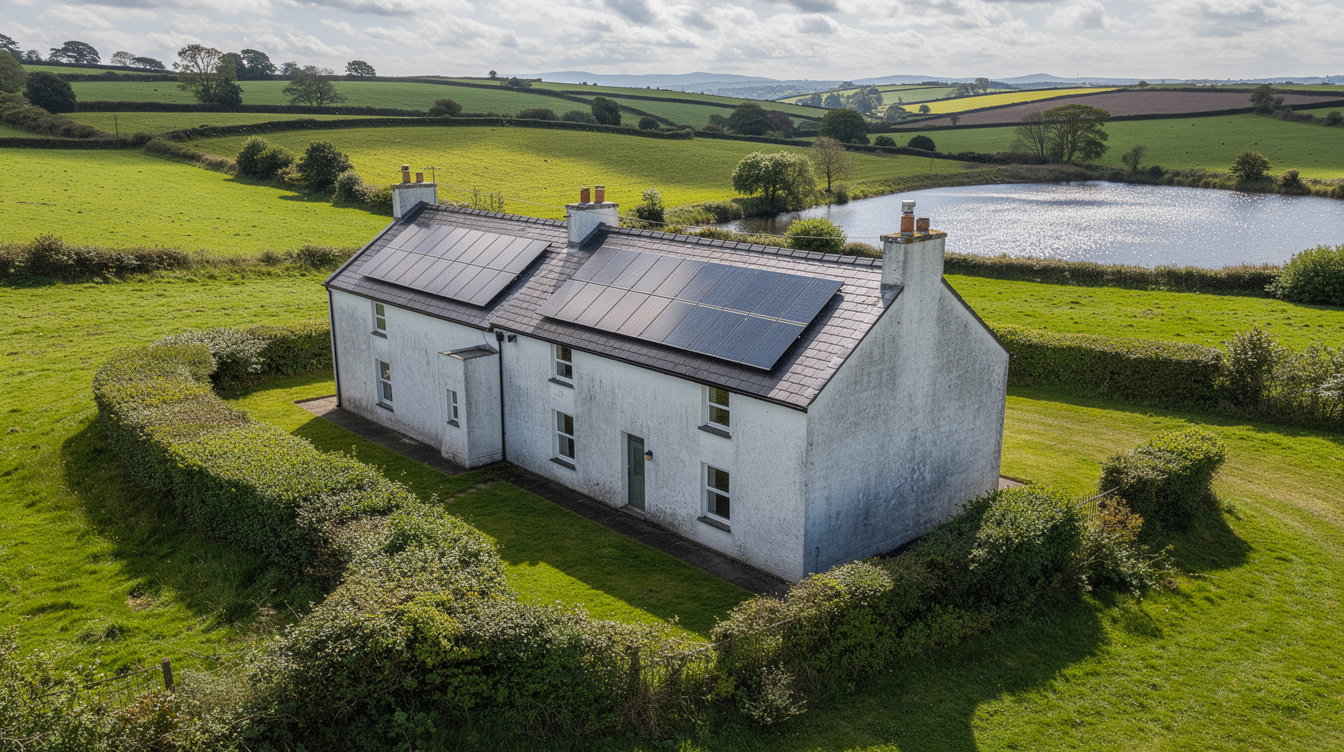
Cavan has 365 lakes. Two of them — Lough Sheelin in the south of the county and the Lough Oughter complex around Killykeen — carry serious planning sensitivities for solar.
Lough Sheelin is a designated Special Protection Area (SPA) under the EU Birds Directive and a Special Area of Conservation (SAC) under the Habitats Directive. Properties within 200 m of the lakeshore fall inside the “views to and from the lake” protective zone of the Cavan County Development Plan. Domestic roof-mounted solar arrays are still allowed under the standard exempted-development rules (up to 50 m2, set back 50 cm from the roof edge, no glare onto designated viewpoints), but ground-mount within this zone is effectively impossible. Any reflective glass-on-glass module is also likely to draw an objection.
Lough Oughter is part of a complex SPA covering 12 km2. The same protection regime applies. The standard practical install pattern: pick panels with low-reflectance black-frame ARC glass (most Tier-1 modules qualify), and document the panel anti-reflective coating spec sheet in the planning notification you would file as a courtesy to the council, even though one is not legally required for exempted development. A council planner ringing your installer mid-install costs days; a pre-emptive notification costs five minutes.
Killykeen Forest Park properties (state-owned holiday cabins) sit inside Coillte land and are not eligible for SEAI grants — they are leasehold, not owner-occupied principal residences.
The M3 commuter belt: Virginia, Bailieborough, the EV economics
Cavan’s south-east corner sits along the M3 motorway, the main corridor into Dublin. Virginia is 100 km from the IFSC; Bailieborough is 95 km. Both are popular commuter towns — lower house prices than Meath, decent broadband, and a 75–85-minute peak-hour drive into Dublin city centre.
That commute is the single biggest variable in the Cavan solar payback equation. A petrol-or-diesel Dublin commuter from Virginia spends €3,200–€3,800 a year on fuel. Switching to an EV charged overnight on a smart-tariff (currently 9.5 c/kWh nightly in 2026) drops that to €820 a year. Adding 4–6 kWp of solar with a small battery means the EV can also pull some daytime weekend charge from the solar surplus, dropping the annual EV running cost to around €680. The combined household saving (PV displacement + EV vs diesel) on a Virginia M3-commuter household is typically €3,400–€4,200 a year, and the combined-spec payback (solar + battery + EV charger) lands inside 5 years.
Practical sizing for an M3 commuter household:
- 4–5 kWp PV array (sized to match the larger of import or future EV-charging surplus).
- Dual-MPPT inverter (almost always needed because of the drumlin aspect issue above).
- 5 kWh battery (small, for time-shifting the 17:00–22:00 evening peak when the EV is plugged in).
- Smart EV charger with night-tariff scheduling.
- Solar diverter only if the immersion is electric — most Virginia properties are oil-heated with electric immersion top-up.
Virginia & Bailieborough EV Homes
Solar plus EV charger spec is a different game from solar alone. Get quotes from installers who do both.
Cross-border reality: Belturbet vs Enniskillen
Belturbet is 20 km from Enniskillen across the border in Co Fermanagh. Many Cavan businesses and farmers cross weekly to do supplies runs into NI. The 0% VAT on UK domestic solar runs to 31 March 2027. Should a Belturbet homeowner just shop the Enniskillen side and avoid the Cavan installer waitlist?
The maths, comparing the same 4 kWp install:
| Item | Belturbet (ROI) | Enniskillen (NI) |
|---|---|---|
| Gross 4 kWp install | €8,400–€9,200 | £6,700–£7,500 (~€7,900–€8,850) |
| VAT | 9% (included) | 0% to March 2027 |
| Grant | €1,800 SEAI | None |
| Net cost | €6,600–€7,400 | ~€7,900–€8,850 |
| Eligibility for SEAI grant if installer is NI? | N/A | No — SEAI requires Irish-registered SEAI installer at install site. |
| Net annual benefit (4 kWp) | ~€880 | ~€730 (lower SEG export rate) |
| Simple payback | 7.5–8.4 years | 10.8–12.1 years |
Critically: an Enniskillen-based installer cannot claim the SEAI grant for an install at a Belturbet address. The installer must be on the SEAI register and have an Irish VAT number. The few NI installers who have set up Irish subsidiaries for this purpose typically do not push price down enough to compete with Cavan-based crews on net cost after grant. The honest conclusion for Belturbet residents is the same as for Lifford: get one cross-border informational quote if you wish, but the ROI grant and CEG combination still wins.
Five Cavan solar scenarios with 2026 numbers
Scenario 1: Cavan town 3-bed semi-detached
Setup: Family of four. 4,800 kWh annual import. Oil central heating, no EV, electric immersion. East–west drumlin gable roof.
Spec: 4.0 kWp split 2 kWp east + 2 kWp west (10 x 410 W TOPCon panels), 5 kW dual-MPPT hybrid inverter, no battery.
Maths: Gross €8,500. SEAI grant €1,800. Net €6,700. Yield 895 kWh/kWp x 0.93 (E/W penalty) = 3,330 kWh/yr. Self-consumption 40% (E/W bonus + electric immersion): 1,332 kWh saved at 36 c/kWh = €480. Export 1,998 kWh on CEG at 20 c/kWh = €400. Total annual benefit €880. Payback 7.6 years.
Scenario 2: Virginia M3-commuter household with EV
Setup: Couple commuting to Dublin daily, one EV (added 2026), 14,000 km/yr. House electricity 4,400 kWh/yr. South-east gable roof. Smart night tariff.
Spec: 5.1 kWp west-leaning array (catches afternoon-into-evening sun), 5.5 kW hybrid dual-MPPT inverter, 5.1 kWh battery, 7 kW EV charger.
Maths: Solar+battery gross €12,800. SEAI grant €1,800. Net €11,000. Yield 905 x 5.1 = 4,615 kWh/yr. Solar self-consumption with battery 55%: 2,540 kWh saved at 36 c/kWh = €914. Export 2,075 kWh at 20 c/kWh = €415. EV diesel displacement: 14,000 km / 16.5 km/L diesel x €1.79 = €1,519 saved; night-tariff EV cost 14,000 / 6.0 km/kWh x 9.5 c = €222. Net EV saving €1,297. Combined annual benefit €2,626. Payback 4.2 years on the combined €11,000 spend.
Scenario 3: Lough Sheelin lakeshore retiree bungalow
Setup: Retired couple, 3-bed bungalow 150 m from Lough Sheelin shore. 3,800 kWh annual import. Oil heating, no EV. South-facing roof but property sits inside the SPA buffer.
Spec: 3.2 kWp (8 x 400 W TOPCon panels with anti-reflective coating, black-frame), 3.6 kW hybrid inverter, no battery. Pre-emptive courtesy notification to council planner.
Maths: Gross €6,800. SEAI grant €1,440 (proportional to size). Net €5,360. Yield 880 kWh/kWp = 2,816 kWh/yr. Self-consumption 38%: 1,070 kWh saved at 36 c/kWh = €385. Export 1,746 kWh on CEG at 20 c/kWh = €349. Total annual benefit €734. Payback 7.3 years. Smaller spec is the right answer for a low-use retiree household; oversizing wastes capital on a low-load curve.
Scenario 4: Cootehill 4-bed detached with heat pump
Setup: Family of five, new build 2023, heat pump heating, 7,200 kWh annual import. East–west drumlin gable. Two EVs eventually planned.
Spec: 6.0 kWp split 3 kWp east + 3 kWp west (14 x 430 W TOPCon panels), 6 kW dual-MPPT hybrid inverter, 10.2 kWh battery.
Maths: Gross €15,400. SEAI grant €1,800. Net €13,600. Yield 895 x 6.0 x 0.93 = 4,995 kWh/yr. Self-consumption 65% (heat pump + battery): 3,247 kWh saved at 36 c/kWh = €1,169. Export 1,748 kWh on CEG at 22 c/kWh = €385. Total annual benefit €1,554. Payback 8.8 years. The right oversizing for a future two-EV household.
Scenario 5: Bailieborough dairy farm, 12 kWp TAMS 3
Setup: 72-cow dairy outside Bailieborough. Two milkings per day, bulk-tank chilling pattern matched to PV better than morning milking. Annual electricity 24,500 kWh.
Spec: 12.0 kWp (30 x 400 W TOPCon panels) on east–west parlour and shed roofs (only viable orientation on a drumlin farm), 10 kW three-phase dual-MPPT inverter, no battery (chilling load takes the daytime surplus directly).
Maths: Gross €15,200. TAMS 3 grant 60% = €9,120. Net €6,080. Yield 895 x 12 x 0.93 = 9,990 kWh/yr. Self-consumption 64% (chilling load matches afternoon generation): 6,394 kWh saved at 28 c/kWh = €1,790. Export 3,596 kWh on commercial CEG at 16 c/kWh = €575. Total annual benefit €2,365. Payback 2.6 years. The drumlin E/W array actually helps farm-solar self-consumption because the bulk-tank chilling cycle runs longer than the PV south-peak window.
Cavan Dairy Farmers
12–18 kWp roof-mount with TAMS 3 60% is paying back inside 3 years across Cavan in 2026. Get quotes from installers experienced with farm three-phase installs.
What it actually costs by system size in Cavan (2026)
| System size | Gross price | SEAI / TAMS grant | Net price | Typical payback |
|---|---|---|---|---|
| 2 kWp (5 panels) | €5,300–€6,000 | €900 | €4,400–€5,100 | 7.8–9.2 yrs |
| 4 kWp E/W (10 panels, drumlin) | €8,400–€9,300 | €1,800 | €6,600–€7,500 | 7.0–9.0 yrs |
| 5.1 kWp + 5 kWh battery + EV charger | €12,400–€13,400 | €1,800 | €10,600–€11,600 | 4.0–5.0 yrs (with EV diesel savings) |
| 6 kWp + 10 kWh battery (heat pump) | €15,000–€16,400 | €1,800 | €13,200–€14,600 | 8.4–9.4 yrs |
| 10–12 kWp TAMS 3 (dairy) | €13,800–€16,200 | 60% TAMS 3 | €5,520–€6,480 | 2.5–3.0 yrs |
Cavan installer waitlists: plan early
There are roughly 11–13 SEAI-registered installers who do meaningful Cavan domestic volume in 2026. Three are Cavan town-based, two each in Virginia and Cootehill, one in Belturbet, and the rest come up from Meath (Navan, Kells) or down from Monaghan town. Aggregate Cavan domestic capacity is around 35–45 installs per month in peak season — tighter than demand from June through October.
Practical advice on timing:
- Submit a SEAI grant pre-approval and quote request in January or February for a peak-season install. Pre-approval lasts 6 months, so February pre-approval covers an August install.
- Avoid signing a quote for a same-week install in July or August. Crews padding the diary at peak season charge a 6–10% premium.
- October–March installs are typically 5–8% cheaper than peak season. Installation weather is rarely the blocker that homeowners expect — only persistent rain (more than 8 mm in 24 hours) stops a roof install, and Cavan winters average 2–3 acceptable install days per week.
- For farms, plan around silage and slurry season — April–May and August–September windows are when farmers prefer install crews on the yard, and TAMS 3 grant administration adds 8–12 weeks to the timeline.
Cavan solar FAQ
I have an east–west drumlin roof. Should I just do south-mount ground array instead? Almost never. Ground-mount triggers planning permission outside a 25 m2 envelope, costs €1,800–€2,500 more in groundworks per kWp, and a properly-spec’d dual-MPPT east–west roof array recovers 93% of the south yield. Stay on the roof.
What inverter brand is best for east–west in Cavan? Any mainstream hybrid 5–6 kW inverter with dual independent MPPT inputs handles E/W well. Ask the installer to show you a string diagram before signing — the words you want to see are “two MPPT inputs, east string on MPPT1, west string on MPPT2”. Single-MPPT inverters should not be used on E/W arrays.
I’m in the Lough Sheelin SPA buffer. Will the council force me to remove panels? No, not for properly-installed exempted-development roof solar. The constraint is on glare reflection toward designated viewpoints and on the visible character of the panels from the lake. Black-frame, anti-reflective ARC panels and pre-emptive notification are the right protective steps.
Is there a Cavan-specific extra grant? No. The SEAI Solar PV Grant (€1,800) is national. Cavan County Council does not currently run a top-up scheme.
Can I claim the SEAI grant if the installer is in Monaghan? Yes. The grant requires the installer to be on the SEAI register and Irish-registered. Most Monaghan installers cover north Cavan as their natural catchment.
What size system fits a typical Cavan 3-bed semi on a drumlin? 4 kWp split 2 kWp east + 2 kWp west is the standard answer. Use the solar panel calculator with the E/W toggle to model your specific case.
Am I eligible for the SEAI grant? If your Cavan home was built before 1 January 2021, is your principal private residence, you own it, and no prior PV grant has been claimed at the MPRN — yes. Confirm via the SEAI grant eligibility checker.
How do I find a Cavan-experienced installer? Browse the Cavan installer directory for SEAI-registered options.
The Cavan solar takeaway
Cavan’s solar economics are quietly distinctive. Yields are middle-of-the-pack but the drumlin landscape means east–west arrays with dual-MPPT inverters are the right default spec for most homes — not the south-facing standard the national guides assume. The county is a strong farm-solar market under TAMS 3 because of the dairy density, and the M3 commuter belt around Virginia and Bailieborough has some of the most compelling combined solar-plus-EV paybacks in Ireland. Installer waitlists are real and plan-ahead behaviour pays. Get three quotes, ask for the inverter MPPT diagram before signing, and pick a panel coating that respects lakeshore planning if you live within sight of Lough Sheelin or Oughter.
Get Three Cavan Solar Quotes
Free, no obligation. SEAI-registered installers covering every corner of Cavan and the M3 commuter belt.
Related Articles
Solar Panels Donegal 2026 — Costs, Grants & Installers
Solar Panels Donegal 2026: pricing by area, Atlantic salt-spec mounting, Lifford basin TAMS 3 dairy maths, Wild Atlantic Way B&B economics, Strabane comparison.
Solar Panels Tipperary 2026 — Costs, Grants & Installers
Solar Panels Tipperary 2026: pricing by micro-market, Tipp plain yields, Knockmealdown shadow, M7/M8 EV commuter maths, Golden Vale TAMS 3 dairy payback.
Solar Panels Louth 2026 — Costs, Grants & Installers
Solar Panels Louth 2026: pricing, yields by area, M1 EV commuter maths, Boyne valley planning, Cooley salt-spec, TAMS 3 farms & five worked payback scenarios.