
Solar Panels Donegal 2026 — Costs, Grants & Installers
Donegal is the third-largest county in Ireland by area — 4,860 km2 of granite hills, Atlantic-battered coastline, peat-bog interior and dispersed villages connected by narrow R-roads. It is also the most northerly county in the Republic, sitting at 54.5°–55.4°N. Both of those facts shape Donegal’s solar economics more than people expect.
The northerly latitude knocks 7–10% off annual yields versus Wexford or Tipperary. The size of the county means installers spend a lot of time driving — a Letterkenny-based crew sent to Glencolmcille loses three and a half hours of the day to the road. That doubles into a quote spread on the same 4 kWp spec of 15–20%, the widest in Ireland, because every installer prices in different assumptions about distance, salt risk and winter access. The Atlantic edge is where most of Donegal’s tourist economy lives, and salt-spec aluminium mounting is mandatory there or panels will be peeling clamp-coatings inside six years.
This guide covers 2026 Donegal solar pricing, yields by area (Inishowen, Letterkenny basin, south Donegal coast, Gaeltacht west), salt-spec mounting reality, the cross-border Strabane comparison (NI has no SEAI grant but charges 0% VAT until 2027), Wild Atlantic Way B&B/holiday-let economics, Letterkenny–Lifford dairy TAMS 3 maths, and five worked scenarios from an Inishowen cottage to a Lifford basin dairy farm.
Get a Donegal Solar Quote
Three free quotes from SEAI-registered installers covering Letterkenny, Buncrana, Donegal Town, Bundoran and the Inishowen Peninsula.
Quick answer: Donegal solar costs and payback in 2026
A typical 4 kWp domestic install in Donegal costs €8,400–€9,800 gross, or €6,600–€8,000 net of the €1,800 SEAI Solar PV Grant. Yields are the lowest in the Republic by county: 870–895 kWh per kWp in the Letterkenny–Lifford basin, 880–905 on the south coast around Bundoran and Ballyshannon, 850–880 across Inishowen, and 830–870 on the exposed Atlantic west around Gweedore and Bloody Foreland where annual cloud cover is highest. A 4 kWp Donegal array generates 3,400–3,600 kWh a year. Combined import savings and CEG export income land at €760–€900 a year on a no-battery domestic install. Net payback: 7.8–10.0 years.
The Donegal headline: pricing is the most variable in Ireland because installer travel costs vary by an order of magnitude. A Letterkenny crew servicing a same-town install carries roughly €200 of travel cost. The same crew sent to Malin Head or Glencolmcille carries €700–€900 of travel and an overnight if winter access closes the road late afternoon. Most homeowners can shrink that spread by getting at least one quote from a Donegal-based installer rather than three from a Letterkenny base.
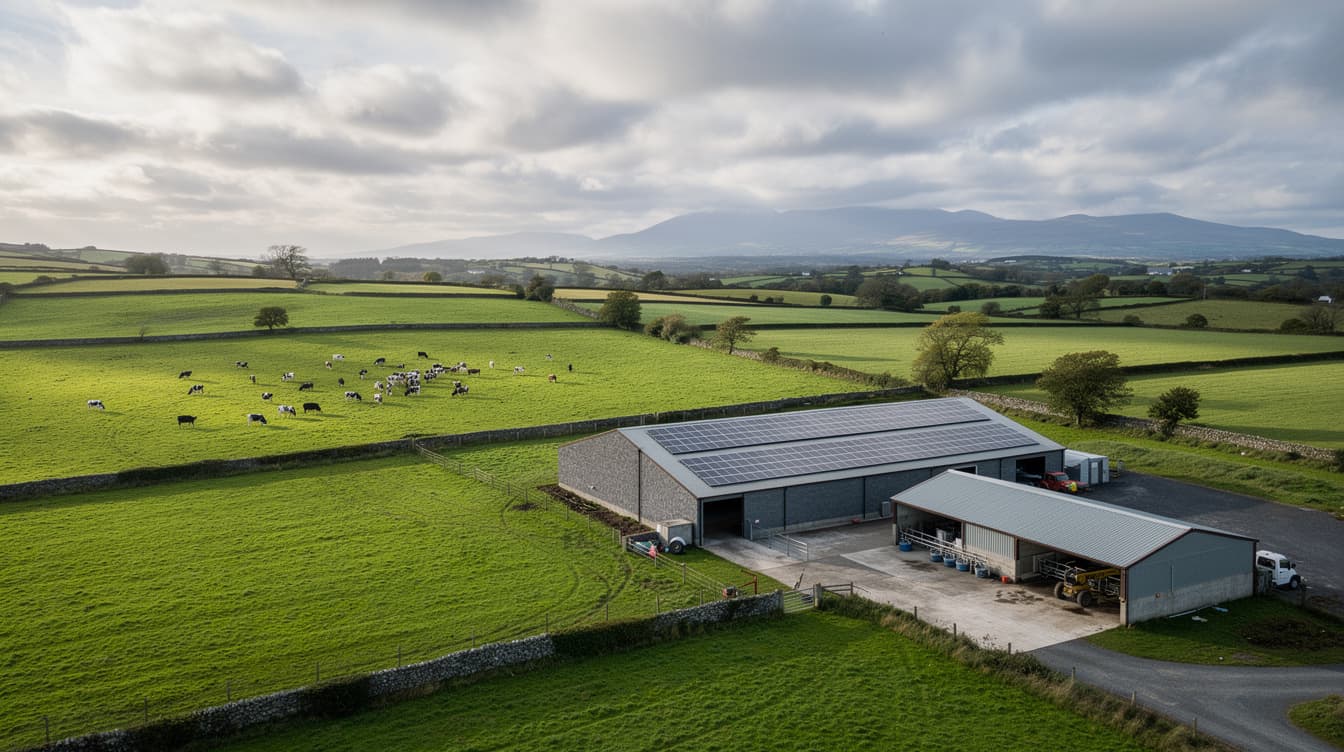
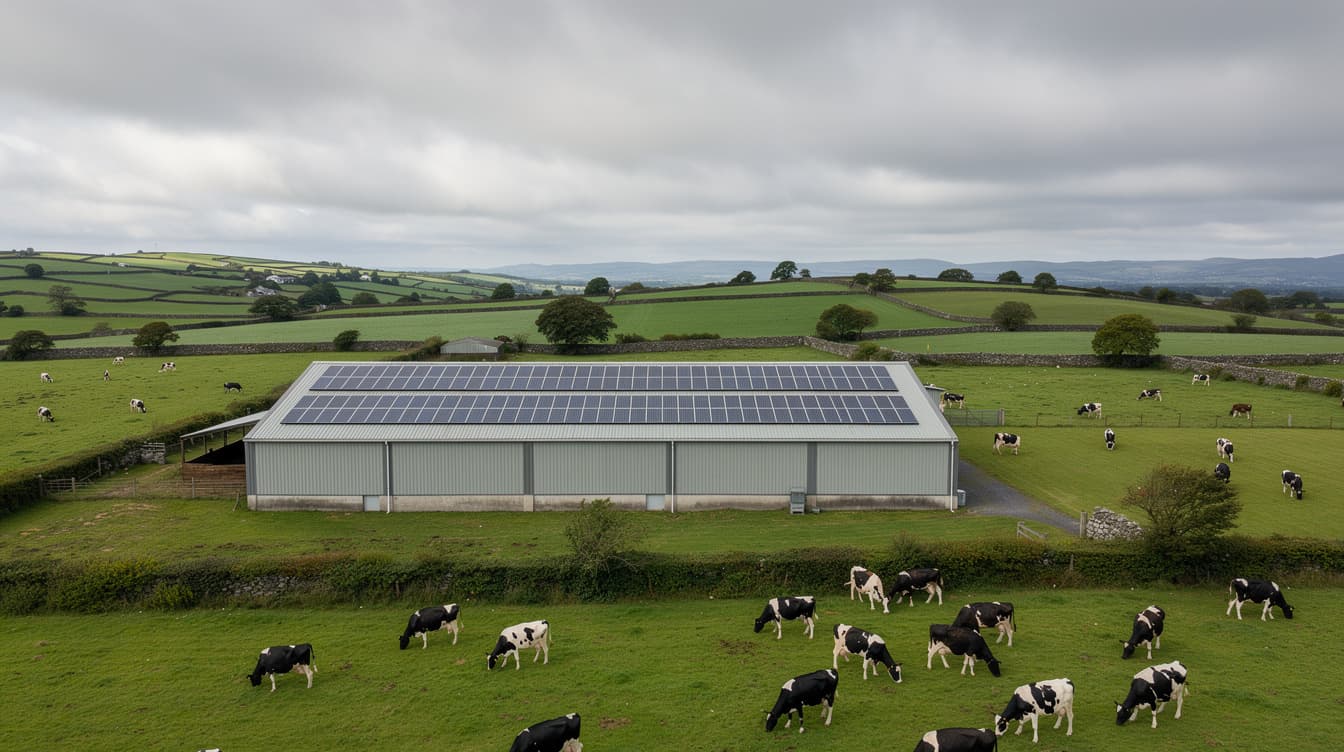
Farms: the Lifford and Letterkenny basin sits on the eastern dairy band that runs from Lifford down to Castlefinn. East Donegal dairy farms with 15–20 kWp arrays funded under TAMS 3 are paying back in 3.6–4.4 years — slower than Tipperary or Cork because yields are lower, but still inside the lifetime of the grant funding window.
Solar yields by area in Donegal
Donegal sits at the same latitude as Edinburgh or Hamburg. That latitude alone costs you around 7% of annual yield compared with Cork, before you account for cloud cover. The west coast of Donegal gets the highest annual rainfall in the Republic outside parts of Kerry, and the Atlantic cloud bands cut another 3–5% off summer yields versus the east side of the county. The Lifford–Letterkenny basin and the south Donegal coast around Bundoran are the two highest-yielding pockets.
| Area | Typical south-facing yield (kWh/kWp/yr) | Notes |
|---|---|---|
| Letterkenny & Lifford basin | 870–895 | Best inland yields; sheltered by Sperrins (NI) from worst Atlantic cloud. |
| Bundoran & Ballyshannon | 880–905 | Best yields in the county; south Donegal coast sees more direct sun than the west or north. |
| Donegal Town & Killybegs | 860–885 | Decent south-coast aspect; Killybegs harbour fog clips November–February output by ~3%. |
| Inishowen (Buncrana, Carndonagh, Moville) | 850–880 | Northerly latitude (55°N) is the dominant penalty; Slieve Snaght throws shadow on south Inishowen valleys. |
| Dunfanaghy, Gweedore, Bloody Foreland | 830–870 | Highest cloud cover in county; Errigal shadow on east aspects. Salt-spec mounting essential. |
| Glencolmcille & Slieve League | 855–885 | Surprisingly good south aspects on south-facing valley walls; salt-spec mandatory. |
| Fanad & Rosguill peninsulas | 855–885 | Open peninsulas, no terrain shadow, but salt exposure is the highest in Ireland. |
The practical read-across: anywhere east of the Errigal-to-Croaghgorm spine you are getting 870+ kWh/kWp. Anywhere west of it, expect to lose 30–50 kWh/kWp annually to cloud and salt-clearing maintenance, and budget €250–€400 of premium mounting on top.
Salt-spec mounting: the Donegal non-negotiable
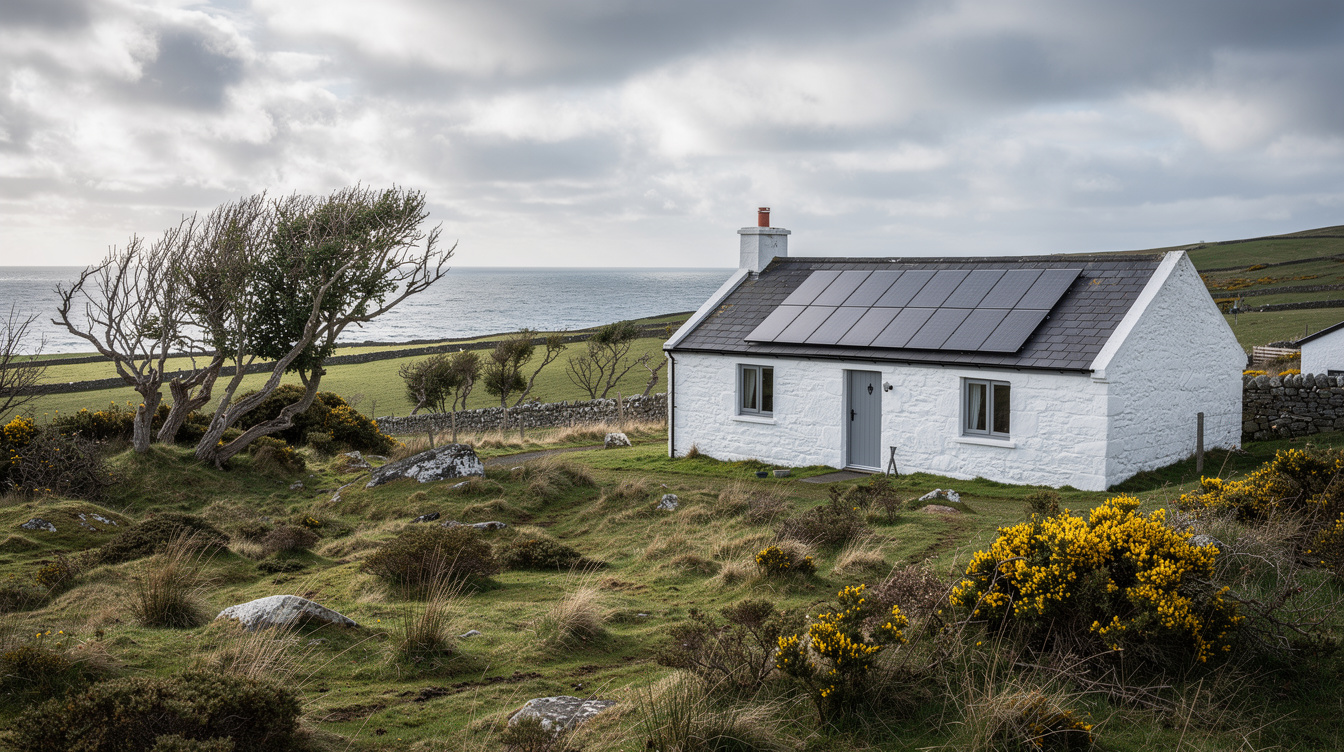
The C5-M corrosion category — the highest in EN ISO 12944 — runs the full length of Donegal’s Atlantic coast, from Tory Island and Bloody Foreland through Gweedore, Killybegs, Glencolmcille and on down to Bundoran. Anything within 1 km of open Atlantic water in Donegal is C5-M. Anything within 5 km on a peninsula is C5-I. Both demand a different spec from a typical Letterkenny suburban quote.
What this actually means on the install:
- Aluminium rails: EN AW-6005A-T6 with mill-finish anodised coating. Powder-coat alone fails inside 5–7 years on C5-M sites. Cheaper rails common in inland quotes are not acceptable on the Donegal coast.
- Mid- and end-clamps: A2 (316) stainless. A1 (304) corrodes inside 3–4 years on Atlantic peninsulas. Verify with the installer in writing.
- Roof hooks and L-feet: A4 (316L) stainless or hot-dip galvanised to ISO 1461. Avoid mild-steel-zinc-only on coastal Donegal.
- Module frames: Anodised aluminium, not painted. All Tier-1 panels qualify by default; check the data sheet for “salt-mist tested to IEC 61701 Severity 6”.
- Inverter: Indoor location preferred. If wall-mounted outdoors, must be IP66-rated. Some popular hybrid models lose warranty cover when installed within 1 km of open Atlantic water.
The premium for the full salt-spec mounting kit on a 4 kWp array is €280–€420 over standard inland spec. That is the lowest-friction insurance you can buy in coastal Donegal — an out-of-spec rail set replaced under warranty after 6 years involves scaffolding, removing the array and reinstalling, easily €2,500 worth of labour. Pay the €350 now.
Inland Letterkenny and Lifford do not need salt-spec. Anywhere with sea visible from the site does.
The Letterkenny–Lifford basin: where Donegal’s dairy solar lives
The Foyle valley running from Lifford north to Letterkenny and on to Buncrana is a different solar market from the rest of the county. Sheltered from west Atlantic cloud by the Sperrin Mountains across the border in Tyrone, the basin gets 870–895 kWh/kWp — close to Sligo numbers despite the latitude penalty. It is also the only sustained dairy-tillage corridor in Donegal.
For TAMS 3 farm solar, this is where almost every Donegal application gets approved. A 15 kWp roof on a milking parlour outside Castlefinn or Manorcunningham generates around 13,200 kWh a year — matched closely to summer milking and morning chilling loads. With the 60% TAMS 3 grant on the €18,500 gross install, the farmer’s net spend is around €7,400 and the system displaces €2,000–€2,300 of grid import annually. Payback: 3.6–4.4 years. We work through the maths under Lifford Dairy in Section 9.
Domestic installs in the basin are the easiest in Donegal: standard inland spec, no salt premium, decent yields, and Letterkenny-based crews can usually do two installs a day along the N56 corridor. Quote spreads compress here to 5–8% on the same 4 kWp spec, much closer to Louth or Meath economics than to the Donegal county average.
Compare Donegal Installers
Get matched with three SEAI-registered installers covering your part of Donegal — Inishowen, Gaeltacht, south coast or the Lifford basin.
Cross-border reality: Lifford vs Strabane
Lifford and Strabane are 1.4 km apart across the river Foyle. They share GPs, schools, supermarkets and weather. They do not share solar economics — and the 2026 picture has shifted again. Here is the same 4 kWp install costed both sides of the bridge:
| Item | Lifford (ROI) | Strabane (NI) |
|---|---|---|
| 4 kWp system gross price | €8,500–€9,200 | £6,800–£7,600 (~€8,000–€8,950) |
| VAT | 9% (included in price above) | 0% to 31 March 2027 |
| Grant | €1,800 SEAI | None (NI Energy Saving Trust grant scheme paused) |
| Net cost | €6,700–€7,400 | ~€8,000–€8,950 |
| Annual yield (4 kWp) | ~3,500 kWh | ~3,500 kWh (same latitude) |
| Export tariff | CEG 18–24 c/kWh by supplier | SEG 5–15 p/kWh by supplier |
| Net annual benefit | ~€850 | ~£640 (~€750) |
| Simple payback | 7.9–8.7 years | 10.7–11.9 years |
The Republic still wins comfortably on net cost and payback — the €1,800 SEAI grant plus a stronger Clean Export Guarantee tariff outpace the NI 0% VAT advantage. The Strabane numbers do close once the SEAI grant tapers (currently scheduled to drop by €300 in mid-2027), so this comparison will look closer in 18 months. If you live in the Lifford–Strabane corridor and have heard the “0% VAT means NI is cheaper” story at a hardware counter, the maths above is what to push back with.
Wild Atlantic Way B&Bs and holiday lets: winter use changes the maths
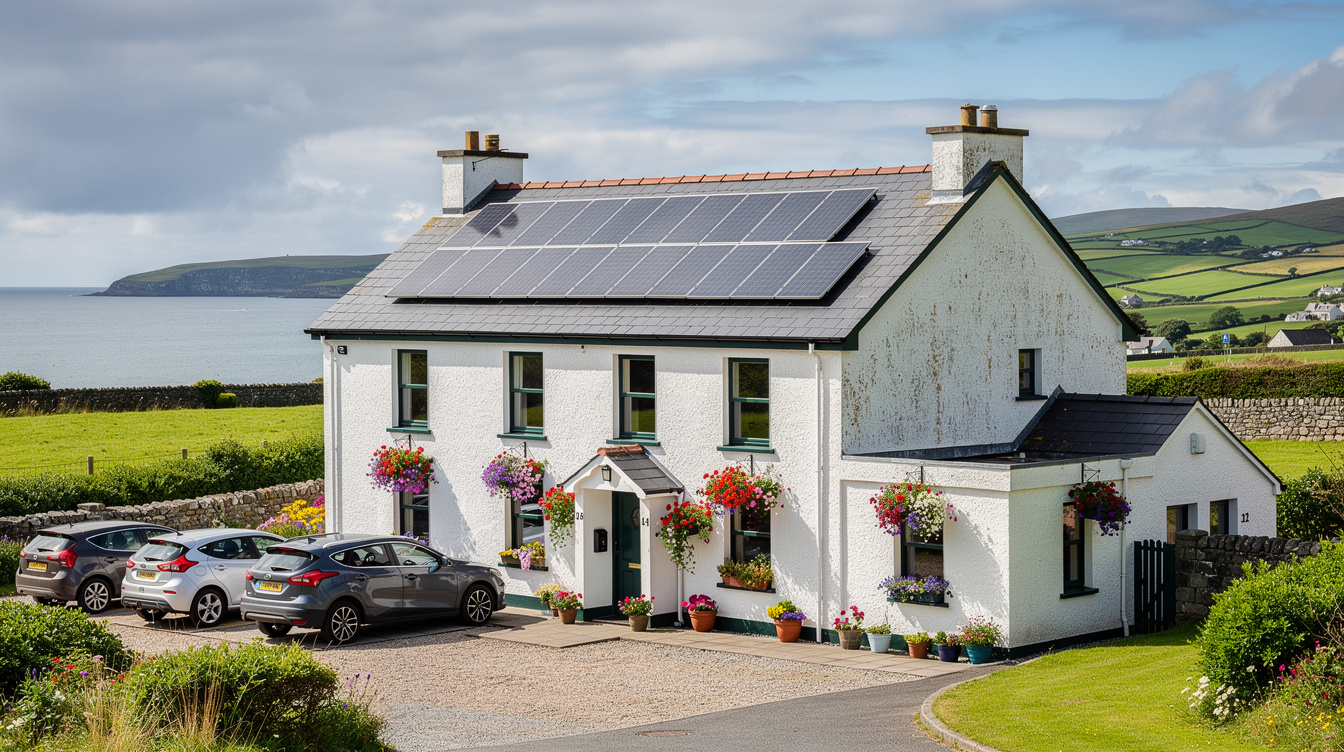
Most Donegal solar advice assumes a domestic load curve: low daytime use, big evening peak, summer surplus exported, battery to shift evening loads. Wild Atlantic Way B&Bs and holiday lets run the opposite shape:
- Peak occupancy June–September matches peak solar generation. Almost all generation goes straight to laundry, hot water, kettles and EV chargers — self-consumption is 70–80%.
- Shoulder occupancy October–May leaves the building lightly used. Without a guest, daytime load drops to ~150 W of fridges and Wi-Fi. Most surplus is exported.
- Hot water is the easiest single load to displace — a solar diverter feeding an immersion heater on the cylinder absorbs 12–18 kWh a day in summer.
The right Donegal coastal B&B spec is usually 5–6 kWp (not the domestic-default 4) with a solar diverter, no battery. The diverter costs €450–€650 and a battery saves you a tariff differential that almost never appears because most generation is consumed live. Payback on a 5 kWp Bundoran B&B install: 6.4–7.6 years on import-only savings, faster with a CEG export uplift.
For the planning side, virtually all coastal Donegal sits inside a Scenic Landscape Area as designated under the Donegal County Development Plan. Domestic-scale arrays still fall under the exempted-development rules (50 m2 roof-mounted, no glare onto a public road or Wild Atlantic Way viewpoint), but ground-mount is effectively impossible without full planning permission and is rarely granted.
Letterkenny, Donegal Town, Inishowen: the three installer bases
Almost every accredited installer working domestically in Donegal is based in one of three locations: Letterkenny (most), Donegal Town (a handful), or Buncrana/Carndonagh (Inishowen-only crews). Each base has its own catchment economics:
- Letterkenny base: efficient inside the N56/N13/N15 corridor (Lifford, Manorcunningham, Ballybofey, Stranorlar, Letterkenny itself). Travel time goes punitive going west of Glenties or south of Donegal Town. Typical quote covers 60% of county postcodes; will quote for the rest with a €300–€600 mobilisation premium.
- Donegal Town base: strongest from Bundoran through Killybegs and into south-west Donegal. Crosses Barnesmore Gap into Letterkenny territory but usually only for repeat clients. Best pricing on south coast and around Mountcharles, Frosses and Inver.
- Inishowen base (Buncrana/Carndonagh): serves the peninsula only. Local salt-spec defaults, knows the Inishowen wind exposure, sticks to Greencastle–Moville–Buncrana–Carndonagh axis. Most cost-effective option for Inishowen homeowners.
The classic Donegal mistake is to take three quotes all from Letterkenny installers when the property is in Inishowen or Glencolmcille. The result is three quotes with the same €500–€700 mobilisation premium baked in, and an inflated price spread that looks like a quote race but is just a travel-cost race. Get at least one quote from a local-to-site installer.
Five Donegal solar scenarios with 2026 numbers
Scenario 1: 3-bed Letterkenny semi-detached
Setup: Two adults, two teenagers. 4,500 kWh annual import. Gas central heating, no EV. South-east roof, no shading, 2010 build. Letterkenny town, inland, no salt issue.
Spec: 4.0 kWp (10 x 410 W TOPCon panels), 5 kW string inverter, no battery.
Maths: Gross €8,600. SEAI grant €1,800. Net €6,800. Yield 880 kWh/kWp = 3,520 kWh/yr. Self-consumption 35% (no battery): 1,232 kWh saved on import at 36 c/kWh = €443. Export 2,288 kWh on CEG at 20 c/kWh = €458. Total annual benefit €901. Payback 7.5 years.
Scenario 2: Letterkenny semi-d plus EV
Setup: Same household upgrades to an EV in 2026. 12,000 km a year. Charges overnight on a smart night tariff (9.5 c/kWh, 23:00–08:00).
Spec: Add 5.1 kWh battery to the array above for time-shifting.
Maths: Add €3,800 for battery (gross, no grant). Net additional €3,800. Battery shifts 1,800 kWh/yr of surplus solar into evening import-displacement at 36 c/kWh = €648 of additional saving (less the €360 it would have exported = €288 net battery uplift). Plus night-tariff EV charging cost €855 (vs €1,860 of equivalent petrol diesel). Combined household annual benefit €1,190 + EV petrol displacement €1,005 = €2,195 effective. Combined payback on full €10,600 net spend: 4.8 years.
Scenario 3: Bundoran B&B with solar diverter
Setup: Six-bedroom B&B on the Wild Atlantic Way. Open mid-March to mid-October. 11,000 kWh annual import. Gas-fired central heating, electric immersion for top-up summer hot water. Coastal site, salt-spec required.
Spec: 5.5 kWp (14 x 395 W TOPCon panels), salt-spec mounting, hybrid 5 kW inverter, solar diverter on the hot-water cylinder, no battery.
Maths: Gross €12,400. SEAI grant €1,800 (residential portion qualifies as principal private residence as the owner lives onsite). Net €10,600. Yield 890 kWh/kWp = 4,895 kWh/yr. Summer self-consumption 75% (guests in residence, diverter dumping to immersion): 2,500 kWh saved on import at 36 c/kWh = €900. Export 1,460 kWh on CEG at 22 c/kWh = €321. Hot-water diverter avoids ~1,800 kWh of grid immersion top-up — absorbed into self-consumption already. Total annual benefit €1,221. Payback 8.7 years on a guest-house spec with no battery.
Scenario 4: Inishowen detached cottage (Carndonagh)
Setup: Retired couple, 4-bed detached cottage outside Carndonagh. Heat pump (installed 2024), no gas connection. 7,500 kWh annual import. South-facing roof. Inishowen coast, salt-spec required, no EV.
Spec: 5.0 kWp (12 x 415 W TOPCon panels), salt-spec aluminium and A2 stainless mounting, 5 kW hybrid inverter, 10.2 kWh battery.
Maths: Gross €15,200. SEAI grant €1,800 (PV only — battery not separately grant-eligible). Net €13,400. Yield 870 kWh/kWp = 4,350 kWh/yr. With battery, self-consumption 78%: 3,393 kWh saved on import at 36 c/kWh = €1,221. Export 957 kWh on CEG at 22 c/kWh = €211. Heat-pump COP 3.4 on shoulder months — PV directly powers daytime defrost cycles efficiently. Total annual benefit €1,432. Payback 9.4 years. Slower than southern equivalents, but the heat-pump household has the strongest case for a battery in Donegal because winter heating dominates the load curve.
Scenario 5: Lifford dairy farm 18 kWp TAMS 3
Setup: 95-cow dairy outside Lifford. Two milkings a day (06:00 and 16:30), bulk tank chilling running 06:30–09:00 and 17:00–19:30. Annual electricity 32,000 kWh. South-facing parlour roof, inland Lifford basin (no salt issue).
Spec: 18.0 kWp (44 x 410 W TOPCon panels) on the parlour roof, 15 kW three-phase inverter, no battery (chilling load matches generation profile closely enough to skip storage).
Maths: Gross €22,400. TAMS 3 grant 60% = €13,440. Net €8,960. Yield 880 kWh/kWp = 15,840 kWh/yr. Morning milking is too early for solar (chilling starts pre-dawn), but the afternoon-into-evening chilling cycle is a strong match: self-consumption 62%, 9,820 kWh at the farm business import rate of 28 c/kWh = €2,750. Export 6,020 kWh on commercial CEG at 16 c/kWh = €963. Total annual benefit €3,713. Payback 2.4 years. The fastest farm-solar payback in Donegal, driven by the chilling-load match and the TAMS 3 60% rate.
Donegal Farmers & B&B Owners
TAMS 3, commercial CEG and salt-spec mounting are specialist areas. Get quotes from installers who actually work in Donegal.
What it actually costs by system size in Donegal (2026)
| System size | Gross price (inland) | Gross price (coastal, salt-spec) | SEAI grant | Net |
|---|---|---|---|---|
| 2 kWp (5 panels, starter) | €5,400–€6,200 | €5,700–€6,500 | €900 | €4,500–€5,600 |
| 4 kWp (10 panels, typical 3-bed) | €8,400–€9,400 | €8,800–€9,800 | €1,800 | €6,600–€8,000 |
| 5 kWp + diverter (B&B / heat pump) | €11,000–€12,200 | €11,600–€12,800 | €1,800 | €9,200–€11,000 |
| 5 kWp + 10 kWh battery (heat pump) | €14,500–€15,800 | €15,000–€16,400 | €1,800 | €12,700–€14,600 |
| 6 kWp + battery (large family home) | €15,800–€17,200 | €16,400–€17,800 | €1,800 | €14,000–€16,000 |
| 15–20 kWp TAMS 3 (farm) | €19,500–€24,500 | N/A (rarely coastal) | 60% TAMS 3 | €7,800–€9,800 |
Spread within bands is wider than other counties — that is the installer-travel-cost effect described earlier. To narrow it, ask each quoting installer where their base is and how many other jobs they have within 30 km of your address this quarter. The crew with a neighbour on the same route in two weeks will quote sharper than a crew making the trip just for you.
Donegal solar FAQ
Is Donegal actually too far north for solar to be worth it? No. The latitude penalty is real (7–10% versus Cork) but the €1,800 SEAI grant, strong CEG export tariff, and 36 c/kWh import prices still produce 7.5–10-year paybacks. That is well inside a panel’s 25-year linear-output warranty.
Do panels work in Donegal winter? Yes, but generation is much lower. Expect 50–70 kWh per kWp in December–January (about 6–8% of annual yield in those two months combined). Solar diverters and batteries are most useful for shifting the strong April–September generation across the day; trying to size a system for winter self-sufficiency is not economic in Donegal.
What about snow? Snow lying on panels for more than a couple of days is rare in Donegal outside high Inishowen, the Bluestack Mountains and inland Glenties. Panels are tilted; snow either slides off or melts within a day of sun. Snow load is not a structural concern for any spec compliant with EN 1991-1-3.
I’m in the Gaeltacht — is there extra grant funding? Údarás na Gaeltachta runs enterprise grants for Gaeltacht-based businesses, including solar PV on commercial premises in some funding rounds. Domestic households fall under the standard SEAI Solar PV Grant only.
Can I get a quote for a holiday home I rent out? Yes, but the SEAI grant only covers the principal private residence. A holiday home rented out through Airbnb or a letting agent is not the owner’s principal private residence and does not qualify. The system itself is still economic on full-cost basis if occupancy is above 60%.
Is my Donegal home eligible for the SEAI Solar PV Grant? Yes, if the house was built before 1 January 2021, it is your principal private residence, you own it, and no prior PV grant has been claimed at the MPRN. Check the live SEAI grant eligibility checker.
What size system fits a typical Donegal 3-bed semi? 4 kWp (10 panels) is the typical fit on an 8–10 m by 4 m south-east or south-west roof. Use the solar panel calculator to size against your last 12 months of import.
How do I find a SEAI-registered installer in Donegal? Browse the Donegal installer directory for vetted local options across Letterkenny, Donegal Town, Buncrana and Inishowen.
The Donegal solar takeaway
Donegal’s solar economics are uniquely shaped by its size, its latitude and its Atlantic edge. Yields are the lowest in the Republic but still strong enough to deliver sub-10-year paybacks on every domestic system size with the SEAI grant. Salt-spec mounting on the coast is non-negotiable. The Letterkenny–Lifford basin is the strongest farm-solar pocket in Ulster. And the gap between a well-quoted and badly-quoted job is €1,500–€2,500 — almost entirely a function of which installer base ends up doing the install. Get three quotes, at least one from your local catchment, and pay for the salt-spec if you can see the Atlantic from your roof.
Get Three Donegal Solar Quotes
Free, no obligation. SEAI-registered installers serving every corner of Donegal.
Related Articles
Solar Panels Cavan 2026 — Costs, Grants & Installers
Solar Panels Cavan 2026: drumlin east-west arrays, Virginia M3 commuter EV maths, Lough Sheelin lakeshore planning, Bailieborough dairy TAMS 3 payback.
Solar Panels Tipperary 2026 — Costs, Grants & Installers
Solar Panels Tipperary 2026: pricing by micro-market, Tipp plain yields, Knockmealdown shadow, M7/M8 EV commuter maths, Golden Vale TAMS 3 dairy payback.
Solar Panels Louth 2026 — Costs, Grants & Installers
Solar Panels Louth 2026: pricing, yields by area, M1 EV commuter maths, Boyne valley planning, Cooley salt-spec, TAMS 3 farms & five worked payback scenarios.