
Solar Panels Tipperary 2026 — Costs, Grants & Installers
Tipperary is the largest inland county in Ireland, second-largest by area overall, and that single fact shapes everything about its solar market. The Golden Vale dairy country between the Galtee, Knockmealdown, Slieve Felim and Silvermine ranges is some of the most productive farmland in Europe — and it sits 50–90 km from the nearest major solar installer hubs in Limerick, Cork and Kilkenny. That distance is a tax on every Tipperary solar quote, and the way smart Tipperary homeowners get around it is the entire story of this guide.
Three things make Tipperary distinctive in a 2026 solar context. First, it splits cleanly into three economic micro-markets — Nenagh and north Tipperary tied to Limerick on the M7; Thurles and the central plain tied to the M8 corridor and Kilkenny; Clonmel and south Tipperary tied to Cork via the M8 and Mitchelstown Gap. Second, it’s the dairy capital of Ireland by a wide margin, which means TAMS 3 farm solar is overwhelmingly the largest single chunk of new capacity going in. Third, the high yields on the Tipperary plain (970–990 kWh per kWp around Nenagh, Thurles, Templemore and Cashel) get clipped sharply in the Knockmealdown and Galtee shadow zones to the south, with a 25–40 kWh/kWp gap depending on aspect.
This guide covers 2026 Tipperary solar pricing by micro-market, the M7/M8/M9 commuter case, planning for the Comeragh and Galtee scenic landscape areas, TAMS 3 dairy parlour maths, and five worked payback scenarios from a Nenagh retiree to a Cahir heritage cottage.
Get a Tipperary Solar Quote
Three free quotes from SEAI-registered installers covering Nenagh, Thurles, Clonmel, Cashel, Tipperary Town and the Golden Vale.
Quick answer: Tipperary solar costs and payback in 2026
A typical 4 kWp domestic install in Tipperary costs €8,300–€9,800 gross, or €6,500–€8,000 net of the €1,800 SEAI Solar PV Grant. Yields run from 975–990 kWh per kWp on the Tipperary plain (Thurles, Nenagh, Cashel) down to 945–960 in the Knockmealdown and Galtee shadow zones near Clogheen, Burncourt and Newcastle. A 4 kWp Tipp-plain array generates 3,900–3,960 kWh per year. Combined import savings and CEG export income come in at €885–€1,010 a year on a no-battery domestic install. Net payback: 6.6–8.6 years — the wider range than smaller counties reflects which micro-market you’re in.
The Tipperary headline: yields are excellent across most of the county, the SEAI grant economics are identical to the rest of Ireland, and the variable is which installer base you tap. Limerick-side installers will quote tight for north Tipp (Nenagh, Newport, Ballina) but will add 12–15% travel premium for Clonmel jobs. Cork-side installers do the opposite. The right answer for most Tipperary homeowners is to source quotes from installers in the nearest major town for your micro-market, not the nearest motorway corner.
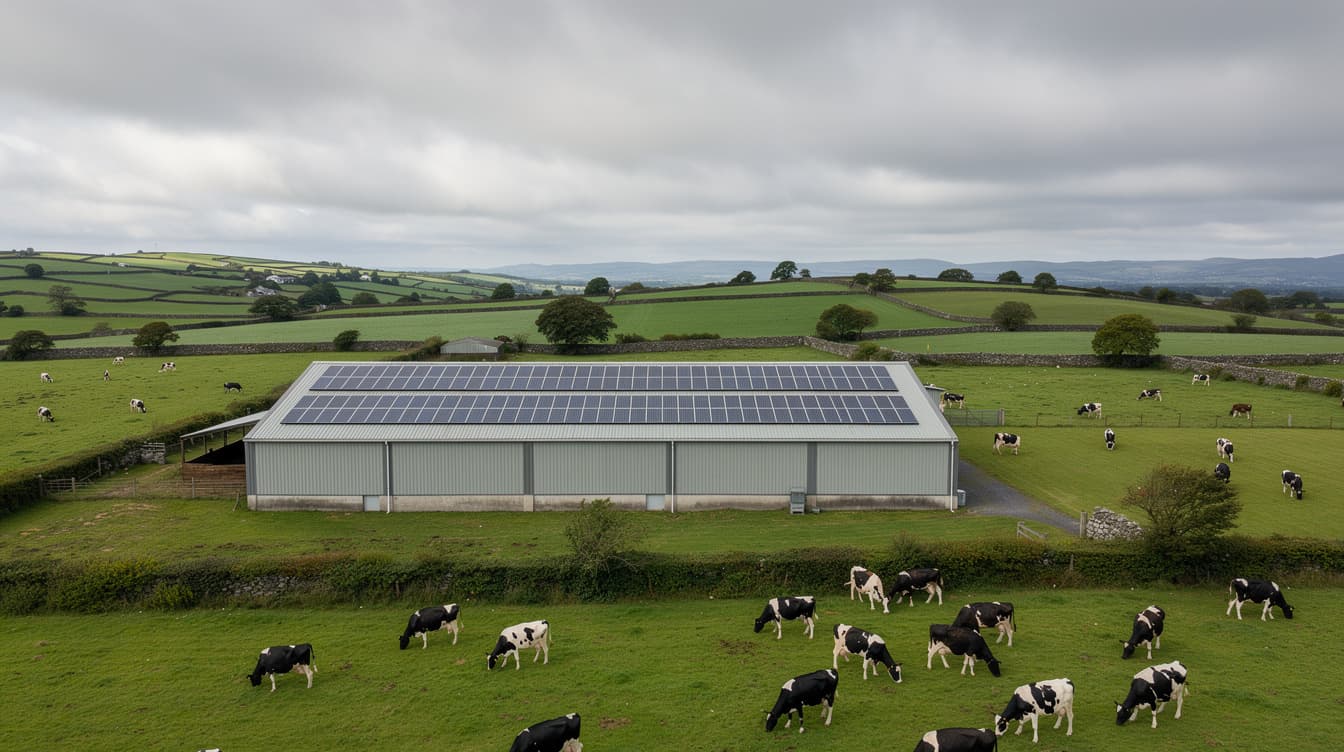
Farms: the Golden Vale dairy concentration around Cashel, Cahir, Tipperary Town and south Limerick border puts Tipperary at the top of the TAMS 3 solar leaderboard nationally. A 15 kWp dairy-parlour install pays back in 2.9–3.5 years here. Scenario 5 walks through the maths.
Yields by area in Tipperary
The Tipperary yield map has three bands. The plain — running roughly north from Cashel through Thurles to Nenagh and Roscrea — gets some of the best PV yields in inland Ireland because the surrounding ridges keep most cloud bands moving and you sit at modest elevation with no shading horizon. The southern slope of the Galtees and Knockmealdowns gives you serious horizon-shading on east aspects, particularly around Clogheen, Ballyporeen and Newcastle. The eastern edge of the county, near the Slievenamon and southern Comeragh slopes, sits in a slightly damper micro-climate but still produces above-national-average yields.
| Area | Typical south-facing yield (kWh/kWp/yr) | Notes |
|---|---|---|
| Nenagh & north Tipp plain | 970–985 | Strong yields; Lough Derg cooling effect helps panel temperature on summer peaks. |
| Thurles & central plain | 975–990 | Highest yields in the county; flat land, low cloud cover. |
| Cashel & Tipperary Town | 970–985 | Golden Vale heart; long summer evenings; ideal farm-roof yields. |
| Roscrea & Templemore | 965–980 | Slightly higher elevation; Slieve Bloom shadow on west aspects late afternoon. |
| Clonmel & Suir valley | 950–965 | Comeragh shadow on south aspects; valley fog occasional in autumn. |
| Cahir & mid-Suir | 955–970 | Open aspect on north side; Galtee shadow on south. |
| Clogheen, Ballyporeen, Burncourt | 945–960 | Knockmealdown shadow; east aspects lose 45–60 min morning sun. |
| Carrick-on-Suir & east | 955–970 | Damper micro-climate; Slievenamon shadow on north-east aspects. |
If an installer quotes you below 920 kWh/kWp on a south-facing roof anywhere in central Tipperary, ask why — either they’re using outdated PVGIS data, or they’ve spotted shading you missed.
Solar installation costs in Tipperary (2026)
Tipperary pricing has the widest spread of any solar market in Ireland because of the three-micro-market dynamic. Same-spec quotes from three installers in Nenagh might come in within €500 of each other. The same three specs sourced from a Cork-side, Limerick-side and Kilkenny-side installer for a Clonmel address might span €1,800. The way to win in Tipperary is to make installers compete on their home turf, not on yours.
| System size | Gross install | SEAI grant | Net cost | Suited to |
|---|---|---|---|---|
| 2.5 kWp (6 panels) | €6,200–€7,200 | €1,800 | €4,400–€5,400 | Thurles or Nenagh terraced; low-use household. |
| 4.0 kWp (10 panels) | €8,300–€9,800 | €1,800 | €6,500–€8,000 | Most Tipperary 3-bed semis. The volume spec. |
| 4.0 kWp + 5 kWh battery | €11,900–€13,500 | €1,800 | €10,100–€11,700 | EV-charging households; rural detached. |
| 6.0 kWp + 10 kWh battery | €17,000–€19,200 | €1,800 | €15,200–€17,400 | Large rural detached, heat pump + EV combo. |
| 15 kWp TAMS 3 (dairy) | €22,500–€26,500 | 60% TAMS 3 | €9,000–€10,600 | Cashel, Cahir, Tipp Town and Nenagh dairy yards. |
Add €300–€600 to any same-spec quote you get from an installer based outside your micro-market. A Cork installer quoting Nenagh, or a Limerick installer quoting Clonmel, is paying for 90 minutes of one-way van time twice and they need to recover it somewhere.
Compare 3 Tipperary Quotes Free
SEAI-registered local installers matched to your micro-market — Nenagh, Thurles, Cashel or Clonmel. Same-day response.
The three Tipperary micro-markets
If you live in Tipperary and you’re sourcing solar quotes, the most important thing you can do for your wallet is be aware of which installer base your address sits inside. Here’s the rough map:
North Tipperary (M7 / Limerick)
Nenagh, Roscrea, Borrisokane, Templemore, Newport, Ballina, Killaloe (Clare side has overlap). Limerick-based installers will quote tight here — many do daily site visits across the Shannon. M7 motorway makes commuting to Limerick under 45 minutes; lots of households in Nenagh and Killaloe are Limerick commuters, which means EV solar maths is a big selling point. Lough Derg shoreline properties get the small cooling-benefit yield bump (panels are cooler in summer, output is fractionally better).
Central Tipperary (M8 / Thurles & Cashel)
Thurles, Cashel, Tipperary Town, Cahir, Bansha, Golden, Rosegreen. This is dairy heartland — the TAMS 3 farm solar conversation dominates here. Kilkenny-side and Limerick-side installers both reach this band cleanly; Cork-side installers reach as far north as Cahir but charge a premium beyond. The town centres are small enough that they don’t have their own home-installer hubs, so most quotes come from out-of-county. Three quotes is more like 3-from-3-counties than 3-from-1-area.
South Tipperary (M8 south / Cork-side)
Clonmel, Carrick-on-Suir, Cahir (overlap), Clogheen, Ballyporeen, Newcastle. Clonmel is the largest town in the county and has a small native installer base — 4–6 active firms. Cork-side installers reach Clonmel and Carrick-on-Suir easily via the M8 and the new Dungarvan bypass. Knockmealdown shadow becomes a real factor for properties south of Clonmel — insist on a 12-month PVGIS yield estimate, not just an azimuth/tilt calculation.
Planning & scenic landscape areas
Standard Irish rules apply: rooftop PV is exempt development up to 19 m2 at front, side or rear, 16 m2 for an apartment, 0.5 m perimeter setback. That covers a 4–5 kWp install on most Tipperary roofs without planning involvement.
Tipperary-specific overlays to be aware of:
- Scenic Landscape Areas: Tipperary County Council’s development plan designates large parts of the Galtee, Knockmealdown, Comeragh and Slieve Felim ranges as Scenic Landscape Areas (SLAs). Inside an SLA, ground-mount field arrays normally need planning, even small ones. Roof installs are still covered by the standard exemption.
- Architectural Conservation Areas: Cashel (the Rock and the surrounding heritage core), Cahir (around the castle), Clonmel town centre, Roscrea (Damer House and the castle quarter) and Carrick-on-Suir all have ACA designations. Inside an ACA the council will look at front-of-house arrays more carefully; rear-roof installs are normally unproblematic.
- Protected Structures: Tipperary’s RPS lists ~720 structures, the largest in any inland county. Any install on a protected structure needs planning regardless of size. Budget €1,200–€1,800 in fees and 8–12 weeks.
- Rock of Cashel buffer: Properties with line-of-sight to the Rock of Cashel get extra scrutiny on any visible modification. Rear-only installs, all-black panels, hidden mounting are the route through.
Outside the SLAs and ACAs, rural Tipperary planning is permissive. Farm-roof installs on barns, parlours and yard sheds rarely encounter difficulty.
TAMS 3 dairy parlour maths
Tipperary has the largest dairy cow population of any county in Ireland (~225,000 head) and the highest concentration of milking parlours. The TAMS 3 Solar Capital Investment Scheme grants 60% of eligible cost up to a €90,000 reference cost for solar PV on farm buildings. Dairy farms have a uniquely good load profile for solar: chilling, vacuum pumps, water heating and parlour wash mean the parlour is pulling 8–25 kW essentially every daylight hour. Daytime self-consumption on a well-sized dairy install is typically 80–92% — far higher than domestic.
Worked numbers for a typical 50–cow Golden Vale dairy with a 15 kWp install:
- Gross cost: €24,500 (3-phase inverter, meter upgrade, parlour wiring tie-in)
- TAMS 3 grant (60%): €14,700
- Net cost: €9,800
- Annual generation: 14,700 kWh in central Tipp
- Daytime self-consumption: 88%
- Electricity bill saving: €3,000/year
- CEG export (12% sold): €200/year
- Total saving: €3,200/year
- Payback: 3.1 years
That number stretches to 2.7 years if the parlour also installs a thermal store and uses excess solar to pre-heat parlour-wash water. It stretches to 3.6 years if the farm is in the Knockmealdown shadow band with reduced yield.
The bigger farm conversation in Tipperary is whether to size for current load (~15 kWp on a 50-cow yard) or for a future heat pump replacement of the oil parlour boiler (~25 kWp with battery). The TAMS 3 cap supports both. Talk to your installer about a future-proofed inverter that can take an extra string in year three.
Choosing a Tipperary installer
The Tipperary installer base is unusual because of the three-micro-market problem. Use the right group for the right address:
- Limerick-side installers: Best for Nenagh, Newport, Ballina, Killaloe, Roscrea, Borrisokane. M7 access means same-day site visits and tight pricing. Look for SEAI-registered firms with a Limerick or Castletroy address.
- Native Tipperary installers (Thurles, Clonmel, Cashel): A small but growing group, 8–12 active firms across the central and south county. Best for Cahir, Cashel, Tipperary Town, Thurles, Carrick-on-Suir. They understand the dairy farm context better than out-of-county firms.
- Cork-side installers: Best for Clonmel south, Ballyporeen, Mitchelstown border. The M8 corridor makes Cork-to-Clonmel a comfortable hour. Useful when the Tipperary native firms are booked out (which happens during peak season — TAMS 3 application season in Q1 and Q4 jams up the local market).
- Kilkenny-side installers: Cover east Tipp (Carrick-on-Suir, Clonmel east, Fethard, Killenaule) cleanly via the N76. Strong on tillage farm installs.
Three questions to ask any Tipperary installer before signing:
- “What yield estimate are you using, and what’s the source?” The right answer references PVGIS 5.2 (current EU dataset) and shows you a downloaded PDF, not a hand-calculated guess. If you’re in a shadow zone (south of Clonmel, west of Cahir, east of Newcastle) the yield estimate is the most important number in your quote and bad estimates cost real money.
- “Are you SEAI registered? What’s your installer ID?” Same as every county — verify on seai.ie. Don’t sign without it.
- “What’s your travel cost included in this quote?” Honest installers from out-of-county will tell you up-front. The dishonest variant hides it inside the line items. If a Cork-based installer quotes Nenagh and shows zero travel-cost line, ask politely where it went — somewhere in the inverter or the panels they’ve quietly downgraded.
Five Tipperary payback scenarios
Scenario 1 — Nenagh retiree, oil heating, solar diverter
Two retirees in a 3-bed 1980s bungalow outside Nenagh. Annual electricity use 4,200 kWh. Oil heating, 2,000 L per year at €1.10/L = €2,200. South-facing roof, 28 m2 available. 3.5 kWp install plus a solar diverter feeding the existing oil cylinder.
- Gross cost: €8,200
- Net after €1,800 SEAI grant: €6,400
- Annual generation: 3,380 kWh (Nenagh yield 965 kWh/kWp)
- Self-consumption (diverter): 62%
- Electricity saving: €620/year
- Oil saved (diverter): €360/year
- CEG export: €220/year
- Total saving: €1,200/year
- Payback: 5.3 years
Scenario 2 — Thurles family, M8 EV commuter
Family of four in a 4-bed Thurles estate semi. Two cars: one petrol (kept), one EV used for the Thurles–Limerick or Thurles–Cork commute. 5,200 kWh existing house use + 3,400 kWh EV. South-facing roof, 32 m2. 5 kWp + 5 kWh battery, EV charger.
- Gross cost: €13,600 (including charger)
- Net after €1,800 SEAI grant: €11,800
- Annual generation: 4,900 kWh (Thurles plain 980 kWh/kWp)
- Self-consumption (battery + EV): 80%
- House saving: €650/year
- EV vs petrol saving: €2,200/year
- CEG export: €250/year
- Total saving: €3,100/year
- Payback: 3.8 years
Scenario 3 — Clonmel south-facing semi, gas heating
Family of three in a 3-bed Clonmel semi off the Cahir Road. Natural gas heating, 4,800 kWh electricity. South-facing roof, 22 m2. 4 kWp standard install, no battery (gas heating means evening peaks are gas-served, less battery payoff).
- Gross cost: €8,900
- Net after €1,800 SEAI grant: €7,100
- Annual generation: 3,860 kWh (Clonmel 955 kWh/kWp)
- Self-consumption: 48% (no battery)
- Electricity saving: €560/year
- CEG export: €360/year
- Total saving: €920/year
- Payback: 7.7 years
Scenario 4 — Cahir-area heritage cottage
Restored stone cottage outside Cahir, inside a Scenic Landscape Area, near a protected structure. Owner-occupied, 3,400 kWh/year, air-to-water heat pump. Slate roof, 20 m2, south-east aspect. 3.5 kWp all-black with hidden mounting; planning permission required.
- Gross cost: €9,400 (all-black + heritage spec premium €800)
- Planning fees + architect: €1,400
- Net after €1,800 SEAI grant: €9,000 total project
- Annual generation: 3,360 kWh (Cahir 960 kWh/kWp, slight south aspect loss)
- Self-consumption (heat pump): 70%
- Electricity saving: €720/year
- CEG export: €180/year
- Total saving: €900/year
- Payback: 10.0 years
Scenario 5 — Cashel-area Golden Vale dairy, 15 kWp TAMS 3
50-cow dairy operation south of Cashel. Parlour pulls ~75 kWh/day for chilling, vacuum and wash. Two flat-roof sheds, south-facing parlour roof selected for the array. 15 kWp install with 3-phase inverter and parlour wiring tie-in.
- Gross cost: €24,500
- TAMS 3 grant (60%): €14,700
- Net cost: €9,800
- Annual generation: 14,700 kWh (Cashel 980 kWh/kWp)
- Daytime self-consumption: 88%
- Electricity saving: €3,000/year
- CEG export (12% sold): €200/year
- Total saving: €3,200/year
- Payback: 3.1 years
The dairy install is the fastest-payback solar project of any kind anywhere in the country. If you’re a Tipperary dairy farmer and you’ve been on the fence about solar, the maths in 2026 is essentially unarguable — the question is when, not whether.
See What Your Tipperary Roof Could Earn
Free solar panel calculator — or get three quotes from local Tipperary installers.
Tipperary solar FAQ
Is Tipperary a good county for solar? Yes — especially on the Tipperary plain (Thurles, Nenagh, Cashel, Templemore), where yields are among the highest inland values in Ireland (975–990 kWh/kWp). The Knockmealdown and Galtee shadow zones to the south are still above-average but you should make sure your installer’s yield estimate accounts for horizon shading.
How does the SEAI grant work? €1,800 for domestic systems — check seai.ie for the current scheme. You must own the home, it must have been built and occupied before 1 January 2021, and you can’t have claimed a Solar PV grant at the MPRN before. The installer must be SEAI-registered.
Will I need planning permission? Almost never for rooftop. The 19 m2 exemption covers most domestic installs. Exceptions: protected structures (always need planning), buildings inside an ACA with front-facing arrays, and ground-mount field arrays inside a Scenic Landscape Area.
Why does my Tipperary quote vary so much? The three-micro-market problem — you may be getting quotes from Cork, Limerick, Kilkenny and local installers all of whom have different travel-cost burdens for your address. The fix: tell us your micro-market when you submit a quote request, and we’ll route to local installers first.
What about TAMS 3 if I’m a dairy farmer? Tipperary is the country’s strongest TAMS 3 solar market because dairy parlours have the best load profile for solar in Irish agriculture. 60% grant intensity, payback in 2.7–3.6 years depending on yield zone. The TAMS 3 application window varies — check the Department of Agriculture portal for the current tranche.
How much does an EV charger add to my install? €350–€500 if fitted at install time; €900–€1,200 as a retrofit. There’s also a separate SEAI EV home charger grant (€300, currently active).
Do I need a battery? Depends on your usage pattern. EV-charging households almost always pay back a battery (it stores midday surplus for night EV charging). Households with no EV and gas heating usually don’t — the CEG export tariff already monetises your midday surplus reasonably well. Talk to your installer about your daily usage shape before adding battery cost.
Can I do my own install in Tipperary? You can do the panels and basic mounting if you have the skills, but the inverter tie-in and meter upgrade must be done by a registered electrician, and to claim the SEAI grant the whole install must be done by an SEAI-registered company. For most homeowners that means using a registered installer end-to-end. See our legal DIY guide for the regulatory detail.
How do I get three Tipperary quotes? Use the form on our site. We cover Nenagh, Thurles, Clonmel, Cashel, Tipperary Town, Cahir, Templemore, Roscrea, Carrick-on-Suir, Borrisokane, Killaloe and the rural parishes in between. Submit a quote request and we’ll route it to three local installers in your micro-market.
Ready to Go Solar in Tipperary?
Three free quotes. SEAI-registered Tipperary installers matched to your micro-market. Same-day response.
Related Articles
Solar Panels Cavan 2026 — Costs, Grants & Installers
Solar Panels Cavan 2026: drumlin east-west arrays, Virginia M3 commuter EV maths, Lough Sheelin lakeshore planning, Bailieborough dairy TAMS 3 payback.
Solar Panels Donegal 2026 — Costs, Grants & Installers
Solar Panels Donegal 2026: pricing by area, Atlantic salt-spec mounting, Lifford basin TAMS 3 dairy maths, Wild Atlantic Way B&B economics, Strabane comparison.
Solar Panels Louth 2026 — Costs, Grants & Installers
Solar Panels Louth 2026: pricing, yields by area, M1 EV commuter maths, Boyne valley planning, Cooley salt-spec, TAMS 3 farms & five worked payback scenarios.