
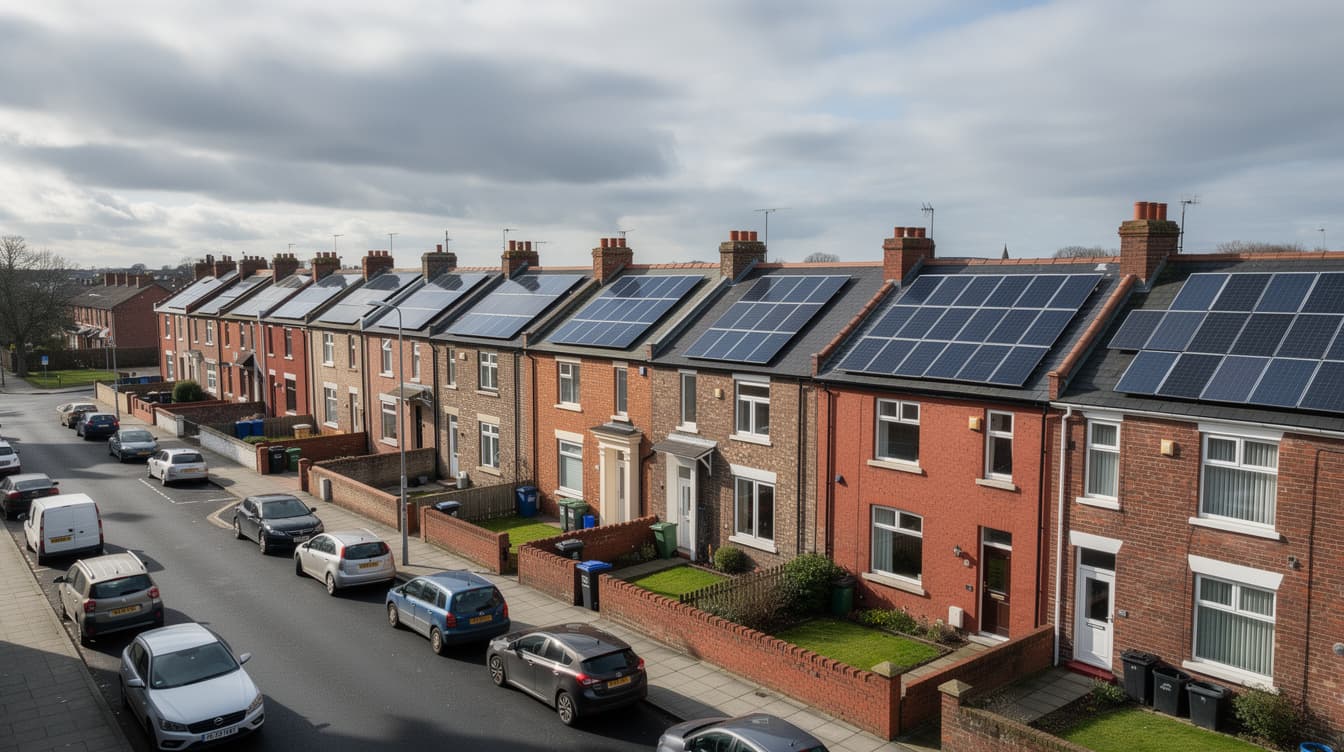
Solar Panels for Landlords Ireland 2026: BER Compliance, RPZ Reset & Tax Treatment
If you let a property in Ireland in 2026, the rules just changed twice in two months. From 1 March 2026 the rent-pressure-zone cap can be reset to market value on a tenancy break — but only if the property has been “substantially changed.” A jump of seven BER levels qualifies. And the Energy Performance of Buildings Directive, transposed into Irish law in May 2026, sets a hard floor: every let dwelling must hit BER D2 by end of 2026, C1 by end of 2028, and B2 by end of 2030. Properties below those grades come off the rental market.
For a landlord with a 1990s semi sitting at D1 or worse, solar PV is no longer an optional retrofit — it’s a piece in a much bigger compliance puzzle. This guide is what a portfolio of one or many lets actually needs to know about installing solar in 2026: what it costs, who pays, who keeps the export earnings, how the tax works, and where the new BER and RPZ rules collide.
Quick Answer: Are solar panels worth it for Irish landlords in 2026?
For most landlords, yes — but the maths is different from owner-occupiers. A typical 4 kW PV install on a let property costs €7,500–€9,500 after the €1,800 SEAI grant, drops the BER by 2–3 grades, and qualifies for both Revenue’s landlord retrofit deduction (up to €10,000 against rental income) and 12.5% capital allowances over 8 years. Where solar earns its keep isn’t the €200–€400 a year of CEG export — it’s passing the 2026/2028/2030 BER minimums and unlocking the post–1 March 2026 substantial-change rent reset.
Why the 2026 BER timeline changes everything for landlords
The Building Energy Rating (BER) Standards for Private Rented Accommodation Bill was published in 2025 and follows the EU’s Energy Performance of Buildings Directive (EPBD), which Ireland was required to transpose by 29 May 2026. The timeline below is what landlords actually need to plan for. Properties below the floor for each date cannot be advertised, registered with the RTB, or re-let.
| Deadline | Minimum BER for letting | What it means in practice |
|---|---|---|
| 31 December 2026 | D2 | Pre-2000 semis at D1, E1, F or G must be upgraded before next letting |
| 31 December 2028 | C1 | Roughly two-thirds of all Irish lets currently sit below C1 (Daft.ie 2025 rental BER study) |
| 31 December 2030 | B2 | Equivalent to the SEAI deep retrofit target. Pre-2010 builds will need fabric work, not just PV |
| From 1 March 2026 | BER on RTB tenancy registration | Landlords must record the current BER when registering a new tenancy with the RTB and reference comparable BERs when setting rent |
Solar PV alone won’t move a property from F to B2. But it’s one of the highest-impact single interventions per euro spent on the DEAP energy-rating calculation: a 4 kW system typically uplifts the BER by two to three grades on its own (e.g. D1 → C1, or C3 → B3), and the higher the existing rating, the bigger the marginal contribution PV makes versus extra insulation.
The substantial-change rent reset — the 7-BER-level rule
RPZ rules were extended to all of Ireland from 20 June 2025, then significantly reformed under the Residential Tenancies (Amendment) Act 2025. From 1 March 2026, tenancies created on or after that date can have rent reset to market value if the property has been “substantially changed” between tenancies. The substantial-change definition includes:
- A permanent extension increasing internal floor area by at least 25%, or
- A BER improvement of at least 7 grade levels (e.g. F → C2, or D1 → A3), or
- Three or more qualifying improvements (layout change, disability adaptation, room addition, or significant BER upgrade)
The 7-grade BER route is the relevant one for solar landlords. For a property currently at E1 or worse, a comprehensive retrofit — insulation, heating upgrade, glazing and PV — can credibly hit a B-grade and unlock the market reset on a future re-let. PV is rarely enough on its own (you need 7 grades), but it is almost always the cheapest of the four components per BER point earned, and it stacks well with a heat pump because both reduce the primary energy demand the DEAP calc penalises.
Important: The market reset only applies when a tenancy ends and a new one begins, and only if the change happened between those tenancies. If you upgrade mid-tenancy, the cap still applies until the tenancy ends. Plan the retrofit around tenant turnover.
What a typical landlord install actually costs in 2026
Below are real 2026 installer quotes for the three most common letting property types in Ireland. Prices include VAT (zero-rated on residential PV since May 2023), the €1,800 SEAI grant deducted, and standard scaffolding/work-at-height costs.
| Let property | PV size | Net cost | Expected BER uplift |
|---|---|---|---|
| 2-bed mid-terrace | 3.0 kW (7 panels) | €5,200–€6,800 | D2 → C2 (2 grades) |
| 3-bed semi | 4.0 kW (10 panels) | €7,500–€9,500 | D1 → C1 (2–3 grades) |
| 4-bed detached | 5.5 kW (13 panels) | €9,800–€12,500 | C3 → B3 (2–3 grades) |
| Add: 5 kWh battery | (any) | +€3,200–€4,500 | No DEAP uplift (yet) |
Note one important quirk: as of the 2026 DEAP version still in widespread use, batteries do not earn BER credit. The energy-rating calculation only counts panel output and self-consumption assumed by occupancy patterns. For a landlord whose primary motivation is BER compliance, a battery is a nice-to-have for the tenant but not a smart capital allocation.
The tax treatment landlords need to plan around
Solar PV on a let property triggers three separate Revenue treatments. Get any of them wrong and you either overpay tax or trigger a Revenue query.
1. The landlord retrofit deduction (the headline relief)
Introduced in Budget 2023 and extended to 31 December 2028, this is the most generous solar-relevant relief available to Irish landlords. The mechanics:
- Deduction available for retrofit expenditure incurred between 1 January 2023 and 31 December 2028
- You must have received an approved SEAI retrofitting grant for the works (Solar PV grant qualifies)
- Maximum deduction: lesser of €10,000 per premises or the qualifying expenditure net of the grant
- Capped at two premises per landlord per year (so €20,000 maximum)
- Claimed in the year the expenditure is incurred, against Case V rental income
The relief is unusual because it lets you deduct what is normally a capital expense (panels are clearly capital plant) as if it were a current-year repair. For a higher-rate-taxed landlord (40% + PRSI 4% + USC 8% = 52% marginal rate), a €9,000 PV net spend reduces tax by roughly €4,680 in the year of install. That is the single biggest reason solar pays back faster on a let than on an owner-occupied home.
2. Capital allowances (if you don’t use the retrofit deduction)
If you don’t claim the landlord retrofit deduction — for instance, if the work falls outside the SEAI grant window, or you already maxed out your two premises — solar PV qualifies as plant and machinery under section 284 TCA 1997. Capital allowances are claimed at 12.5% per annum over 8 years against Case V rental income. Same total deduction, spread over 8 years instead of one.
3. Grant netting (you can’t double-dip)
The portion of the install funded by the €1,800 SEAI grant cannot be deducted as either an expense or a capital allowance — you didn’t incur it. This is why every example in this article uses net cost. Get this wrong on a tax return and Revenue’s automated checks will flag it.
Letting a property and need solar quotes?
Get free quotes from SEAI-registered installers who handle landlord paperwork — grant application, BER assessor coordination, and compliance docs.
Who keeps the export earnings? The CEG and meter question
This is the question that trips up almost every first-time landlord PV install. The MPRN (the meter) is in the tenant’s name during their tenancy. So when the system exports surplus to the grid:
- The Clean Export Guarantee (CEG) payment is paid by the tenant’s electricity supplier into the tenant’s account, not yours
- The self-consumed electricity — the kWh the tenant uses on-site instead of importing — reduces the tenant’s bill, not yours
- You as landlord paid for the system but capture no direct financial benefit from its day-to-day output
This is not as bad as it sounds. The financial case for a landlord install rests almost entirely on (a) the BER compliance you now have, (b) the rental price you can charge for a higher-BER property, (c) the substantial-change rent reset on future tenancies, and (d) the retrofit tax deduction in the year of install. The day-to-day CEG income flows to the tenant, but a B-rated property in Dublin commands roughly €90–€140 more in monthly rent than the equivalent D-rated property (Daft.ie 2025 quarterly rental index, BER-controlled analysis). That alone covers the install in 5–7 years.
Two structural workarounds exist for landlords who want direct ownership of the export:
- Separate landlord MPRN: For multi-unit blocks or properties with detached outbuildings, the landlord can install a dedicated MPRN for common areas or a separate dwelling, and put the panels on that meter. Only practical for HMOs and small portfolios.
- Rent inclusive of electricity: Some landlords with PV-equipped lets opt for rent-inclusive-of-utilities, capture the CEG and self-consumption value, and price it back into the rent. This is rare for residential lets but common for serviced lets and short-stay accommodation.
The step-by-step install process for a let property
The mechanics differ from an owner-occupier install in three important ways — tenant notice, grant timing, and post-install BER recertification. Here’s the right sequence:
- Pre-install BER assessment. You need a current BER cert anyway to register the tenancy. Get the assessor to model the post-PV BER as a “what-if” before you install. This gives you the grade-uplift number to plan around the 2026/2028/2030 deadlines.
- SEAI grant application. Submit through the SEAI portal before the works begin. The €1,800 PV grant requires SEAI-registered installer and BER assessor sign-off. Don’t start work without grant approval — you forfeit the relief.
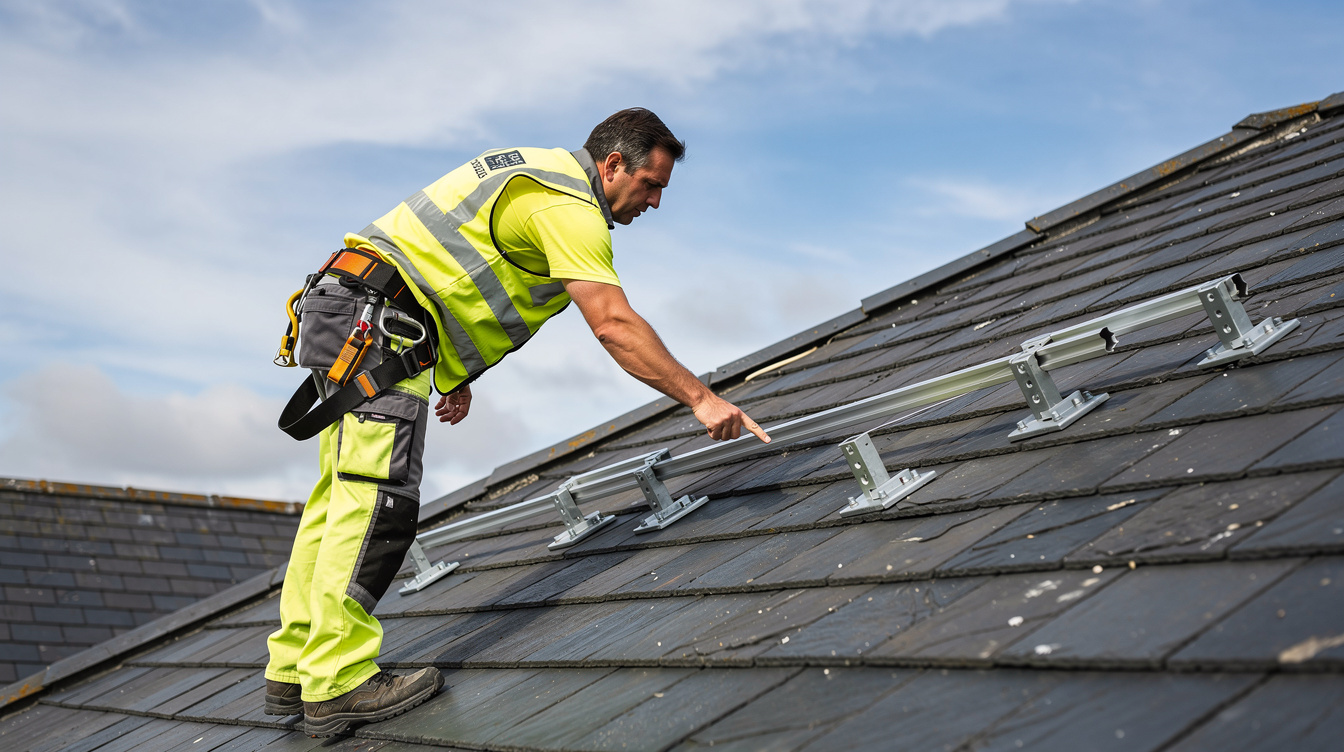
- Tenant notice. Give the tenant at least 4 weeks’ written notice of works. Solar PV install typically requires 2–3 days of roof access, scaffolding outside the property, and a single day of internal work to install the inverter and consumer unit cabling. The tenant doesn’t need to vacate, but expect reduced amenity for the install week.
- Installation. Use a Safe Electric–certified installer registered on the SEAI installer list. The installer files the NC6 form with ESB Networks to connect the system. As landlord, keep copies of the NC6, the SEAI grant approval, and all installer invoices — you need these for both the BER reassessment and the tax return.
- Post-install BER reassessment. Once the system is commissioned, book a fresh BER assessment. The new cert is what unlocks the higher-rate letting under the 2026 floor and (for tenancy turnover) the substantial-change reset.
- Tax return treatment. Claim the retrofit deduction (or capital allowances) on Form 11 for the year of install. Keep the net-of-grant figure on file in case Revenue queries.
Where solar fits in a wider retrofit strategy
For most landlord properties, PV is the second or third intervention in a sensible retrofit sequence, not the first. The order that maximises BER uplift per euro spent is roughly:
| Order | Intervention | Typical BER grade uplift | Typical net cost |
|---|---|---|---|
| 1 | Attic insulation (300mm) | 1–2 grades | €800–€1,400 |
| 2 | Cavity-wall insulation | 1–2 grades | €900–€1,800 |
| 3 | Solar PV (4 kW) | 2–3 grades | €7,500–€9,500 |
| 4 | Heating system upgrade (heat pump) | 2–3 grades | €9,000–€13,000 |
| 5 | Triple-glazing | 1 grade | €7,000–€12,000 |
Insulation comes first because it’s the cheapest BER uplift per euro and because solar PV produces less marginal benefit on a poorly-insulated house (the DEAP calc punishes high heat-demand homes regardless of how much electricity the PV produces). For landlords aiming for B2 by 2030, a sequenced approach — fabric in 2026, PV in 2027, heat pump in 2028–29 — spreads the cash outflow and lets each step earn its own retrofit deduction.
FAQ — landlord solar PV in Ireland 2026
Can my tenant refuse the install?
Probably not. The Residential Tenancies Acts give the landlord a right to enter and carry out works needed to comply with legal obligations — and from 2026, BER minimums are a legal obligation, not a choice. You still must give reasonable notice (4 weeks recommended), minimise disruption, and not increase the rent during the existing tenancy on account of the works (RPZ cap still applies mid-tenancy).
Will solar PV survive on the roof of a property I sell in 5 years?
Solar PV adds documented value at resale. The 2025 SCSI residential valuation guidance includes solar PV as a positive value-driver, and a B3-rated semi sells for roughly 6–9% more than a D-rated equivalent (CSO property price register 2025 BER-banded analysis). For landlords planning a future sale rather than long-term hold, PV plus the BER uplift usually adds more to sale price than the install cost — especially under the post-2030 B2 letting floor, where un-upgraded D-grade homes will be either un-lettable or sold at a deep discount.
Does the €1,800 SEAI grant work the same for landlords as owner-occupiers?
Yes, with one nuance: the property must have been built and occupied before 1 January 2021, and the SEAI grant for solar PV is limited to one per MPRN. You as landlord apply, but the BER assessor visits the let property to confirm pre- and post-works ratings. Tenant cooperation on access is essential.
What happens if my BER is already C1 today — do I need to upgrade?
You hit the 2026 D2 floor and the 2028 C1 floor automatically. You still need to plan for the 2030 B2 floor. C1 to B2 is a single-grade jump but requires a meaningful intervention — typically PV plus one fabric upgrade. Better to start in 2026 with the headline retrofit deduction live than to wait until late 2029 with limited installer availability.
Can I install solar PV on a HMO (multi-room let)?
Yes. The install logic is the same. The MPRN question becomes trickier in HMOs where there’s typically one MPRN for the whole property and rent includes utilities — in that case the landlord captures the CEG and self-consumption value directly. HMO landlords benefit most clearly from the cash flow side of PV, not just the BER compliance side.
Is it worth installing solar on a property I’m about to deregister from letting?
Almost never. The retrofit deduction requires the property to be a let property in the year of install and for three subsequent years. Deregister early and Revenue can claw back the relief.
Bottom line for landlords in 2026
Solar PV on a let property in 2026 is no longer about €200/year of export income. It’s about clearing the BER bar for letting, capturing the most generous landlord-specific tax deduction Revenue has ever offered for retrofit, and unlocking the substantial-change rent reset on tenancy turnover. The maths only fails if you treat it as a standalone investment. Treat it as part of the legally-required compliance trajectory to B2 by 2030 and it is the single best value step in the sequence.
Plan your landlord retrofit with real quotes
Compare prices from SEAI-registered installers experienced with letting properties. Free, no-pressure quotes — including BER projection.
This guide is informational and does not constitute legal, tax or financial advice. Verify all reliefs and limits with Revenue and the SEAI before applying. Tenancy law references are current as of June 2026.
Related Articles

BER Rating Calculator Ireland 2026: How to Estimate Your Home’s Energy Rating
Estimate your home's BER on the new 2026 A0-G scale, learn how DEAP calculates it, and see which upgrades lift the rating most in Ireland.
Selling a House With Solar Panels in Ireland 2026: BER Uplift, Buyer Docs & Contract Traps
Real 2026 data on the sale price boost from solar in Ireland, the exact docs your buyer's solicitor needs, SEAI grant transfer rules and PPA contract traps.
BER Rating Ireland 2026: Grade Scale, Cost & How Solar Lifts Your Score
Full BER rating Ireland 2026 guide: A1-G scale explained, assessment cost €150-€350, what assessors check, and how solar PV lifts your grade 1-2 bands.