
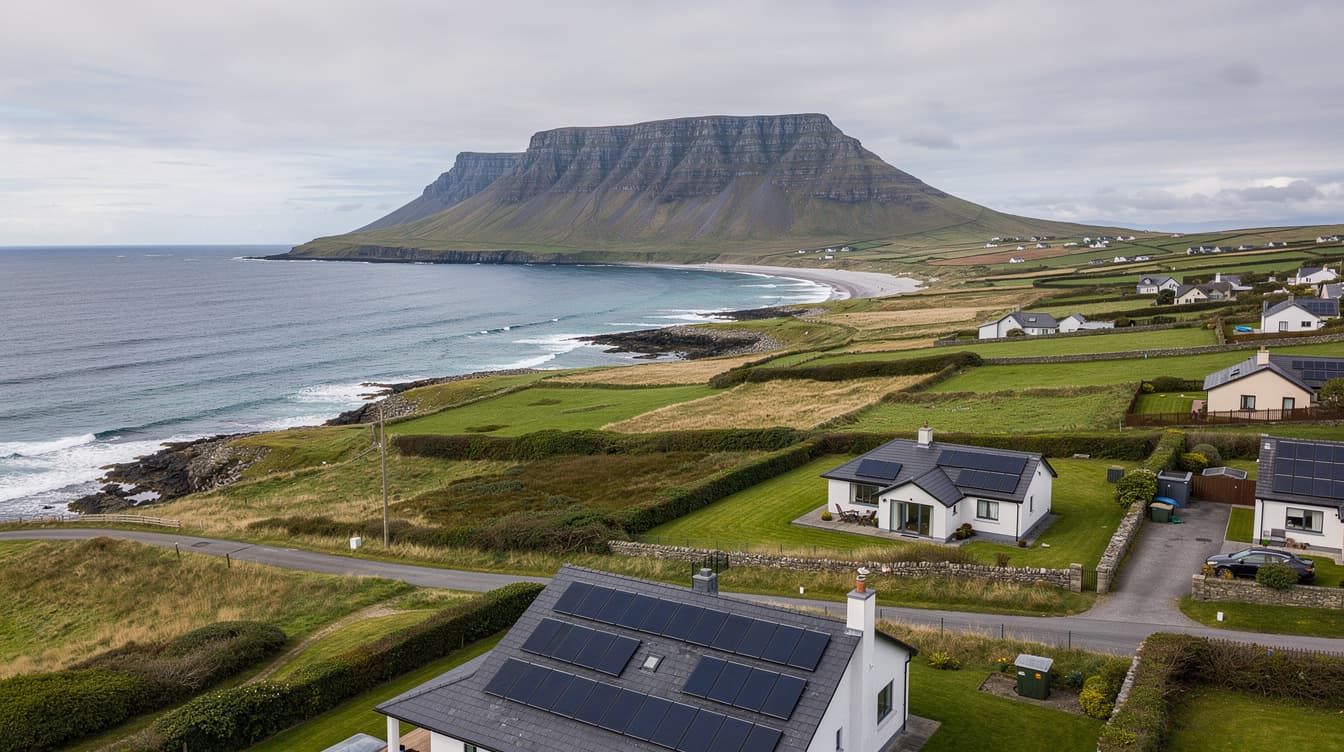
Solar Panels Sligo 2026: Costs, Grants, Atlantic Wind & Salt Considerations
If you live in Sligo and you've been told the west coast is a bad place for solar panels, you've been told something wrong. Sligo’s real yield sits around 925–940 kWh per kWp installed — not the very top of the Irish table (Wexford and Waterford own those rungs), but ahead of Donegal and in the same band as Galway and Mayo. The Atlantic cloud blanket is real, but so are the long June and July days, and a south-facing 4 kWp install on a Strandhill bungalow in 2026 should clear roughly 3,700 kWh a year. That’s about €1,300 of electricity at current grid prices — before you sell a single kWh back to the grid.
This is a Sligo-specific guide. We’ll cover what panels actually cost here in 2026, how the SEAI €1,800 grant interacts with the typical Sligo system size, the two things that make installs on the Wild Atlantic Way different from installs in the midlands (salt-spray corrosion and wind loading), how the planning rules apply to Sligo’s Architectural Conservation Areas, payback scenarios from five real Sligo locations, and what to ask any installer who quotes you.
Sligo solar yield in 2026 — what the numbers actually say
The SEAI’s own PVGIS dataset, which is what every qualified Irish installer should be modelling against, puts Sligo county in the 925–945 kWh/kWp band for a south-facing 30° pitched array with no shading. That’s the figure for a kilowatt-peak (kWp) of panel capacity. A typical 4-bed semi-detached install of 4.0–4.4 kWp will therefore generate between 3,700 and 4,150 kWh of electricity a year.
For context, here’s where Sligo sits against its near neighbours and the highest- and lowest-yield counties in Ireland:
| County | Typical Yield (kWh/kWp/yr) | Annual output of a 4 kWp system |
|---|---|---|
| Wexford | 980–1,000 | ~3,920–4,000 kWh |
| Waterford | 965–985 | ~3,860–3,940 kWh |
| Galway | 935–950 | ~3,740–3,800 kWh |
| Sligo | 925–945 | ~3,700–3,780 kWh |
| Mayo | 920–940 | ~3,680–3,760 kWh |
| Leitrim | 905–925 | ~3,620–3,700 kWh |
| Donegal | 895–920 | ~3,580–3,680 kWh |
The headline: Sligo is roughly 5–6% below Wexford for raw yield, and about 2–3% above Donegal. If anyone tells you Sligo isn’t worth doing solar in, they’re wrong by single-digit percentages. The west coast cloud cover takes a small bite; it doesn’t close the door.
The bigger driver of your actual return is how much of that generation you use yourself (vs. exporting to the grid at the Clean Export Guarantee tariff). Most Sligo households self-consume 28–38% of generation without a battery, climbing to 65–80% with a properly-sized 5 kWh battery and a timer-controlled immersion diverter heating the hot water tank during midday sun.
What solar costs in Sligo in 2026
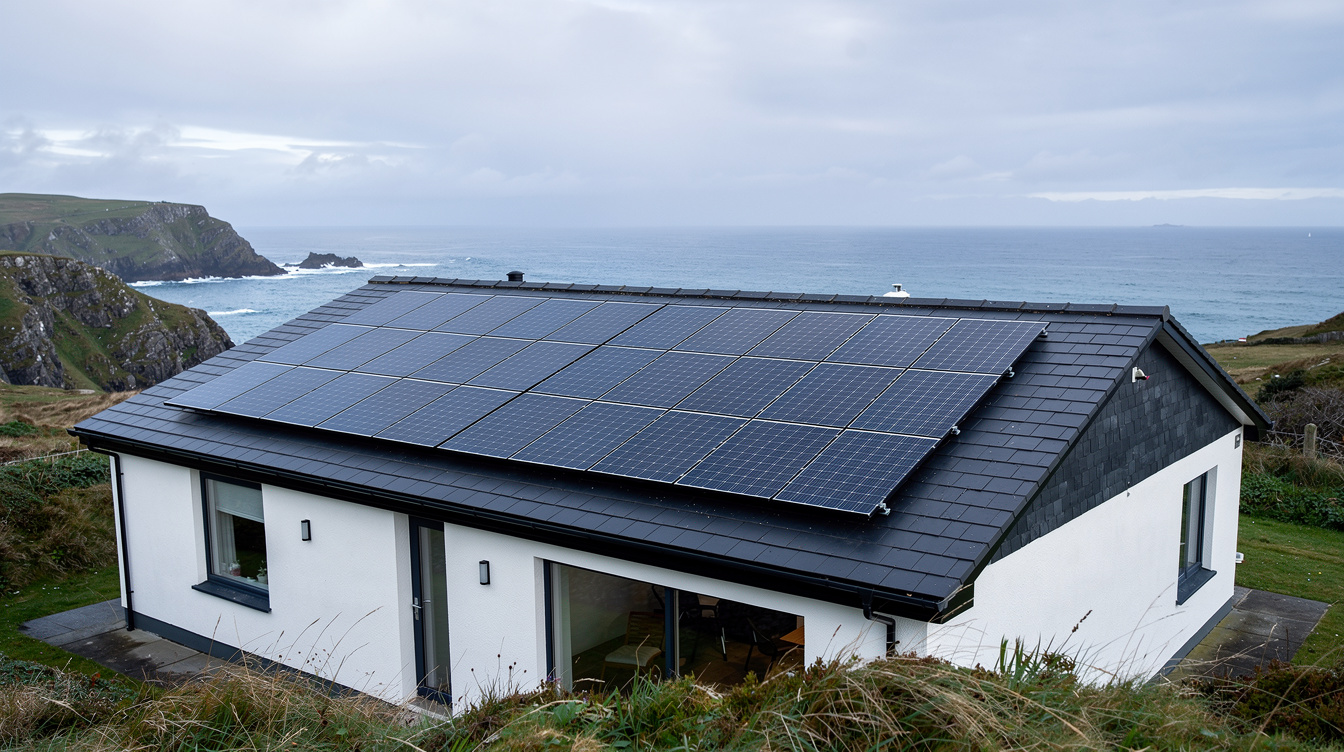
Sligo pricing is in line with the rest of Connacht. There’s no west-coast premium for standard pitched-roof installs — the biggest installers serving Sligo (a handful local, several that travel from Galway, Roscommon, and Mayo) compete on similar terms. Here’s what you should expect to pay in 2026, before and after the SEAI grant:
| System size | Typical Sligo price (fitted) | SEAI grant | Net cost to homeowner |
|---|---|---|---|
| 2.0 kWp (5 panels) | €5,200–€5,800 | €900 | €4,300–€4,900 |
| 3.0 kWp (7–8 panels) | €6,400–€7,200 | €1,350 | €5,050–€5,850 |
| 4.0–4.4 kWp (10–11 panels) | €7,600–€8,800 | €1,800 | €5,800–€7,000 |
| 6.0 kWp + 5 kWh battery | €11,800–€13,500 | €1,800 | €10,000–€11,700 |
| 8.0 kWp + 10 kWh battery | €15,500–€17,800 | €1,800 | €13,700–€16,000 |
The SEAI grant is €900 per kWp up to a maximum of €1,800 for systems of 2 kWp or larger. To qualify your home must have been built and occupied before 1 January 2021, you must be the homeowner, and the property must not have received a previous Solar PV grant at its MPRN. The grant amount is capped at €1,800 regardless of system size — bigger systems give better self-consumption economics but get the same grant ceiling.
Sligo — Get a Free Quote
Compare prices from SEAI-registered installers covering Sligo county.
The two things that make Sligo installs different: salt and wind
Most installer chat about Sligo is generic. The two things you actually need to know are about the coast:
Salt-spray corrosion
If your house is within roughly 2–3 km of the Atlantic — so Strandhill, Rosses Point, Enniscrone, Easkey, Mullaghmore, Streedagh, parts of Aughris Head — airborne sodium chloride is real and will eat substandard mounting hardware over a 25-year system life. The fix is straightforward but you have to specify it: ask your installer to confirm that all roof-mounted hardware is marine-grade stainless steel (A4/316), not the cheaper A2/304 grade that’s fine in the midlands but pits and corrodes near the sea. Aluminium rails are inherently corrosion-resistant. Panel frames should be anodised aluminium (all major brands are). For your inverter, install it indoors in a utility room or attic — not on an exterior wall facing the prevailing south-westerly wind, which carries salt mist inland for kilometres in a January storm.
Wind loading
Sligo coastal areas fall into Eurocode wind zone Zone 4 (the highest in Ireland). What this means in practice: your installer must use a higher density of roof anchors (typically every panel needs two clamps + at least one mid-rail bracket every 1.2 m of rail length, sometimes tighter) and the structural calculation needs to account for uplift pressures up to 1.6 kN/m² vs. 0.8–1.0 kN/m² in the midlands. A reputable installer will produce a wind-load calculation for your specific roof. If they wave it away with “we’ve done loads of these” without showing the maths, walk.
Inland Sligo (Ballymote, Tubbercurry, Riverstown, Coolaney, Collooney) gets wind zone 3 and standard A2/304 stainless is fine. No premium needed.
Planning — Sligo’s heritage areas and where Section 5 helps
The Solar Safeguarding Regulations (SI 2022/255 as amended by SI 2024/156) made the vast majority of domestic rooftop solar installs in Ireland exempt from planning permission. For Sligo specifically:
- Standard houses (post-1980 bungalows, semis, detached) outside any Architectural Conservation Area: no planning permission needed for any roof-mounted PV install, regardless of size, provided the panels don’t project more than 50 cm above the roof plane.
- Sligo town ACA: a relatively small ACA covering parts of Stephen Street, John Street, Old Market, and the area around Sligo Abbey. Rear-facing or hidden-from-street installs are usually fine. Front-facing installs on properties contributing to the ACA streetscape will likely need a Section 5 Declaration from Sligo County Council confirming exempted-development status — this is free, takes 4–6 weeks, and gives you written cover.
- Protected Structures (RPS): a small number of listed buildings (Drumcliffe, Lissadell, Markree, a handful in Sligo town). PV here requires planning permission. Most installers won’t even quote until you have that locked down. Realistically, ground-mount on a paddock is often the only viable path on a Protected Structure.
- Sligo Yeats Country area / Drumcliffe-Mullaghmore landscape character zone: scenic-amenity status doesn’t add planning conditions for standard rooftop PV, but if you’re considering ground-mount or pole-mount arrays visible from a designated scenic route (e.g. the R287 along Lough Gill, the N15 north of Drumcliffe), a Section 5 Declaration is the safe path.
If your installer doesn’t mention any of this and you live anywhere near Sligo town centre or in a heritage village, ask them directly whether they’ve checked the ACA boundary and the RPS. A two-minute lookup on Sligo County Council’s online planning map saves a lot of pain later.
Five Sligo payback scenarios
1. Strandhill couple, 4.2 kWp, no battery
Surfing-town two-bed bungalow, gas-only (no heat pump), both partners work from home 3 days/week. System: 4.2 kWp, marine-grade A4 stainless, no battery, immersion diverter heating hot water tank.
- Cost fitted: €8,200 — SEAI grant €1,800 — net €6,400
- Generation: ~3,860 kWh/year
- Self-consumption: ~36% (boosted by WFH + immersion) = 1,390 kWh @ €0.35 = €486
- Export: 2,470 kWh @ €0.18 CEG = €445
- Total saving: €931/year → payback 6.9 years
2. Tubbercurry dairy farm, 22 kWp + TAMS 3
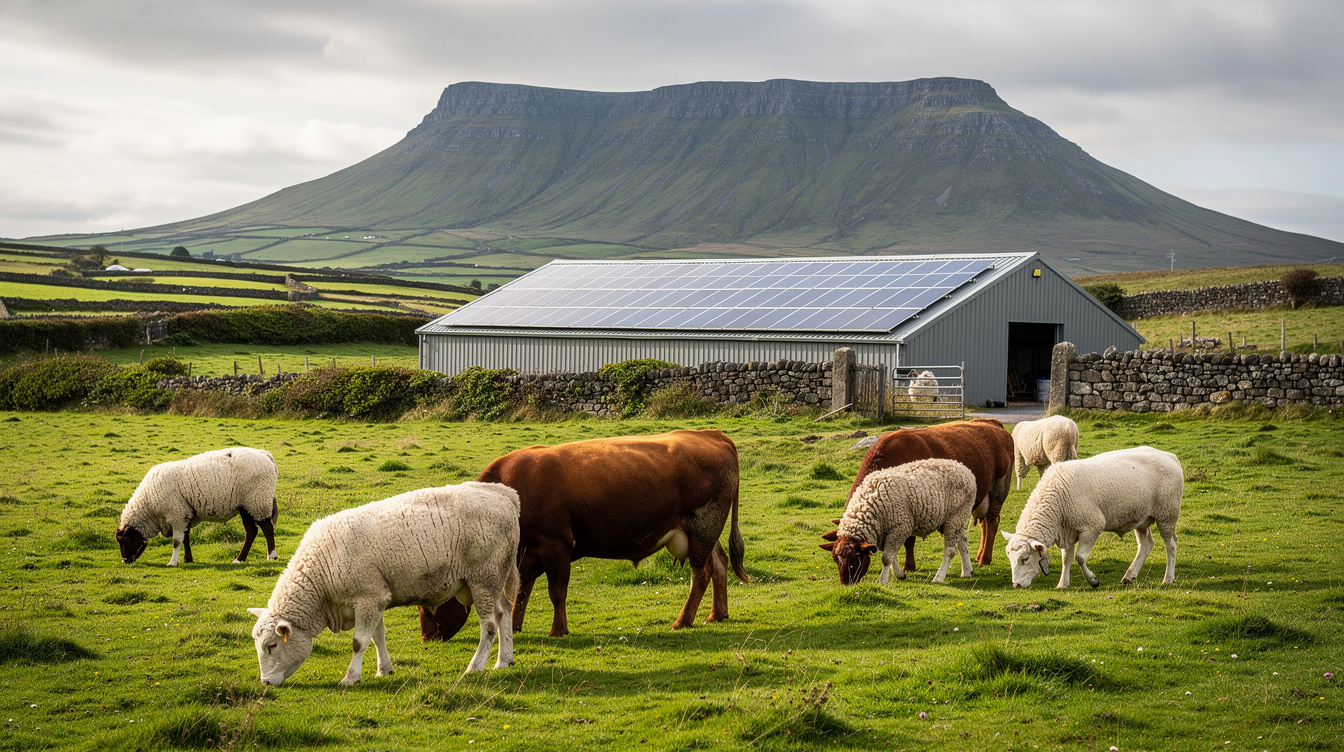
140-cow dairy farm with a bulk milk tank running mostly daytime. TAMS 3 Solar Capital Investment Scheme reimburses 60% of approved costs up to €90,000 of investment. System: 22 kWp on the milking parlour roof + cubicle shed roof.
- Gross cost: €34,500
- TAMS 3 grant: €20,700 (60%)
- Net cost: €13,800
- Generation: ~20,300 kWh/year
- Self-consumption: ~78% (bulk tank chilling + parlour vacuum pump match midday solar)
- Annual saving: ~€6,150 → payback 2.2 years
3. Rosses Point retired couple, 3.0 kWp + 5 kWh battery
Three-bed coastal bungalow, both home all day, modest electrical demand (~3,800 kWh/year). Battery added to soak up midday generation for evening TV/cooking.
- Cost fitted: €10,800 — SEAI grant €1,350 — net €9,450
- Generation: ~2,790 kWh/year
- Self-consumption with battery: ~74% = 2,065 kWh @ €0.35 = €723
- Export: 725 kWh @ €0.18 CEG = €131
- Total saving: €854/year → payback 11.1 years (the battery extends payback but cuts grid dependence dramatically)
4. Sligo town terraced house (inside ACA), 2.4 kWp on rear roof
Stephen Street area Victorian terrace inside the Sligo town ACA. Front roof visible from street — refused via Section 5. Rear-facing roof, hidden from public view, approved as exempt. Small system, west-facing.
- Cost fitted: €5,600 — SEAI grant €1,080 — net €4,520
- Generation: ~1,950 kWh/year (west orientation hits it ~15%)
- Self-consumption: ~42% = 820 kWh @ €0.35 = €287
- Export: 1,130 kWh @ €0.18 CEG = €203
- Total saving: €490/year → payback 9.2 years
5. Ballymote family + heat pump + EV, 7.8 kWp + 10 kWh battery
Inland location (no salt premium needed). New-build A-rated detached, heat pump for heating, EV charged at home mostly overnight. System sized to feed the heat pump in shoulder months and the EV via timer charging.
- Cost fitted: €16,400 — SEAI grant €1,800 — net €14,600
- Generation: ~7,250 kWh/year
- Self-consumption with battery + EV/heat pump load: ~82% = 5,945 kWh @ €0.35 = €2,081
- Export: 1,305 kWh @ €0.18 CEG = €235
- Total saving: €2,316/year → payback 6.3 years
Choosing an installer in Sligo
There are only a small handful of installers headquartered in County Sligo itself. Most installs come from companies based in Galway, Mayo, Roscommon, or the wider west region travelling in. That’s fine — the work is portable — but it does mean you should ask different questions than you would in Dublin.
Mandatory checks:
- SEAI registration. Search the public SEAI Registered Solar PV Companies list. If they’re not on it, you cannot claim the grant. End of conversation.
- Safe Electric (RECI/ECSSA) registration of the electrician doing the consumer unit work. Anything touching your fuseboard requires a registered electrician’s sign-off — this is Irish electrical law (SI 192/2018), not optional.
- Wind load calc. Ask: “Will you produce a wind-load calculation for my specific roof to the relevant Eurocode zone?” If they don’t know what you’re talking about, find someone else.
- Marine-grade hardware for coastal properties. Ask: “Will all roof-side hardware be A4/316 stainless?” If they say A2/304 or won’t commit, find someone else.
- Travel time / response time. If they’re a 90-minute drive away and your inverter throws a fault on a January Friday, how soon can they be on-site? Ask them flatly.
- Workmanship warranty. 10 years minimum for installation workmanship. Panels typically come with 25 years (output) + 12–15 (product). Inverters 10–12. Batteries 10.
- Written quote with kWp, brand, model, count. Verbal quotes are not quotes. Get the brand and model of the panel, inverter, and (if applicable) battery in writing.
Avoid: door-to-door cold callers, anyone who pressures you to sign on the first visit, anyone who quotes without a roof inspection, anyone offering a price “only good until Friday.” These are the signals of churn-and-burn operators that turn up across Connacht in late spring every year.
Sligo vs. neighbouring counties — should I cross the border?
Asked frequently in Sligo: should I bring in an installer from Galway or Mayo to save money? In 2026, prices are tight enough that the answer is almost always no — you save maybe €200–€400 on a typical 4 kWp install, and you lose convenient warranty callouts. Worth it for unusual systems (e.g. you can’t find a local installer who’ll quote on a Protected Structure, or for a 60 kWp commercial farm install where the price gap is €3,000+), not worth it for a standard pitched-roof domestic install.
| Comparing 4 kWp installs | Sligo | Mayo | Leitrim | Donegal |
|---|---|---|---|---|
| Typical price fitted | €8,200 | €8,000 | €7,900 | €8,400 |
| Annual generation | 3,720 kWh | 3,680 kWh | 3,640 kWh | 3,580 kWh |
| SEAI grant | €1,800 | €1,800 | €1,800 | €1,800 |
| Net cost after grant | €6,400 | €6,200 | €6,100 | €6,600 |
| Typical payback (no battery) | 6.9 yr | 6.8 yr | 6.8 yr | 7.4 yr |
The Atlantic question: is solar worth it on the west coast?
Short answer: yes. The Wexford-vs-Sligo yield gap is about 5–6%. The cost gap on a fitted install is essentially zero. The grant is identical. The CEG export tariff is identical. Net payback on a Sligo 4 kWp install is ~6.9 years vs ~6.4 years in Wexford — six months. Over 25 years of generation, that’s noise.
What actually matters more than your county is: roof orientation (south > SE/SW > E/W > N), roof pitch (25–40° optimal), shading from chimneys/trees/neighbouring buildings, how much electricity you use during daylight hours, and whether you can heat your hot water with surplus generation via an immersion diverter. Get those four right and Sligo solar is a 7-year-payback investment that runs another 18+ years for free.
Get Quoted by Sligo-Capable Installers
Free, no-obligation quotes from SEAI-registered companies working across Sligo and the wider west region.
Frequently asked questions
Is the Atlantic salt actually a problem in Sligo?
Yes, within about 2–3 km of the coast. The fix is marine-grade A4/316 stainless mounting hardware. You don’t need a different inverter or different panels — all major panel brands have anodised aluminium frames already — you just need the brackets and bolts on the roof to be the right grade. Cost difference vs. standard A2/304: roughly €120–€180 on a 4 kWp install. Cheap insurance.
Do I need planning permission for solar in Sligo?
For 95% of Sligo homes, no. The 2022/2024 Solar Safeguarding Regulations made domestic rooftop PV exempt regardless of size. The exceptions: Protected Structures (need planning), some properties inside Sligo town ACA where front-facing installs change the streetscape (Section 5 Declaration recommended), and ground-mount or pole-mount arrays larger than 25 m² in scenic-amenity zones.
What’s the cheapest way to do solar in Sligo?
2.0 kWp grid-tied with SEAI grant. Roughly €5,500 fitted minus €900 grant = €4,600 net. Generates ~1,850 kWh/year. Pays back around 8 years. Not the best ROI on a per-euro basis — that’s the 4–4.4 kWp size — but the lowest cash outlay if budget is tight.
Can I add a battery later or do I have to fit it on day one?
You can absolutely add a battery later. Choose a hybrid inverter on the original install (most decent installers do this by default in 2026) and you’re future-proofed. Adding the battery in year 3 or 4, once you’ve seen your real generation/consumption pattern, usually leads to better-sized choices than guessing on day one.
What about the Clean Export Guarantee — what will Sligo solar earn in exports?
The CEG export tariff in 2026 is paid by your electricity supplier and varies from €0.18/kWh (Bord Gáis, Energia, Pinergy at the upper end) down to €0.16/kWh at some suppliers. A typical Sligo 4 kWp system without a battery exports about 2,400 kWh/year, earning roughly €400–€432/year. Plus the first €400 of CEG income is tax-exempt under the 2024 Finance Act (extended through 2027).
Are there local Sligo solar grants on top of SEAI?
Not at present. Sligo County Council does not currently operate a top-up solar grant. The SEAI €1,800 PV grant is the headline support for households; TAMS 3 covers agricultural; the Non-Domestic Microgen Scheme covers SMEs up to 1,000 kWp.
The bottom line for Sligo
Sligo’s yield is 5–6% below the south-east leaders and roughly 2–3% above its northern neighbour Donegal. Pricing is in line with the rest of Connacht. The two genuine wrinkles — salt-spray hardware and Eurocode wind-zone-4 fixings on the coast — add maybe €200 to a quoted install and are non-negotiable for a 25-year system life. With the SEAI €1,800 grant, a typical 4 kWp install pays back in just under 7 years and runs nearly two more decades essentially free. If you’re a Sligo dairy farmer with TAMS 3 access, those numbers compress to roughly 2 years.
Compare three written quotes from SEAI-registered installers, confirm A4 stainless if you’re near the Atlantic, get the wind-load calc in writing, and ignore anyone telling you the west coast is too cloudy for solar.
Get Your Free Sligo Solar Quote
SEAI-registered, fully insured, marine-grade hardware available. Quote within 48 hours.
Related Articles
BER Rating Ireland 2026: Scale, Cost & How Solar PV Boosts Your Rating
A1 to G explained, 2026 BER assessment cost (€150–€280), how solar PV, heat pumps & insulation lift your rating, and 3 worked retrofit scenarios.
Solar Panel System Cost by Number of Panels Ireland 2026: 8, 12, 14, 20, 24 Panel Prices
What 8, 12, 14, 16, 20 or 24 solar panels actually cost in Ireland 2026 — net after €1,800 SEAI grant & 0% VAT, output kWh, roof area & battery add-ons.
Vacant Property Refurbishment Grant + Solar Ireland 2026: How to Stack €50k VPRG With €1,800 SEAI
Stack the €50,000 Vacant Property Refurbishment Grant with the €1,800 SEAI Solar PV grant in Ireland 2026 — real refurb numbers, timing, traps.