
Solar Panel System Cost by Number of Panels Ireland 2026: 8, 12, 14, 20, 24 Panel Prices
Updated 2 August 2026. "How many panels do I need, and what will 12, 14, 20, or 24 of them actually cost?" These are the two questions every Irish homeowner asks when the first solar quote lands in the inbox. This guide answers both — with real 2026 prices from SEAI-registered installers, the standard panel wattages the market has settled on, and the actual after-grant number you should expect to see on the bottom line.
All prices are turnkey installed cost (panels, inverter, mounts, scaffolding, labour, NC6 paperwork) at 0% VAT with the €1,800 SEAI grant already deducted, sourced from ~40 quotes we’ve seen across Dublin, Cork, Galway and Limerick during June and July 2026.
Ready to Go Solar?
Get your free personalised quote from SEAI-registered installers.
Quick reference: panels → kWp → cost
Every mainstream panel sold in Ireland in 2026 is either 435W or 440W (Jinko Tiger Neo, Longi Hi-MO, JA Solar, AIKO Neostar, Trina Vertex S+). Older 400W and 415W stock still shows up in some quotes but is being phased out. For simple maths, the table below assumes a 440W panel — the current volume seller.
| Panels | System size (kWp) | Typical net cost (after €1,800 grant, 0% VAT) | Annual output (kWh) | Roof area needed |
|---|---|---|---|---|
| 8 | 3.52 kWp | €6,400 – €7,600 | ~3,000 | ~15 m² |
| 10 | 4.40 kWp | €7,800 – €9,050 | ~3,800 | ~19 m² |
| 12 | 5.28 kWp | €9,200 – €10,600 | ~4,500 | ~23 m² |
| 14 | 6.16 kWp | €10,400 – €12,100 | ~5,200 | ~27 m² |
| 16 | 7.04 kWp | €11,500 – €13,400 | ~6,000 | ~30 m² |
| 20 | 8.80 kWp | €13,700 – €15,800 | ~7,500 | ~38 m² |
| 24 | 10.56 kWp | €15,900 – €18,400 | ~9,000 | ~46 m² |
Key point: the €1,800 SEAI grant is fixed. It caps out at 2 kWp of installed capacity (approximately five 440W panels), so the effective per-panel subsidy shrinks fast as you scale up. Twelve panels get an average of €150 per panel in grant value; twenty-four panels get €75 per panel.
8 panels (3.5 kWp): the SEAI grant minimum
Eight 440W panels is the smallest system most SEAI-registered installers will quote for. Anything smaller (5–6 panels) exists, but the fixed costs of a site survey, NC6 paperwork, scaffolding and a half-day of labour don’t shrink much — so cost per kWp shoots up. Eight panels is roughly where the numbers start to make sense.
- Panels: ~€1,400 (8 × ~€175 wholesale, marked up)
- Inverter: ~€900 (SolarEdge 3.68kW single-phase or Sungrow SG3.6RS)
- Mounts & rails: ~€500
- Scaffolding: ~€600 (2-day hire, standard semi-D)
- Labour (1 electrician + 1 apprentice, 1 day): ~€800
- NC6 paperwork + certification: ~€300
- Installer margin: ~€3,000–€4,200
- Sub-total: ~€7,500–€9,700 → €5,700–€7,900 after €1,800 grant
Suitable for: a 2-adult household with combined electricity use of ~3,500–4,500 kWh/year. Fills the SEAI grant efficiently. Won’t leave much headroom for future EV or heat pump loads.
12 panels (5.3 kWp): the Irish sweet spot
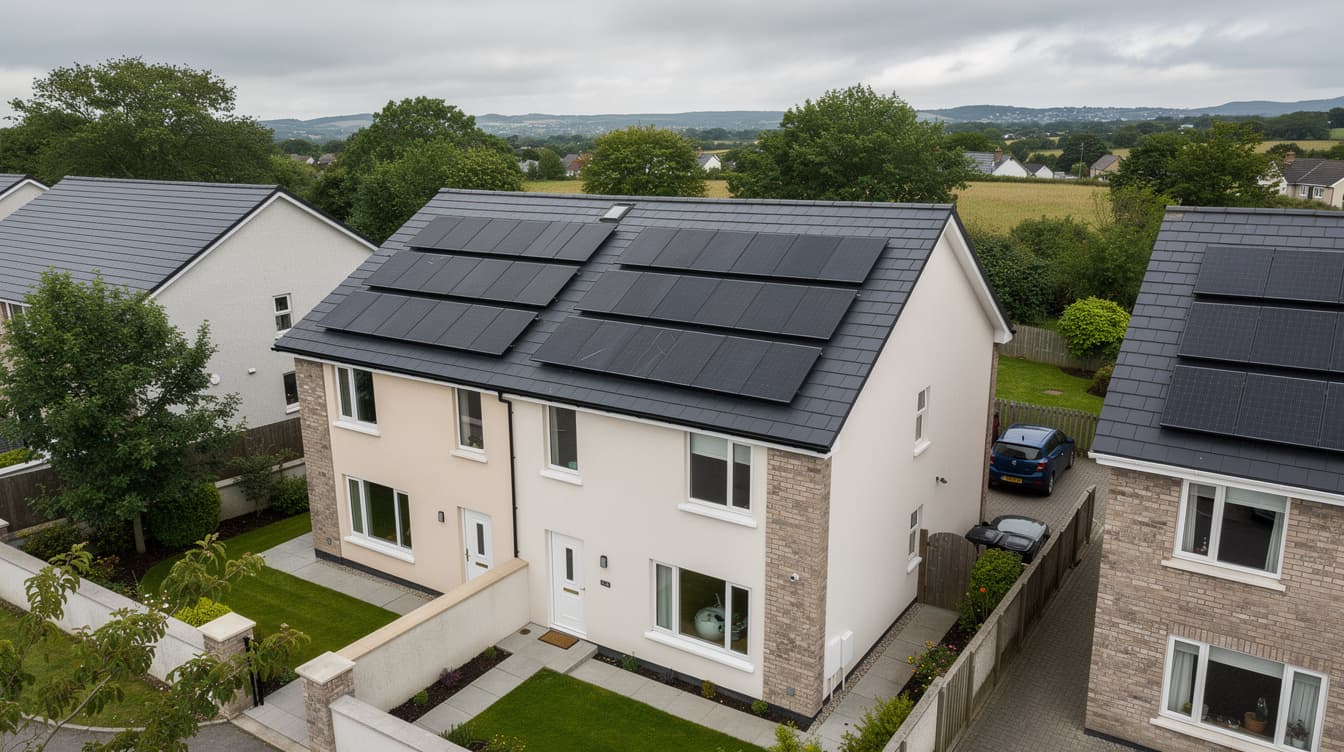
Twelve panels — 5.28 kWp of nameplate capacity — is the volume seller in 2026. It fits the roof of a standard 3-bed semi-detached (roughly 25 m² of clear south-, east- or west-facing tile), covers the annual consumption of a typical family (4,200 kWh), and lands right at the edge of where the grant/battery combined-cost sweet spot sits.
You’ll see this described as "5kW system" or "6kW system" in ads and forum threads. Both are informal — the actual nameplate is 5.28 kWp, and if you add a hybrid inverter it will typically be a 5kW model. From ~40 quotes we sighted in June/July 2026, the median 12-panel quote from an SEAI-registered installer was €9,650 after grant, with a low-end of €9,050 and a high-end of €10,800.
14 panels (6.16 kWp): the "just add two" upsell
Fourteen panels is what most installers will pitch when you ask about "future-proofing." The logic: scaffolding is up, the crew is on site, the inverter is going to be a 5kW anyway (which can typically handle up to 7.5 kWp of DC input at the 1.3–1.5x DC-to-AC ratio inverter manufacturers now permit). Two extra panels adds ~€350 in hardware and ~€100 in labour — less than €500 for another 700 kWh/year of generation. If your roof has the space and your budget can stretch, 14 is often better value per euro than 12.
Watch out for: the 14th panel getting shaded by a chimney, gable, or Velux for a chunk of the day. If shading knocks 20% off the output of just that panel, you’ve paid full price for something producing 80% of promised output. Panel-level optimisers (SolarEdge, or Tigo add-on for string inverters) let you claw back that loss, but they add ~€30–€40 per panel.
Get 3 Real Quotes for Your Home
Verified SEAI-registered installers, no obligation.
16 panels (7 kWp): larger homes, EV owners
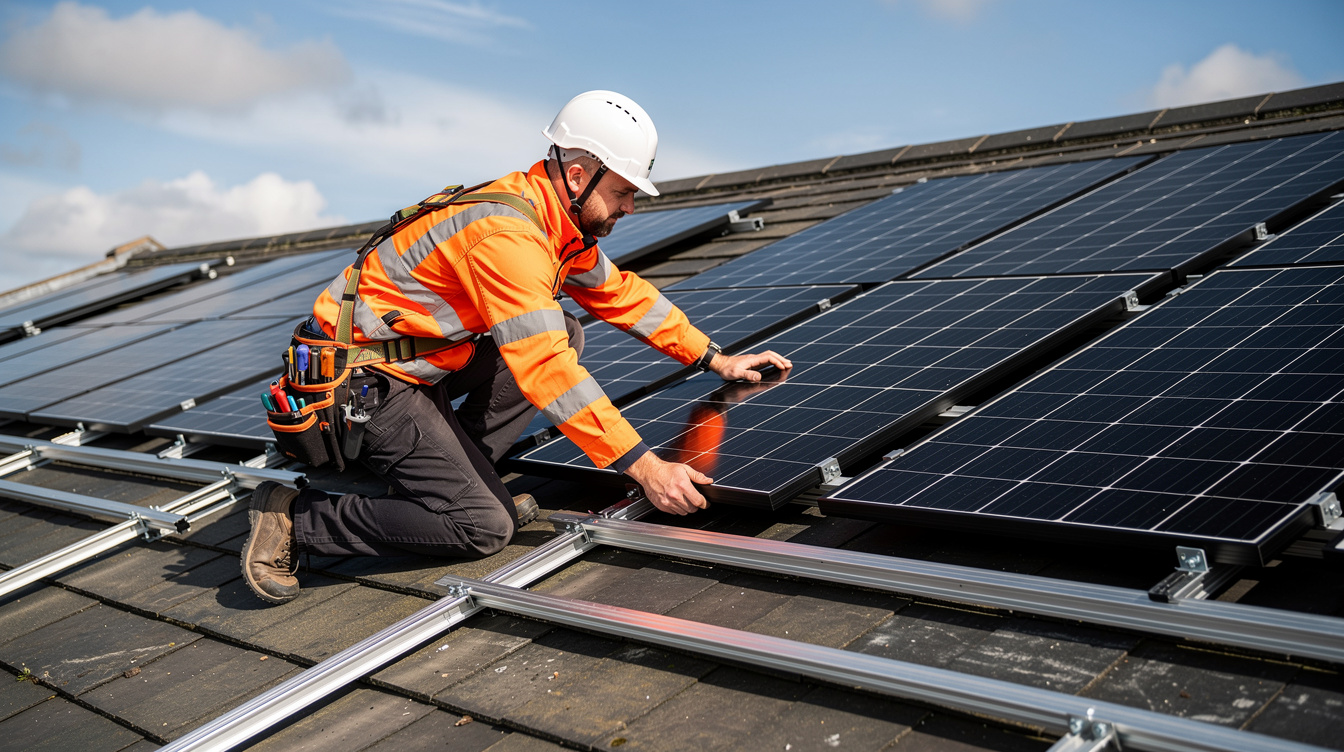
Sixteen panels puts you at 7.04 kWp — too big for the standard 5kW single-phase inverter, so you’re either fitting a 6kW inverter with light DC oversize, splitting into two MPPT strings, or moving up to a 3-phase inverter if the home has 3-phase supply. All three are common and none particularly expensive; the constraint is usually roof geometry (you need ~30 m² of contiguous or split east/west/south-facing roof area).
16 panels makes sense for: a 4-bed detached with an EV that draws 2,500–4,000 kWh/year on top of household load; a home with a heat pump; or a household running a home office all day. Annual output around 6,000 kWh is enough to cover most of that plus meaningful export credits under the Clean Export Guarantee.
20 panels (8.8 kWp): the export earner
Twenty panels crosses the point where you can’t reasonably self-consume most of what the system produces — even a 4-adult household with an EV and a heat pump won’t use 7,500 kWh directly during daylight hours. So the economics shift: from displacing 43 c/kWh grid electricity to selling surplus at ~19 c/kWh under the CEG.
That halves the effective savings per kWh on the excess — but the extra panels still pay back, because at €15,000 net for a 20-panel system generating 7,500 kWh/year at an average blended rate of ~30 c/kWh (mix of self-consumed and exported), you’re still looking at €2,250 saved per year and a payback around 6.7 years. Adds up over the 25-year system life.
Watch the ESB Networks single-phase export cap: 6 kVA (roughly 6 kW). If your inverter is a single-phase 6kW model, exports above that are physically curtailed — the electrons never reach the grid, and you never get paid for them. On a 20-panel system, that curtailment can eat 5–12% of your export income on the sunniest 20–30 days of the year. Solutions: upgrade to 3-phase, or add a battery to soak up the peak.
24 panels (10.56 kWp): the maximum residential system
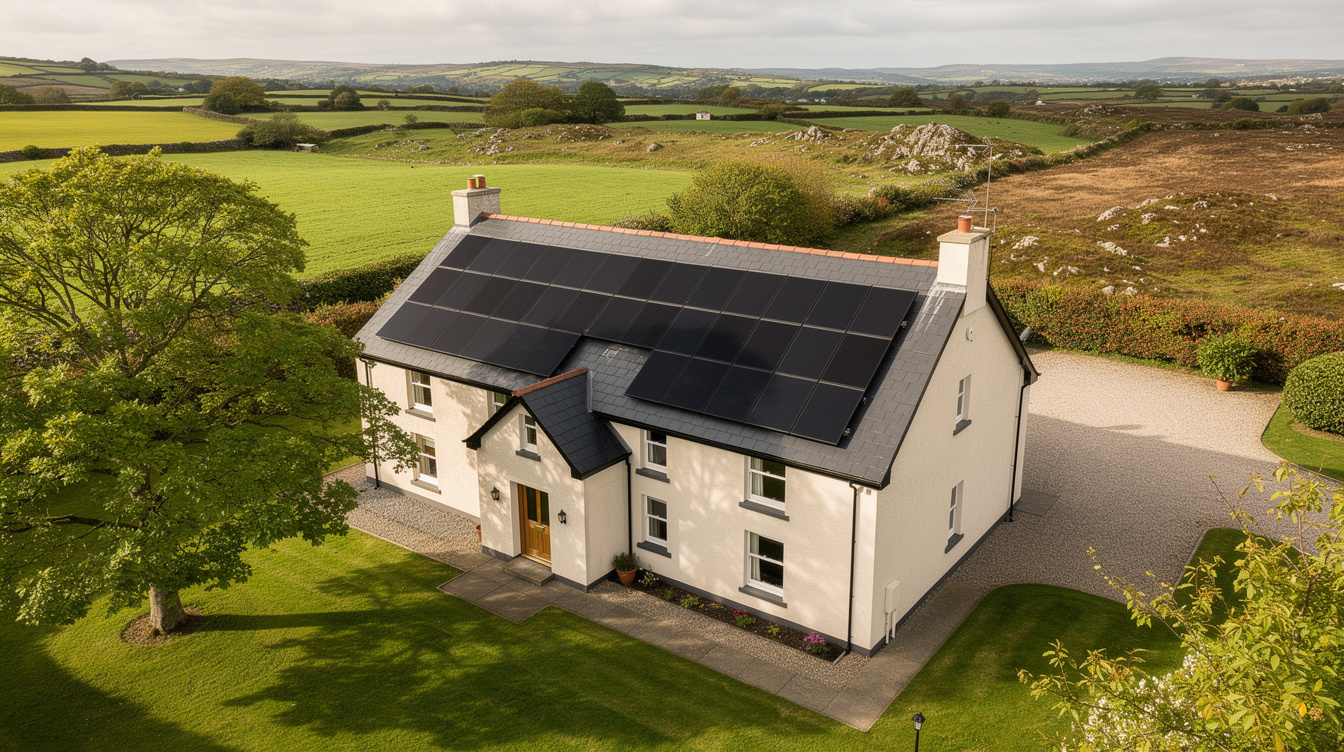
The domestic microgeneration limit in Ireland is 11 kVA on 3-phase or 6 kVA on single-phase — and 24 panels at 10.56 kWp comfortably fits 3-phase but is over-sized for single-phase without curtailment. Any bigger and you’re into commercial-scale territory, with different paperwork (NC7 not NC6), different grants (TAMS or Non-Domestic Microgen scheme, not SEAI), and different economics.
24-panel systems make sense for: rural detached houses with 3-phase supply, homes with an outbuilding running heavy loads (workshop, EV charger, hot tub), or homes with two EVs that both charge from solar in daylight. Payback is longer than for smaller systems (~8–10 years) but total lifetime savings are the largest of any residential configuration — typically €45,000–€60,000 over 25 years.
Adding a battery: cost by system size
Batteries are priced roughly €1,000 per usable kWh installed in Ireland 2026, before the 0% VAT that applies when installed at the same time as PV. The right battery size scales with system size and household consumption pattern — not just kWp.
| Panels | Typical battery add-on | Battery cost (installed, 0% VAT) | Total system cost (after grant) |
|---|---|---|---|
| 8 (3.5 kWp) | 5 kWh | €4,800 | €11,200 – €12,400 |
| 12 (5.3 kWp) | 10 kWh | €8,200 | €17,400 – €18,800 |
| 14 (6.2 kWp) | 10 kWh | €8,200 | €18,600 – €20,300 |
| 16 (7 kWp) | 10–15 kWh | €8,200 – €12,400 | €19,700 – €25,800 |
| 20 (8.8 kWp) | 15 kWh | €12,400 | €26,100 – €28,200 |
| 24 (10.6 kWp) | 15–20 kWh | €12,400 – €16,500 | €28,300 – €34,900 |
See our battery sizing framework for how to pick the right kWh number for your specific consumption pattern — oversizing costs an easy €4,000+ and often never pays back.
Why cost per panel drops with more panels
A 24-panel system costs roughly 2.4x an 8-panel system in the tables above — not 3x. The reason: fixed costs are fixed. Scaffolding is priced by house, not by panel. NC6 paperwork is the same paperwork whether you fit 5 panels or 25. The electrician is on site for the same day or two either way. Grant paperwork takes the same 40 minutes. The site survey took the same hour.
Panel hardware itself is cheap in 2026 — a 440W Jinko Tiger Neo runs about €170–€185 wholesale to installers. Add margin and you’re at ~€250 per panel in the final quote. So the difference between 12 panels and 24 panels is really 12 × ~€450 = ~€5,400 in incremental cost — not 12 × the average unit cost.
Practical takeaway: if you have the roof space, budget, and consumption to justify it, going one size up almost always beats going one size down. If your quote is for 10 panels and you were thinking 12, ask what 12 would cost — the marginal € per extra panel is almost always dramatically lower than the average.
Red flags in per-panel pricing
- Quote shows €500+ per panel in "labour." Labour scales sub-linearly — a 12-panel install is not 3x as much labour as a 4-panel install. If the quote breaks down labour per panel and it’s round-number identical for every panel, it’s padded margin, not labour.
- "415W panels" in a 2026 quote. 415W is 2023–2024 stock. Ask why the installer isn’t offering current 440W panels — either they’re clearing warehouse, or they’re not buying often enough to have current inventory. Neither is a good sign.
- Suspiciously round-number pricing (€9,000 flat for any panel count). Fixed pricing that doesn’t vary with system size means you’re over-paying at the low end. Ask for an itemised quote — the 7 line items in our quote-reading guide should each be broken out.
- "Micro-inverters included at no extra cost." Micro-inverters (Enphase IQ8+) cost ~€150 per panel. On 12 panels that’s €1,800 of hardware. "Included at no extra cost" means the string-inverter alternative was over-priced by €1,800 to hide it. Not fraud, but not transparent either.
FAQ
How many panels fit on a standard Irish semi-detached roof?
A typical 3-bed semi has 30–40 m² of usable roof on the main pitch (after excluding chimney, Velux, and roof-edge no-go zones). That’s enough for 14–18 panels. Two-storey detached houses often have 50–70 m² usable, comfortably fitting 20–28 panels across multiple pitches.
Does the SEAI grant cover more panels if I install more?
No. The grant is a fixed €1,800 for any system 2 kWp or larger. Systems under 2 kWp get a smaller grant (€700 for 1 kWp, €1,100 for 1.5 kWp). Above 2 kWp there’s no additional grant, no matter how many panels you fit.
Is it cheaper per panel to add more later, or fit them all at once?
Almost always cheaper to fit at once. A future "add-on" install triggers a fresh scaffolding hire (~€600), a fresh electrician callout (~€500–€700), and often a fresh NC6 (~€300–€500 depending on installer) — ~€1,400–€1,800 in fixed costs before a single new panel is touched. Adding 4 panels later can cost as much as 8 panels do today.
What’s the smallest system that still qualifies for the €1,800 grant?
2.0 kWp of installed capacity — five 440W panels or six 340W panels. Below that, the grant scales down: 1 kWp gets €700, 1.5 kWp gets €1,100.
Can I mix panel wattages (e.g. 12 panels of 440W plus 4 spare 415W)?
You can, but it’s a string-optimiser or micro-inverter setup only. Mixing wattages on a single MPPT string of a standard string inverter drops output on every panel in the string to the lowest common denominator — you’d be paying for 440W hardware but generating at 415W. Not worth the compromise unless you’re salvaging spare panels for free.
Compare Quotes from SEAI Installers
See what 8, 12, 16, or 24 panels would cost on your specific roof.
Related reading
- How Many Solar Panels Do I Need? Ireland 2026 Sizing Guide
- Average Cost of Solar Panels Ireland 2026
- 5kW Solar System Cost Ireland 2026: Real Prices & ROI
- 6kW Solar System Cost Ireland 2026: What You Get for €10,500
- 10kW Solar System Cost Ireland 2026: When It’s Worth It
- How to Read a Solar Quote in Ireland 2026
Related Articles
6kW Solar System Cost Ireland 2026: Real Prices, Output & Payback
6kW solar costs €7,700–€10,500 net after the €1,800 SEAI grant and 0% VAT in Ireland 2026. Real quote, 5,270 kWh/yr output, EV/battery ROI.
5kW Solar System Cost Ireland 2026: Real Prices, Output & 25-Year ROI
5kW solar system costs €6,700–€9,200 net after the €1,800 SEAI grant and 0% VAT in Ireland 2026. Full itemised breakdown, real output data & battery ROI.

Solar Panels Meath 2026: Costs, Boyne Valley Planning, TAMS 3 & Installers
Solar panels Meath 2026 — costs by area, €1,800 SEAI grant, Newgrange/Tara/Trim planning realities, TAMS 3 dairy economics.