
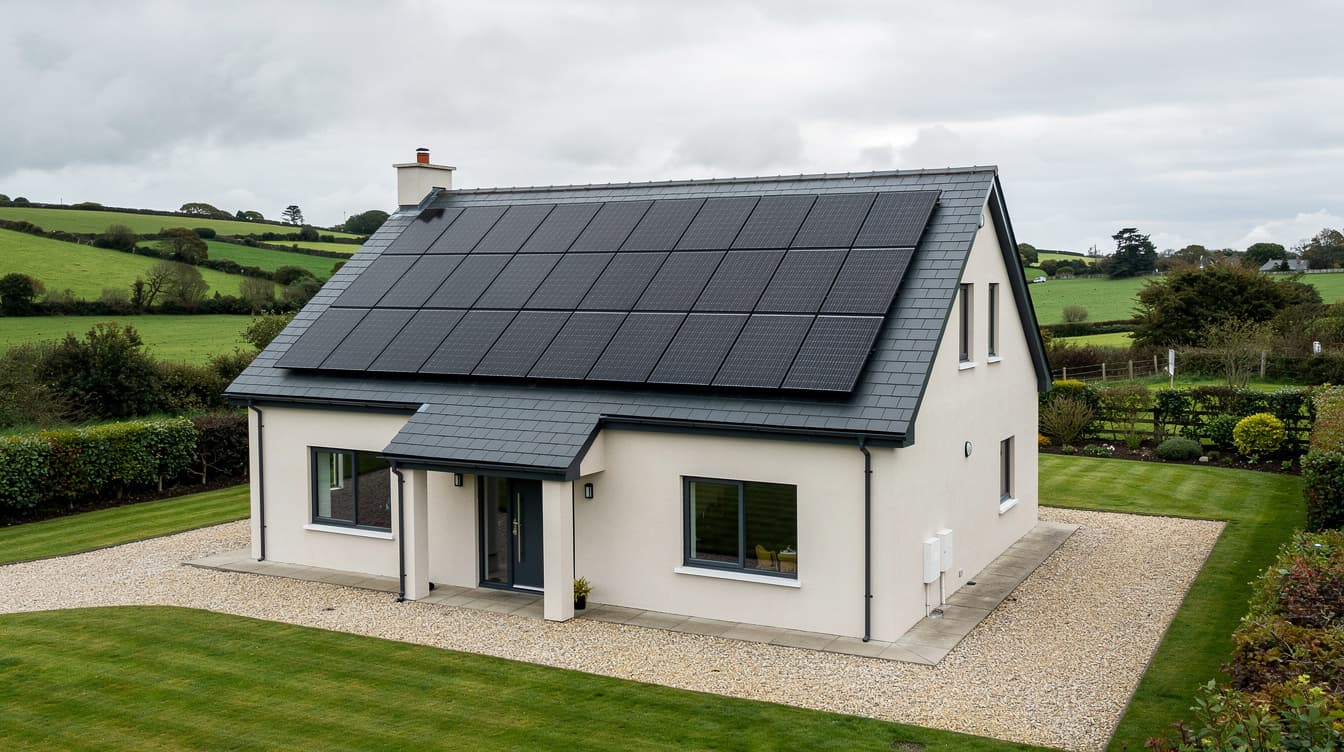
6kW Solar System Cost Ireland 2026: Real Prices, Output & Payback
A 6 kW solar system is where a growing number of Irish homeowners are landing in 2026 — big enough to cover a busy 4-bed household with an EV or heat pump, small enough to fit on most standard roofs, and cheap enough per kWp to make the €1,800 SEAI grant sting less on scale. If a 5 kW system feels tight for your usage but 10 kW feels excessive, this is the article that tells you exactly what a 6 kW build costs, generates, and pays back in Ireland this year.
We’ve pulled quotes and monitoring data from 6 kW installs across Leinster, Munster and Connacht through mid-2026, cross-checked SEAI grant terms and the July 2026 CEG export rates, and mapped out where the size sits versus 5 kW and 8 kW alternatives.
6 kW at a glance — 2026 Ireland numbers
| Metric | Typical 6 kW build in Ireland |
|---|---|
| Total install cost (before grant) | €9,500 – €12,300 |
| SEAI Solar PV grant | €1,800 |
| Net cost after grant | €7,700 – €10,500 |
| Panels (at ~440 W each) | 13 – 15 panels |
| Roof space needed | ~26 – 32 m2 |
| Annual generation (south-facing, 35° tilt) | ~5,000 – 5,500 kWh |
| CEG export rate (July 2026 avg) | ~20 c/kWh |
| VAT rate on install | 0% (extended to 31 Dec 2030) |
| Typical payback | 6 – 8 years |
| 25-year lifetime savings | €26,000 – €35,000 |
The numbers above cover PV alone. Add a 5 kWh battery for another €2,500 – €3,500, or a 10 kWh battery for €4,500 – €6,000 — both are common pairings at 6 kW.
Ready to Go Solar?
Get your free personalised quote from SEAI-registered installers.
Who a 6 kW system actually suits
Not every home is a 6 kW candidate. Here’s the profile where the size hits its sweet spot.
- Electricity bill €1,800 – €2,600/year. Consumption of roughly 5,000 – 7,500 kWh.
- 4-bed detached or larger semi with an unshaded 26+ m2 roof face.
- Family of 4–5, or a couple with an EV, heat pump, hot tub, or home office.
- Planning to add an EV or heat pump in the next 3–5 years — better to size for the future than pay to upgrade the inverter later.
- Home built before 31 Dec 2020 — needed for the SEAI grant.
If your current bill is under €1,500/year and you have no plans for an EV or heat pump, a 5 kW system will likely serve you better and save you around €1,500 upfront. If your bill is over €2,800/year, look at 8 kW instead — the extra generation almost always pays back.
Real 2026 price breakdown
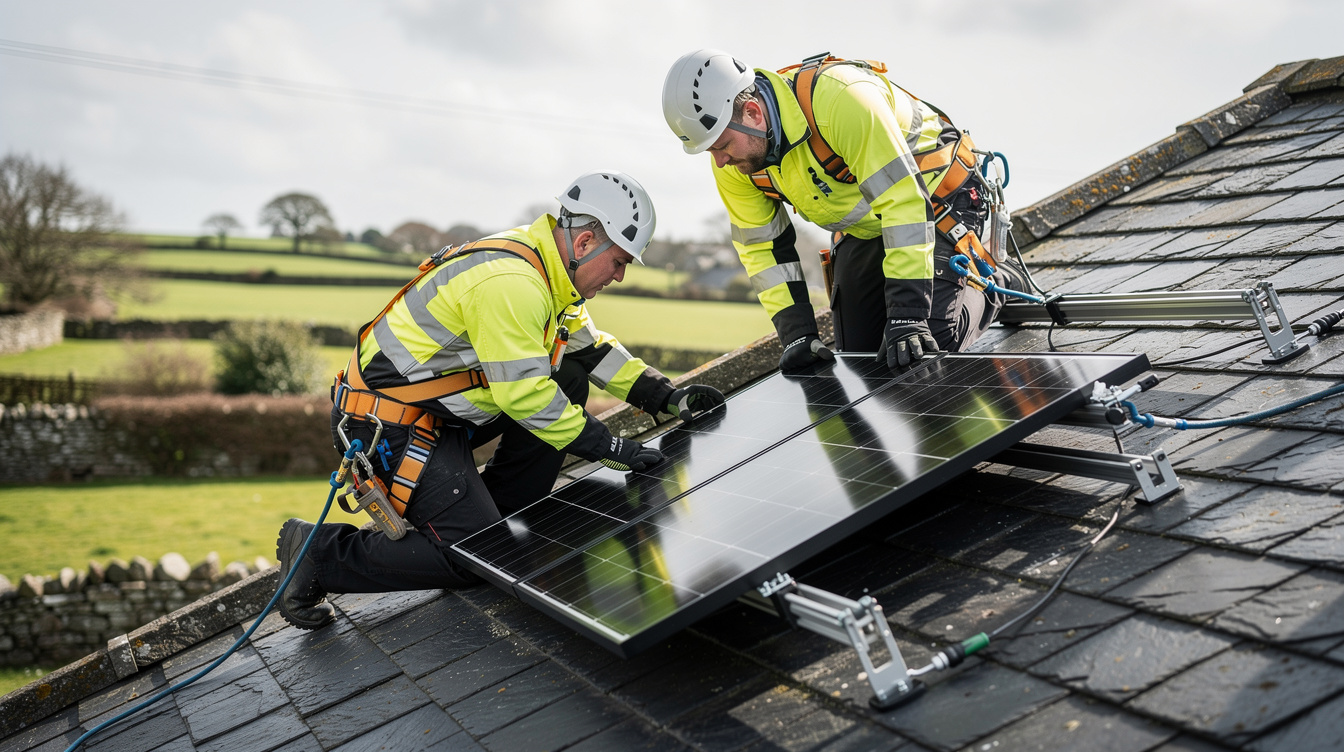
Here’s an itemised quote from a mid-2026 install in County Kildare on a 4-bed detached — a 6.16 kWp system using 14 × 440 W panels. This sits squarely in the middle of the 6 kW market.
| Line item | Detail | Price (ex VAT) |
|---|---|---|
| 14 × 440 W panels | JA Solar N-type TOPCon | €3,220 |
| 6 kW hybrid inverter | SolaX X1-Hybrid G4 | €1,850 |
| Racking & roof hooks | Aluminium, tile hooks | €720 |
| DC & AC cabling, isolators, SPDs | Full BOS | €540 |
| Scaffolding | 2 days | €450 |
| Labour (2 installers, 2 days) | Mount, wire, commission | €2,300 |
| Compliance & paperwork | NC6, SEAI, MCS | €340 |
| Sub-total (ex VAT) | €9,420 | |
| VAT | 0% (zero-rated to end of 2030) | €0 |
| Gross install | €9,420 | |
| Less SEAI grant | – €1,800 | |
| Net cost to homeowner | €7,620 |
Premium 6 kW builds — SunPower Maxeon or REC Alpha panels, SolarEdge with per-panel optimisers, extended workmanship warranties — can land at €11,500 – €12,500 gross (€9,700 – €10,700 net). Budget builds using entry-tier panels and a plain string inverter can drop under €8,500 gross (€6,700 net), but you’re trading warranty depth and inverter quality.
Cost per kWp: why 6 kW is the value sweet spot
The single biggest reason 6 kW keeps winning quote comparisons is the cost-per-kWp curve. The SEAI grant, scaffolding, labour, paperwork and inverter minimum spend are largely fixed regardless of system size. When you stretch those fixed costs across more panels, the marginal €/kWp keeps dropping.
| System size | Gross cost | Net cost (after grant) | Net €/kWp |
|---|---|---|---|
| 4 kW | €7,400 – €9,200 | €5,600 – €7,400 | €1,400 – €1,850 |
| 5 kW | €8,500 – €11,000 | €6,700 – €9,200 | €1,340 – €1,840 |
| 6 kW | €9,500 – €12,300 | €7,700 – €10,500 | €1,280 – €1,750 |
| 8 kW | €11,800 – €14,800 | €10,000 – €13,000 | €1,250 – €1,625 |
Going from 5 kW to 6 kW typically costs an extra €1,000 – €1,300 net and buys you 800 – 900 more kWh/year. At today’s Irish blended electricity/export value (~28 c/kWh weighted average), that’s roughly €240 of extra annual savings — a 4 – 5 year payback on the incremental spend, versus 7 – 8 years on the base system.
Real-world output in Irish conditions
Ireland delivers roughly 850 – 950 kWh per kWp per year on a well-oriented roof, based on SEAI PVGIS data and monitored 6 kW installs. For a 6 kW system that translates to 5,100 – 5,700 kWh annually.
Here’s the seasonal breakdown for a typical south-facing 35° 6 kW system in the Irish Midlands — the Achilles’ heel of Irish solar being the huge summer/winter swing.
| Month | Generation (kWh) | Daily avg |
|---|---|---|
| January | 140 | 4.5 kWh |
| February | 220 | 7.8 kWh |
| March | 400 | 12.9 kWh |
| April | 570 | 19.0 kWh |
| May | 680 | 21.9 kWh |
| June | 705 | 23.5 kWh |
| July | 675 | 21.8 kWh |
| August | 590 | 19.0 kWh |
| September | 450 | 15.0 kWh |
| October | 285 | 9.2 kWh |
| November | 155 | 5.2 kWh |
| December | 100 | 3.2 kWh |
| Total | ~5,270 |
May through August alone delivers about 48% of your annual generation. December delivers under 2%. This is why battery sizing matters more than most homeowners think — excess summer production is only worth something if you can store it, self-consume it, or export it at a decent rate.
Where the money actually comes from — savings breakdown
Total 6 kW savings come from three streams. The mix changes dramatically depending on whether you have a battery, a home charger, or a hot-water diverter.
| Setup | Self-consumed kWh | Exported kWh | Yr 1 savings |
|---|---|---|---|
| 6 kW PV only, no diverter | ~1,850 | ~3,400 | ~€1,140 |
| 6 kW PV + hot-water diverter | ~2,500 | ~2,700 | ~€1,290 |
| 6 kW PV + 5 kWh battery | ~3,300 | ~1,950 | ~€1,440 |
| 6 kW PV + 10 kWh battery + EV | ~4,600 | ~650 | ~€1,780 |
Assumptions: retail import rate ~34 c/kWh, CEG export ~20 c/kWh (July 2026 average), 5,270 kWh annual generation. See our CEG rates 2026 breakdown for the by-supplier tariffs.
Not sure whether to go 5 kW, 6 kW or 8 kW?
One form, three tailored quotes from SEAI-registered installers — each sized to your bill and roof.
Roof and inverter fit — the practical checks
Roof space
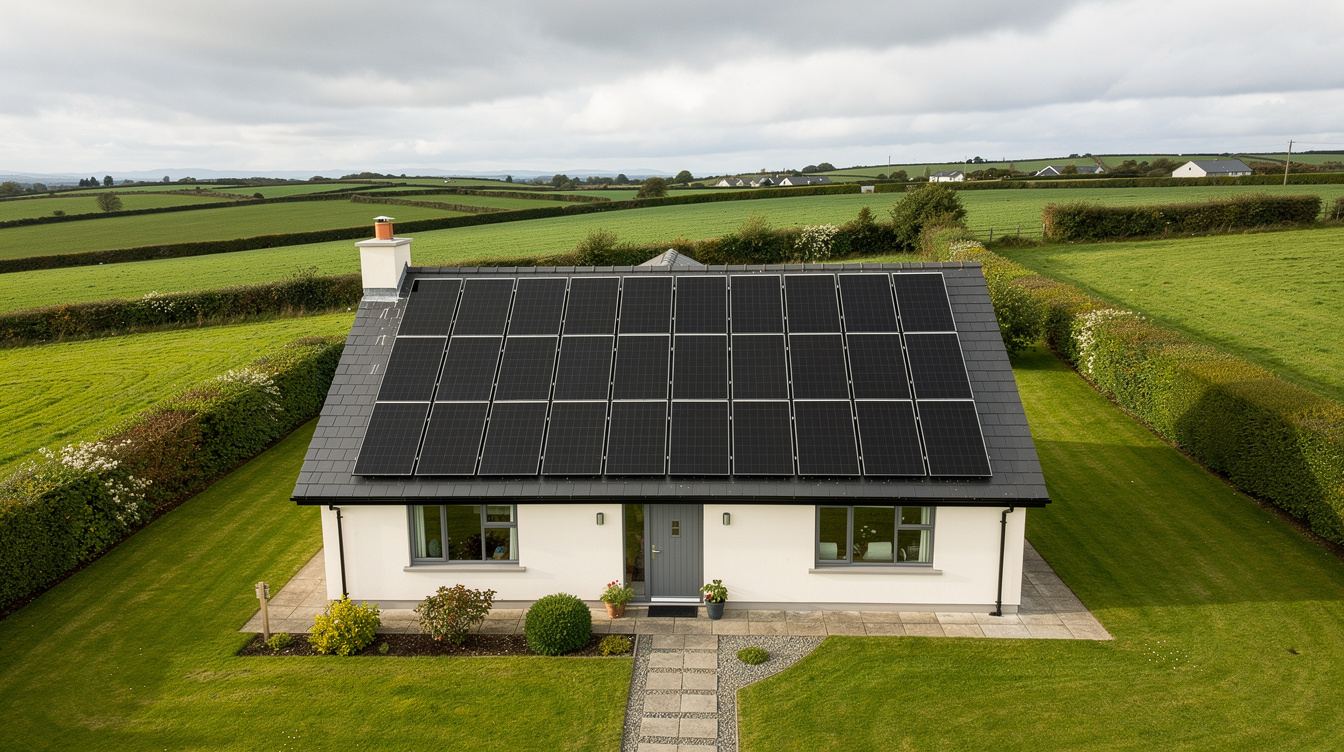
Fourteen 440 W panels each measure ~1.75 m × 1.13 m (roughly 2 m2 each). You need about 28 – 30 m2 of usable roof face, allowing 300 mm perimeter margins for building regs and fire access. A typical 4-bed semi rear roof face is 20 – 25 m2; a detached rear or main hipped face is usually 30 – 45 m2.
If your best face is too small, an east-west split across two faces works well at 6 kW — and often produces a flatter daily curve, which is better for self-consumption without a battery.
Inverter sizing
The three most common inverter choices at 6 kW in Ireland right now:
- SolaX X1-Hybrid 6.0. Popular mid-market hybrid, battery-ready, 10-year warranty when registered. Around €1,700 – €1,900 installed.
- SolarEdge SE6000H. Requires per-panel optimisers (add €65 per panel). Best for shaded or complex roofs. 12-year inverter warranty, 25-year on optimisers.
- Enphase IQ8 microinverters. Fully panel-level, 25-year warranty on the microinverter. Highest upfront cost but the most future-proof if roof shading is a factor.
Our SolarEdge vs Enphase comparison covers when each brand actually pays off. For a straight, unshaded south-facing 6 kW system, a plain hybrid inverter is almost always the right choice.
What about a 6 kW system with an EV?
This is where 6 kW starts to shine over 5 kW. An average Irish EV covering 15,000 km/year needs about 2,800 – 3,200 kWh of charging annually. Between April and September, a 6 kW system can realistically cover the majority of that demand for free — assuming you can flex your charging to daylight hours (weekends, home working, or a solar-diverting charger like a Zappi or the SolarEdge Home EV Charger).
Winter is a different story. From October to March you’ll be relying heavily on grid or night rate. This is why an EV-owner combo usually looks like: 6–8 kW PV + solar-diverting charger + 5–10 kWh battery. Our EV charger + solar guide has the full stack.
Grants and incentives at 6 kW
- SEAI Solar PV grant — €1,800. A flat €1,800 for any residential PV install of 2 kWp or more on a pre-31-Dec-2020 home (subject to homeowner status and no previous PV grant at the MPRN). See the SEAI grant application guide.
- 0% VAT on install. Zero-rated to 31 Dec 2030 following the Budget 2025 extension. Saves ~€1,300 versus the pre-2023 13.5% rate on a 6 kW build.
- SEAI Home Energy Upgrade Loan. Available from participating banks at ~2.99% APR for solar + retrofit works. Not everyone needs it, but it’s a good option if you don’t want to touch savings. See the loan walkthrough.
- CEG payments. Every kWh you export earns 18 – 21c depending on your supplier, credited quarterly against your bill. Not a grant, but effectively an ongoing subsidy from the export market.
25-year lifetime ROI on 6 kW
Using conservative assumptions — 5,270 kWh year-one generation, 0.5% annual panel degradation, electricity prices rising at 3%/year, CEG rate flat at 20 c/kWh — a typical 6 kW system saves roughly:
- Year 1: ~€1,140 (PV only) or ~€1,440 (with 5 kWh battery)
- Year 10 cumulative: ~€13,000 (PV only) or ~€16,500 (with battery)
- Year 25 cumulative: ~€30,000 (PV only) or ~€39,000 (with battery)
That’s a 3–4x return on your net upfront outlay — comfortably better than most retail savings products and, critically, largely inflation-linked because your savings scale with the electricity price.
Common mistakes to avoid at 6 kW
- Under-sized inverter clipping. Some quotes pair 6.16 kWp of panels with a 5 kW inverter to shave €300 off the price. In peak summer this can cost you 3–6% of annual generation. Specify a 6 kW hybrid inverter.
- Skipping DC surge protection. Ireland has plenty of thunderstorms. A DC SPD adds €60 — a lightning-induced inverter replacement costs €1,800.
- Not future-proofing the CU. Ask if the installer will upgrade your consumer unit to have a spare way for a future battery or EV charger.
- Cheap panel warranty small-print. Look for 25-year linear performance warranty and at least a 15-year product warranty. Tier-1 brands (Longi, JA, Trina, Canadian Solar, REC) all deliver this in 2026 spec sheets.
- Missing workmanship guarantee. Installer workmanship should be covered separately for at least 5 years, ideally 10. Panel warranty doesn’t protect you from bad flashing or a roof leak in year 3.
Bottom line
A 6 kW system in Ireland in 2026 lands at €7,700 – €10,500 net after the €1,800 SEAI grant and 0% VAT, generates ~5,200 kWh/year, and pays back in 6 – 8 years while saving €30,000+ over its 25-year lifetime. If your electricity bill is over €1,800/year, if you’re running (or planning) an EV or heat pump, or if you just have the roof space and want to future-proof, 6 kW is the size that keeps winning on cost per kWp without needing three-phase power.
Get 3 Free 6 kW Quotes from SEAI Installers
One form, three tailored quotes from vetted local installers. No obligation, no cost.
Related Articles
Solar Panel System Cost by Number of Panels Ireland 2026: 8, 12, 14, 20, 24 Panel Prices
What 8, 12, 14, 16, 20 or 24 solar panels actually cost in Ireland 2026 — net after €1,800 SEAI grant & 0% VAT, output kWh, roof area & battery add-ons.
5kW Solar System Cost Ireland 2026: Real Prices, Output & 25-Year ROI
5kW solar system costs €6,700–€9,200 net after the €1,800 SEAI grant and 0% VAT in Ireland 2026. Full itemised breakdown, real output data & battery ROI.

Solar Panels Meath 2026: Costs, Boyne Valley Planning, TAMS 3 & Installers
Solar panels Meath 2026 — costs by area, €1,800 SEAI grant, Newgrange/Tara/Trim planning realities, TAMS 3 dairy economics.