
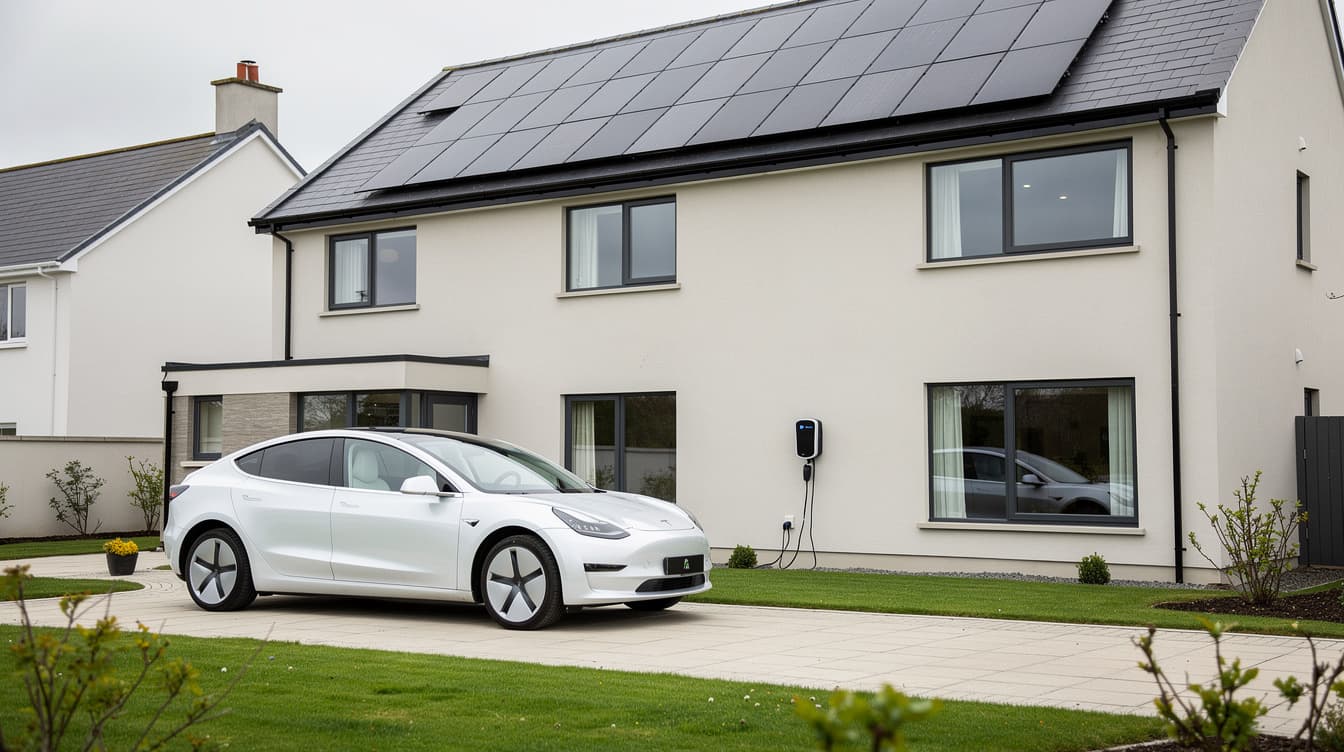
EV Charger + Solar Panels Ireland 2026: Combined Install Costs & Free Charging
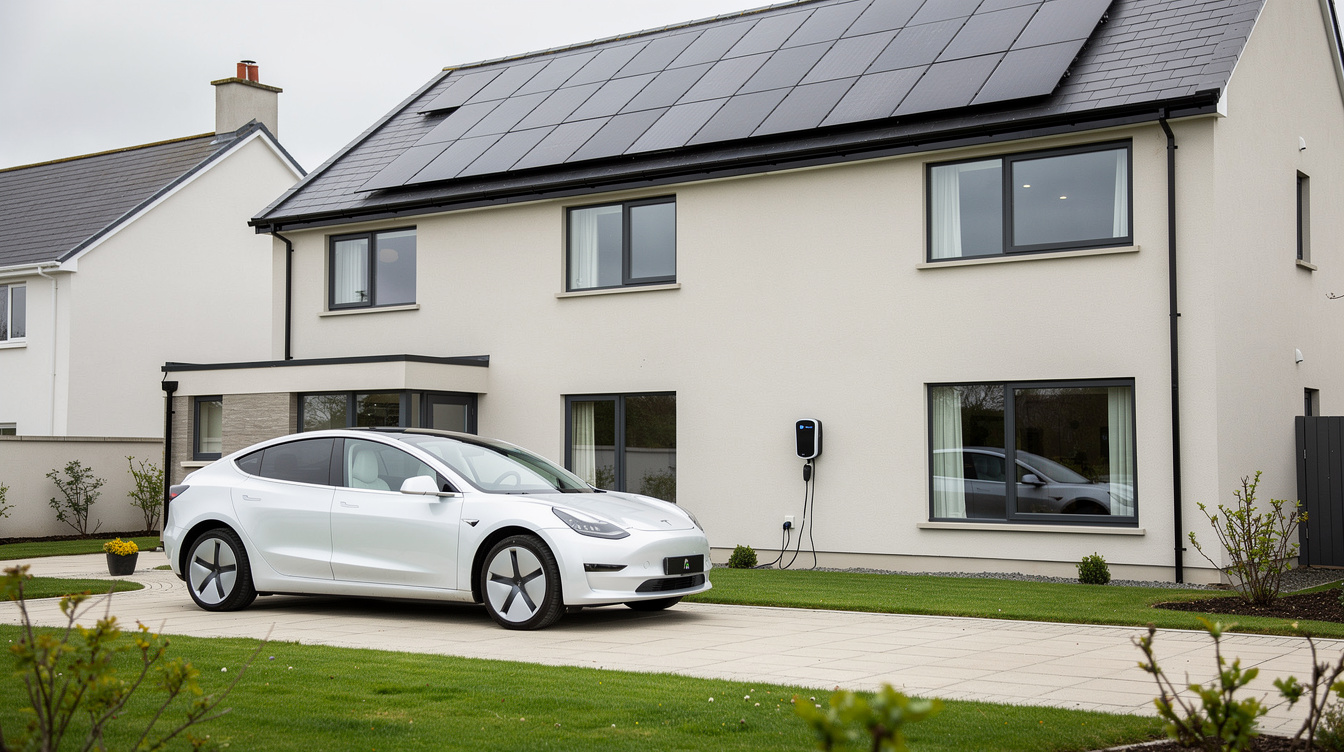
Your solar panels produce most of their electricity between 10am and 4pm. Your electric car sits on the driveway between roughly 6pm and 8am. On paper those two facts kill the “solar-charged EV” dream before it starts. In reality, a solar-diverting home charger and a bit of scheduling closes most of the gap — and combining a solar install with an EV charger in one job is 2026’s single best home-energy value in Ireland.
This guide covers the real 2026 numbers: what a combined solar + EV install costs, which grants stack, which chargers actually divert solar (and which just pretend to), how many free kWh an Irish 4kWp system genuinely delivers to a car, and the wiring gotchas that catch out first-time installs.
Quick numbers
A typical Irish home combining a 4kWp solar PV system with a solar-diverting 7kW EV charger pays €8,600–€11,800 before grants, or €6,500–€9,700 net after the €1,800 SEAI solar grant + €300 EV Home Charger grant. Realistic free solar charging: 1,400–2,000 kWh/year = 8,500–12,000 EV km. That’s €450–€650/year of fuel savings on top of the normal PV bill reduction.
Why do the two together?
Two installs in one visit saves money on scaffolding, cable pulls, MCB space in the consumer unit, and installer travel. It also lets one electrician design the two systems so they cooperate rather than compete for consumer-unit capacity. The concrete savings versus two separate installs across two visits:
- Scaffolding €300–€500 — only pays once
- Trenching or cable pull to the driveway €150–€400 — done alongside the DC pull from the roof
- Second consumer-unit visit €180–€250 — avoided
- Combined ESB Networks NC6 paperwork — one filing, one lead time
Realistically, doing both together saves roughly €600–€900 versus buying solar this year and adding an EV charger next year. It also means the whole install is designed by one head rather than shoe-horned together later, which matters more than the money.
What a combined install costs in Ireland, 2026
Prices below are what installers are actually quoting for combined jobs in mid-2026, before grants. Grants (SEAI €1,800 solar + €300 EV Home Charger) are applied separately after commissioning. 0% VAT on domestic solar PV runs until 31 December 2026.
| Package | Before grants | After €2,100 grants | Best for |
|---|---|---|---|
| 3kWp solar + 7kW Zappi | €7,200–€9,000 | €5,100–€6,900 | 1–2 person, low mileage EV |
| 4kWp solar + 7kW Zappi | €8,600–€11,800 | €6,500–€9,700 | 3-bed family, one EV |
| 6kWp solar + 7kW Zappi + 5kWh battery | €13,800–€17,500 | €11,700–€15,400 | 4-bed, EV + heat pump plans |
| Add: bidirectional (V2H) charger | +€2,500–€4,000 | n/a | V2H-capable EV owners (Nissan Leaf, MG4) |
| Add: 3-phase upgrade for 22kW charger | +€1,800–€3,500 | n/a | Rare — most 3-phase homes want 7kW anyway |
The EV charger itself is the smallest line item in the bill: a fitted 7kW Zappi, Ohme Home Pro, or Hypervolt Home 3.0 costs roughly €950–€1,450. The rest of the €300 EV grant and consumer unit work is what varies.
Which chargers actually divert surplus solar?
“Solar-compatible” on a product page can mean anything from “the charger knows what time of day it is” to “full CT-clamp export monitoring with sub-second dynamic modulation”. For an Irish home wanting to funnel surplus PV into the car, only the second one matters. The chargers below are the four that genuinely do it.
| Charger | Solar divert | Fitted price | Notes |
|---|---|---|---|
| Myenergi Zappi v2.1 | ECO+ mode (uses only surplus) | €1,150–€1,450 | Irish best-seller. Adds Harvi CT sensor. Made in UK |
| Hypervolt Home 3.0 | Solar-only, hybrid, boost modes | €1,050–€1,350 | Slick app, LED ring. Needs its own CT clamp |
| Ohme Home Pro | Yes, via CT clamp + smart tariff | €950–€1,250 | Excellent for stacking with Energia EV night rate |
| Wallbox Pulsar Pro | With Eco-Smart / Power Boost | €1,050–€1,350 | Requires separate PowerMeter unit |
Basic tethered chargers (Easee, Rolec BasicCharge, older Wallbox Copper SB) can be schedule-programmed but do not actively track your PV export in real time. If your goal is to squeeze free kWh from the roof, spec a genuine solar-diverting charger from install day one — retrofitting a CT clamp later is fiddly and often not economic.

How many free kWh will you actually get?
This is where installer sales pitches often collapse on contact with reality. The genuine solar-to-EV yield in Ireland depends on three things: how big your PV system is, how much of the day the car is at home, and whether you have a home battery.
Modelled numbers for a Dublin/Meath/Kildare home with a 4kWp system and a Zappi in ECO+ mode:
| Driver pattern | Solar → car (kWh/yr) | Free EV km/yr | Value (at 32c/kWh) |
|---|---|---|---|
| Car home most days (WFH / retired) | 1,700–2,100 | 10,000–12,500 | €540–€670 |
| Hybrid / part-time office | 1,000–1,400 | 6,000–8,300 | €320–€450 |
| Full-time commuter (car gone Mon–Fri 8–6) | 550–900 | 3,300–5,300 | €180–€290 |
| Commuter + 5kWh home battery buffer | 1,300–1,800 | 7,800–10,700 | €420–€580 |
The commuter case is where it matters most. Without a battery, most of your generation happens while the car is at the office. A 5kWh AC-coupled battery stores morning/midday surplus, then feeds it into the car at 6pm when it plugs in. That is why the “solar + battery + EV” stack is the most sensible sequence for the average Irish commuter, and why we generally recommend at least a 5kWh battery on any combined install with a commuter EV.
Grants: what stacks in 2026
Combined 2026 grant stack (max)
- €1,800 — SEAI Solar PV Grant (up to 2kWp full grant, tapering to 4kWp)
- €300 — SEAI EV Home Charger Grant (Zappi, Ohme, Hypervolt and Wallbox all eligible)
- 0% VAT on residential PV supply-and-install until 31 December 2026 — worth €900–€1,400 on a typical system
- €3,500 — SEAI EV Purchase Grant (BEV under €60k) — separate application when buying the car
All four are cumulative. On a €10,500 solar + charger install for a household buying a new BEV, total support is €5,600 (€1,800 + €300 + €3,500 + implicit 0% VAT), which is why 2026 is a genuinely well-timed year for the combined move.
Wiring reality — the CT clamp, load balancing and NC6
Three technical details that separate a good combined install from a headache one.
The CT clamp is not optional. Any solar-diverting charger needs a current transformer (CT) clamp fitted on your incoming ESB Networks tail. This is what tells the charger whether you are exporting or importing at any given moment. Zappi uses a wired Harvi sensor by default; others need a hardwired clamp. If your incoming meter is out at the road boundary (common in rural Ireland), the installer may need to run comms wiring back to the charger or use a wireless Harvi to bridge the gap. Ask about this before quote day.
Load balancing matters when heat pump, EV and cooker share a phase. On a single-phase 63A house supply (the Irish default), your combined draw at 6pm can easily push over the main breaker: 7kW EV charging + 3kW heat pump + 3kW oven = 13kW = 56A on a 63A trip. A well-configured charger dynamically throttles down when it sees other loads spike. Zappi does this via the Harvi; Wallbox needs the Power Boost module. Skip this at your peril — nuisance main-breaker trips are the #1 complaint in the first month after an EV charger install.
ESB Networks NC6 covers both. A single NC6 (Notification of Connection) filing to ESB Networks covers PV export and increased demand from the EV charger. Combining the installs means one form, one 8-week review window, not two. See our ESB grid connection guide for the details.

Battery or EV as storage?
A parked EV with a big battery is, in theory, a house battery on wheels. In practice for Irish homes in 2026:
- Almost all Irish EV chargers are one-way. The car takes in solar but doesn’t give back. So the EV does NOT reduce your evening grid draw.
- Bidirectional (V2H, vehicle-to-home) is genuinely available now but only on a small number of cars — Nissan Leaf and Ariya, Kia EV6/EV9 (via software update), some MG4 trims. The chargers cost €2,500–€4,000 fitted and there’s a specific 5-year ESB Networks pilot approval process.
- A dedicated 5–10kWh home battery is still the simpler answer for time-shifting surplus into evening use.
Practical recommendation: get the solar + solar-diverting charger + 5kWh battery combination now. V2H will mature over the next 3–5 years and can be retrofitted then. Do not delay solar today waiting for a V2H solution that isn’t ready.
Payback: does the combined install pay for itself?
The base solar payback (5–8 years for a 4kWp system in Ireland — see payback guide) is barely affected by adding an EV charger. But the EV charger changes the shape of savings significantly. A worked example for a 4-bed hybrid-commuter household with a Kia EV6 doing 20,000 km/year:
| Annual savings component | Amount |
|---|---|
| Reduced house electricity import (self-consumption) | €720–€950 |
| CEG export payment (20 c/kWh, July 2026 average) | €180–€320 |
| Free solar EV charging (1,400 kWh × avoided 32c) | €450 |
| Night-rate top-up for balance of EV need (Energia EV 4hr @ ~9c/kWh) | savings vs day rate €280–€380 |
| Total annual saving | €1,630–€2,100 |
Combined net install cost (€6,500–€9,700 after grants) divided by annual savings gives a 4–6 year payback on the whole package — faster than solar alone in most cases, because the EV lets you use more of what you generate before it exports at the lower CEG rate.
Get a Combined Solar + EV Quote
Tell us your home, your driving pattern, and whether you already own an EV. We’ll match you with installers who spec the two together properly — one visit, one filing, one number.
Common mistakes on combined installs
- Buying the wrong charger and finding out later. The €550 Easee off the shelf is a fine charger, but it will not divert solar. If solar-charging is a priority, spend the extra €300–€500 on a Zappi, Hypervolt or Ohme.
- Skipping the home battery on a commuter setup. Without one, the daytime surplus goes to the grid at 20 c/kWh instead of into the car at 32 c/kWh avoided.
- Undersizing the solar array. A 3kWp system barely covers house baseline in winter. If you have EV and heat pump plans, size for 5–6kWp upfront — adding panels later means new scaffolding and a possibly new inverter.
- Ignoring the driveway cable pull distance. Every extra 5m of armoured cable is €40–€70. Long driveway = budget accordingly. Wall-mounted chargers within 2m of the consumer unit are much cheaper.
- Applying for the €300 EV grant before installation. The EV Home Charger grant must be applied for by the SEAI-registered installer after the install is complete, with commissioning paperwork. If you buy the charger on Amazon and self-install, you forfeit the grant.
Timing: do it this year or wait?
Three 2026 policy items make combining this year attractive:
- 0% VAT on residential PV expires 31 December 2026. No confirmed extension. Domestic PV VAT reverts to 13.5% from 1 January 2027 — a €900–€1,400 hit on the solar portion of a combined install.
- SEAI Solar PV grant confirmed at €1,800 for calendar 2026 with review at year-end. The Government has signalled a taper is likely from 2027 as installation prices continue to fall.
- Clean Export Guarantee is being reviewed by CRU with a decision expected Q4 2026 — current 20 c/kWh average from suppliers may or may not persist into 2027.
Any of these three moving against the homeowner in 2027 pushes payback out by 6–12 months. Combined with the €600–€900 saving from doing solar and EV together in one visit, 2026 is the strongest year we’ve seen for the combined install.
FAQs
Do I need to own an EV before installing the charger? No. Many homeowners install the charger during a solar job in anticipation of buying a BEV within the next 12–24 months. The €300 EV Home Charger grant does require you to have a BEV registered in your name at the time of installation or shortly after, so time the two.
Can I charge two EVs from one Zappi? Yes, but not simultaneously without upgrading. A single 7kW Zappi charges one car at a time. For dual-EV households, either fit a second unit (which most single-phase homes cannot power fully at once — you’ll need load balancing) or upgrade to 3-phase.
Will a smart tariff (Energia EV 4hr, Electric Ireland Home Electric+) work alongside solar diverting? Yes, and it’s the recommended stack. The charger diverts free solar during the day, then tops up on the ~9c/kWh 4-hour night window overnight for any remaining charge need. Modern Ohme and Zappi units integrate directly with these tariffs.
Do I need planning permission? No, for both. Domestic solar PV is exempt under the 2022 planning rules (see planning exemptions). Wall-mounted EV chargers on your own driveway are exempt development.
Can renters do this? Solar generally no (unless the landlord agrees and pays), EV charger yes with landlord permission and if the charger stays. If you’re a landlord considering solar for a rental, see our landlord solar guide.
What about 3-phase homes? A 3-phase supply lets you install a 22kW EV charger, which is overkill for most homes (a Model 3 accepts only 11kW AC max, most cars 7kW). See our 3-phase electricity guide for the trade-offs.
Related reading: Solar inverter guide · Payback calculator · Home battery guide.
Related Articles

SEAI Home Energy Upgrade Loan Ireland 2026: 2.99% Loans for Solar & Retrofit
Full 2026 guide to the SEAI Home Energy Upgrade Loan: rates from 2.99% APR, €5k-€75k, how to use it for solar PV, lender comparison and worked example.

SolarEdge vs Enphase Ireland 2026: Price, Warranty & Which Wins on Irish Roofs
Full Ireland 2026 comparison: SolarEdge vs Enphase microinverters. Real installer prices, warranty gap, shading gains, and which wins for Irish roofs.

Storm & Lightning Damage to Solar Panels Ireland 2026: Insurance, Surge Protection, Repairs
How Irish solar systems survived Storm Éowyn's 183km/h gusts. Wind loading zones, surge protection costs, home insurance gotchas, before-storm checklist.