
Solar Panels for Rental Properties Ireland 2026: The Landlord's Guide to Costs, Grants & BER Uplift
Ireland has roughly 335,000 privately-rented tenancies (RTB Q1 2026), and something quiet has been shifting under landlord feet: from 1 January 2025 onwards, a property rented under the private rental sector must have a minimum BER of E1 for new tenancies, with a phased tightening to a D1 minimum by 2029 and a C1 minimum by 2035 — the "Rented Sector Minimum Standards" pathway published under the Climate Action Plan. Solar PV is one of the cheapest levers a landlord has to shift a rental up a BER band, and unlike an oil-to-heat-pump swap it does not require dispossessing the tenant for weeks.
But solar on a rental is not the same conversation as solar on your own home. The person paying for the electricity is not the person paying for the panels. The SEAI grant rules are different. VAT is different. Section 23-style reliefs, wear-and-tear allowances, and Local Property Tax deductibility all matter. And a chunk of landlords have never even seen the property they own solar-fied. This guide is the one we’d hand a new landlord client asking, "Should I put panels on the Rathmines two-bed before the tenant renews?"
Landlord? Get Rental-Specific Solar Quotes
Three free quotes from SEAI-registered installers who understand landlord/BER requirements. No pressure, no follow-up spam.
Quick answer: solar on a rental in 2026
If your rental is a 3-bed semi with a decent south-ish roof, expect the sums to look roughly like this in 2026:
| Item | Amount | Notes |
|---|---|---|
| 4kWp panels-only install | €6,800–€8,200 | Before SEAI grant |
| SEAI grant (landlord eligible) | −€1,800 | Property built pre-2021, no prior PV grant at MPRN |
| 0% VAT (residential) | Applied at invoice | Runs to 31 Dec 2026 |
| Landlord net outlay | €5,000–€6,400 | Deductible against rental income over 8 years |
| BER uplift | +1 to +2 bands | Typical uplift on a D–E rated 3-bed |
| Effective post-tax payback | 6–9 years | Depending on how you structure the tenancy |
The rest of this guide is where the numbers get more interesting — and where landlords fall over. Read the tenancy-structure section carefully. The wrong choice there can turn a good install into a break-even one.
The 2025 minimum BER rule and why solar suddenly matters
The Housing (Standards for Rented Houses) (Amendment) Regulations, phased in from 2025, set a floor for the BER of rented dwellings offered on new tenancies. The schedule agreed between the Department of Housing and industry stakeholders is:
- 1 Jan 2025: New tenancies must have a valid BER, no minimum grade yet enforced but disclosure required.
- 1 Jan 2027: Minimum E1 for new tenancies (existing tenancies unaffected unless renewed).
- 1 Jan 2029: Minimum D1 for new tenancies.
- 1 Jan 2035: Minimum C1 for all tenancies including existing.
Read that carefully. The 2027 floor is E1, not C1 — so today, panic isn’t the right emotion. Planning is. If your rental is currently F or G rated (typically pre-1980s uninsulated builds), you have less than two years to move it up. Solar PV alone won’t take an F to an E if the fabric is poor — you’ll need attic insulation, cavity fill and airtightness work in parallel. But solar contributes 15–30 points to the BER score (out of 300 total) and often is what pushes a "just barely" property over a band boundary.
See our BER rating scale and how solar shifts it guide for the mechanics.
Is the landlord or tenant paying for the electricity?
This is the question that decides whether your solar install is a genuine investment or an expensive greenwash. There are three common tenancy structures in Ireland, and each changes the solar maths completely:
1. Tenant pays all utilities (most common in Irish PRS)
The tenant pays the ESB bill. The landlord installed the panels. The tenant reaps the savings.
On the face of it this looks like a bad deal for the landlord — and it is, at the day-one level. But it’s the structure that produces the biggest tenant-retention effect. A tenant paying €80/month less on electricity does not go looking to move house. In a market where re-letting a rental costs 4–6 weeks of rent (agent fees, void, BER cert, painter, cleaner), reduced turnover pays back the panels on its own. And you still get the BER uplift, the capital cost deductibility, and a small "green rent premium" that daft.ie’s Q4 2025 landlord report pegged at €40–€70/month over comparable non-PV homes in Dublin, Cork and Galway.
2. Landlord pays utilities, rent is inclusive
Common in short-lets, corporate lets, and student/HAP rentals with all-in pricing. Here the landlord pays the ESB bill directly — and every kWh the panels generate is a euro saved by the landlord. On a 4kWp system on a rental with typical 4,500 kWh/year daytime-heavy use, you’re looking at €480–€720/year in direct savings, which is a straight 6–7 year payback on the net cost. This is by far the cleanest financial case.
3. Split-metering or "solar rent" arrangement
Rare but growing. The landlord installs panels, keeps ownership of them, and charges the tenant a fixed "solar contribution" (say €40/month) in exchange for the electricity generated. This is legally viable in Ireland but requires a written addendum to the tenancy agreement and clean accounting — and RTB will not enforce a solar-contribution dispute the way they’ll enforce a rent dispute, so this only works with a trusted tenant.
Which of these structures produces the best return? Almost always #2 if the property is short-let or HAP; otherwise #1 with the retention and BER-uplift value factored in.
SEAI grant — can landlords actually claim it?
Yes, but not always. The SEAI Solar PV grant of €1,800 is available to landlords under the same eligibility rules as owner-occupiers, provided:
- The property was built and occupied before 1 January 2021.
- No prior SEAI Solar PV grant has been paid at that MPRN.
- The landlord is the registered owner of the property (Land Registry / Registry of Deeds).
- The install is completed by an SEAI-registered installer.
The grant is paid to the applicant, not to the tenant. Where a property is jointly owned, either owner may apply as long as documented consent from the other is attached. HAP or RAS tenancies do not affect eligibility — the grant is tied to the dwelling, not the tenancy structure.
Timing tip: the grant application must be approved before the works begin. Post-hoc claims are rejected. Turnaround on grant approval in 2026 is running at 8–15 working days per the SEAI applications portal, so build a 3-week buffer into any tenancy-change planning.
Tax treatment: how landlords write off solar against rental income
This is where landlord solar economics diverge sharply from owner-occupier solar economics.
Capital allowances — wear and tear on the panels
Solar PV panels installed on a residential rental qualify as plant and machinery for the purposes of the Case V rental income computation. Under Section 284 TCA 1997, wear and tear on plant is deductible at 12.5% straight-line over 8 years. So a €6,000 net install (after grant) generates a €750/year deduction against rental income for 8 years.
For a landlord in the 40% band with USC and PRSI, that’s roughly €372 in tax saved per year, or €2,976 over the 8-year write-down period — which effectively cuts the net cost of the install by half.
Section 97(2)(e) — repairs vs improvements
You can’t claim a full deduction in year one because solar is a capital improvement, not a repair. Retiling around the panel array to make the roof waterproof again can be treated as a repair. Any competent tax advisor will structure the works invoice to itemise those elements separately.
Local Property Tax
Solar panels do not add to the LPT valuation because they are treated as removable fixtures. Confirmed with Revenue eBrief 08/2024. However, a rebuild of the roof structure to support panels would.
Pre-letting expenses
Under Section 97A TCA, up to €10,000 of pre-letting expenses on a previously vacant property (vacant >6 months) is deductible against rental income. If you’re bringing a long-vacant house back to the rental market, a solar install fits neatly here — and can accelerate the deduction significantly.
Landlord tax caveat: Rental tax treatment is highly individual. The above is a general framework based on current Revenue guidance. Confirm with a tax advisor before treating solar as a Case V deduction.
The BER uplift — how many bands does 4kWp buy you?
SEAI’s DEAP methodology assigns solar PV a "self-consumption" credit based on system size, orientation, tilt and dwelling floor area. In broad strokes, on a typical Irish 3-bed semi (110–140 m²) here’s what a 4kWp south-facing install does:
| Starting BER | Post-solar BER (typical) | Bands moved |
|---|---|---|
| G | G or F3 | 0–1 (fabric usually dominates) |
| F | E2 | 1 |
| E1–E2 | D2 | 1 |
| D1–D2 | C3 | 1 |
| C1–C3 | B3 | 1 |
The pattern: solar reliably buys you one BER band on any property already rated D or better. On F/G rated stock it’s not the leading solution — insulation is. On a C3 rental it can push the certificate into B3, which is what banks and prospective tenants notice.
Bulk landlords: portfolio installs across multiple properties
If you own 5+ rental units, most SEAI-registered installers will do portfolio pricing. Typical volume discounts we’ve seen quoted in 2026:
- 5–9 units: 4–7% off per-unit install cost
- 10–24 units: 8–12% off
- 25+ units: 12–18% off, plus flexible mobilisation scheduling
The catch: portfolio bookings mean the installer needs continuous roof access, so the tenancies must be workable. Void periods are ideal. Between-tenancy re-lets are workable if you can commit to a 5–7 day window. Occupied properties with cooperative tenants also work but add 20% to the labour cost because the installer needs to plan around agreed access windows.
See our county-by-county installer directory for firms actively taking portfolio work in 2026.
Do you need the tenant’s permission?
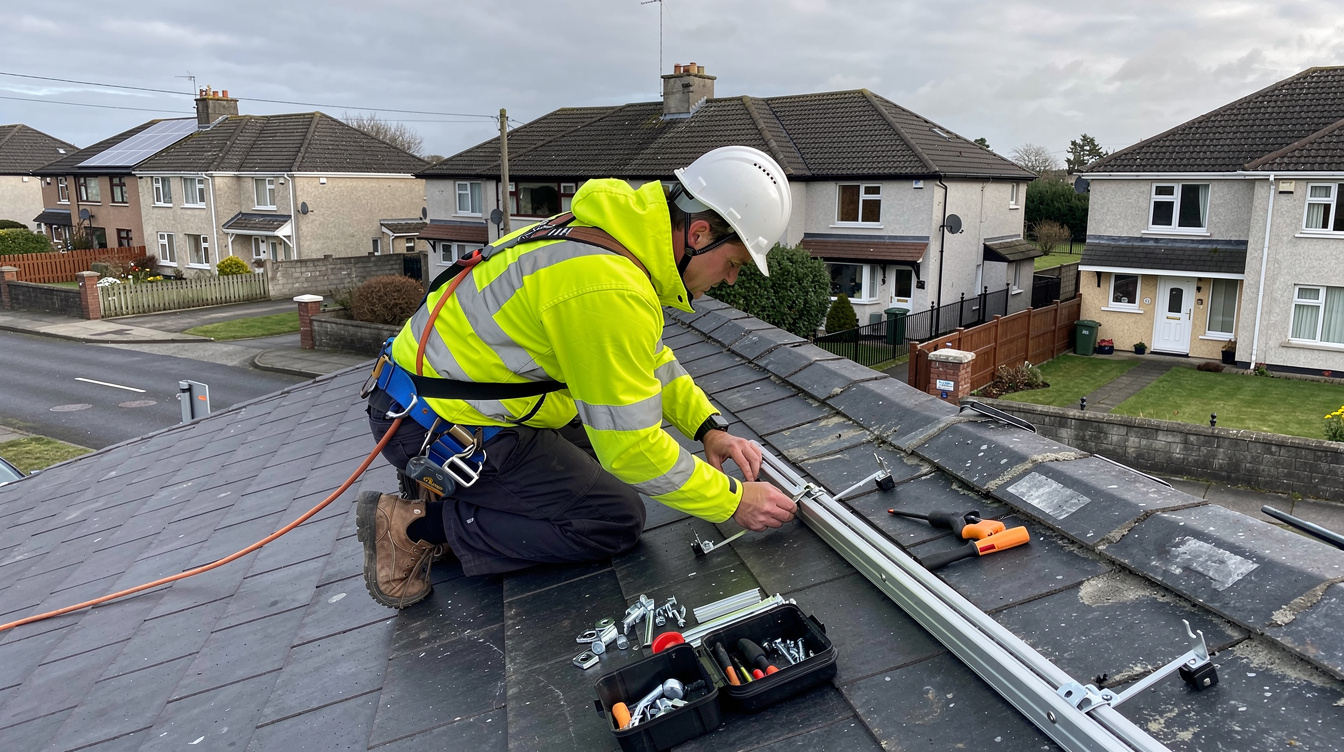
Under the Residential Tenancies Act 2004 (as amended), the tenant has the right to quiet enjoyment. Solar works do not require tenant consent in the same way a rent increase does, but you must give:
- Written notice of works, not less than 24 hours in advance (RTB Section 16(f) landlord obligations).
- Reasonable access arrangements — typically a full working day or two for a domestic install.
- Assurance that the roof, walls and any internal cabling routes will be reinstated to original condition.
In practice, decent tenants react well to solar because they will be the primary beneficiary. Send the notice at least a week in advance, offer a small gesture (a €50 rent credit for the disruption is common in Dublin), and time the install for a weekday when they’re at work. Legal compulsion is rarely necessary.
One nuance: if you plan a partial re-roof or scaffolding that materially inconveniences the tenant (e.g. blocking a garden entrance for several days), the RTB expects you to negotiate that in good faith and may consider a small rent abatement to be reasonable.
Landlord insurance and mortgage lender considerations
Two admin items landlords often miss:
Buildings insurance
Most Irish rental buildings-only insurance policies (Allianz, AXA, RSA, Aviva) automatically cover the panels under the "external fixtures" clause once they’re installed. But the reinstatement value on the property may need to be raised by €5,000–€8,000 to reflect the added asset. Ignore this and you may find the panels excluded from a hail or storm claim. Update the policy the week after the install completes.
Buy-to-let mortgage
Structural alterations to a mortgaged property require lender consent under most Irish BTL mortgage deeds. Solar panels are usually treated as a non-material alteration and permission is granted routinely, but you should still write to the lender before starting and keep the reply on file. BOI, AIB, and PTSB all publish templates for this.
Common landlord mistakes we see — and how to avoid them
- Installing panels before doing insulation. If the BER is F or G, solar is not the priority — wall/attic/airtightness is. Fabric first, PV second.
- Applying for the grant after the works started. Grant applications must be approved before spade goes in the ground. Post-hoc claims are rejected.
- Not updating buildings insurance. The panels sit exposed on the roof and are the most storm-vulnerable part of the property. Update the policy value.
- Choosing the cheapest installer without checking SEAI registration. SEAI grant requires an SEAI-registered installer. See our SEAI registration verification guide before signing anything.
- Forgetting the CEG. Even a rental with an absent-during-day tenant profile can earn €180–€400/year in Clean Export Guarantee payments. Make sure the installer files the NC6 form and confirms the export MPRN registration.
- Not documenting the tenant notice. The RTB looks at documented notice periods. A verbal "we’re doing the panels next week" is not enforceable if a dispute arises. Send it in writing (email is fine).
- Underpricing rent post-install. A B-rated rental commands a €40–€70/month premium over C-rated equivalents in the same estate. If your next tenancy start-date lets you reset rent within RPZ rules, use it.
When solar is NOT the right call for a rental
To be honest: not every rental should get panels. Skip solar if:
- The property is on a north-facing terrace with negligible unshaded roof area. The BER uplift won’t justify the cost.
- You are within 12 months of selling — the buyer discounts the panels below their cost in most sale negotiations, so you rarely recover the outlay.
- The property is a very short-term let (Airbnb, corporate 1-year lets) — wear-and-tear write-down needs 8 years of continuous rental to fully absorb, and short-let taxation (Case I, not Case V) doesn’t treat capital allowances the same way.
- The building is a protected structure or in a conservation area with active enforcement. Get planning clarity first — see our protected structures solar guide.
- The tenancy is HAP-only and long-term with a tenant who is out of the property most of the day. In this case the tenant sees minimal savings and the landlord doesn’t pay the bill — the numbers don’t work unless you can structure a solar-contribution arrangement.
Ready to Quote a Rental Install?
Three SEAI-registered installers, landlord-experienced, will send free written quotes tailored to your property. No obligation.
FAQ
Can I pass the cost of solar on to the tenant?
Not directly. You cannot "recharge" the install cost through rent. But post-install you may increase rent within RPZ rules on renewal or on a new tenancy, and the BER-driven value uplift often justifies the maximum allowed rise.
Do I need Registered Electrical Contractor (REC) sign-off?
Yes — the install must be signed off by a Safe Electric registered contractor (RECI or ECSSA). Any SEAI-registered installer will handle this. Keep the RECI cert on file — it’s often requested at BER assessment.
What happens if the tenant damages the panels?
Panels on the roof are not accessible in normal tenant use, so damage is very rare. Where it occurs (e.g. tenant sublets to Airbnb guests who climb the roof), it’s a tenancy breach and covered by the tenancy deposit and RTB dispute process. Buildings insurance covers weather events regardless.
Can I install a battery on a rental?
Yes, and it’s worth considering if the tenant is on a smart tariff and consumes most electricity in the evening. The current SEAI grant does not include batteries, but the 0% VAT applies. The tax deduction runs on the same 12.5% wear-and-tear basis. Payback is 8–12 years vs 6–9 for panels alone.
How does this interact with the Rent Pressure Zone rules?
Under Section 24A of the Residential Tenancies Act, a "substantial change" to the property permits a rent review outside the normal RPZ cap. Solar PV plus insulation improvements have qualified as substantial changes in a number of RTB adjudications since 2023. This is fact-specific — get legal advice before relying on it.
What about apartments — can a landlord install solar on an OMC-managed block?
The Owner Management Company controls the roof by default. Unless the OMC votes to permit individual-owner PV installation on their apportioned roof area (uncommon but growing), you can’t. See our solar for apartments guide for the OMC process.
Is the SEAI grant recoverable if I sell the property within a few years?
No. The grant is not clawed back on sale. It stays with the property.
The one-sentence version
Solar on a well-chosen Irish rental in 2026 is a real investment, not a virtue signal — the SEAI grant, 0% VAT, Case V capital allowances and BER-driven rent premium combine to make net payback 6–9 years on a 4kWp install, and the 2025–2029 minimum BER regulations will make it cheaper to do now than to be forced into it later.
Get Landlord-Ready Solar Quotes
Compare three free quotes from SEAI-registered installers with landlord and BER experience.
Related Articles
Green Mortgages Ireland 2026: How Solar Panels Unlock Cheaper Rates from AIB, BOI, PTSB, Haven & Avant
How Irish green mortgages work in 2026, what BER you need, and where a solar install pays back inside the mortgage itself. AIB, BOI, PTSB, Haven, Avant.
A1, A2, A3 BER Rating Ireland 2026: What Each A-Grade Means & the Cost to Reach One
A1, A2 and A3 BER ratings explained for Irish homes in 2026: kWh/m²/yr thresholds, retrofit costs to reach each grade, resale premium and why A2 is usually the sensible stopping point.
BER Assessment Cost Ireland 2026: What You Pay, Who Does It & When You Need One
What a BER assessment costs in Ireland in 2026: typical €150-€350 range, what drives the price, when you legally need one, and how to book a SEAI-registered assessor.