
Solar Panels for Apartments Ireland 2026: OMC Rooftop, Balcony Plug-In & Portable Routes
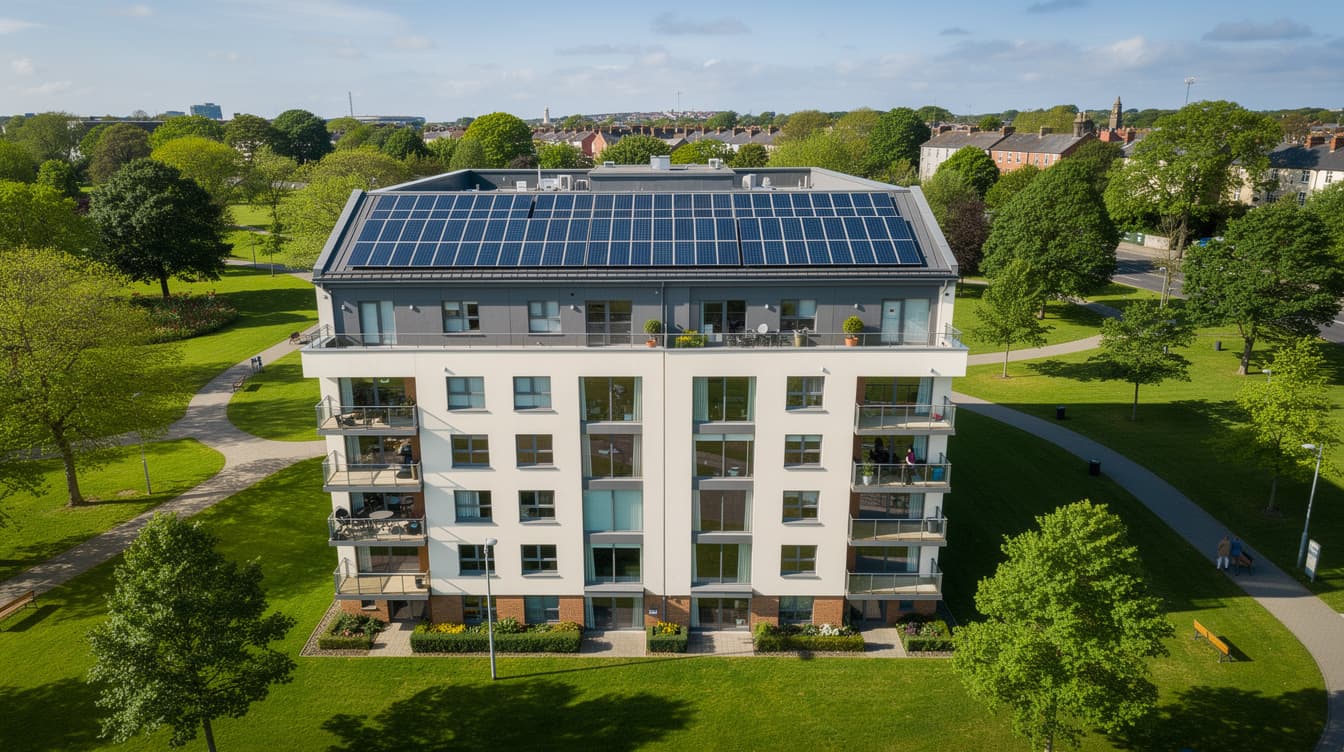
Roughly 10% of all Irish households now live in apartments (CSO 2022 Census), and that share has more than doubled in Dublin in a decade. Yet almost every Irish solar guide is written for the semi-detached owner-occupier with a south-facing rear roof to themselves. If you live in a Dublin or Cork apartment and you’ve been told solar is “not really an option,” that’s outdated. There are now three legal routes for an apartment dweller in Ireland to generate solar electricity in 2026 — and one of them qualifies for the €1,800 SEAI grant just like a house.
This is the practical guide to what is actually possible. We’ll cover the OMC-led shared roof install (the route that captures the SEAI grant), the legal balcony plug-in (which is legal — with a catch), and the off-grid battery-station route (legal DIY). Plus the realities almost nobody mentions: the OMC consent process, the lift and common-area electricity question, and what tenants in apartments can and can’t do without the freeholder.
Quick Answer: Can apartment dwellers get solar panels in Ireland?
Yes, but the practical routes are different from a house. The three legal options are: (1) OMC-led shared rooftop PV with consent from the Owners’ Management Company — this captures the €1,800 SEAI grant and powers common areas and (where metered) individual units; (2) balcony plug-in solar, legal in Ireland only when installed by a Safe Electric–certified electrician with an NC6 form filed; and (3) off-grid portable battery stations (EcoFlow, Anker Solix) with a small panel — legal DIY because they never connect to the grid. DIY balcony plug-in straight into the wall socket is not legal in Ireland as of June 2026.
Why apartment solar is harder than house solar — the four constraints
Before the three routes, here’s why this is a different problem from putting panels on a 3-bed semi:
- The roof isn’t yours. In a typical Irish apartment block, the freehold (and therefore the roof) is held by the Owners’ Management Company. Individual leaseholders own their unit airspace, not the roof above. Nothing goes on that roof without OMC board approval.
- The MPRN problem. Each unit has its own MPRN. The roof PV system feeds either common-area circuits (lift, hallway lighting, gates) or, in newer blocks, a shared distribution that splits output across unit MPRNs. The wiring complexity is the single biggest cost driver for retrofitted apartment-block PV.
- Balcony orientation lottery. Even if you can hang a panel on your balcony, west-facing balconies on a high floor generate well, but north-facing balconies generate barely anything. There’s no equivalent of the “put it on the south-facing roof” default.
- Tenants need the landlord. If you rent, you’re asking two parties for permission: your landlord and the OMC. That said, all three legal routes are accessible to renters, including portable battery stations which need no permissions at all.
Route 1: OMC-led shared rooftop PV — the grant-eligible option
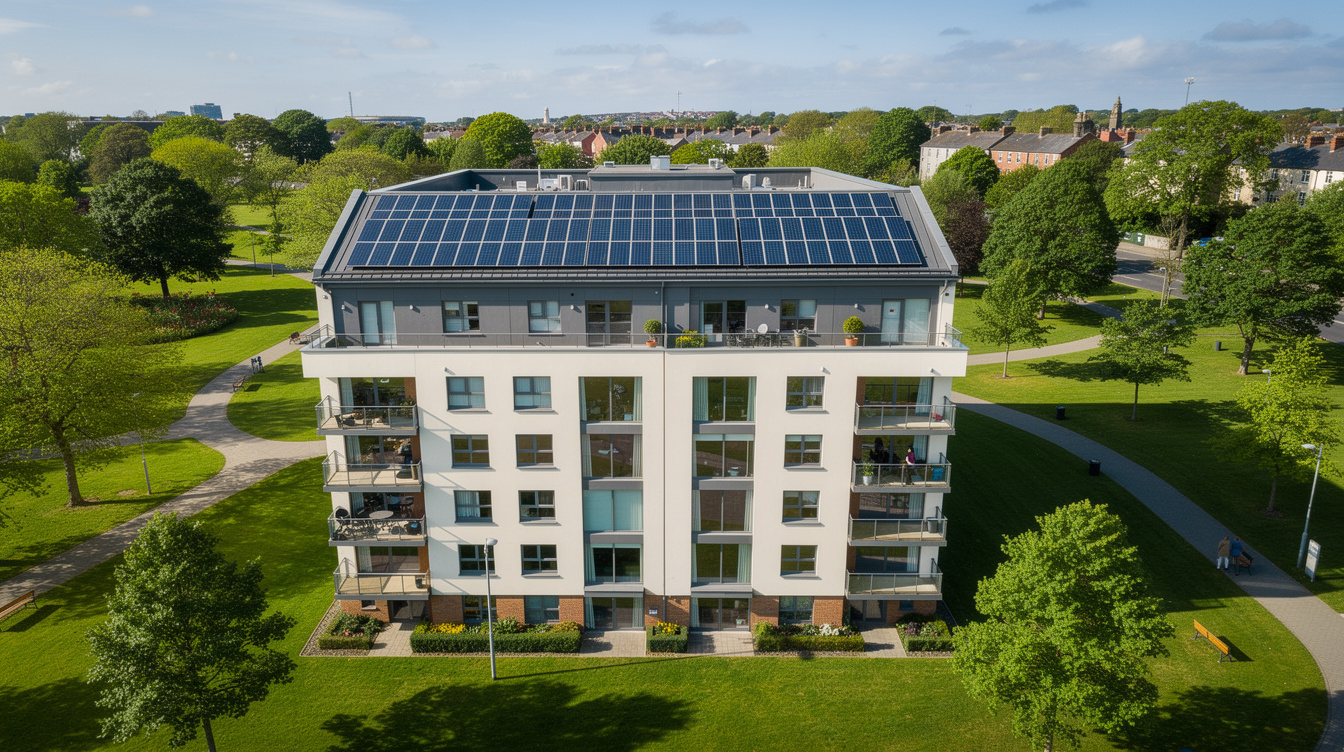
Since the 2022 Planning & Development (Solar Energy) Regulations, an Owners’ Management Company can install solar PV across the entire flat or pitched roof of an apartment block without planning permission, provided the building is not in a designated Solar Safeguarding Zone (the small no-PV corridors around airports). This is the route most likely to make economic sense at scale.
What the OMC needs to do
- Board resolution. The OMC board must pass a resolution at AGM or EGM authorising the install. Voting thresholds vary by lease — most require a simple majority of unit owners but check yours.
- Engineering survey. A structural engineer must confirm the roof can take the panel load. Older blocks (1970s–90s) often need additional ballast or strengthening for flat-roof installs.
- SEAI OMC grant application. Apartments qualify for the €1,800 PV grant per unit MPRN, but the application must be submitted by the OMC (or the appointed Property Management Agent) with written authorisation. Each unit needing the grant must have its own MPRN, be in a pre-2021 build, and not have had a previous SEAI PV grant on that MPRN.
- Installer procurement. Use an SEAI-registered installer experienced with multi-MPRN distribution. The wiring of who-gets-what-kWh is the bulk of installation complexity.
- Output allocation. Three common models: (a) common-area only (lift, hallways, gates) — reduces the OMC service charge; (b) common-area plus pro-rata credit to each unit MPRN; (c) dedicated per-unit panels and inverters. (c) is the most expensive but the cleanest from a metering perspective.
Cost ranges for an OMC install (2026)
| Block size | PV size | Gross cost | Net per unit (after SEAI) |
|---|---|---|---|
| 8-unit block (3 storeys) | 12 kW | €28,000–€36,000 | €1,700–€2,750 per unit |
| 20-unit block (5 storeys) | 30 kW | €58,000–€72,000 | €1,100–€1,800 per unit |
| 60-unit complex (multi-block) | 90 kW (split across roofs) | €155,000–€195,000 | €800–€1,450 per unit |
Per-unit cost falls sharply with block size because the structural and inverter overheads are largely fixed. A 20-unit block is roughly the sweet spot for cost-per-kWh delivered to residents. The OMC grant per unit MPRN puts solar in reach of most residents for less than three years of service-charge savings — assuming the install is structured to send output to either common areas or individual unit meters.
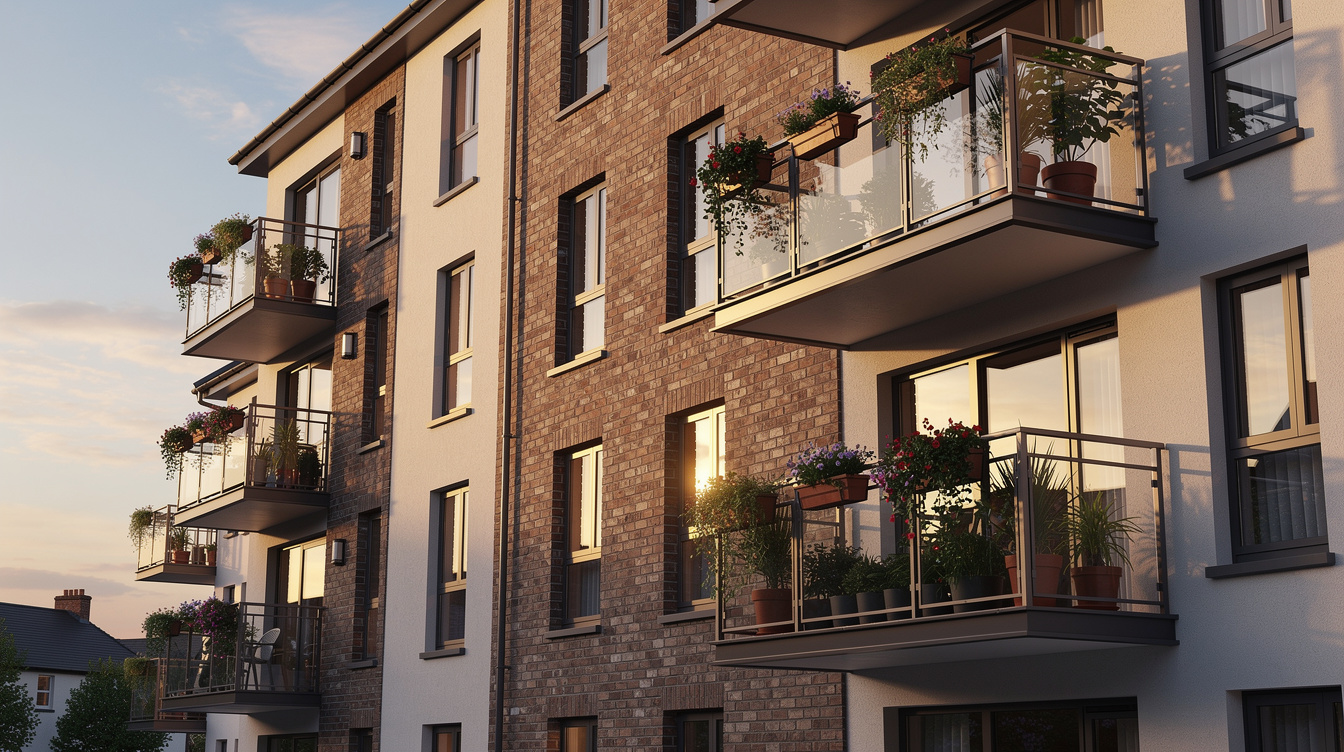
Route 2: Balcony plug-in solar — legal, but not as plug-in as Germany
This is the route most apartment dwellers ask about — you’ve seen the Lidl plug-in panels coming to Ireland, you’ve seen what German Steckersolar apartments look like. The Irish version is different.
Under ESB Networks NC6 and ER10 regulations, any solar PV connected to the grid via a domestic socket must be:
- Installed by a Safe Electric–certified electrician (not the resident)
- Connected through a dedicated micro-inverter that meets G99 or equivalent grid-protection standards
- Notified to ESB Networks via an NC6 form filed by the electrician
- Capped at a connection limit set by the local DNO — typically 800 W per phase for a single-phase apartment
Translated: you can’t just unbox a Lidl plug-in kit, plug it into the wall socket on your balcony, and start saving money. You can use a kit, but the install needs an electrician site visit, a micro-inverter conformity check, and the NC6 paperwork. Total cost of a balcony plug-in install in 2026 typically runs €650–€1,200, which is the hardware (€399–€700 for a 800 W kit) plus €250–€500 for the electrician’s call-out and NC6 filing.
2026 watch:
In April 2026, Energy Minister Darragh O’Brien told the Dáil he is “very open” to legalising true DIY plug-in solar. No timeline has been announced. Germany’s €400 unboxed plug-and-play model is the reference design, and the Lidl Ireland rollout has put political pressure on a 2026/2027 reform. We’re tracking this on our Lidl plug-in solar Ireland guide — if the rules change, we’ll update there first.
Does the SEAI grant apply to balcony plug-in?
No. The SEAI Solar Electricity grant requires a minimum installed capacity of 2 kWp (10 panels of 200 W each, roughly) and a permanent install. An 800 W balcony kit is well below that floor and is treated as a portable supplemental install, not a grant-eligible system.
Does balcony plug-in need OMC consent?
If the kit attaches to the balcony railing or external wall — yes. The exterior of the building is OMC common property under almost every Irish apartment lease. Free-standing setups on a balcony floor (not attached to the railing or wall) are typically permitted under your individual demise, though some OMCs explicitly restrict balcony appearance under house rules.
Route 3: Off-grid portable battery stations — legal, no permissions, no payback
This is the route that nobody’s pushing because nobody makes commission on it — but it’s the only fully-DIY, fully-permission-free way for an Irish apartment dweller to use solar today.
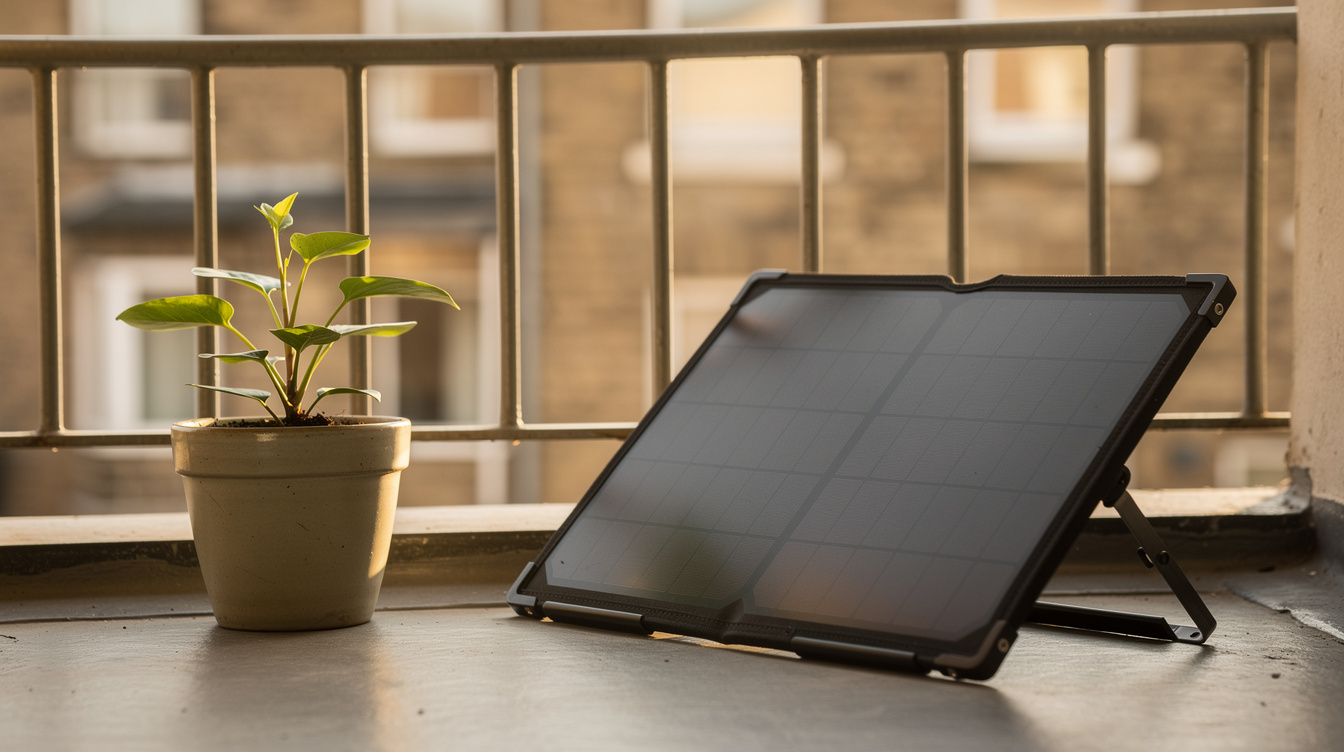
A portable solar battery station (e.g. EcoFlow Delta 2, Anker Solix C800, Bluetti AC180) plus one 200 W folding panel, used together but never connected to your home wiring or the grid, is legal DIY in Ireland. You’re running it as an off-grid mini-system. You charge the battery from the panel on your balcony, then run a phone, laptop, fridge, or small kitchen appliance off the battery via its own AC sockets.
Typical kit and what it actually does
| Setup | 2026 price | Realistic Irish daily output (summer) | Annual saving |
|---|---|---|---|
| EcoFlow River 2 (256 Wh) + 100 W panel | €299–€349 | 0.2–0.4 kWh | €25–€55 |
| Anker Solix C800 (768 Wh) + 200 W panel | €549–€649 | 0.4–0.8 kWh | €55–€110 |
| EcoFlow Delta 2 (1024 Wh) + 2×200 W panels | €899–€1,099 | 0.8–1.5 kWh | €110–€200 |
The honest truth about payback: at €55–€200 a year of saved electricity, a portable solar station’s “payback” is 5–10 years — longer than its expected useful life if used heavily. Sold as a primary income strategy, this is a bad investment. Sold as a backup-power-with-solar-trickle (handy when your block’s electricity is cut for maintenance, or when a winter storm causes outages), it’s fine value. Don’t buy one to save money. Buy one because you want resilient backup that doesn’t run on petrol.
Live in an apartment, planning to buy a house?
The €1,800 SEAI grant is waiting when you do. Get quotes for your future house install now — pricing is current and installers can budget around your move.
Common-area solar — the route OMCs underuse
Even when residents don’t want to fund a full block install, an OMC can install a small (4–8 kW) common-area-only solar system to power the lift, gates, hallway lighting and EV chargers. The economics here are unusually good:
- Common-area electricity load runs 24/7 (always-on lighting, lift standby) — high self-consumption ratio
- Demand profile matches solar generation in summer when load is highest (warmer days, more lift use)
- The capital cost is paid from the sinking fund and the saving directly reduces the service charge, so every resident benefits proportionally
- OMC qualifies for the SEAI grant against the unit MPRNs it supplies (or for non-residential common areas, the SEAI Non-Domestic Microgen scheme separately)
A typical 6 kW common-area install in a 20-unit block costs €14,000–€17,000 before grants and pays back in 5–7 years through service-charge reduction. Most Irish OMCs haven’t done this yet purely because nobody’s proposed it at the AGM.
FAQ — apartment solar in Ireland 2026
I rent my apartment — can I do any of this?
The portable battery-station route (Route 3) is fully accessible to renters — it’s a piece of furniture, you take it with you. Routes 1 and 2 need landlord and OMC permission. Landlords increasingly say yes to balcony plug-in because it raises the BER and helps them clear the 2026–2030 BER letting floors — our landlord solar guide covers the BER/RPZ side from the landlord’s perspective.
What if my balcony faces north?
A north-facing vertical panel in Ireland generates roughly 20–30% of the output of a south-facing 30-degree rooftop install. It’s not zero but it’s low enough that a paid Route 2 install (with the €250–€500 electrician fee) probably doesn’t pay back. For north-facing balconies, the off-grid portable station with a folding panel that can be moved to a south-facing internal window during peak sun is a better fit than a fixed balcony install.
Does an apartment with PV qualify for the BER C1/B2 letting minimum?
Yes, and apartments tend to upgrade more easily than houses because their thermal envelope is smaller and shared with neighbours (less external wall area per unit). A 1–1.5 kW share of an OMC roof system can deliver a 1–2 grade BER uplift to each unit — that’s often enough to bring a C3 apartment to B3 and pass the 2030 floor.
Can the OMC stop me installing balcony plug-in via the lease?
Probably yes. Almost every Irish apartment lease grants the OMC control over the exterior appearance of the building. House rules can prohibit balcony attachments. Free-standing balcony installs on the floor of the demise are usually fine; rail-mounted ones aren’t. Check your lease and the OMC’s house rules document before buying.
What about EV chargers in apartment blocks — can solar feed them?
Yes. The 2024 SEAI Communal EV Charger grant covers apartment-block EV charging install, and an OMC-led PV system feeding the EV charger circuit is the cleanest energy-economics setup — the load is in the right place at the right time of day. This is the single biggest 2026 reason OMCs are commissioning roof PV.
Is there a SEAI grant for the OMC itself (not per unit)?
For non-domestic common areas (lift motors, common lighting), the OMC can apply through the SEAI Non-Domestic Microgen scheme. The per-unit residential grants are claimed per MPRN through the standard Solar PV grant route via the OMC application.
Bottom line for apartment dwellers
Apartment solar in Ireland is real and growing, but you need to pick the right route. If you can get your OMC behind a shared roof install, the per-unit cost after the SEAI grant is genuinely affordable and the BER uplift helps everyone. If you can’t, balcony plug-in is the next-best paid route — legal but with electrician overhead. If you just want some solar in your life without permissions or paperwork, a portable battery station is the only true DIY option in Ireland in 2026. None of these are as good as the south-facing semi roof, but all three are better than the “solar isn’t for apartments” advice you’ve probably been given.
OMC planning a block solar install?
Get free quotes from SEAI-registered installers experienced with multi-MPRN apartment buildings. We’ll match you with installers who handle the OMC application paperwork.
Regulatory references are current as of June 2026. Verify SEAI grant eligibility on seai.ie and ESB Networks NC6 procedures via your installer before purchase.
Related Articles
Can I Install Solar Panels Myself in Ireland 2026? The Honest DIY Guide
Can you legally install solar panels yourself in Ireland? Safe Electric, NC6, SEAI grant, insurance, and the 4 DIY routes that actually work in 2026.
Solar Panels for Landlords Ireland 2026: BER Compliance, RPZ Reset & Tax Treatment
Full 2026 landlord guide: BER D2/C1/B2 timeline, RPZ market-rent reset rules, retrofit tax deduction up to €10,000, capital allowances, real install costs.
Solar Panel System Cost by Number of Panels Ireland 2026: 8, 12, 14, 20, 24 Panel Prices
What 8, 12, 14, 16, 20 or 24 solar panels actually cost in Ireland 2026 — net after €1,800 SEAI grant & 0% VAT, output kWh, roof area & battery add-ons.