
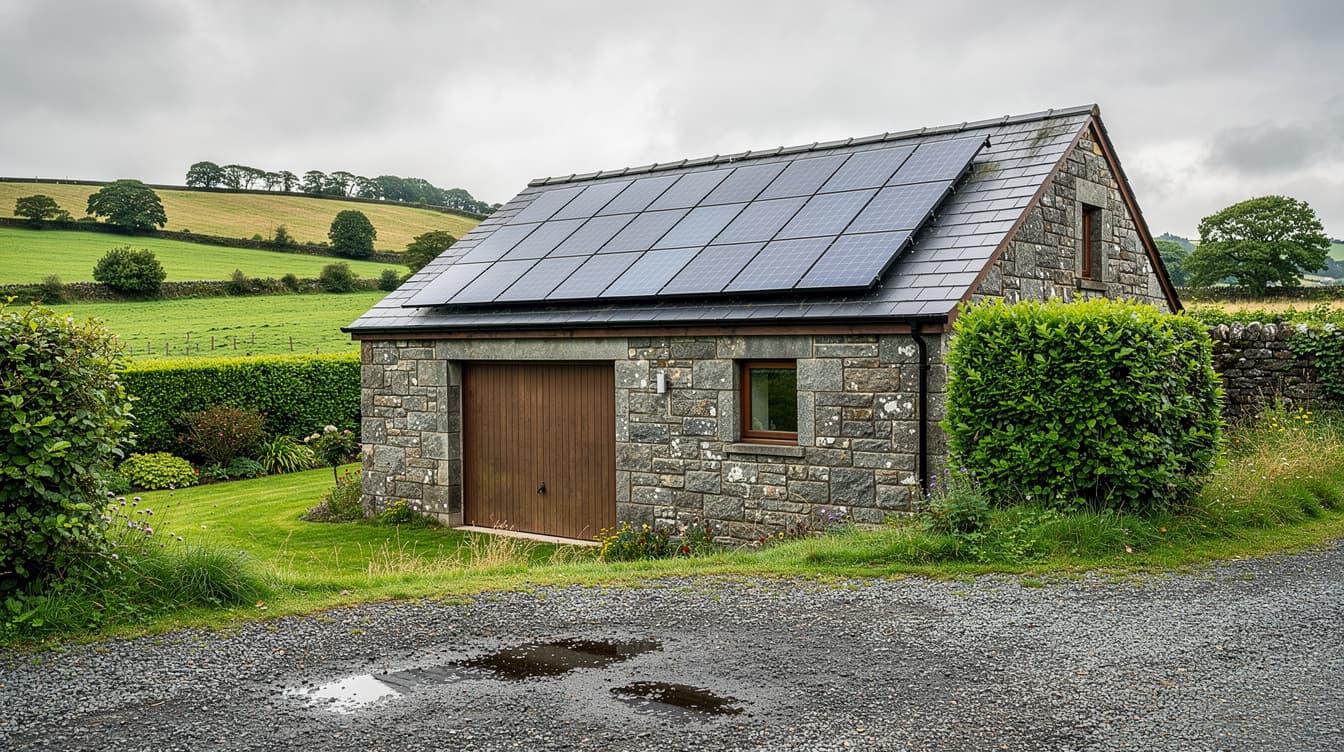
Solar Panels on a Shed, Garage or Outbuilding in Ireland 2026: Grants, Planning & Costs
The SEAI grant office gets a version of this call every week: "My south-facing house roof is shaded and useless — can I put the panels on my shed instead and still claim the €1,800?" The answer, unfortunately for most callers, is it depends what you mean by shed.
Solar on outbuildings is one of the most under-covered corners of the Irish market. The 2022 planning-permission overhaul made rooftop domestic solar effectively rule-free — but it left an awkward set of edge cases for detached garages, sheds, workshops, farm buildings and any structure that isn't the house itself. Some of them qualify for the grant. Some qualify for planning exemption but not the grant. And some are technically illegal to install on without a planning application, even now.
This is the 2026 map: which outbuildings the SEAI will pay for, the exact planning rules by structure type, realistic costs, and how to get power from an outbuilding array back into the main house without triggering an ESB re-registration.
Not sure if your shed or garage qualifies?
SEAI-registered installers on our panel do free site visits for outbuilding installs — they'll confirm grant eligibility and planning status before you commit.
The SEAI grant rule (in one sentence)
The SEAI Solar Electricity Grant pays for panels on the dwelling and any structure directly connected to it that shares the same MPRN, provided the whole property was built and occupied before 1 January 2021.
Applied to real Irish outbuildings, that means:
| Structure | Grant-eligible? | Why |
|---|---|---|
| Attached garage under the same roof | Yes | Treated as part of the dwelling |
| Detached garage on same MPRN, feeding house consumer unit | Usually yes | Shares meter, counted as domestic PV |
| Detached garden shed under 25 m², no independent MPRN | Yes if wired back to house | Same domestic connection |
| Standalone workshop with its own MPRN and meter | No (as domestic) | SEAI treats it as non-domestic; check TAMS 3 or IDA schemes |
| Farm shed or barn | Different scheme | Falls under TAMS III solar (up to 60% grant for farmers) |
| Home office cabin built after 2021 | Only if the main house was pre-2021 | Grant tied to occupancy date of dwelling, not outbuilding |
Two subtleties bite people in the SEAI application:
- The panels must be tied to your dwelling's electrical circuit. If your outbuilding has its own MPRN, ESB Networks treats it as a separate premises and it cannot share the grant. A single-house SEAI application will fail.
- The pre-2021 build test looks at the house, not the shed. If your bungalow is from 1978 but you slapped up a modern shed in 2024, that's still fine — SEAI is verifying you live in an eligible house.
Planning permission by outbuilding type
Since the September 2022 statutory instrument, roof-mounted solar on a domestic property is exempt from planning permission almost everywhere in Ireland. But the exemption has different clauses for different structures:
Attached garage (part of the house)
Treated identically to the house roof. No area limit, no protection radius. Only exception: protected structures, listed buildings and Architectural Conservation Areas (ACAs).
Detached garage or shed in your garden
Exempt if:
- Panels don't project more than 15 cm above the roof surface
- Panels don't extend above the highest point of the roof
- The outbuilding isn't in front of the house (between house and public road)
- Neither the outbuilding nor the house is a protected structure
There is no cap on outbuilding roof area covered after the 2022 revision. Older guides still cite the 12 m² or 50% roof limits — those were removed.
Ground-mounted array beside the house
Different, stricter set of rules. Must not exceed 25 m², must not be more than 2 m tall, must be at least 2 m from any boundary and cannot be between the house and the road. For an average 4 kWp system (~20 m² of panel), you're right at the ceiling — larger arrays need planning.
Farm buildings
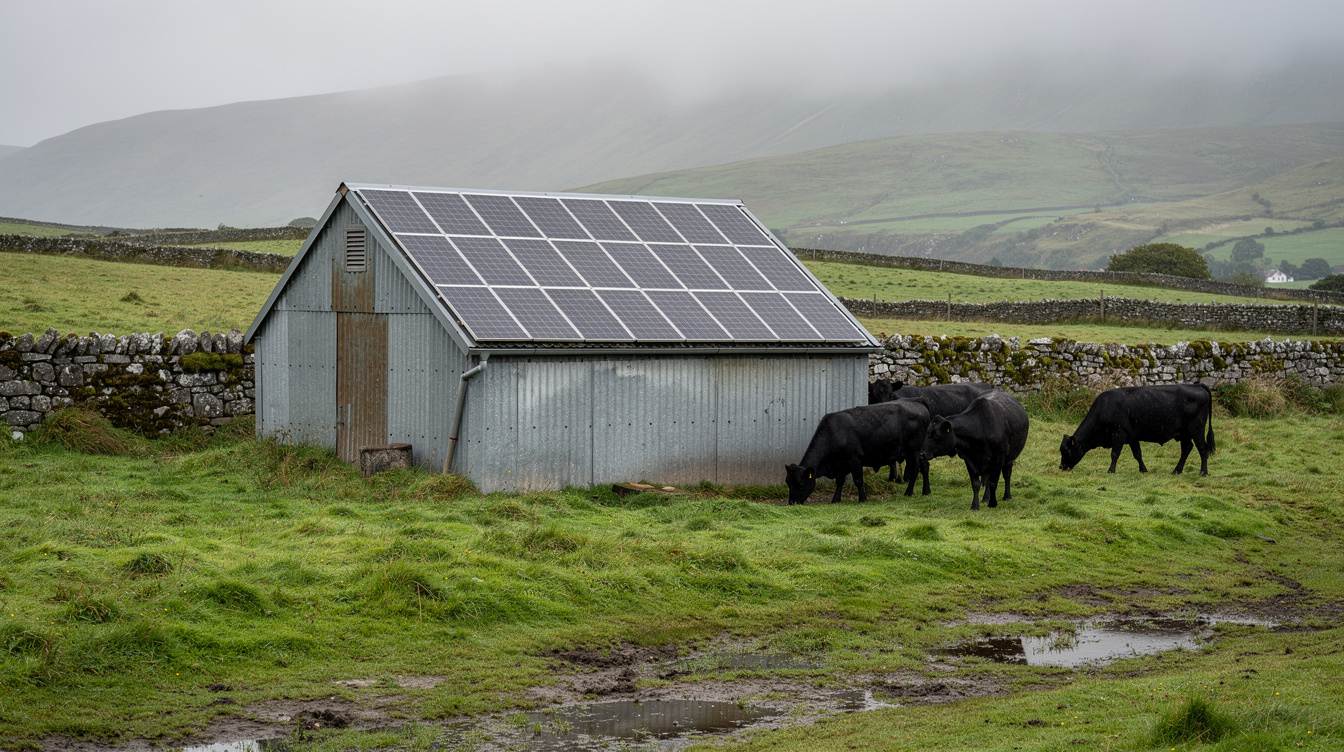
Panels on farm sheds and barns are generally exempt under a separate agricultural class of use. But two edge cases trigger permission: an ACA farm, or a shed in view of a protected structure. If your farm buildings are within 5 km of a designated heritage site, ring the county planner before proceeding.
Protected structures and ACAs
Always require planning permission for solar — on the house, on the shed, on the ground, regardless. The exemption doesn't apply full stop. Around 40,000 Irish properties are on the protected structures list.
The four common outbuilding installs (with 2026 costs)
1. Detached garage — 4 kWp, self-consumption
Typical use case: your house roof faces east and north-west; the garage roof faces south. Panels go on the garage, DC feed runs underground back to a hybrid inverter in the utility room.
| Line item | 2026 typical price |
|---|---|
| 10 × 405 W panels + mounting | €3,900 |
| 5 kW hybrid inverter | €1,700 |
| Underground DC trench + armoured cable (garage to house) | €900–€1,600 |
| Install, RECI cert, MCB works | €1,400 |
| Total before grant | €7,900–€8,600 |
| Less SEAI grant | − €1,800 |
| Net cost | €6,100–€6,800 |
2. Garden shed — 2 kWp, house-tied
Simpler jobs. Six panels on a well-oriented shed roof, single-phase micro-inverter feed back to the house consumer unit. About €4,800–€5,400 before grant, but only 2 kWp so grant caps at €1,400. Suits homes where the main roof is fully unusable (dormers, thatch, ACA).
3. Farm shed — 10–20 kWp, TAMS III
Different scheme entirely. TAMS III (Targeted Agricultural Modernisation Scheme) covers up to 60% of solar on qualifying farm buildings for approved farmers. Cost per kWp is lower (larger install) but you'll need the farm advisor to file. Talk to Teagasc before your installer.
4. Ground-mounted 4 kWp in the back garden
Only realistic when both the house roof and any outbuilding are unsuitable. Ground-mount frames add ~€900–€1,400 to a like-for-like rooftop install, plus civil works. And you must stay under 25 m² without planning — that's practically the ceiling of a domestic system.
Structural checks before you commit
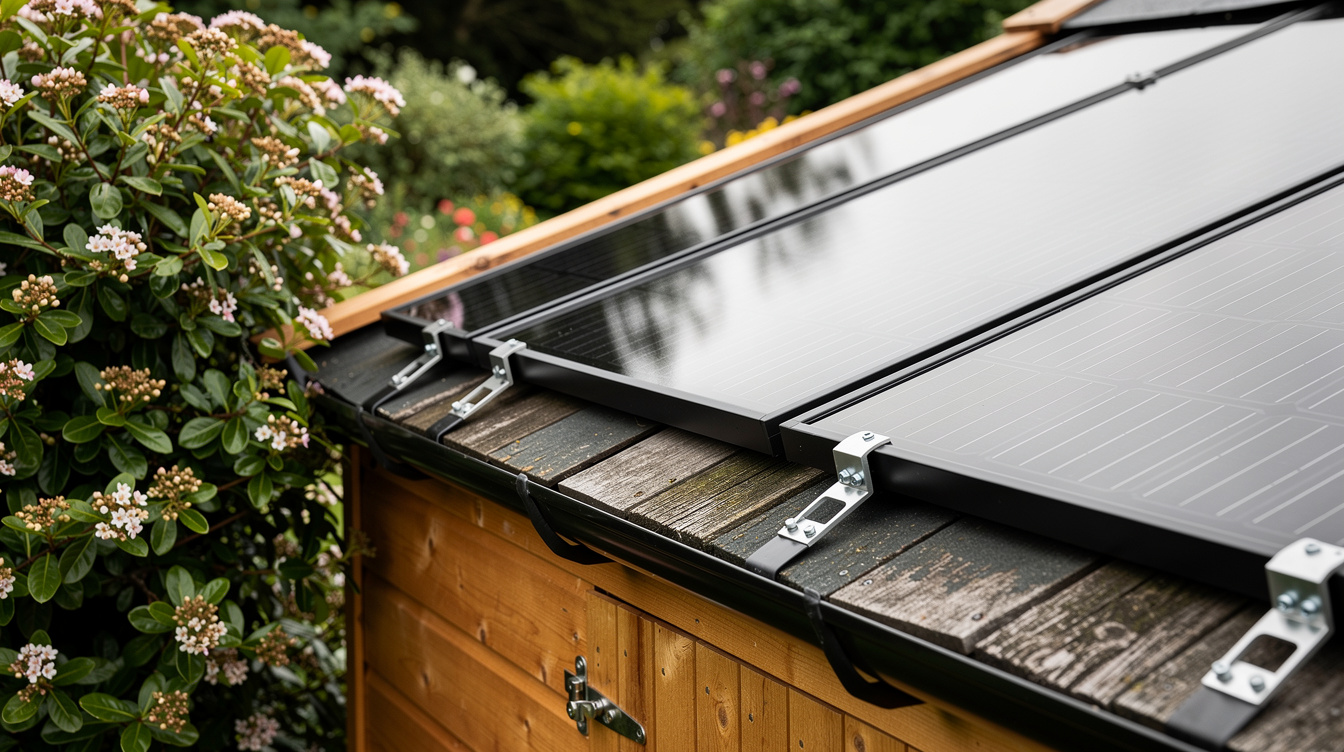
Not every shed roof can carry solar. A typical 400 W panel is about 22 kg, plus rails at ~4 kg per metre. A 4 kWp array puts around 300–350 kg spread over 20 m² — roughly the weight of one adult per two square metres. The three failure modes we see:
- Corrugated tin roofs on old sheds: the sheet metal is fine; the timber purlins underneath are usually rotten. Get a structural check.
- Fibre-cement (asbestos) sheeting: panels cannot be mechanically fixed through it without HSA-notified handling. Costs jump to €3,500+ for stripping and replacement before install. If your shed is pre-1999 and the roof is grey wavy sheet, assume it's cement-asbestos until tested.
- Timber sheds with felt roofing: fine for 6–8 panels max. The panels last 25 years; the felt lasts 12. Better to replace the felt before install, otherwise you'll be paying for a €700–€1,200 panel-off / panel-on job in a decade.
Wiring an outbuilding array back to the house
This is where 60% of the total install effort actually lives, and where DIY jobs go wrong most often. There are two legal ways to do it:
DC feed (most common)
Panels on the outbuilding roof, DC cable trenched underground back to a hybrid inverter inside the house utility room. Advantages: one inverter, one connection point, one CEG registration, no second earth. Disadvantages: DC volt drop over long runs (over ~40 m start losing efficiency; over 60 m needs oversized cable).
AC feed (for long runs)
Inverter mounted in the outbuilding, AC cable back to the house. Advantages: cheaper wire for long distances. Disadvantages: inverter in an unheated shed reduces lifespan; you need a proper AC isolation switch and an ESB Networks NC6 amendment.
Any competent SEAI-registered installer runs the volt-drop math for you and quotes the right method — but if a quote doesn't specify DC or AC feed and cable size, ask before you sign.
The connection-and-registration paperwork
An outbuilding-mounted array still needs the same paperwork as a rooftop one:
- NC6 (Notification of Connection) to ESB Networks before commissioning. Same form as normal.
- SEAI grant application via a registered installer before install starts — retrospective applications are rejected.
- BER re-cert is only mandatory for grant claims above €7,000 (SEAI One Stop Shop level) — not for a standalone €1,800 solar grant. But it's still worth doing to boost your BER rating.
- CEG registration with your supplier post-install to activate export payments.
Get an outbuilding solar quote today
Our SEAI-registered installers spec sheds, garages and farm buildings across Ireland. Free site visit, structural check and grant paperwork included.
When outbuilding solar beats rooftop solar
Rooftop is still the default answer for the vast majority of Irish homes. But outbuilding solar wins in five specific situations:
- Your house roof faces east/west or north with heavy shading, and a garage or shed has a proper south aspect (see our east-facing article before dismissing the main roof outright).
- Your house is a protected structure or in an ACA where solar isn't allowed, but your standalone garage is not itself protected.
- Your house roof is fibre-cement, thatch, badly perished slate or otherwise structurally unable to take the load.
- You want to future-proof for a home office, EV charger or heat pump in the outbuilding and running the AC circuit anyway.
- You're a farmer with a large south-facing shed and access to TAMS III — the economics beat any domestic installation.
FAQ
Can I claim two €1,800 grants — one for house, one for shed?
No. The grant is per MPRN, once. If both your house roof and your shed roof share the domestic meter, they count as one system with one combined kWp figure and one grant.
Do I need permission if my shed is technically in the front garden?
Yes. The forward-of-the-house restriction is absolute for exempted development. A tucked-away side-garden shed within the line of the house facade is fine; anything nearer the road is not.
What if my neighbour objects because the panels are visible from their garden?
Not their call. Planning exemption is not conditional on neighbour consent. Only if you're in an ACA or protected zone can visibility trigger an issue — and even then it's the planning authority, not the neighbour, who rules.
Can I use a plug-in balcony-style kit on my shed to avoid installer cost?
Currently no. Plug-in solar is not yet legal in Ireland (2026 rules still bar direct-plug systems — see our plug-in solar guide). Every install still needs an RECI-registered electrician and NC6.
What about lithium battery storage in the shed?
Fine, and increasingly common. A well-ventilated dry shed with a solid concrete floor is a better home for a battery than most utility rooms. Just make sure the shed is not less than 1 m from any timber structure, and that it doesn't freeze — lithium below 0°C loses cycle life.
Does an outbuilding install increase my house insurance premium?
Usually by nothing, but you must inform your insurer in writing. Failure to notify voids fire cover on both the outbuilding and the domestic circuit that panels connect to.
Bottom line
If you own an Irish house built before 2021, and your shed, garage or outbuilding has a south, south-east or south-west roof that's structurally sound and shares your electricity meter, you can claim the €1,800 SEAI grant on panels installed there — without planning permission, in most cases. Farm buildings have a separate, more generous scheme (TAMS III). Protected structures, ACAs and standalone workshops with their own MPRN are the outliers that need extra paperwork.
The economics look almost identical to a rooftop install once you factor in the trenching for the DC feed. The install just needs an installer who has actually done a dozen outbuilding jobs — ask for two reference sites before signing.
Ready to spec your outbuilding array?
Compare quotes from SEAI-registered installers with real outbuilding experience. Free, no obligation, delivered within 48 hours.
Related Articles
Solar Panels on Protected Structures & Listed Buildings in Ireland 2026: Planning, Section 5 & Real Costs
Own a Georgian or listed home in Ireland? Section 5 vs planning permission, what heritage installs actually cost, and what gets approved in 2026.
Green Mortgages Ireland 2026: How Solar Panels Unlock Cheaper Rates from AIB, BOI, PTSB, Haven & Avant
How Irish green mortgages work in 2026, what BER you need, and where a solar install pays back inside the mortgage itself. AIB, BOI, PTSB, Haven, Avant.
Best Solar Setup Ireland 2026: Complete System Design Guide
The best solar setup for Ireland 2026 — panels, inverter, battery, diverter and installer — with 4 real-world configurations, prices and paybacks.