
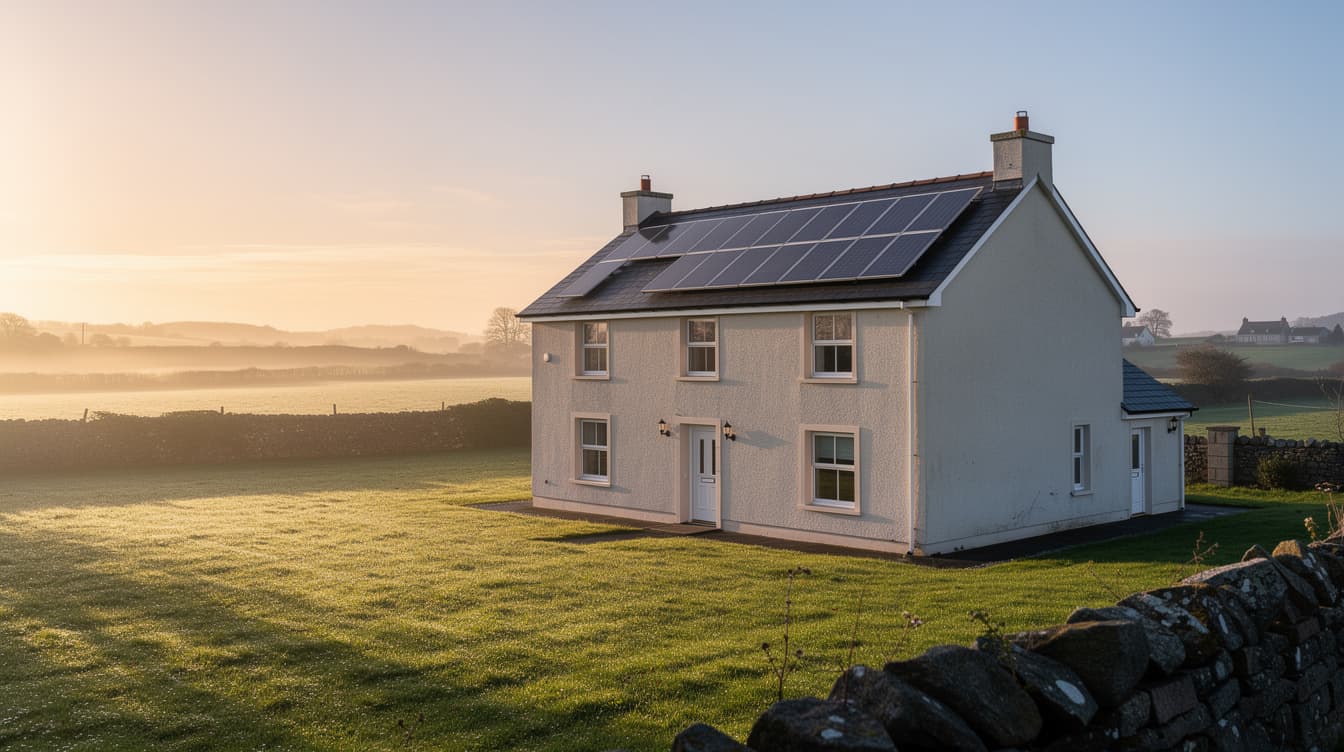
East Facing Solar Panels Ireland 2026: Do They Work? Yields, Costs & When East Beats South
Almost every solar buying guide written before 2020 said the same thing: "panels must face south or you're wasting your money." That advice was wrong even then — and in 2026, with cheaper panels, the Clean Export Guarantee paying you for surplus generation, and most Irish homes preferring power early and late in the day, an east-facing roof is no longer a dealbreaker. In fact, for a lot of households it produces a better real-world result than a south-facing array.
This guide tells you exactly what an east-facing solar array delivers in Ireland in 2026: yield numbers compared to south, when east is actually better than south, when it's not, what to expect on a quote, and how to spot an installer who's quietly downgrading your numbers to push you toward more expensive panels.
Quick Answer: Do East-Facing Solar Panels Work in Ireland?
Yes — east-facing solar panels in Ireland produce around 82–88% of what an identical south-facing array would generate (roughly a 12–18% yield reduction at a 30–35° roof pitch).
- South-facing 4 kWp array: ~3,400 kWh/yr
- East-facing 4 kWp array: ~2,900–3,000 kWh/yr
- Cost penalty: none — same install price, same SEAI €1,800 grant
- Payback penalty: ~1–1.5 extra years (10.5 yrs vs ~9 yrs typical)
East is actually better than south if you're home in the morning (work-from-home households, retirees, families with young children) or if your tariff has a higher daytime rate before noon — you self-consume more of what you generate.
The Real Numbers: East vs South in Ireland (2026 DEAP Data)
SEAI's DEAP software (the same one BER assessors use) models solar yield using Irish Met Éireann irradiation data. Across the typical Irish 30–40° roof pitch, here's the percentage of annual yield each orientation produces compared to a perfect south-facing reference (100%):
| Roof Orientation | Annual Yield (% of South) | Real kWh on 4 kWp System | Annual CEG + Self Income (est) |
|---|---|---|---|
| South (180°) | 100% | 3,400 kWh | ~€850 |
| South-East (135°) | 95% | 3,230 kWh | ~€810 |
| South-West (225°) | 95% | 3,230 kWh | ~€810 |
| East (90°) | 82–88% | 2,800–3,000 kWh | ~€720–760 |
| West (270°) | 82–88% | 2,800–3,000 kWh | ~€720–760 |
| East + West split | 85–90% | 2,900–3,050 kWh | ~€740–770 |
| North-East (45°) | 70–75% | 2,400–2,550 kWh | ~€600–640 |
| North (0°) | 60–65% | 2,050–2,200 kWh | ~€510–550 |
Three things worth flagging in this table:
- The east penalty is real but small. You're losing ~€100–130 of annual income on a 4 kWp system, not half your output. Over 25 years that's about €2,500–3,250.
- East and west are identical. Same number. They differ only in when the energy arrives — morning vs afternoon.
- North is still viable. A north-facing roof in 2026 produces 60% of south. With panels at €1,100/kWp installed (after grant), that's actually still cash-positive over the system lifetime — just slower payback (~14–16 years).
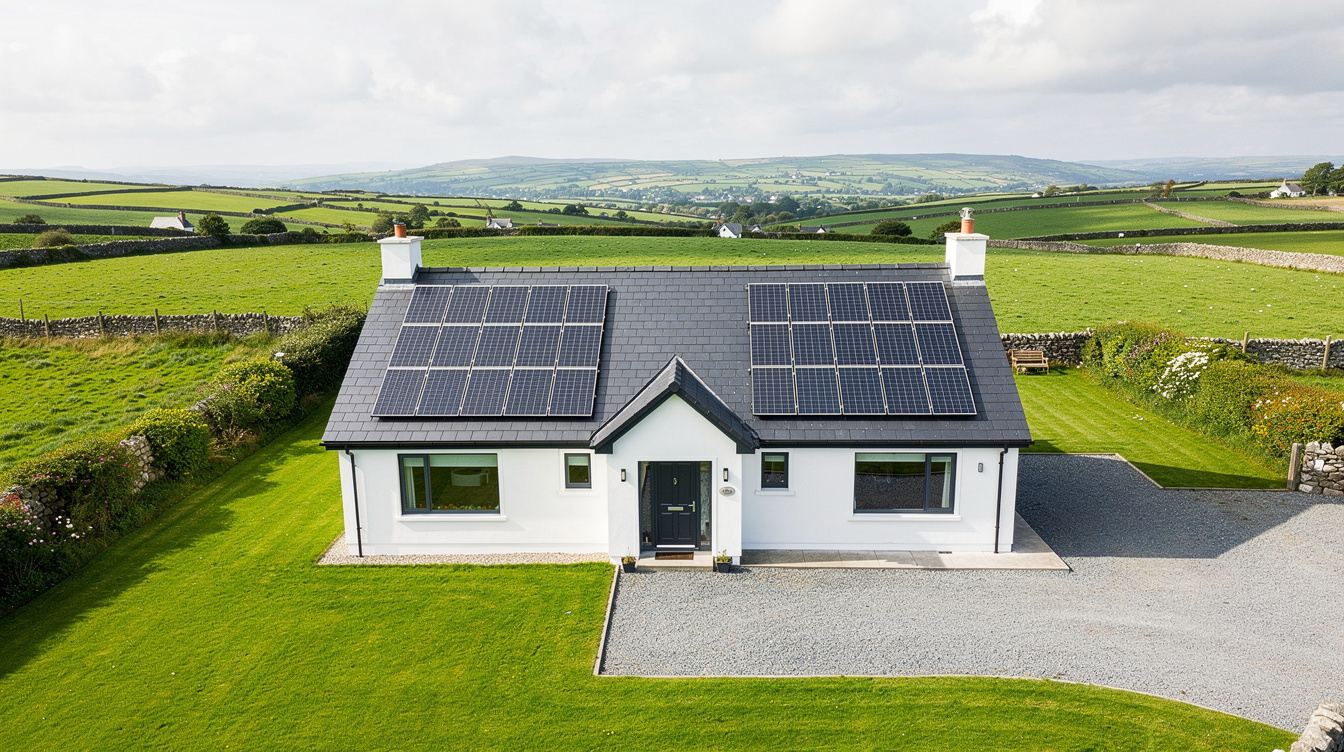
When East Is Actually Better Than South
Counter-intuitively, an east-facing roof can produce a better financial return than south in three situations. The reason is self-consumption: the only kWh that fully replace your retail electricity rate (around 35 cent in 2026) are the ones you use as they're generated. Exported kWh earn the Clean Export Guarantee rate (around 18–22 cent), so each kWh you use yourself is worth nearly twice as much.
| Situation | Why East Wins |
|---|---|
| Work-from-home household | Most home-office, kettle and laundry use happens 8–12 noon. East peaks at 10am — you self-consume 50–60% vs 35% for south. |
| Family with young children | Breakfast, baby bottles, washer-dryer loads — all morning. Self-consumption beats south's afternoon glut. |
| Retired homeowners | Earlier rising, breakfast cooking, morning baking. Better match with east generation curve. |
| No battery, no diverter | Self-consumption matters more than total kWh. East often matches use 5–10 percentage points higher than south. |
If you fall in any of those categories, an east-facing roof is not a compromise — it's actually an asset.
When East Is a Bad Choice
- Empty-home daytime users: If nobody's home before 5pm, an east array generates while the house is empty. You'll export most of it at 18–22 cent and lose the south advantage of late-afternoon peak that matches the after-school/work spike.
- Heat pump + immersion home, no diverter: Heat pumps and immersions typically run when scheduled (often around midday). South better matches that.
- Heavy EV charging at home: EVs usually charge overnight or in the early evening — a south or west array catches more of that, especially with a battery to store the afternoon peak.
Unsure if East Works for Your Usage Pattern?
SEAI-registered partners do free 24-hour load shape analysis using your last 12 months of smart-meter data. They'll model east vs south for your actual usage — no guesswork.
The East-West Split Array: The Best of Both Worlds
The single most underrated configuration for Irish homes is the east-west split array: half your panels on the east-facing slope, half on the west-facing slope of the same roof. Total annual yield is around 85–90% of an equivalent south array — but the production curve is much flatter.
What that means in practice:
| Time of Day | South Array Output | East-West Split Output |
|---|---|---|
| 8am | Low (~15% of peak) | Mid (~40% of peak) |
| 10am | Rising (~55%) | Strong (~75%) |
| 12pm | Peak (100%) | Steady (~75%) |
| 3pm | Falling (~55%) | Strong (~75%) |
| 5pm | Low (~15%) | Mid (~40%) |
Result: you self-consume 40–50% of generation without a battery (vs 30–35% for south). Over a year, the east-west split household often earns more than the south-facing house with the same number of panels — because more kWh are used at retail rate instead of exported at the lower CEG rate.
If your roof has both an east and a west slope, ask your installer to quote a split array, not just one side. Most modern hybrid inverters handle dual-orientation strings without issue.

Common Installer Tactics on East-Facing Roofs
| Tactic | What's Actually Happening | What to Say |
|---|---|---|
| "East won't work, you need premium panels" | Upsell. East works fine on any tier-1 panel. Premium panels gain ~3% efficiency — nowhere near the cost difference. | "DEAP shows 82–88% yield on east. Why are you quoting 60%?" |
| "We'll mount tilt-frames to angle them south" | Tilt-frames on a pitched roof = planning permission risk + ugly + 30% more €/kWp. Almost never worth it. | "What's the yield gain after the frame cost? Show me the maths." |
| "You can't apply for the SEAI grant on east" | False. SEAI doesn't restrict by orientation. As long as the system is ≥ 2 kWp and installed by an SEAI-registered installer, you get the €1,800. | "Show me the SEAI rule that says that." (They can't — it doesn't exist.) |
| "We'll only quote 6 panels because of yield loss" | Wrong approach. Yield loss is per-panel. You size for total annual kWh, not per-panel performance. | "Size to my kWh, not to your assumed yield. I want a 4–5 kWp system." |
Worked Example: 3-Bed Semi with East-Only Roof
Dublin 3-bed mid-terrace, family of 4. Annual use: 3,800 kWh. South-facing roof is over an extension and unusable (felt-only, no rafters that meet wind load). East-facing main roof: 26 m² clear, 35° pitch, no shading.
- System: 10 panels × 450W = 4.5 kWp
- Cost (2026): ~€9,800 — SEAI grant €1,800 = €8,000 net
- Annual yield: 4.5 kWp × 850 kWh/kWp × 0.85 (east factor) = ~3,250 kWh
- Self-consumption (work-from-home household): ~50% = 1,625 kWh saved at €0.35 = €570
- CEG export: 1,625 kWh × €0.20 = €325
- Total first-year saving: €895/yr
- Payback: ~9 years — better than the south-facing alternative because of higher self-consumption
This household's east-facing roof actually delivers a better financial outcome than south would, because their morning-heavy usage pattern matches the production curve.
Other Frequently Asked Questions
Do I need different panels for an east-facing roof?
No. Any tier-1 mono panel (Jinko, AIKO, LONGi, Trina, JA, etc.) works on any orientation. Premium half-cell or bifacial panels gain a couple of percent — not enough to justify the upgrade if you're choosing solely based on orientation.
What about east-facing roofs with shading?
Shading hurts every orientation, but east-facing is more sensitive in the morning hours when most of your generation happens. If you have a chimney, dormer, or trees to the east, ask your installer for microinverters or DC optimisers instead of a string inverter. Cost adds ~€500–1,200 but protects yield against partial shade.
What roof pitch is best for east-facing panels in Ireland?
Flatter pitches (20–30°) actually improve east-facing yield slightly because the sun is lower in the morning. Steep roofs (45°+) compromise east more than south. Most Irish housing-estate roofs are 30–40° — this is fine for east.
Will an east-facing roof affect my SEAI grant?
No. The SEAI €1,800 grant has no orientation requirement. The only criteria are: house built before 1 January 2021, you live there, you've not received a prior PV grant on the MPRN, and the installer is SEAI-registered.
Does an east-facing solar array still add to my BER rating?
Yes. The DEAP software inside the BER calculation knows about east-facing arrays and credits the actual modelled yield. You typically get a sub-band BER uplift on a 4 kWp east system, same as south — sometimes even a full grade lift for homes starting at C2–D1.
Should I add a battery if my roof is east-facing?
If you're already getting 50%+ self-consumption from your usage pattern, the battery payback gets longer because there's less excess to store. For empty-home daytime households on an east roof, a 5 kWh battery is more valuable than for south because it shifts the morning peak to evening — check our battery guide.
What if I'm replacing the roof tiles in the next 5 years?
Tell the installer. Solar panels can be lifted and re-installed during a re-roof, but adds €1,500–2,500 of labour. If a re-roof is planned, it's cheaper to combine it with solar install in one trip.
Get an Honest Quote on Your East-Facing Roof
Our SEAI-registered partners quote east-facing arrays the same way they quote south — no penalty pricing, no dismissive "won't work" upsells. Free, no obligation, three competing quotes.
Related reading: East & West Facing Roof Solar Panels · Best Solar Panel Direction in Ireland · Solar Inverters Ireland 2026 · How Many Solar Panels Do I Need
Related Articles
Solar Battery Brands Ireland 2026: Tesla Powerwall 3 vs BYD vs Pylontech vs Sigenergy vs Sunsynk Compared
Compare Tesla Powerwall 3, BYD, Pylontech Force H2, Sigenergy and Sunsynk for Irish homes in 2026: installed prices, warranties, cycle counts, backup and V2G.
PV Solar Diverter Ireland 2026: Eddi vs iBoost vs PowerDiverter Compared
Compare Eddi, Solar iBoost+ and PowerDiverter for Irish solar homes in 2026: real prices, install costs, VAT savings, and honest payback vs the CEG.
2kW Solar System Ireland 2026: Cost, Suitability & Payback for Small Homes
2 kWp solar in Ireland 2026: costs €3,500 net after €700 SEAI grant, generates 1,850 kWh/yr south-facing, pays back in 5.4 years. When it fits vs going to 4.4 kWp.