
Solar Roof Tiles Ireland 2026: Real Cost, Availability & Honest Comparison
Solar roof tiles look beautiful. The marketing photos are stunning. But in Ireland, the reality in 2026 is more nuanced than the brochures suggest. Here’s what they actually cost, what’s actually available, and when (if ever) they make sense over conventional panels.
Solar roof tiles — also called solar shingles, BIPV (building-integrated photovoltaics), or in-roof solar — promise the holy grail of residential solar: a roof that generates electricity but looks like a normal roof. No bulky black rectangles bolted onto your slates. Just a clean, uniform surface that quietly powers your home.
If you’ve seen Tesla’s Solar Roof launch videos or the GAF Timberline Solar promo material, you’ve seen the dream. The reality in Ireland in 2026 is… more complicated. This guide gives you the honest picture: what’s available, what it costs, who installs it, and whether it’s worth waiting for if you’re building or re-roofing.
The three things people mean by “solar roof tiles”
Confusingly, the same term gets used for three quite different products. Get this distinction clear before you talk to any installer.
| Product type | What it actually is | Available in Ireland 2026? |
|---|---|---|
| True solar shingles (Tesla Solar Roof, GAF Timberline Solar, CertainTeed Apollo II) | Each individual roof tile or shingle is a tiny solar cell. Replaces the entire roof. | No. None of these are officially sold or supported in Ireland. |
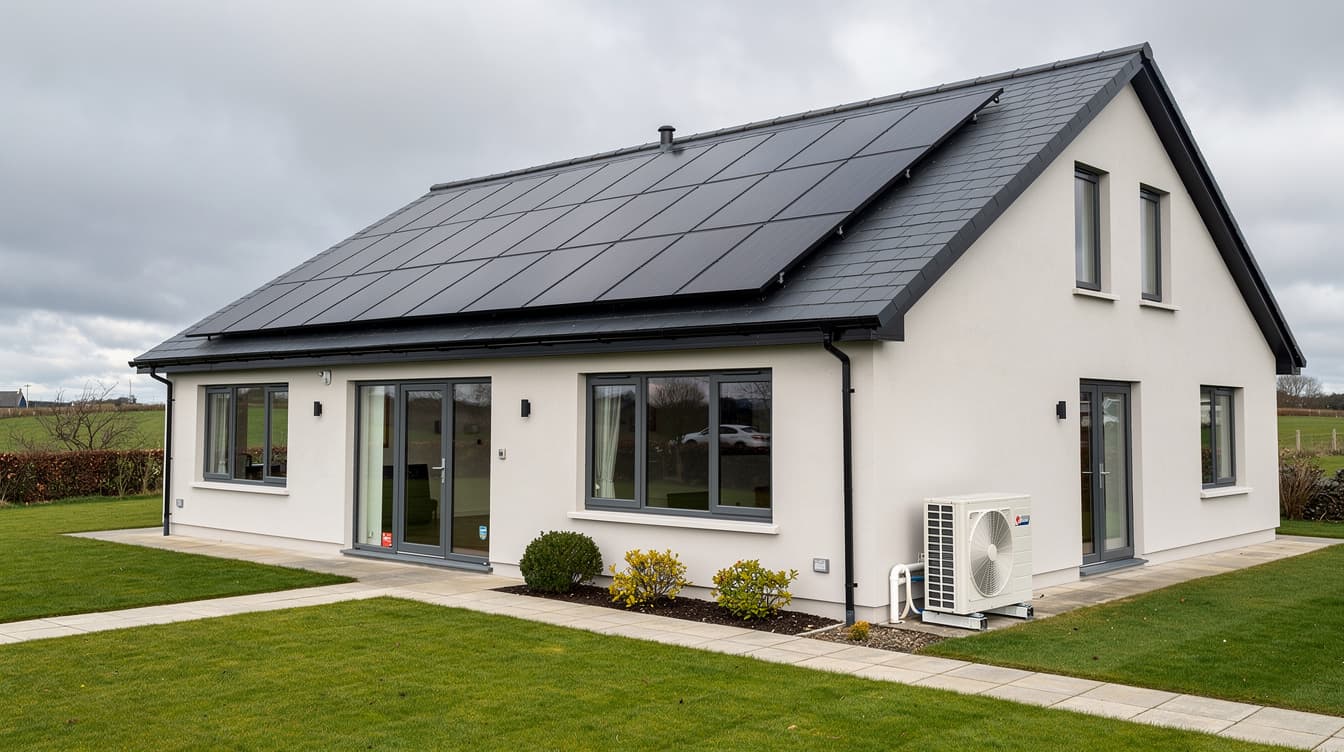
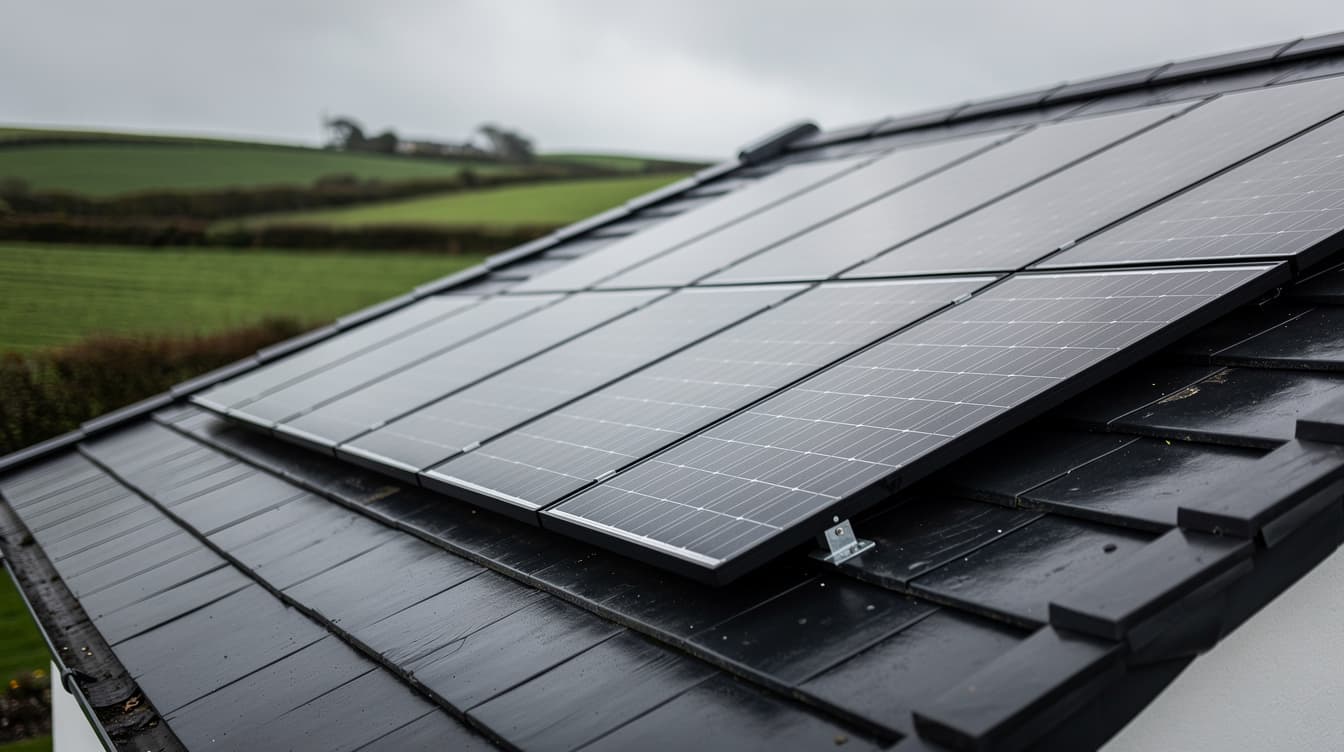
| In-roof / integrated panels (GSE In-Roof, Viridian Clearline Fusion, K2 Sungrip InsertRail) | Standard solar panels mounted flush with the roof, replacing the slate underneath. Looks tidy, no “hat” effect. | Yes — widely available, especially for new builds. |
| Solar slates (e.g. Marley SolarTile, Nulok Eclipse) | Small modular slate-shaped solar tiles. Installs interspersed with conventional slates. | Marley SolarTile: yes via specialist roofers. Most others: no. |
For 99% of Irish homeowners, “solar roof tiles” in practice means option 2 — in-roof integrated panels. Let’s start there.
In-roof solar panels: the real Irish “solar tile” option
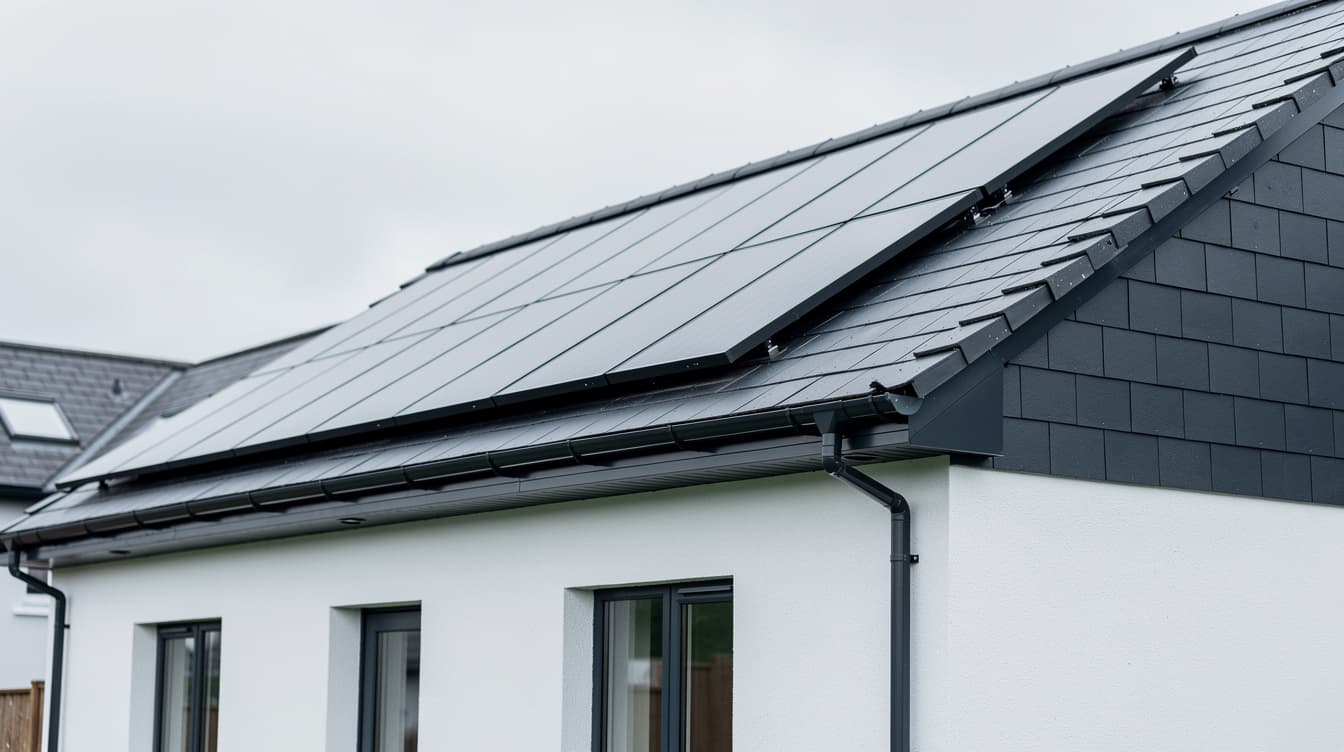
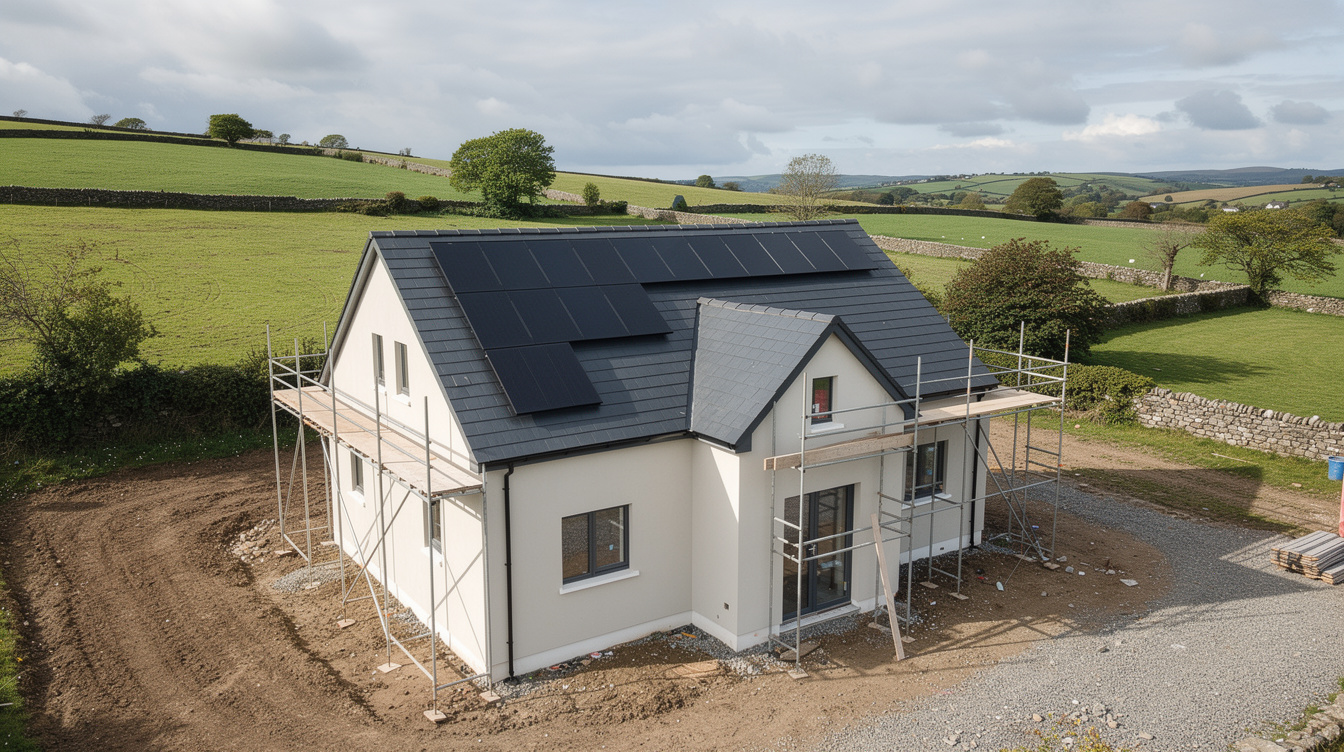
In-roof panel systems use standard PV panels (Longi, JinkoSolar, JA Solar, REC, etc.) but mount them flush with the slate or tile line using a special tray system. The visual result is a clean, low-profile array that sits IN the roof rather than ON it.
This is the option you’ll actually get quoted on in Ireland. Two main systems are in regular use:
- GSE In-Roof System (French manufacturer, widely stocked in Ireland). Polypropylene tray that replaces the slates underneath the panels. Installs in 1–2 days for a 4–6kWp array.
- Viridian Clearline Fusion (UK manufacturer, MCS-certified). Aluminium-and-EPDM frame. Slightly more expensive but generally regarded as the cleaner finish.
What in-roof systems cost in Ireland in 2026
The headline: an in-roof install costs roughly 20–35% more than the equivalent “on-roof” (bolt-on) array. But on a new build or full re-roof, the math gets much better because you save on slate.
| System size | Standard on-roof install | In-roof install (retrofit) | In-roof on new build (slate offset) |
|---|---|---|---|
| 3kWp (7–8 panels) | €6,500–€8,000 | €8,500–€10,500 | €7,500–€9,000 |
| 4kWp (10–11 panels) | €7,500–€9,500 | €10,000–€12,500 | €8,500–€10,500 |
| 5kWp (12–14 panels) | €8,500–€10,500 | €11,500–€14,000 | €9,800–€11,800 |
| 6kWp (15–17 panels) | €9,500–€11,500 | €13,000–€15,500 | €11,000–€13,000 |
All prices are before the €1,800 SEAI grant, which applies to in-roof systems exactly the same as on-roof — provided your installer is on the SEAI register.
Quote in-roof vs. on-roof
Get a personalised quote and we’ll show you both options side-by-side. SEAI-registered installers only.
When in-roof actually makes sense
Don’t pay the in-roof premium unless one of these is true:
- You’re building new. Slate or tile you don’t install offsets a chunk of the panel cost. A 4kWp in-roof array uses roughly 25 m² of roof you don’t need to slate.
- You’re re-roofing anyway. Same logic. If the slate is coming off, integrating panels at the same time costs barely more than separate jobs done years apart.
- You’re in a conservation area or near a protected structure. Some planning authorities (notably parts of Dublin City Council and Cork City Council’s historic core) prefer flush in-roof solar over bolt-on panels for visual reasons. In a tiny number of cases, they require it.
- The aesthetic genuinely matters to you and resale value. A clean flush array adds 1–3% to resale value vs. bolt-on, per RICS data on Dublin and Cork sales 2024–2025. That can recoup the install premium on a higher-end property.
If none of these apply — if you have an existing roof in good nick and just want the cheapest path to solar electricity — stick with conventional on-roof panels. The 25–35% saving funds your battery storage or covers a chunk of a future heat pump install.
Why Tesla Solar Roof isn’t (and probably won’t be) sold in Ireland
Tesla Solar Roof — the product that’s done more for solar tile awareness than any other — has been in development since 2016. As of mid-2026 it is:
- Available only in selected US states, with a network of certified Tesla Roofers
- NOT sold in Europe, the UK, or Ireland
- Quietly de-emphasised by Tesla itself in favour of conventional panels in its Tesla Energy lineup
- Priced in the US at roughly $4.50–$6.00/W installed — about three to four times the cost of a standard panel system
Translated to Ireland, a Tesla Solar Roof equivalent of a 6kWp system would cost €28,000–€38,000 if it were available — before the roof underneath, electrical work, and import duties. The Tesla Powerwall 3 IS available in Ireland; the Solar Roof is not, and Tesla has given no Irish launch date.
If you’ve been quoted a “Tesla Solar Roof” by an Irish installer in 2026, ask very pointed questions about where the product is coming from, how it’s being warranted, and who handles claims. Most cases are either (a) the installer is conflating it with a Powerwall + standard panels, or (b) it’s an unofficial grey-import without manufacturer warranty.
GAF Timberline Solar and other US shingles
GAF Energy launched the Timberline Solar shingle in 2022 and it’s become the best-selling solar shingle in the US, partly because it nails on like regular asphalt shingles. But:
- Ireland uses slate or concrete tiles, not asphalt shingles. The Timberline product doesn’t fit Irish roof construction.
- No Irish distributor or trained installer network.
- No CE marking or MCS certification for the EU/Ireland market.
- No SEAI grant eligibility, even if you somehow imported it — the SEAI register lists products, not just installers.
The same applies to CertainTeed Apollo II and other US shingle products. None are realistic options in Ireland in 2026.
Marley SolarTile and modular slate-style solar
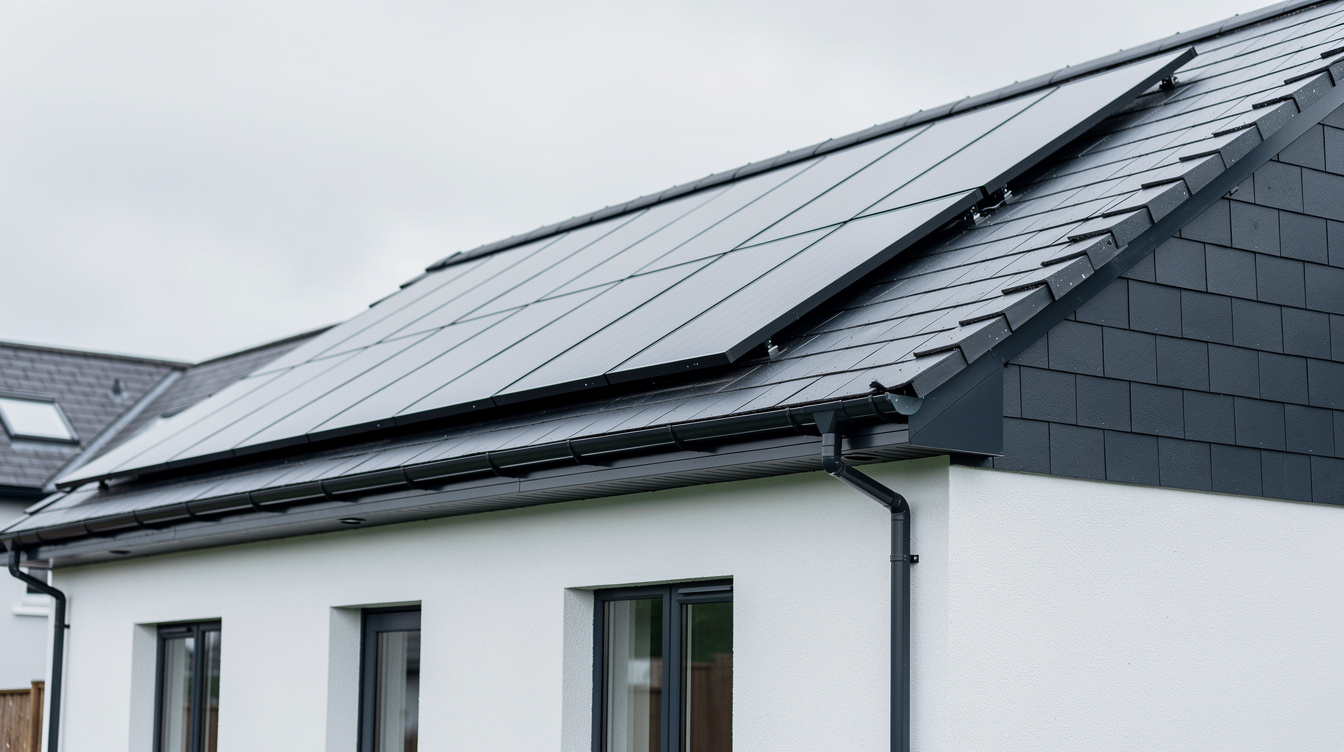
The one true “solar tile” product that has gained any traction in Ireland is the Marley SolarTile — a slate-effect modular solar panel sized to interleave with standard concrete tiles. A few characteristics:
- Each tile generates roughly 38–45W. You need about 90–100 tiles for a 4kWp system.
- Installs by a roofer (not a solar PV firm) using standard tile fixings, with an electrical sign-off at the end.
- Cost: roughly €14,000–€18,000 for a 4kWp setup, before grant. Significantly more than in-roof panels.
- Aesthetic match with concrete tile roofs is excellent. Less convincing on slate roofs.
- Output per m² is lower than full-size panels — you need more roof area for the same kWp.
Realistically, this is a niche product for homeowners who really hate the look of standard panels and have roof area to spare. The economics make it a worse investment than in-roof panels for most.
The honest comparison: solar tiles vs. conventional panels in Ireland 2026
| Criterion | Conventional panels | In-roof integrated | Solar tiles (Marley) |
|---|---|---|---|
| Cost per kWp installed | €1,600–€1,900 | €2,200–€2,800 | €3,500–€4,500 |
| Aesthetics | Visible “raised” panels | Flush with roof line; tidy | Best — looks like roof tiles |
| Efficiency / output | 21–22% (best in class) | Same as conventional (same panels) | 14–17% (smaller cells) |
| Install time | 1–2 days | 2–3 days | 4–6 days (roofing job) |
| SEAI grant eligible | Yes — €1,800 | Yes — €1,800 | Yes if installer is registered — €1,800 |
| Payback period (avg Irish home) | 6–8 years | 8–11 years | 12–16 years |
| Installer availability | 400+ SEAI-registered | ~80 installers offer it | ~15 specialist firms |
| Future replacement / maintenance | Easy — lift, swap, refit | Moderate — involves tray system | Harder — needs roofer |
Planning permission for solar tiles in Ireland
Good news: solar tiles, in-roof panels, and conventional panels all fall under the same planning exemption introduced in October 2022 (S.I. No. 493/2022). For domestic properties:
- No planning permission needed for roof-mounted solar (any style) on most homes
- Exemption now includes flat roofs and many previously-restricted areas
- Protected structures (RPS) and ACAs (Architectural Conservation Areas) still require council approval — in-roof or solar tile solutions tend to get approval more easily than bolt-on panels
- Listed buildings always need explicit consent; have the conversation with your council’s conservation officer early
See our complete Irish solar planning guide for the full rules.
Are solar tiles a good fit for an Irish climate?
Yes, with one caveat. All three product types — conventional, in-roof, and solar tile — perform fine in Irish conditions: lots of diffuse light, moderate temperatures, occasional storms. There’s no climate-based reason to prefer or avoid solar tiles in Ireland.
The one Irish-specific consideration: storm uplift. Atlantic-facing properties in Donegal, Mayo, Galway, Clare, Kerry and west Cork need wind-load engineering on any solar install. Both conventional and in-roof systems handle this with the right fixings. Marley SolarTile and similar modular products use standard slate fixings, which limits them to wind-load-zone 1–2 sites — not the wildest Atlantic exposures.
Buying advice in 2026: the simple decision tree
- Are you building new or re-roofing? Get an in-roof quote alongside the standard quote. The premium is much smaller and the aesthetics worth it.
- Existing roof in good condition, panels just being added? Standard on-roof panels. Save the 30% and put the difference into a battery or larger array.
- Conservation area or planning officer asking for “low visual impact”? In-roof. Document the planning conversation and feed it back to your installer to scope properly.
- You hate the look of panels and money isn’t the issue? Marley SolarTile via a specialist roofer + electrician. Be ready for the longer install and higher cost.
- You read about Tesla Solar Roof and want one? Wait. It’s not coming to Ireland soon. The current best option is in-roof panels with all-black frames — visually very similar.
Frequently asked questions
Are solar roof tiles more efficient than panels?
Generally no — they’re usually less efficient per m², because individual tiles are smaller and have more gaps. In-roof integrated panels use the same cells as on-roof panels, so efficiency is identical — the difference is purely cosmetic and structural.
Will solar tiles damage my roof?
A correctly installed in-roof system is actually a tighter weather seal than slates + bolt-on panels, because the integration tray sheds rainwater under-tile. Poorly installed: yes, leaks happen. Use an SEAI-registered installer with at least 5 years of in-roof experience.
Do solar tiles work in cloudy Irish weather?
Yes — same as conventional panels. Modern PV cells generate 25–30% of peak output even on heavily overcast days. Annual output for any solar product in Ireland is around 850–950 kWh per kWp installed, regardless of whether it’s in-roof, on-roof, or solar tile.
Can I retrofit solar tiles onto my existing house?
Marley SolarTile-style modular tiles: yes, but you essentially re-roof the affected section. In-roof systems: yes, by stripping the slate where panels will go, installing the integration tray, and re-slating the rest. Best done if your roof is approaching end of life anyway.
What’s the warranty on in-roof solar in Ireland?
Panel warranties are unchanged from on-roof installs — typically 25–30 years performance, 12–15 years product. The integration tray adds a separate 10–15 year warranty (GSE: 10 years; Viridian: 15 years). Workmanship warranty depends on the installer — insist on 5+ years.
Do solar tiles add to my home insurance premium?
No more than conventional panels. Most Irish insurers (Allianz, Aviva, AXA, Liberty) treat any SEAI-grant-eligible install identically. You must declare the install to your insurer; failure to do so can void claims.
If a tile fails, how do I replace it?
For in-roof systems, the same as a normal panel: a roofer lifts the surrounding slates, the panel is unclipped and swapped, slates go back. Half-day job, usually. For Marley SolarTile, the failed tile is unbolted and the replacement slotted in — a 1–2 hour job per tile.
The bottom line for Irish homeowners
Solar roof tiles, in the strictest sense, are mostly a marketing category in Ireland in 2026. The genuine option is in-roof integrated panels, which are a 20–35% premium over conventional on-roof for a noticeable aesthetic improvement.
For most homeowners with an existing roof in good condition, the premium isn’t justified. For new builds, re-roofs, and conservation-sensitive properties, it is.
The dream of a fully solar-shingled Tesla-style roof remains, for now, mostly a US phenomenon. The current best Irish equivalent is an all-black, frameless, in-roof panel array — which looks remarkably close to the dream and costs a fraction of what an imported solar shingle system would.
Ready to Go Solar?
Get your free personalised quote from SEAI-registered installers. Specify “in-roof option” if you want it priced alongside standard on-roof.
Further reading: Best Solar Panels Ireland 2026: 8 Brands Compared, Solar Panel Costs Ireland 2026, SEAI Solar Grant 2026 Guide, Planning Permission for Solar Panels Ireland.
Related Articles
4kW Solar System Cost Ireland 2026: Real Prices, Output & Payback
Real 2026 Irish 4kW quotes (€7,210 gross, €5,410 net after €1,800 SEAI grant), 3,600–4,200 kWh/yr output, 4.8yr payback and when 4kW beats 3kW or 5kW.
10kW Solar System Cost Ireland 2026: Price, Output & When It’s Worth It
Real 2026 Irish installer prices for a 10kW solar system (€14,300 gross – €1,800 SEAI grant), three-phase rules, expected output and when 10kW beats 6kW.
Solar Panel Brands Ireland 2026: Longi, JA, Jinko, Trina, Canadian, REC & SunPower Compared
Honest 2026 comparison of Longi, JA, Jinko, Trina, Canadian, REC and SunPower for Irish homes — real installer prices, warranty gaps and when premium pays off.