
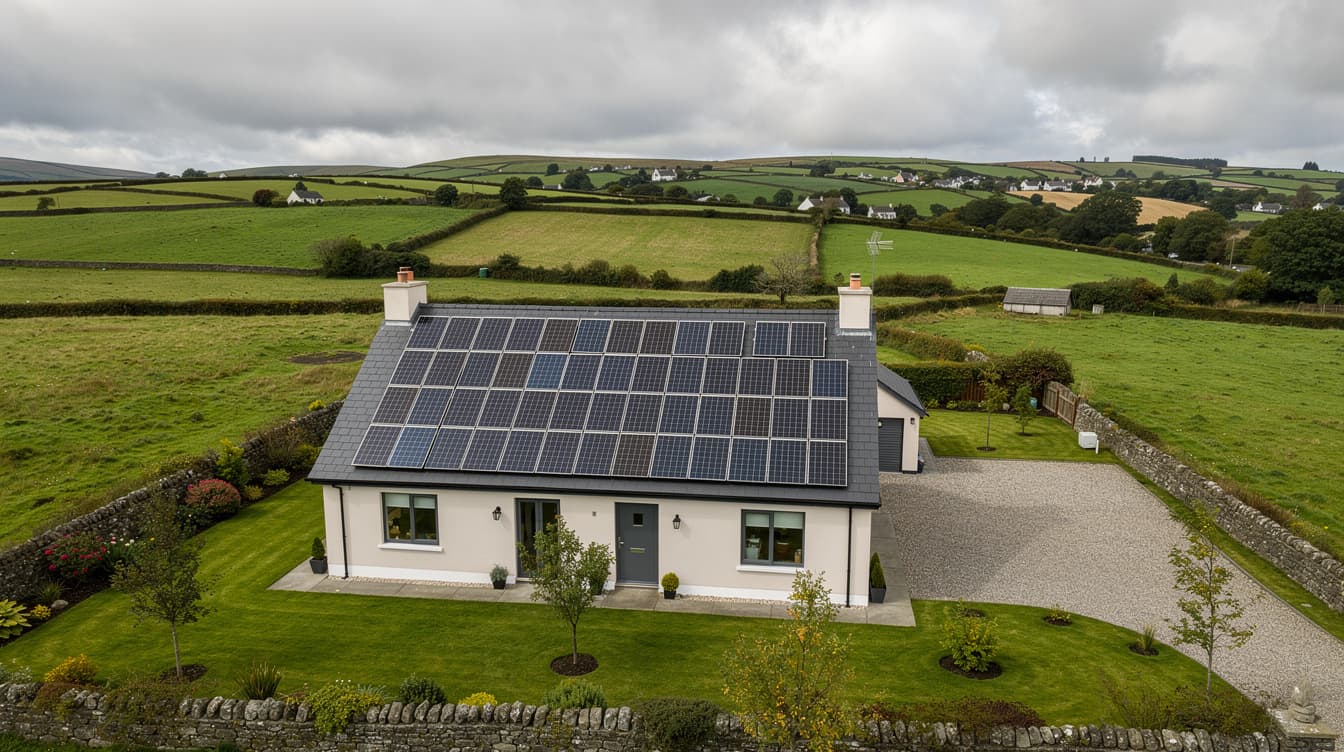
Solar Panels for a 4-Bed House in Ireland 2026: Costs, System Sizes & Real Savings
A 4-bedroom house in Ireland typically uses 4,500–6,000 kWh of electricity per year — significantly more than a 3-bed semi. The good news? A larger roof means more space for panels, and a 5–6.5 kW system can slash your electricity bills by €1,100–€1,600 annually. After the €1,800 SEAI grant and 0% VAT, most 4-bed homeowners pay €4,500–€7,500 out of pocket and see a full payback in 4–6 years.
This guide is specifically for 4-bedroom homes — detached, semi-detached, and dormer bungalows. We cover the right system size for your consumption, real 2026 pricing, roof space calculations, and whether adding a battery makes financial sense at your usage level.
What Does a 4-Bed House Actually Use?
Before sizing a solar system, you need to understand your electricity consumption. A 4-bed house uses more than a 3-bed for several reasons: more occupants, more appliances, often a larger hot water demand, and increasingly, an electric vehicle or heat pump.
| 4-Bed Household Type | Annual Electricity Usage | Key Drivers |
|---|---|---|
| Couple or small family, gas heating | 4,000–4,500 kWh | Cooking, lighting, appliances |
| Family with teenagers | 5,000–6,000 kWh | Multiple devices, gaming, tumble dryer |
| Family with EV | 6,500–8,000 kWh | EV adds 2,000–3,000 kWh/year |
| Family with heat pump + EV | 8,000–11,000 kWh | Heat pump adds 3,000–5,000 kWh/year |
How to find your actual usage: Check your last 12 months of electricity bills, or log into your supplier's online portal. If you have a smart meter, your supplier can give you an exact annual figure. This number is the single most important input for sizing your solar system correctly.
How Much Do Solar Panels Cost for a 4-Bed House? (2026 Prices)
Here are the real costs for a 4-bedroom house in Ireland in 2026. All prices include installation and are shown after the €1,800 SEAI grant. VAT on solar panels is 0% until at least 2030.
| System Size | Panels | Cost (After Grant) | Annual Output | Annual Savings | Payback |
|---|---|---|---|---|---|
| 4 kW | 10 | €3,500–€4,500 | 3,600–4,200 kWh | €900–€1,100 | 4–5 years |
| 5 kW | 12–13 | €4,500–€5,800 | 4,500–5,250 kWh | €1,100–€1,400 | 4–5 years |
| 6.5 kW | 16 | €5,800–€7,500 | 5,850–6,825 kWh | €1,300–€1,600 | 4–6 years |
| 5 kW + 5 kWh Battery | 12–13 | €7,500–€9,500 | 4,500–5,250 kWh | €1,400–€1,800 | 5–7 years |
| 6.5 kW + 10 kWh Battery | 16 | €10,000–€13,000 | 5,850–6,825 kWh | €1,800–€2,400 | 5–7 years |
Why the price range? The cost depends on your inverter brand (Huawei, SolarEdge, Enphase), the panel brand (Trina, JA Solar, Longi), scaffolding complexity, and your location. Dublin and surrounding counties tend to be slightly cheaper due to installer competition; rural and western counties can be €500–€1,000 more.
Get an Exact Price for Your 4-Bed Home
Free quotes from SEAI-registered installers — tailored to your roof and electricity usage.
What Size Solar System Does a 4-Bed House Need?
The right system size depends on three factors: how much electricity you use, how much roof space you have, and whether you have (or plan to get) a battery, EV, or heat pump.
Here's our recommendation for each scenario:
| Your Situation | Recommended System | Why |
|---|---|---|
| Standard 4-bed, gas heating, no EV | 5 kW (12–13 panels) | Covers 80–100% of annual usage, maximises SEAI grant |
| 4-bed with EV | 6–6.5 kW (15–16 panels) | Extra capacity offsets EV charging (especially weekend/WFH charging) |
| 4-bed with heat pump | 6–6.5 kW + battery | Heat pump runs year-round; battery stores daytime solar for evening heating |
| 4-bed with heat pump + EV | 6.5 kW + 10 kWh battery | Maximum self-consumption; biggest long-term savings |
| Budget-conscious | 4 kW (10 panels), no battery | Lowest cost, fastest payback, still saves €900+/year |
The sweet spot for most 4-bed homes is 5–6 kW. This range generates enough electricity to cover 70–100% of a typical household's needs while keeping the payback period under 5 years. Going larger only makes sense if you have an EV or heat pump to absorb the extra production.
Use our solar panel calculator to get a personalised estimate based on your specific usage and roof.
Roof Space: How Many Panels Will Fit on a 4-Bed House?
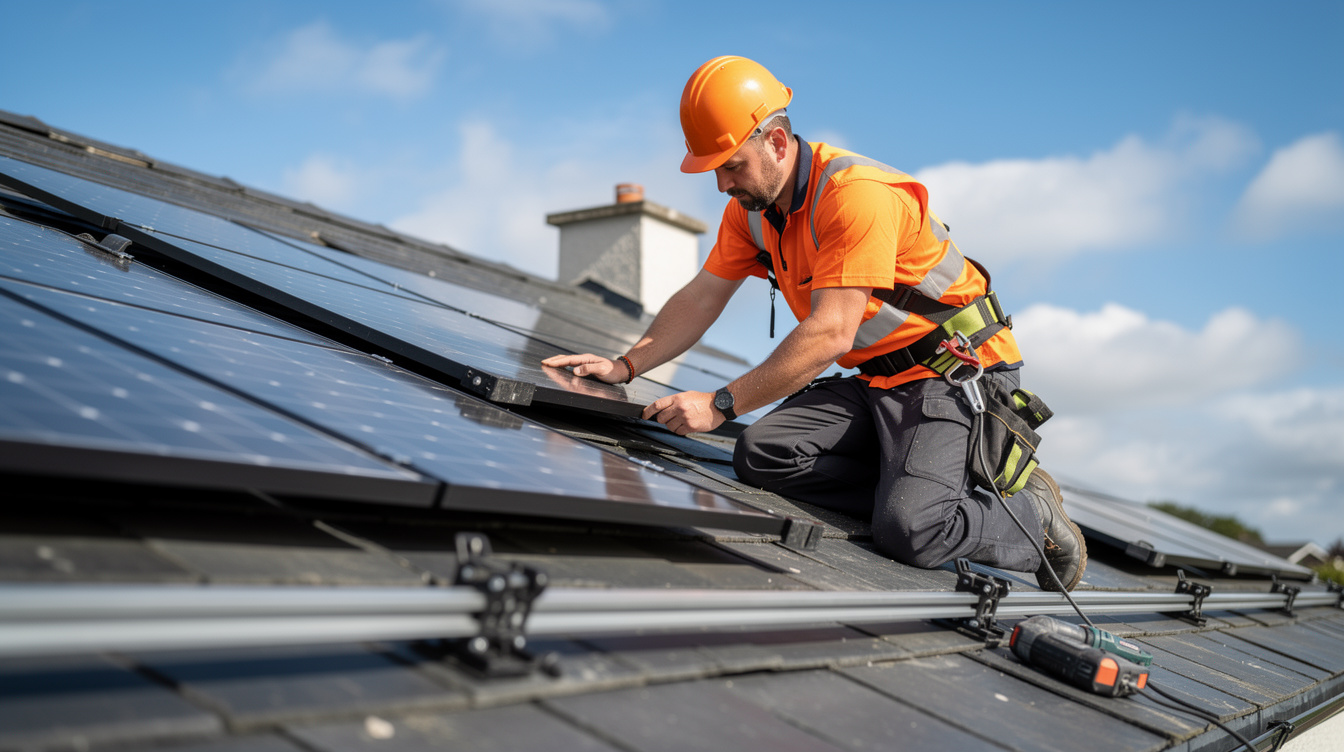
Four-bedroom houses generally have significantly more roof space than 3-bed semis. Here's what you can expect by house type:
| House Type | Typical Usable Roof (One Slope) | Max Panels | Max System Size |
|---|---|---|---|
| 4-bed detached (two-storey) | 40–55 m² | 16–22 | 6.4–8.8 kW |
| 4-bed semi-detached | 35–45 m² | 12–18 | 4.8–7.2 kW |
| 4-bed dormer bungalow | 45–65 m² | 18–26 | 7.2–10.4 kW |
| 4-bed bungalow | 50–70 m² | 20–28 | 8–11.2 kW |
Each modern 400 W panel measures approximately 1.7 m × 1.1 m (1.87 m²), but you need roughly 2.5 m² per panel when you account for the 50 cm setback from roof edges required under Irish planning exemption rules, plus spacing between rows on lower-pitch roofs.
Dormer bungalows deserve special mention. The extended roof slopes on a dormer bungalow often provide the most usable area of any house type — sometimes enough for 20+ panels. If you have a dormer bungalow, you can often install a larger system than you strictly need, banking on future EV or heat pump adoption.
The SEAI Grant: How Much Will You Get Back?
The SEAI solar PV grant for 2026 is calculated as follows:
- €700 per kWp for the first 2 kWp
- €200 per kWp from 2 kWp to 4 kWp
- Maximum grant: €1,800 (reached at 4 kWp and above)
For a 4-bed house installing a 5–6.5 kW system, you'll receive the full €1,800 grant. The grant was confirmed to remain at this level for 2026 by Minister for Climate Darragh O'Brien, after plans to reduce it by €300 were shelved.
Important: You must apply for the grant before installation begins. Your SEAI-registered installer handles the application, but make sure approval is confirmed before any work starts.
Real Savings Breakdown: What Will You Actually Save?
The value of solar panels depends on two things: how much of the generated electricity you use yourself (self-consumption), and how much you export to the grid. In 2026, Irish electricity costs average 36 cent/kWh, while export payments under the Clean Export Guarantee range from 18–24 cent/kWh.
Here's a realistic savings breakdown for a 5 kW system on a 4-bed house using 5,000 kWh/year:
| Savings Component | Without Battery | With 5 kWh Battery |
|---|---|---|
| Annual solar generation | 4,750 kWh | 4,750 kWh |
| Self-consumed (used in home) | 1,900 kWh (40%) | 3,325 kWh (70%) |
| Exported to grid | 2,850 kWh (60%) | 1,425 kWh (30%) |
| Savings from self-consumption (@ 36c/kWh) | €684 | €1,197 |
| Export income (@ 21c/kWh avg) | €599 | €299 |
| Total annual benefit | €1,283 | €1,496 |
A battery adds €200–€300/year in extra savings by shifting solar energy from daytime (when you may not be home) to evening peak hours. Whether the €3,000–€4,000 battery cost is worth it depends on your lifestyle — families who are out during the day benefit most. Read our full battery analysis for a detailed breakdown.
Ready to Go Solar?
Get your free personalised quote from SEAI-registered installers.
4-Bed vs 3-Bed: Key Differences for Solar
If you've read our 3-bed house guide, here's how a 4-bed installation differs:
- Higher consumption — 4-bed households typically use 20–40% more electricity, meaning you need a larger system to cover the same percentage of your usage
- More roof space — Detached 4-beds generally have 30–50% more usable roof area, so fitting a larger system is rarely a problem
- Better battery economics — Higher evening consumption means a battery gets discharged more fully each day, improving its financial return
- Same grant — The €1,800 SEAI grant is identical regardless of house size, so larger systems receive a proportionally smaller subsidy
- Potentially faster payback — Because you use more electricity at home, your self-consumption rate can be higher (especially if someone works from home), which means more savings per kWh generated
Step-by-Step: Getting Solar on Your 4-Bed House
- Check your electricity usage. Dig out your last 12 months of bills or check your supplier's online portal. Note your total annual kWh consumption.
- Get 2–3 quotes. Request quotes from SEAI-registered installers in your area. A good installer will assess your roof (orientation, pitch, shading, obstructions) and recommend a system size based on your consumption.
- Compare quotes carefully. Don't just compare the bottom-line price. Check what inverter brand is included, the panel warranty length (25–30 years is standard), whether the quote includes scaffolding, and whether a hybrid inverter is included (essential if you want to add a battery later). See our installer checklist for what to look for.
- Accept a quote and apply for the grant. Your chosen installer applies for the €1,800 SEAI grant on your behalf. Wait for approval before work begins (2–4 weeks).
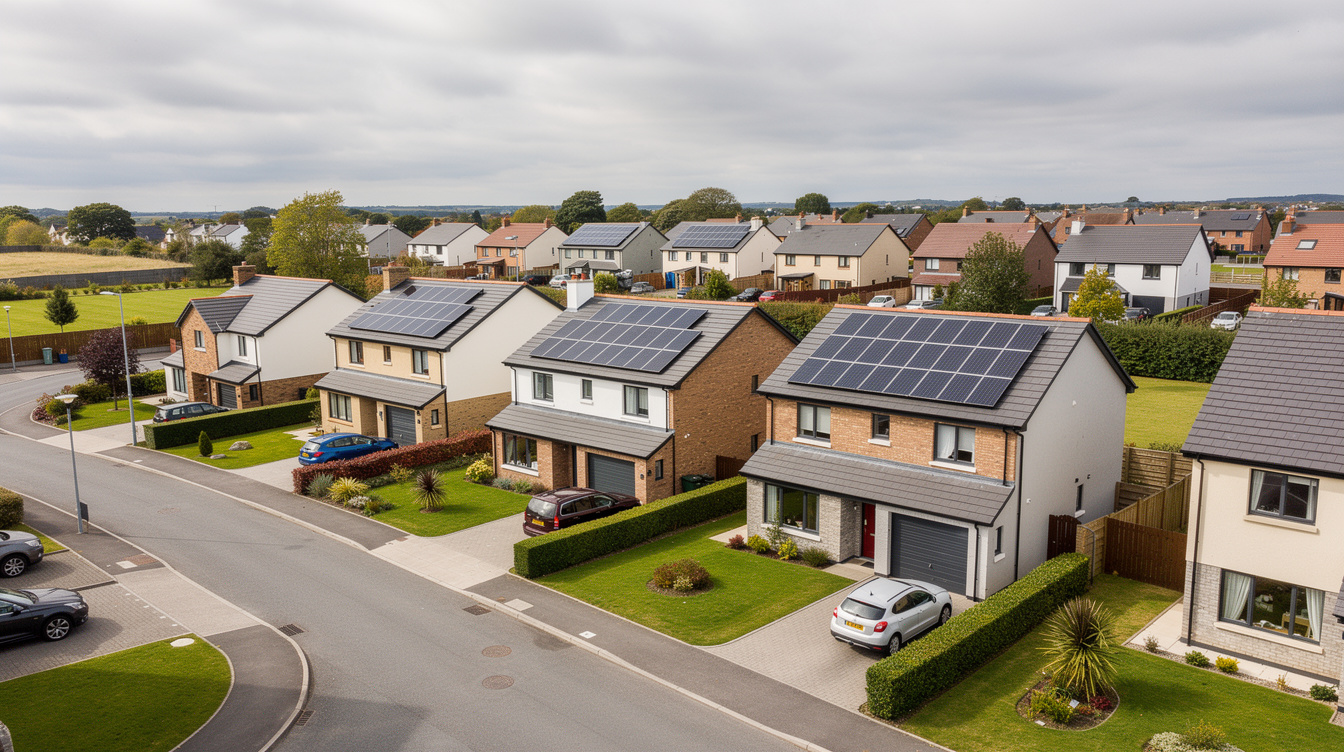
- Installation day. Typically takes 1–1.5 days for a 5–6.5 kW system. The crew installs scaffolding, mounts panels, fits the inverter, and connects everything to your consumer unit.
- Register for export payments. Contact your electricity supplier to register for the Clean Export Guarantee. You'll need a smart meter (ESB Networks installs these free of charge).
- Get your BER assessment. Required for the SEAI grant. Budget €250–€340. Your BER will typically improve by 1–2 grades — a major boost to your property value.
Total time from first enquiry to generating electricity: 4–8 weeks, depending on installer availability and SEAI grant processing. See our waiting times guide for current lead times.
Should You Add a Battery?
For 4-bed homes, a battery is often more worthwhile than for smaller houses. Here's why: your evening electricity consumption is higher (cooking dinner for a larger family, multiple devices, heating water), so the battery gets properly discharged each night.
A quick decision framework:
- Add a battery if: Someone is out during the day (can't self-consume daytime solar), you have an EV or heat pump, or you're on a time-of-use tariff that rewards shifting consumption
- Skip the battery if: Someone is home during the day to use solar directly, you want the fastest payback possible, or budget is tight — you can always add one later if you install a hybrid inverter now
The most popular battery options for Irish 4-bed homes in 2026 are the Huawei LUNA2000 5 kWh (€2,800–€3,500), GivEnergy 5.2 kWh (€2,500–€3,200), and Tesla Powerwall 2 13.5 kWh (€7,000–€9,000). See our full battery comparison for detailed pricing.
Will Solar Panels Increase Your 4-Bed House's Value?
Yes — and the effect is often more significant on a 4-bed house than a smaller property. A BER upgrade from C3 to B2 (typical after solar installation) adds an estimated €10,000–€20,000 to a 4-bed detached house's value, according to SEAI and Irish estate agent data. For semi-detached 4-beds, the uplift is €7,000–€15,000.
With the EU's Energy Performance of Buildings Directive (EPBD) pushing Ireland towards higher minimum BER standards, a solar installation is increasingly seen as essential rather than optional for larger homes. Read more in our home value guide.
Frequently Asked Questions
Is a 4 kW system big enough for a 4-bed house?
It can be, if your annual usage is under 4,500 kWh and you're on gas heating. A 4 kW system generates 3,600–4,200 kWh per year in Ireland. For larger families or homes with an EV, you'll want 5–6.5 kW to avoid underproducing.
Do I need planning permission for solar panels on a 4-bed house?
No. Solar panels are exempt development in Ireland, meaning no planning permission is needed. The panels must not project more than 15 cm from the roof surface, and they must be at least 50 cm from any roof edge. There is no limit on the number of panels or percentage of roof covered.
How long do solar panels last?
Modern solar panels come with 25–30 year manufacturer warranties and are expected to last 30–40 years in practice. After 25 years, panels typically still produce 80–85% of their original output. The inverter usually needs replacing once, around year 12–15 (€1,200–€1,800). See our lifespan guide for details.
Can I install solar panels myself on a 4-bed house?
Technically yes, but you won't qualify for the €1,800 SEAI grant (it requires an SEAI-registered installer), and you'll need a qualified electrician for the grid connection. For most 4-bed homeowners, the grant alone more than justifies using a professional installer. See our DIY guide if you're still considering it.
What happens if I sell my 4-bed house with solar panels?
The solar system stays with the house and transfers to the new owner. There's no clawback on the SEAI grant. The improved BER rating and lower running costs make your house more attractive to buyers and can command a higher sale price.
Will solar panels work if my 4-bed house faces east-west?
Yes. An east-west split array produces about 80–85% of what a south-facing installation would generate, but it spreads generation more evenly across the day. This can actually improve self-consumption for families who use electricity in the mornings and evenings. See our east-west guide for more.
Find Out What Solar Would Cost on Your 4-Bed Home
Our SEAI-registered installers provide free, no-obligation quotes tailored to your roof and usage.
Related Articles
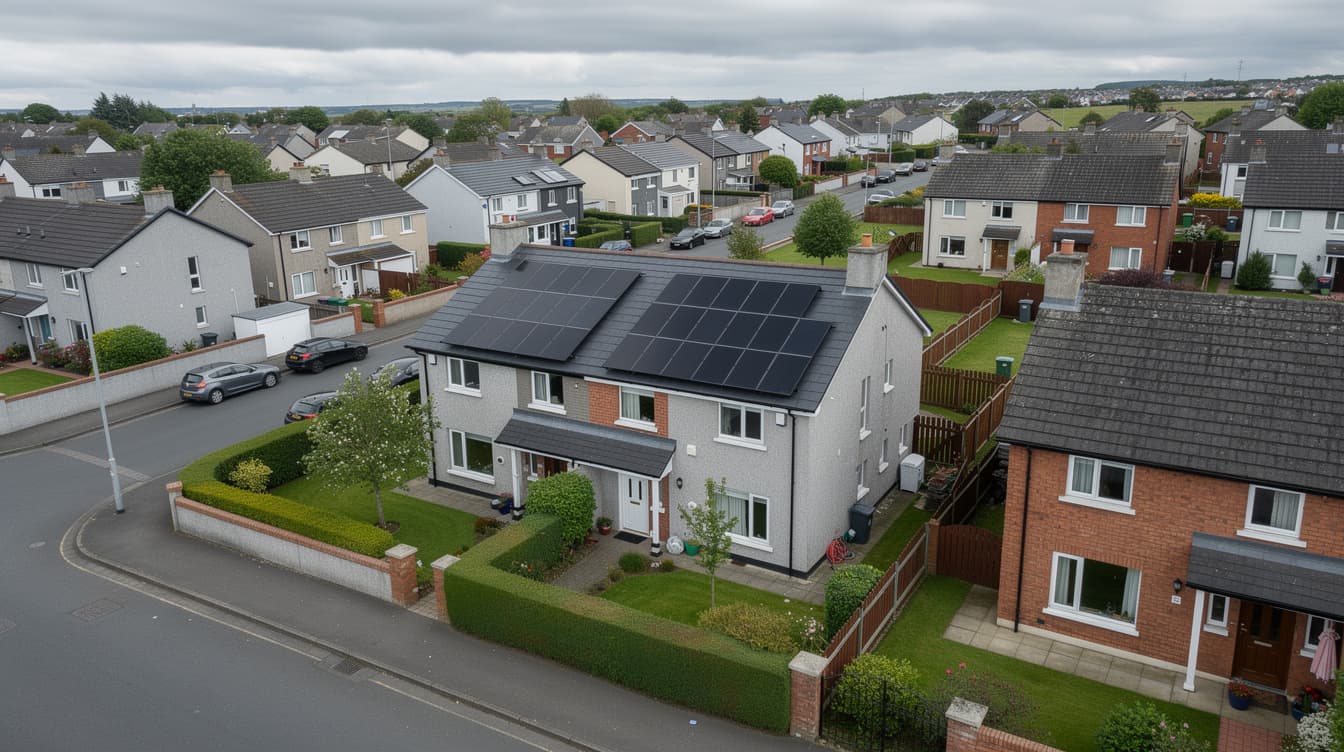
Solar Panels for a Semi-Detached House in Ireland 2026: Costs, Roof Space & What to Expect
How much do solar panels cost for a semi-detached house in Ireland? Real 2026 prices, SEAI grant details, roof space guide and installation timeline.
Solar Panel Costs Ireland 2026: Complete Price Breakdown by System Size
Solar panel costs in Ireland 2026: €3,100–€11,700 after SEAI grants. Full breakdown, brand comparison & ROI calculator. Get an accurate quote today.
Solar Panels Ireland 2026: The Complete Guide to Costs, Grants, Savings & Installation
Everything you need to know about solar panels in Ireland in 2026. Real costs, SEAI grants, payback periods, best installers, and how much you can save.